SharedCanvas


Digital Manuscripts and
Interoperability Across Repositories

LIBER : promoting access to manuscript content
Paris, BnF, may 2012
How we started ?
•   Andrew W. Mellon Foundation funded numerous
    manuscript digitization projects over several decades

•   All had in common:
     – Inability to share data across silos to satisfy scholarly
         use
     – Inability to leverage existing infrastructure
     – No sustainability model for data or access

•   Goal:
     – Interoperability between repositories and tools
Who’s involved ?
• Repositories
  –   Parker on the Web (Stanford)
  –   Roman de la Rose (Johns Hopkins)
  –   E-codices (Univ. Fribourg)
  –   Gallica (BnF)
  –   British Library
  –   Bodleian Library
• Tools
  – T-PEN
  – Digital MappaeMundi (Drew Univ.)
  – TILE (Univ. Of Maryland)
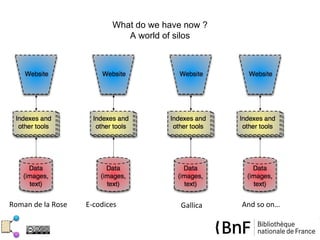
What do we have now ?
                             A world of silos


Roman de la Rose   E-codices             Gallica   And so on…
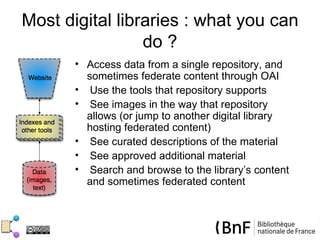
Most digital libraries : what you can
                 do ?
       • Access data from a single repository, and
         sometimes federate content through OAI
       • Use the tools that repository supports
       • See images in the way that repository
         allows (or jump to another digital library
         hosting federated content)
       • See curated descriptions of the material
       • See approved additional material
       • Search and browse to the library’s content
         and sometimes federated content
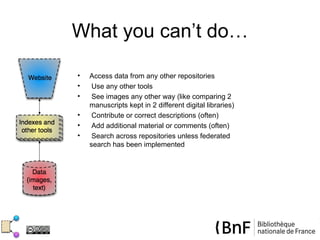
What you can’t do…

•   Access data from any other repositories
•    Use any other tools
•    See images any other way (like comparing 2
    manuscripts kept in 2 different digital libraries)
•    Contribute or correct descriptions (often)
•    Add additional material or comments (often)
•    Search across repositories unless federated
    search has been implemented
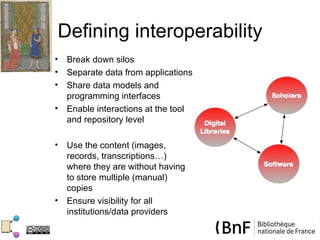
Defining interoperability
•   Break down silos
•   Separate data from applications
•   Share data models and
    programming interfaces
•   Enable interactions at the tool
    and repository level

•   Use the content (images,
    records, transcriptions…)
    where they are without having
    to store multiple (manual)
    copies
•   Ensure visibility for all
    institutions/data providers
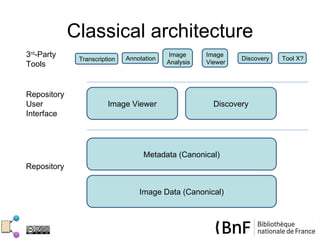
Classical architecture
3rd-Party                     Annotation
                                            Image     Image
                                                               Discovery   Tool X?
              Transcription                Analysis   Viewer
Tools


Repository
User                    Image Viewer                    Discovery
Interface


                                   Metadata (Canonical)
Repository


                                  Image Data (Canonical)
What does SharedCanvas do ?

• Provide, at the digital library level, a
  manifest : « here is what we have »
• Give a standardized and highly
  detailed description of the digital
  document’s organization
• If validated, link to any content
  generated about a manuscript, and/
  or use it without having to store this
  content
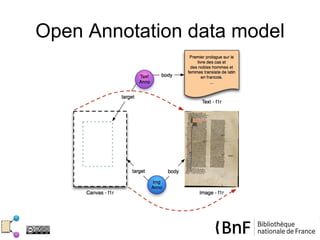
Open Annotation data model
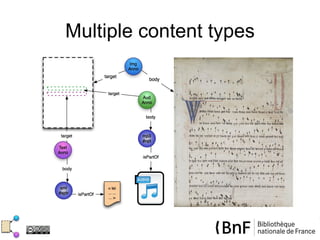
Multiple content types
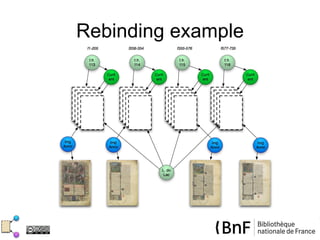
Rebinding example
A few demos
• Manifests for BNF Machaut manuscripts
• http://dms-data.stanford.edu/BnF/

• Images annotations of Morgan 804
    • http://www.shared-canvas.org/impl/demo1/

Shared Canvas presentation at the LIBER conference

  • 1.
    SharedCanvas Digital Manuscripts and InteroperabilityAcross Repositories LIBER : promoting access to manuscript content Paris, BnF, may 2012
  • 2.
    How we started? • Andrew W. Mellon Foundation funded numerous manuscript digitization projects over several decades • All had in common: – Inability to share data across silos to satisfy scholarly use – Inability to leverage existing infrastructure – No sustainability model for data or access • Goal: – Interoperability between repositories and tools
  • 3.
    Who’s involved ? •Repositories – Parker on the Web (Stanford) – Roman de la Rose (Johns Hopkins) – E-codices (Univ. Fribourg) – Gallica (BnF) – British Library – Bodleian Library • Tools – T-PEN – Digital MappaeMundi (Drew Univ.) – TILE (Univ. Of Maryland)
  • 4.
    What do wehave now ? A world of silos Roman de la Rose E-codices Gallica And so on…
  • 5.
    Most digital libraries: what you can do ? • Access data from a single repository, and sometimes federate content through OAI • Use the tools that repository supports • See images in the way that repository allows (or jump to another digital library hosting federated content) • See curated descriptions of the material • See approved additional material • Search and browse to the library’s content and sometimes federated content
  • 6.
    What you can’tdo… • Access data from any other repositories • Use any other tools • See images any other way (like comparing 2 manuscripts kept in 2 different digital libraries) • Contribute or correct descriptions (often) • Add additional material or comments (often) • Search across repositories unless federated search has been implemented
  • 7.
    Defining interoperability • Break down silos • Separate data from applications • Share data models and programming interfaces • Enable interactions at the tool and repository level • Use the content (images, records, transcriptions…) where they are without having to store multiple (manual) copies • Ensure visibility for all institutions/data providers
  • 8.
    Classical architecture 3rd-Party Annotation Image Image Discovery Tool X? Transcription Analysis Viewer Tools Repository User Image Viewer Discovery Interface Metadata (Canonical) Repository Image Data (Canonical)
  • 9.
    What does SharedCanvasdo ? • Provide, at the digital library level, a manifest : « here is what we have » • Give a standardized and highly detailed description of the digital document’s organization • If validated, link to any content generated about a manuscript, and/ or use it without having to store this content
  • 10.
  • 11.
  • 12.
  • 13.
    A few demos •Manifests for BNF Machaut manuscripts • http://dms-data.stanford.edu/BnF/ • Images annotations of Morgan 804 • http://www.shared-canvas.org/impl/demo1/

Editor's Notes

  • #4 TILE : projet de lien texte images /
  • #12 Parker CCC 286
  • #13 BnF Français 113-116 : Lancelot du Lac