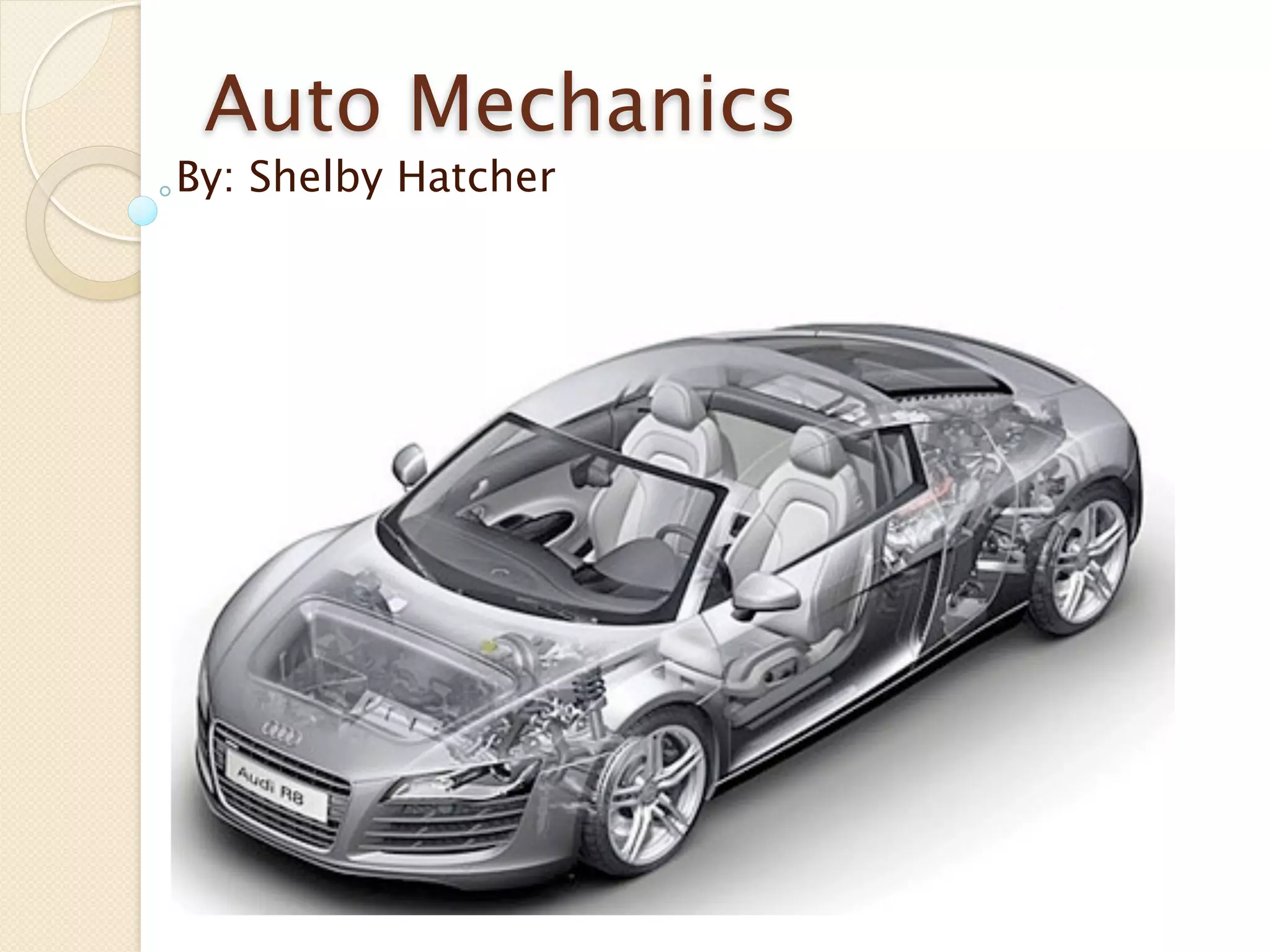
Auto Mechanics
By: Shelby Hatcher
Thesis Statement
   The main goal for my senior
    graduation project is to educate my
    class and myself about the field of
    automotives. In my project I will
    include information on general
    automotives and the history of
    women in the automotives field. I
    find it necessary that people are
    aware of the growing population of
Personal Relevance
   This topic personally relates to me
    because all of the mechanics I
    know are male and most of the
    woman I know are not
    knowledgeable about cars. I believe
    that it is important to educate
    myself in this field and be
    comfortable knowing how cars
    work.
Cars in History
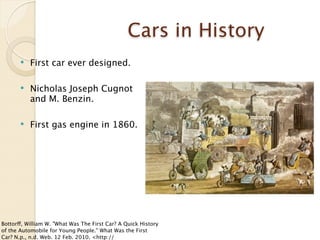
          First car ever designed.

          Nicholas Joseph Cugnot
           and M. Benzin.

          First gas engine in 1860.


Bottorff, William W. "What Was The First Car? A Quick History
of the Automobile for Young People." What Was the First
Car? N.p., n.d. Web. 12 Feb. 2010. <http://
Cars in History
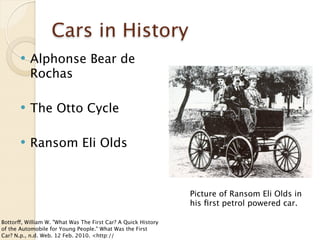
          Alphonse Bear de
           Rochas

          The Otto Cycle

          Ransom Eli Olds


                                                                Picture of Ransom Eli Olds in
                                                                his first petrol powered car.

Bottorff, William W. "What Was The First Car? A Quick History
of the Automobile for Young People." What Was the First
Car? N.p., n.d. Web. 12 Feb. 2010. <http://
Women in Auto Mechanics
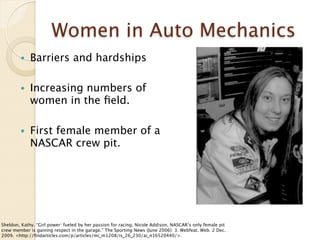
        •    Barriers and hardships

        •    Increasing numbers of
             women in the field.

        •    First female member of a
             NASCAR crew pit.


Sheldon, Kathy. “Girl power: fueled by her passion for racing, Nicole Addison, NASCAR’s only female pit
crew member is gaining respect in the garage.” The Sporting News (June 2006): 3. Webfeat. Web. 2 Dec.
2009. <http://findarticles.com/p/articles/mi_m1208/is_26_230/ai_n16520440/>.
Women in Auto Mechanics
           Powder Puff Clinic


MULLANE, JD. “Auto tech 101 for women.” Bucks County Courier Times [Levittown] 27 Oct. 2009: 1. Newsbank. Web. 29 Nov. 2009.
<http://infoweb.newsbank.com/iw-search/we/InfoWeb?
p_product=AWNB&p_theme=aggregated5&p_action=doc&p_docid=12C0AA4DC4CB14D0&p_docnum=4&p_queryname=3>.
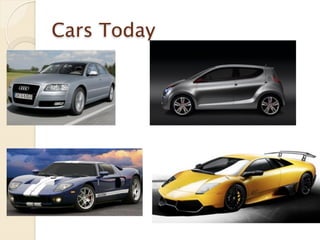
Cars Today
Cars Today
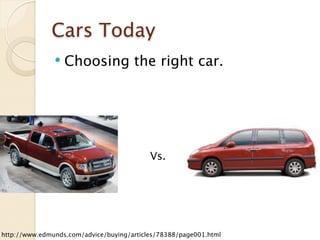
                  Choosing the right car.


                                           Vs.


http://www.edmunds.com/advice/buying/articles/78388/page001.html
Choosing the Right Car
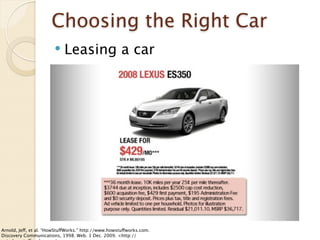
                           Leasing a car


Arnold, Jeff, et al. “HowStuffWorks.” http://www.howstuffworks.com.
Discovery Communications, 1998. Web. 1 Dec. 2009. <http://
Cars Today
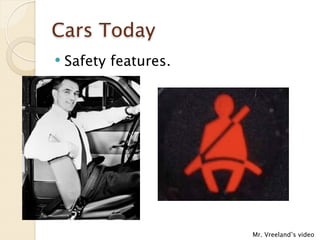
   Safety features.


                       Mr. Vreeland’s video
Arnold, Jeff, et al. “HowStuffWorks.” http://www.howstuffworks.com.
Discovery Communications, 1998. Web. 1 Dec. 2009. <http://
auto.howstuffworks.com/>.
Arnold, Jeff, et al. “HowStuffWorks.” http://www.howstuffworks.com.
Discovery Communications, 1998. Web. 1 Dec. 2009. <http://
auto.howstuffworks.com/>.
Cars Today
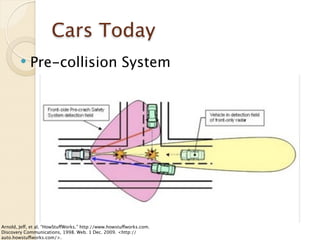
            Pre-collision System


Arnold, Jeff, et al. “HowStuffWorks.” http://www.howstuffworks.com.
Discovery Communications, 1998. Web. 1 Dec. 2009. <http://
auto.howstuffworks.com/>.
Cars Today
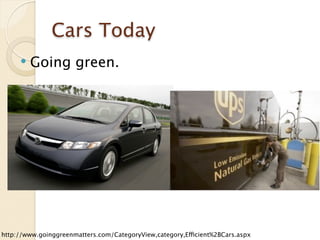
        Going green.


http://www.goinggreenmatters.com/CategoryView,category,Efficient%2BCars.aspx
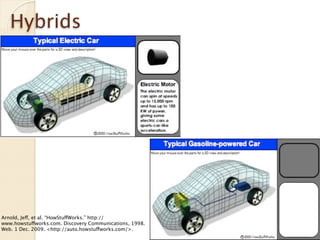
Hybrids


Arnold, Jeff, et al. “HowStuffWorks.” http://
www.howstuffworks.com. Discovery Communications, 1998.
Web. 1 Dec. 2009. <http://auto.howstuffworks.com/>.
Under the Hood
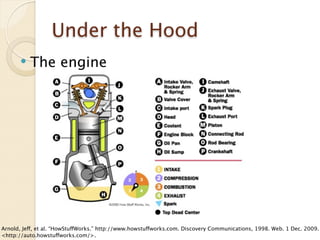
         The engine


Arnold, Jeff, et al. “HowStuffWorks.” http://www.howstuffworks.com. Discovery Communications, 1998. Web. 1 Dec. 2009.
<http://auto.howstuffworks.com/>.
Under the Hood


Arnold, Jeff, et al. “HowStuffWorks.” http://www.howstuffworks.com. Discovery
Communications, 1998. Web. 1 Dec. 2009. <http://auto.howstuffworks.com/>.
Under the Hood


Arnold, Jeff, et al. “HowStuffWorks.” http://www.howstuffworks.com.
Discovery Communications, 1998. Web. 1 Dec. 2009. <http://
Under the Hood
         Parts of the engine:


      -Spark plug


      -Valves


Arnold, Jeff, et al. “HowStuffWorks.” http://www.howstuffworks.com. Discovery Communications, 1998. Web. 1 Dec. 2009.
<http://auto.howstuffworks.com/>.
Under the Hood


                        -Piston


                        -Piston rings
Arnold, Jeff, et al. “HowStuffWorks.” http://www.howstuffworks.com.
Discovery Communications, 1998. Web. 1 Dec. 2009. <http://
auto.howstuffworks.com/>.
Under the Hood
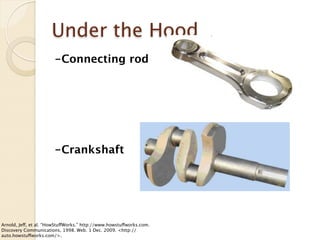
                        -Connecting rod


                        -Crankshaft


Arnold, Jeff, et al. “HowStuffWorks.” http://www.howstuffworks.com.
Discovery Communications, 1998. Web. 1 Dec. 2009. <http://
auto.howstuffworks.com/>.
Under the Hood
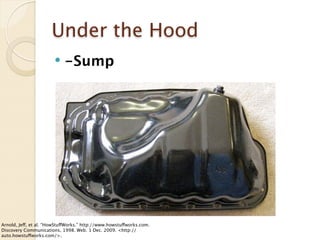
                           -Sump


Arnold, Jeff, et al. “HowStuffWorks.” http://www.howstuffworks.com.
Discovery Communications, 1998. Web. 1 Dec. 2009. <http://
auto.howstuffworks.com/>.
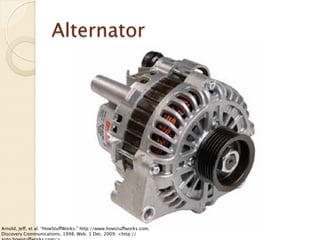
Alternator


Arnold, Jeff, et al. “HowStuffWorks.” http://www.howstuffworks.com.
Discovery Communications, 1998. Web. 1 Dec. 2009. <http://
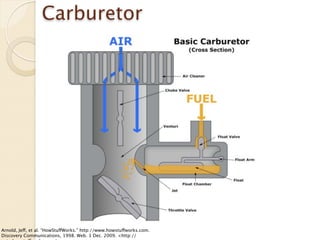
Carburetor


Arnold, Jeff, et al. “HowStuffWorks.” http://www.howstuffworks.com.
Discovery Communications, 1998. Web. 1 Dec. 2009. <http://
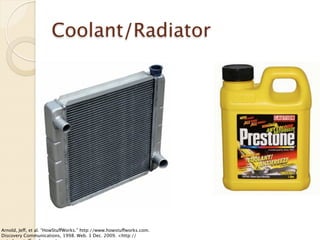
Coolant/Radiator


Arnold, Jeff, et al. “HowStuffWorks.” http://www.howstuffworks.com.
Discovery Communications, 1998. Web. 1 Dec. 2009. <http://
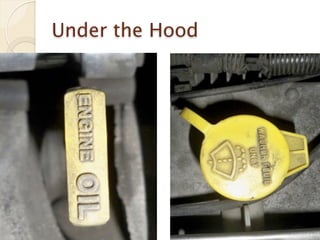
Under the Hood
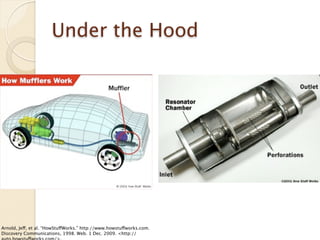
Under the Hood


Arnold, Jeff, et al. “HowStuffWorks.” http://www.howstuffworks.com.
Discovery Communications, 1998. Web. 1 Dec. 2009. <http://
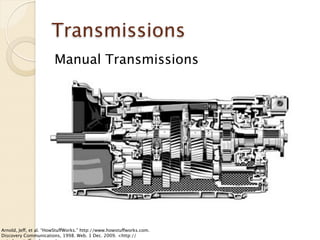
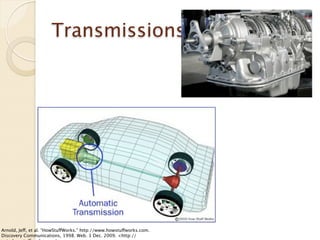
Transmissions
                        Manual Transmissions


Arnold, Jeff, et al. “HowStuffWorks.” http://www.howstuffworks.com.
Discovery Communications, 1998. Web. 1 Dec. 2009. <http://
Transmissions


Arnold, Jeff, et al. “HowStuffWorks.” http://www.howstuffworks.com.
Discovery Communications, 1998. Web. 1 Dec. 2009. <http://
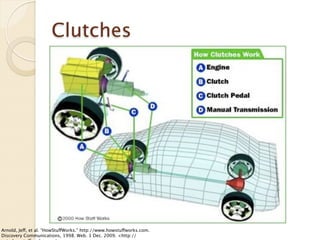
Clutches


Arnold, Jeff, et al. “HowStuffWorks.” http://www.howstuffworks.com.
Discovery Communications, 1998. Web. 1 Dec. 2009. <http://
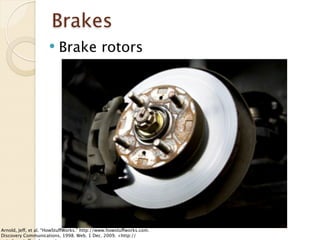
Brakes
                         Brake rotors


Arnold, Jeff, et al. “HowStuffWorks.” http://www.howstuffworks.com.
Discovery Communications, 1998. Web. 1 Dec. 2009. <http://
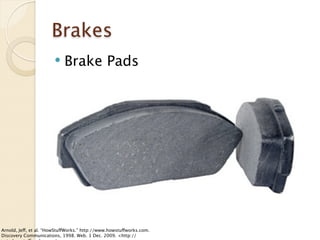
Brakes
                           Brake Pads


Arnold, Jeff, et al. “HowStuffWorks.” http://www.howstuffworks.com.
Discovery Communications, 1998. Web. 1 Dec. 2009. <http://
Steering


Arnold, Jeff, et al. “HowStuffWorks.” http://www.howstuffworks.com. Discovery Communications, 1998. Web. 1 Dec. 2009.
<http://auto.howstuffworks.com/>.
Suspension System


Arnold, Jeff, et al. “HowStuffWorks.” http://www.howstuffworks.com.
Discovery Communications, 1998. Web. 1 Dec. 2009. <http://
auto.howstuffworks.com/>.
Suspension System


Arnold, Jeff, et al. “HowStuffWorks.” http://www.howstuffworks.com.
Discovery Communications, 1998. Web. 1 Dec. 2009. <http://
Tires


Arnold, Jeff, et al. “HowStuffWorks.” http://www.howstuffworks.com. Discovery Communications, 1998. Web. 1 Dec. 2009.
<http://auto.howstuffworks.com/>.
Application
Class Activity
   For my class activity, I will create a
    miniature trivia quiz based on the
    information from my research. It
    will be a battle of the sexes to see
    if the girls or guys do better on the
    quiz. Candy will be given out to the
    winners.
Work Cited
   Blackwell, Vivian. "Women's Car Care; Girl Power, Meet Horsepower." Editorial.
         Women's Car Care: Girl Power, Meet Horsepower. Edmunds Inc., 1995. Web.
         24 Mar. 2010. <http://www.edmunds.com/advice/womenfamilies/articles/
         126355/article.html>.

   Bottorff, William W. "What Was The First Car? A Quick History of the Automobile
         for Young People." What Was the First Car? N.p., n.d. Web. 12 Feb. 2010.
         <http://www.ausbcomp.com/~bbott/cars/carhist.htm>.

   "Efficient Cars - Going Green Matters." Going Green Matters. N.p., 2009. Web. 24
         Mar. 2010. <http://www.goinggreenmatters.com/
         CategoryView,category,Efficient%2BCars.aspx>.

   Howie, Craig. "Quick Things to Check to Keep Your Car Safe on the Road."
         Editorial. Quick Car Safety Check. AOL Inc., 2010. Web. 10 Apr. 2010.
         <http://autos.aol.com/article/quick-car-safety-check/>.

   "Should Cars Have Built-In Breathalyzers?" Editorial. Should Cars Have
         Built-In Breathalyzers? AOL Inc., 2010. Web. 11 Mar. 2010.
         http://autos.aol.com/article/interlock-devices-breathalyzer/
   "Women's Automotive History Highlights." N.d. PDF file.
   Weber, Robert M. Opportunites in Automotive Service Careers. Ed. Philip A Perry.
         2002. New York, NY: McGraw-Hill, 2002. N. pag. Print.
Work Cited
   Sheldon, Kathy. "Girl power: fueled by her passion for racing, Nicole
    Addison,
         NASCAR's only female pit crew member is gaining respect in the
    garage."
         The Sporting News (June 2006): 3. Webfeat. Web. 2 Dec. 2009.
         <http://findarticles.com/p/articles/mi_m1208/is_26_230/
    ai_n16520440/>.
   MULLANE, JD. "Auto tech 101 for women." Bucks County Courier Times
    [Levittown]
         27 Oct. 2009: 1. Newsbank. Web. 29 Nov. 2009.
         <http://infoweb.newsbank.com/iw-search/we/
         InfoWeb?
    p_product=AWNB&p_theme=aggregated5&p_action=doc&p_docid=12C0A
    A4DC4CB14D0&
         p_docnum=4&p_queryname=3>.
   Lavacot, Bob, and Ken Lavacot. "Free Auto Repair Advice." 2CarPros.
    Specialty
         Equipment Market Association, 1999. Web. 1 Dec. 2009.
         <http://www.2carpros.com/index.htm>.
   Boram, Joan. "Looking for Ms. Goodwrench." Nation's Business 84.10
    (1996): 1.
         ProQuest. Web. 29 Nov. 2009. <http://proquest.umi.com/
         pqdweb?
    index=2&did=10241632&SrchMode=1&sid=3&Fmt=4&VInst=PROD&VTyp
Conclusion
   History of cars

   Women in the field of auto
    mechanics.

   The different systems and parts of
    the car.

SGP Final Slides

  • 1.
  • 2.
    Thesis Statement  The main goal for my senior graduation project is to educate my class and myself about the field of automotives. In my project I will include information on general automotives and the history of women in the automotives field. I find it necessary that people are aware of the growing population of
  • 3.
    Personal Relevance  This topic personally relates to me because all of the mechanics I know are male and most of the woman I know are not knowledgeable about cars. I believe that it is important to educate myself in this field and be comfortable knowing how cars work.
  • 4.
    Cars in History  First car ever designed.  Nicholas Joseph Cugnot and M. Benzin.  First gas engine in 1860. Bottorff, William W. "What Was The First Car? A Quick History of the Automobile for Young People." What Was the First Car? N.p., n.d. Web. 12 Feb. 2010. <http://
  • 5.
    Cars in History  Alphonse Bear de Rochas  The Otto Cycle  Ransom Eli Olds Picture of Ransom Eli Olds in his first petrol powered car. Bottorff, William W. "What Was The First Car? A Quick History of the Automobile for Young People." What Was the First Car? N.p., n.d. Web. 12 Feb. 2010. <http://
  • 7.
    Women in AutoMechanics • Barriers and hardships • Increasing numbers of women in the field. • First female member of a NASCAR crew pit. Sheldon, Kathy. “Girl power: fueled by her passion for racing, Nicole Addison, NASCAR’s only female pit crew member is gaining respect in the garage.” The Sporting News (June 2006): 3. Webfeat. Web. 2 Dec. 2009. <http://findarticles.com/p/articles/mi_m1208/is_26_230/ai_n16520440/>.
  • 8.
    Women in AutoMechanics  Powder Puff Clinic MULLANE, JD. “Auto tech 101 for women.” Bucks County Courier Times [Levittown] 27 Oct. 2009: 1. Newsbank. Web. 29 Nov. 2009. <http://infoweb.newsbank.com/iw-search/we/InfoWeb? p_product=AWNB&p_theme=aggregated5&p_action=doc&p_docid=12C0AA4DC4CB14D0&p_docnum=4&p_queryname=3>.
  • 9.
  • 10.
    Cars Today  Choosing the right car. Vs. http://www.edmunds.com/advice/buying/articles/78388/page001.html
  • 11.
    Choosing the RightCar  Leasing a car Arnold, Jeff, et al. “HowStuffWorks.” http://www.howstuffworks.com. Discovery Communications, 1998. Web. 1 Dec. 2009. <http://
  • 12.
    Cars Today  Safety features. Mr. Vreeland’s video
  • 13.
    Arnold, Jeff, etal. “HowStuffWorks.” http://www.howstuffworks.com. Discovery Communications, 1998. Web. 1 Dec. 2009. <http:// auto.howstuffworks.com/>.
  • 14.
    Arnold, Jeff, etal. “HowStuffWorks.” http://www.howstuffworks.com. Discovery Communications, 1998. Web. 1 Dec. 2009. <http:// auto.howstuffworks.com/>.
  • 15.
    Cars Today  Pre-collision System Arnold, Jeff, et al. “HowStuffWorks.” http://www.howstuffworks.com. Discovery Communications, 1998. Web. 1 Dec. 2009. <http:// auto.howstuffworks.com/>.
  • 16.
    Cars Today  Going green. http://www.goinggreenmatters.com/CategoryView,category,Efficient%2BCars.aspx
  • 17.
    Hybrids Arnold, Jeff, etal. “HowStuffWorks.” http:// www.howstuffworks.com. Discovery Communications, 1998. Web. 1 Dec. 2009. <http://auto.howstuffworks.com/>.
  • 18.
    Under the Hood  The engine Arnold, Jeff, et al. “HowStuffWorks.” http://www.howstuffworks.com. Discovery Communications, 1998. Web. 1 Dec. 2009. <http://auto.howstuffworks.com/>.
  • 19.
    Under the Hood Arnold,Jeff, et al. “HowStuffWorks.” http://www.howstuffworks.com. Discovery Communications, 1998. Web. 1 Dec. 2009. <http://auto.howstuffworks.com/>.
  • 20.
    Under the Hood Arnold,Jeff, et al. “HowStuffWorks.” http://www.howstuffworks.com. Discovery Communications, 1998. Web. 1 Dec. 2009. <http://
  • 21.
    Under the Hood  Parts of the engine: -Spark plug -Valves Arnold, Jeff, et al. “HowStuffWorks.” http://www.howstuffworks.com. Discovery Communications, 1998. Web. 1 Dec. 2009. <http://auto.howstuffworks.com/>.
  • 22.
    Under the Hood -Piston -Piston rings Arnold, Jeff, et al. “HowStuffWorks.” http://www.howstuffworks.com. Discovery Communications, 1998. Web. 1 Dec. 2009. <http:// auto.howstuffworks.com/>.
  • 23.
    Under the Hood -Connecting rod -Crankshaft Arnold, Jeff, et al. “HowStuffWorks.” http://www.howstuffworks.com. Discovery Communications, 1998. Web. 1 Dec. 2009. <http:// auto.howstuffworks.com/>.
  • 24.
    Under the Hood  -Sump Arnold, Jeff, et al. “HowStuffWorks.” http://www.howstuffworks.com. Discovery Communications, 1998. Web. 1 Dec. 2009. <http:// auto.howstuffworks.com/>.
  • 25.
    Alternator Arnold, Jeff, etal. “HowStuffWorks.” http://www.howstuffworks.com. Discovery Communications, 1998. Web. 1 Dec. 2009. <http://
  • 26.
    Carburetor Arnold, Jeff, etal. “HowStuffWorks.” http://www.howstuffworks.com. Discovery Communications, 1998. Web. 1 Dec. 2009. <http://
  • 27.
    Coolant/Radiator Arnold, Jeff, etal. “HowStuffWorks.” http://www.howstuffworks.com. Discovery Communications, 1998. Web. 1 Dec. 2009. <http://
  • 28.
  • 29.
    Under the Hood Arnold,Jeff, et al. “HowStuffWorks.” http://www.howstuffworks.com. Discovery Communications, 1998. Web. 1 Dec. 2009. <http://
  • 30.
    Transmissions Manual Transmissions Arnold, Jeff, et al. “HowStuffWorks.” http://www.howstuffworks.com. Discovery Communications, 1998. Web. 1 Dec. 2009. <http://
  • 31.
    Transmissions Arnold, Jeff, etal. “HowStuffWorks.” http://www.howstuffworks.com. Discovery Communications, 1998. Web. 1 Dec. 2009. <http://
  • 32.
    Clutches Arnold, Jeff, etal. “HowStuffWorks.” http://www.howstuffworks.com. Discovery Communications, 1998. Web. 1 Dec. 2009. <http://
  • 33.
    Brakes  Brake rotors Arnold, Jeff, et al. “HowStuffWorks.” http://www.howstuffworks.com. Discovery Communications, 1998. Web. 1 Dec. 2009. <http://
  • 34.
    Brakes  Brake Pads Arnold, Jeff, et al. “HowStuffWorks.” http://www.howstuffworks.com. Discovery Communications, 1998. Web. 1 Dec. 2009. <http://
  • 35.
    Steering Arnold, Jeff, etal. “HowStuffWorks.” http://www.howstuffworks.com. Discovery Communications, 1998. Web. 1 Dec. 2009. <http://auto.howstuffworks.com/>.
  • 36.
    Suspension System Arnold, Jeff,et al. “HowStuffWorks.” http://www.howstuffworks.com. Discovery Communications, 1998. Web. 1 Dec. 2009. <http:// auto.howstuffworks.com/>.
  • 37.
    Suspension System Arnold, Jeff,et al. “HowStuffWorks.” http://www.howstuffworks.com. Discovery Communications, 1998. Web. 1 Dec. 2009. <http://
  • 38.
    Tires Arnold, Jeff, etal. “HowStuffWorks.” http://www.howstuffworks.com. Discovery Communications, 1998. Web. 1 Dec. 2009. <http://auto.howstuffworks.com/>.
  • 39.
  • 40.
    Class Activity  For my class activity, I will create a miniature trivia quiz based on the information from my research. It will be a battle of the sexes to see if the girls or guys do better on the quiz. Candy will be given out to the winners.
  • 41.
    Work Cited  Blackwell, Vivian. "Women's Car Care; Girl Power, Meet Horsepower." Editorial.      Women's Car Care: Girl Power, Meet Horsepower. Edmunds Inc., 1995. Web.      24 Mar. 2010. <http://www.edmunds.com/advice/womenfamilies/articles/      126355/article.html>.  Bottorff, William W. "What Was The First Car? A Quick History of the Automobile      for Young People." What Was the First Car? N.p., n.d. Web. 12 Feb. 2010.      <http://www.ausbcomp.com/~bbott/cars/carhist.htm>.  "Efficient Cars - Going Green Matters." Going Green Matters. N.p., 2009. Web. 24      Mar. 2010. <http://www.goinggreenmatters.com/      CategoryView,category,Efficient%2BCars.aspx>.  Howie, Craig. "Quick Things to Check to Keep Your Car Safe on the Road."      Editorial. Quick Car Safety Check. AOL Inc., 2010. Web. 10 Apr. 2010.      <http://autos.aol.com/article/quick-car-safety-check/>.  "Should Cars Have Built-In Breathalyzers?" Editorial. Should Cars Have      Built-In Breathalyzers? AOL Inc., 2010. Web. 11 Mar. 2010.      http://autos.aol.com/article/interlock-devices-breathalyzer/  "Women's Automotive History Highlights." N.d. PDF file.  Weber, Robert M. Opportunites in Automotive Service Careers. Ed. Philip A Perry.      2002. New York, NY: McGraw-Hill, 2002. N. pag. Print.
  • 42.
    Work Cited  Sheldon, Kathy. "Girl power: fueled by her passion for racing, Nicole Addison,      NASCAR's only female pit crew member is gaining respect in the garage."      The Sporting News (June 2006): 3. Webfeat. Web. 2 Dec. 2009.      <http://findarticles.com/p/articles/mi_m1208/is_26_230/ ai_n16520440/>.  MULLANE, JD. "Auto tech 101 for women." Bucks County Courier Times [Levittown]      27 Oct. 2009: 1. Newsbank. Web. 29 Nov. 2009.      <http://infoweb.newsbank.com/iw-search/we/      InfoWeb? p_product=AWNB&p_theme=aggregated5&p_action=doc&p_docid=12C0A A4DC4CB14D0&      p_docnum=4&p_queryname=3>.  Lavacot, Bob, and Ken Lavacot. "Free Auto Repair Advice." 2CarPros. Specialty      Equipment Market Association, 1999. Web. 1 Dec. 2009.      <http://www.2carpros.com/index.htm>.  Boram, Joan. "Looking for Ms. Goodwrench." Nation's Business 84.10 (1996): 1.      ProQuest. Web. 29 Nov. 2009. <http://proquest.umi.com/      pqdweb? index=2&did=10241632&SrchMode=1&sid=3&Fmt=4&VInst=PROD&VTyp
  • 43.
    Conclusion  History of cars  Women in the field of auto mechanics.  The different systems and parts of the car.

Editor's Notes

  • #5 The first self-powered car ever recorded was designed by Nicholas Joseph Cugnot and constructed by M. Brezin in 1770. It was driven around the cobblestone roads of Paris and went only two miles per hour. It was used for transporting canons Early steam-powered vehicles were so heavy that they were only practical for flat, heavy materials such as iron. Roads were made out of iron rails to support these cars. These iron roads were used for the next 125 years. By the 1830&amp;#x2019;s, England had made many attempts to create a vehicle that did not need rails, but they failed. In 1860, a man by the name of Etienne Lenoir patented the first gas engine. He used a separate mechanism to compress the gas before combustion. His car only had one half horse power. He died in 1990 and his design never took off.
  • #6 Around the same time, Alphonse Bear de Rochas figured out how to compress the gas in the same cylinder in which it was burned. This is the same method we use today, though he never patented it. Later, de Rochas&amp;#x2019; discovery was patented and called the Otto cycle. This cycle had become the basis for motor companies such as Daimler and Benz. It wasn&amp;#x2019;t until 1893 that Henry Ford built and sold his first car. He called it the Quadracycle and sold it for 200 dollars. He used the money for build another car and eventually, in 1899, received enough funding to start the Detroit Automobile Company. The company failed and eventually diminished and Ford did not sell another car until 1903. At the same time, Ransom Eli Olds had started his own company called the Olds Motor Vehicle Company of Detroit, The first successful car they produced was called the Curved Dash Oldsmobile. Ransom Eli Olds was the First mass producer of gasoline powered cars in America. -(Picture of Ransom Eli Olds in his first petrol powered car.)
  • #7 -By 1910, 5% of licensed drivers were woman. -in 1902 a woman by the name of Mary Anderson invented the windshield wiper. -In 1916 Alice Burke and Nell Richardson traveled for seven months carrying the women&amp;#x2019;s suffrage, demonstrating women&amp;#x2019;s equality at the wheel. -During the early years of WW1, women were hired to drive Red Cross trucks. They were expected to be able to maintain the trucks themselves. -In 1916, the Girl Scouts created the &amp;#x201C;Automobiling Badge&amp;#x201D; , which was rewarded for driving mechanical skills .-In 1922, Henry Ford starting employing women to work in his factories. He only hired single or widowed women because he still believed that married women should be housewives, but he paid the working women the same amount as the men. -In the early 1920&amp;#x2019;s, women finally started to be recognized in the mechanics field. Many companies started printing ad campaigns and hiring more women. - (http://www.oberlin.edu/library/special/virtualexhibits/ww2posters/images/wecan.jpg)
  • #8 -A lot of people are still against the idea of women working the this field. Many of the the more traditional (mostly older) people still believe that is taboo for a woman to work in a auto shop. They believe that it is a man&amp;#x2019;s job to work on cars. -Over the past 12 years, the number of woman in the auto mechanics field has almost doubled. -Nicole Addison is the first woman to be a part of a NASCAR pit crew, She had to put all her effort into her goals, learning all that she could, plus more. She enrolled in training courses at PIT.
  • #9 While some people still believe that women should not be working on cars and in auto shops, others encourage women to learn all that they can, and strongly believe that all women should have at least a basic knowledge of cars. the Powder Puff Car Clinic is an annul gathering for woman of all ages to learn about the basics of cars. They have 5 automotive professionals come in and educate the women about their cars and necessary knowledge needed to repair simple things, and not get cheated when they take their cars in.
  • #10 -As the years passed, more companies rose up and started making and selling different models of cars. Now there are so many different types to choose from. Some of the more popular companies today are, Ford, Audi, Mercury, Lexus, Saturn, Suzuki, Acura, Honda, and Jeep. Some companies make and sell their cars on the idea of safety, whole others, luxury. The more expensive models, such as the Ferrari or Lamborghini are based more on speed and performance, rather than safety. (All images from google.com/images ; Specific url&amp;#x2019;s: http://www.kenneyjacob.com/wp-content/uploads/2009/03/08-audi-a8-fsa.jpg ; http://www.supercars.dk/cars/ford/wallpaper-ford-gt-car.jpg : http://www.iwebie.com/wp-content/uploads/2008/07/maruti-suzuki-a-star-concept-side1.jpg : http://www.yosax.com/car_images/lamborghini-murcielago-lp-670-4-superveloce.jpg)
  • #11 The right car is different for everyone, and, luckily, there is a model out there for everyone. Before, only high class, rich people could afford cars, but now, just about anyone can afford one. -To find the right car, you have to look at your lifestyle. People with big families should look into SUVs or Minivans. People in the blue collar work force would get more sue out of a sturdy pick-up truck such as the Ford F150. -Of course, if you don&amp;#x2019;t have a big family and you have an office job, then you have a wider range of vehicles to choose from, and now picking a car simply depends on personal preference, and salary. (photos: http://images.google.com/images?hl=en&amp;safe=active&amp;gbv=2&amp;tbs=isch%3A1&amp;sa=1&amp;q=Ford+f150&amp;aq=f&amp;aqi=g10&amp;aql=&amp;oq=&amp;start=0 : http://www.goerieblogs.com/lifestyle/hertimes/wp-content/uploads/2009/10/large_minivan.jpg)
  • #12 Leasing a car has its advantages and its disadvantages: Advantages: -lower down payment -lower monthly cost -easier to obtain -little or no repair costs -new car every few years -ability to drive nicer/more expensive cars Disadvantages -higher insurance rate -added fees for depreciation (lessening the value of the car; wear and tear, damages, extra mileage) Down payments must be continually made each time you trade in your car. - On average, costs more over larger amounts of time (10years) (http://www.edmunds.com/media/advice/leasing/dissecting.the.deal/lease.500.jpg)
  • #13 -Cars have also become safer over the years. Some of the features are older, such as the three point seatbelt, and some are more recent. Now a days, cars will often have a flashing light on the dashboard, followed by a beeping noise if at least the driver is not buckled up. Currently, the government is debating on whether or not they should place regulates breathalyzers in every car. The device would be hooked up to the ignition and requires the driver to blow into it before starting the car. If the breathalyzer picks up alcohol on the driver&amp;#x2019;s breath, the car will not start. This will enable safer driving and greatly reduce the number of accidents caused by drunk driving. Another safety feature that most people don&amp;#x2019;t think about is the size and weight of the car and the length of the front of their car. The bigger and heavier that car, the more force it will be able to withstand in a collision. Also, the longer the front of the car is, the more time the car has to absorb the impact, lessening the force applied to the driver. Also, cars will not allow the driver to shift gears (park, drive, reverse) unless the brake pedal is pressed down. (pictures: http://www.topgear.com.ph/images/articleImages/news/Seatbelt_50th_Anniversary/3_point_seatbelt_in_1959_PV.jpg : http://www.streetcorner.com.au/assetLibrary/images/GenericImages08/WC_919684_39_image.jpg)
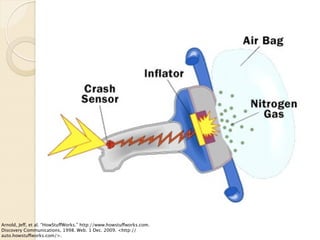
  • #14 This is a basic diagram of an airbag system. Upon a crash, a switch is flipped that triggers a chemical reaction of sodium azide with potassium nitrate, creating nitrogen gas. A burst of the nitrogen gas is what quickly fills the airbag, which is folded up inside of the steering wheel or dashboard.
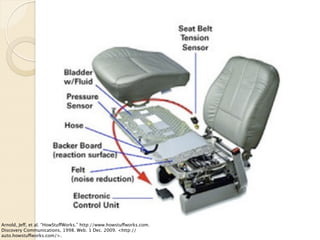
  • #15 Impact of airbag could result in serious head injury or death for children/people of small stature. -most cars give the option to turn of the airbag system. -some cars have an Occupant Classification Systems (OCS) which are able to sense who is sitting in the front seat by measuring size and weight of the person. -it is also able to tell the position the person is sitting in or whether or not there in a child safety seat in the seat. -with the given information the car&amp;#x2019;s computer decides whether or not to turn the airbags off and lets the driver know if they are on or off with a light on the instrument panel.
  • #16 This system is a set of radar detectors placed at the front of the car, normally in the grill. They send high frequency waves out, which bounce off of near by objects and return to sensors in the car. This allows the car to determine if there are any danger factor on the road. They can even tell the distance, location, speed and relative velocity if other cars.
  • #17 Buying a Hybrid car is probably the most known way to save gasoline and be energy efficient, but there are plenty of other ways to do it to. While normal cars get an average of 30 miles per gallon, a hybrid car gets an average of 40. Also, it emits less greenhouse gases. Unfortunately, hybrids are much more expensive than regular cars and not everyone can afford them. Luckily, there are other ways to go green with your car. For example, UPS has utilized trucked that run on compressed Natural Gas. Also, electric-powered and solar-powered cars are gaining popularity. Another option is a new system that can be installed into a regular car. The system allows the car to channel the power of hydrogen. The electricity from the battery allows the fuel cells to separate the oxygen from the hydrogen and mixes the hydrogen with the fuel. This makes the fuel more efficient and allows it last longer, greatly boosting the miles per gallon from an average 30 mpg to 55 mpg. (pictures; http://www.autospectator.com/cars/files/images/2008_Civic_Hybrid_105.jpg ; http://www.goinggreenmatters.com/CategoryView,category,Efficient%2BCars.aspx)
  • #18 A hybrid car is exactly what it says it is, a hybrid. It is a mix between a gasoline-powered car and a electric car. A gasoline powered car (bottom diagram) has a fuel tank that supplies gasoline to the engine, which turns the transmission, which turns the wheels. The problem with these cars is that they do not get good mileage and they emit gases to the greenhouse effect. An electric car has a set of batteries that power an electric motor, that turns the transmission that turns the wheels. These cars get great mileage and do less damage to the ozone, but they only go about 100 miles before needing to be recharged. Hybrids are a combination of the two types, still using gas, but using a battery system that allows the car to do less damage to the ozone, and rise the mileage to 40-50 miles to the gallon.
  • #19 -The purpose the the gas engine is to burn the gasoline and use it to make the car run. They harness the energy that is created for the expending gas that is formed when the gasoline is ignited. This happens inside of the engine, thus calling it internal combustion engine. -Most of today&amp;#x2019;s engine use the four-stroke combustion cycle, or the &amp;#x201C;Otto Cycle&amp;#x201D; to convert gasoline to energy. This cycle includes the intake stroke, the compression stroke, the combustion stroke, and the exhaust stroke. During the first stroke, the cylinder labeled as &amp;#x201C;M&amp;#x201D; drops and fills with air and gasoline. This cylindrical piece of metal in the cylinder is called the piston. There only needs to be a drop or two of gasoline for the cycle to work. Then, in the compression stroke, the piston moves back up and compresses the air and the gasoline. This stroke assists in making the explosion more powerful. In the third stroke, the spark plug, labeled &amp;#x201C;K&amp;#x201D; ignites the gasoline and causes the explosion. The explosion causes the piston to drop again. Finally, in the last stroke, when the piston hits the bottom, the exhaust valve labeled &amp;#x201C;J&amp;#x201D; opens and the exhaust exits and travels to the tailpipe.
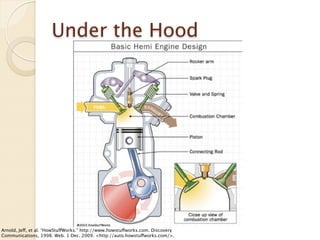
  • #20 The Hemi engine has always been looked at as amazing. It was first developed (V-6) in 1948 by Harry Westlake and others, though in 1951, Crystler came out with the 180 horsepower V-8 Hemi. Its unique design allows it to produce more power, and thus, more horsepower and faster cars. As seen above, instead of the cylinder combustion chamber, the chamber is shaped like a half sphere, and rather than having the valves are located in the block, instead of the head. -There are advantages and disadvantages to the HEMI engine. One advantage is that the surface area is much smaller than that of a normal flathead engine. This helps to reduce the loss of heat in the head walls. If too much heat is lost, the fuel will be too cool to burn correctly. Another advantage is the location of the valves. Because the valves are on opposite sides of the head, the valves have more room and can be larger, improving the air and exhaust flow. In a flathead engine, the valves are inline with one another, reducing the space that the valves head, forcing them to be smaller.
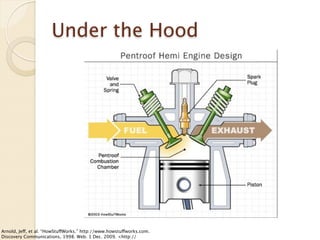
  • #21 -There are also disadvantages to the HEMI engine. Other than the higher cost to produce them, the HEMI design only has room for 2 valves. In more recent designs, the pentroof (as shone above) allows for 4 smaller valves. This helps the engine &amp;#x201C;breathe&amp;#x201D; easier. Also, this new design enables smaller chambers. Smaller chamber further reduce heat loss and also reduce the distance the &amp;#x201C;front flame&amp;#x201D; has to travel during the combustion process.
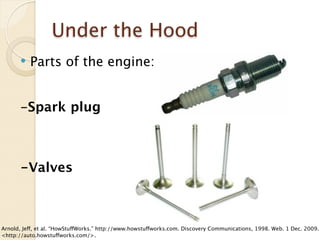
  • #22 -The spark plug provides the spark at just the right time, igniting the mixture of air and gasoline, allowing combustion to occur. -The valves open at the precise time to allow air and gasoline in and exhaust out. Both valves are closed during the compression and combustion process so that the combustion chamber is sealed. (http://angliaautogas.com/catalog/images/spark_plug.jpg; http://image.made-in-china.com/4f0j00zCsabpRcOgqP/Engine-Valve.jpg)
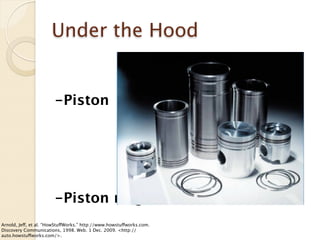
  • #23 -Piston is the cylindrical piece of metal located inside the cylinder. Moves up and down during the Otto cycle to compress the air and gasoline mixture and push the exhaust out through the valve. -Piston rings are placed on the outside of the piston and the inside of the cylinder. They seal the chamber during the compression and combustion process so that the air/gasoline or exhaust leak out of the chamber, into the sump, and so that the oil in the sump doesn&amp;#x2019;t leak into he chamber, where it is burned. If the rings are worn and the seal isn&amp;#x2019;t complete, the owner will have to add about a quart of oil every 1000 miles, due the the burning of the oil. (http://imgs.tootoo.com/19/55/19553c65efd3330d1df7d48a43ce2825.jpg)
  • #24 -Connecting rod attaches the piston to the crankshaft and is able to rotate at both of its ends, allowing its angle to change to move with the piston and the crankshaft properly. -Crankshaft rotates in a circular motion, moving the piston up and down. (http://www.extremepsi.com/store/images//t_21525.gif; http://www.jpfoundries.com/images/Crank-Shaft.jpg)
  • #25 -Sump is also known as the oil pan. It surrounds the crankshaft. (http://www.fordprobestore.co.uk/store/images/sump24v.jpg)
  • #26 The alternator is generally located in front of the engine, and works with the battery to create power for the electrical parts of the car. i.e. exterior and interior lights. (http://baxters.com.au/HTML/Images/Products_Alternator2.jpg)
  • #27 -The main point of the carburetor is to mix the correct amount of gas and air for the engine to burn. If there is not enough gas in the mixture, the engine will not run, and if there is too much, the engine could flood or not run correctly. Either way, it could cause damage to the engine. (http://www.atvmagblog.com/wp-content/uploads/2009/03/598px-carburetor_svg.png)
  • #28 - Radiators, put together with antifreeze and a system of hoses and pumps, work to keep the engine at an appropriate temperature. If there is not enough antifreeze or something goes wrong with the radiator/one of the hoses/pumps/fans the engine will overheat. If the antifreeze does not already come pre-mixed, a mixture of 50% antifreeze and 50%water should be made before adding it to your car. The antifreeze should be replaced at least every two years and the radiator should be cleaned using a special chemical that breaks down and build up. (http://www.getprice.com.au/images/uploadimg/1277/350_123734.jpg)
  • #29 Two important components of under the hood are the windshield wiper fluid chamber and the check oil rod. Both are located in different places in different cars, but can easily be located. The pictures above illustrate what each looks like. -The check oil rod has a checkered pattern at the bottom of the rod. The level of the oil is at a good point when it makes a mark that is within the checkered pattern.
  • #30 Mufflers are used to minimize the noise that the engine makes. It seems like it has a simple design, yet it it is a very intricate device. The sound wave enters the inlet tube and is bounced off of the back wall of the muffler. The resonator chamber contains a certain volume of air and has a length that is calculated to create a wave that a certain frequency of sound. It is then sent through a hole that leads to the main part of the muffler, where it is passed through the perforations. Finally, it leaves through the outlet pipe.
  • #31 Allows changeable gears ratios between the engine and the drive wheels. -keeps the engine from exceeding its redline (max rpm) -needs clutch pedal and gear shift.
  • #32 -allows engine to output a wide range of speeds while working within its small range of speeds. Without it the car would only have one gear that would include the car&amp;#x2019;s max rpm. This would wear the car down quickly and initial acceleration would be difficult. -there is no gear shift. -there is no clutch pedal. -a single set of gears produces all needed gear ratios.
  • #33 -connects or disconnects the engine from the transmission. -There are three main components to a clutch. -flywheel: circular piece of metal that is attached to the engine. -clutch pad: attaches to the flywheel. -pressure pad: attaches to the clutch pad. -whenever someone lets in and out of the clutch pedal, the pressure plate will move in and out, engaging or disengaging the clutch pad to the flywheel. Once engaged, the friction will eventually stop the pad from turning, which will allow for the power (torque) to be transferred from the flywheel, to the transmission, and ultimately to the wheels.
  • #34 -The brake rotor is the disk (shown above) the the brake pad clamps down on to stop the wheels from spinning. -There are drilled and slotted rotors. -drilled have multiple holes in them. -holes allow heat, gas and water to escape easier. -weakens wall of rotors (cracks easier) -better for street cars. -slotted have slots carved into the metal. -same uses as holes. -stronger support (less cracks) -better for race/high performance cars
  • #35 They are what actually comes in contact with the rotors in order to apply pressure and friction, bringing the car to a complete stop.
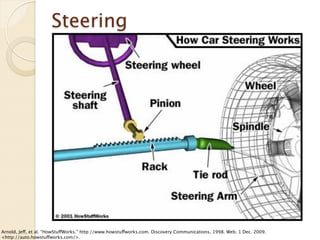
  • #36 The most common system of steering is the rack-in-pinion system. -pinion gear is connected to the end of the steering shaft. When the wheel is turn, the pinion moves, also moving the rack. -the tie rod (which is tied to each end of the rack) is connected to the steering arm on the spindle. When the rack moves, so does the spindle, turning the wheel.
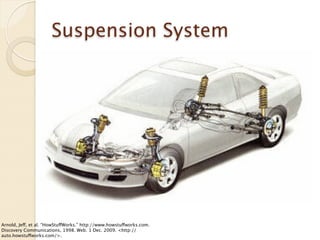
  • #37 The car&amp;#x2019;s suspension increases the friction between the road and the tires to allow for a smoother ride and to make the car easier to handle. -absorbs energy from the wheel hitting a bump, so the rest of the car in undisturbed. -
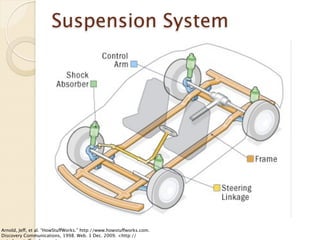
  • #38 -the suspension itself is in link with three of the other main systems of a car; steering, wheels, and the frame, As seen above, -frame supports the body of the car -suspension absorbs shock from roads. -and the steering rod and the control arms are all connected to the frame,
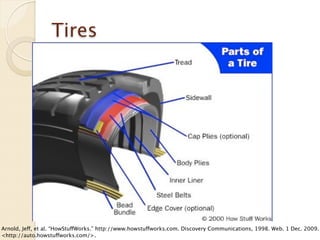
  • #39 -The bead, or bead bundle, is a set of steel cables that are coated in rubber. They help to support the tire when it is being set onto the rim. -The body of the tire is made up of plies, mostly of polyester cords, that runs perpendicular to the treads. -Steel belts serve as a reinforcement in the area under the tread. It helps avoid punctures and help to keep the tire flat and get the best traction. -Sidewall- it protects the body plies and keeps the air in the tire from leaking. -Tread- The outside wall of the tire. Its made up of different types of synthetic and natural rubbers. A pattern is shaped into the tread to create traction with the roads. -Cap Plies are optional. They provide extra support and help keep everything in place. They are mostly used to tires used in high-speed cars. (NASCAR)