Set Operators
Goals
• Show how set identities are established
• Introduce some important identities.
Copyright © Peter Cappello 2
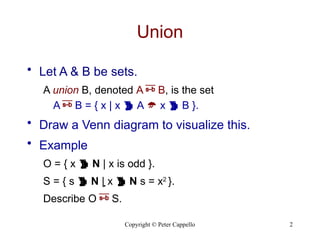
Union
• Let A & B be sets.
A union B, denoted A  B, is the set
A  B = { x | x  A  x  B }.
• Draw a Venn diagram to visualize this.
• Example
O = { x  N | x is odd }.
S = { s  N | x  N s = x2
}.
Describe O  S.
Copyright © Peter Cappello 3
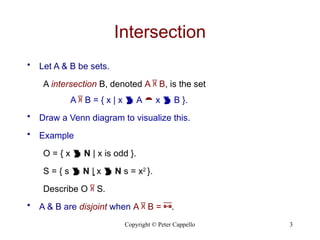
Intersection
• Let A & B be sets.
A intersection B, denoted A  B, is the set
A  B = { x | x  A  x  B }.
• Draw a Venn diagram to visualize this.
• Example
O = { x  N | x is odd }.
S = { s  N | x  N s = x2
}.
Describe O  S.
• A & B are disjoint when A  B = .
Copyright © Peter Cappello 4
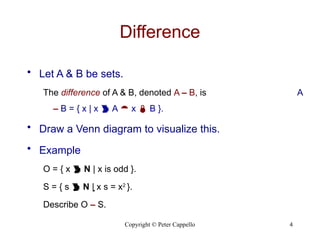
Difference
• Let A & B be sets.
The difference of A & B, denoted A – B, is A
– B = { x | x  A  x  B }.
• Draw a Venn diagram to visualize this.
• Example
O = { x  N | x is odd }.
S = { s  N | x s = x2
}.
Describe O – S.
Copyright © Peter Cappello 5
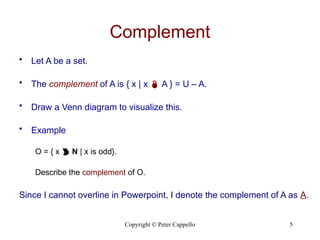
Complement
• Let A be a set.
• The complement of A is { x | x  A } = U – A.
• Draw a Venn diagram to visualize this.
• Example
O = { x  N | x is odd}.
Describe the complement of O.
Since I cannot overline in Powerpoint, I denote the complement of A as A.
Copyright © Peter Cappello 6
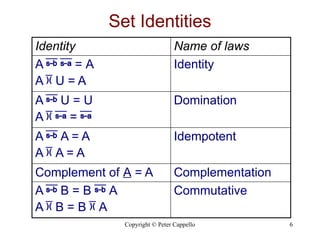
Set Identities
Identity Name of laws
A   = A
A  U = A
Identity
A  U = U
A   = 
Domination
A  A = A
A  A = A
Idempotent
Complement of A = A Complementation
A  B = B  A
A  B = B  A
Commutative
Copyright © Peter Cappello 7
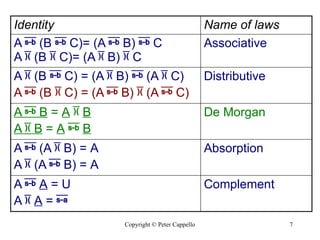
Identity Name of laws
A  (B  C)= (A  B)  C
A  (B  C)= (A  B)  C
Associative
A  (B  C) = (A  B)  (A  C)
A  (B  C) = (A  B)  (A  C)
Distributive
A  B = A  B
A  B = A  B
De Morgan
A  (A  B) = A
A  (A  B) = A
Absorption
A  A = U
A  A = 
Complement
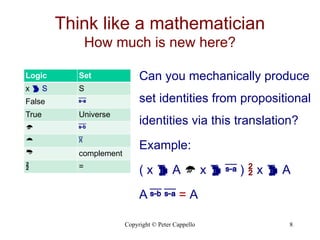
Think like a mathematician
How much is new here?
Logic Set
x  S S
False 
True Universe
 
 
 complement
 =
Can you mechanically produce
set identities from propositional
identities via this translation?
Example:
( x  A  x   )  x  A
A   = A
Copyright © Peter Cappello 8
Copyright © Peter Cappello 9
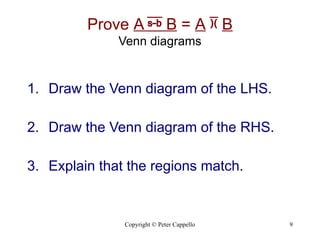
Prove A  B = A  B
Venn diagrams
1. Draw the Venn diagram of the LHS.
2. Draw the Venn diagram of the RHS.
3. Explain that the regions match.
Copyright © Peter Cappello 10
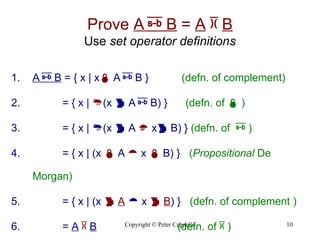
Prove A  B = A  B
Use set operator definitions
1. A  B = { x | x A  B } (defn. of complement)
2. = { x | (x  A  B) } (defn. of  )
3. = { x | (x  A  x B) } (defn. of  )
4. = { x | (x  A  x  B) } (Propositional De
Morgan)
5. = { x | (x  A  x  B) } (defn. of complement )
6. = A  B (defn. of  )
Copyright © Peter Cappello 11
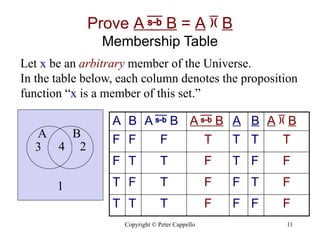
Prove A  B = A  B
Membership Table
A B A  B A  B A B A  B
F F F T T T T
F T T F T F F
T F T F F T F
T T T F F F F
1
2
3 4
A B
Let x be an arbitrary member of the Universe.
In the table below, each column denotes the proposition
function “x is a member of this set.”
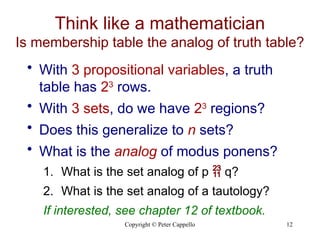
Think like a mathematician
Is membership table the analog of truth table?
• With 3 propositional variables, a truth
table has 23
rows.
• With 3 sets, do we have 23
regions?
• Does this generalize to n sets?
• What is the analog of modus ponens?
1. What is the set analog of p  q?
2. What is the set analog of a tautology?
If interested, see chapter 12 of textbook.
Copyright © Peter Cappello 12
Analogy between logic & sets
• In logic: p  q ≡ p  q
• Its set analog is P  Q
• Set analog of modus ponens
( p  ( p  q ) )  q
is
Complement[ P  ( P  Q ) ]  Q
Copyright © Peter Cappello 13
Copyright © Peter Cappello 14
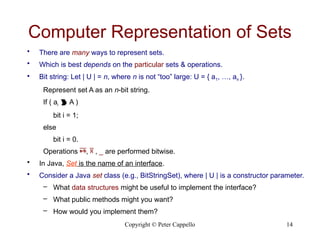
Computer Representation of Sets
• There are many ways to represent sets.
• Which is best depends on the particular sets & operations.
• Bit string: Let | U | = n, where n is not “too” large: U = { a1, …, an }.
Represent set A as an n-bit string.
If ( ai  A )
bit i = 1;
else
bit i = 0.
Operations ,  , _ are performed bitwise.
• In Java, Set is the name of an interface.
• Consider a Java set class (e.g., BitStringSet), where | U | is a constructor parameter.
– What data structures might be useful to implement the interface?
– What public methods might you want?
– How would you implement them?

sets ppt for grade 7 students set operationd

  • 1.
    Set Operators Goals • Showhow set identities are established • Introduce some important identities.
  • 2.
    Copyright © PeterCappello 2 Union • Let A & B be sets. A union B, denoted A  B, is the set A  B = { x | x  A  x  B }. • Draw a Venn diagram to visualize this. • Example O = { x  N | x is odd }. S = { s  N | x  N s = x2 }. Describe O  S.
  • 3.
    Copyright © PeterCappello 3 Intersection • Let A & B be sets. A intersection B, denoted A  B, is the set A  B = { x | x  A  x  B }. • Draw a Venn diagram to visualize this. • Example O = { x  N | x is odd }. S = { s  N | x  N s = x2 }. Describe O  S. • A & B are disjoint when A  B = .
  • 4.
    Copyright © PeterCappello 4 Difference • Let A & B be sets. The difference of A & B, denoted A – B, is A – B = { x | x  A  x  B }. • Draw a Venn diagram to visualize this. • Example O = { x  N | x is odd }. S = { s  N | x s = x2 }. Describe O – S.
  • 5.
    Copyright © PeterCappello 5 Complement • Let A be a set. • The complement of A is { x | x  A } = U – A. • Draw a Venn diagram to visualize this. • Example O = { x  N | x is odd}. Describe the complement of O. Since I cannot overline in Powerpoint, I denote the complement of A as A.
  • 6.
    Copyright © PeterCappello 6 Set Identities Identity Name of laws A   = A A  U = A Identity A  U = U A   =  Domination A  A = A A  A = A Idempotent Complement of A = A Complementation A  B = B  A A  B = B  A Commutative
  • 7.
    Copyright © PeterCappello 7 Identity Name of laws A  (B  C)= (A  B)  C A  (B  C)= (A  B)  C Associative A  (B  C) = (A  B)  (A  C) A  (B  C) = (A  B)  (A  C) Distributive A  B = A  B A  B = A  B De Morgan A  (A  B) = A A  (A  B) = A Absorption A  A = U A  A =  Complement
  • 8.
    Think like amathematician How much is new here? Logic Set x  S S False  True Universe      complement  = Can you mechanically produce set identities from propositional identities via this translation? Example: ( x  A  x   )  x  A A   = A Copyright © Peter Cappello 8
  • 9.
    Copyright © PeterCappello 9 Prove A  B = A  B Venn diagrams 1. Draw the Venn diagram of the LHS. 2. Draw the Venn diagram of the RHS. 3. Explain that the regions match.
  • 10.
    Copyright © PeterCappello 10 Prove A  B = A  B Use set operator definitions 1. A  B = { x | x A  B } (defn. of complement) 2. = { x | (x  A  B) } (defn. of  ) 3. = { x | (x  A  x B) } (defn. of  ) 4. = { x | (x  A  x  B) } (Propositional De Morgan) 5. = { x | (x  A  x  B) } (defn. of complement ) 6. = A  B (defn. of  )
  • 11.
    Copyright © PeterCappello 11 Prove A  B = A  B Membership Table A B A  B A  B A B A  B F F F T T T T F T T F T F F T F T F F T F T T T F F F F 1 2 3 4 A B Let x be an arbitrary member of the Universe. In the table below, each column denotes the proposition function “x is a member of this set.”
  • 12.
    Think like amathematician Is membership table the analog of truth table? • With 3 propositional variables, a truth table has 23 rows. • With 3 sets, do we have 23 regions? • Does this generalize to n sets? • What is the analog of modus ponens? 1. What is the set analog of p  q? 2. What is the set analog of a tautology? If interested, see chapter 12 of textbook. Copyright © Peter Cappello 12
  • 13.
    Analogy between logic& sets • In logic: p  q ≡ p  q • Its set analog is P  Q • Set analog of modus ponens ( p  ( p  q ) )  q is Complement[ P  ( P  Q ) ]  Q Copyright © Peter Cappello 13
  • 14.
    Copyright © PeterCappello 14 Computer Representation of Sets • There are many ways to represent sets. • Which is best depends on the particular sets & operations. • Bit string: Let | U | = n, where n is not “too” large: U = { a1, …, an }. Represent set A as an n-bit string. If ( ai  A ) bit i = 1; else bit i = 0. Operations ,  , _ are performed bitwise. • In Java, Set is the name of an interface. • Consider a Java set class (e.g., BitStringSet), where | U | is a constructor parameter. – What data structures might be useful to implement the interface? – What public methods might you want? – How would you implement them?