CHAPTER 1
SETS
What is a Set?
 A set is a well-defined collection of
distinct objects.
 The objects in a set are called the
elements or members of the set.
 Capital letters A,B,C,… usually
denote sets.
 Lowercase letters a,b,c,… denote
the elements of a set.
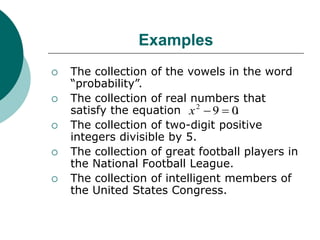
Examples
 The collection of the vowels in the word
“probability”.
 The collection of real numbers that
satisfy the equation .
 The collection of two-digit positive
integers divisible by 5.
 The collection of great football players in
the National Football League.
 The collection of intelligent members of
the United States Congress.
0
9
2


x
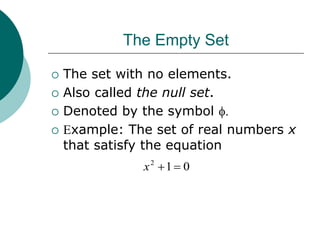
The Empty Set
 The set with no elements.
 Also called the null set.
 Denoted by the symbol f.
 Example: The set of real numbers x
that satisfy the equation
0
1
2


x
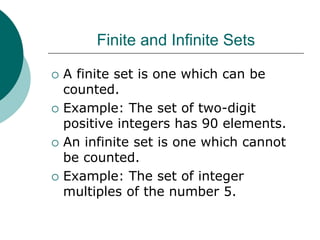
Finite and Infinite Sets
 A finite set is one which can be
counted.
 Example: The set of two-digit
positive integers has 90 elements.
 An infinite set is one which cannot
be counted.
 Example: The set of integer
multiples of the number 5.
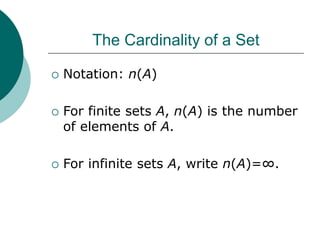
The Cardinality of a Set
 Notation: n(A)
 For finite sets A, n(A) is the number
of elements of A.
 For infinite sets A, write n(A)=∞.
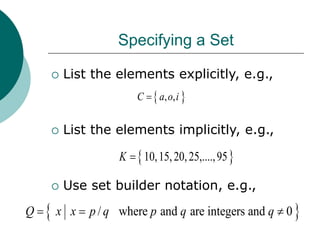
Specifying a Set
 List the elements explicitly, e.g.,
 List the elements implicitly, e.g.,
 Use set builder notation, e.g.,
 
, ,
C a o i

 
10,15,20,25,....,95
K 
 
/ where and are integers and 0
Q x x p q p q q
  
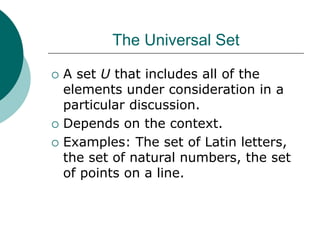
The Universal Set
 A set U that includes all of the
elements under consideration in a
particular discussion.
 Depends on the context.
 Examples: The set of Latin letters,
the set of natural numbers, the set
of points on a line.
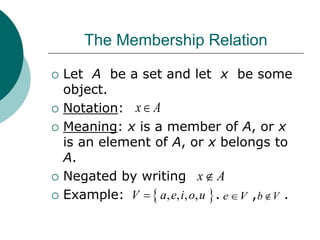
The Membership Relation
 Let A be a set and let x be some
object.
 Notation:
 Meaning: x is a member of A, or x
is an element of A, or x belongs to
A.
 Negated by writing
 Example: . , .
A
x
A
x
 
, , , ,
V a e i o u
 V
e  V
b 
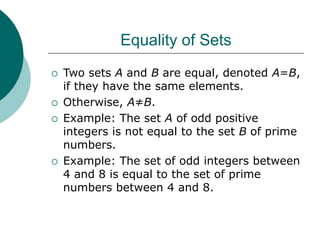
Equality of Sets
 Two sets A and B are equal, denoted A=B,
if they have the same elements.
 Otherwise, A≠B.
 Example: The set A of odd positive
integers is not equal to the set B of prime
numbers.
 Example: The set of odd integers between
4 and 8 is equal to the set of prime
numbers between 4 and 8.
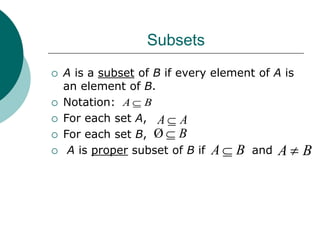
Subsets
 A is a subset of B if every element of A is
an element of B.
 Notation:
 For each set A,
 For each set B,
 A is proper subset of B if and
B
A 
B
A 
A
A 
B

Ø
B
A 
Unions
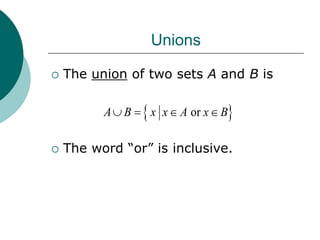
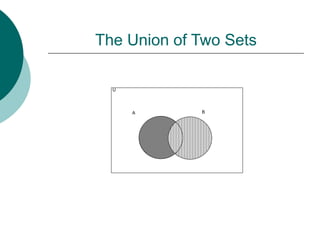
 The union of two sets A and B is
 The word “or” is inclusive.
 
or
A B x x A x B
   
Intersections
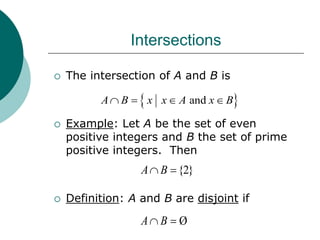
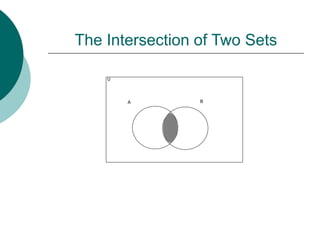
 The intersection of A and B is
 Example: Let A be the set of even
positive integers and B the set of prime
positive integers. Then
 Definition: A and B are disjoint if
 
and
A B x x A x B
   
}
2
{

 B
A
Ø

 B
A
Complements
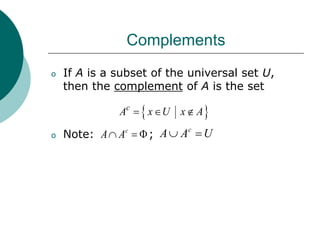
o If A is a subset of the universal set U,
then the complement of A is the set
o Note: ;


 c
A
A
 
c
A x U x A
  
U
A
A c


Venn Diagrams
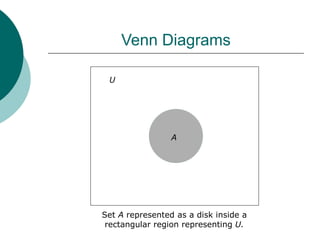
A
Set A represented as a disk inside a
rectangular region representing U.
U
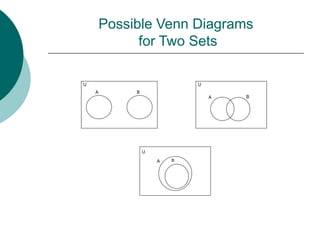
Possible Venn Diagrams
for Two Sets
U
A B
U
A B
U
A B
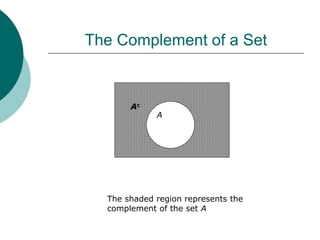
The Complement of a Set
A
The shaded region represents the
complement of the set A
Ac
The Union of Two Sets
U
A B
The Intersection of Two Sets
U
A B
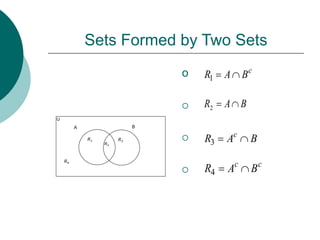
Sets Formed by Two Sets
o



R1 R3
U
A B
R2
R4
c
B
A
R 

1
B
A
R 

2
B
A
R c


3
c
c
B
A
R 

4
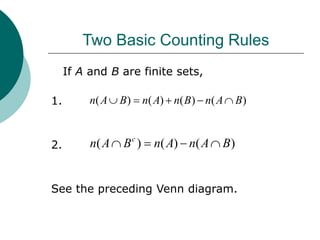
Two Basic Counting Rules
If A and B are finite sets,
1.
2.
See the preceding Venn diagram.
)
(
)
(
)
(
)
( B
A
n
B
n
A
n
B
A
n 




)
(
)
(
)
( B
A
n
A
n
B
A
n c




Sets.ppt

Sets.ppt

  • 1.
  • 2.
    What is aSet?  A set is a well-defined collection of distinct objects.  The objects in a set are called the elements or members of the set.  Capital letters A,B,C,… usually denote sets.  Lowercase letters a,b,c,… denote the elements of a set.
  • 3.
    Examples  The collectionof the vowels in the word “probability”.  The collection of real numbers that satisfy the equation .  The collection of two-digit positive integers divisible by 5.  The collection of great football players in the National Football League.  The collection of intelligent members of the United States Congress. 0 9 2   x
  • 4.
    The Empty Set The set with no elements.  Also called the null set.  Denoted by the symbol f.  Example: The set of real numbers x that satisfy the equation 0 1 2   x
  • 5.
    Finite and InfiniteSets  A finite set is one which can be counted.  Example: The set of two-digit positive integers has 90 elements.  An infinite set is one which cannot be counted.  Example: The set of integer multiples of the number 5.
  • 6.
    The Cardinality ofa Set  Notation: n(A)  For finite sets A, n(A) is the number of elements of A.  For infinite sets A, write n(A)=∞.
  • 7.
    Specifying a Set List the elements explicitly, e.g.,  List the elements implicitly, e.g.,  Use set builder notation, e.g.,   , , C a o i    10,15,20,25,....,95 K    / where and are integers and 0 Q x x p q p q q   
  • 8.
    The Universal Set A set U that includes all of the elements under consideration in a particular discussion.  Depends on the context.  Examples: The set of Latin letters, the set of natural numbers, the set of points on a line.
  • 9.
    The Membership Relation Let A be a set and let x be some object.  Notation:  Meaning: x is a member of A, or x is an element of A, or x belongs to A.  Negated by writing  Example: . , . A x A x   , , , , V a e i o u  V e  V b 
  • 10.
    Equality of Sets Two sets A and B are equal, denoted A=B, if they have the same elements.  Otherwise, A≠B.  Example: The set A of odd positive integers is not equal to the set B of prime numbers.  Example: The set of odd integers between 4 and 8 is equal to the set of prime numbers between 4 and 8.
  • 11.
    Subsets  A isa subset of B if every element of A is an element of B.  Notation:  For each set A,  For each set B,  A is proper subset of B if and B A  B A  A A  B  Ø B A 
  • 12.
    Unions  The unionof two sets A and B is  The word “or” is inclusive.   or A B x x A x B    
  • 13.
    Intersections  The intersectionof A and B is  Example: Let A be the set of even positive integers and B the set of prime positive integers. Then  Definition: A and B are disjoint if   and A B x x A x B     } 2 {   B A Ø   B A
  • 14.
    Complements o If Ais a subset of the universal set U, then the complement of A is the set o Note: ;    c A A   c A x U x A    U A A c  
  • 15.
    Venn Diagrams A Set Arepresented as a disk inside a rectangular region representing U. U
  • 16.
    Possible Venn Diagrams forTwo Sets U A B U A B U A B
  • 17.
    The Complement ofa Set A The shaded region represents the complement of the set A Ac
  • 18.
    The Union ofTwo Sets U A B
  • 19.
    The Intersection ofTwo Sets U A B
  • 20.
    Sets Formed byTwo Sets o    R1 R3 U A B R2 R4 c B A R   1 B A R   2 B A R c   3 c c B A R   4
  • 21.
    Two Basic CountingRules If A and B are finite sets, 1. 2. See the preceding Venn diagram. ) ( ) ( ) ( ) ( B A n B n A n B A n      ) ( ) ( ) ( B A n A n B A n c    