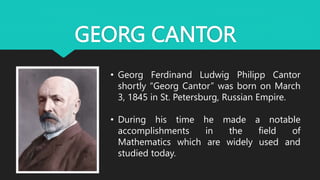
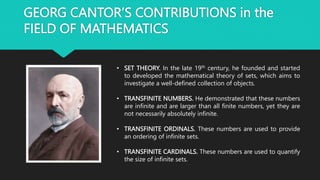
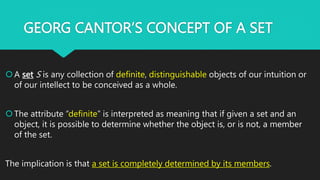
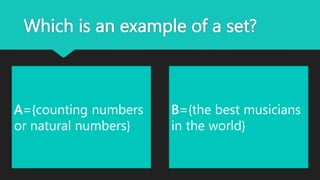
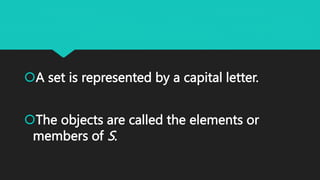
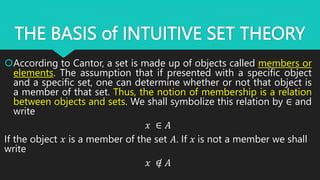
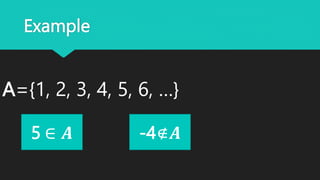
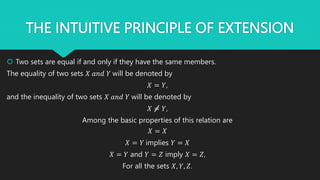
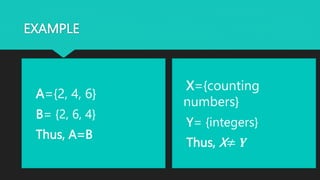
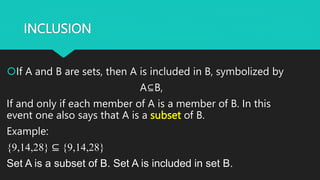
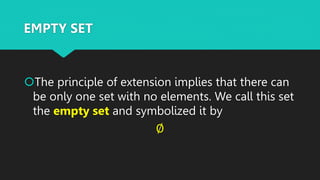
Georg Cantor founded set theory in the late 19th century and made notable contributions to mathematics. He demonstrated that transfinite numbers, which include infinite cardinal and ordinal numbers, are larger than finite numbers but not absolutely infinite. Cantor defined a set as a collection of definite objects that can be determined as members or non-members. He established the intuitive principle of extension stating that two sets are equal if they have the same members. Cantor also defined inclusion and the empty set, which contains no elements.