ANSOFF MATRIX, BCG MATRIX
ANOSFF MATRIX
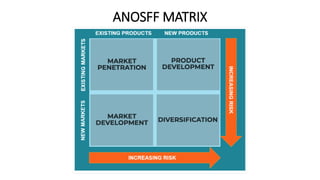
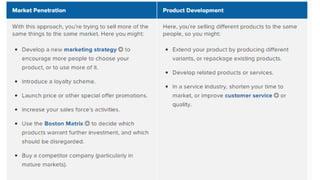
THE ANSOFF MATRIX: MARKET PENETRATION
The market penetration strategy can be done in a number of ways:
• Decreasing prices to attract existing or new customers
• Increasing promotion and distribution efforts
• Acquiring a competitor in the same marketplace
THE ANSOFF MATRIX: PRODUCT DEVELOPMENT
• Investing in R&D to develop new products to cater to the existing market
• Acquiring a competitor’s product and merging resources to create a new product
that better meets the need of the existing market
• Strategic partnerships with other firms to gain access to each partner’s
distribution channels or brand
E.G, automotive companies creating electric cars to meet the changing needs of
their existing market. Current market consumers in the automobile market are
becoming more environmentally conscious
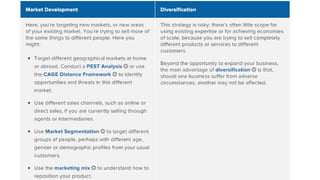
THE ANSOFF MATRIX: MARKET DEVELOPMENT
• Catering to a different customer segment
• Entering into a new domestic market (expanding regionally)
• Entering into a foreign market (expanding internationally)
The market development strategy is most successful if
• The firm owns proprietary technology that it can leverage into new markets
• Consumers in the new market are profitable (i.e., they possess disposable
income)
• Consumer behavior in the new markets does not deviate too far from the existing
markets.
THE ANSOFF MATRIX: DIVERSIFICATION
Two types of diversification a firm can employ:
1. Related diversification: There are potential synergies to be realized between the
existing business and the new product/market.
For example, a leather bag producer that starts a line of leather shoes
2. Unrelated diversification: There are no potential synergies to be realized
between the existing business and the new product/market.
For example, a leather bag producer that starts manufacturing smartphones
Session 9 - Ansoff Matrix.pdf

Session 9 - Ansoff Matrix.pdf

  • 1.
  • 10.
  • 11.
    THE ANSOFF MATRIX:MARKET PENETRATION The market penetration strategy can be done in a number of ways: • Decreasing prices to attract existing or new customers • Increasing promotion and distribution efforts • Acquiring a competitor in the same marketplace
  • 12.
    THE ANSOFF MATRIX:PRODUCT DEVELOPMENT • Investing in R&D to develop new products to cater to the existing market • Acquiring a competitor’s product and merging resources to create a new product that better meets the need of the existing market • Strategic partnerships with other firms to gain access to each partner’s distribution channels or brand E.G, automotive companies creating electric cars to meet the changing needs of their existing market. Current market consumers in the automobile market are becoming more environmentally conscious
  • 13.
    THE ANSOFF MATRIX:MARKET DEVELOPMENT • Catering to a different customer segment • Entering into a new domestic market (expanding regionally) • Entering into a foreign market (expanding internationally) The market development strategy is most successful if • The firm owns proprietary technology that it can leverage into new markets • Consumers in the new market are profitable (i.e., they possess disposable income) • Consumer behavior in the new markets does not deviate too far from the existing markets.
  • 14.
    THE ANSOFF MATRIX:DIVERSIFICATION Two types of diversification a firm can employ: 1. Related diversification: There are potential synergies to be realized between the existing business and the new product/market. For example, a leather bag producer that starts a line of leather shoes 2. Unrelated diversification: There are no potential synergies to be realized between the existing business and the new product/market. For example, a leather bag producer that starts manufacturing smartphones