Transit-Supportive TDM Measures
Paul Supawanich, AICP
@tweetsupa
Associate Project Planner


2013 American Planning Association Conference | CHICAGO, IL
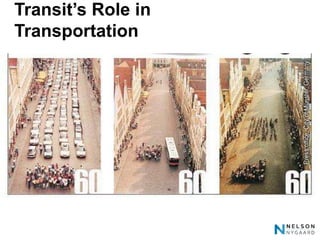
Transit’s Role in
Transportation


What?
Transit’s Role in
Transportation


Capacity for what?
                     3
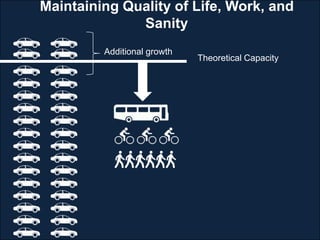
Maintaining Quality of Life, Work, and
              Sanity
         Additional growth
                             Theoretical Capacity
“Do what you can, with what you
have, where you are” –Theodore
          Roosevelt
So remind me, what’s the connection
     between TDM and transit?
So remind me, what’s the connection
       between TDM and transit?

TDM measures Incent and Enable Transit
              Access
So remind me, what’s the connection
       between TDM and transit?

TDM Measures Incent and Enable Transit
              Access

Essentially: TDM enables transit to work
                better
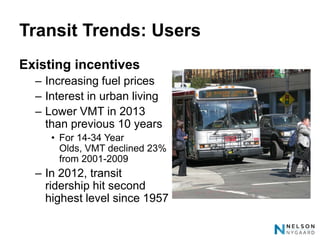
Transit Trends: Users
Existing incentives
  – Increasing fuel prices
  – Interest in urban living
  – Lower VMT in 2013
    than previous 10 years
     • For 14-34 Year
       Olds, VMT declined 23%
       from 2001-2009
  – In 2012, transit
    ridership hit second
    highest level since 1957
Transit Trends: Providers
Previous metric of focus: Ridership
  – Park and Ride
  – Planning extent: The stop + station

New metrics: Ridership + Access
  – Reducing barriers and increasing incentives
  – Transit-oriented development
  – Station pedestrian and bicycle access plans
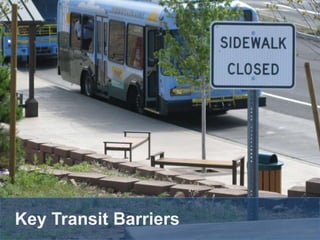
Key Transit Barriers
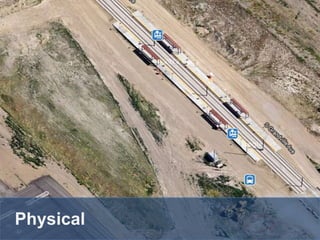
Physical
Folding Bikes on
              Transit
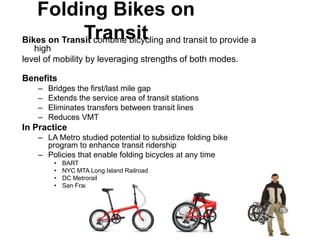
Bikes on Transit combine bicycling and transit to provide a
   high
level of mobility by leveraging strengths of both modes.

Benefits
    –   Bridges the first/last mile gap
    –   Extends the service area of transit stations
    –   Eliminates transfers between transit lines
    –   Reduces VMT
In Practice
    – LA Metro studied potential to subsidize folding bike
      program to enhance transit ridership
    – Policies that enable folding bicycles at any time
         •   BART
         •   NYC MTA Long Island Railroad
         •   DC Metrorail
         •   San Francisco MTA
Circulator Shuttles
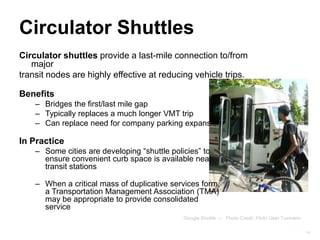
Circulator shuttles provide a last-mile connection to/from
   major
transit nodes are highly effective at reducing vehicle trips.

Benefits
    – Bridges the first/last mile gap
    – Typically replaces a much longer VMT trip
    – Can replace need for company parking expansion

In Practice
    – Some cities are developing “shuttle policies” to
      ensure convenient curb space is available near
      transit stations

    – When a critical mass of duplicative services form,
      a Transportation Management Association (TMA)
      may be appropriate to provide consolidated
      service
                                              Google Shuttle -- Photo Credit: Flickr User Tuxmann

                                                                                                    14
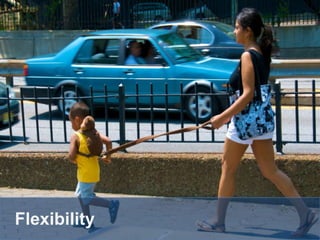
Flexibility
Guaranteed Ride Home
Guaranteed Ride Home Programs: provide a free ride
   home for
“encouraged” modes when emergency situations arise.

Benefits
   – Eliminates fear of being
     “stuck at work”
   – Leverages existing
     transportation resources
   – Low cost program to
     encourage transit and other
     modes

In Practice
   – Alameda County (Oakland, CA) estimates
     program reduced 405,496 one-way car
     trips in 2012
   – Equivalent to 3,330 tons of CO2

                                                      Credit: Roosbeh Rokni

                                                                              16
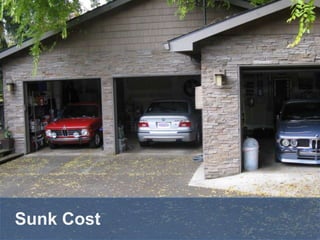
Sunk Cost
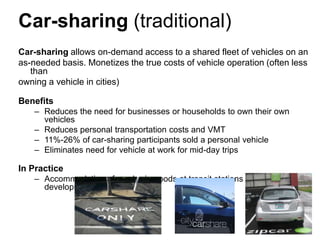
Car-sharing (traditional)
Car-sharing allows on-demand access to a shared fleet of vehicles on an
as-needed basis. Monetizes the true costs of vehicle operation (often less
   than
owning a vehicle in cities)

Benefits
    – Reduces the need for businesses or households to own their own
      vehicles
    – Reduces personal transportation costs and VMT
    – 11%-26% of car-sharing participants sold a personal vehicle
    – Eliminates need for vehicle at work for mid-day trips

In Practice
    – Accommodation of carsharing pods at transit stations and in residential
      developments, even airports
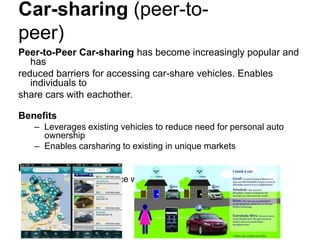
Car-sharing (peer-to-
peer)
Peer-to-Peer Car-sharing has become increasingly popular and
   has
reduced barriers for accessing car-share vehicles. Enables
   individuals to
share cars with eachother.

Benefits
   – Leverages existing vehicles to reduce need for personal auto
     ownership
   – Enables carsharing to existing in unique markets

In Practice
   – Growing marketplace with several nationwide networks
“Touchscreen”
Transportation
Incentives
Transit Pass Programs
Transit Pass (Ecopass) Programs provide a deep discount for
   transit
passes which provide unlimited ride for participants.

Benefits
   – Highly effective at incentivizing transit use
   – Reduces need for parking and traffic mitigations

In Practice
   – Often bundled with residential “move-in” or company benefits
   – College campuses have been doing this for years
90%


                               81%
80%
      76%
                                                                        Drove Before Pass              Drove After Pass


70%

                                                                        Transit Before Pass            Transit After Pass
            60%
60%                                  57%


50%
                                                                                   46%
                                                                                         42%
40%
                                                                                                                                   36%
                                                                                                                33%

30%                      27%
                                                                            25%                                       24%
                                                                      20%                                                    21%
20%                                               18%

                                            13%                                                        13%
                   11%
10%                                                                                               8%


0%
      Santa Clara (VTA) [1]    Bellevue, Washington[2]   Ann Arbor, Michigan[3]   UCLA[4] (faculty and staff)         Univ. of
                                                                                                                Washington, Seattle[5]
                                                                                                                                     23
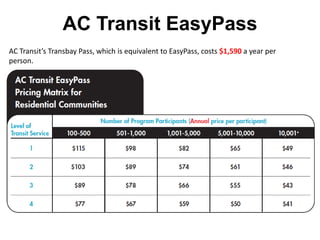
AC Transit EasyPass
AC Transit’s Transbay Pass, which is equivalent to EasyPass, costs $1,590 a year per
person.
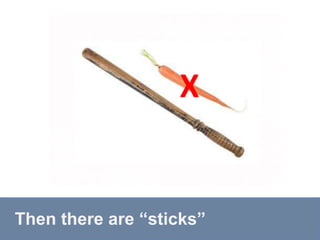
X


Then there are “sticks”
Commuter Benefits Ordinance
San Francisco
Who?
• Businesses in San Francisco
• 20 or more employees nationwide
What (Requirements)
• Pre-tax benefits: up to $245/month for transit/vanpool
  expenses
• Employer-Paid transportation benefits: Monthly subsidy for
  transportation expenses equivalent to the price of a monthly
  transit pass
• Employer-provided transportation: Company funded bus or
  van service between employee homes
Commute Trip Reduction Law (CTR)
Seattle, WA

Who?
• Statewide for major employers
  (100+ employees)
• Applied through ordinance at local level
What (Requirements)
• Local Transportation Coordinator: individual
  responsible for locally administering CTR
  program
• Implementation of at minimum two of “menu” of
Paul Supawanich, AICP
 NelsonNygaard Consulting Associates
 116 New Montgomery Street, Suite 500
          San Francisco, CA
            415-284-1544
   psupawanich@nelsonnygaard.com
             @tweetsupa


NELSONNYGAARD CONSULTING ASSOCIATES © 2013

Transit-Supportive TDM Programs

  • 1.
    Transit-Supportive TDM Measures PaulSupawanich, AICP @tweetsupa Associate Project Planner 2013 American Planning Association Conference | CHICAGO, IL
  • 2.
  • 3.
  • 4.
    Maintaining Quality ofLife, Work, and Sanity Additional growth Theoretical Capacity
  • 5.
    “Do what youcan, with what you have, where you are” –Theodore Roosevelt
  • 6.
    So remind me,what’s the connection between TDM and transit?
  • 7.
    So remind me,what’s the connection between TDM and transit? TDM measures Incent and Enable Transit Access
  • 8.
    So remind me,what’s the connection between TDM and transit? TDM Measures Incent and Enable Transit Access Essentially: TDM enables transit to work better
  • 9.
    Transit Trends: Users Existingincentives – Increasing fuel prices – Interest in urban living – Lower VMT in 2013 than previous 10 years • For 14-34 Year Olds, VMT declined 23% from 2001-2009 – In 2012, transit ridership hit second highest level since 1957
  • 10.
    Transit Trends: Providers Previousmetric of focus: Ridership – Park and Ride – Planning extent: The stop + station New metrics: Ridership + Access – Reducing barriers and increasing incentives – Transit-oriented development – Station pedestrian and bicycle access plans
  • 11.
  • 12.
  • 13.
    Folding Bikes on Transit Bikes on Transit combine bicycling and transit to provide a high level of mobility by leveraging strengths of both modes. Benefits – Bridges the first/last mile gap – Extends the service area of transit stations – Eliminates transfers between transit lines – Reduces VMT In Practice – LA Metro studied potential to subsidize folding bike program to enhance transit ridership – Policies that enable folding bicycles at any time • BART • NYC MTA Long Island Railroad • DC Metrorail • San Francisco MTA
  • 14.
    Circulator Shuttles Circulator shuttlesprovide a last-mile connection to/from major transit nodes are highly effective at reducing vehicle trips. Benefits – Bridges the first/last mile gap – Typically replaces a much longer VMT trip – Can replace need for company parking expansion In Practice – Some cities are developing “shuttle policies” to ensure convenient curb space is available near transit stations – When a critical mass of duplicative services form, a Transportation Management Association (TMA) may be appropriate to provide consolidated service Google Shuttle -- Photo Credit: Flickr User Tuxmann 14
  • 15.
  • 16.
    Guaranteed Ride Home GuaranteedRide Home Programs: provide a free ride home for “encouraged” modes when emergency situations arise. Benefits – Eliminates fear of being “stuck at work” – Leverages existing transportation resources – Low cost program to encourage transit and other modes In Practice – Alameda County (Oakland, CA) estimates program reduced 405,496 one-way car trips in 2012 – Equivalent to 3,330 tons of CO2 Credit: Roosbeh Rokni 16
  • 17.
  • 18.
    Car-sharing (traditional) Car-sharing allowson-demand access to a shared fleet of vehicles on an as-needed basis. Monetizes the true costs of vehicle operation (often less than owning a vehicle in cities) Benefits – Reduces the need for businesses or households to own their own vehicles – Reduces personal transportation costs and VMT – 11%-26% of car-sharing participants sold a personal vehicle – Eliminates need for vehicle at work for mid-day trips In Practice – Accommodation of carsharing pods at transit stations and in residential developments, even airports
  • 19.
    Car-sharing (peer-to- peer) Peer-to-Peer Car-sharinghas become increasingly popular and has reduced barriers for accessing car-share vehicles. Enables individuals to share cars with eachother. Benefits – Leverages existing vehicles to reduce need for personal auto ownership – Enables carsharing to existing in unique markets In Practice – Growing marketplace with several nationwide networks
  • 20.
  • 21.
  • 22.
    Transit Pass Programs TransitPass (Ecopass) Programs provide a deep discount for transit passes which provide unlimited ride for participants. Benefits – Highly effective at incentivizing transit use – Reduces need for parking and traffic mitigations In Practice – Often bundled with residential “move-in” or company benefits – College campuses have been doing this for years
  • 23.
    90% 81% 80% 76% Drove Before Pass Drove After Pass 70% Transit Before Pass Transit After Pass 60% 60% 57% 50% 46% 42% 40% 36% 33% 30% 27% 25% 24% 20% 21% 20% 18% 13% 13% 11% 10% 8% 0% Santa Clara (VTA) [1] Bellevue, Washington[2] Ann Arbor, Michigan[3] UCLA[4] (faculty and staff) Univ. of Washington, Seattle[5] 23
  • 24.
    AC Transit EasyPass ACTransit’s Transbay Pass, which is equivalent to EasyPass, costs $1,590 a year per person.
  • 25.
    X Then there are“sticks”
  • 26.
    Commuter Benefits Ordinance SanFrancisco Who? • Businesses in San Francisco • 20 or more employees nationwide What (Requirements) • Pre-tax benefits: up to $245/month for transit/vanpool expenses • Employer-Paid transportation benefits: Monthly subsidy for transportation expenses equivalent to the price of a monthly transit pass • Employer-provided transportation: Company funded bus or van service between employee homes
  • 27.
    Commute Trip ReductionLaw (CTR) Seattle, WA Who? • Statewide for major employers (100+ employees) • Applied through ordinance at local level What (Requirements) • Local Transportation Coordinator: individual responsible for locally administering CTR program • Implementation of at minimum two of “menu” of
  • 28.
    Paul Supawanich, AICP NelsonNygaard Consulting Associates 116 New Montgomery Street, Suite 500 San Francisco, CA 415-284-1544 psupawanich@nelsonnygaard.com @tweetsupa NELSONNYGAARD CONSULTING ASSOCIATES © 2013

Editor's Notes

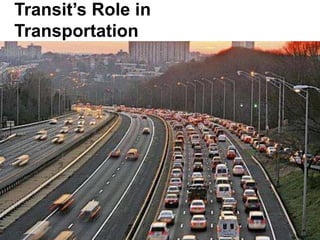
  • #3 To preface: Transit serves communities in many ways. However, in today’s context. I want to focus on the element of moving people efficiency. Most places do not have a perpetual traffic problem – they have a peak problem.
  • #4 But while vehicle capacity is limited, person capacity is virtually unlimited – it all depends on how you choose to use the precious real estate of the public rights of way.This image is borrowed from Germany, but has been replicated many times in communities all around the U.S. It shows the real estate consumed by 60 persons in single occupant vehicles, the same 60 people on a bus, and the same 60 people on bicycles or walking.The person capacity of the street is enormous.
  • #5 But there is a difference between theoretical capacity and freeflow conditions. Like most people, I value sanity when traveling and bumper to bumper traffic hardly offers that, so for quality of life (and safety and sanity) we need to get back to free flow conditions.The good news is, it can take as little as a 10% reduction in traffic – making it possible and inviting to just 10% of the people to travel on bus, bike or foot means the other 90% can enjoy a better commute as well. We hear about a “war on cars” but this couldn’t be more wrong. Most people CAN still continue to drive, and in fact drivers should be the chief cheerleaders supporting the move of the willing 10%.But of course there is growth, so that means it is a circle that needs to continueMore good news – the majority of trips taken in the U.S. are less than 3 miles in length – and over 1/3 of them are a mile or less. These distances lend themselves well to alternate modes **IF** they areReliableAffordableEfficient
  • #6 Simply put, transportation demand management is inducing travel patterns that use the resources you HAVE to accommodate the growth you WANT.This can be done by “infilling travel” to modes and time periods where surplus capacity existsFor the most part, because TDM optimizes capacity that IS, even the most expensive techniques are still vastly cheaper than attempting to build a region out of congestion
  • #10 2009 NHTS2012 http://www.reuters.com/article/2013/03/11/us-usa-transportation-transit-idUSBRE92A02D20130311
  • #12 Will talk about three key barriers to transit where TDM programs have been largely helpful.PhysicalFlexibility (Time)Sunk Cost (Vehicle ownership)
  • #15 On the upper end of employer transit are employer shuttles. The leaders in this area (like Google) have gone out of their way to make the shuttle fun, sexy, and trendyThese are exclusive – part of a clubThe provision of WiFi or other amenities makes it an extension of the workspaceDraw backsExclusivity precludes public utilizationMany redundant routes = additional traffic congestionAlthough less expensive than constructing parking, still a major expense
  • #17 Of course a lot of people shy away from pooling with others fearing “what if something happens and I need to get home?” Guaranteed Ride Home programs ease this fear. While relatively low cost, they can have a big impact in giving confidence to those “interested but skeptical” populations
  • #22 Will talk about three key barriers to transit where TDM programs have been largely helpful.PhysicalFlexibility (Time)Sunk Cost (Vehicle ownership)
  • #24 Transit pass programs step a little higher on the benefit ladder, but still can be extremely cost effective.The best time to influence commuting patterns is during a major life change like moving to a new residence or changing jobs. By providing buyers, renters or workers a first time transit benefit card – even for as little as $100 – this can acquaint the commuter with the system and begin a habit that lasts a lifetime.Many transit systems offer discount fares to employers who buy transit benefits in bulk.Some employers and educational institutions purchase unlimited ride passes for their workers or students. Other offer employer transit benefits.
  • #26 Will talk about three key barriers to transit where TDM programs have been largely helpful.PhysicalFlexibility (Time)Sunk Cost (Vehicle ownership)
  • #27 ExemptionsBusinesses with fewer than 20 employees nationwideBusinesses that do not operate in San FranciscoContractors with headquarters located outside of San Francisco if A) project assignments in San Francisco are less than 6 months, or B) employees are required to drive specialty vehicles to project sites. This includes construction workers driving heavy equipment vehicles, caterers driving refrigerated vehicles or specialty vans or delivery companies.Employers with employees that solely telecommuteCompliance Reporting FormAnnual compliance reporting forms are due by April 30 every year. This form is an easy and short online form, meant to relay the programmatic offerings at each company for verification of compliance.http://www.sfbos.org/ftp/uploadedfiles/bdsupvrs/ordinances08/o0199-08.pdf
  • #28 http://www.kingcounty.gov/transportation/CommuteSolutions/About/CTRLaw/Seattle.aspx