Please consider the environment before printing this slide deck
Icon from all-free-download.com, Environmental icons 310835, by BSGstudio, license CC-BY
COVID-19 impacts on energy demand can help reduce
long-term mitigation challenge
Bas van Ruijven
OECD Expert Workshop, 13 April 2021
vruijven@iiasa.ac.at
Kikstra, J., Vinca, A., Lovat, F., Boza-Kiss, B., van Ruijven, B. J., Wilson, C., Rogelj, J., Zakeri, B., Fricko, O., & Riahi, K. (2021). COVID-19 impacts on
energy demand can help reduce long-term mitigation challenge. In Review https://doi.org/10.21203/rs.3.rs-155224/v1
Main goals
1. Estimate the shock on energy demand activities in 2020
2. Assess first order effect of retaining behavioral change from
COVID-19-crisis on energy demand and emissions.
Kikstra, J., Vinca, A., Lovat, F., Boza-Kiss, B., van Ruijven, B. J., Wilson, C., Rogelj, J., Zakeri, B., Fricko, O., & Riahi, K. (2021). COVID-19 impacts on
energy demand can help reduce long-term mitigation challenge. In Review https://doi.org/10.21203/rs.3.rs-155224/v1
3
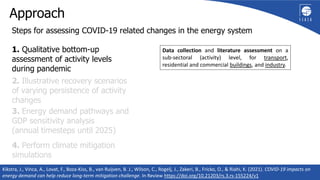
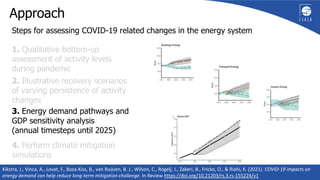
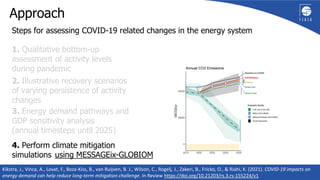
Approach
Steps for assessing COVID-19 related changes in the energy system
1. Qualitative bottom-up
assessment of activity levels
during pandemic
2. Illustrative recovery scenarios
of varying persistence of activity
changes
3. Energy demand pathways and
GDP sensitivity analysis
(annual timesteps until 2025)
4. Perform climate mitigation
simulations
Kikstra et al., 2021, In Review
Data collection and literature assessment on a
sub-sectoral (activity) level, for transport,
residential and commercial buildings, and industry.
Kikstra, J., Vinca, A., Lovat, F., Boza-Kiss, B., van Ruijven, B. J., Wilson, C., Rogelj, J., Zakeri, B., Fricko, O., & Riahi, K. (2021). COVID-19 impacts on
energy demand can help reduce long-term mitigation challenge. In Review https://doi.org/10.21203/rs.3.rs-155224/v1
4
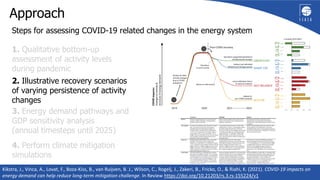
Approach
Steps for assessing COVID-19 related changes in the energy system
1. Qualitative bottom-up
assessment of activity levels
during pandemic
2. Illustrative recovery scenarios
of varying persistence of activity
changes
3. Energy demand pathways and
GDP sensitivity analysis
(annual timesteps until 2025)
4. Perform climate mitigation
simulations
Kikstra et al., 2021, In Review
Kikstra, J., Vinca, A., Lovat, F., Boza-Kiss, B., van Ruijven, B. J., Wilson, C., Rogelj, J., Zakeri, B., Fricko, O., & Riahi, K. (2021). COVID-19 impacts on
energy demand can help reduce long-term mitigation challenge. In Review https://doi.org/10.21203/rs.3.rs-155224/v1
5
Approach
Steps for assessing COVID-19 related changes in the energy system
1. Qualitative bottom-up
assessment of activity levels
during pandemic
2. Illustrative recovery scenarios
of varying persistence of activity
changes
3. Energy demand pathways and
GDP sensitivity analysis
(annual timesteps until 2025)
4. Perform climate mitigation
simulations
Kikstra et al., 2021, In Review
Kikstra, J., Vinca, A., Lovat, F., Boza-Kiss, B., van Ruijven, B. J., Wilson, C., Rogelj, J., Zakeri, B., Fricko, O., & Riahi, K. (2021). COVID-19 impacts on
energy demand can help reduce long-term mitigation challenge. In Review https://doi.org/10.21203/rs.3.rs-155224/v1
6
Approach
Steps for assessing COVID-19 related changes in the energy system
1. Qualitative bottom-up
assessment of activity levels
during pandemic
2. Illustrative recovery scenarios
of varying persistence of activity
changes
3. Energy demand pathways and
GDP sensitivity analysis
(annual timesteps until 2025)
4. Perform climate mitigation
simulations
Kikstra et al., 2021, In Review
using MESSAGEix-GLOBIOM
Kikstra, J., Vinca, A., Lovat, F., Boza-Kiss, B., van Ruijven, B. J., Wilson, C., Rogelj, J., Zakeri, B., Fricko, O., & Riahi, K. (2021). COVID-19 impacts on
energy demand can help reduce long-term mitigation challenge. In Review https://doi.org/10.21203/rs.3.rs-155224/v1
7
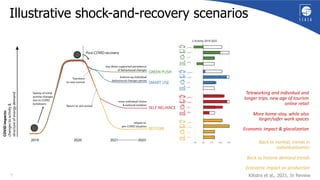
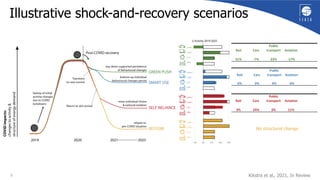
Illustrative shock-and-recovery scenarios
Kikstra et al., 2021, In Review
Teleworking and individual and
longer trips, new age of tourism
online retail
More home-stay, while also
larger/safer work spaces
Economic impact & glocalization
Back to normal, trends in
individualization
Back to historic demand trends
Economic impact on production
8
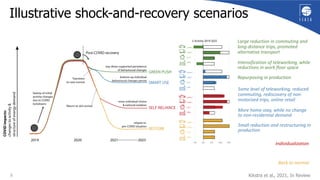
Illustrative shock-and-recovery scenarios
Kikstra et al., 2021, In Review
Large reduction in commuting and
long-distance trips, promoted
alternative transport
Intensification of teleworking, while
reductions in work floor space
Repurposing in production
Some level of teleworking, reduced
commuting, rediscovery of non-
motorized trips, online retail
More home-stay, while no change
to non-residential demand
Small reduction and restructuring in
production
Individualization
Back to normal
9
Illustrative shock-and-recovery scenarios
Kikstra et al., 2021, In Review
Rail Cars
Public
transport Aviation
31% -7% 23% -17%
Rail Cars
Public
transport Aviation
6% 3% 4% -4%
Rail Cars
Public
transport Aviation
3% 24% 3% 11%
No structural change
10
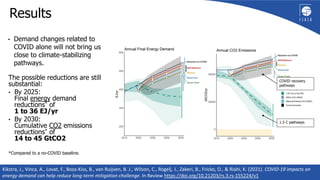
Results
• Demand changes related to
COVID alone will not bring us
close to climate-stabilizing
pathways.
Kikstra et al., 2021, In Review
The possible reductions are still
substantial:
• By 2025:
Final energy demand
reductions* of
1 to 36 EJ/yr
• By 2030:
Cumulative CO2 emissions
reductions* of
14 to 45 GtCO2
*Compared to a no-COVID baseline.
1.5 C pathways
COVID recovery
pathways
Kikstra, J., Vinca, A., Lovat, F., Boza-Kiss, B., van Ruijven, B. J., Wilson, C., Rogelj, J., Zakeri, B., Fricko, O., & Riahi, K. (2021). COVID-19 impacts on
energy demand can help reduce long-term mitigation challenge. In Review https://doi.org/10.21203/rs.3.rs-155224/v1
Kikstra et al., 2021, In Review
11
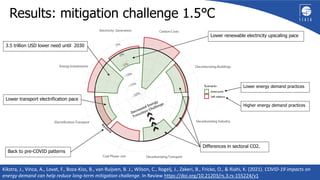
Results: mitigation challenge 1.5℃
Back to pre-COVID patterns
3.5 trillion USD lower need until 2030
Lower renewable electricity upscaling pace
Higher energy demand practices
Lower energy demand practices
Lower transport electrification pace
Differences in sectoral CO2.
Kikstra, J., Vinca, A., Lovat, F., Boza-Kiss, B., van Ruijven, B. J., Wilson, C., Rogelj, J., Zakeri, B., Fricko, O., & Riahi, K. (2021). COVID-19 impacts on
energy demand can help reduce long-term mitigation challenge. In Review https://doi.org/10.21203/rs.3.rs-155224/v1
12
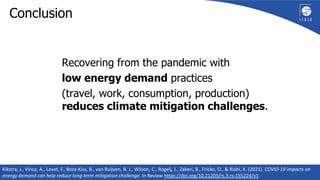
Conclusion
Recovering from the pandemic with
low energy demand practices
(travel, work, consumption, production)
reduces climate mitigation challenges.
Kikstra et al., 2021, In Review
Kikstra, J., Vinca, A., Lovat, F., Boza-Kiss, B., van Ruijven, B. J., Wilson, C., Rogelj, J., Zakeri, B., Fricko, O., & Riahi, K. (2021). COVID-19 impacts on
energy demand can help reduce long-term mitigation challenge. In Review https://doi.org/10.21203/rs.3.rs-155224/v1
Bas van Ruijven
Research Group Leader, Sustainable Service Systems
Energy, Climate, and Environment Program
International Institute for Applied Systems Analysis (IIASA)
Laxenburg, Austria
vruijven@iiasa.ac.at
www.iiasa.ac.at
This project received funding from the European Union’s Horizon 2020 research and innovation programme under grant agreement No. 821471 (ENGAGE)
Thank you very much for your attention!

Session 1.2 bas van ruijven-iiasa

  • 1.
    Please consider theenvironment before printing this slide deck Icon from all-free-download.com, Environmental icons 310835, by BSGstudio, license CC-BY COVID-19 impacts on energy demand can help reduce long-term mitigation challenge Bas van Ruijven OECD Expert Workshop, 13 April 2021 vruijven@iiasa.ac.at Kikstra, J., Vinca, A., Lovat, F., Boza-Kiss, B., van Ruijven, B. J., Wilson, C., Rogelj, J., Zakeri, B., Fricko, O., & Riahi, K. (2021). COVID-19 impacts on energy demand can help reduce long-term mitigation challenge. In Review https://doi.org/10.21203/rs.3.rs-155224/v1
  • 2.
    Main goals 1. Estimatethe shock on energy demand activities in 2020 2. Assess first order effect of retaining behavioral change from COVID-19-crisis on energy demand and emissions. Kikstra, J., Vinca, A., Lovat, F., Boza-Kiss, B., van Ruijven, B. J., Wilson, C., Rogelj, J., Zakeri, B., Fricko, O., & Riahi, K. (2021). COVID-19 impacts on energy demand can help reduce long-term mitigation challenge. In Review https://doi.org/10.21203/rs.3.rs-155224/v1
  • 3.
    3 Approach Steps for assessingCOVID-19 related changes in the energy system 1. Qualitative bottom-up assessment of activity levels during pandemic 2. Illustrative recovery scenarios of varying persistence of activity changes 3. Energy demand pathways and GDP sensitivity analysis (annual timesteps until 2025) 4. Perform climate mitigation simulations Kikstra et al., 2021, In Review Data collection and literature assessment on a sub-sectoral (activity) level, for transport, residential and commercial buildings, and industry. Kikstra, J., Vinca, A., Lovat, F., Boza-Kiss, B., van Ruijven, B. J., Wilson, C., Rogelj, J., Zakeri, B., Fricko, O., & Riahi, K. (2021). COVID-19 impacts on energy demand can help reduce long-term mitigation challenge. In Review https://doi.org/10.21203/rs.3.rs-155224/v1
  • 4.
    4 Approach Steps for assessingCOVID-19 related changes in the energy system 1. Qualitative bottom-up assessment of activity levels during pandemic 2. Illustrative recovery scenarios of varying persistence of activity changes 3. Energy demand pathways and GDP sensitivity analysis (annual timesteps until 2025) 4. Perform climate mitigation simulations Kikstra et al., 2021, In Review Kikstra, J., Vinca, A., Lovat, F., Boza-Kiss, B., van Ruijven, B. J., Wilson, C., Rogelj, J., Zakeri, B., Fricko, O., & Riahi, K. (2021). COVID-19 impacts on energy demand can help reduce long-term mitigation challenge. In Review https://doi.org/10.21203/rs.3.rs-155224/v1
  • 5.
    5 Approach Steps for assessingCOVID-19 related changes in the energy system 1. Qualitative bottom-up assessment of activity levels during pandemic 2. Illustrative recovery scenarios of varying persistence of activity changes 3. Energy demand pathways and GDP sensitivity analysis (annual timesteps until 2025) 4. Perform climate mitigation simulations Kikstra et al., 2021, In Review Kikstra, J., Vinca, A., Lovat, F., Boza-Kiss, B., van Ruijven, B. J., Wilson, C., Rogelj, J., Zakeri, B., Fricko, O., & Riahi, K. (2021). COVID-19 impacts on energy demand can help reduce long-term mitigation challenge. In Review https://doi.org/10.21203/rs.3.rs-155224/v1
  • 6.
    6 Approach Steps for assessingCOVID-19 related changes in the energy system 1. Qualitative bottom-up assessment of activity levels during pandemic 2. Illustrative recovery scenarios of varying persistence of activity changes 3. Energy demand pathways and GDP sensitivity analysis (annual timesteps until 2025) 4. Perform climate mitigation simulations Kikstra et al., 2021, In Review using MESSAGEix-GLOBIOM Kikstra, J., Vinca, A., Lovat, F., Boza-Kiss, B., van Ruijven, B. J., Wilson, C., Rogelj, J., Zakeri, B., Fricko, O., & Riahi, K. (2021). COVID-19 impacts on energy demand can help reduce long-term mitigation challenge. In Review https://doi.org/10.21203/rs.3.rs-155224/v1
  • 7.
    7 Illustrative shock-and-recovery scenarios Kikstraet al., 2021, In Review Teleworking and individual and longer trips, new age of tourism online retail More home-stay, while also larger/safer work spaces Economic impact & glocalization Back to normal, trends in individualization Back to historic demand trends Economic impact on production
  • 8.
    8 Illustrative shock-and-recovery scenarios Kikstraet al., 2021, In Review Large reduction in commuting and long-distance trips, promoted alternative transport Intensification of teleworking, while reductions in work floor space Repurposing in production Some level of teleworking, reduced commuting, rediscovery of non- motorized trips, online retail More home-stay, while no change to non-residential demand Small reduction and restructuring in production Individualization Back to normal
  • 9.
    9 Illustrative shock-and-recovery scenarios Kikstraet al., 2021, In Review Rail Cars Public transport Aviation 31% -7% 23% -17% Rail Cars Public transport Aviation 6% 3% 4% -4% Rail Cars Public transport Aviation 3% 24% 3% 11% No structural change
  • 10.
    10 Results • Demand changesrelated to COVID alone will not bring us close to climate-stabilizing pathways. Kikstra et al., 2021, In Review The possible reductions are still substantial: • By 2025: Final energy demand reductions* of 1 to 36 EJ/yr • By 2030: Cumulative CO2 emissions reductions* of 14 to 45 GtCO2 *Compared to a no-COVID baseline. 1.5 C pathways COVID recovery pathways Kikstra, J., Vinca, A., Lovat, F., Boza-Kiss, B., van Ruijven, B. J., Wilson, C., Rogelj, J., Zakeri, B., Fricko, O., & Riahi, K. (2021). COVID-19 impacts on energy demand can help reduce long-term mitigation challenge. In Review https://doi.org/10.21203/rs.3.rs-155224/v1
  • 11.
    Kikstra et al.,2021, In Review 11 Results: mitigation challenge 1.5℃ Back to pre-COVID patterns 3.5 trillion USD lower need until 2030 Lower renewable electricity upscaling pace Higher energy demand practices Lower energy demand practices Lower transport electrification pace Differences in sectoral CO2. Kikstra, J., Vinca, A., Lovat, F., Boza-Kiss, B., van Ruijven, B. J., Wilson, C., Rogelj, J., Zakeri, B., Fricko, O., & Riahi, K. (2021). COVID-19 impacts on energy demand can help reduce long-term mitigation challenge. In Review https://doi.org/10.21203/rs.3.rs-155224/v1
  • 12.
    12 Conclusion Recovering from thepandemic with low energy demand practices (travel, work, consumption, production) reduces climate mitigation challenges. Kikstra et al., 2021, In Review Kikstra, J., Vinca, A., Lovat, F., Boza-Kiss, B., van Ruijven, B. J., Wilson, C., Rogelj, J., Zakeri, B., Fricko, O., & Riahi, K. (2021). COVID-19 impacts on energy demand can help reduce long-term mitigation challenge. In Review https://doi.org/10.21203/rs.3.rs-155224/v1
  • 13.
    Bas van Ruijven ResearchGroup Leader, Sustainable Service Systems Energy, Climate, and Environment Program International Institute for Applied Systems Analysis (IIASA) Laxenburg, Austria vruijven@iiasa.ac.at www.iiasa.ac.at This project received funding from the European Union’s Horizon 2020 research and innovation programme under grant agreement No. 821471 (ENGAGE) Thank you very much for your attention!