Service Quality
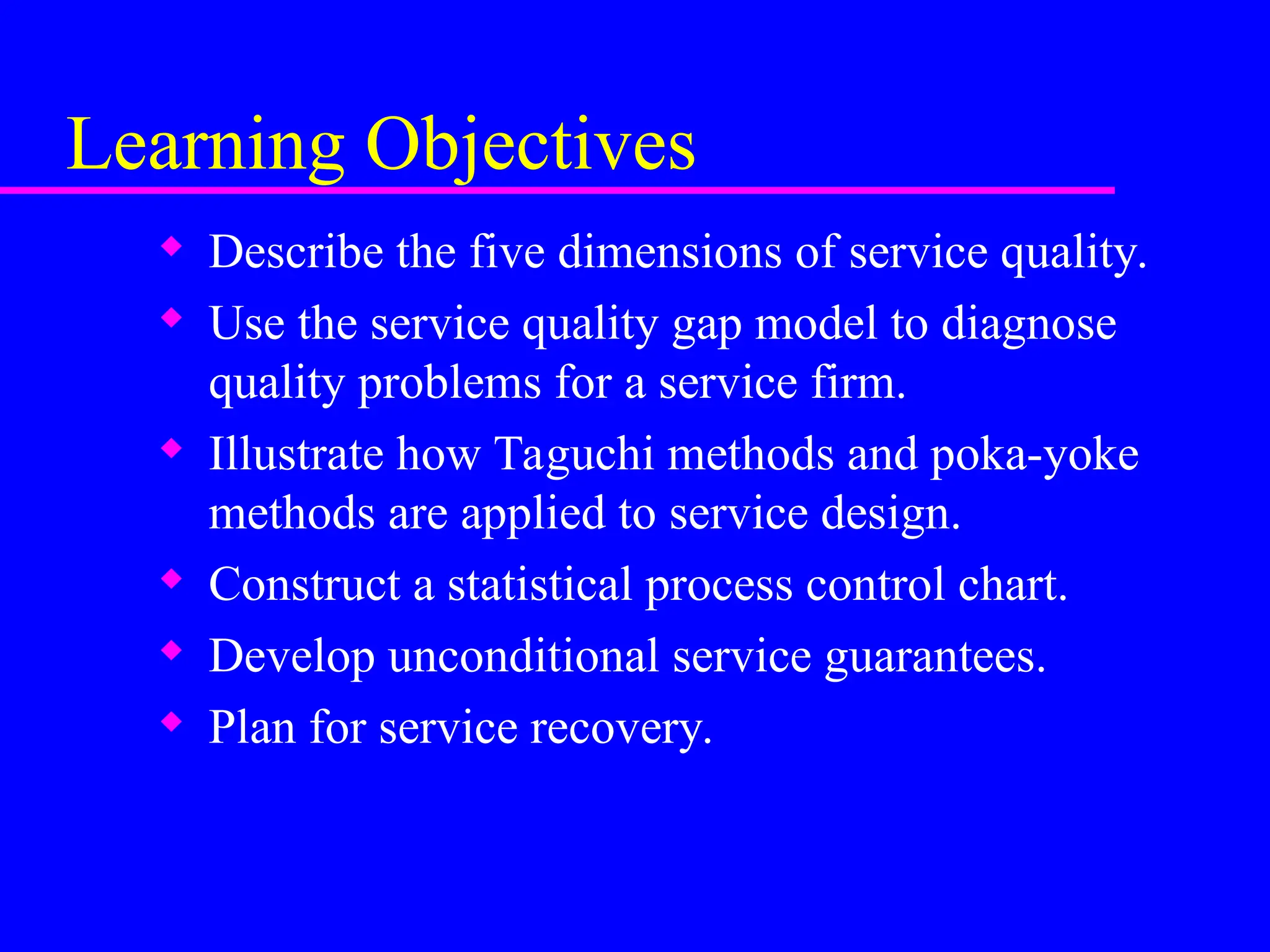
Learning Objectives
 Describe the five dimensions of service quality.
 Use the service quality gap model to diagnose
quality problems for a service firm.
 Illustrate how Taguchi methods and poka-yoke
methods are applied to service design.
 Construct a statistical process control chart.
 Develop unconditional service guarantees.
 Plan for service recovery.
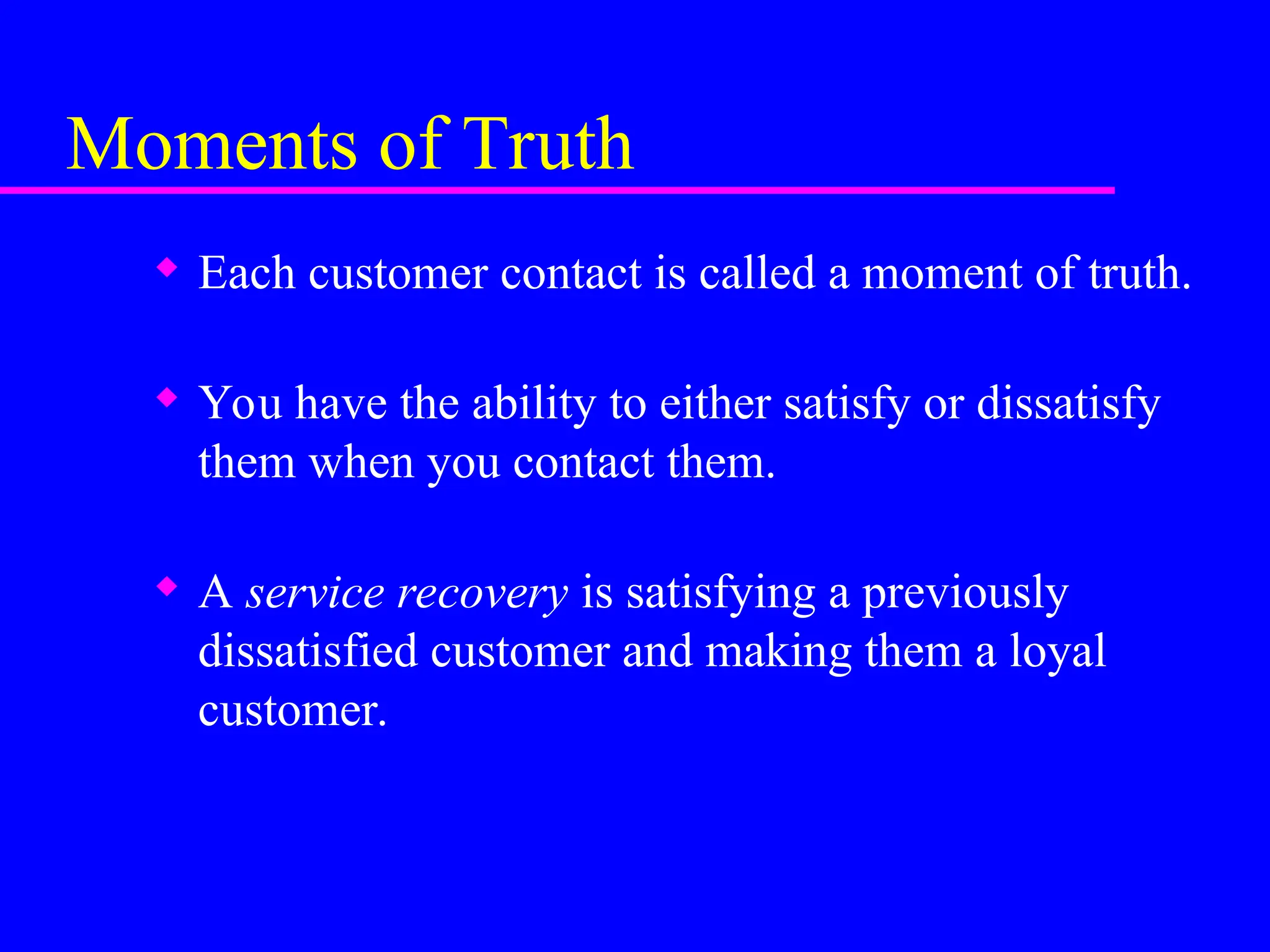
Moments of Truth
 Each customer contact is called a moment of truth.
 You have the ability to either satisfy or dissatisfy
them when you contact them.
 A service recovery is satisfying a previously
dissatisfied customer and making them a loyal
customer.
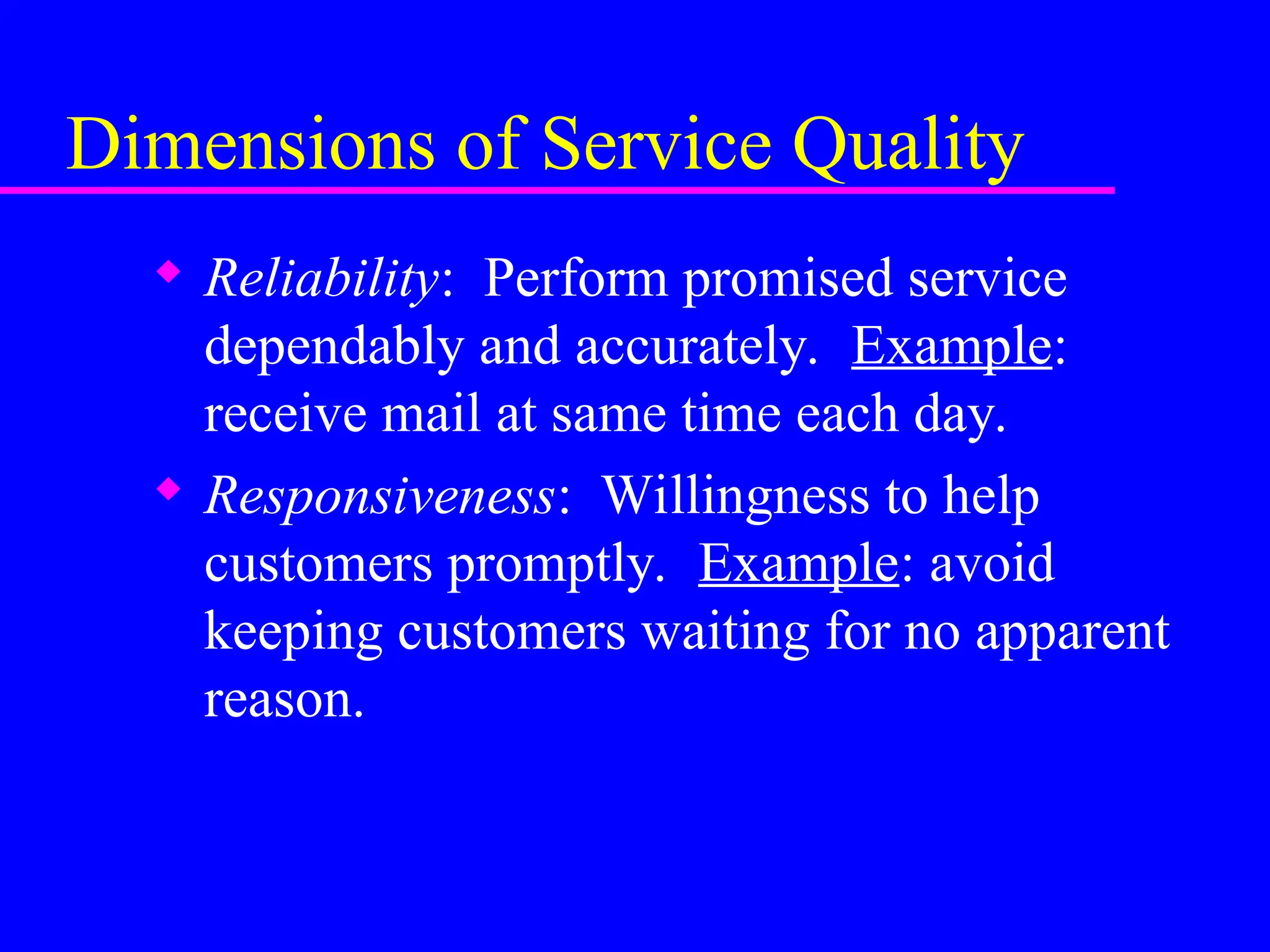
Dimensions of Service Quality
 Reliability: Perform promised service
dependably and accurately. Example:
receive mail at same time each day.
 Responsiveness: Willingness to help
customers promptly. Example: avoid
keeping customers waiting for no apparent
reason.
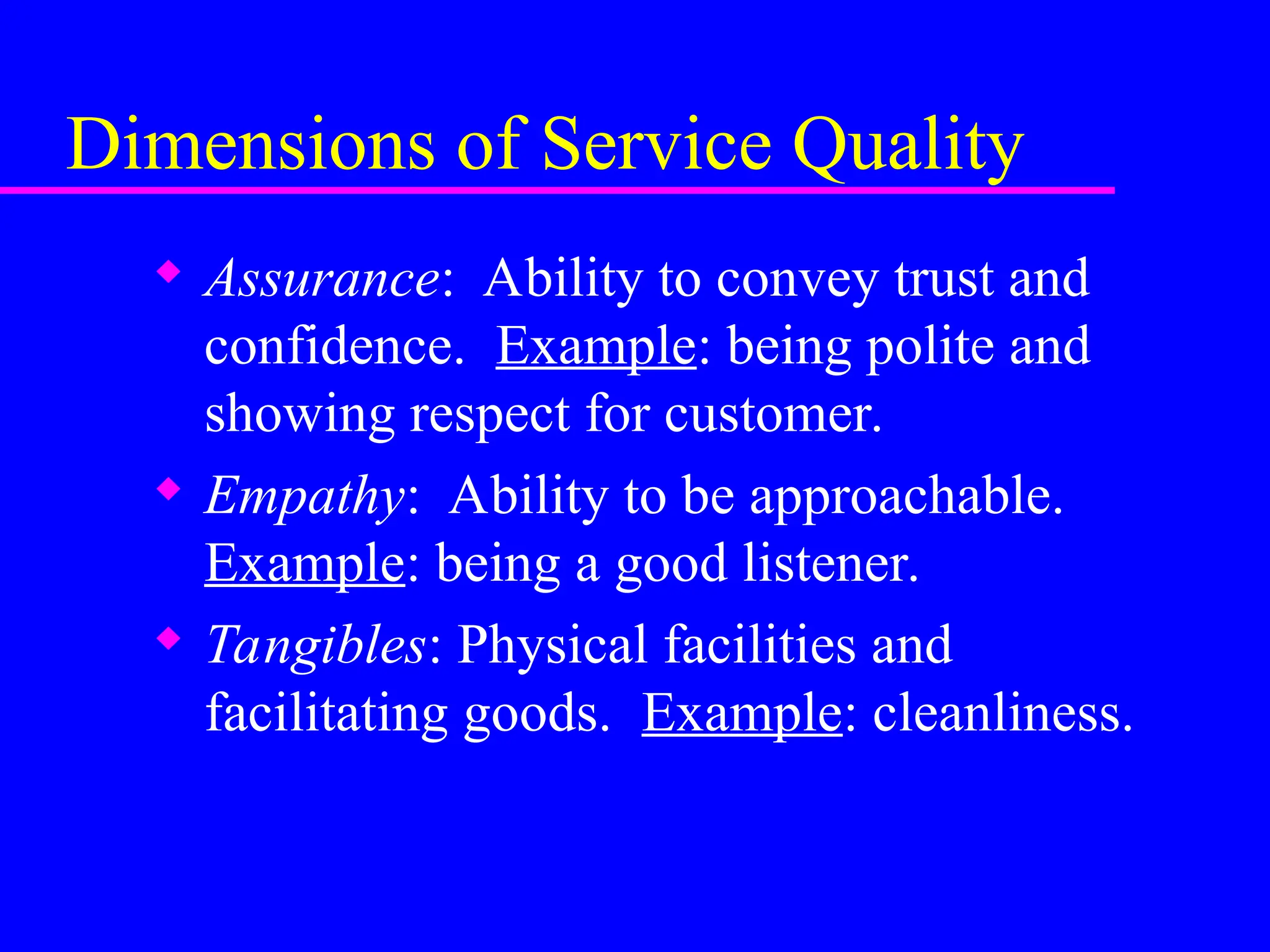
Dimensions of Service Quality
 Assurance: Ability to convey trust and
confidence. Example: being polite and
showing respect for customer.
 Empathy: Ability to be approachable.
Example: being a good listener.
 Tangibles: Physical facilities and
facilitating goods. Example: cleanliness.
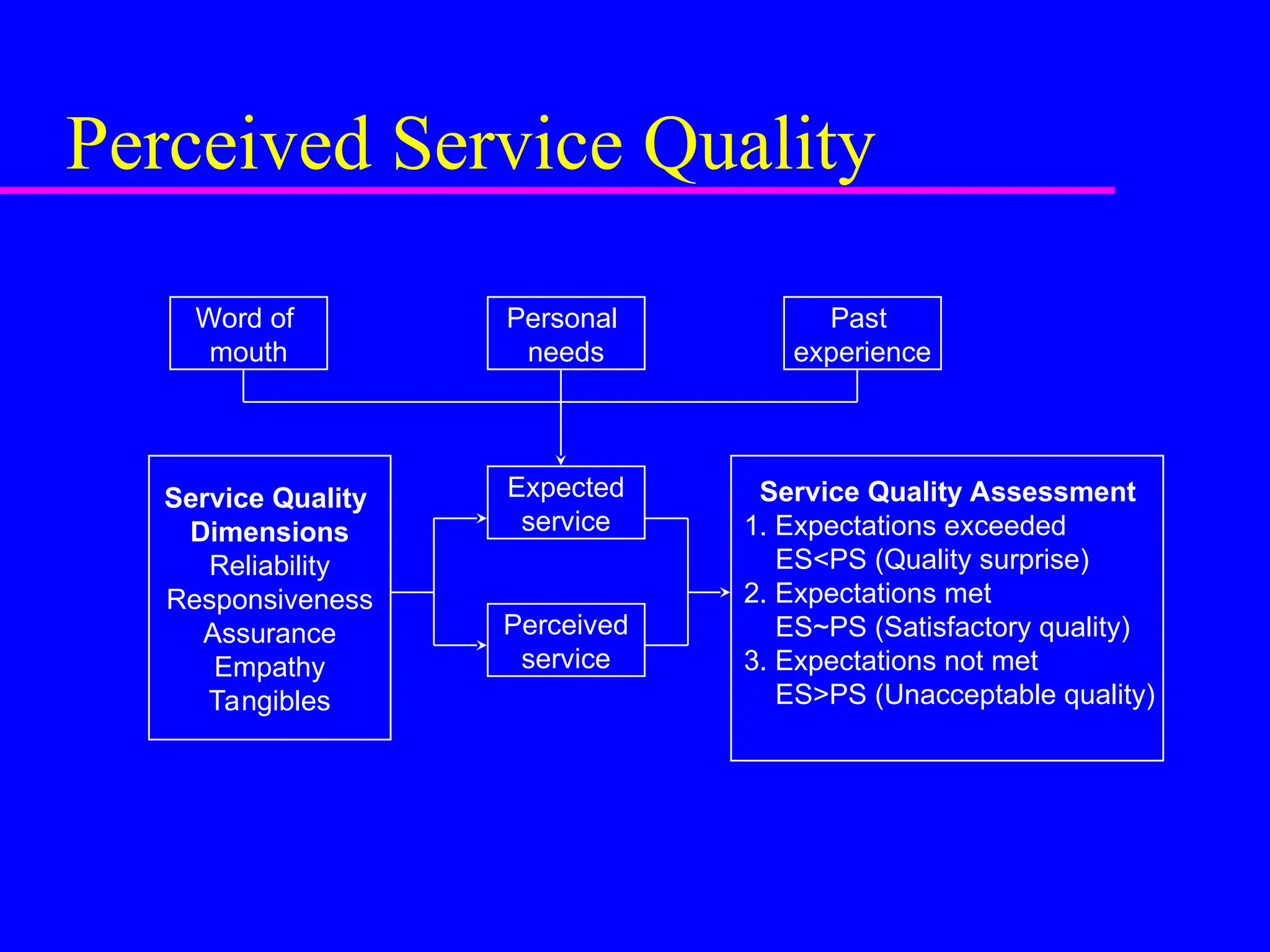
Perceived Service Quality
Word of
mouth
Personal
needs
Past
experience
Expected
service
Perceived
service
Service Quality
Dimensions
Reliability
Responsiveness
Assurance
Empathy
Tangibles
Service Quality Assessment
1. Expectations exceeded
ES<PS (Quality surprise)
2. Expectations met
ES~PS (Satisfactory quality)
3. Expectations not met
ES>PS (Unacceptable quality)
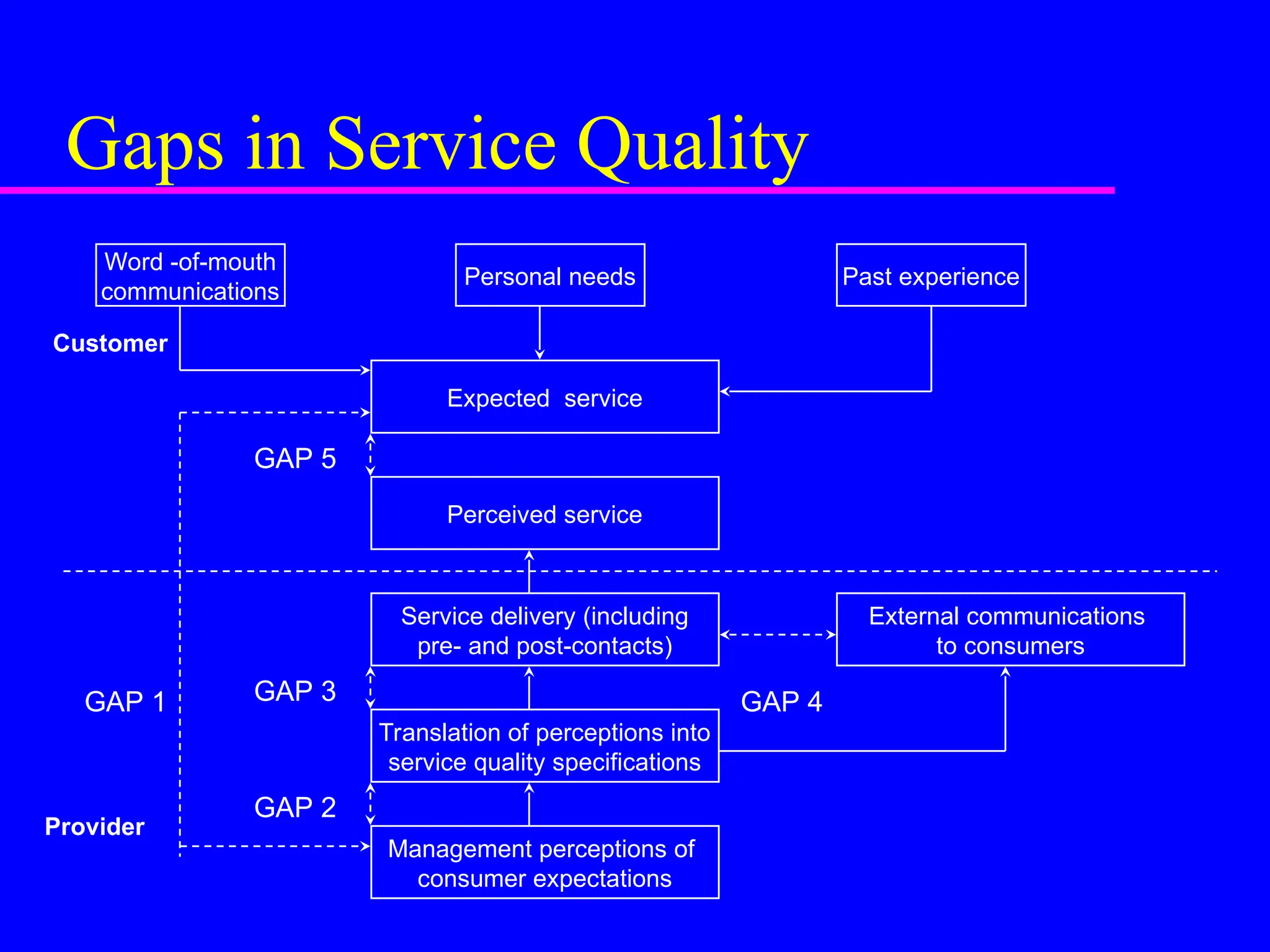
Gaps in Service Quality
Word -of-mouth
communications
Personal needs Past experience
Expected service
External communications
to consumers
Perceived service
Service delivery (including
pre- and post-contacts)
Translation of perceptions into
service quality specifications
Management perceptions of
consumer expectations
GAP 5
GAP 3
GAP 2
GAP 1 GAP 4
Customer
Provider
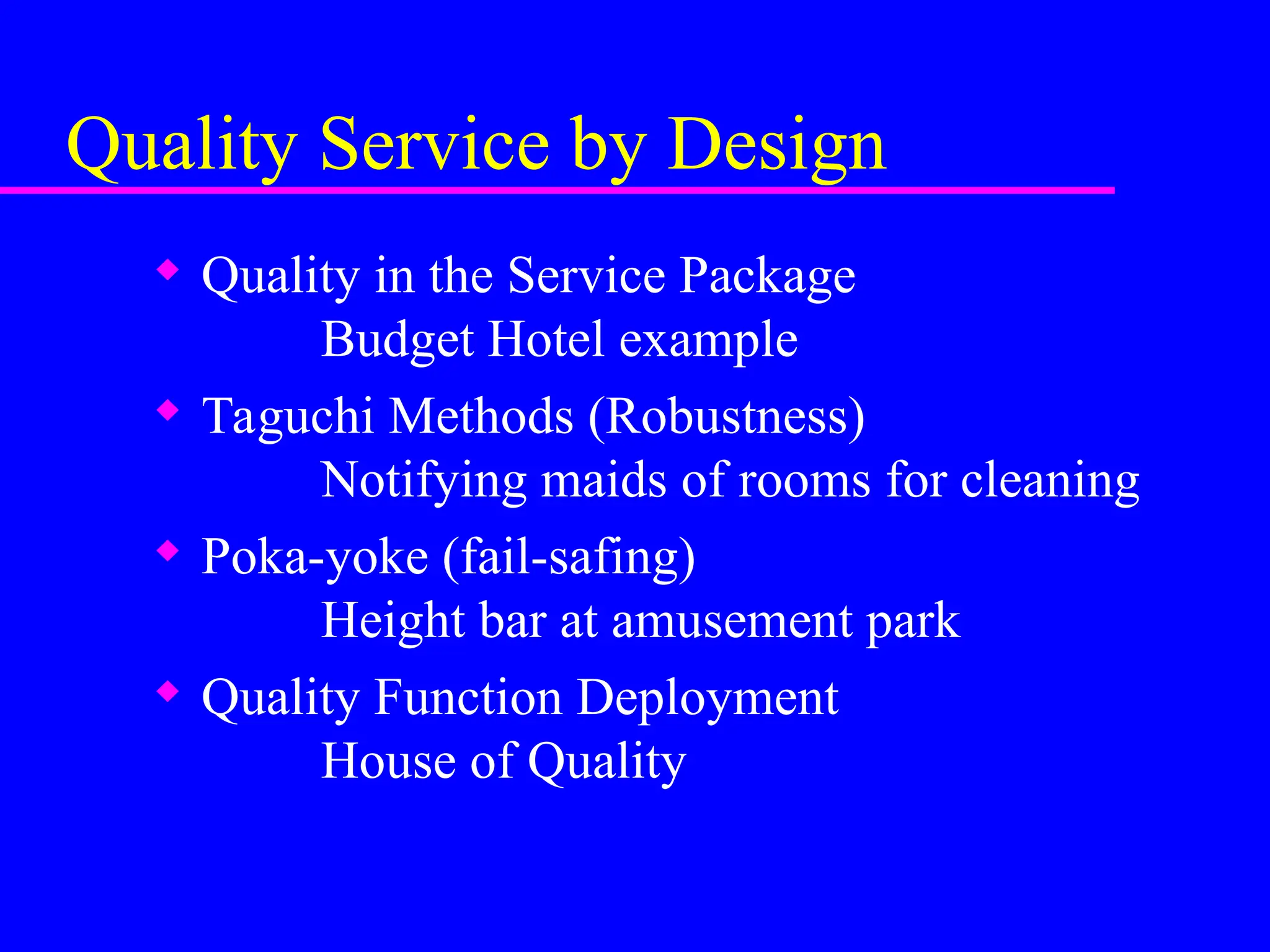
Quality Service by Design
 Quality in the Service Package
Budget Hotel example
 Taguchi Methods (Robustness)
Notifying maids of rooms for cleaning
 Poka-yoke (fail-safing)
Height bar at amusement park
 Quality Function Deployment
House of Quality
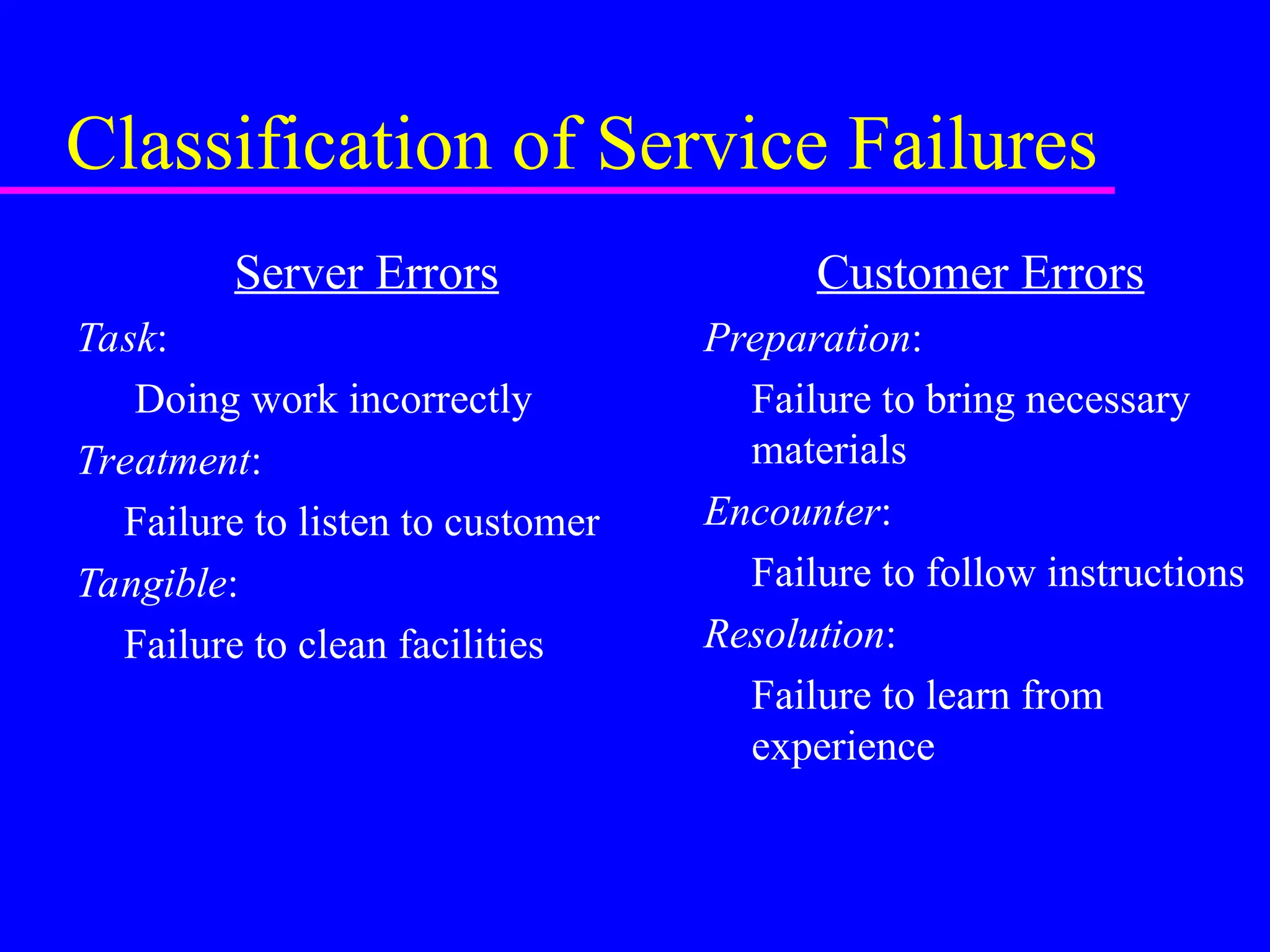
Classification of Service Failures
Server Errors
Task:
Doing work incorrectly
Treatment:
Failure to listen to customer
Tangible:
Failure to clean facilities
Customer Errors
Preparation:
Failure to bring necessary
materials
Encounter:
Failure to follow instructions
Resolution:
Failure to learn from
experience
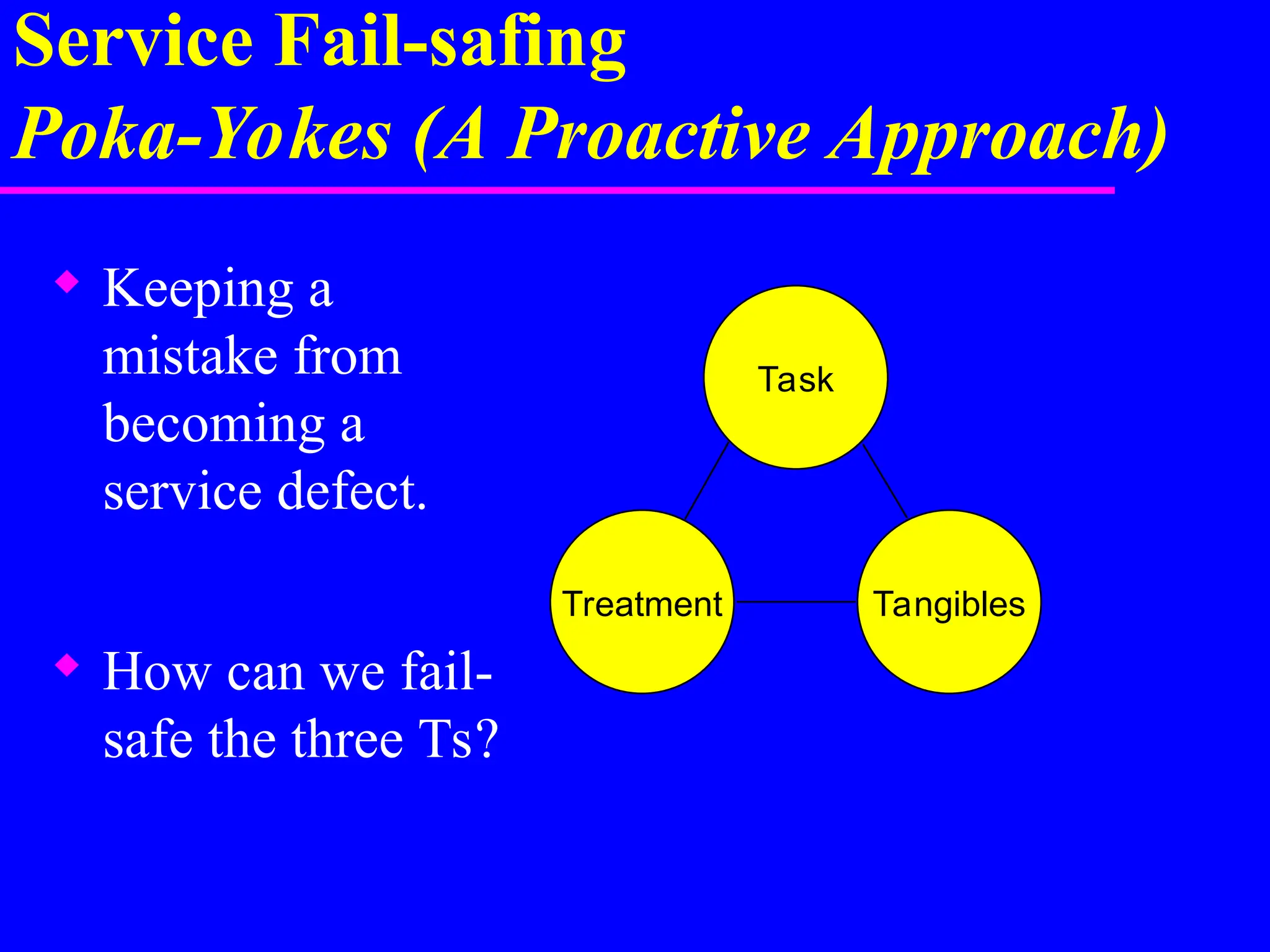
Service Fail-safing
Poka-Yokes (A Proactive Approach)
 Keeping a
mistake from
becoming a
service defect.
 How can we fail-
safe the three Ts?
Task
Tangibles
Treatment
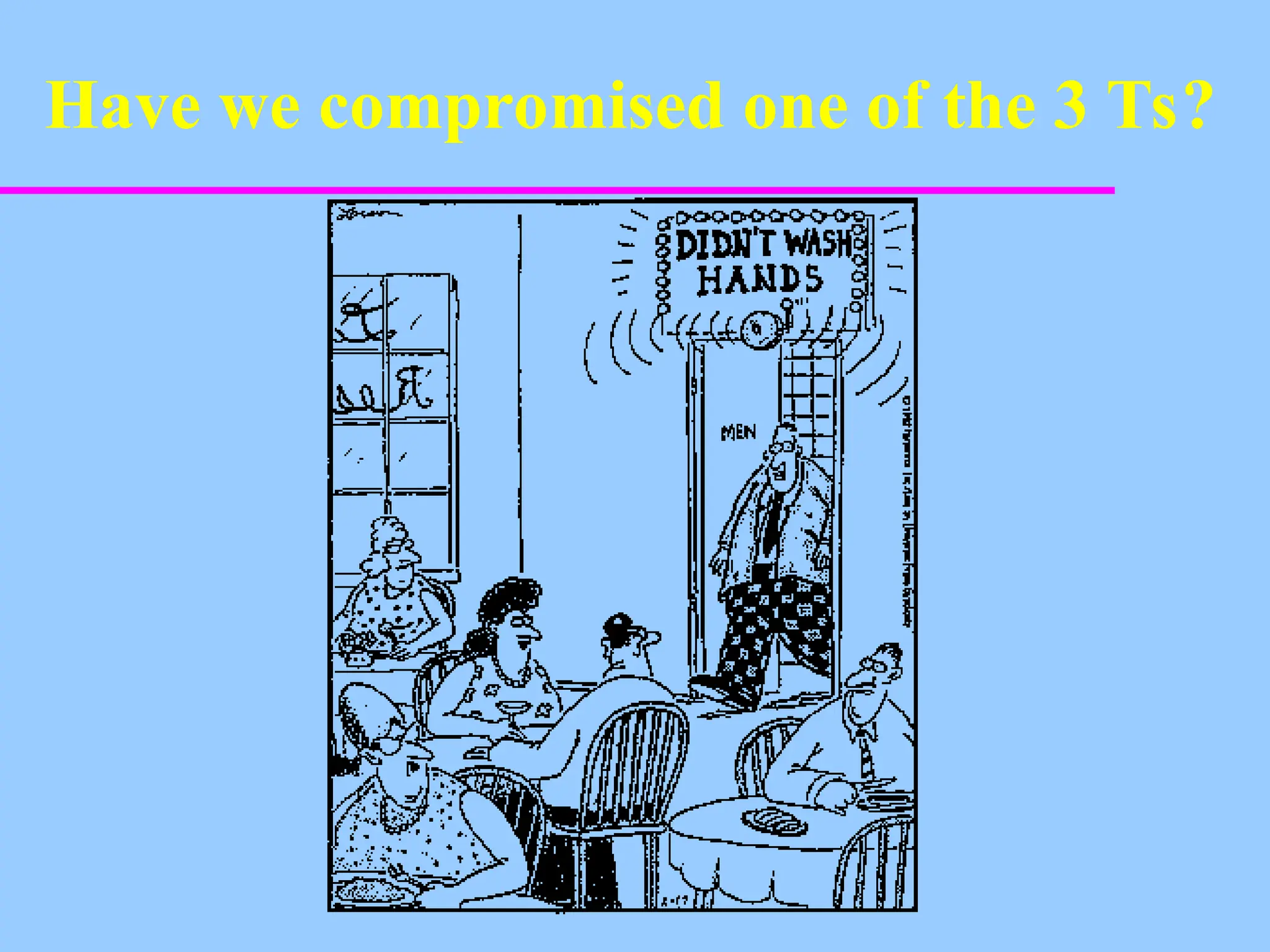
Have we compromised one of the 3 Ts?
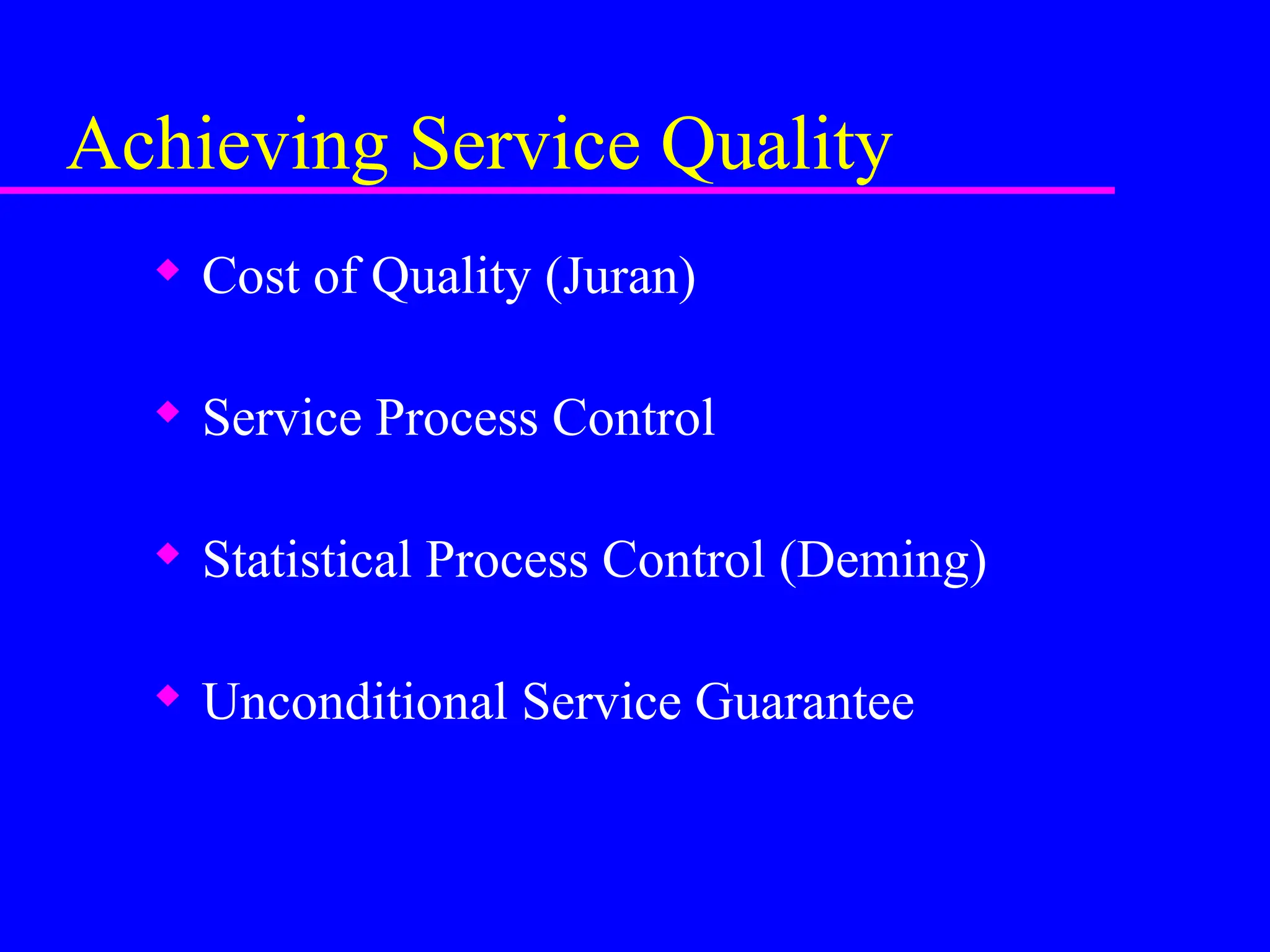
Achieving Service Quality
 Cost of Quality (Juran)
 Service Process Control
 Statistical Process Control (Deming)
 Unconditional Service Guarantee
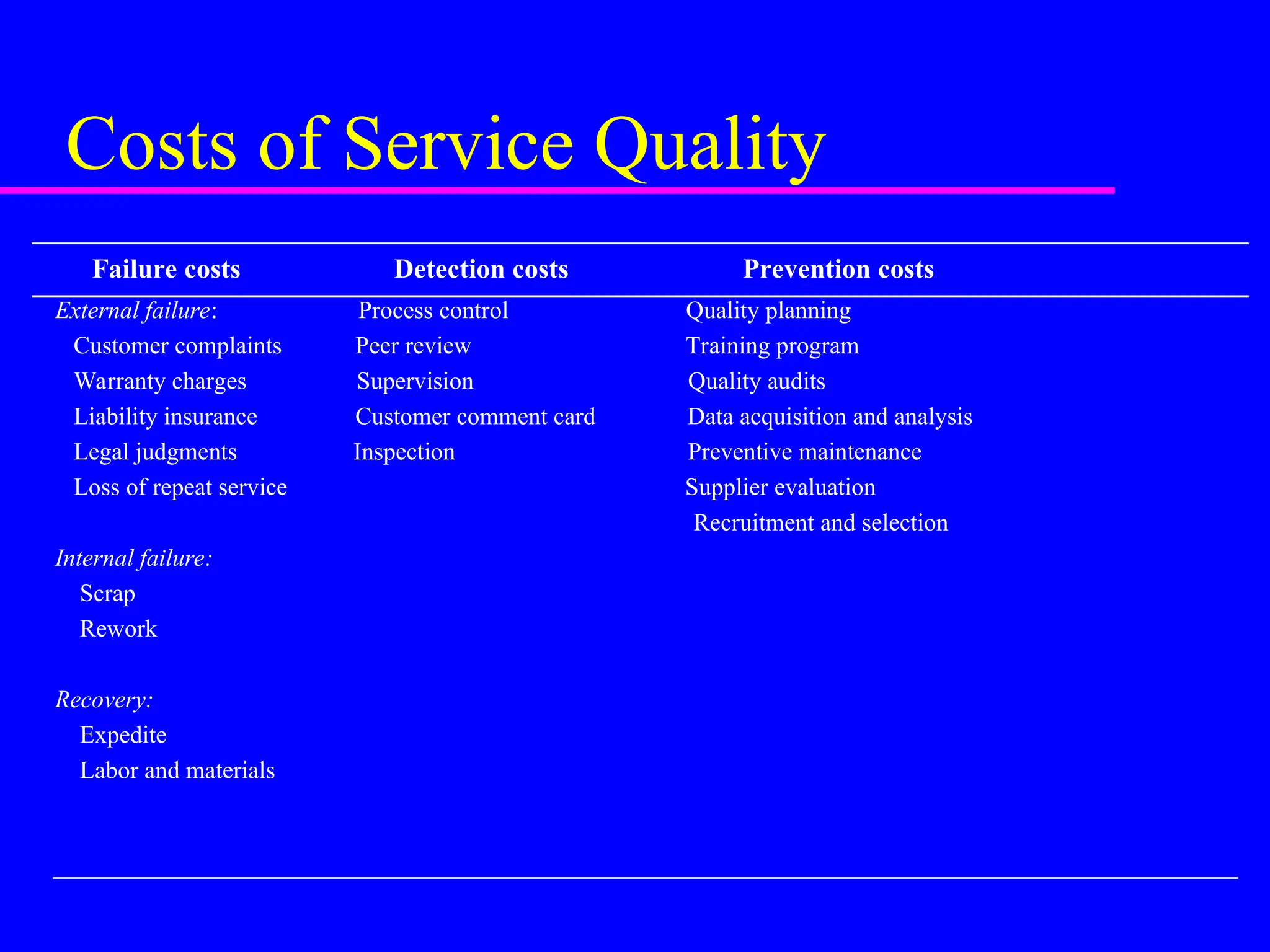
Costs of Service Quality
Failure costs Detection costs Prevention costs
External failure: Process control Quality planning
Customer complaints Peer review Training program
Warranty charges Supervision Quality audits
Liability insurance Customer comment card Data acquisition and analysis
Legal judgments Inspection Preventive maintenance
Loss of repeat service Supplier evaluation
Recruitment and selection
Internal failure:
Scrap
Rework
Recovery:
Expedite
Labor and materials
Service Process Control
Resources
Identify reason
for
nonconformance
Establish
measure of
performance
Monitor
conformance to
requirements
Take
corrective
action
Service
concept
Customer
input
Customer
output
Service
process
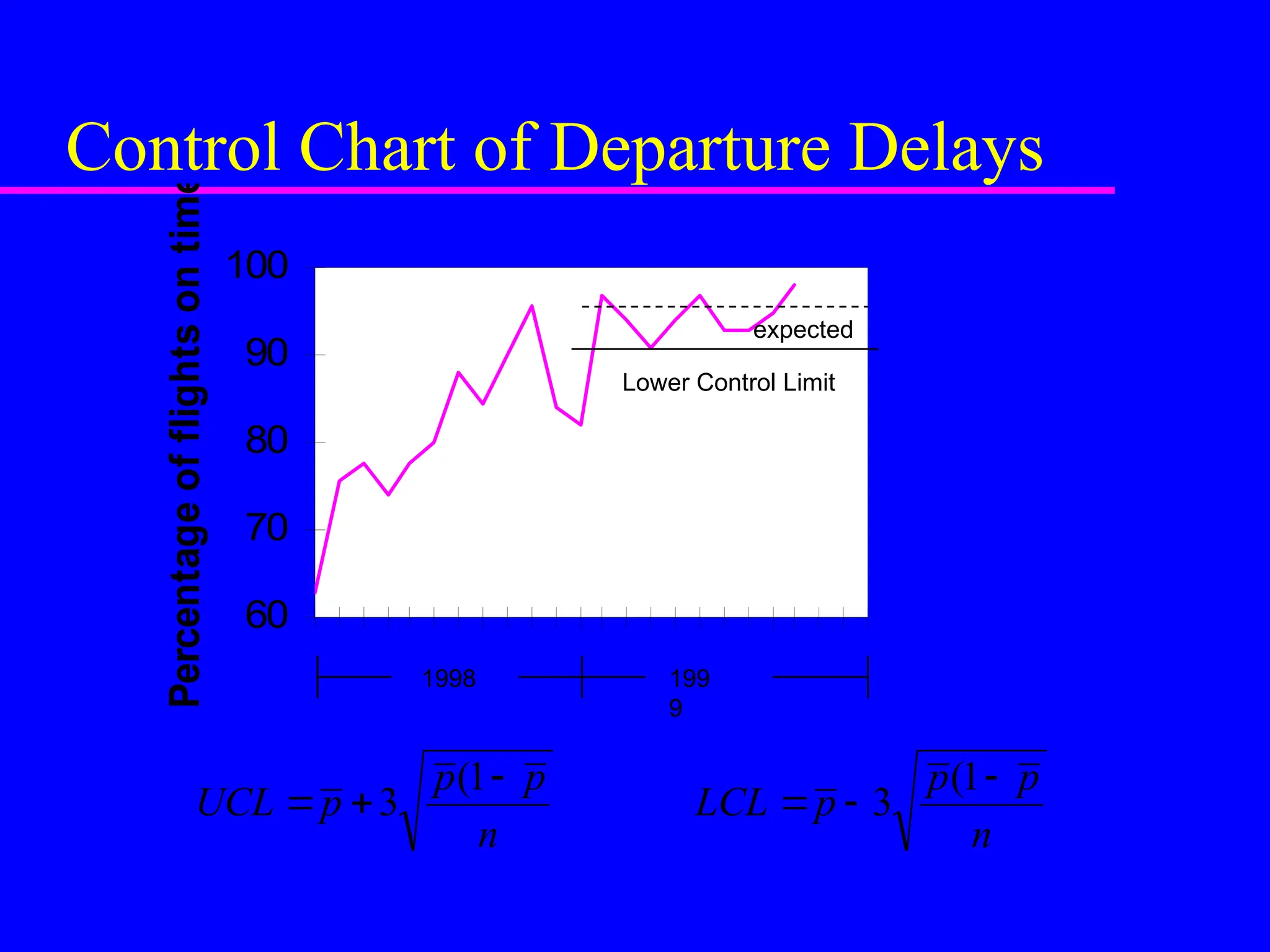
Control Chart of Departure Delays
60
70
80
90
100
Percentage
of
flights
on
time
expected
Lower Control Limit
1998 199
9
n
p
p
p
UCL



1
(
3
n
p
p
p
LCL



1
(
3
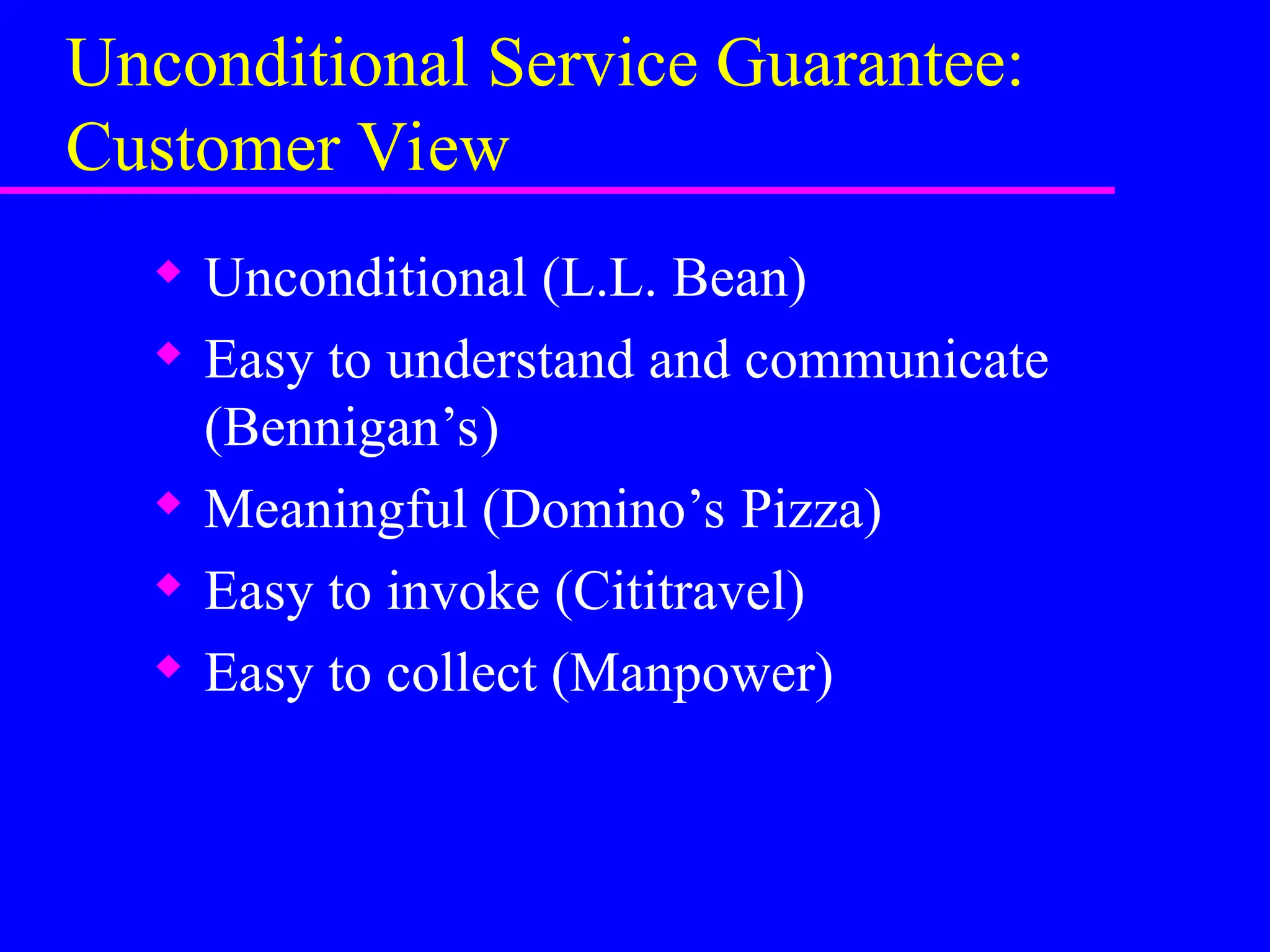
Unconditional Service Guarantee:
Customer View
 Unconditional (L.L. Bean)
 Easy to understand and communicate
(Bennigan’s)
 Meaningful (Domino’s Pizza)
 Easy to invoke (Cititravel)
 Easy to collect (Manpower)
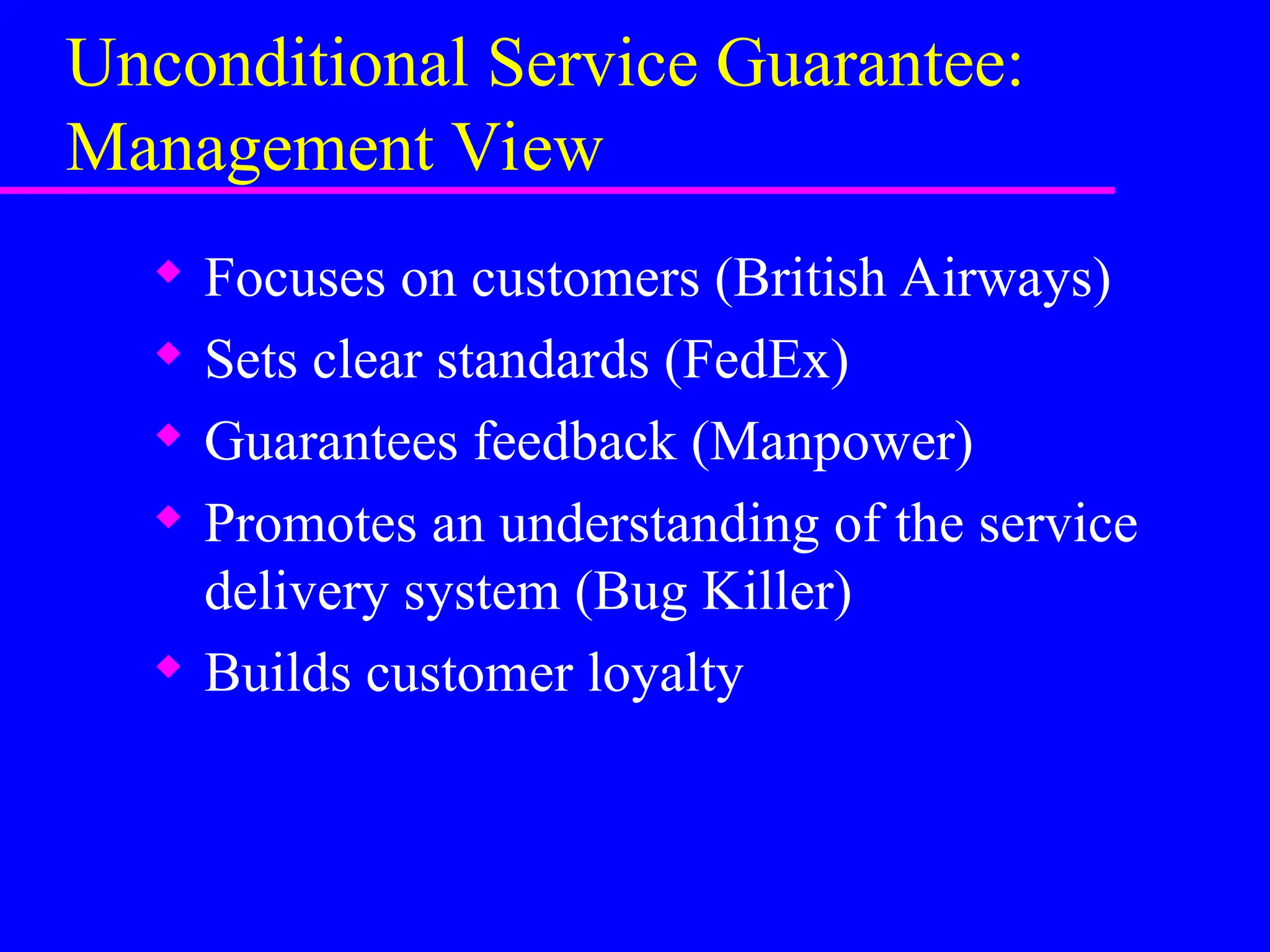
Unconditional Service Guarantee:
Management View
 Focuses on customers (British Airways)
 Sets clear standards (FedEx)
 Guarantees feedback (Manpower)
 Promotes an understanding of the service
delivery system (Bug Killer)
 Builds customer loyalty
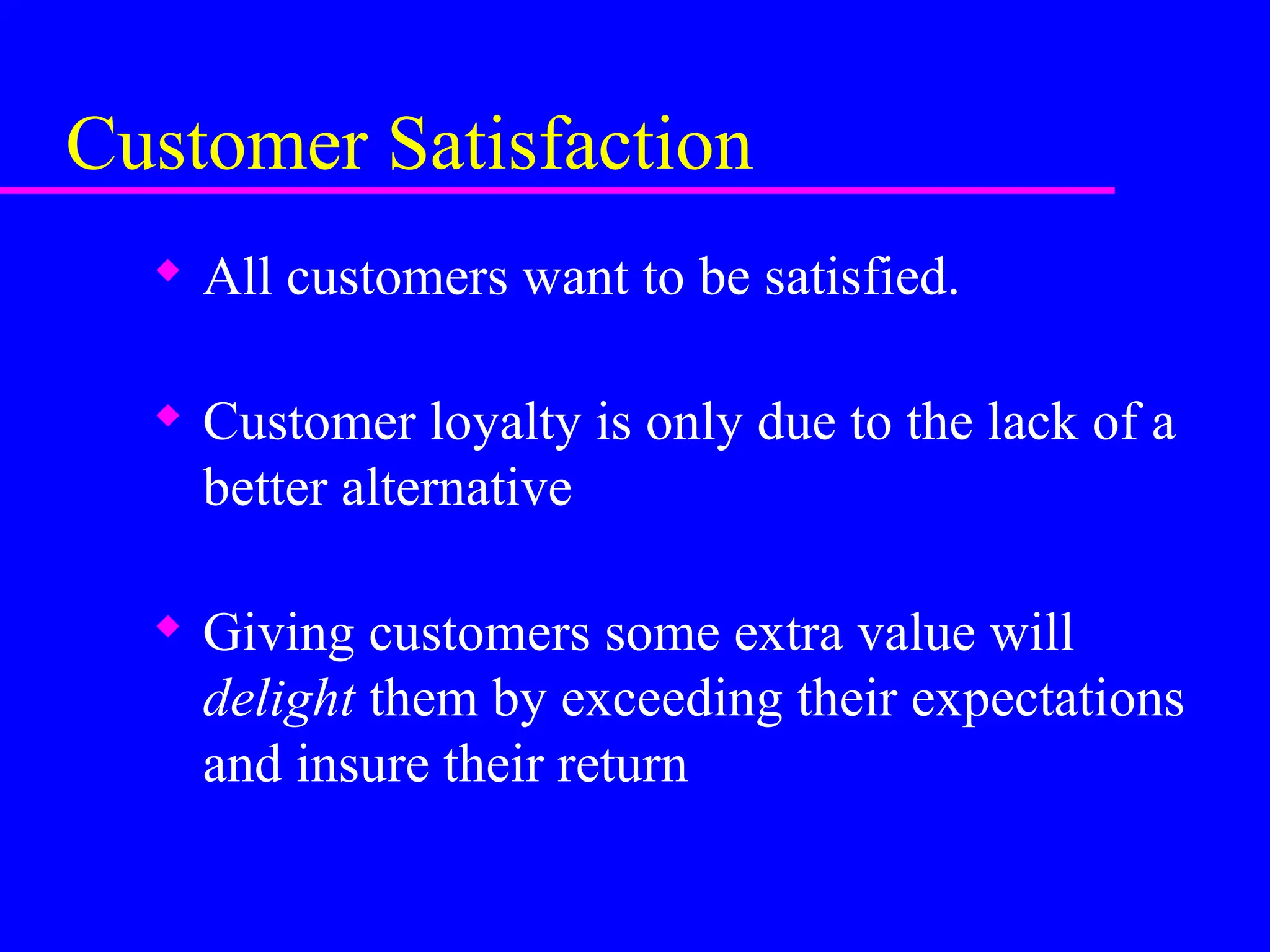
Customer Satisfaction
 All customers want to be satisfied.
 Customer loyalty is only due to the lack of a
better alternative
 Giving customers some extra value will
delight them by exceeding their expectations
and insure their return
Expressing Dissatisfaction
Dissatisfaction
occurs
Action
No Action
Public Action
Private Action
Seek redress directly from
the firm
Take legal action
Complaint to business, private,
or governmental agencies
Stop buying the product or
boycott the seller
Warn friends about the product
and /or seller
Customer Feedback and Word-
of-Mouth
 The average business only hears from 4% of their customers who are dissatisfied
with their products or services. Of the 96% who do not bother to complain, 25%
of them have serious problems.
 The 4% complainers are more likely to stay with the supplier than are the 96%
non-complainers.
 About 60% of the complainers would stay as customers if their problems was
resolved and 95% would stay if the problem was resolved quickly.
 A dissatisfied customer will tell between 10 and 20 other people about their
problem.
 A customer who has had a problem resolved by a company will tell about 5
people about their situation.
Number of People Told Based
on Level of Dissatisfaction
average number of people told
0
5
10
15
20
25
30
Slight
diss
Annoyed Very
annoyed
Ext
annoyed
Abs
furious
Action Taken Based on Level of
Dissatisfaction
0
20
40
60
80
100
Slightly
diss
Annoyed Very
annoyed
Ext
annoyed
Abs
furlous
Tell friends
Complain
Make a fuses
Not use again
Dissuade others
Complain against
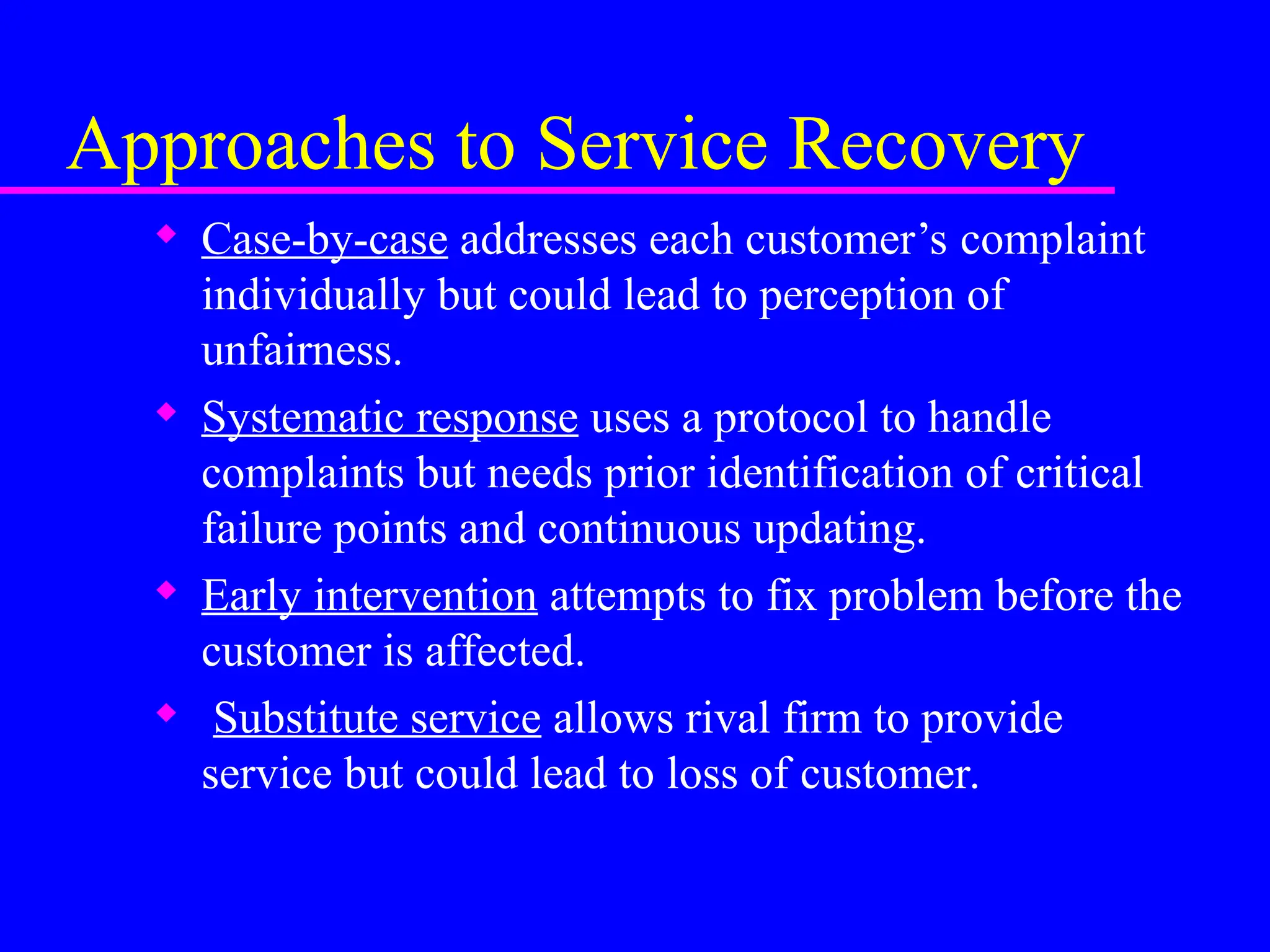
Approaches to Service Recovery
 Case-by-case addresses each customer’s complaint
individually but could lead to perception of
unfairness.
 Systematic response uses a protocol to handle
complaints but needs prior identification of critical
failure points and continuous updating.
 Early intervention attempts to fix problem before the
customer is affected.
 Substitute service allows rival firm to provide
service but could lead to loss of customer.
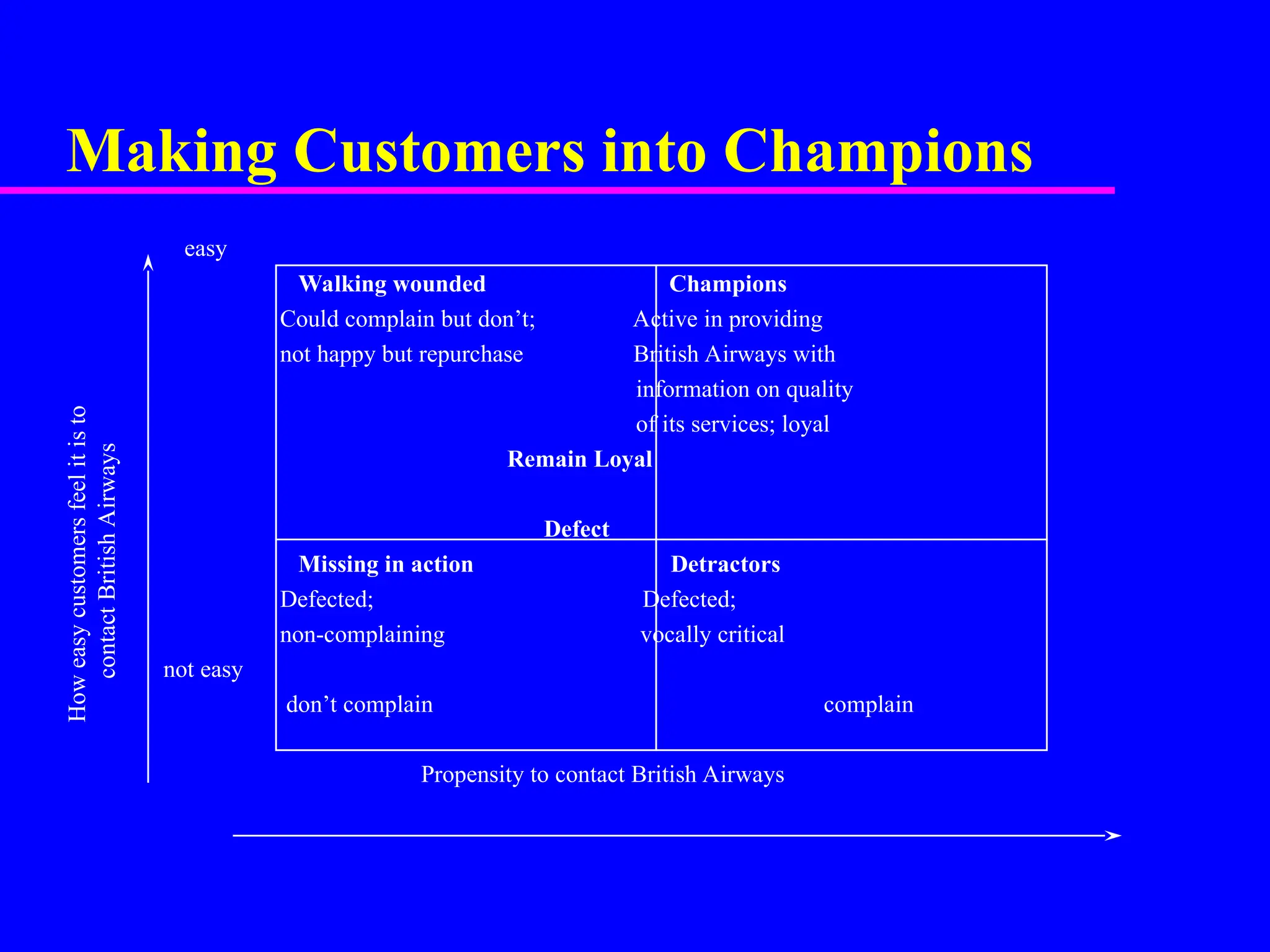
Making Customers into Champions
easy
Walking wounded Champions
Could complain but don’t; Active in providing
not happy but repurchase British Airways with
information on quality
of its services; loyal
Remain Loyal
Defect
Missing in action Detractors
Defected; Defected;
non-complaining vocally critical
not easy
don’t complain complain
Propensity to contact British Airways
How
easy
customers
feel
it
is
to
contact
British
Airways
Topics for Discussion
 How do the dimensions of service quality differ
from those of product quality?
 Why is measuring service quality so difficult?
 Illustrate the four components in the cost of
quality for a service of your choice.
 Why do service firms hesitate to offer a service
guarantee?
 How can recovery from a service failure be a
blessing in disguise?
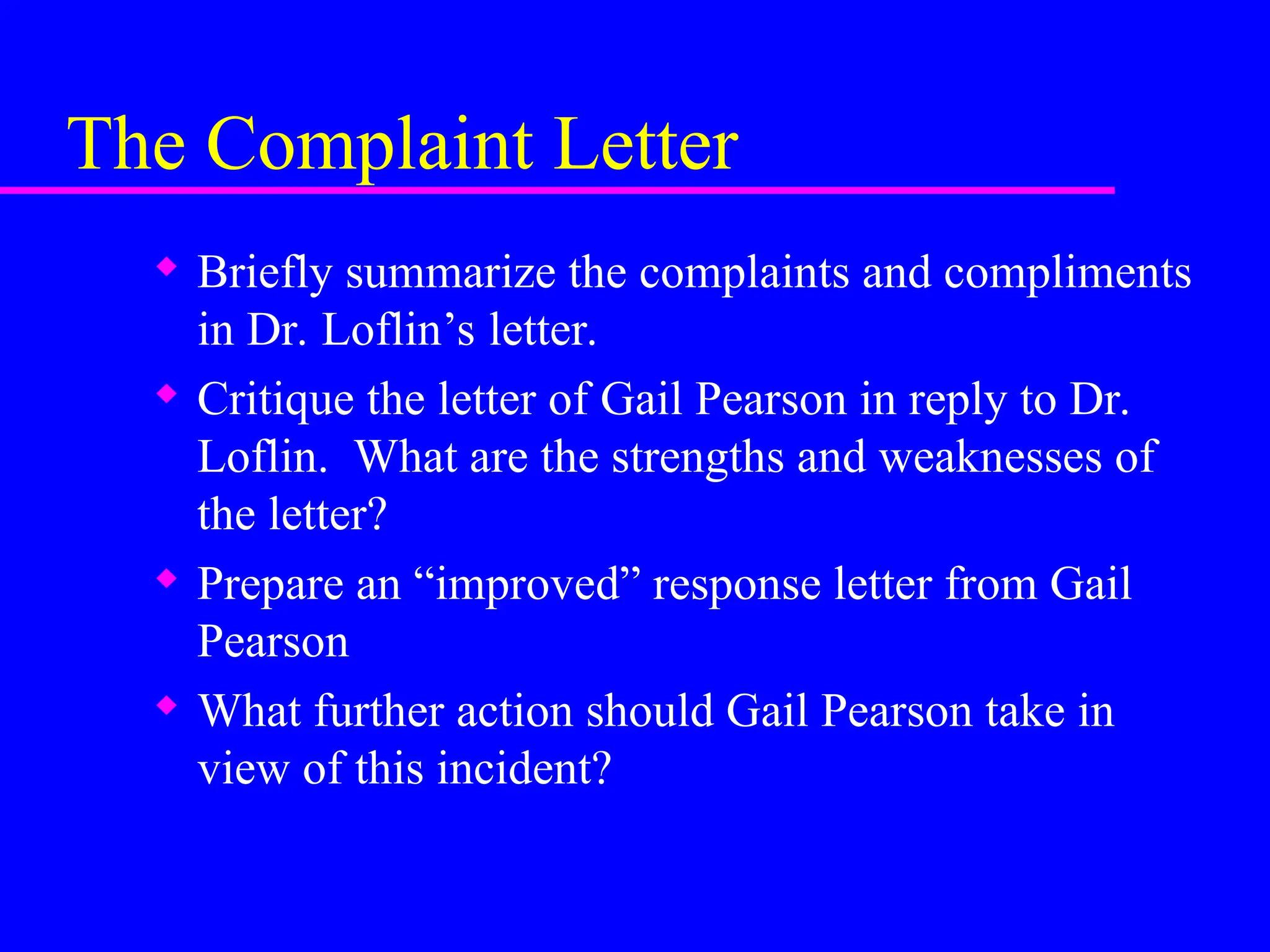
The Complaint Letter
 Briefly summarize the complaints and compliments
in Dr. Loflin’s letter.
 Critique the letter of Gail Pearson in reply to Dr.
Loflin. What are the strengths and weaknesses of
the letter?
 Prepare an “improved” response letter from Gail
Pearson
 What further action should Gail Pearson take in
view of this incident?
service quality descrptive ppt for students

  • 1.
  • 2.
    Learning Objectives  Describethe five dimensions of service quality.  Use the service quality gap model to diagnose quality problems for a service firm.  Illustrate how Taguchi methods and poka-yoke methods are applied to service design.  Construct a statistical process control chart.  Develop unconditional service guarantees.  Plan for service recovery.
  • 3.
    Moments of Truth Each customer contact is called a moment of truth.  You have the ability to either satisfy or dissatisfy them when you contact them.  A service recovery is satisfying a previously dissatisfied customer and making them a loyal customer.
  • 4.
    Dimensions of ServiceQuality  Reliability: Perform promised service dependably and accurately. Example: receive mail at same time each day.  Responsiveness: Willingness to help customers promptly. Example: avoid keeping customers waiting for no apparent reason.
  • 5.
    Dimensions of ServiceQuality  Assurance: Ability to convey trust and confidence. Example: being polite and showing respect for customer.  Empathy: Ability to be approachable. Example: being a good listener.  Tangibles: Physical facilities and facilitating goods. Example: cleanliness.
  • 6.
    Perceived Service Quality Wordof mouth Personal needs Past experience Expected service Perceived service Service Quality Dimensions Reliability Responsiveness Assurance Empathy Tangibles Service Quality Assessment 1. Expectations exceeded ES<PS (Quality surprise) 2. Expectations met ES~PS (Satisfactory quality) 3. Expectations not met ES>PS (Unacceptable quality)
  • 7.
    Gaps in ServiceQuality Word -of-mouth communications Personal needs Past experience Expected service External communications to consumers Perceived service Service delivery (including pre- and post-contacts) Translation of perceptions into service quality specifications Management perceptions of consumer expectations GAP 5 GAP 3 GAP 2 GAP 1 GAP 4 Customer Provider
  • 8.
    Quality Service byDesign  Quality in the Service Package Budget Hotel example  Taguchi Methods (Robustness) Notifying maids of rooms for cleaning  Poka-yoke (fail-safing) Height bar at amusement park  Quality Function Deployment House of Quality
  • 9.
    Classification of ServiceFailures Server Errors Task: Doing work incorrectly Treatment: Failure to listen to customer Tangible: Failure to clean facilities Customer Errors Preparation: Failure to bring necessary materials Encounter: Failure to follow instructions Resolution: Failure to learn from experience
  • 10.
    Service Fail-safing Poka-Yokes (AProactive Approach)  Keeping a mistake from becoming a service defect.  How can we fail- safe the three Ts? Task Tangibles Treatment
  • 11.
    Have we compromisedone of the 3 Ts?
  • 12.
    Achieving Service Quality Cost of Quality (Juran)  Service Process Control  Statistical Process Control (Deming)  Unconditional Service Guarantee
  • 13.
    Costs of ServiceQuality Failure costs Detection costs Prevention costs External failure: Process control Quality planning Customer complaints Peer review Training program Warranty charges Supervision Quality audits Liability insurance Customer comment card Data acquisition and analysis Legal judgments Inspection Preventive maintenance Loss of repeat service Supplier evaluation Recruitment and selection Internal failure: Scrap Rework Recovery: Expedite Labor and materials
  • 14.
    Service Process Control Resources Identifyreason for nonconformance Establish measure of performance Monitor conformance to requirements Take corrective action Service concept Customer input Customer output Service process
  • 15.
    Control Chart ofDeparture Delays 60 70 80 90 100 Percentage of flights on time expected Lower Control Limit 1998 199 9 n p p p UCL    1 ( 3 n p p p LCL    1 ( 3
  • 16.
    Unconditional Service Guarantee: CustomerView  Unconditional (L.L. Bean)  Easy to understand and communicate (Bennigan’s)  Meaningful (Domino’s Pizza)  Easy to invoke (Cititravel)  Easy to collect (Manpower)
  • 17.
    Unconditional Service Guarantee: ManagementView  Focuses on customers (British Airways)  Sets clear standards (FedEx)  Guarantees feedback (Manpower)  Promotes an understanding of the service delivery system (Bug Killer)  Builds customer loyalty
  • 18.
    Customer Satisfaction  Allcustomers want to be satisfied.  Customer loyalty is only due to the lack of a better alternative  Giving customers some extra value will delight them by exceeding their expectations and insure their return
  • 19.
    Expressing Dissatisfaction Dissatisfaction occurs Action No Action PublicAction Private Action Seek redress directly from the firm Take legal action Complaint to business, private, or governmental agencies Stop buying the product or boycott the seller Warn friends about the product and /or seller
  • 20.
    Customer Feedback andWord- of-Mouth  The average business only hears from 4% of their customers who are dissatisfied with their products or services. Of the 96% who do not bother to complain, 25% of them have serious problems.  The 4% complainers are more likely to stay with the supplier than are the 96% non-complainers.  About 60% of the complainers would stay as customers if their problems was resolved and 95% would stay if the problem was resolved quickly.  A dissatisfied customer will tell between 10 and 20 other people about their problem.  A customer who has had a problem resolved by a company will tell about 5 people about their situation.
  • 21.
    Number of PeopleTold Based on Level of Dissatisfaction average number of people told 0 5 10 15 20 25 30 Slight diss Annoyed Very annoyed Ext annoyed Abs furious
  • 22.
    Action Taken Basedon Level of Dissatisfaction 0 20 40 60 80 100 Slightly diss Annoyed Very annoyed Ext annoyed Abs furlous Tell friends Complain Make a fuses Not use again Dissuade others Complain against
  • 23.
    Approaches to ServiceRecovery  Case-by-case addresses each customer’s complaint individually but could lead to perception of unfairness.  Systematic response uses a protocol to handle complaints but needs prior identification of critical failure points and continuous updating.  Early intervention attempts to fix problem before the customer is affected.  Substitute service allows rival firm to provide service but could lead to loss of customer.
  • 24.
    Making Customers intoChampions easy Walking wounded Champions Could complain but don’t; Active in providing not happy but repurchase British Airways with information on quality of its services; loyal Remain Loyal Defect Missing in action Detractors Defected; Defected; non-complaining vocally critical not easy don’t complain complain Propensity to contact British Airways How easy customers feel it is to contact British Airways
  • 25.
    Topics for Discussion How do the dimensions of service quality differ from those of product quality?  Why is measuring service quality so difficult?  Illustrate the four components in the cost of quality for a service of your choice.  Why do service firms hesitate to offer a service guarantee?  How can recovery from a service failure be a blessing in disguise?
  • 26.
    The Complaint Letter Briefly summarize the complaints and compliments in Dr. Loflin’s letter.  Critique the letter of Gail Pearson in reply to Dr. Loflin. What are the strengths and weaknesses of the letter?  Prepare an “improved” response letter from Gail Pearson  What further action should Gail Pearson take in view of this incident?