Service Oriented Architecture for Net Centric Operations based on Open Source Technology Sanjiva Weerawarana, Ph.D. Founder, Chairman & CEO, WSO2 Founder, Director & Chief Scientist, Lanka Software Foundation Member, Apache Software Foundation Emeritus Board Member, Open Source Initiative Visiting Lecturer, Univ. of Moratuwa, Sri Lanka IONS Technical Seminar. May 21, 2009. Colombo, Sri Lanka.
About me IBM Research from 1997 to 2005 Co-authored most of the key Web services specifications WSDL, WS-Eventing, BPEL4WS, ... Contributor to Apache Web services Contributor to Apache SOAP, Apache Axis, Apache Axis2, Apache WSIF, Apache Neethi, Apache Axiom, ... Member of Apache Software Foundation
Founder & Chief Scientist, Lanka Software Foundation
(Emeritus) Board Member of Open Source Initiative
Founder, Chairman & CEO of WSO2 Open source SOA platform company
Agenda SOA & its implications
Open source and its implications
Open standards
Interoperability framework for net centric operations
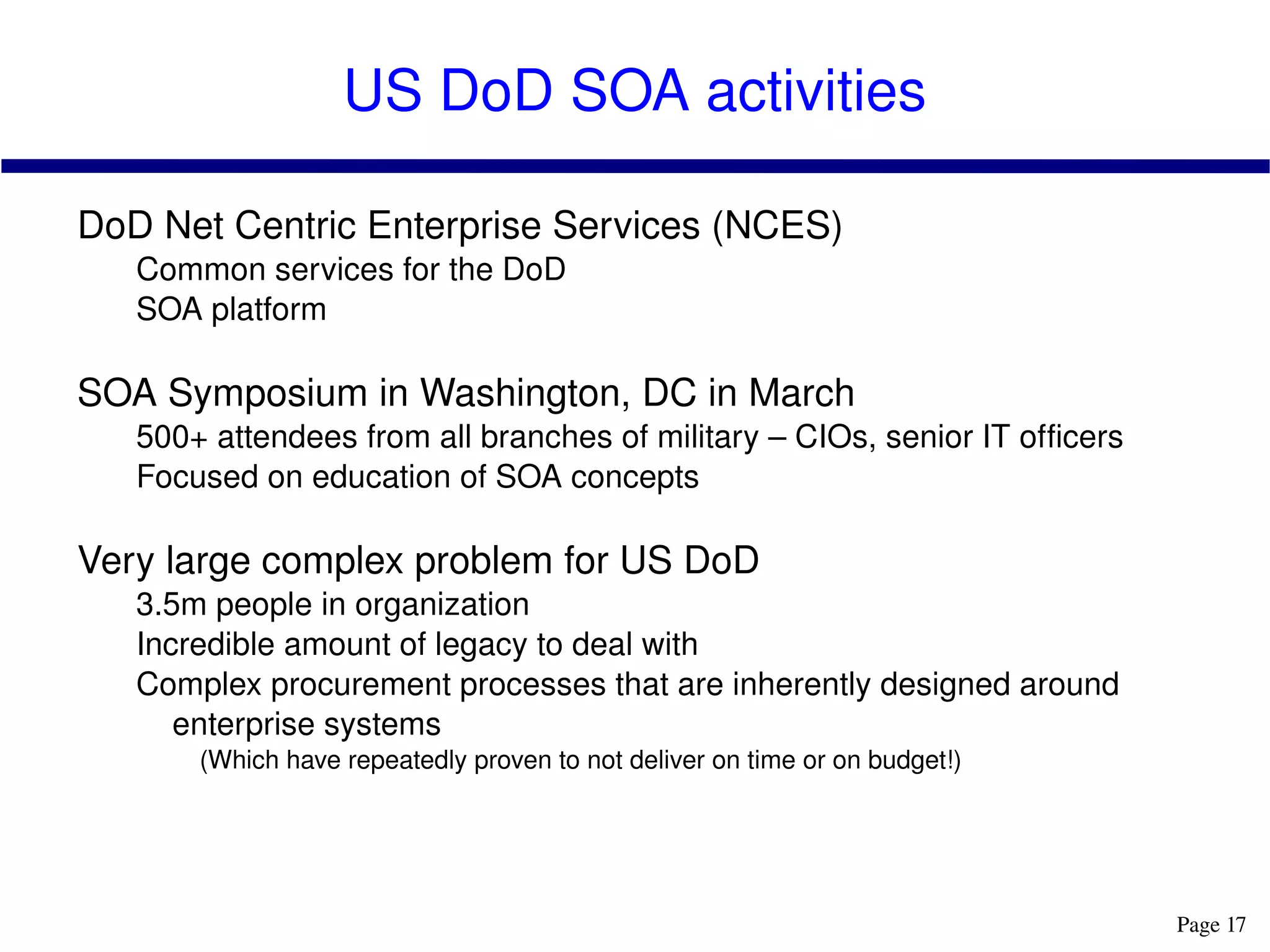
US DoD SOA activities
Open source SOA for defence applications
Summary
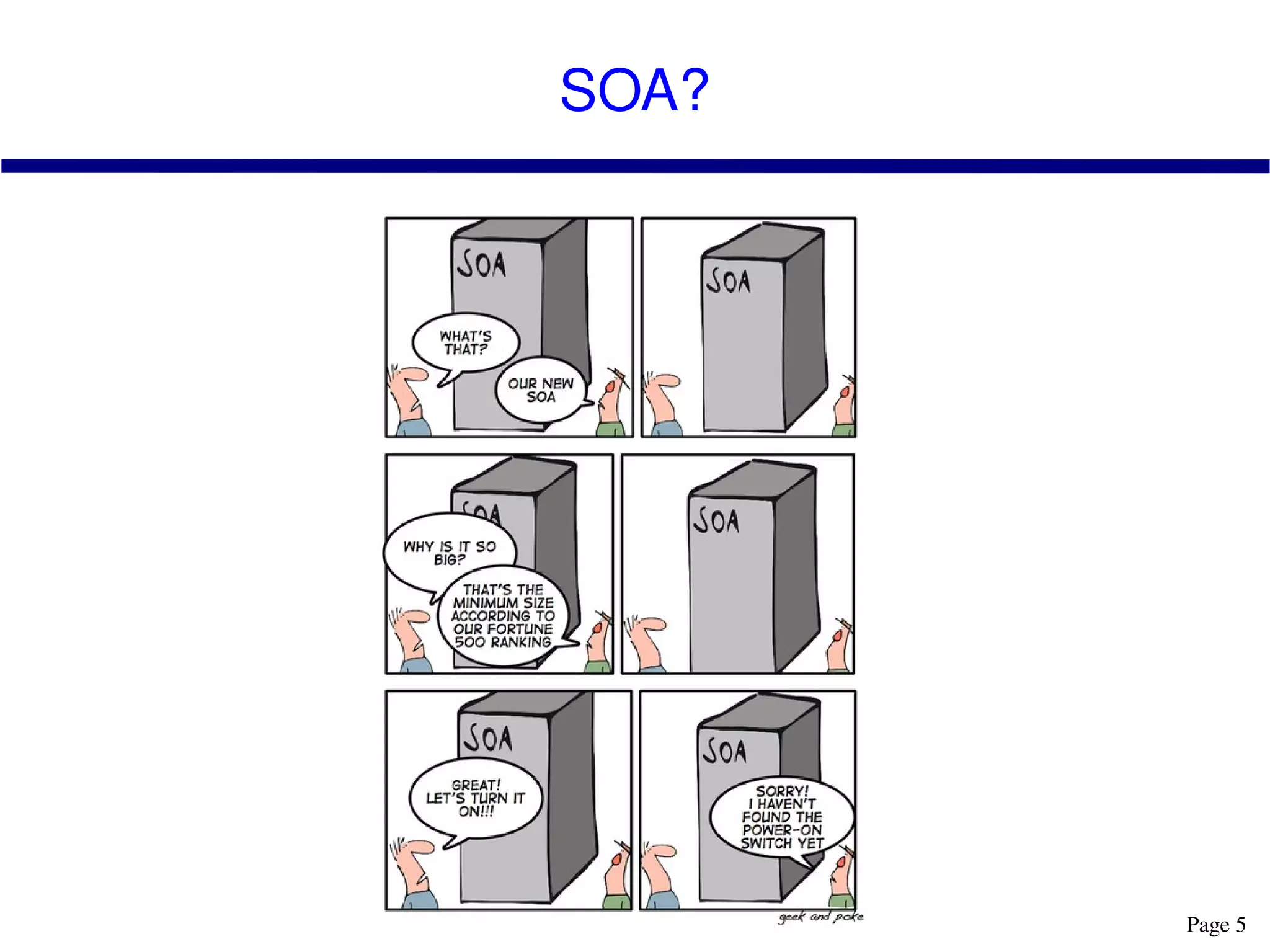
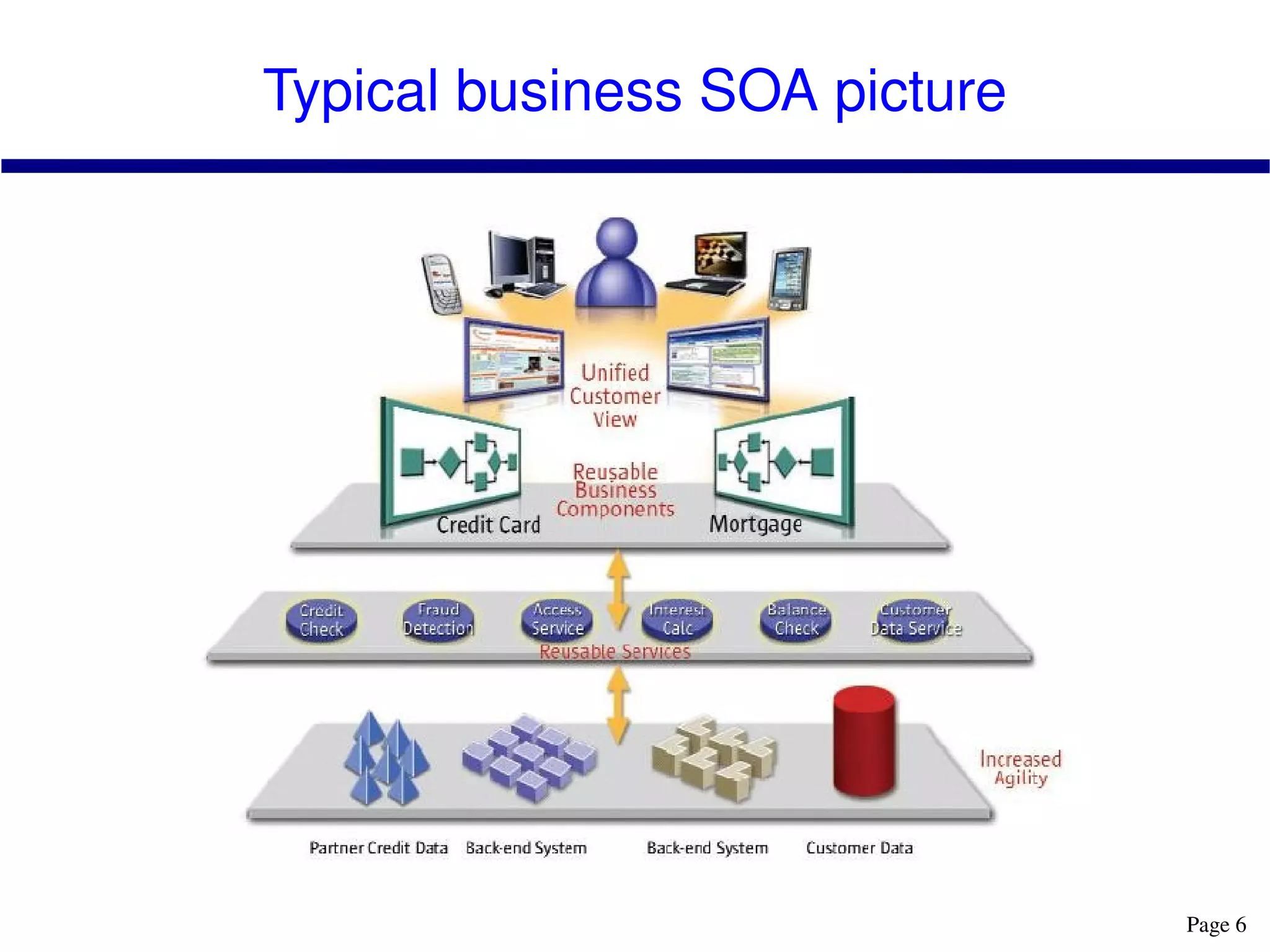
What is SOA? An approach for building large scale systems where functionality is bundled as interoperable “services” Details of how the service is implemented are not important
Consumer operates against a service contract that defines the business interface and qualities of service Services interact with each other by sending messages in an interoperable standard
Service metadata is often registered for easy discovery and governance
SOA?
Typical business SOA picture
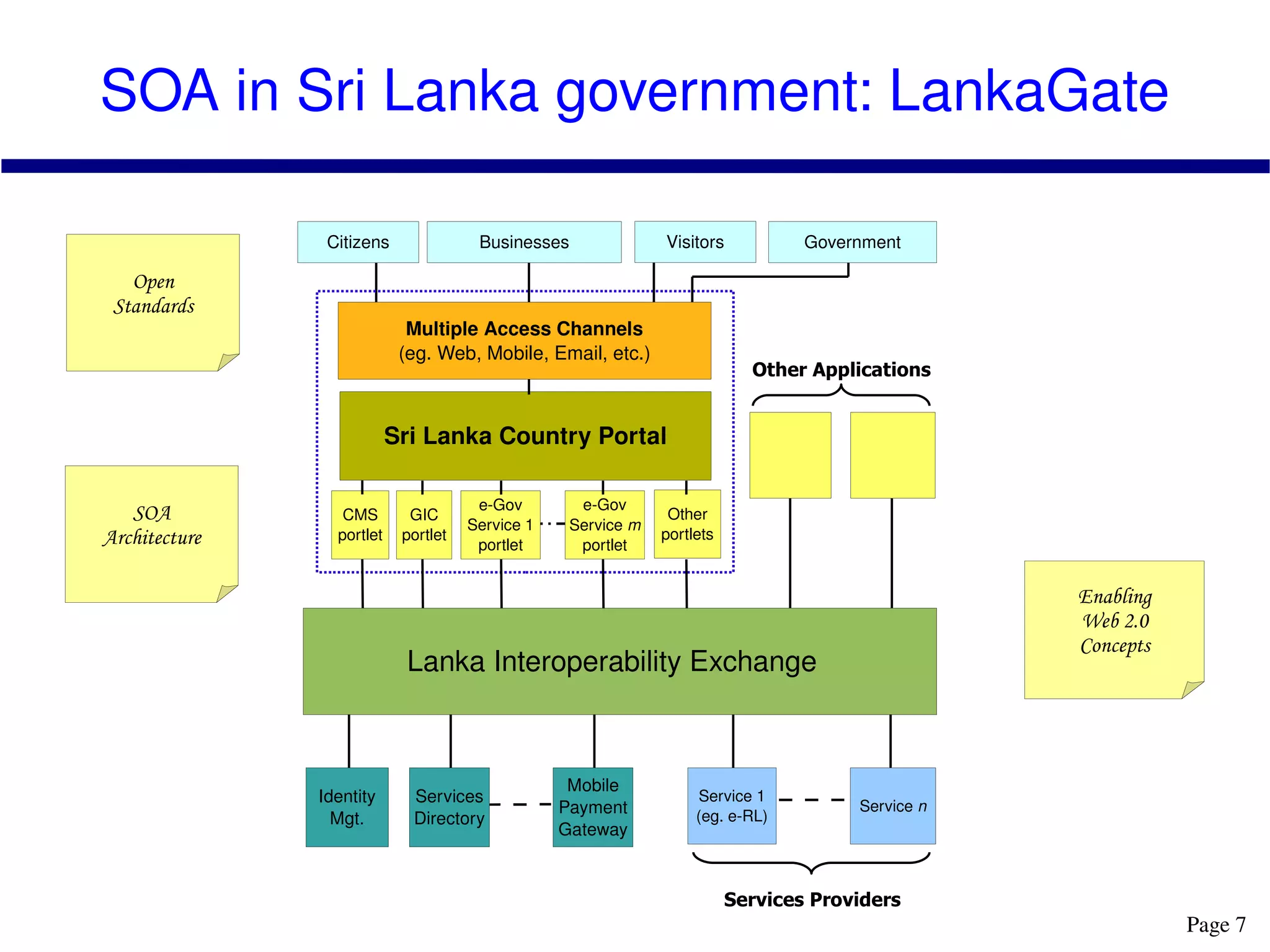
SOA in Sri Lanka government: LankaGate Other Applications Services Providers Open Standards SOA Architecture Enabling Web 2.0 Concepts Mobile Payment Gateway Other portlets Lanka Interoperability Exchange  Citizens Businesses Visitors Government Multiple Access Channels (eg. Web, Mobile, Email, etc.) Identity Mgt. CMS portlet GIC portlet e-Gov Service 1 portlet e-Gov Service  m portlet Services Directory Service 1 (eg. e-RL) Service  n
Advantages of SOA Localized management of information and data (Think of object orientation taken to the next level) Decentralized deployment Owner of information runs the service that exposes the data 100% securable Complete security platform available Total focus on interoperability While maintaining proper authentication & authorization Open-ended, decentralized customization and localization Scalable for a single country or a coalition
Open source Open source fundamentally about source code being available Under license terms that allow you to improve & redistribute Collaborative development paradigm Enabled by the Internet Does not necessarily mean free of charge Support often costs money “Free software” vs. “open source software” Free & open source software (FOSS)
Advantages of FOSS Freedom to innovate

Service Oriented Architecture for Net Centric Operations based on Open Source Technology

  • 1.
    Service Oriented Architecturefor Net Centric Operations based on Open Source Technology Sanjiva Weerawarana, Ph.D. Founder, Chairman & CEO, WSO2 Founder, Director & Chief Scientist, Lanka Software Foundation Member, Apache Software Foundation Emeritus Board Member, Open Source Initiative Visiting Lecturer, Univ. of Moratuwa, Sri Lanka IONS Technical Seminar. May 21, 2009. Colombo, Sri Lanka.
  • 2.
    About me IBMResearch from 1997 to 2005 Co-authored most of the key Web services specifications WSDL, WS-Eventing, BPEL4WS, ... Contributor to Apache Web services Contributor to Apache SOAP, Apache Axis, Apache Axis2, Apache WSIF, Apache Neethi, Apache Axiom, ... Member of Apache Software Foundation
  • 3.
    Founder & ChiefScientist, Lanka Software Foundation
  • 4.
    (Emeritus) Board Memberof Open Source Initiative
  • 5.
    Founder, Chairman &CEO of WSO2 Open source SOA platform company
  • 6.
    Agenda SOA &its implications
  • 7.
    Open source andits implications
  • 8.
  • 9.
    Interoperability framework fornet centric operations
  • 10.
    US DoD SOAactivities
  • 11.
    Open source SOAfor defence applications
  • 12.
  • 13.
    What is SOA?An approach for building large scale systems where functionality is bundled as interoperable “services” Details of how the service is implemented are not important
  • 14.
    Consumer operates againsta service contract that defines the business interface and qualities of service Services interact with each other by sending messages in an interoperable standard
  • 15.
    Service metadata isoften registered for easy discovery and governance
  • 16.
  • 17.
  • 18.
    SOA in SriLanka government: LankaGate Other Applications Services Providers Open Standards SOA Architecture Enabling Web 2.0 Concepts Mobile Payment Gateway Other portlets Lanka Interoperability Exchange Citizens Businesses Visitors Government Multiple Access Channels (eg. Web, Mobile, Email, etc.) Identity Mgt. CMS portlet GIC portlet e-Gov Service 1 portlet e-Gov Service m portlet Services Directory Service 1 (eg. e-RL) Service n
  • 19.
    Advantages of SOALocalized management of information and data (Think of object orientation taken to the next level) Decentralized deployment Owner of information runs the service that exposes the data 100% securable Complete security platform available Total focus on interoperability While maintaining proper authentication & authorization Open-ended, decentralized customization and localization Scalable for a single country or a coalition
  • 20.
    Open source Opensource fundamentally about source code being available Under license terms that allow you to improve & redistribute Collaborative development paradigm Enabled by the Internet Does not necessarily mean free of charge Support often costs money “Free software” vs. “open source software” Free & open source software (FOSS)
  • 21.
    Advantages of FOSSFreedom to innovate
  • 22.
  • 23.
  • 24.
  • 25.
  • 26.
    Everything from server/desktop/embeddedsystem operating systems to all middleware to desktop apps to enterprise apps
  • 27.
    Very often FOSSbuilds on other FOSS Standing on the shoulders of giants
  • 28.
    Culture of easylicense-compatible dependency taking EVERY software vendor now has FOSS in some form, inside or shipping No longer a niche concept
  • 29.
    FOSS & SOA“You can't buy SOA, you have to build it”
  • 30.
    Closed-source SOA productsare complex, non-agile and expensive
  • 31.
    Deployment of SOAalways requires a lot of customization
  • 32.
    Especially in militarycontext, does not provide the framework for the military organization to take control of the software Build local skill and knowledge and reduce external dependency Opportunity to “fork”
  • 33.
    Open standards Standardsare critical for interoperability
  • 34.
    Open standard meanshas wide adoption and support
  • 35.
    Critical for longterm data protection
  • 36.
    Critical for interoperabilitybetween friendly nations
  • 37.
    Interoperability framework vs.architecture framework for net centric operations Traditional thinking on building large scale systems is to have an architecture framework
  • 38.
    Does not providesufficient room for innovation within local contexts “Local” can range from national level to different military branches to different parts of a single organization Key criteria is interoperability Documented data standards
  • 39.
    Use of interoperablemessage protocols and standards
  • 40.
    Use of interoperablesecurity protocols and standards Opportunity to share code across units, branches, nations
  • 41.
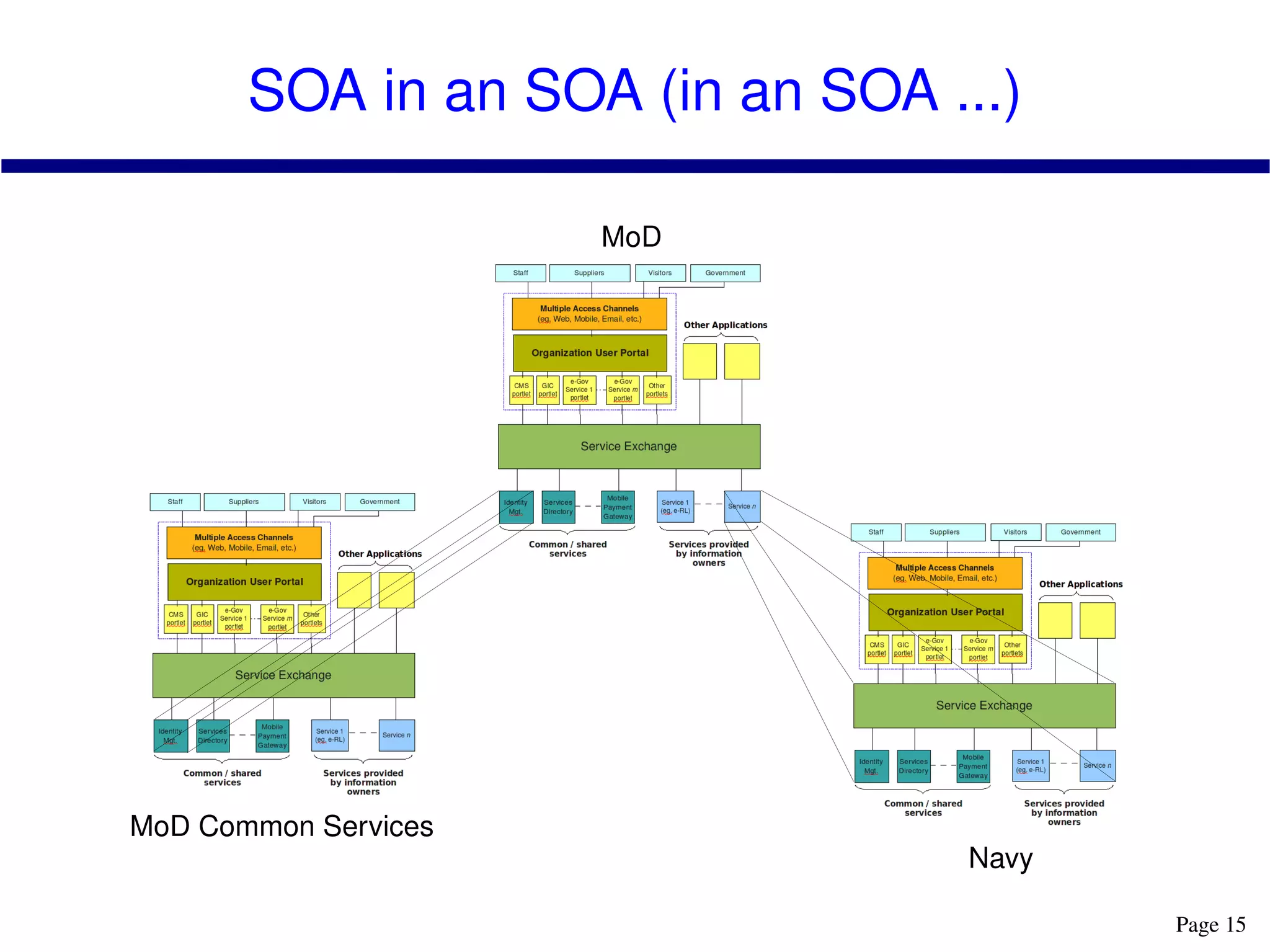
    SOA in anSOA (in an SOA ...) MoD MoD Common Services Navy
  • 42.
    Security in SOASOA technology platform provides complete security story Message level security
  • 43.
  • 44.
  • 45.
    Audit / Non-repudiationEven enemies can share the same technology platform and use policy driven security to ensure proper access and protection
  • 46.
  • 47.
    US DoD SOAactivities DoD Net Centric Enterprise Services (NCES) Common services for the DoD
  • 48.
    SOA platform SOASymposium in Washington, DC in March 500+ attendees from all branches of military – CIOs, senior IT officers
  • 49.
    Focused on educationof SOA concepts Very large complex problem for US DoD 3.5m people in organization
  • 50.
    Incredible amount oflegacy to deal with
  • 51.
    Complex procurement processesthat are inherently designed around enterprise systems (Which have repeatedly proven to not deliver on time or on budget!)
  • 52.
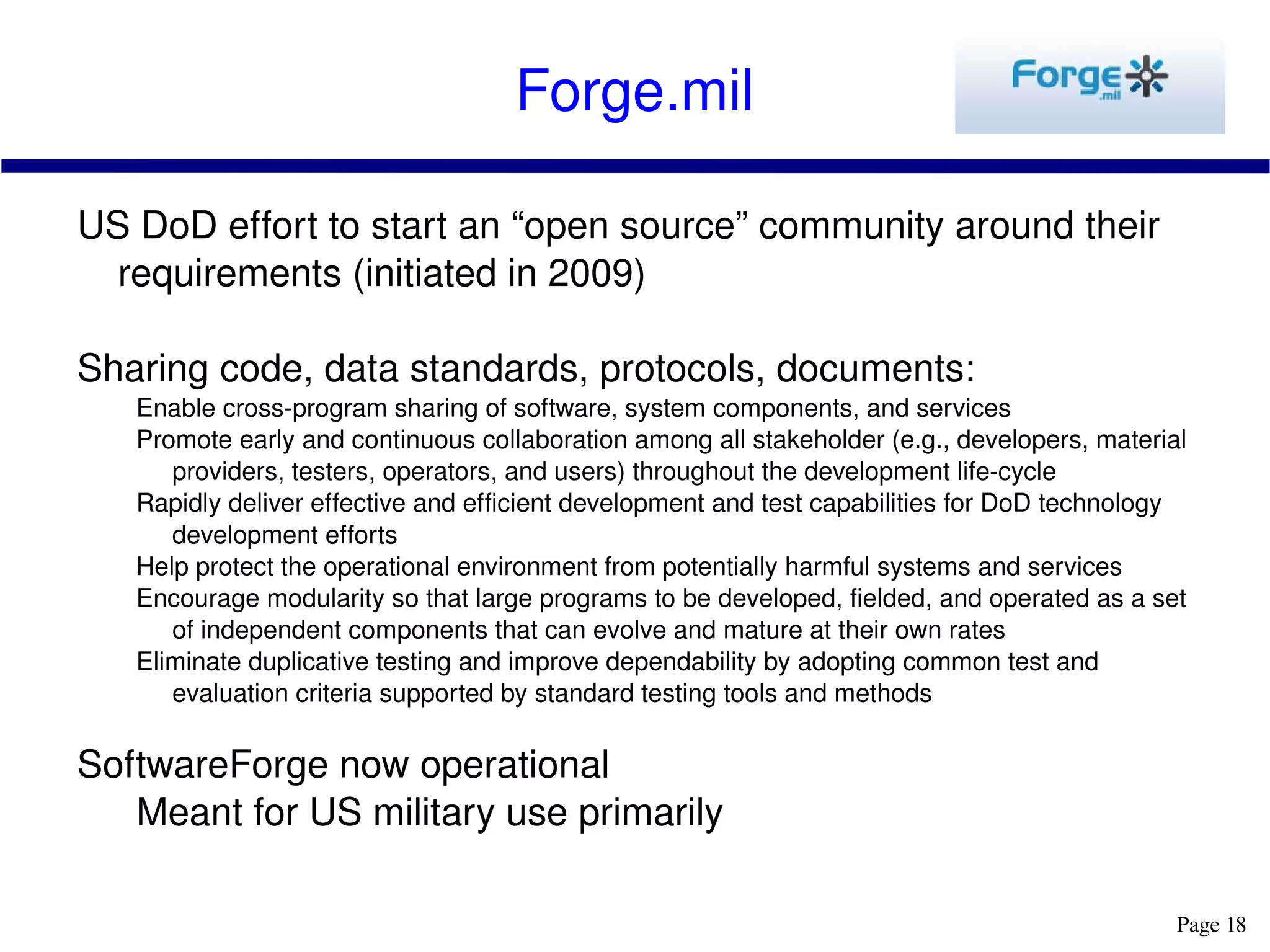
    Forge.mil US DoDeffort to start an “open source” community around their requirements (initiated in 2009)
  • 53.
    Sharing code, datastandards, protocols, documents: Enable cross-program sharing of software, system components, and services
  • 54.
    Promote early andcontinuous collaboration among all stakeholder (e.g., developers, material providers, testers, operators, and users) throughout the development life-cycle
  • 55.
    Rapidly deliver effectiveand efficient development and test capabilities for DoD technology development efforts
  • 56.
    Help protect theoperational environment from potentially harmful systems and services
  • 57.
    Encourage modularity sothat large programs to be developed, fielded, and operated as a set of independent components that can evolve and mature at their own rates
  • 58.
    Eliminate duplicative testingand improve dependability by adopting common test and evaluation criteria supported by standard testing tools and methods SoftwareForge now operational Meant for US military use primarily
  • 59.
    FOSS for defenceSoftware is underpinning everything – from weapons systems to vessels to operational aspects
  • 60.
    Depending on externalsoftware technology providers only is a huge national security risk Exposes one to external threats FOSS allows one to not only consume, but also PRODUCE software assets Which can become currency in global relationship management On a grander national scale, help develop local IT expertise and industry E.g.: US DoD has been catalyst for much innovation
  • 61.
  • 62.
    Recommendations Each countryDoD needs to set up their own SOA platform Using FOSS products to give maximum flexibility Each country needs to set up its own equivalent of Forge.mil
  • 63.
    Set up sharedregistry of data standards E.g.: Definitions of various types of vessels and their characteristics
  • 64.
    (Not mandatory touse, but enable serendipitous reuse when possible) Set up shared data centers using (FOSS) cloud computing technology for use within branches of the military as well as across
  • 65.
    Make military softwaretechnology a strategic weapon for the country & allies
  • 66.
    Summary Service OrientedArchitectures (SOA) is now the accepted approach for building very large scale systems that actually work
  • 67.
    SOA enables scalable,strategic sharing of information in net centric operations
  • 68.
    Free & OpenSource Software (FOSS) provides a superb platform for building SOA solutions
  • 69.
    FOSS provides intrinsicstrategic advantages to the country
  • 70.
    It can bedone – local expertise is already there in every country Look for it, enable it, sponsor it, nurture it