ServiceNow
Fulfiller Basics Training for
Service Desk
Training Links
• Fulfiller: http://utqa.service-now.com
• Self Service Website: http://utqa.service-
now.com/utss
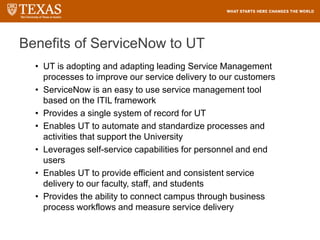
Benefits of ServiceNow to UT
• UT is adopting and adapting leading Service Management
processes to improve our service delivery to our customers
• ServiceNow is an easy to use service management tool
based on the ITIL framework
• Provides a single system of record for UT
• Enables UT to automate and standardize processes and
activities that support the University
• Leverages self-service capabilities for personnel and end
users
• Enables UT to provide efficient and consistent service
delivery to our faculty, staff, and students
• Provides the ability to connect campus through business
process workflows and measure service delivery
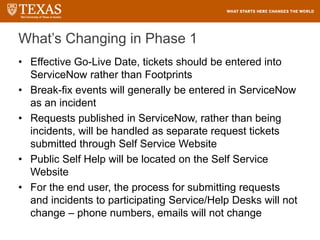
What’s Changing in Phase 1
• Effective Go-Live Date, tickets should be entered into
ServiceNow rather than Footprints
• Break-fix events will generally be entered in ServiceNow
as an incident
• Requests published in ServiceNow, rather than being
incidents, will be handled as separate request tickets
submitted through Self Service Website
• Public Self Help will be located on the Self Service
Website
• For the end user, the process for submitting requests
and incidents to participating Service/Help Desks will not
change – phone numbers, emails will not change
Training Scope
• This training is aimed at IT Fulfillers, specifically those
working for the UT Service Desk
• Processes in Phase 1 that impact Fulfillers include
incident management, service request and catalog,
knowledge
• A Fulfiller is defined as someone who is assigned a task
to perform in the tool and has the appropriate roles
defined in the tool
Learning Objectives
General Navigation in ServiceNow
Incident Management
• Review the Incident Management process, key concepts and metrics
• Review how Knowledge Management interacts with Incident
Management and how to submit knowledge articles
• How to use the Incident Management application and modules within
ServiceNow
Service Catalog
• Service Catalog Overview for Fulfillers including approvals and
catalog tasks
ServiceNow Reporting Overview
Appendix
• Additional Navigation topics, Process Diagrams, Metrics
GENERAL NAVIGATION
ServiceNow
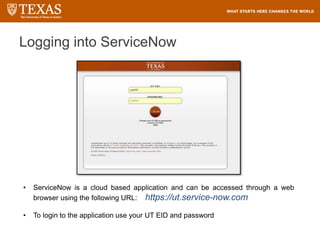
Logging into ServiceNow
• ServiceNow is a cloud based application and can be accessed through a web
browser using the following URL: https://ut.service-now.com
• To login to the application use your UT EID and password
GENERAL NAVIGATION
Tool Demo
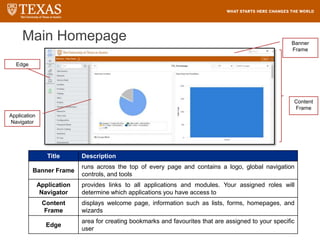
Title Description
Banner Frame
runs across the top of every page and contains a logo, global navigation
controls, and tools
Application
Navigator
provides links to all applications and modules. Your assigned roles will
determine which applications you have access to
Content
Frame
displays welcome page, information such as lists, forms, homepages, and
wizards
Edge
area for creating bookmarks and favourites that are assigned to your specific
user
Content
Frame
Main Homepage
Edge
Application
Navigator
Banner
Frame
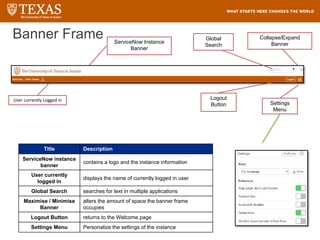
Banner Frame
Title Description
ServiceNow instance
banner
contains a logo and the instance information
User currently
logged in
displays the name of currently logged in user
Global Search searches for text in multiple applications
Maximise / Minimise
Banner
alters the amount of space the banner frame
occupies
Logout Button returns to the Welcome page
Settings Menu Personalize the settings of the instance
User currently Logged in
ServiceNow Instance
Banner
Collapse/Expand
Banner
Global
Search
Settings
Menu
Logout
Button
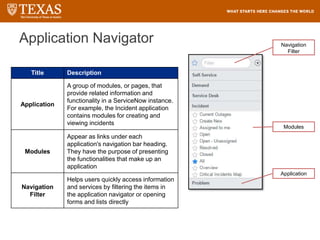
Application Navigator
Title Description
Application
A group of modules, or pages, that
provide related information and
functionality in a ServiceNow instance.
For example, the Incident application
contains modules for creating and
viewing incidents
Modules
Appear as links under each
application's navigation bar heading.
They have the purpose of presenting
the functionalities that make up an
application
Navigation
Filter
Helps users quickly access information
and services by filtering the items in
the application navigator or opening
forms and lists directly
Application
Navigation
Filter
Modules
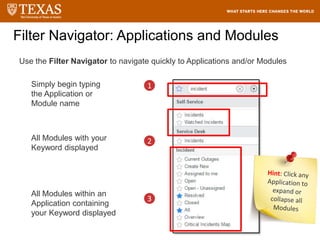
Use the Filter Navigator to navigate quickly to Applications and/or Modules
Simply begin typing
the Application or
Module name
All Modules with your
Keyword displayed
All Modules within an
Application containing
your Keyword displayed
Filter Navigator: Applications and Modules
1
2
3
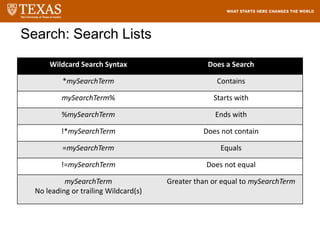
Wildcard Search Syntax Does a Search
*mySearchTerm Contains
mySearchTerm% Starts with
%mySearchTerm Ends with
!*mySearchTerm Does not contain
=mySearchTerm Equals
!=mySearchTerm Does not equal
mySearchTerm
No leading or trailing Wildcard(s)
Greater than or equal to mySearchTerm
Search: Search Lists
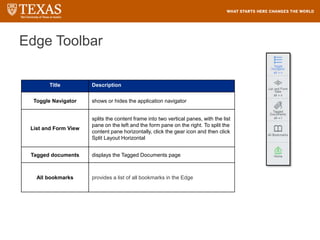
Edge Toolbar
Title Description
Toggle Navigator shows or hides the application navigator
List and Form View
splits the content frame into two vertical panes, with the list
pane on the left and the form pane on the right. To split the
content pane horizontally, click the gear icon and then click
Split Layout Horizontal
Tagged documents displays the Tagged Documents page
All bookmarks provides a list of all bookmarks in the Edge
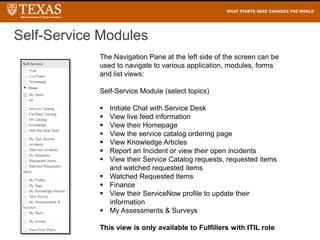
The Navigation Pane at the left side of the screen can be
used to navigate to various application, modules, forms
and list views:
Self-Service Module (select topics)
 Initiate Chat with Service Desk
 View live feed information
 View their Homepage
 View the service catalog ordering page
 View Knowledge Articles
 Report an Incident or view their open incidents
 View their Service Catalog requests, requested items
and watched requested items
 Watched Requested Items
 Finance
 View their ServiceNow profile to update their
information
 My Assessments & Surveys
This view is only available to Fulfillers with ITIL role
Self-Service Modules
Any Questions about Navigation in
ServiceNow at this point?
See additional slides on Navigation in the Appendix
INCIDENT MANAGEMENT
Key Concepts
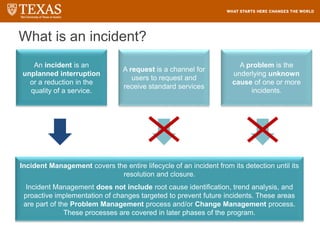
What is an incident?
A problem is the
underlying unknown
cause of one or more
incidents.
An incident is an
unplanned interruption
or a reduction in the
quality of a service.
Incident Management covers the entire lifecycle of an incident from its detection until its
resolution and closure.
Incident Management does not include root cause identification, trend analysis, and
proactive implementation of changes targeted to prevent future incidents. These areas
are part of the Problem Management process and/or Change Management process.
These processes are covered in later phases of the program.
A request is a channel for
users to request and
receive standard services
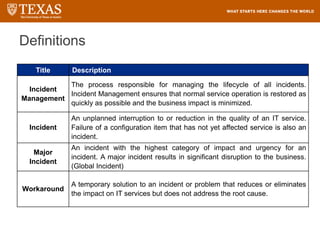
Definitions
Title Description
Incident
Management
The process responsible for managing the lifecycle of all incidents.
Incident Management ensures that normal service operation is restored as
quickly as possible and the business impact is minimized.
Incident
An unplanned interruption to or reduction in the quality of an IT service.
Failure of a configuration item that has not yet affected service is also an
incident.
Major
Incident
An incident with the highest category of impact and urgency for an
incident. A major incident results in significant disruption to the business.
(Global Incident)
Workaround
A temporary solution to an incident or problem that reduces or eliminates
the impact on IT services but does not address the root cause.
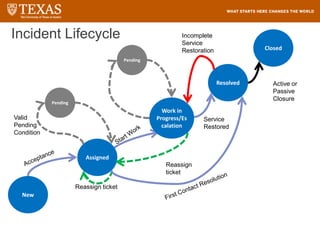
Incident Lifecycle
New
Assigned
Work in
Progress/Es
calation
Resolved
Closed
Active or
Passive
Closure
Incomplete
Service
Restoration
Pending
Valid
Pending
Condition
Pending
Service
Restored
Reassign ticket
Reassign
ticket
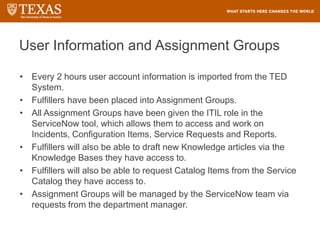
User Information and Assignment Groups
• Every 2 hours user account information is imported from the TED
System.
• Fulfillers have been placed into Assignment Groups.
• All Assignment Groups have been given the ITIL role in the
ServiceNow tool, which allows them to access and work on
Incidents, Configuration Items, Service Requests and Reports.
• Fulfillers will also be able to draft new Knowledge articles via the
Knowledge Bases they have access to.
• Fulfillers will also be able to request Catalog Items from the Service
Catalog they have access to.
• Assignment Groups will be managed by the ServiceNow team via
requests from the department manager.
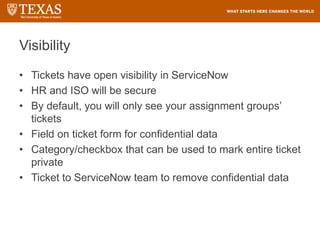
Visibility
• Tickets have open visibility in ServiceNow
• HR and ISO will be secure
• By default, you will only see your assignment groups’
tickets
• Field on ticket form for confidential data
• Category/checkbox that can be used to mark entire ticket
private
• Ticket to ServiceNow team to remove confidential data
END USER PERSPECTIVE AND
THE SELF SERVICE WEBSITE
Incident Management
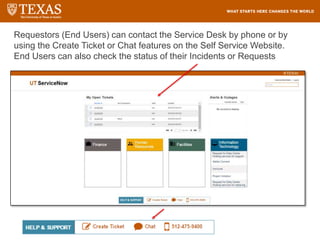
Requestors (End Users) can contact the Service Desk by phone or by
using the Create Ticket or Chat features on the Self Service Website.
End Users can also check the status of their Incidents or Requests
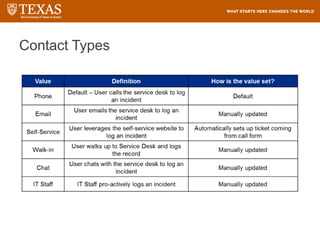
Contact Types
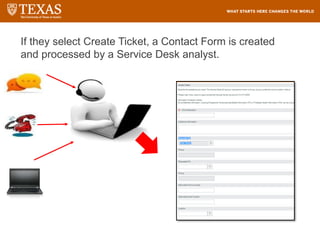
If they select Create Ticket, a Contact Form is created
and processed by a Service Desk analyst.
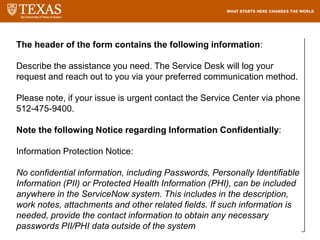
The header of the form contains the following information:
Describe the assistance you need. The Service Desk will log your
request and reach out to you via your preferred communication method.
Please note, if your issue is urgent contact the Service Center via phone
512-475-9400.
Note the following Notice regarding Information Confidentially:
Information Protection Notice:
No confidential information, including Passwords, Personally Identifiable
Information (PII) or Protected Health Information (PHI), can be included
anywhere in the ServiceNow system. This includes in the description,
work notes, attachments and other related fields. If such information is
needed, provide the contact information to obtain any necessary
passwords PII/PHI data outside of the system
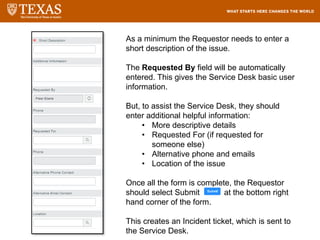
As a minimum the Requestor needs to enter a
short description of the issue.
The Requested By field will be automatically
entered. This gives the Service Desk basic user
information.
But, to assist the Service Desk, they should
enter additional helpful information:
• More descriptive details
• Requested For (if requested for
someone else)
• Alternative phone and emails
• Location of the issue
Once all the form is complete, the Requestor
should select Submit at the bottom right
hand corner of the form.
This creates an Incident ticket, which is sent to
the Service Desk.
CONTACT FORM
Tool Demo
IT SERVICE DESK
PERSPECTIVE
Incident Management
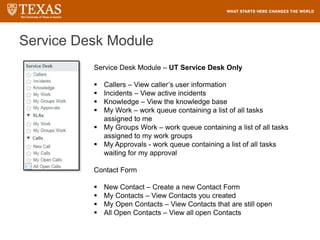
Service Desk Module
Service Desk Module – UT Service Desk Only
 Callers – View caller’s user information
 Incidents – View active incidents
 Knowledge – View the knowledge base
 My Work – work queue containing a list of all tasks
assigned to me
 My Groups Work – work queue containing a list of all tasks
assigned to my work groups
 My Approvals - work queue containing a list of all tasks
waiting for my approval
Contact Form
 New Contact – Create a new Contact Form
 My Contacts – View Contacts you created
 My Open Contacts – View Contacts that are still open
 All Open Contacts – View all open Contacts
FULFILLER PERSPECTIVE
Incident Management
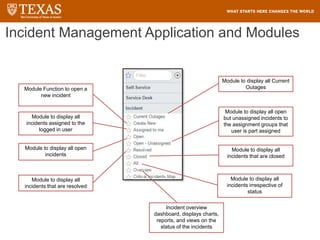
Incident Management Application and Modules
34
Module to display all Current
Outages
Module to display all open
but unassigned incidents to
the assignment groups that
user is part assigned
Module to display all
incidents that are closed
Module to display all
incidents irrespective of
status
Incident overview
dashboard, displays charts,
reports, and views on the
status of the incidents
Module to display all
incidents assigned to the
logged in user
Module to display all
incidents that are resolved
Module to display all open
incidents
Module Function to open a
new incident
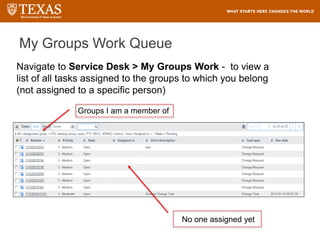
My Groups Work Queue
Navigate to Service Desk > My Groups Work - to view a
list of all tasks assigned to the groups to which you belong
(not assigned to a specific person)
Groups I am a member of
No one assigned yet
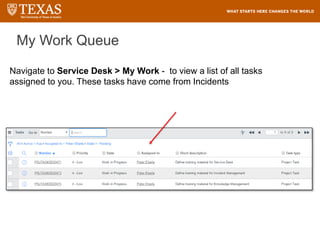
My Work Queue
Navigate to Service Desk > My Work - to view a list of all tasks
assigned to you. These tasks have come from Incidents
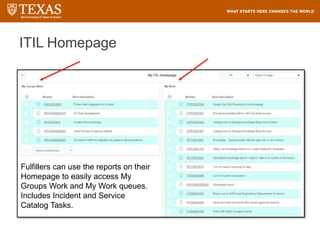
ITIL Homepage
Fulfillers can use the reports on their
Homepage to easily access My
Groups Work and My Work queues.
Includes Incident and Service
Catalog Tasks.
INCIDENT APPLICATION
Tool Demo
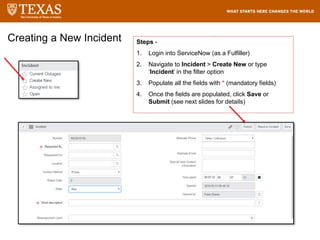
Creating a New Incident Steps -
1. Login into ServiceNow (as a Fulfiller)
2. Navigate to Incident > Create New or type
‘Incident’ in the filter option
3. Populate all the fields with * (mandatory fields)
4. Once the fields are populated, click Save or
Submit (see next slides for details)
Incident Handling
• An end user may contact the Service Desk via the Self Service Website and
select Create Ticket. ServiceNow will create an Incident record in the New
state and assign it to the ITS Service Desk.
• The Service Desk agent will review the ticket, contact the end user for
additional information, and complete the incident form, updating the Affected
CI, Category, and Subcategory fields.
• If the Service Desk can resolve the issue they will Assign the incident to
themselves, complete whatever tasks are required to resolve the incident,
updating the Work Notes field, and change the state to Resolved.
• Service Desk agent can also assign the Incident ticket to a Fulfiller group
(also known as an Assignment Group in ServiceNow). This can be achieved
in one of two ways. First, based on the Affected CI, the ticket will be
automatically assigned to the team responsible for that CI. Secondly, the
Service Desk agent can directly assign to the appropriate Assignment
Group.
Incident Handling
• Fulfiller teams will receive an email notification that an Incident Ticket has
been assigned to their team in Service Desk > My Groups Work
• Anyone in that Assignment Group can assign the ticket to themselves or
anyone in the group.
• Once a ticket has been assigned to an individual, it is visible in Service
Desk > My Work.
• The Fulfiller should open and review the ticket. The Fulfiller should place the
ticket state to Work in Progress. They can also place the ticket into one of
several Pending States if it is necessary to open a Change Request or if
they are waiting on information from the customer, a problem investigation,
or reply from a vendor.
• The Fulfiller should keep track of everything they are doing in the Work
Notes area.
Incident Handling
• If the Incident needs to be assigned to another team, the Fulfiller can
reassign the ticket to that team.
• Once the work has been completed and the service restored, the Fulfiller
should select the Resolve Incident button. Mandatory fields in the Closure
Tab, Close Code and Close Notes need to be completed. Also, the Fulfiller
can check the Knowledge box to generate a draft Knowledge article.
• The Incident will close automatically in 5 days.
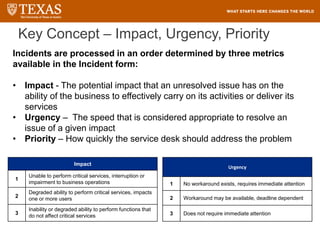
Key Concept – Impact, Urgency, Priority
Impact
1
Unable to perform critical services, interruption or
impairment to business operations
2
Degraded ability to perform critical services, impacts
one or more users
3
Inability or degraded ability to perform functions that
do not affect critical services
Urgency
1 No workaround exists, requires immediate attention
2 Workaround may be available, deadline dependent
3 Does not require immediate attention
Incidents are processed in an order determined by three metrics
available in the Incident form:
• Impact - The potential impact that an unresolved issue has on the
ability of the business to effectively carry on its activities or deliver its
services
• Urgency – The speed that is considered appropriate to resolve an
issue of a given impact
• Priority – How quickly the service desk should address the problem
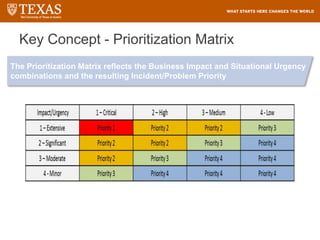
Key Concept - Prioritization Matrix
The Prioritization Matrix reflects the Business Impact and Situational Urgency
combinations and the resulting Incident/Problem Priority
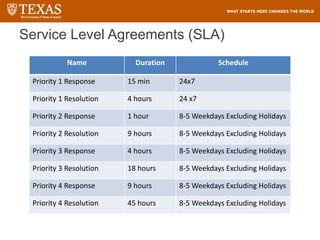
Service Level Agreements (SLA)
Name Duration Schedule
Priority 1 Response 15 min 24x7
Priority 1 Resolution 4 hours 24 x7
Priority 2 Response 1 hour 8-5 Weekdays Excluding Holidays
Priority 2 Resolution 9 hours 8-5 Weekdays Excluding Holidays
Priority 3 Response 4 hours 8-5 Weekdays Excluding Holidays
Priority 3 Resolution 18 hours 8-5 Weekdays Excluding Holidays
Priority 4 Response 9 hours 8-5 Weekdays Excluding Holidays
Priority 4 Resolution 45 hours 8-5 Weekdays Excluding Holidays
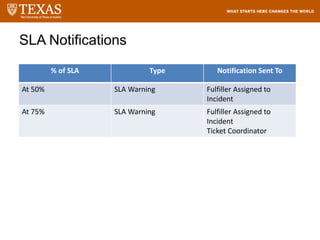
% of SLA Type Notification Sent To
At 50% SLA Warning Fulfiller Assigned to
Incident
At 75% SLA Warning Fulfiller Assigned to
Incident
Ticket Coordinator
SLA Notifications
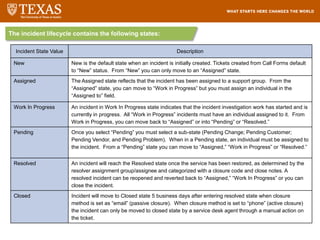
Incident State Value Description
New New is the default state when an incident is initially created. Tickets created from Call Forms default
to “New” status. From “New” you can only move to an “Assigned” state.
Assigned The Assigned state reflects that the incident has been assigned to a support group. From the
“Assigned” state, you can move to “Work in Progress” but you must assign an individual in the
“Assigned to” field.
Work In Progress An incident in Work In Progress state indicates that the incident investigation work has started and is
currently in progress. All “Work in Progress” incidents must have an individual assigned to it. From
Work in Progress, you can move back to “Assigned” or into “Pending” or “Resolved.”
Pending Once you select “Pending” you must select a sub-state (Pending Change; Pending Customer;
Pending Vendor, and Pending Problem). When in a Pending state, an individual must be assigned to
the incident. From a “Pending” state you can move to “Assigned,” “Work in Progress” or “Resolved.”
Resolved An incident will reach the Resolved state once the service has been restored, as determined by the
resolver assignment group/assignee and categorized with a closure code and close notes. A
resolved incident can be reopened and reverted back to “Assigned,” “Work In Progress” or you can
close the incident.
Closed Incident will move to Closed state 5 business days after entering resolved state when closure
method is set as “email” (passive closure). When closure method is set to “phone” (active closure)
the incident can only be moved to closed state by a service desk agent through a manual action on
the ticket.
The incident lifecycle contains the following states:
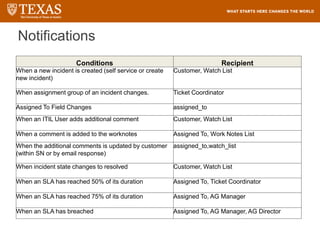
Notifications
Conditions Recipient
When a new incident is created (self service or create
new incident)
Customer, Watch List
When assignment group of an incident changes. Ticket Coordinator
Assigned To Field Changes assigned_to
When an ITIL User adds additional comment Customer, Watch List
When a comment is added to the worknotes Assigned To, Work Notes List
When the additional comments is updated by customer
(within SN or by email response)
assigned_to,watch_list
When incident state changes to resolved Customer, Watch List
When an SLA has reached 50% of its duration Assigned To, Ticket Coordinator
When an SLA has reached 75% of its duration Assigned To, AG Manager
When an SLA has breached Assigned To, AG Manager, AG Director
Notification Examples
Email Subject: [Task] [Number] has been opened on your behalf
To Whom It May Concern,
We have received your [Incident/Request][Number].
Summary: [Short Description of Incident/Request].
Click Here to view: [Link to Incident/Request]
Email Subject: [Task] [Number] has been updated by Requestor
To Whom It May Concern,
[Incident/Request][Number] has been updated by [Name].
Summary: [Short Description] [Work Notes/Comments Update]
Click here to view: [Link to Incident/Request]
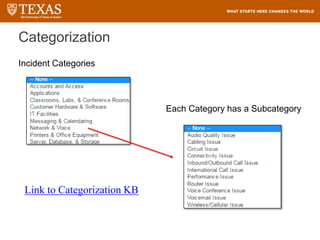
Categorization
Incident Categories
Each Category has a Subcategory
Link to Categorization KB
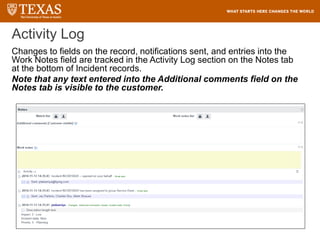
Activity Log
Changes to fields on the record, notifications sent, and entries into the
Work Notes field are tracked in the Activity Log section on the Notes tab
at the bottom of Incident records.
Note that any text entered into the Additional comments field on the
Notes tab is visible to the customer.
INCIDENT FORM
Form Details
53
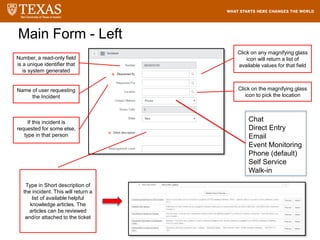
Number, a read-only field
is a unique identifier that
is system generated
Name of user requesting
the Incident
Click on any magnifying glass
icon will return a list of
available values for that field
Click on the magnifying glass
icon to pick the location
If this incident is
requested for some else,
type in that person
Chat
Direct Entry
Email
Event Monitoring
Phone (default)
Self Service
Walk-in
Type in Short description of
the incident. This will return a
list of available helpful
knowledge articles. The
articles can be reviewed
and/or attached to the ticket
Main Form - Left
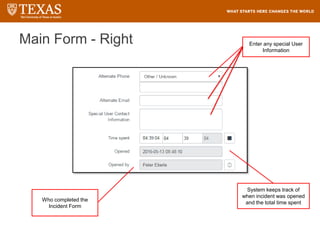
Main Form - Right
54
Enter any special User
Information
System keeps track of
when incident was opened
and the total time spent
Who completed the
Incident Form
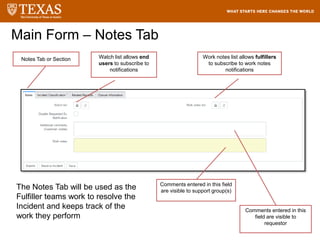
Main Form – Notes Tab
Watch list allows end
users to subscribe to
notifications
Work notes list allows fulfillers
to subscribe to work notes
notifications
Comments entered in this field
are visible to support group(s)
Comments entered in this
field are visible to
requestor
Notes Tab or Section
The Notes Tab will be used as the
Fulfiller teams work to resolve the
Incident and keeps track of the
work they perform
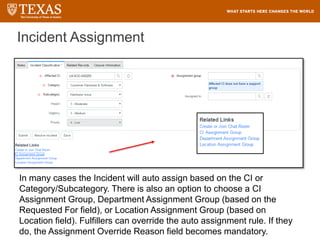
Incident Assignment
In many cases the Incident will auto assign based on the CI or
Category/Subcategory. There is also an option to choose a CI
Assignment Group, Department Assignment Group (based on the
Requested For field), or Location Assignment Group (based on
Location field). Fulfillers can override the auto assignment rule. If they
do, the Assignment Override Reason field becomes mandatory.
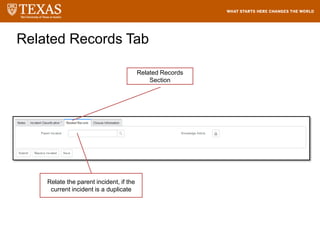
Related Records Tab
Relate the parent incident, if the
current incident is a duplicate
Related Records
Section
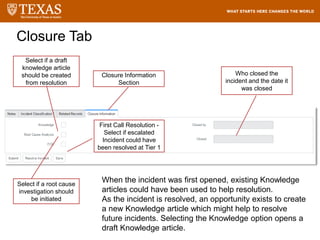
Closure Tab
Closure Information
Section
Select if a draft
knowledge article
should be created
from resolution
Select if a root cause
investigation should
be initiated
First Call Resolution -
Select if escalated
Incident could have
been resolved at Tier 1
Who closed the
incident and the date it
was closed
When the incident was first opened, existing Knowledge
articles could have been used to help resolution.
As the incident is resolved, an opportunity exists to create
a new Knowledge article which might help to resolve
future incidents. Selecting the Knowledge option opens a
draft Knowledge article.
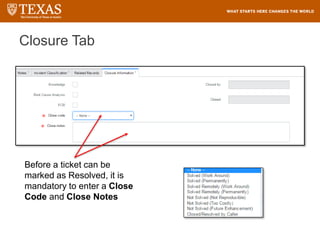
Closure Tab
Before a ticket can be
marked as Resolved, it is
mandatory to enter a Close
Code and Close Notes
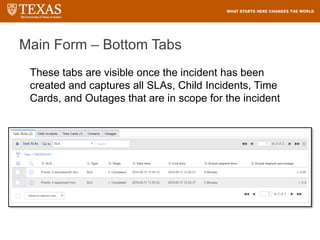
Main Form – Bottom Tabs
60
These tabs are visible once the incident has been
created and captures all SLAs, Child Incidents, Time
Cards, and Outages that are in scope for the incident
Questions about Incident
Management?
SERVICE CATALOG
OVERVIEW FOR FULFILLERS
ServiceNow
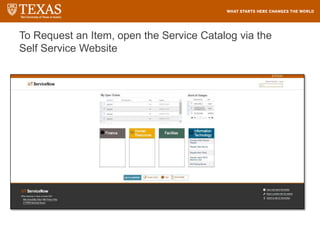
To Request an Item, open the Service Catalog via the
Self Service Website
SERVICE CATALOG
Tool Walk-Through
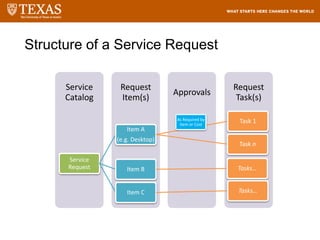
Request
Task(s)
Approvals
Request
Item(s)
Service
Catalog
Service
Request
Item A
(e.g. Desktop)
Task 1
Task n
Item B Tasks…
Item C Tasks…
Structure of a Service Request
As Required by
Item or Cost
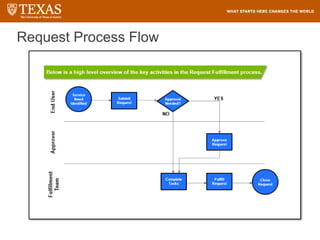
Request Process Flow
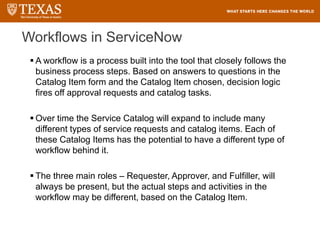
Workflows in ServiceNow
 A workflow is a process built into the tool that closely follows the
business process steps. Based on answers to questions in the
Catalog Item form and the Catalog Item chosen, decision logic
fires off approval requests and catalog tasks.
 Over time the Service Catalog will expand to include many
different types of service requests and catalog items. Each of
these Catalog Items has the potential to have a different type of
workflow behind it.
 The three main roles – Requester, Approver, and Fulfiller, will
always be present, but the actual steps and activities in the
workflow may be different, based on the Catalog Item.
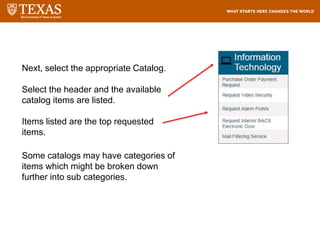
Next, select the appropriate Catalog.
Select the header and the available
catalog items are listed.
Items listed are the top requested
items.
Some catalogs may have categories of
items which might be broken down
further into sub categories.
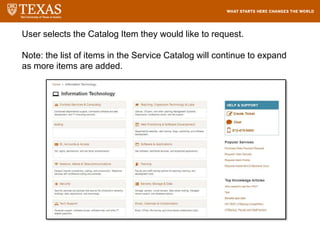
User selects the Catalog Item they would like to request.
Note: the list of items in the Service Catalog will continue to expand
as more items are added.
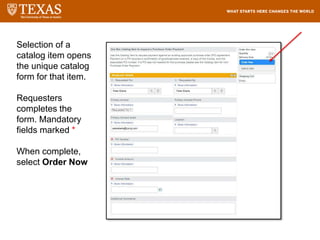
Selection of a
catalog item opens
the unique catalog
form for that item.
Requesters
completes the
form. Mandatory
fields marked *
When complete,
select Order Now
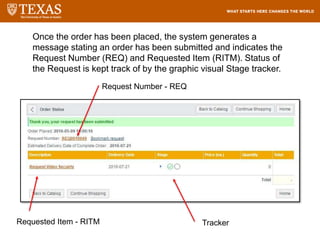
Once the order has been placed, the system generates a
message stating an order has been submitted and indicates the
Request Number (REQ) and Requested Item (RITM). Status of
the Request is kept track of by the graphic visual Stage tracker.
Tracker
Request Number - REQ
Requested Item - RITM
Catalog Item Approvals and Tasks
Based on the Workflow for that Catalog Item, ServiceNow
will generate the following:
• One or more approval requests. Based on the value of the item,
purchasing policy, of other policies, it may be necessary to obtain
one or more approvals from individuals.
• Once the items have been approved (if required), ServiceNow
generates Fulfillment tasks to various Assignment Groups. This
may include purchasing, release form a storeroom, software
installation, set up, etc
APPROVAL QUEUES
ServiceNow
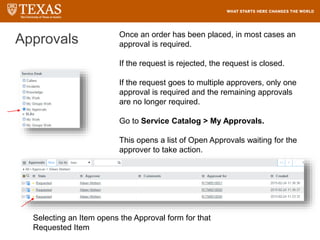
Approvals Once an order has been placed, in most cases an
approval is required.
If the request is rejected, the request is closed.
If the request goes to multiple approvers, only one
approval is required and the remaining approvals
are no longer required.
Go to Service Catalog > My Approvals.
This opens a list of Open Approvals waiting for the
approver to take action.
Selecting an Item opens the Approval form for that
Requested Item
Approval Form
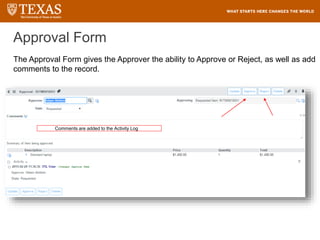
The Approval Form gives the Approver the ability to Approve or Reject, as well as add
comments to the record.
Comments are added to the Activity Log
Approval Form
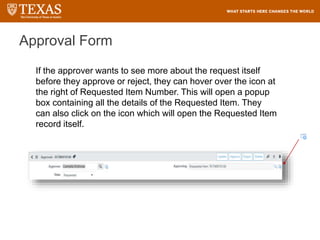
If the approver wants to see more about the request itself
before they approve or reject, they can hover over the icon at
the right of Requested Item Number. This will open a popup
box containing all the details of the Requested Item. They
can also click on the icon which will open the Requested Item
record itself.
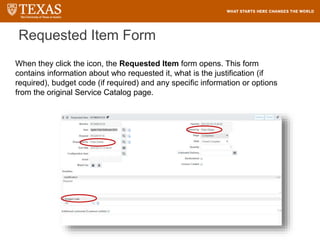
Requested Item Form
When they click the icon, the Requested Item form opens. This form
contains information about who requested it, what is the justification (if
required), budget code (if required) and any specific information or options
from the original Service Catalog page.
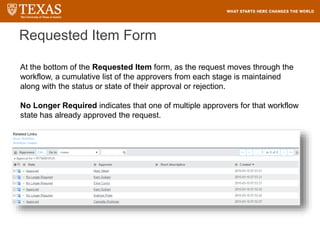
Requested Item Form
At the bottom of the Requested Item form, as the request moves through the
workflow, a cumulative list of the approvers from each stage is maintained
along with the status or state of their approval or rejection.
No Longer Required indicates that one of multiple approvers for that workflow
state has already approved the request.
FULFILLER TASKS
ServiceNow
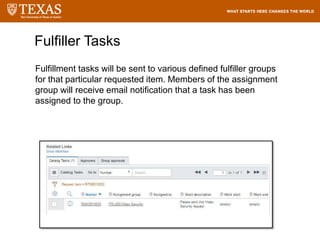
Fulfillment tasks will be sent to various defined fulfiller groups
for that particular requested item. Members of the assignment
group will receive email notification that a task has been
assigned to the group.
Fulfiller Tasks
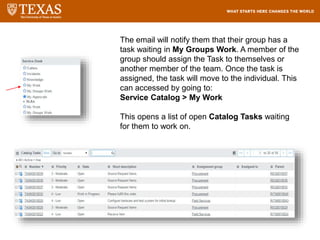
The email will notify them that their group has a
task waiting in My Groups Work. A member of the
group should assign the Task to themselves or
another member of the team. Once the task is
assigned, the task will move to the individual. This
can accessed by going to:
Service Catalog > My Work
This opens a list of open Catalog Tasks waiting
for them to work on.
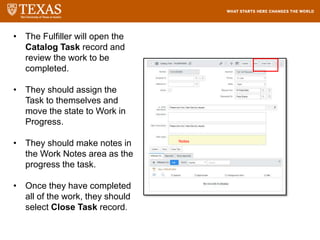
• The Fulfiller will open the
Catalog Task record and
review the work to be
completed.
• They should assign the
Task to themselves and
move the state to Work in
Progress.
• They should make notes in
the Work Notes area as the
progress the task.
• Once they have completed
all of the work, they should
select Close Task record.
Notes
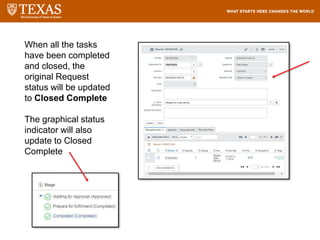
When all the tasks
have been completed
and closed, the
original Request
status will be updated
to Closed Complete
The graphical status
indicator will also
update to Closed
Complete
Questions about the Service
Catalog?
Additional Training on Service Catalog is available
in the Deep Dive for Service Catalog/CMDB
REPORTING OVERVIEW FOR
FULFILLERS
ServiceNow
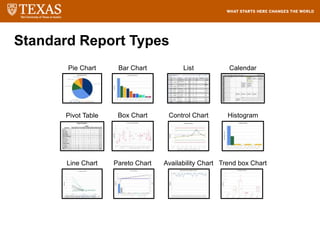
Standard Report Types
Pivot Table Box Chart Control Chart Histogram
Line Chart Pareto Chart Availability Chart Trend box Chart
Pie Chart List Calendar
Bar Chart
3 Ways to Produce Reports
1. Reports can be created from Record Lists
2. Reports can be viewed or modified from existing Out of Box
Reports
3. New Reports can be produced using the built in report
generator
Additional Training on Reporting is available in
the Deep Dive for Reporting
REPORTING
Tool Demo
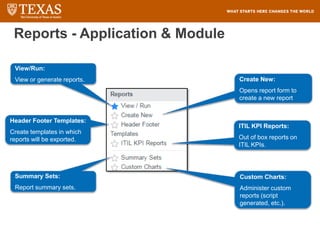
Reports - Application & Module
Custom Charts:
Administer custom
reports (script
generated, etc.).
Summary Sets:
Report summary sets.
ITIL KPI Reports:
Out of box reports on
ITIL KPIs.
Create New:
Opens report form to
create a new report
Header Footer Templates:
Create templates in which
reports will be exported.
View/Run:
View or generate reports.
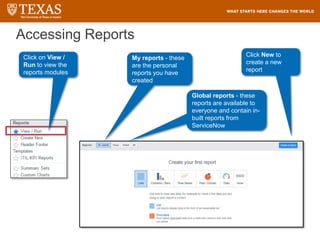
Accessing Reports
My reports - these
are the personal
reports you have
created
Click New to
create a new
report
Click on View /
Run to view the
reports modules
Global reports - these
reports are available to
everyone and contain in-
built reports from
ServiceNow
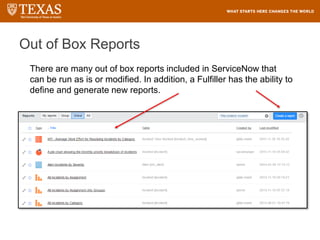
Out of Box Reports
There are many out of box reports included in ServiceNow that
can be run as is or modified. In addition, a Fulfiller has the ability to
define and generate new reports.
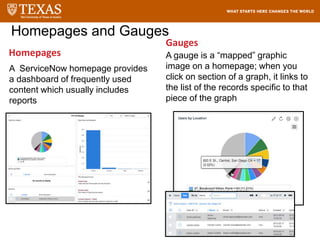
Homepages
A ServiceNow homepage provides
a dashboard of frequently used
content which usually includes
reports
Gauges
Homepages and Gauges
A gauge is a “mapped” graphic
image on a homepage; when you
click on section of a graph, it links to
the list of the records specific to that
piece of the graph
Questions about ServiceNow
Reports?
APPENDICES
INCIDENT DIAGRAMS AND
ACTIVITIES
Appendix
Process Activities Description
The Incident Management process is composed of the following
activities:
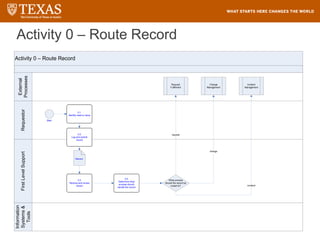
• Activity 0 – Route Record: logging, review and routing of the record to
either Request Fulfillment, Incident or Change Management
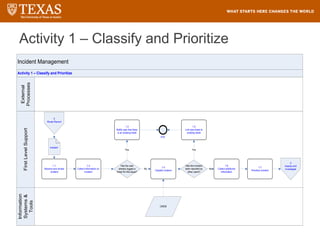
• Activity 1 – Classify and Prioritize: recording, categorization and
prioritization of the incident
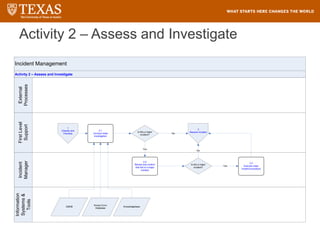
• Activity 2 – Assess and Investigate: evaluation of the incident, trigger of
the major incident procedure if necessary
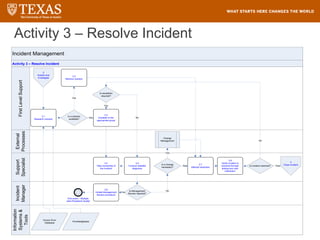
• Activity 3 – Resolve Incident: investigation, escalation and resolution of
the incident
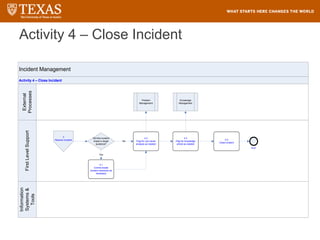
• Activity 4 – Close Incident: review of the incident, communication to
Problem Management and Knowledge Management as necessary and
closing
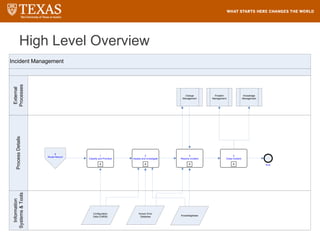
High Level Overview
Incident Management
Information
Systems
&
Tools
Process
Details
External
Processes
3
Resolve Incident
1
Classify and Prioritize
4
Close Incident
2
Assess and Investigate
Change
Management
End
Known Error
Database Knowledgebase
Problem
Management
Configuration
Data (CMDB)
Knowledge
Management
0
Route Record
Activity 0 – Route Record
Requestor
Information
Systems
&
Tools
First
Level
Support
External
Processes
What process
should the record be
routed to?
Start
Record
Change
Management
0.3
Receive and review
record
Incident
Management
Request
Fulfillment
request
change
incident
0.1
Identify need or issue
0.4
Determine what
process should
handle the record
0.2
Log and submit
record
Activity 1 – Classify and Prioritize
Incident Management
Information
Systems
&
Tools
First
Level
Support
External
Processes
Activity 1 – Classify and Prioritize
1.6
Collect additional
information
Has this incident
been reported by
other users?
Yes
2
Assess and
Investigate
1.1
Receive and review
incident
1.5
Link new ticket to
existing ticket
No
0
Route Record
Incident
1.4
Classify incident
Has the user
already logged a
ticket for this issue?
End
1.3
Notify user that there
is an existing ticket
Yes
1.7
Prioritize incident
No
1.2
Collect information on
incident
CMDB
Activity 2 – Assess and Investigate
Incident Management
First
Level
Support
Information
Systems
&
Tools
Incident
Manager
External
Processes
Activity 2 – Assess and Investigate
3
Resolve Incident
1
Classify and
Prioritize
2.1
Conduct initial
investigation
Is this a major
incident?
2.2
Review and confirm
that this is a major
incident
Yes
Known Error
Database
CMDB Knowledgebase
No
2.3
Execute major
incident procedure
Is this a major
incident?
Yes
No
Activity 3 – Resolve Incident
Incident Management
Information
Systems
&
Tools
Incident
Manager
Support
Specialist
First
Level
Support
External
Processes
Activity 3 – Resolve Incident
3.5
Conduct detailed
diagnosis
Is escalation
required?
2
Assess and
Investigate
4
Close Incident
3.7
Attempt resolution
No
Is a change
necessary?
Change
Management
Yes
3.8
Verify incident is
resolved through
testing and user
interaction
3.3
Escalate to the
appropriate group
No
Yes
Is a solution
available?
3.2
Retrieve solution
Yes
3.4
Take ownership of
the incident
Is incident resolved? Yes
No
No
3.1
Research solution
Known Error
Database
Knowledgebase
Is Management
Review required?
No
End event – Multiple
(see Procedure Guide)
3.6
Initiate Management
Review procedure
Yes
Activity 4 – Close Incident
Incident Management
Information
Systems
&
Tools
First
Level
Support
External
Processes
Activity 4 – Close Incident
4.1
Communicate
incident resolution as
necessary
4.4
Close incident
End
3
Resolve Incident
Problem
Management
Knowledge
Management
4.2
Flag for root cause
analysis as needed
4.3
Flag for knowledge
article as needed
Did this incident
impact a larger
audience?
No
Yes
NAVIGATION SLIDES
Appendix
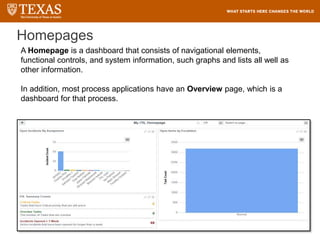
Homepages
A Homepage is a dashboard that consists of navigational elements,
functional controls, and system information, such graphs and lists all well as
other information.
In addition, most process applications have an Overview page, which is a
dashboard for that process.
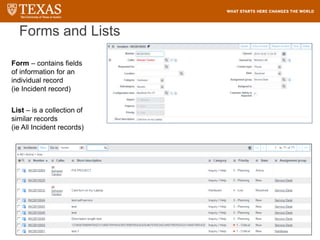
Forms and Lists
Form – contains fields
of information for an
individual record
(ie Incident record)
List – is a collection of
similar records
(ie All Incident records)
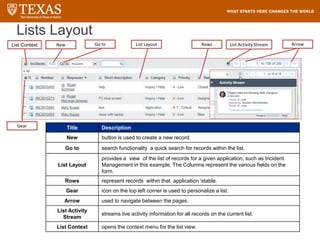
Lists Layout
Title Description
New button is used to create a new record.
Go to search functionality a quick search for records within the list.
List Layout
provides a view of the list of records for a given application, such as Incident
Management in this example. The Columns represent the various fields on the
form.
Rows represent records within that application ‘stable.
Gear icon on the top left corner is used to personalize a list.
Arrow used to navigate between the pages.
List Activity
Stream
streams live activity information for all records on the current list.
List Context opens the context menu for the list view.
New Go to List Layout Rows
Gear
Arrow
List Activity Stream
List Context
Personalize List
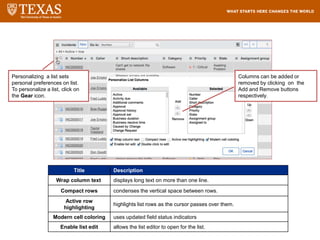
Personalizing a list sets
personal preferences on list.
To personalize a list, click on
the Gear icon.
Columns can be added or
removed by clicking on the
Add and Remove buttons
respectively.
Title Description
Wrap column text displays long text on more than one line.
Compact rows condenses the vertical space between rows.
Active row
highlighting
highlights list rows as the cursor passes over them.
Modern cell coloring uses updated field status indicators
Enable list edit allows the list editor to open for the list.
Personalize List – Reset to Default
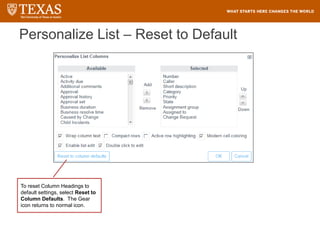
To reset Column Headings to
default settings, select Reset to
Column Defaults. The Gear
icon returns to normal icon.
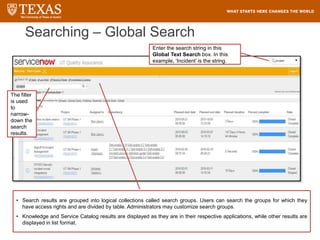
Enter the search string in this
Global Text Search box. In this
example, ‘Incident’ is the string.
Searching – Global Search
• Search results are grouped into logical collections called search groups. Users can search the groups for which they
have access rights and are divided by table. Administrators may customize search groups.
• Knowledge and Service Catalog results are displayed as they are in their respective applications, while other results are
displayed in list format.
The filter
is used
to
narrow-
down the
search
results.
Searching – List
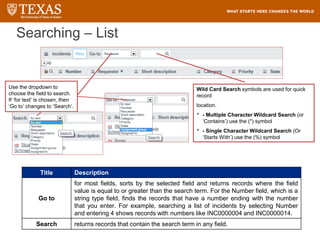
Wild Card Search symbols are used for quick
record
location.
• - Multiple Character Wildcard Search (or
‘Contains’) use the (*) symbol
• - Single Character Wildcard Search (Or
‘Starts With’) use the (%) symbol
Use the dropdown to
choose the field to search.
If ‘for text’ is chosen, then
‘Go to’ changes to ‘Search’.
Title Description
Go to
for most fields, sorts by the selected field and returns records where the field
value is equal to or greater than the search term. For the Number field, which is a
string type field, finds the records that have a number ending with the number
that you enter. For example, searching a list of incidents by selecting Number
and entering 4 shows records with numbers like INC0000004 and INC0000014.
Search returns records that contain the search term in any field.
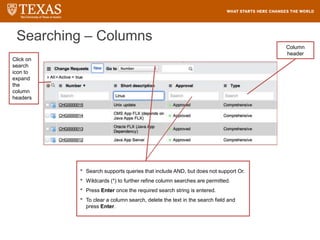
Searching – Columns
• Search supports queries that include AND, but does not support Or.
• Wildcards (*) to further refine column searches are permitted.
• Press Enter once the required search string is entered.
• To clear a column search, delete the text in the search field and
press Enter.
Click on
search
icon to
expand
the
column
headers
Column
header
Searching – Filter
The system will display breadcrumbs at the top of the
screen, displaying the applied conditions in the filter
and the filtered results
1. Click
on drop
down
icon to
expand
the filter.
2. Select a field
from the drop
down list, select
an operator, and
then enter or
select the value of
the field to filter
by.
Click the AND
condition or the
OR condition to
add more
relationships to
the filter
Click Delete [X] to
remove a
condition
3. Click on Run to view the
results.
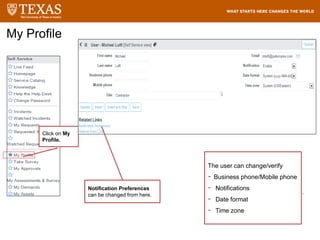
My Profile
The user can change/verify
- Business phone/Mobile phone
- Notifications
- Date format
- Time zone
Click on My
Profile.
Notification Preferences
can be changed from here.
My Profile
METRICS
Appendix
Definitions
Critical Success Factors (CSF) – something that must happen if an IT
service, process, plan, project or other activity is to succeed
Key Performance Indicators (KPI) – are used to measure the
achievement of each critical success factor
Operational Metric – something that is measured and reported to help
manage a process, IT service or activity
Note: Phase 1 metrics are under review
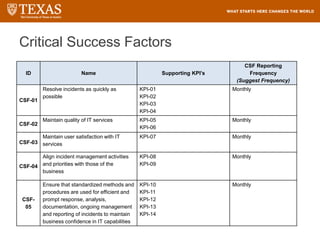
Critical Success Factors
116
ID Name Supporting KPI’s
CSF Reporting
Frequency
(Suggest Frequency)
CSF-01
Resolve incidents as quickly as
possible
KPI-01
KPI-02
KPI-03
KPI-04
Monthly
CSF-02
Maintain quality of IT services KPI-05
KPI-06
Monthly
CSF-03
Maintain user satisfaction with IT
services
KPI-07 Monthly
CSF-04
Align incident management activities
and priorities with those of the
business
KPI-08
KPI-09
Monthly
CSF-
05
Ensure that standardized methods and
procedures are used for efficient and
prompt response, analysis,
documentation, ongoing management
and reporting of incidents to maintain
business confidence in IT capabilities
KPI-10
KPI-11
KPI-12
KPI-13
KPI-14
Monthly
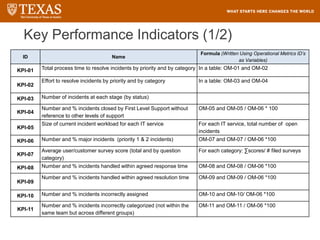
Key Performance Indicators (1/2)
117
ID Name
Formula (Written Using Operational Metrics ID’s
as Variables)
KPI-01 Total process time to resolve incidents by priority and by category In a table: OM-01 and OM-02
KPI-02
Effort to resolve incidents by priority and by category In a table: OM-03 and OM-04
KPI-03 Number of incidents at each stage (by status)
KPI-04
Number and % incidents closed by First Level Support without
reference to other levels of support
OM-05 and OM-05 / OM-06 * 100
KPI-05
Size of current incident workload for each IT service For each IT service, total number of open
incidents
KPI-06 Number and % major incidents (priority 1 & 2 incidents) OM-07 and OM-07 / OM-06 *100
KPI-07
Average user/customer survey score (total and by question
category)
For each category: ∑scores/ # filed surveys
KPI-08 Number and % incidents handled within agreed response time OM-08 and OM-08 / OM-06 *100
KPI-09
Number and % incidents handled within agreed resolution time OM-09 and OM-09 / OM-06 *100
KPI-10 Number and % incidents incorrectly assigned OM-10 and OM-10/ OM-06 *100
KPI-11
Number and % incidents incorrectly categorized (not within the
same team but across different groups)
OM-11 and OM-11 / OM-06 *100
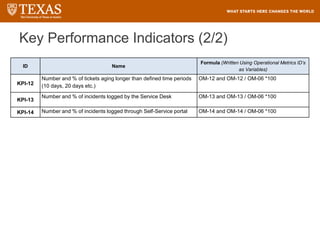
Key Performance Indicators (2/2)
118
ID Name
Formula (Written Using Operational Metrics ID’s
as Variables)
KPI-12
Number and % of tickets aging longer than defined time periods
(10 days, 20 days etc.)
OM-12 and OM-12 / OM-06 *100
KPI-13
Number and % of incidents logged by the Service Desk OM-13 and OM-13 / OM-06 *100
KPI-14 Number and % of incidents logged through Self-Service portal OM-14 and OM-14 / OM-06 *100
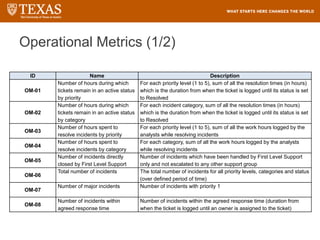
Operational Metrics (1/2)
119
ID Name Description
OM-01
Number of hours during which
tickets remain in an active status
by priority
For each priority level (1 to 5), sum of all the resolution times (in hours)
which is the duration from when the ticket is logged until its status is set
to Resolved
OM-02
Number of hours during which
tickets remain in an active status
by category
For each incident category, sum of all the resolution times (in hours)
which is the duration from when the ticket is logged until its status is set
to Resolved
OM-03
Number of hours spent to
resolve incidents by priority
For each priority level (1 to 5), sum of all the work hours logged by the
analysts while resolving incidents
OM-04
Number of hours spent to
resolve incidents by category
For each category, sum of all the work hours logged by the analysts
while resolving incidents
OM-05
Number of incidents directly
closed by First Level Support
Number of incidents which have been handled by First Level Support
only and not escalated to any other support group
OM-06
Total number of incidents The total number of incidents for all priority levels, categories and status
(over defined period of time)
OM-07
Number of major incidents Number of incidents with priority 1
OM-08
Number of incidents within
agreed response time
Number of incidents within the agreed response time (duration from
when the ticket is logged until an owner is assigned to the ticket)
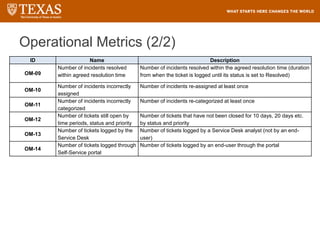
Operational Metrics (2/2)
120
ID Name Description
OM-09
Number of incidents resolved
within agreed resolution time
Number of incidents resolved within the agreed resolution time (duration
from when the ticket is logged until its status is set to Resolved)
OM-10
Number of incidents incorrectly
assigned
Number of incidents re-assigned at least once
OM-11
Number of incidents incorrectly
categorized
Number of incidents re-categorized at least once
OM-12
Number of tickets still open by
time periods, status and priority
Number of tickets that have not been closed for 10 days, 20 days etc.
by status and priority
OM-13
Number of tickets logged by the
Service Desk
Number of tickets logged by a Service Desk analyst (not by an end-
user)
OM-14
Number of tickets logged through
Self-Service portal
Number of tickets logged by an end-user through the portal
Review Learning Objectives
General Navigation in ServiceNow
Incident Management
• Review the Incident Management process, roles, key concepts and
metrics
• Review how Knowledge Management interacts with Incident
Management and how to submit knowledge articles
• How to use the Incident Management application and modules within
ServiceNow
Service Catalog
• Service Catalog Overview for Fulfillers including approvals and
catalog tasks
ServiceNow Reporting Overview
• Appendix – Additional Navigation topics, Process Diagrams, Metrics
Questions about Fulfiller Training

Service Desk Fulfiller Training.pptx

  • 1.
  • 2.
    Training Links • Fulfiller:http://utqa.service-now.com • Self Service Website: http://utqa.service- now.com/utss
  • 3.
    Benefits of ServiceNowto UT • UT is adopting and adapting leading Service Management processes to improve our service delivery to our customers • ServiceNow is an easy to use service management tool based on the ITIL framework • Provides a single system of record for UT • Enables UT to automate and standardize processes and activities that support the University • Leverages self-service capabilities for personnel and end users • Enables UT to provide efficient and consistent service delivery to our faculty, staff, and students • Provides the ability to connect campus through business process workflows and measure service delivery
  • 4.
    What’s Changing inPhase 1 • Effective Go-Live Date, tickets should be entered into ServiceNow rather than Footprints • Break-fix events will generally be entered in ServiceNow as an incident • Requests published in ServiceNow, rather than being incidents, will be handled as separate request tickets submitted through Self Service Website • Public Self Help will be located on the Self Service Website • For the end user, the process for submitting requests and incidents to participating Service/Help Desks will not change – phone numbers, emails will not change
  • 5.
    Training Scope • Thistraining is aimed at IT Fulfillers, specifically those working for the UT Service Desk • Processes in Phase 1 that impact Fulfillers include incident management, service request and catalog, knowledge • A Fulfiller is defined as someone who is assigned a task to perform in the tool and has the appropriate roles defined in the tool
  • 6.
    Learning Objectives General Navigationin ServiceNow Incident Management • Review the Incident Management process, key concepts and metrics • Review how Knowledge Management interacts with Incident Management and how to submit knowledge articles • How to use the Incident Management application and modules within ServiceNow Service Catalog • Service Catalog Overview for Fulfillers including approvals and catalog tasks ServiceNow Reporting Overview Appendix • Additional Navigation topics, Process Diagrams, Metrics
  • 7.
  • 8.
    Logging into ServiceNow •ServiceNow is a cloud based application and can be accessed through a web browser using the following URL: https://ut.service-now.com • To login to the application use your UT EID and password
  • 9.
  • 10.
    Title Description Banner Frame runsacross the top of every page and contains a logo, global navigation controls, and tools Application Navigator provides links to all applications and modules. Your assigned roles will determine which applications you have access to Content Frame displays welcome page, information such as lists, forms, homepages, and wizards Edge area for creating bookmarks and favourites that are assigned to your specific user Content Frame Main Homepage Edge Application Navigator Banner Frame
  • 11.
    Banner Frame Title Description ServiceNowinstance banner contains a logo and the instance information User currently logged in displays the name of currently logged in user Global Search searches for text in multiple applications Maximise / Minimise Banner alters the amount of space the banner frame occupies Logout Button returns to the Welcome page Settings Menu Personalize the settings of the instance User currently Logged in ServiceNow Instance Banner Collapse/Expand Banner Global Search Settings Menu Logout Button
  • 12.
    Application Navigator Title Description Application Agroup of modules, or pages, that provide related information and functionality in a ServiceNow instance. For example, the Incident application contains modules for creating and viewing incidents Modules Appear as links under each application's navigation bar heading. They have the purpose of presenting the functionalities that make up an application Navigation Filter Helps users quickly access information and services by filtering the items in the application navigator or opening forms and lists directly Application Navigation Filter Modules
  • 13.
    Use the FilterNavigator to navigate quickly to Applications and/or Modules Simply begin typing the Application or Module name All Modules with your Keyword displayed All Modules within an Application containing your Keyword displayed Filter Navigator: Applications and Modules 1 2 3
  • 14.
    Wildcard Search SyntaxDoes a Search *mySearchTerm Contains mySearchTerm% Starts with %mySearchTerm Ends with !*mySearchTerm Does not contain =mySearchTerm Equals !=mySearchTerm Does not equal mySearchTerm No leading or trailing Wildcard(s) Greater than or equal to mySearchTerm Search: Search Lists
  • 15.
    Edge Toolbar Title Description ToggleNavigator shows or hides the application navigator List and Form View splits the content frame into two vertical panes, with the list pane on the left and the form pane on the right. To split the content pane horizontally, click the gear icon and then click Split Layout Horizontal Tagged documents displays the Tagged Documents page All bookmarks provides a list of all bookmarks in the Edge
  • 16.
    The Navigation Paneat the left side of the screen can be used to navigate to various application, modules, forms and list views: Self-Service Module (select topics)  Initiate Chat with Service Desk  View live feed information  View their Homepage  View the service catalog ordering page  View Knowledge Articles  Report an Incident or view their open incidents  View their Service Catalog requests, requested items and watched requested items  Watched Requested Items  Finance  View their ServiceNow profile to update their information  My Assessments & Surveys This view is only available to Fulfillers with ITIL role Self-Service Modules
  • 17.
    Any Questions aboutNavigation in ServiceNow at this point? See additional slides on Navigation in the Appendix
  • 18.
  • 19.
    What is anincident? A problem is the underlying unknown cause of one or more incidents. An incident is an unplanned interruption or a reduction in the quality of a service. Incident Management covers the entire lifecycle of an incident from its detection until its resolution and closure. Incident Management does not include root cause identification, trend analysis, and proactive implementation of changes targeted to prevent future incidents. These areas are part of the Problem Management process and/or Change Management process. These processes are covered in later phases of the program. A request is a channel for users to request and receive standard services
  • 20.
    Definitions Title Description Incident Management The processresponsible for managing the lifecycle of all incidents. Incident Management ensures that normal service operation is restored as quickly as possible and the business impact is minimized. Incident An unplanned interruption to or reduction in the quality of an IT service. Failure of a configuration item that has not yet affected service is also an incident. Major Incident An incident with the highest category of impact and urgency for an incident. A major incident results in significant disruption to the business. (Global Incident) Workaround A temporary solution to an incident or problem that reduces or eliminates the impact on IT services but does not address the root cause.
  • 21.
    Incident Lifecycle New Assigned Work in Progress/Es calation Resolved Closed Activeor Passive Closure Incomplete Service Restoration Pending Valid Pending Condition Pending Service Restored Reassign ticket Reassign ticket
  • 22.
    User Information andAssignment Groups • Every 2 hours user account information is imported from the TED System. • Fulfillers have been placed into Assignment Groups. • All Assignment Groups have been given the ITIL role in the ServiceNow tool, which allows them to access and work on Incidents, Configuration Items, Service Requests and Reports. • Fulfillers will also be able to draft new Knowledge articles via the Knowledge Bases they have access to. • Fulfillers will also be able to request Catalog Items from the Service Catalog they have access to. • Assignment Groups will be managed by the ServiceNow team via requests from the department manager.
  • 23.
    Visibility • Tickets haveopen visibility in ServiceNow • HR and ISO will be secure • By default, you will only see your assignment groups’ tickets • Field on ticket form for confidential data • Category/checkbox that can be used to mark entire ticket private • Ticket to ServiceNow team to remove confidential data
  • 24.
    END USER PERSPECTIVEAND THE SELF SERVICE WEBSITE Incident Management
  • 25.
    Requestors (End Users)can contact the Service Desk by phone or by using the Create Ticket or Chat features on the Self Service Website. End Users can also check the status of their Incidents or Requests
  • 26.
  • 27.
    If they selectCreate Ticket, a Contact Form is created and processed by a Service Desk analyst.
  • 28.
    The header ofthe form contains the following information: Describe the assistance you need. The Service Desk will log your request and reach out to you via your preferred communication method. Please note, if your issue is urgent contact the Service Center via phone 512-475-9400. Note the following Notice regarding Information Confidentially: Information Protection Notice: No confidential information, including Passwords, Personally Identifiable Information (PII) or Protected Health Information (PHI), can be included anywhere in the ServiceNow system. This includes in the description, work notes, attachments and other related fields. If such information is needed, provide the contact information to obtain any necessary passwords PII/PHI data outside of the system
  • 29.
    As a minimumthe Requestor needs to enter a short description of the issue. The Requested By field will be automatically entered. This gives the Service Desk basic user information. But, to assist the Service Desk, they should enter additional helpful information: • More descriptive details • Requested For (if requested for someone else) • Alternative phone and emails • Location of the issue Once all the form is complete, the Requestor should select Submit at the bottom right hand corner of the form. This creates an Incident ticket, which is sent to the Service Desk.
  • 30.
  • 31.
  • 32.
    Service Desk Module ServiceDesk Module – UT Service Desk Only  Callers – View caller’s user information  Incidents – View active incidents  Knowledge – View the knowledge base  My Work – work queue containing a list of all tasks assigned to me  My Groups Work – work queue containing a list of all tasks assigned to my work groups  My Approvals - work queue containing a list of all tasks waiting for my approval Contact Form  New Contact – Create a new Contact Form  My Contacts – View Contacts you created  My Open Contacts – View Contacts that are still open  All Open Contacts – View all open Contacts
  • 33.
  • 34.
    Incident Management Applicationand Modules 34 Module to display all Current Outages Module to display all open but unassigned incidents to the assignment groups that user is part assigned Module to display all incidents that are closed Module to display all incidents irrespective of status Incident overview dashboard, displays charts, reports, and views on the status of the incidents Module to display all incidents assigned to the logged in user Module to display all incidents that are resolved Module to display all open incidents Module Function to open a new incident
  • 35.
    My Groups WorkQueue Navigate to Service Desk > My Groups Work - to view a list of all tasks assigned to the groups to which you belong (not assigned to a specific person) Groups I am a member of No one assigned yet
  • 36.
    My Work Queue Navigateto Service Desk > My Work - to view a list of all tasks assigned to you. These tasks have come from Incidents
  • 37.
    ITIL Homepage Fulfillers canuse the reports on their Homepage to easily access My Groups Work and My Work queues. Includes Incident and Service Catalog Tasks.
  • 38.
  • 39.
    Creating a NewIncident Steps - 1. Login into ServiceNow (as a Fulfiller) 2. Navigate to Incident > Create New or type ‘Incident’ in the filter option 3. Populate all the fields with * (mandatory fields) 4. Once the fields are populated, click Save or Submit (see next slides for details)
  • 40.
    Incident Handling • Anend user may contact the Service Desk via the Self Service Website and select Create Ticket. ServiceNow will create an Incident record in the New state and assign it to the ITS Service Desk. • The Service Desk agent will review the ticket, contact the end user for additional information, and complete the incident form, updating the Affected CI, Category, and Subcategory fields. • If the Service Desk can resolve the issue they will Assign the incident to themselves, complete whatever tasks are required to resolve the incident, updating the Work Notes field, and change the state to Resolved. • Service Desk agent can also assign the Incident ticket to a Fulfiller group (also known as an Assignment Group in ServiceNow). This can be achieved in one of two ways. First, based on the Affected CI, the ticket will be automatically assigned to the team responsible for that CI. Secondly, the Service Desk agent can directly assign to the appropriate Assignment Group.
  • 41.
    Incident Handling • Fulfillerteams will receive an email notification that an Incident Ticket has been assigned to their team in Service Desk > My Groups Work • Anyone in that Assignment Group can assign the ticket to themselves or anyone in the group. • Once a ticket has been assigned to an individual, it is visible in Service Desk > My Work. • The Fulfiller should open and review the ticket. The Fulfiller should place the ticket state to Work in Progress. They can also place the ticket into one of several Pending States if it is necessary to open a Change Request or if they are waiting on information from the customer, a problem investigation, or reply from a vendor. • The Fulfiller should keep track of everything they are doing in the Work Notes area.
  • 42.
    Incident Handling • Ifthe Incident needs to be assigned to another team, the Fulfiller can reassign the ticket to that team. • Once the work has been completed and the service restored, the Fulfiller should select the Resolve Incident button. Mandatory fields in the Closure Tab, Close Code and Close Notes need to be completed. Also, the Fulfiller can check the Knowledge box to generate a draft Knowledge article. • The Incident will close automatically in 5 days.
  • 43.
    Key Concept –Impact, Urgency, Priority Impact 1 Unable to perform critical services, interruption or impairment to business operations 2 Degraded ability to perform critical services, impacts one or more users 3 Inability or degraded ability to perform functions that do not affect critical services Urgency 1 No workaround exists, requires immediate attention 2 Workaround may be available, deadline dependent 3 Does not require immediate attention Incidents are processed in an order determined by three metrics available in the Incident form: • Impact - The potential impact that an unresolved issue has on the ability of the business to effectively carry on its activities or deliver its services • Urgency – The speed that is considered appropriate to resolve an issue of a given impact • Priority – How quickly the service desk should address the problem
  • 44.
    Key Concept -Prioritization Matrix The Prioritization Matrix reflects the Business Impact and Situational Urgency combinations and the resulting Incident/Problem Priority
  • 45.
    Service Level Agreements(SLA) Name Duration Schedule Priority 1 Response 15 min 24x7 Priority 1 Resolution 4 hours 24 x7 Priority 2 Response 1 hour 8-5 Weekdays Excluding Holidays Priority 2 Resolution 9 hours 8-5 Weekdays Excluding Holidays Priority 3 Response 4 hours 8-5 Weekdays Excluding Holidays Priority 3 Resolution 18 hours 8-5 Weekdays Excluding Holidays Priority 4 Response 9 hours 8-5 Weekdays Excluding Holidays Priority 4 Resolution 45 hours 8-5 Weekdays Excluding Holidays
  • 46.
    % of SLAType Notification Sent To At 50% SLA Warning Fulfiller Assigned to Incident At 75% SLA Warning Fulfiller Assigned to Incident Ticket Coordinator SLA Notifications
  • 47.
    Incident State ValueDescription New New is the default state when an incident is initially created. Tickets created from Call Forms default to “New” status. From “New” you can only move to an “Assigned” state. Assigned The Assigned state reflects that the incident has been assigned to a support group. From the “Assigned” state, you can move to “Work in Progress” but you must assign an individual in the “Assigned to” field. Work In Progress An incident in Work In Progress state indicates that the incident investigation work has started and is currently in progress. All “Work in Progress” incidents must have an individual assigned to it. From Work in Progress, you can move back to “Assigned” or into “Pending” or “Resolved.” Pending Once you select “Pending” you must select a sub-state (Pending Change; Pending Customer; Pending Vendor, and Pending Problem). When in a Pending state, an individual must be assigned to the incident. From a “Pending” state you can move to “Assigned,” “Work in Progress” or “Resolved.” Resolved An incident will reach the Resolved state once the service has been restored, as determined by the resolver assignment group/assignee and categorized with a closure code and close notes. A resolved incident can be reopened and reverted back to “Assigned,” “Work In Progress” or you can close the incident. Closed Incident will move to Closed state 5 business days after entering resolved state when closure method is set as “email” (passive closure). When closure method is set to “phone” (active closure) the incident can only be moved to closed state by a service desk agent through a manual action on the ticket. The incident lifecycle contains the following states:
  • 48.
    Notifications Conditions Recipient When anew incident is created (self service or create new incident) Customer, Watch List When assignment group of an incident changes. Ticket Coordinator Assigned To Field Changes assigned_to When an ITIL User adds additional comment Customer, Watch List When a comment is added to the worknotes Assigned To, Work Notes List When the additional comments is updated by customer (within SN or by email response) assigned_to,watch_list When incident state changes to resolved Customer, Watch List When an SLA has reached 50% of its duration Assigned To, Ticket Coordinator When an SLA has reached 75% of its duration Assigned To, AG Manager When an SLA has breached Assigned To, AG Manager, AG Director
  • 49.
    Notification Examples Email Subject:[Task] [Number] has been opened on your behalf To Whom It May Concern, We have received your [Incident/Request][Number]. Summary: [Short Description of Incident/Request]. Click Here to view: [Link to Incident/Request] Email Subject: [Task] [Number] has been updated by Requestor To Whom It May Concern, [Incident/Request][Number] has been updated by [Name]. Summary: [Short Description] [Work Notes/Comments Update] Click here to view: [Link to Incident/Request]
  • 50.
    Categorization Incident Categories Each Categoryhas a Subcategory Link to Categorization KB
  • 51.
    Activity Log Changes tofields on the record, notifications sent, and entries into the Work Notes field are tracked in the Activity Log section on the Notes tab at the bottom of Incident records. Note that any text entered into the Additional comments field on the Notes tab is visible to the customer.
  • 52.
  • 53.
    53 Number, a read-onlyfield is a unique identifier that is system generated Name of user requesting the Incident Click on any magnifying glass icon will return a list of available values for that field Click on the magnifying glass icon to pick the location If this incident is requested for some else, type in that person Chat Direct Entry Email Event Monitoring Phone (default) Self Service Walk-in Type in Short description of the incident. This will return a list of available helpful knowledge articles. The articles can be reviewed and/or attached to the ticket Main Form - Left

  • 54.
    Main Form -Right 54 Enter any special User Information System keeps track of when incident was opened and the total time spent Who completed the Incident Form
  • 55.
    Main Form –Notes Tab Watch list allows end users to subscribe to notifications Work notes list allows fulfillers to subscribe to work notes notifications Comments entered in this field are visible to support group(s) Comments entered in this field are visible to requestor Notes Tab or Section The Notes Tab will be used as the Fulfiller teams work to resolve the Incident and keeps track of the work they perform
  • 56.
    Incident Assignment In manycases the Incident will auto assign based on the CI or Category/Subcategory. There is also an option to choose a CI Assignment Group, Department Assignment Group (based on the Requested For field), or Location Assignment Group (based on Location field). Fulfillers can override the auto assignment rule. If they do, the Assignment Override Reason field becomes mandatory.
  • 57.
    Related Records Tab Relatethe parent incident, if the current incident is a duplicate Related Records Section
  • 58.
    Closure Tab Closure Information Section Selectif a draft knowledge article should be created from resolution Select if a root cause investigation should be initiated First Call Resolution - Select if escalated Incident could have been resolved at Tier 1 Who closed the incident and the date it was closed When the incident was first opened, existing Knowledge articles could have been used to help resolution. As the incident is resolved, an opportunity exists to create a new Knowledge article which might help to resolve future incidents. Selecting the Knowledge option opens a draft Knowledge article.
  • 59.
    Closure Tab Before aticket can be marked as Resolved, it is mandatory to enter a Close Code and Close Notes
  • 60.
    Main Form –Bottom Tabs 60 These tabs are visible once the incident has been created and captures all SLAs, Child Incidents, Time Cards, and Outages that are in scope for the incident
  • 61.
  • 62.
    SERVICE CATALOG OVERVIEW FORFULFILLERS ServiceNow
  • 63.
    To Request anItem, open the Service Catalog via the Self Service Website
  • 64.
  • 65.
    Request Task(s) Approvals Request Item(s) Service Catalog Service Request Item A (e.g. Desktop) Task1 Task n Item B Tasks… Item C Tasks… Structure of a Service Request As Required by Item or Cost
  • 66.
  • 67.
    Workflows in ServiceNow A workflow is a process built into the tool that closely follows the business process steps. Based on answers to questions in the Catalog Item form and the Catalog Item chosen, decision logic fires off approval requests and catalog tasks.  Over time the Service Catalog will expand to include many different types of service requests and catalog items. Each of these Catalog Items has the potential to have a different type of workflow behind it.  The three main roles – Requester, Approver, and Fulfiller, will always be present, but the actual steps and activities in the workflow may be different, based on the Catalog Item.
  • 68.
    Next, select theappropriate Catalog. Select the header and the available catalog items are listed. Items listed are the top requested items. Some catalogs may have categories of items which might be broken down further into sub categories.
  • 69.
    User selects theCatalog Item they would like to request. Note: the list of items in the Service Catalog will continue to expand as more items are added.
  • 70.
    Selection of a catalogitem opens the unique catalog form for that item. Requesters completes the form. Mandatory fields marked * When complete, select Order Now
  • 71.
    Once the orderhas been placed, the system generates a message stating an order has been submitted and indicates the Request Number (REQ) and Requested Item (RITM). Status of the Request is kept track of by the graphic visual Stage tracker. Tracker Request Number - REQ Requested Item - RITM
  • 72.
    Catalog Item Approvalsand Tasks Based on the Workflow for that Catalog Item, ServiceNow will generate the following: • One or more approval requests. Based on the value of the item, purchasing policy, of other policies, it may be necessary to obtain one or more approvals from individuals. • Once the items have been approved (if required), ServiceNow generates Fulfillment tasks to various Assignment Groups. This may include purchasing, release form a storeroom, software installation, set up, etc
  • 73.
  • 74.
    Approvals Once anorder has been placed, in most cases an approval is required. If the request is rejected, the request is closed. If the request goes to multiple approvers, only one approval is required and the remaining approvals are no longer required. Go to Service Catalog > My Approvals. This opens a list of Open Approvals waiting for the approver to take action. Selecting an Item opens the Approval form for that Requested Item
  • 75.
    Approval Form The ApprovalForm gives the Approver the ability to Approve or Reject, as well as add comments to the record. Comments are added to the Activity Log
  • 76.
    Approval Form If theapprover wants to see more about the request itself before they approve or reject, they can hover over the icon at the right of Requested Item Number. This will open a popup box containing all the details of the Requested Item. They can also click on the icon which will open the Requested Item record itself.
  • 77.
    Requested Item Form Whenthey click the icon, the Requested Item form opens. This form contains information about who requested it, what is the justification (if required), budget code (if required) and any specific information or options from the original Service Catalog page.
  • 78.
    Requested Item Form Atthe bottom of the Requested Item form, as the request moves through the workflow, a cumulative list of the approvers from each stage is maintained along with the status or state of their approval or rejection. No Longer Required indicates that one of multiple approvers for that workflow state has already approved the request.
  • 79.
  • 80.
    Fulfillment tasks willbe sent to various defined fulfiller groups for that particular requested item. Members of the assignment group will receive email notification that a task has been assigned to the group. Fulfiller Tasks
  • 81.
    The email willnotify them that their group has a task waiting in My Groups Work. A member of the group should assign the Task to themselves or another member of the team. Once the task is assigned, the task will move to the individual. This can accessed by going to: Service Catalog > My Work This opens a list of open Catalog Tasks waiting for them to work on.
  • 82.
    • The Fulfillerwill open the Catalog Task record and review the work to be completed. • They should assign the Task to themselves and move the state to Work in Progress. • They should make notes in the Work Notes area as the progress the task. • Once they have completed all of the work, they should select Close Task record. Notes
  • 83.
    When all thetasks have been completed and closed, the original Request status will be updated to Closed Complete The graphical status indicator will also update to Closed Complete
  • 84.
    Questions about theService Catalog? Additional Training on Service Catalog is available in the Deep Dive for Service Catalog/CMDB
  • 85.
  • 86.
    Standard Report Types PivotTable Box Chart Control Chart Histogram Line Chart Pareto Chart Availability Chart Trend box Chart Pie Chart List Calendar Bar Chart
  • 87.
    3 Ways toProduce Reports 1. Reports can be created from Record Lists 2. Reports can be viewed or modified from existing Out of Box Reports 3. New Reports can be produced using the built in report generator Additional Training on Reporting is available in the Deep Dive for Reporting
  • 88.
  • 89.
    Reports - Application& Module Custom Charts: Administer custom reports (script generated, etc.). Summary Sets: Report summary sets. ITIL KPI Reports: Out of box reports on ITIL KPIs. Create New: Opens report form to create a new report Header Footer Templates: Create templates in which reports will be exported. View/Run: View or generate reports.
  • 90.
    Accessing Reports My reports- these are the personal reports you have created Click New to create a new report Click on View / Run to view the reports modules Global reports - these reports are available to everyone and contain in- built reports from ServiceNow
  • 91.
    Out of BoxReports There are many out of box reports included in ServiceNow that can be run as is or modified. In addition, a Fulfiller has the ability to define and generate new reports.
  • 92.
    Homepages A ServiceNow homepageprovides a dashboard of frequently used content which usually includes reports Gauges Homepages and Gauges A gauge is a “mapped” graphic image on a homepage; when you click on section of a graph, it links to the list of the records specific to that piece of the graph
  • 93.
  • 94.
  • 95.
  • 96.
    Process Activities Description TheIncident Management process is composed of the following activities: • Activity 0 – Route Record: logging, review and routing of the record to either Request Fulfillment, Incident or Change Management • Activity 1 – Classify and Prioritize: recording, categorization and prioritization of the incident • Activity 2 – Assess and Investigate: evaluation of the incident, trigger of the major incident procedure if necessary • Activity 3 – Resolve Incident: investigation, escalation and resolution of the incident • Activity 4 – Close Incident: review of the incident, communication to Problem Management and Knowledge Management as necessary and closing
  • 97.
    High Level Overview IncidentManagement Information Systems & Tools Process Details External Processes 3 Resolve Incident 1 Classify and Prioritize 4 Close Incident 2 Assess and Investigate Change Management End Known Error Database Knowledgebase Problem Management Configuration Data (CMDB) Knowledge Management 0 Route Record
  • 98.
    Activity 0 –Route Record Activity 0 – Route Record Requestor Information Systems & Tools First Level Support External Processes What process should the record be routed to? Start Record Change Management 0.3 Receive and review record Incident Management Request Fulfillment request change incident 0.1 Identify need or issue 0.4 Determine what process should handle the record 0.2 Log and submit record
  • 99.
    Activity 1 –Classify and Prioritize Incident Management Information Systems & Tools First Level Support External Processes Activity 1 – Classify and Prioritize 1.6 Collect additional information Has this incident been reported by other users? Yes 2 Assess and Investigate 1.1 Receive and review incident 1.5 Link new ticket to existing ticket No 0 Route Record Incident 1.4 Classify incident Has the user already logged a ticket for this issue? End 1.3 Notify user that there is an existing ticket Yes 1.7 Prioritize incident No 1.2 Collect information on incident CMDB
  • 100.
    Activity 2 –Assess and Investigate Incident Management First Level Support Information Systems & Tools Incident Manager External Processes Activity 2 – Assess and Investigate 3 Resolve Incident 1 Classify and Prioritize 2.1 Conduct initial investigation Is this a major incident? 2.2 Review and confirm that this is a major incident Yes Known Error Database CMDB Knowledgebase No 2.3 Execute major incident procedure Is this a major incident? Yes No
  • 101.
    Activity 3 –Resolve Incident Incident Management Information Systems & Tools Incident Manager Support Specialist First Level Support External Processes Activity 3 – Resolve Incident 3.5 Conduct detailed diagnosis Is escalation required? 2 Assess and Investigate 4 Close Incident 3.7 Attempt resolution No Is a change necessary? Change Management Yes 3.8 Verify incident is resolved through testing and user interaction 3.3 Escalate to the appropriate group No Yes Is a solution available? 3.2 Retrieve solution Yes 3.4 Take ownership of the incident Is incident resolved? Yes No No 3.1 Research solution Known Error Database Knowledgebase Is Management Review required? No End event – Multiple (see Procedure Guide) 3.6 Initiate Management Review procedure Yes
  • 102.
    Activity 4 –Close Incident Incident Management Information Systems & Tools First Level Support External Processes Activity 4 – Close Incident 4.1 Communicate incident resolution as necessary 4.4 Close incident End 3 Resolve Incident Problem Management Knowledge Management 4.2 Flag for root cause analysis as needed 4.3 Flag for knowledge article as needed Did this incident impact a larger audience? No Yes
  • 103.
  • 104.
    Homepages A Homepage isa dashboard that consists of navigational elements, functional controls, and system information, such graphs and lists all well as other information. In addition, most process applications have an Overview page, which is a dashboard for that process.
  • 105.
    Forms and Lists Form– contains fields of information for an individual record (ie Incident record) List – is a collection of similar records (ie All Incident records)
  • 106.
    Lists Layout Title Description Newbutton is used to create a new record. Go to search functionality a quick search for records within the list. List Layout provides a view of the list of records for a given application, such as Incident Management in this example. The Columns represent the various fields on the form. Rows represent records within that application ‘stable. Gear icon on the top left corner is used to personalize a list. Arrow used to navigate between the pages. List Activity Stream streams live activity information for all records on the current list. List Context opens the context menu for the list view. New Go to List Layout Rows Gear Arrow List Activity Stream List Context
  • 107.
    Personalize List Personalizing alist sets personal preferences on list. To personalize a list, click on the Gear icon. Columns can be added or removed by clicking on the Add and Remove buttons respectively. Title Description Wrap column text displays long text on more than one line. Compact rows condenses the vertical space between rows. Active row highlighting highlights list rows as the cursor passes over them. Modern cell coloring uses updated field status indicators Enable list edit allows the list editor to open for the list.
  • 108.
    Personalize List –Reset to Default To reset Column Headings to default settings, select Reset to Column Defaults. The Gear icon returns to normal icon.
  • 109.
    Enter the searchstring in this Global Text Search box. In this example, ‘Incident’ is the string. Searching – Global Search • Search results are grouped into logical collections called search groups. Users can search the groups for which they have access rights and are divided by table. Administrators may customize search groups. • Knowledge and Service Catalog results are displayed as they are in their respective applications, while other results are displayed in list format. The filter is used to narrow- down the search results.
  • 110.
    Searching – List WildCard Search symbols are used for quick record location. • - Multiple Character Wildcard Search (or ‘Contains’) use the (*) symbol • - Single Character Wildcard Search (Or ‘Starts With’) use the (%) symbol Use the dropdown to choose the field to search. If ‘for text’ is chosen, then ‘Go to’ changes to ‘Search’. Title Description Go to for most fields, sorts by the selected field and returns records where the field value is equal to or greater than the search term. For the Number field, which is a string type field, finds the records that have a number ending with the number that you enter. For example, searching a list of incidents by selecting Number and entering 4 shows records with numbers like INC0000004 and INC0000014. Search returns records that contain the search term in any field.
  • 111.
    Searching – Columns •Search supports queries that include AND, but does not support Or. • Wildcards (*) to further refine column searches are permitted. • Press Enter once the required search string is entered. • To clear a column search, delete the text in the search field and press Enter. Click on search icon to expand the column headers Column header
  • 112.
    Searching – Filter Thesystem will display breadcrumbs at the top of the screen, displaying the applied conditions in the filter and the filtered results 1. Click on drop down icon to expand the filter. 2. Select a field from the drop down list, select an operator, and then enter or select the value of the field to filter by. Click the AND condition or the OR condition to add more relationships to the filter Click Delete [X] to remove a condition 3. Click on Run to view the results.
  • 113.
    My Profile The usercan change/verify - Business phone/Mobile phone - Notifications - Date format - Time zone Click on My Profile. Notification Preferences can be changed from here. My Profile
  • 114.
  • 115.
    Definitions Critical Success Factors(CSF) – something that must happen if an IT service, process, plan, project or other activity is to succeed Key Performance Indicators (KPI) – are used to measure the achievement of each critical success factor Operational Metric – something that is measured and reported to help manage a process, IT service or activity Note: Phase 1 metrics are under review
  • 116.
    Critical Success Factors 116 IDName Supporting KPI’s CSF Reporting Frequency (Suggest Frequency) CSF-01 Resolve incidents as quickly as possible KPI-01 KPI-02 KPI-03 KPI-04 Monthly CSF-02 Maintain quality of IT services KPI-05 KPI-06 Monthly CSF-03 Maintain user satisfaction with IT services KPI-07 Monthly CSF-04 Align incident management activities and priorities with those of the business KPI-08 KPI-09 Monthly CSF- 05 Ensure that standardized methods and procedures are used for efficient and prompt response, analysis, documentation, ongoing management and reporting of incidents to maintain business confidence in IT capabilities KPI-10 KPI-11 KPI-12 KPI-13 KPI-14 Monthly
  • 117.
    Key Performance Indicators(1/2) 117 ID Name Formula (Written Using Operational Metrics ID’s as Variables) KPI-01 Total process time to resolve incidents by priority and by category In a table: OM-01 and OM-02 KPI-02 Effort to resolve incidents by priority and by category In a table: OM-03 and OM-04 KPI-03 Number of incidents at each stage (by status) KPI-04 Number and % incidents closed by First Level Support without reference to other levels of support OM-05 and OM-05 / OM-06 * 100 KPI-05 Size of current incident workload for each IT service For each IT service, total number of open incidents KPI-06 Number and % major incidents (priority 1 & 2 incidents) OM-07 and OM-07 / OM-06 *100 KPI-07 Average user/customer survey score (total and by question category) For each category: ∑scores/ # filed surveys KPI-08 Number and % incidents handled within agreed response time OM-08 and OM-08 / OM-06 *100 KPI-09 Number and % incidents handled within agreed resolution time OM-09 and OM-09 / OM-06 *100 KPI-10 Number and % incidents incorrectly assigned OM-10 and OM-10/ OM-06 *100 KPI-11 Number and % incidents incorrectly categorized (not within the same team but across different groups) OM-11 and OM-11 / OM-06 *100
  • 118.
    Key Performance Indicators(2/2) 118 ID Name Formula (Written Using Operational Metrics ID’s as Variables) KPI-12 Number and % of tickets aging longer than defined time periods (10 days, 20 days etc.) OM-12 and OM-12 / OM-06 *100 KPI-13 Number and % of incidents logged by the Service Desk OM-13 and OM-13 / OM-06 *100 KPI-14 Number and % of incidents logged through Self-Service portal OM-14 and OM-14 / OM-06 *100
  • 119.
    Operational Metrics (1/2) 119 IDName Description OM-01 Number of hours during which tickets remain in an active status by priority For each priority level (1 to 5), sum of all the resolution times (in hours) which is the duration from when the ticket is logged until its status is set to Resolved OM-02 Number of hours during which tickets remain in an active status by category For each incident category, sum of all the resolution times (in hours) which is the duration from when the ticket is logged until its status is set to Resolved OM-03 Number of hours spent to resolve incidents by priority For each priority level (1 to 5), sum of all the work hours logged by the analysts while resolving incidents OM-04 Number of hours spent to resolve incidents by category For each category, sum of all the work hours logged by the analysts while resolving incidents OM-05 Number of incidents directly closed by First Level Support Number of incidents which have been handled by First Level Support only and not escalated to any other support group OM-06 Total number of incidents The total number of incidents for all priority levels, categories and status (over defined period of time) OM-07 Number of major incidents Number of incidents with priority 1 OM-08 Number of incidents within agreed response time Number of incidents within the agreed response time (duration from when the ticket is logged until an owner is assigned to the ticket)
  • 120.
    Operational Metrics (2/2) 120 IDName Description OM-09 Number of incidents resolved within agreed resolution time Number of incidents resolved within the agreed resolution time (duration from when the ticket is logged until its status is set to Resolved) OM-10 Number of incidents incorrectly assigned Number of incidents re-assigned at least once OM-11 Number of incidents incorrectly categorized Number of incidents re-categorized at least once OM-12 Number of tickets still open by time periods, status and priority Number of tickets that have not been closed for 10 days, 20 days etc. by status and priority OM-13 Number of tickets logged by the Service Desk Number of tickets logged by a Service Desk analyst (not by an end- user) OM-14 Number of tickets logged through Self-Service portal Number of tickets logged by an end-user through the portal
  • 121.
    Review Learning Objectives GeneralNavigation in ServiceNow Incident Management • Review the Incident Management process, roles, key concepts and metrics • Review how Knowledge Management interacts with Incident Management and how to submit knowledge articles • How to use the Incident Management application and modules within ServiceNow Service Catalog • Service Catalog Overview for Fulfillers including approvals and catalog tasks ServiceNow Reporting Overview • Appendix – Additional Navigation topics, Process Diagrams, Metrics
  • 122.