We said last time
that communication
is a two-way
process.
What do we mean
by this? Lina?
(finally stops)
I think . . .
(Draws a diagram on the board)
Let’s look at
this diagram on
the board.
What do the
two circles
represent?
Lina?
The first circle
stands for the
speaker. . .
And the second
stands. . . For. . .
(finally stops)
If this circle is for
the speaker, what
could the second
circle be for?
(silence)
If there’s a
speaker there
should be a. . .
Yes Lina?
A listener!
Very good! Why
do we therefore
say that
communication is a
two-way process?
Try to analyze the given
situation.
What seems to be the problem
of the teacher?
What does the teacher try to
do then?
Initially, the teacher poses a question,
the purpose of which is to assess
previous learning.
Second, when the teacher fails to get
an answer, s/he concretizes the
concept by way of diagram on the
board; until s/he finally gets the
correct answer.
This sequence of questioning is
called funneling .
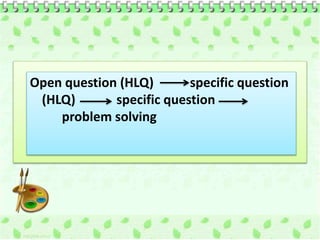
Open question (HLQ) specific question
(HLQ) specific question
problem solving
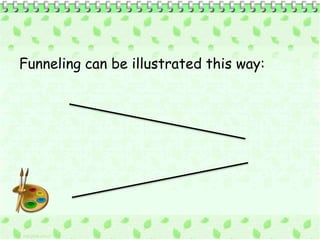
Funneling can be illustrated this way:
Funneling as a sequence of
questions lends itself strongly to
a teaching situation where the
teacher assists the learner to
arrive at an answer. It begins
with an open question and
proceeds to specifics and then to
problem solving.
The teacher initially asked an open
question (HLQ): “what do you mean by
communication is a two-way process?”;
then s/he proceeded to do something
specific: “what do the two circles
represent?”(which is a high level
question); finally s/he asked the
clincher question: “Why do we
therefore say that communication is a
two-way process?(once again this is
a high level question.)
The teacher would
like to go back one part
of a lesson on Type 1
conditional. S/He then
asks the following
questions:
Yesterday, we said
that there are four
types of conditional
and these are types
1,2,3, and 4. lets go
back to the type 1
conditional.
Lets go back to the
type 1 conditional.
What characterizes
Type 1 conditional,
class?
(No answer; there is
complete silence)
What characterizes
Type 1 conditional?
(no answer; there is
complete silence)
Let me write this
sample sentence in the
board
(She writes. . . )
If I come
tomorrow,
I’ll join you
Let’s look at the sentence
once again and divide it
into two parts.
Where can we divide
the sentence?
Yes, Leo?
In the middle,
ma’am.
Would you like to
come to the board
and show to the class
how it is done?
(Leo goes to the front and divides the sentence)
If I come
tomorrow/
I will join you
for lunch.
That’s very good,
Leo! Now which of the
two parts sets the
condition?
The first part; the
if part, ma’am.
Okay. What about
the second part,
Myra?
It shows the
effect. This
means that if the
person comes
tomorrow
something will
happen.
Very good, Myra.
Is this thing
likely to happen,
class? Yes Molly?
Yes, Ma’am.
Okay. What then
characterizes
Type 1 conditional?
Look who’s doing
the dirty work
There is definitely a change in the
attitude of our young people towards work
nowadays. Some years back, most of them
wouldn’t be caught dead holding a broom
or doing anything else associated with
manual labor. But these days they’re
fighting over jobs which call for who will
wield the mops, peel potatoes, and clean
out garbage bins in such places as
McDonalds, Wendy’s, Jollibee, and other
fast-food chains.
Getting the manual jobs in these
establishments has become so
attractive even among the preppies of
elite, private schools where children of
the upper socioeconomic strata of our
society study. This summer, these
students will be competing again for
jobs at the fast-food chains
particularly the multinationals.
The operations manager of
McDonald’s says, “Our company no
longer advertises opening in its
outlets. Each time vacancies are
announced, 500 to a thousand eager
teenagers turn-up, giving the
personnel department headaches.
We just ask the kids who work here
to refer their friends to us.”
Another young girl from a very affluent
family, Alice Soria, a McDonald’s part-timer
explains the phenomenon.
“Before it was low class, cheap, to work in a
restaurant. Now my friends, say: ‘wow,’
‘Heavy!’ when I tell them to work at
McDonald’s.”
Julie Solis, 19, a third year college student,
says her friends at school all want to land
part-time jobs at Wendy’s where she
prepares food.
Sequencing Questions (Funneling)

Sequencing Questions (Funneling)

  • 2.
    We said lasttime that communication is a two-way process. What do we mean by this? Lina?
  • 3.
  • 4.
    (Draws a diagramon the board) Let’s look at this diagram on the board. What do the two circles represent? Lina?
  • 5.
    The first circle standsfor the speaker. . . And the second stands. . . For. . . (finally stops)
  • 6.
    If this circleis for the speaker, what could the second circle be for? (silence)
  • 7.
    If there’s a speakerthere should be a. . . Yes Lina?
  • 8.
  • 9.
    Very good! Why dowe therefore say that communication is a two-way process?
  • 10.
    Try to analyzethe given situation. What seems to be the problem of the teacher? What does the teacher try to do then?
  • 11.
    Initially, the teacherposes a question, the purpose of which is to assess previous learning. Second, when the teacher fails to get an answer, s/he concretizes the concept by way of diagram on the board; until s/he finally gets the correct answer. This sequence of questioning is called funneling .
  • 12.
    Open question (HLQ)specific question (HLQ) specific question problem solving
  • 13.
    Funneling can beillustrated this way:
  • 14.
    Funneling as asequence of questions lends itself strongly to a teaching situation where the teacher assists the learner to arrive at an answer. It begins with an open question and proceeds to specifics and then to problem solving.
  • 16.
    The teacher initiallyasked an open question (HLQ): “what do you mean by communication is a two-way process?”; then s/he proceeded to do something specific: “what do the two circles represent?”(which is a high level question); finally s/he asked the clincher question: “Why do we therefore say that communication is a two-way process?(once again this is a high level question.)
  • 17.
    The teacher would liketo go back one part of a lesson on Type 1 conditional. S/He then asks the following questions:
  • 18.
    Yesterday, we said thatthere are four types of conditional and these are types 1,2,3, and 4. lets go back to the type 1 conditional.
  • 19.
    Lets go backto the type 1 conditional. What characterizes Type 1 conditional, class? (No answer; there is complete silence)
  • 20.
    What characterizes Type 1conditional? (no answer; there is complete silence)
  • 21.
    Let me writethis sample sentence in the board (She writes. . . )
  • 22.
  • 23.
    Let’s look atthe sentence once again and divide it into two parts. Where can we divide the sentence? Yes, Leo?
  • 24.
  • 25.
    Would you liketo come to the board and show to the class how it is done? (Leo goes to the front and divides the sentence)
  • 26.
    If I come tomorrow/ Iwill join you for lunch.
  • 27.
    That’s very good, Leo!Now which of the two parts sets the condition?
  • 28.
    The first part;the if part, ma’am.
  • 29.
    Okay. What about thesecond part, Myra?
  • 30.
    It shows the effect.This means that if the person comes tomorrow something will happen.
  • 31.
    Very good, Myra. Isthis thing likely to happen, class? Yes Molly?
  • 32.
  • 33.
  • 34.
  • 35.
    There is definitelya change in the attitude of our young people towards work nowadays. Some years back, most of them wouldn’t be caught dead holding a broom or doing anything else associated with manual labor. But these days they’re fighting over jobs which call for who will wield the mops, peel potatoes, and clean out garbage bins in such places as McDonalds, Wendy’s, Jollibee, and other fast-food chains.
  • 36.
    Getting the manualjobs in these establishments has become so attractive even among the preppies of elite, private schools where children of the upper socioeconomic strata of our society study. This summer, these students will be competing again for jobs at the fast-food chains particularly the multinationals.
  • 37.
    The operations managerof McDonald’s says, “Our company no longer advertises opening in its outlets. Each time vacancies are announced, 500 to a thousand eager teenagers turn-up, giving the personnel department headaches. We just ask the kids who work here to refer their friends to us.”
  • 38.
    Another young girlfrom a very affluent family, Alice Soria, a McDonald’s part-timer explains the phenomenon. “Before it was low class, cheap, to work in a restaurant. Now my friends, say: ‘wow,’ ‘Heavy!’ when I tell them to work at McDonald’s.” Julie Solis, 19, a third year college student, says her friends at school all want to land part-time jobs at Wendy’s where she prepares food.