Sequence-to-
Sequence Models
Deep Learning for Sequential Data Transformation
By:
Aliha Hasnain (BSAI-23S-0013)
Asiya Ibrahim (BSAI-23S-0015)
Introduction & History
What is Seq2Seq?
A neural network architecture that transforms one sequence of data into another sequence, enabling variable-length input-output
mappings.
2014
Introduced by Google researchers
Sutskever et al. for machine translation
2015-2016
Attention mechanisms added by
Bahdanau and Luong, revolutionizing
performance
2017+
Foundation for transformers and modern
NLP breakthroughs
Reference: Sutskever et al., "Sequence to Sequence Learning with Neural Networks" (2014)
What is a Seq2Seq Model?
Core Concept
An encoder-decoder architecture that maps variable-length input sequences to variable-length output sequences, learning to
compress input information into a fixed-size context vector.
Encoder
Processes input sequence and compresses information into context
vector
Context Vector
Fixed-size representation of entire input sequence
Decoder
Generates output sequence from context vector
Key Characteristics
Handles variable-length sequences
End-to-end training with backpropagation
Uses recurrent neural networks (LSTM/GRU)
No explicit alignment required
Neural Architecture Design
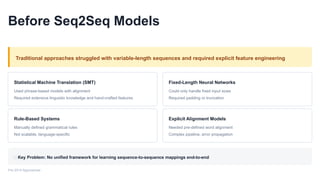
Before Seq2Seq Models
Traditional approaches struggled with variable-length sequences and required explicit feature engineering
Statistical Machine Translation (SMT)
Used phrase-based models with alignment
Required extensive linguistic knowledge and hand-crafted features
Rule-Based Systems
Manually defined grammatical rules
Not scalable, language-specific
Fixed-Length Neural Networks
Could only handle fixed input sizes
Required padding or truncation
Explicit Alignment Models
Needed pre-defined word alignment
Complex pipeline, error propagation
💡 Key Problem: No unified framework for learning sequence-to-sequence mappings end-to-end
Pre-2014 Approaches
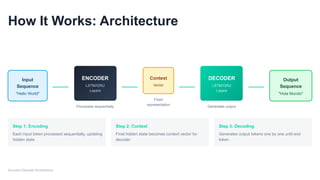
How It Works: Architecture
Input
Sequence
"Hello World"
ENCODER
LSTM/GRU
Layers
Processes sequentially
Context
Vector
Fixed
representation
DECODER
LSTM/GRU
Layers
Generates output
Output
Sequence
"Hola Mundo"
Step 1: Encoding
Each input token processed sequentially, updating
hidden state
Step 2: Context
Final hidden state becomes context vector for
decoder
Step 3: Decoding
Generates output tokens one by one until end
token
Encoder-Decoder Architecture
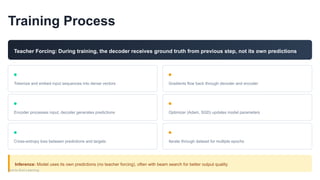
Training Process
Teacher Forcing: During training, the decoder receives ground truth from previous step, not its own predictions
Tokenize and embed input sequences into dense vectors
Encoder processes input, decoder generates predictions
Cross-entropy loss between predictions and targets
Gradients flow back through decoder and encoder
Optimizer (Adam, SGD) updates model parameters
Iterate through dataset for multiple epochs
Inference: Model uses its own predictions (no teacher forcing), often with beam search for better output quality
End-to-End Learning
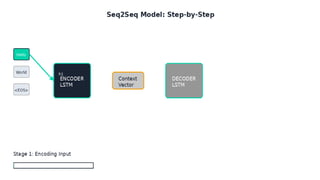
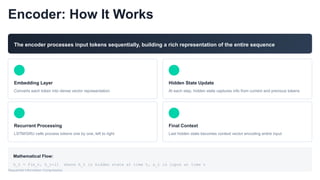
Encoder: How It Works
The encoder processes input tokens sequentially, building a rich representation of the entire sequence
Embedding Layer
Converts each token into dense vector representation
Recurrent Processing
LSTM/GRU cells process tokens one by one, left to right
Hidden State Update
At each step, hidden state captures info from current and previous tokens
Final Context
Last hidden state becomes context vector encoding entire input
Mathematical Flow:
h_t = f(x_t, h_t-1) where h_t is hidden state at time t, x_t is input at time t
Sequential Information Compression
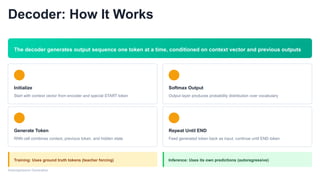
Decoder: How It Works
The decoder generates output sequence one token at a time, conditioned on context vector and previous outputs
Initialize
Start with context vector from encoder and special START token
Generate Token
RNN cell combines context, previous token, and hidden state
Softmax Output
Output layer produces probability distribution over vocabulary
Repeat Until END
Feed generated token back as input, continue until END token
Training: Uses ground truth tokens (teacher forcing) Inference: Uses its own predictions (autoregressive)
Autoregressive Generation
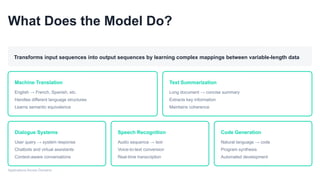
What Does the Model Do?
Transforms input sequences into output sequences by learning complex mappings between variable-length data
Machine Translation
English → French, Spanish, etc.
Handles different language structures
Learns semantic equivalence
Text Summarization
Long document → concise summary
Extracts key information
Maintains coherence
Dialogue Systems
User query → system response
Chatbots and virtual assistants
Context-aware conversations
Speech Recognition
Audio sequence → text
Voice-to-text conversion
Real-time transcription
Code Generation
Natural language → code
Program synthesis
Automated development
Applications Across Domains
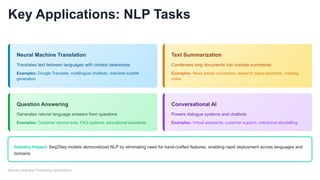
Key Applications: NLP Tasks
Neural Machine Translation
Translates text between languages with context awareness
Examples: Google Translate, multilingual chatbots, real-time subtitle
generation
Text Summarization
Condenses long documents into concise summaries
Examples: News article summaries, research paper abstracts, meeting
notes
Question Answering
Generates natural language answers from questions
Examples: Customer service bots, FAQ systems, educational assistants
Conversational AI
Powers dialogue systems and chatbots
Examples: Virtual assistants, customer support, interactive storytelling
Industry Impact: Seq2Seq models democratized NLP by eliminating need for hand-crafted features, enabling rapid deployment across languages and
domains
Natural Language Processing Applications
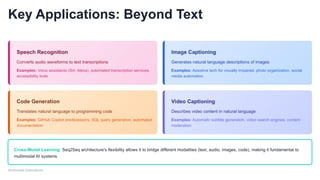
Key Applications: Beyond Text
Speech Recognition
Converts audio waveforms to text transcriptions
Examples: Voice assistants (Siri, Alexa), automated transcription services,
accessibility tools
Image Captioning
Generates natural language descriptions of images
Examples: Assistive tech for visually impaired, photo organization, social
media automation
Code Generation
Translates natural language to programming code
Examples: GitHub Copilot predecessors, SQL query generation, automated
documentation
Video Captioning
Describes video content in natural language
Examples: Automatic subtitle generation, video search engines, content
moderation
Cross-Modal Learning: Seq2Seq architecture's flexibility allows it to bridge different modalities (text, audio, images, code), making it fundamental to
multimodal AI systems
Multimodal Applications
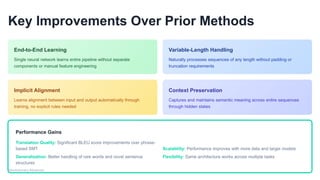
Key Improvements Over Prior Methods
End-to-End Learning
Single neural network learns entire pipeline without separate
components or manual feature engineering
Variable-Length Handling
Naturally processes sequences of any length without padding or
truncation requirements
Implicit Alignment
Learns alignment between input and output automatically through
training, no explicit rules needed
Context Preservation
Captures and maintains semantic meaning across entire sequences
through hidden states
Performance Gains
Translation Quality: Significant BLEU score improvements over phrase-
based SMT
Generalization: Better handling of rare words and novel sentence
structures
Scalability: Performance improves with more data and larger models
Flexibility: Same architecture works across multiple tasks
Revolutionary Advances
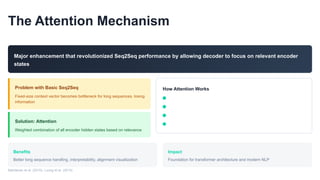
The Attention Mechanism
Major enhancement that revolutionized Seq2Seq performance by allowing decoder to focus on relevant encoder
states
Problem with Basic Seq2Seq
Fixed-size context vector becomes bottleneck for long sequences, losing
information
Solution: Attention
Weighted combination of all encoder hidden states based on relevance
How Attention Works
Benefits
Better long sequence handling, interpretability, alignment visualization
Impact
Foundation for transformer architecture and modern NLP
Bahdanau et al. (2015), Luong et al. (2015)
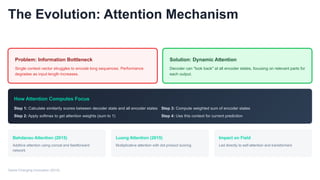
The Evolution: Attention Mechanism
Problem: Information Bottleneck
Single context vector struggles to encode long sequences. Performance
degrades as input length increases.
Solution: Dynamic Attention
Decoder can "look back" at all encoder states, focusing on relevant parts for
each output.
How Attention Computes Focus
Step 1: Calculate similarity scores between decoder state and all encoder states
Step 2: Apply softmax to get attention weights (sum to 1)
Step 3: Compute weighted sum of encoder states
Step 4: Use this context for current prediction
Bahdanau Attention (2015)
Additive attention using concat and feedforward
network
Luong Attention (2015)
Multiplicative attention with dot product scoring
Impact on Field
Led directly to self-attention and transformers
Game-Changing Innovation (2015)
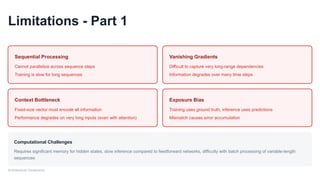
Limitations - Part 1
Sequential Processing
Cannot parallelize across sequence steps
Training is slow for long sequences
Vanishing Gradients
Difficult to capture very long-range dependencies
Information degrades over many time steps
Context Bottleneck
Fixed-size vector must encode all information
Performance degrades on very long inputs (even with attention)
Exposure Bias
Training uses ground truth, inference uses predictions
Mismatch causes error accumulation
Computational Challenges
Requires significant memory for hidden states, slow inference compared to feedforward networks, difficulty with batch processing of variable-length
sequences
Architectural Constraints
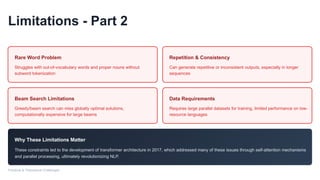
Limitations - Part 2
Rare Word Problem
Struggles with out-of-vocabulary words and proper nouns without
subword tokenization
Repetition & Consistency
Can generate repetitive or inconsistent outputs, especially in longer
sequences
Beam Search Limitations
Greedy/beam search can miss globally optimal solutions,
computationally expensive for large beams
Data Requirements
Requires large parallel datasets for training, limited performance on low-
resource languages
Why These Limitations Matter
These constraints led to the development of transformer architecture in 2017, which addressed many of these issues through self-attention mechanisms
and parallel processing, ultimately revolutionizing NLP.
Practical & Theoretical Challenges
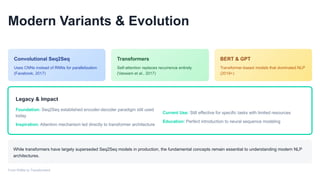
Modern Variants & Evolution
Convolutional Seq2Seq
Uses CNNs instead of RNNs for parallelization
(Facebook, 2017)
Transformers
Self-attention replaces recurrence entirely
(Vaswani et al., 2017)
BERT & GPT
Transformer-based models that dominated NLP
(2018+)
Legacy & Impact
Foundation: Seq2Seq established encoder-decoder paradigm still used
today
Inspiration: Attention mechanism led directly to transformer architecture
Current Use: Still effective for specific tasks with limited resources
Education: Perfect introduction to neural sequence modeling
While transformers have largely superseded Seq2Seq models in production, the fundamental concepts remain essential to understanding modern NLP
architectures.
From RNNs to Transformers
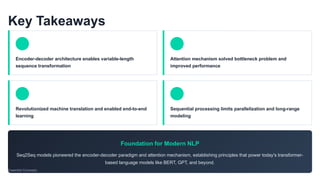
Key Takeaways
Encoder-decoder architecture enables variable-length
sequence transformation
Attention mechanism solved bottleneck problem and
improved performance
Revolutionized machine translation and enabled end-to-end
learning
Sequential processing limits parallelization and long-range
modeling
Foundation for Modern NLP
Seq2Seq models pioneered the encoder-decoder paradigm and attention mechanism, establishing principles that power today's transformer-
based language models like BERT, GPT, and beyond.
Essential Concepts
Thank You

Seq2Seq models of NLP explianed Presentation.pptx

  • 1.
    Sequence-to- Sequence Models Deep Learningfor Sequential Data Transformation By: Aliha Hasnain (BSAI-23S-0013) Asiya Ibrahim (BSAI-23S-0015)
  • 2.
    Introduction & History Whatis Seq2Seq? A neural network architecture that transforms one sequence of data into another sequence, enabling variable-length input-output mappings. 2014 Introduced by Google researchers Sutskever et al. for machine translation 2015-2016 Attention mechanisms added by Bahdanau and Luong, revolutionizing performance 2017+ Foundation for transformers and modern NLP breakthroughs Reference: Sutskever et al., "Sequence to Sequence Learning with Neural Networks" (2014)
  • 3.
    What is aSeq2Seq Model? Core Concept An encoder-decoder architecture that maps variable-length input sequences to variable-length output sequences, learning to compress input information into a fixed-size context vector. Encoder Processes input sequence and compresses information into context vector Context Vector Fixed-size representation of entire input sequence Decoder Generates output sequence from context vector Key Characteristics Handles variable-length sequences End-to-end training with backpropagation Uses recurrent neural networks (LSTM/GRU) No explicit alignment required Neural Architecture Design
  • 4.
    Before Seq2Seq Models Traditionalapproaches struggled with variable-length sequences and required explicit feature engineering Statistical Machine Translation (SMT) Used phrase-based models with alignment Required extensive linguistic knowledge and hand-crafted features Rule-Based Systems Manually defined grammatical rules Not scalable, language-specific Fixed-Length Neural Networks Could only handle fixed input sizes Required padding or truncation Explicit Alignment Models Needed pre-defined word alignment Complex pipeline, error propagation 💡 Key Problem: No unified framework for learning sequence-to-sequence mappings end-to-end Pre-2014 Approaches
  • 5.
    How It Works:Architecture Input Sequence "Hello World" ENCODER LSTM/GRU Layers Processes sequentially Context Vector Fixed representation DECODER LSTM/GRU Layers Generates output Output Sequence "Hola Mundo" Step 1: Encoding Each input token processed sequentially, updating hidden state Step 2: Context Final hidden state becomes context vector for decoder Step 3: Decoding Generates output tokens one by one until end token Encoder-Decoder Architecture
  • 7.
    Training Process Teacher Forcing:During training, the decoder receives ground truth from previous step, not its own predictions Tokenize and embed input sequences into dense vectors Encoder processes input, decoder generates predictions Cross-entropy loss between predictions and targets Gradients flow back through decoder and encoder Optimizer (Adam, SGD) updates model parameters Iterate through dataset for multiple epochs Inference: Model uses its own predictions (no teacher forcing), often with beam search for better output quality End-to-End Learning
  • 8.
    Encoder: How ItWorks The encoder processes input tokens sequentially, building a rich representation of the entire sequence Embedding Layer Converts each token into dense vector representation Recurrent Processing LSTM/GRU cells process tokens one by one, left to right Hidden State Update At each step, hidden state captures info from current and previous tokens Final Context Last hidden state becomes context vector encoding entire input Mathematical Flow: h_t = f(x_t, h_t-1) where h_t is hidden state at time t, x_t is input at time t Sequential Information Compression
  • 9.
    Decoder: How ItWorks The decoder generates output sequence one token at a time, conditioned on context vector and previous outputs Initialize Start with context vector from encoder and special START token Generate Token RNN cell combines context, previous token, and hidden state Softmax Output Output layer produces probability distribution over vocabulary Repeat Until END Feed generated token back as input, continue until END token Training: Uses ground truth tokens (teacher forcing) Inference: Uses its own predictions (autoregressive) Autoregressive Generation
  • 10.
    What Does theModel Do? Transforms input sequences into output sequences by learning complex mappings between variable-length data Machine Translation English → French, Spanish, etc. Handles different language structures Learns semantic equivalence Text Summarization Long document → concise summary Extracts key information Maintains coherence Dialogue Systems User query → system response Chatbots and virtual assistants Context-aware conversations Speech Recognition Audio sequence → text Voice-to-text conversion Real-time transcription Code Generation Natural language → code Program synthesis Automated development Applications Across Domains
  • 11.
    Key Applications: NLPTasks Neural Machine Translation Translates text between languages with context awareness Examples: Google Translate, multilingual chatbots, real-time subtitle generation Text Summarization Condenses long documents into concise summaries Examples: News article summaries, research paper abstracts, meeting notes Question Answering Generates natural language answers from questions Examples: Customer service bots, FAQ systems, educational assistants Conversational AI Powers dialogue systems and chatbots Examples: Virtual assistants, customer support, interactive storytelling Industry Impact: Seq2Seq models democratized NLP by eliminating need for hand-crafted features, enabling rapid deployment across languages and domains Natural Language Processing Applications
  • 12.
    Key Applications: BeyondText Speech Recognition Converts audio waveforms to text transcriptions Examples: Voice assistants (Siri, Alexa), automated transcription services, accessibility tools Image Captioning Generates natural language descriptions of images Examples: Assistive tech for visually impaired, photo organization, social media automation Code Generation Translates natural language to programming code Examples: GitHub Copilot predecessors, SQL query generation, automated documentation Video Captioning Describes video content in natural language Examples: Automatic subtitle generation, video search engines, content moderation Cross-Modal Learning: Seq2Seq architecture's flexibility allows it to bridge different modalities (text, audio, images, code), making it fundamental to multimodal AI systems Multimodal Applications
  • 13.
    Key Improvements OverPrior Methods End-to-End Learning Single neural network learns entire pipeline without separate components or manual feature engineering Variable-Length Handling Naturally processes sequences of any length without padding or truncation requirements Implicit Alignment Learns alignment between input and output automatically through training, no explicit rules needed Context Preservation Captures and maintains semantic meaning across entire sequences through hidden states Performance Gains Translation Quality: Significant BLEU score improvements over phrase- based SMT Generalization: Better handling of rare words and novel sentence structures Scalability: Performance improves with more data and larger models Flexibility: Same architecture works across multiple tasks Revolutionary Advances
  • 14.
    The Attention Mechanism Majorenhancement that revolutionized Seq2Seq performance by allowing decoder to focus on relevant encoder states Problem with Basic Seq2Seq Fixed-size context vector becomes bottleneck for long sequences, losing information Solution: Attention Weighted combination of all encoder hidden states based on relevance How Attention Works Benefits Better long sequence handling, interpretability, alignment visualization Impact Foundation for transformer architecture and modern NLP Bahdanau et al. (2015), Luong et al. (2015)
  • 15.
    The Evolution: AttentionMechanism Problem: Information Bottleneck Single context vector struggles to encode long sequences. Performance degrades as input length increases. Solution: Dynamic Attention Decoder can "look back" at all encoder states, focusing on relevant parts for each output. How Attention Computes Focus Step 1: Calculate similarity scores between decoder state and all encoder states Step 2: Apply softmax to get attention weights (sum to 1) Step 3: Compute weighted sum of encoder states Step 4: Use this context for current prediction Bahdanau Attention (2015) Additive attention using concat and feedforward network Luong Attention (2015) Multiplicative attention with dot product scoring Impact on Field Led directly to self-attention and transformers Game-Changing Innovation (2015)
  • 16.
    Limitations - Part1 Sequential Processing Cannot parallelize across sequence steps Training is slow for long sequences Vanishing Gradients Difficult to capture very long-range dependencies Information degrades over many time steps Context Bottleneck Fixed-size vector must encode all information Performance degrades on very long inputs (even with attention) Exposure Bias Training uses ground truth, inference uses predictions Mismatch causes error accumulation Computational Challenges Requires significant memory for hidden states, slow inference compared to feedforward networks, difficulty with batch processing of variable-length sequences Architectural Constraints
  • 17.
    Limitations - Part2 Rare Word Problem Struggles with out-of-vocabulary words and proper nouns without subword tokenization Repetition & Consistency Can generate repetitive or inconsistent outputs, especially in longer sequences Beam Search Limitations Greedy/beam search can miss globally optimal solutions, computationally expensive for large beams Data Requirements Requires large parallel datasets for training, limited performance on low- resource languages Why These Limitations Matter These constraints led to the development of transformer architecture in 2017, which addressed many of these issues through self-attention mechanisms and parallel processing, ultimately revolutionizing NLP. Practical & Theoretical Challenges
  • 18.
    Modern Variants &Evolution Convolutional Seq2Seq Uses CNNs instead of RNNs for parallelization (Facebook, 2017) Transformers Self-attention replaces recurrence entirely (Vaswani et al., 2017) BERT & GPT Transformer-based models that dominated NLP (2018+) Legacy & Impact Foundation: Seq2Seq established encoder-decoder paradigm still used today Inspiration: Attention mechanism led directly to transformer architecture Current Use: Still effective for specific tasks with limited resources Education: Perfect introduction to neural sequence modeling While transformers have largely superseded Seq2Seq models in production, the fundamental concepts remain essential to understanding modern NLP architectures. From RNNs to Transformers
  • 19.
    Key Takeaways Encoder-decoder architectureenables variable-length sequence transformation Attention mechanism solved bottleneck problem and improved performance Revolutionized machine translation and enabled end-to-end learning Sequential processing limits parallelization and long-range modeling Foundation for Modern NLP Seq2Seq models pioneered the encoder-decoder paradigm and attention mechanism, establishing principles that power today's transformer- based language models like BERT, GPT, and beyond. Essential Concepts
  • 20.