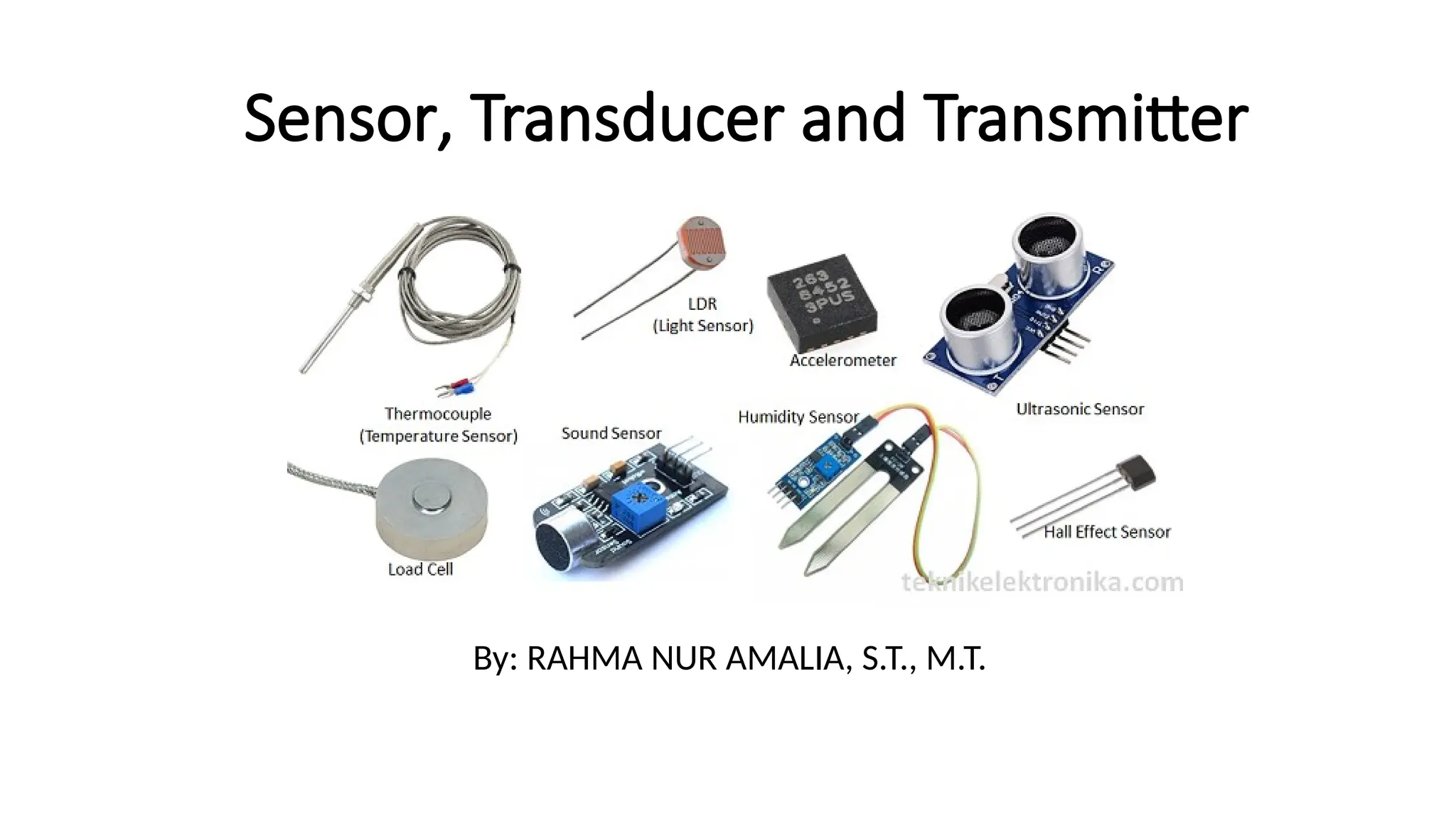
Sensor, Transducer and Transmitter
By: RAHMA NUR AMALIA, S.T., M.T.
OUTLINE
• Sensor
• Types of Sensor
• Transducer
• Transmitter
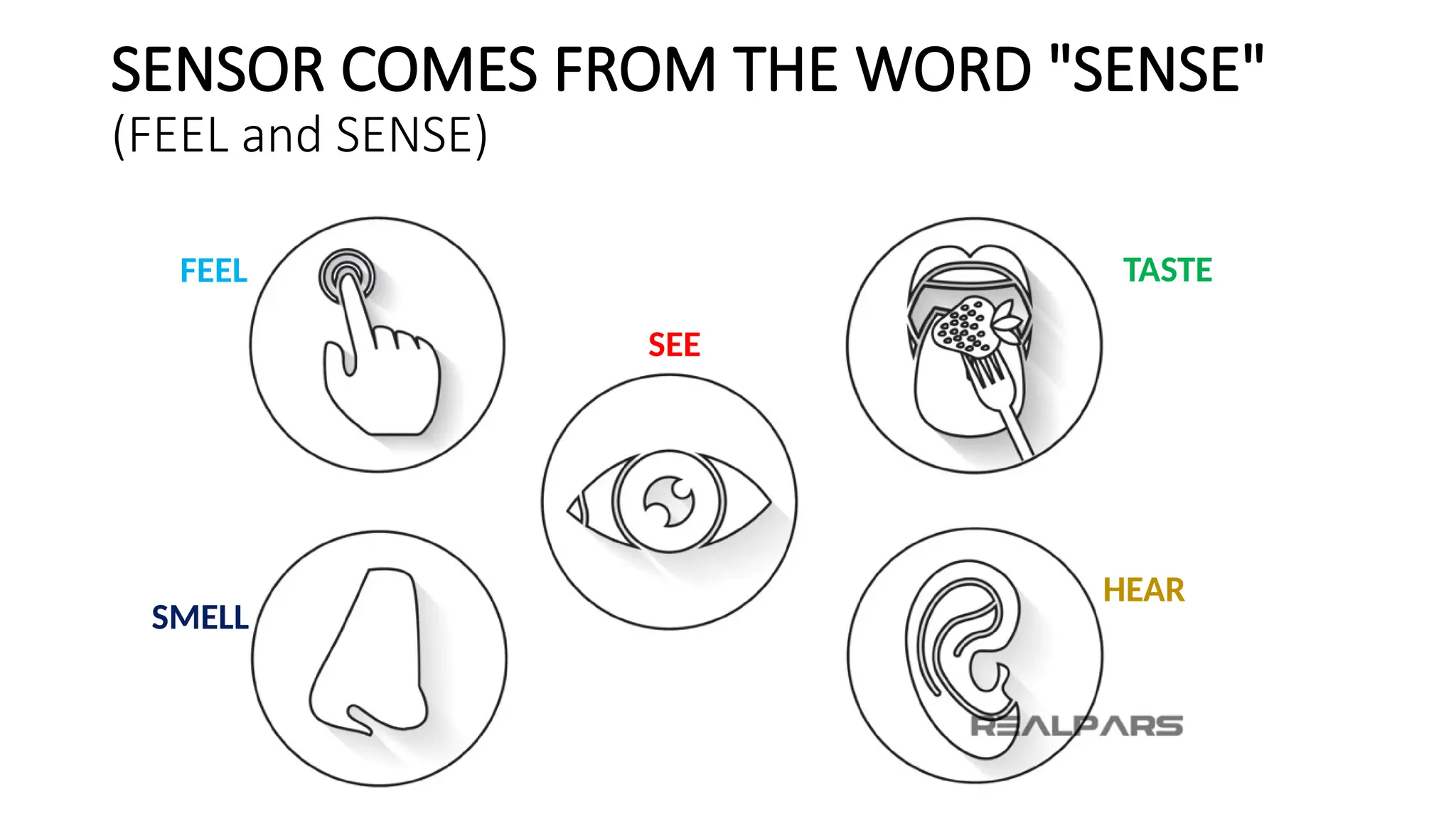
SENSOR COMES FROM THE WORD "SENSE"
(FEEL and SENSE)
FEEL
HEAR
SMELL
TASTE
SEE
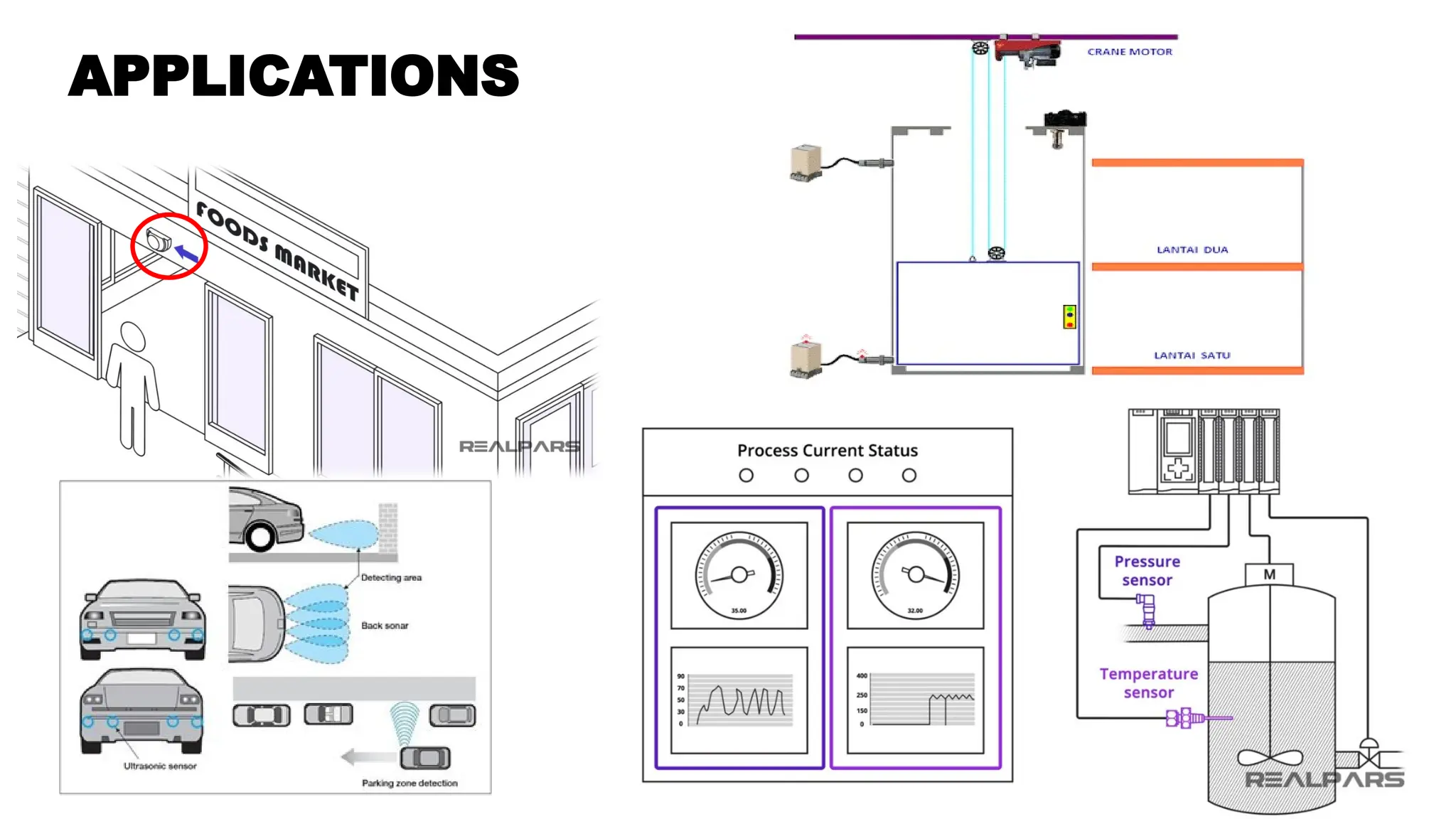
APPLICATIONS
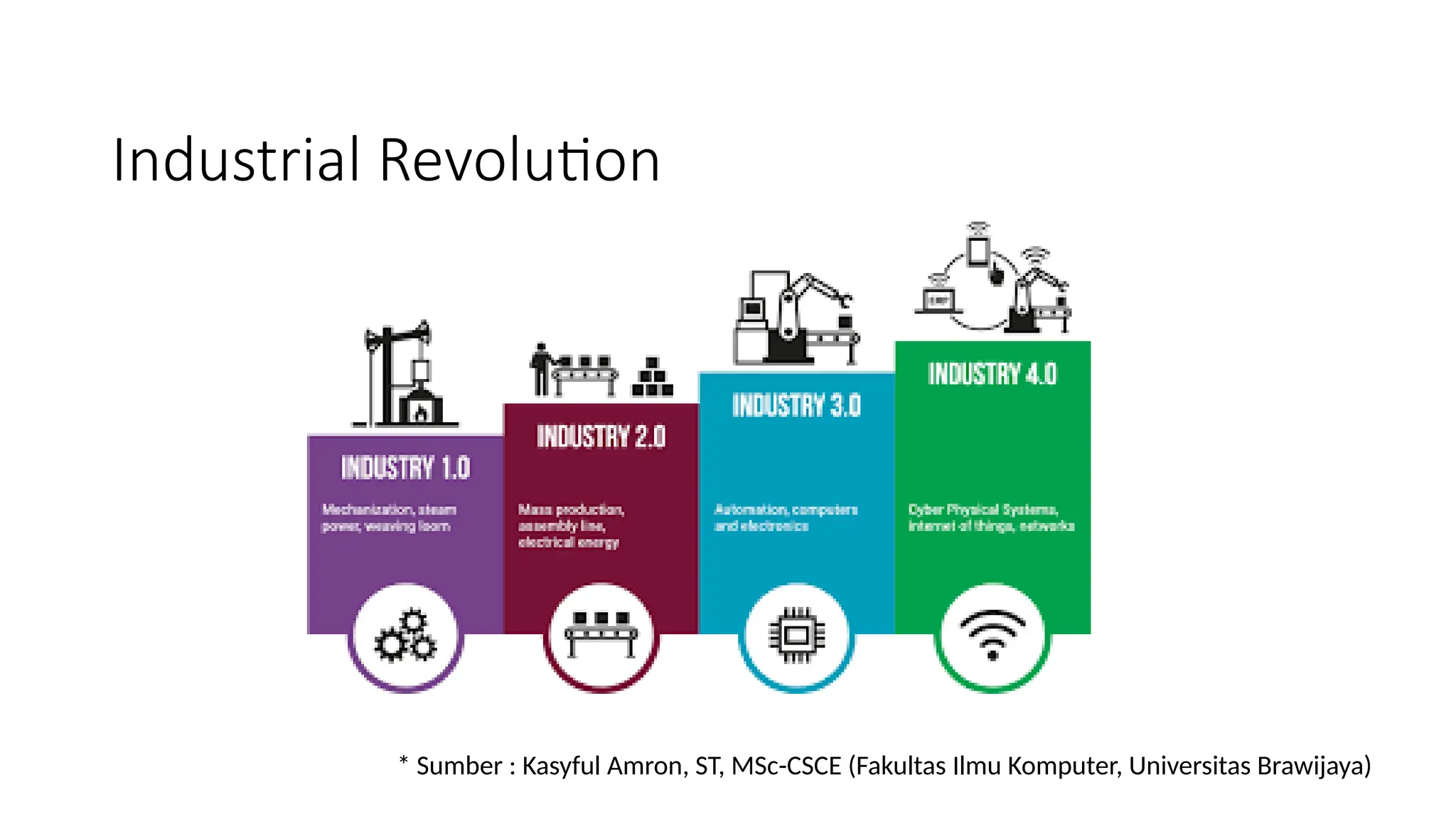
Industrial Revolution
* Sumber : Kasyful Amron, ST, MSc-CSCE (Fakultas Ilmu Komputer, Universitas Brawijaya)
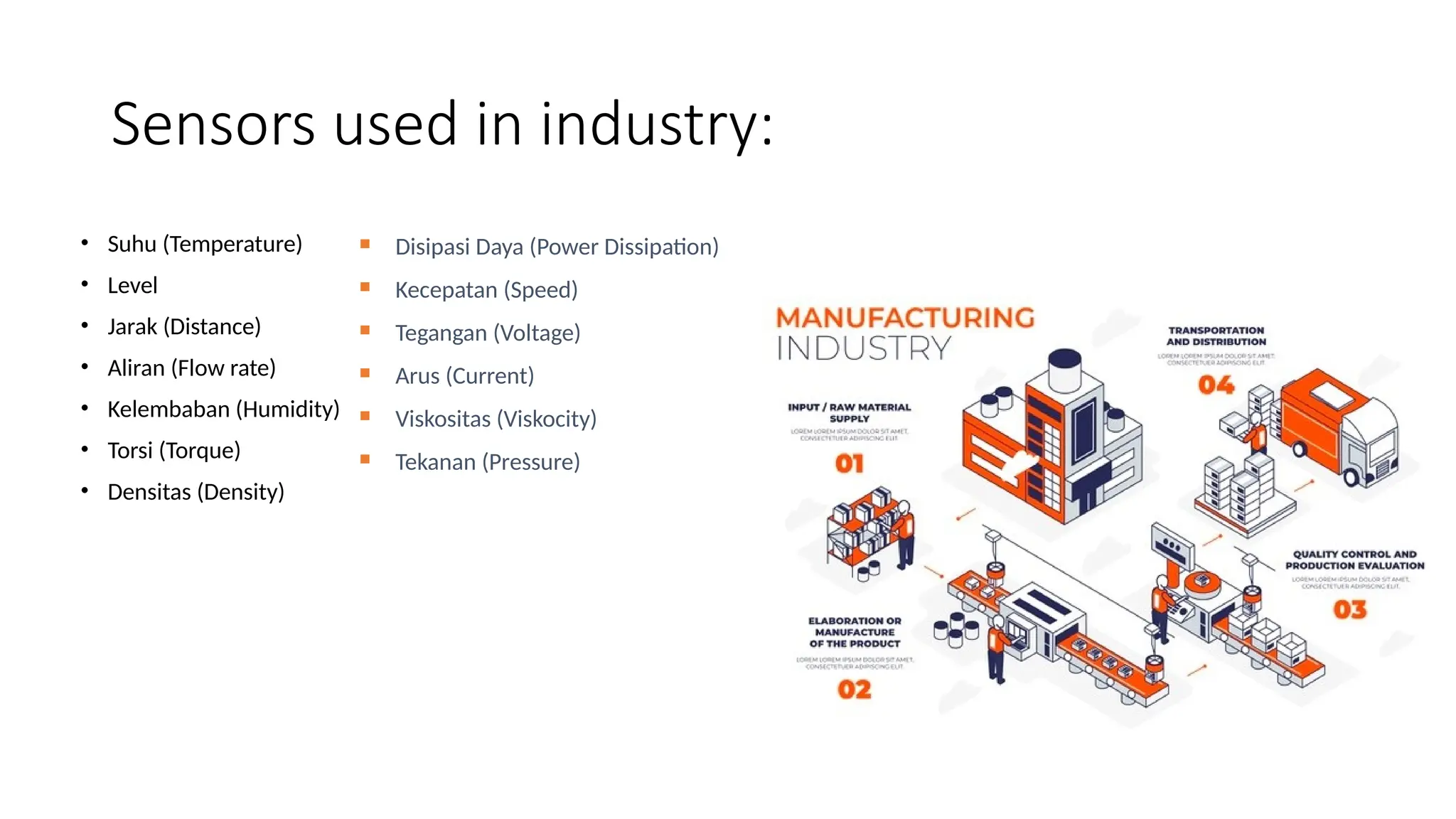
Sensors used in industry:
• Suhu (Temperature)
• Level
• Jarak (Distance)
• Aliran (Flow rate)
• Kelembaban (Humidity)
• Torsi (Torque)
• Densitas (Density)
 Disipasi Daya (Power Dissipation)
 Kecepatan (Speed)
 Tegangan (Voltage)
 Arus (Current)
 Viskositas (Viskocity)
 Tekanan (Pressure)
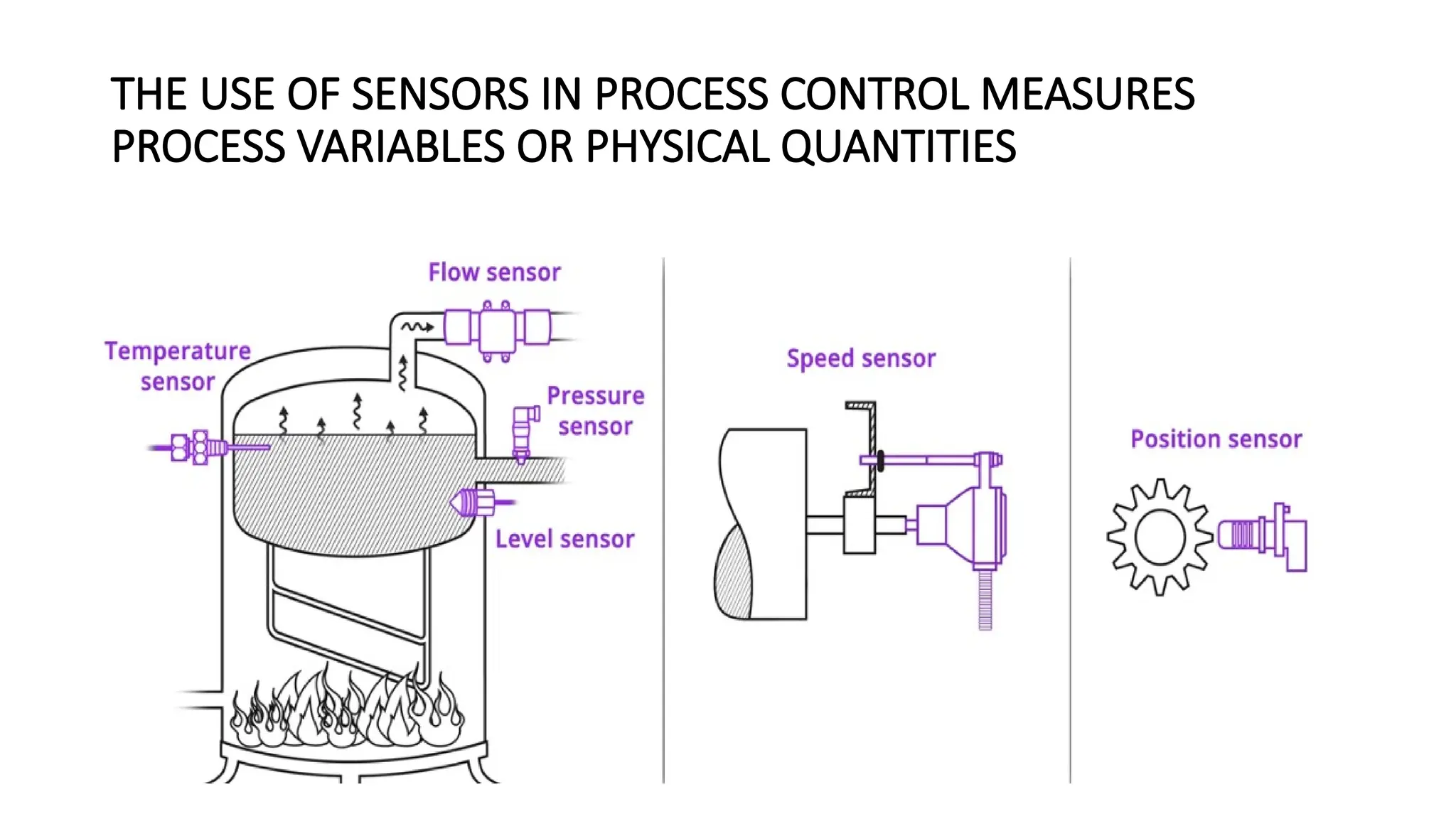
THE USE OF SENSORS IN PROCESS CONTROL MEASURES
PROCESS VARIABLES OR PHYSICAL QUANTITIES
The Definition of Sensor
• Sensors are devices that produce output signals for the purpose of
sensing physical phenomena.
• A sensor is a device that receives and responds to physical signals.
These signals are produced by some type of energy such as heat,
light, motion or chemical reactions
• The sensor detects one or more input signals, these input signals are
converted into analog or digital representation.
• In general, sensors convert a recognized signal into an electrical signal
(current or voltage).
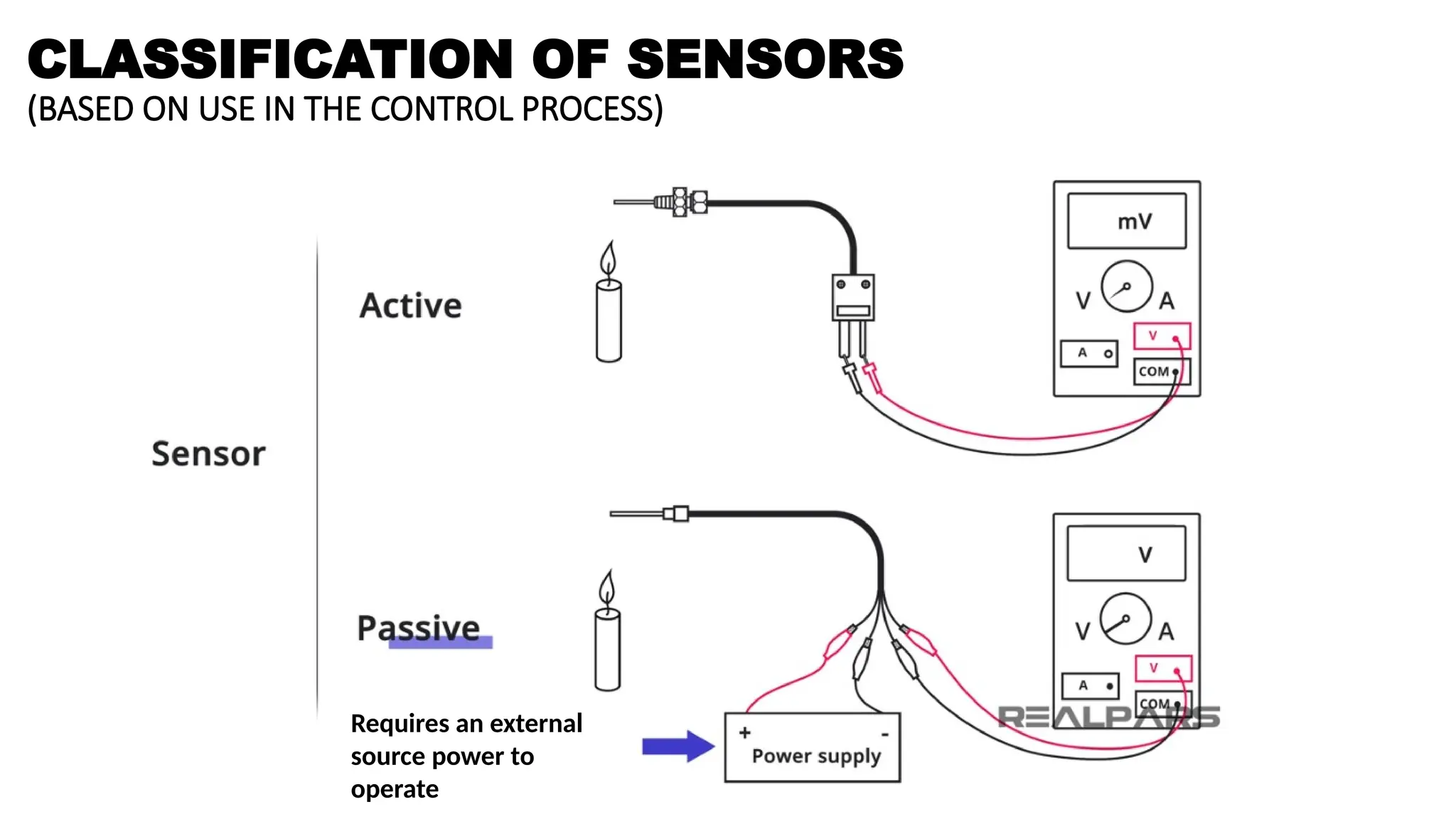
CLASSIFICATION OF SENSORS
(BASED ON USE IN THE CONTROL PROCESS)
Requires an external
source power to
operate
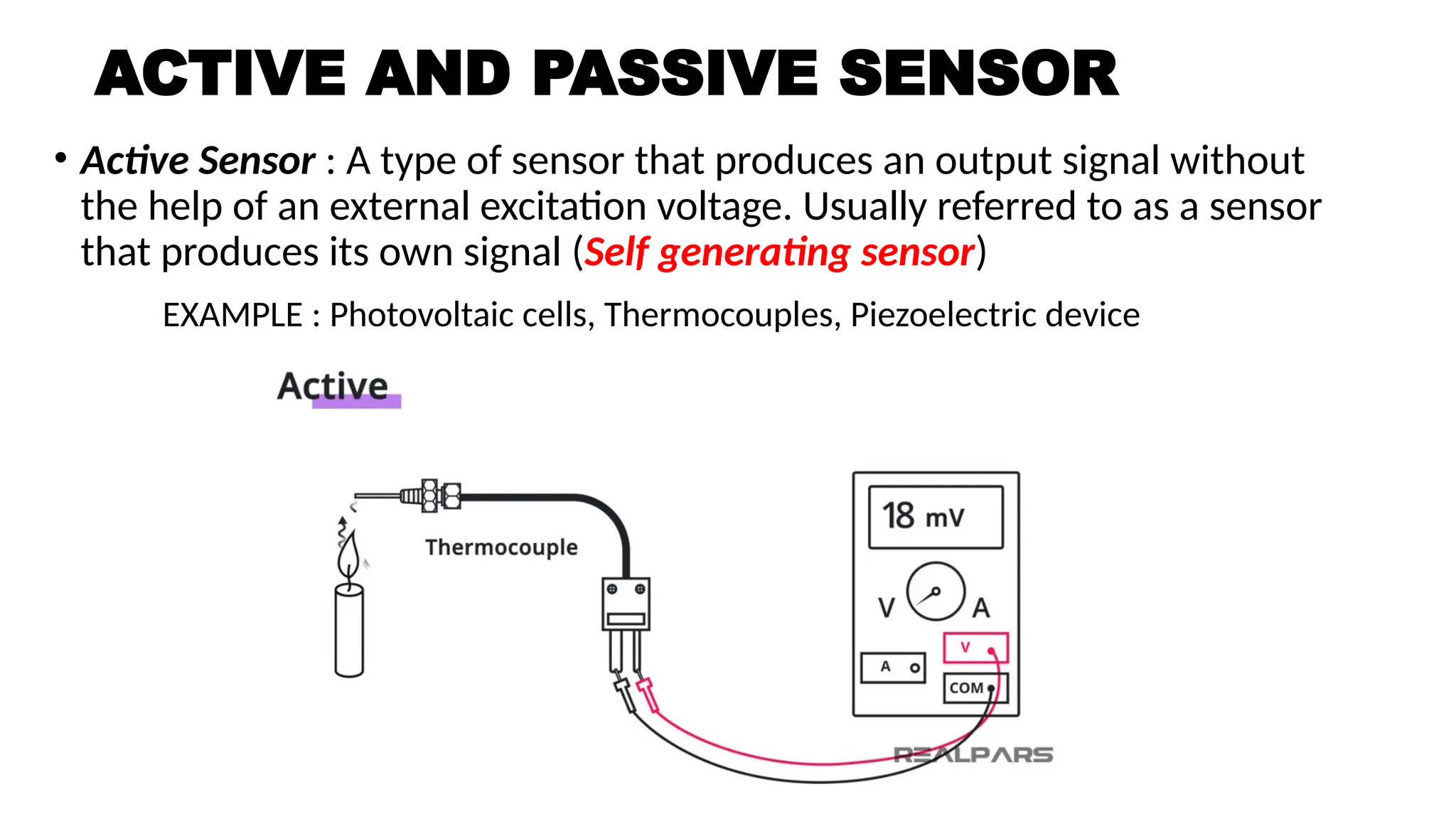
ACTIVE AND PASSIVE SENSOR
• Active Sensor : A type of sensor that produces an output signal without
the help of an external excitation voltage. Usually referred to as a sensor
that produces its own signal (Self generating sensor)
EXAMPLE : Photovoltaic cells, Thermocouples, Piezoelectric device
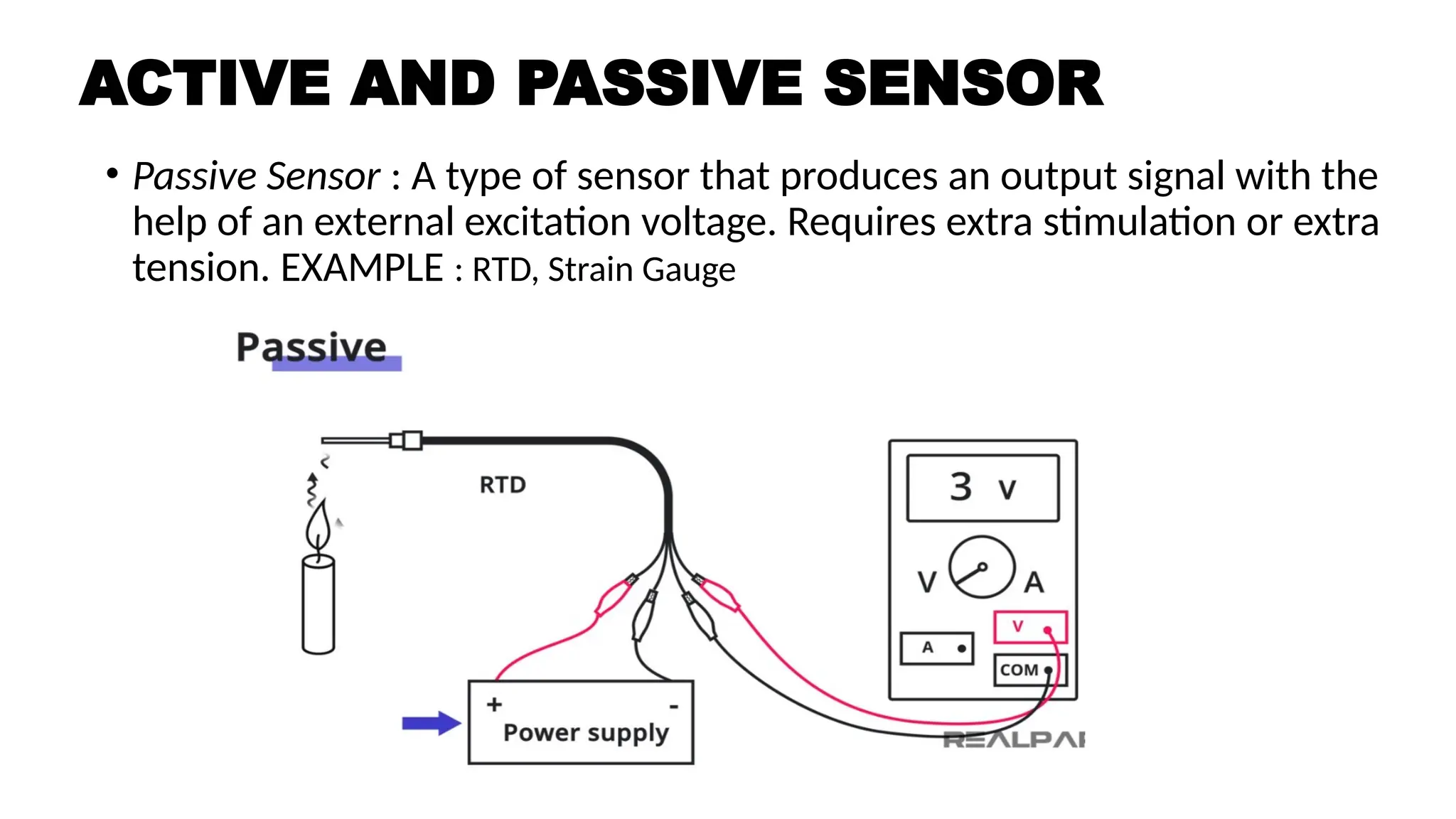
• Passive Sensor : A type of sensor that produces an output signal with the
help of an external excitation voltage. Requires extra stimulation or extra
tension. EXAMPLE : RTD, Strain Gauge
ACTIVE AND PASSIVE SENSOR
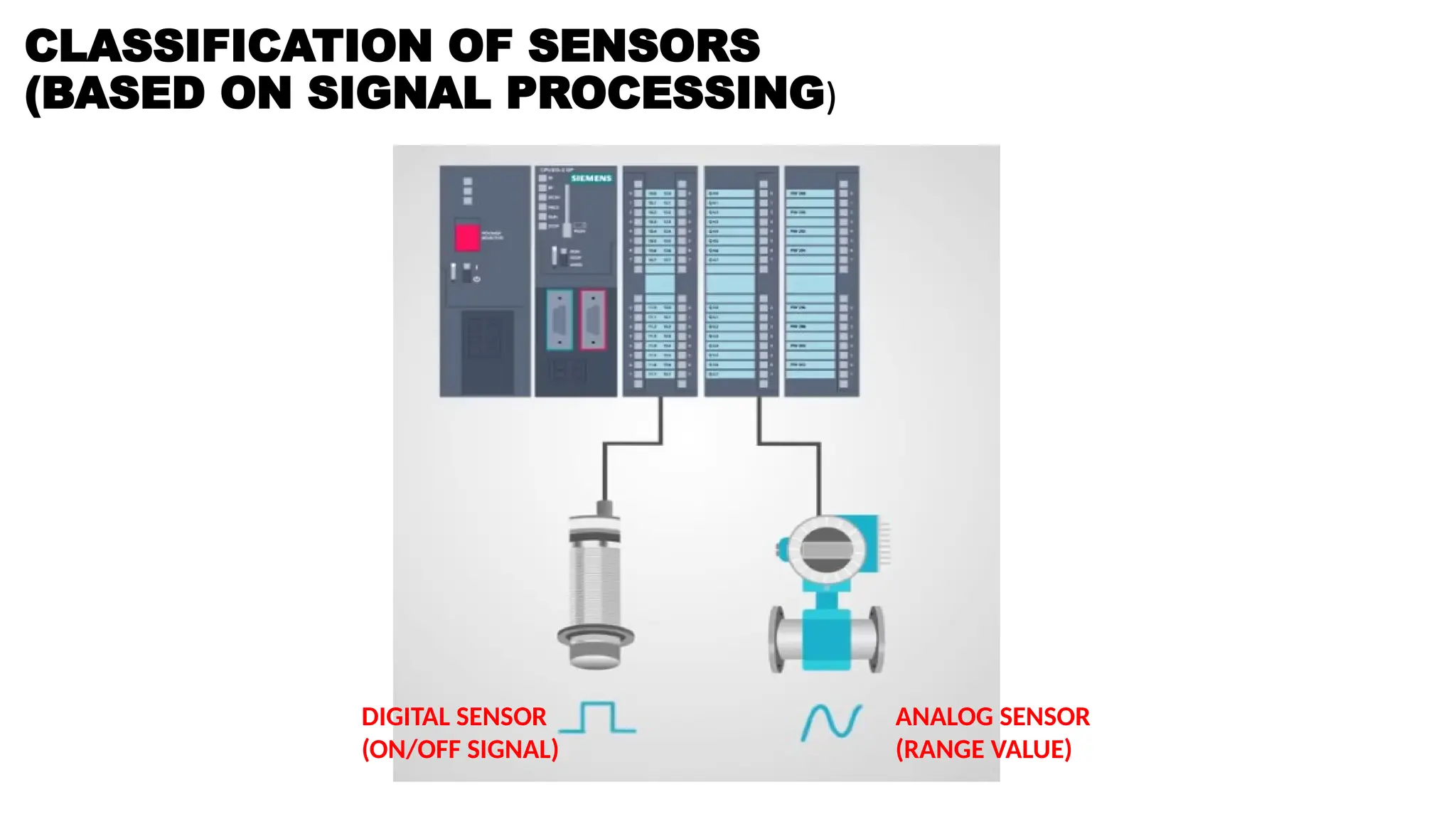
CLASSIFICATION OF SENSORS
(BASED ON SIGNAL PROCESSING)
DIGITAL SENSOR
(ON/OFF SIGNAL)
ANALOG SENSOR
(RANGE VALUE)
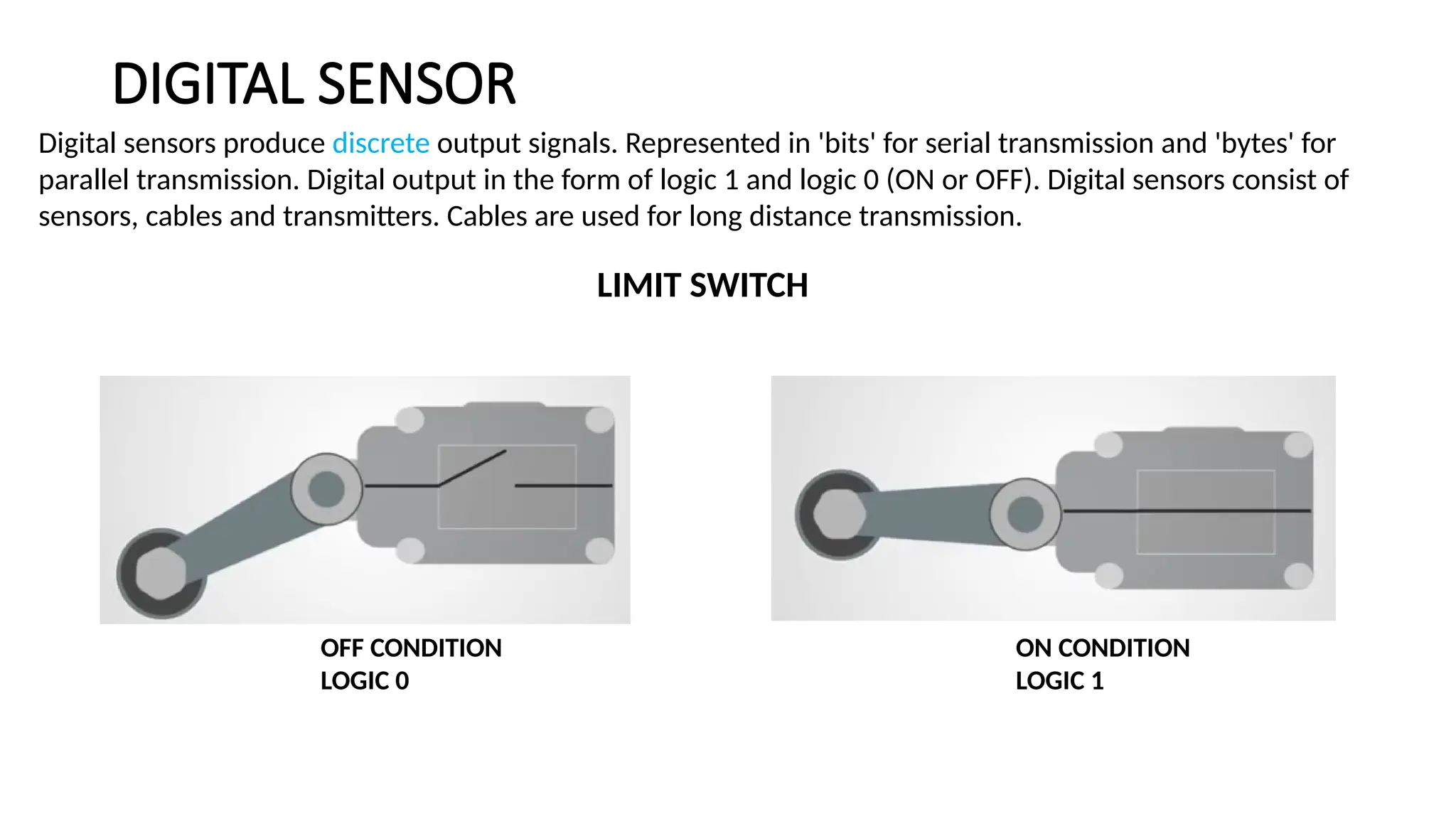
DIGITAL SENSOR
Digital sensors produce discrete output signals. Represented in 'bits' for serial transmission and 'bytes' for
parallel transmission. Digital output in the form of logic 1 and logic 0 (ON or OFF). Digital sensors consist of
sensors, cables and transmitters. Cables are used for long distance transmission.
LIMIT SWITCH
OFF CONDITION
LOGIC 0
ON CONDITION
LOGIC 1
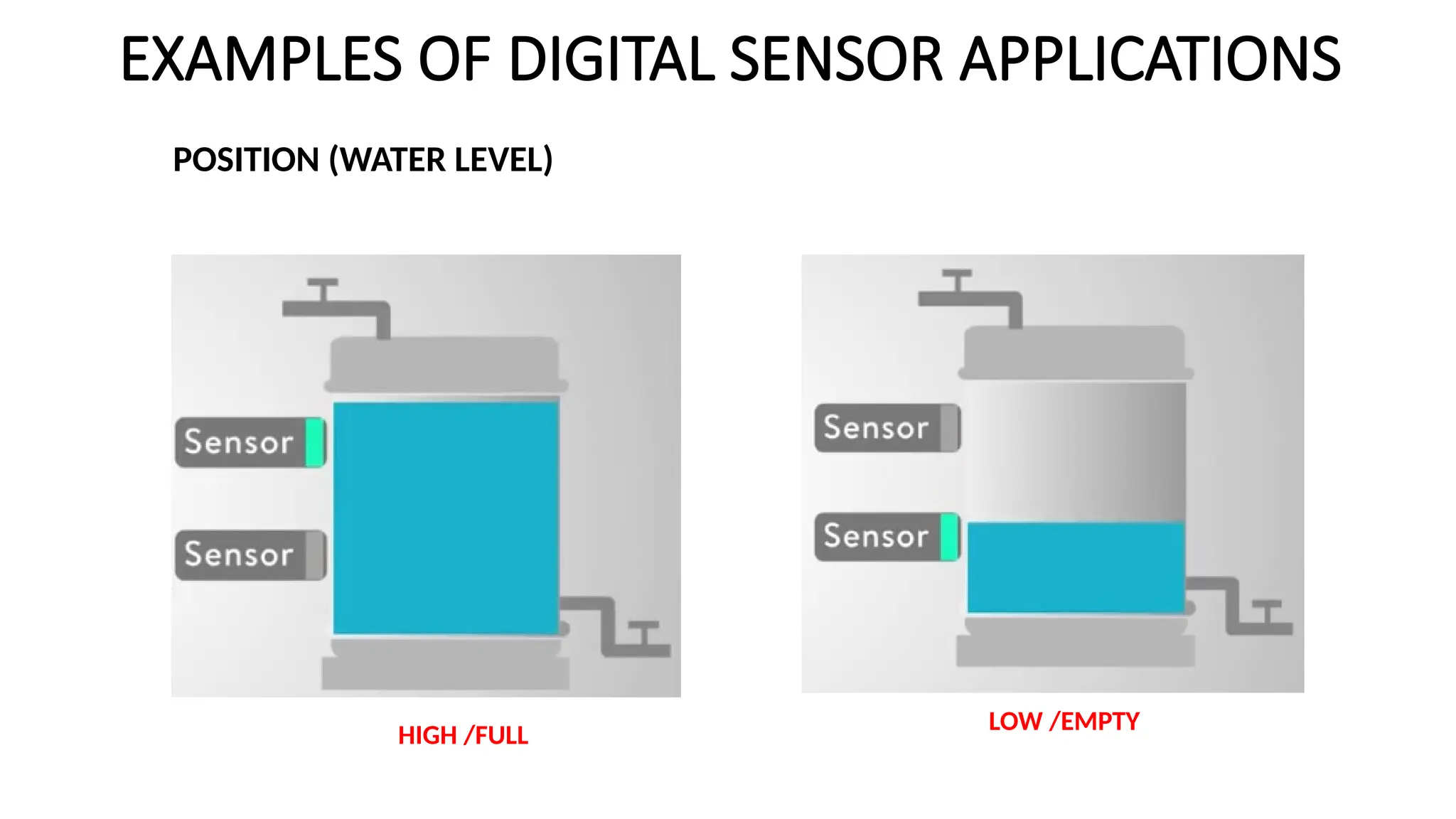
EXAMPLES OF DIGITAL SENSOR APPLICATIONS
POSITION (WATER LEVEL)
HIGH /FULL
LOW /EMPTY
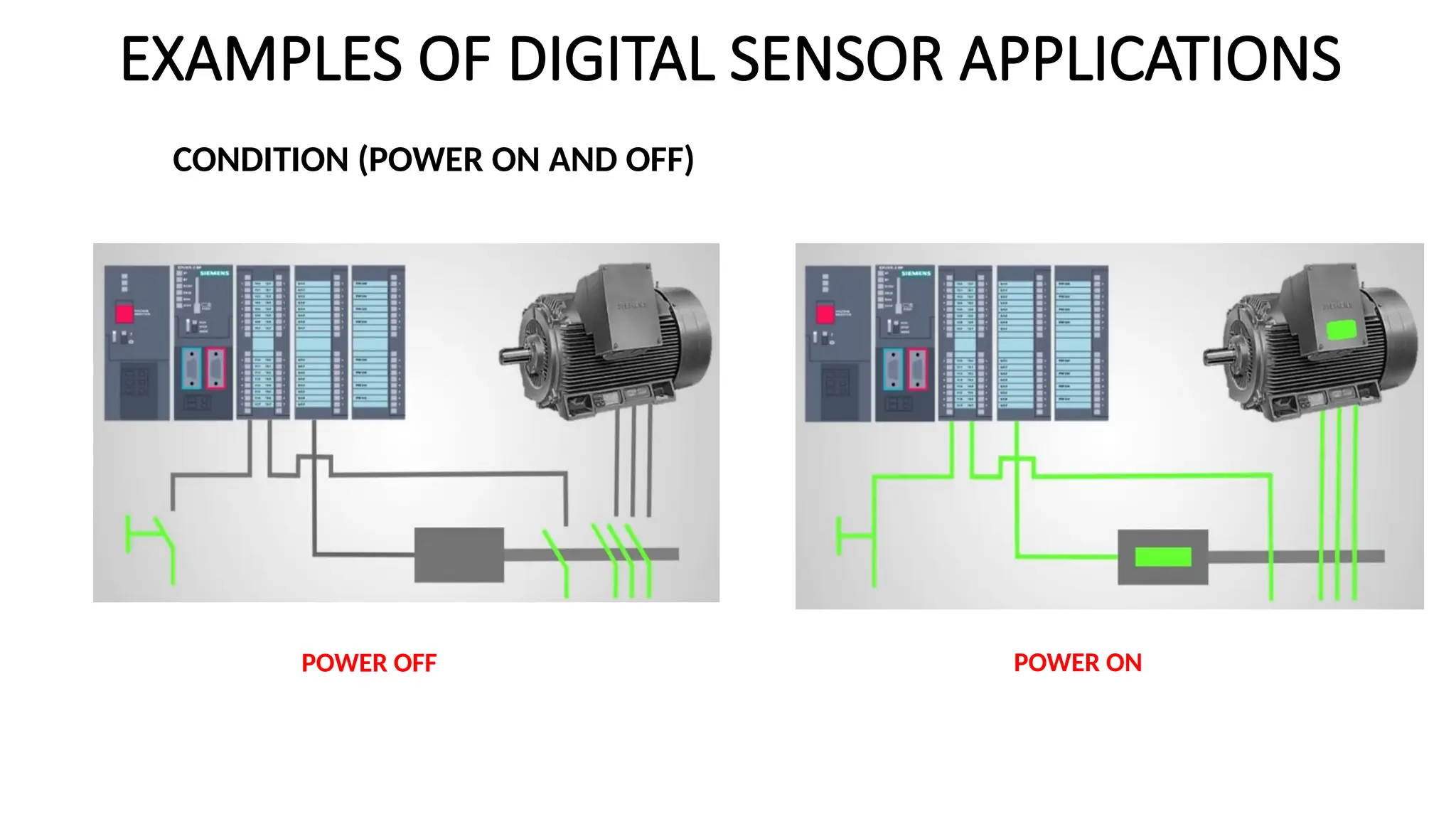
EXAMPLES OF DIGITAL SENSOR APPLICATIONS
CONDITION (POWER ON AND OFF)
POWER OFF POWER ON
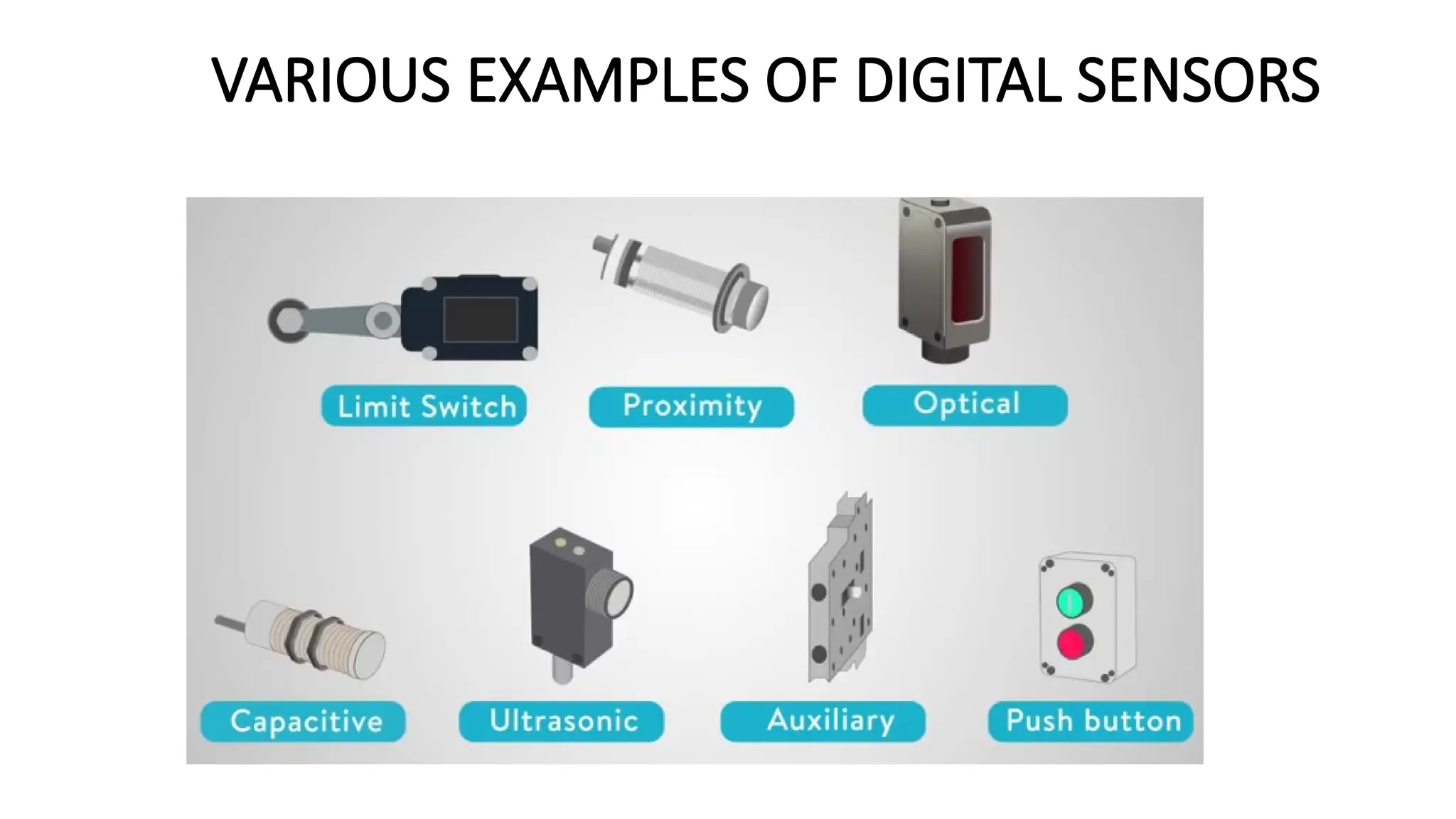
VARIOUS EXAMPLES OF DIGITAL SENSORS
ANALOG SENSOR
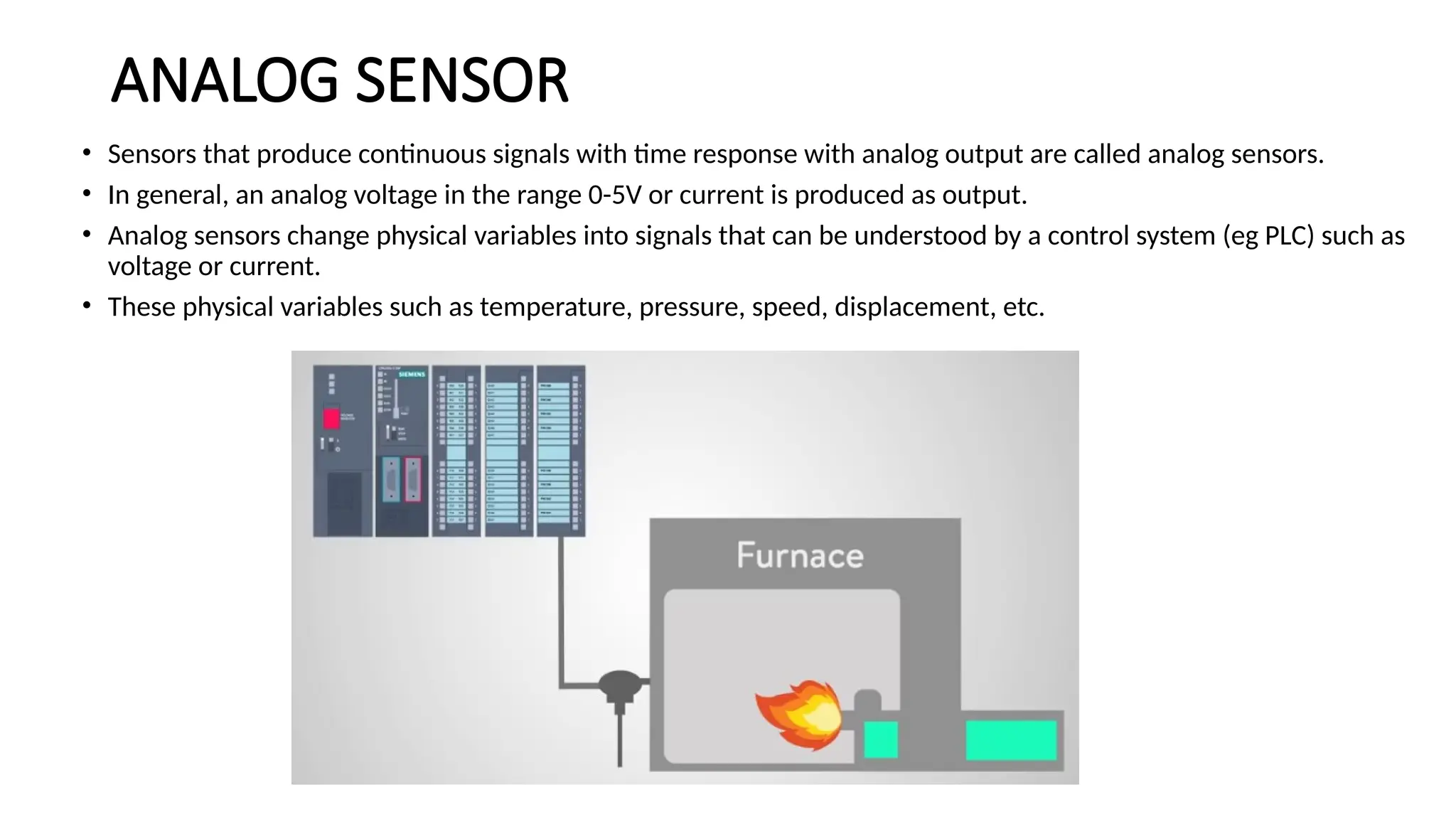
• Sensors that produce continuous signals with time response with analog output are called analog sensors.
• In general, an analog voltage in the range 0-5V or current is produced as output.
• Analog sensors change physical variables into signals that can be understood by a control system (eg PLC) such as
voltage or current.
• These physical variables such as temperature, pressure, speed, displacement, etc.
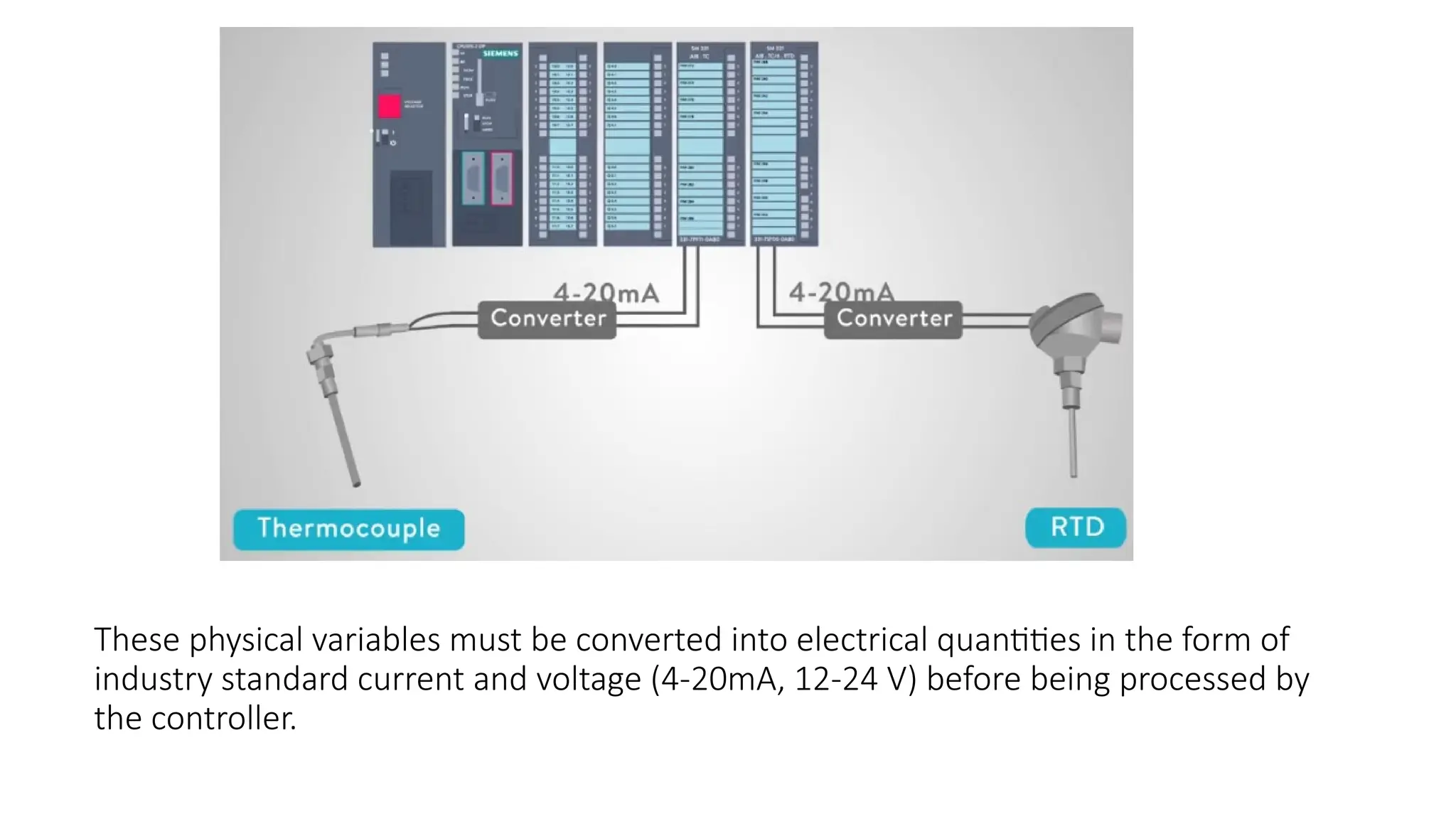
These physical variables must be converted into electrical quantities in the form of
industry standard current and voltage (4-20mA, 12-24 V) before being processed by
the controller.
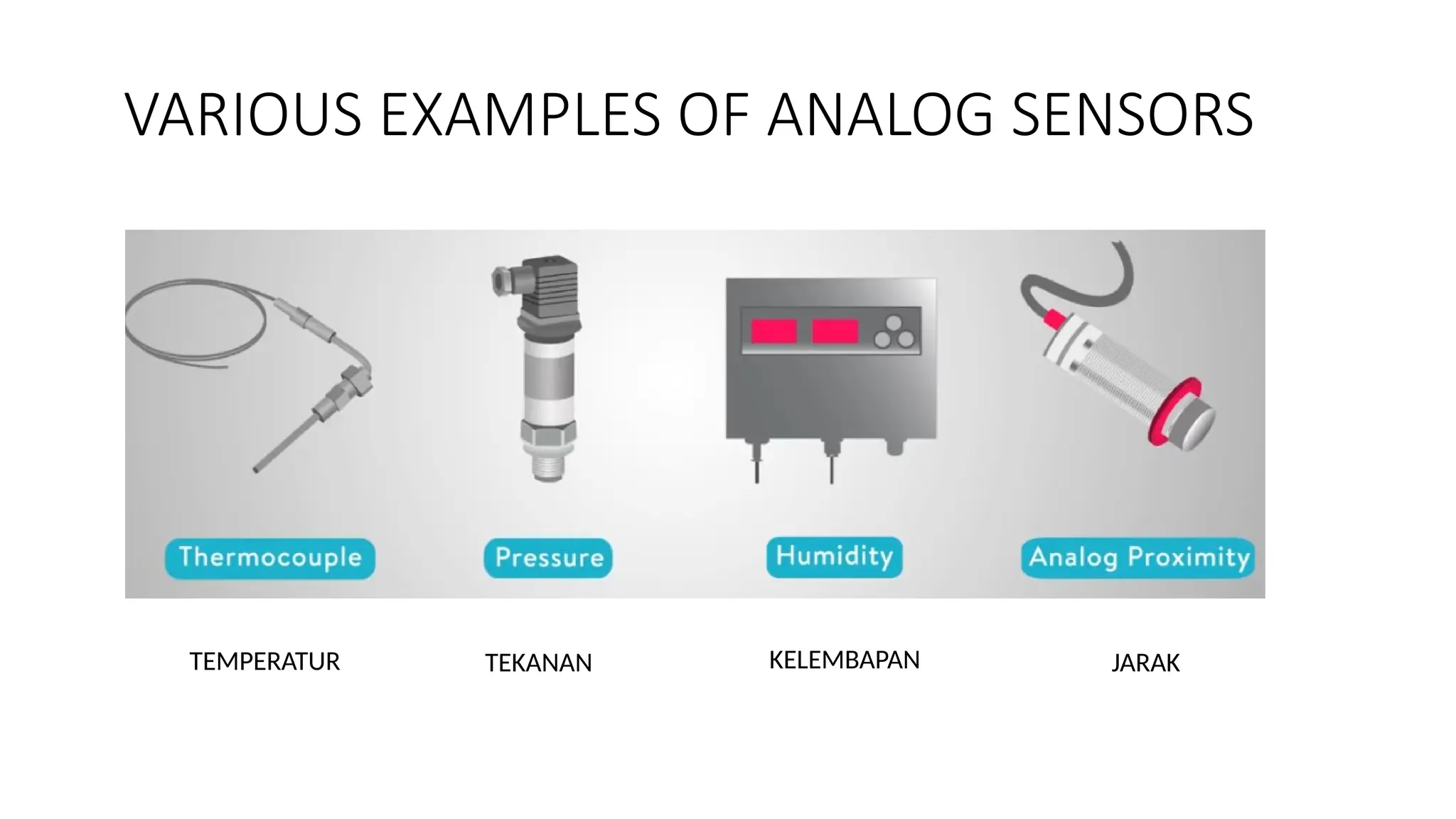
VARIOUS EXAMPLES OF ANALOG SENSORS
TEMPERATUR TEKANAN KELEMBAPAN JARAK
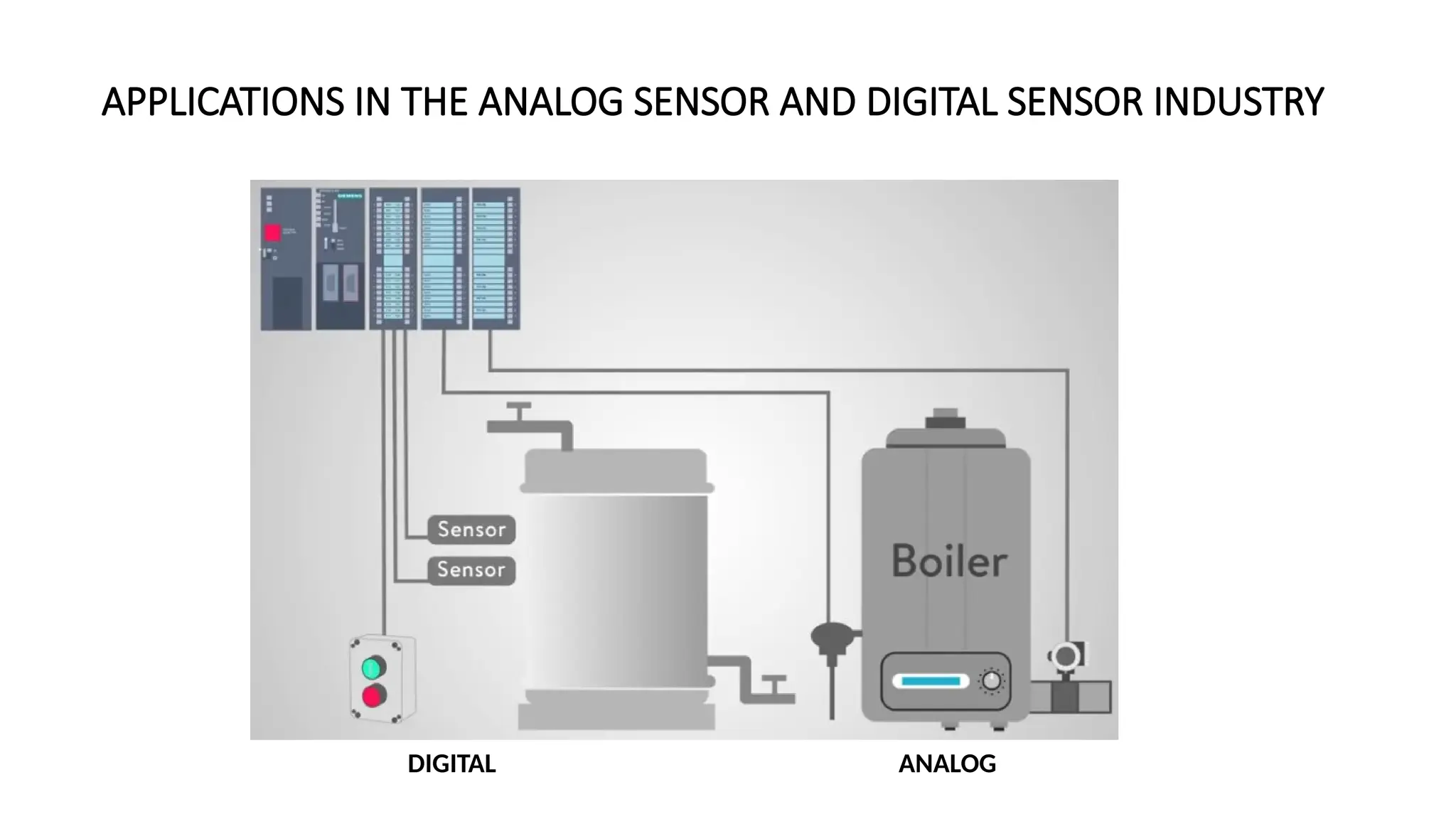
APPLICATIONS IN THE ANALOG SENSOR AND DIGITAL SENSOR INDUSTRY
DIGITAL ANALOG
TRANSDUCER
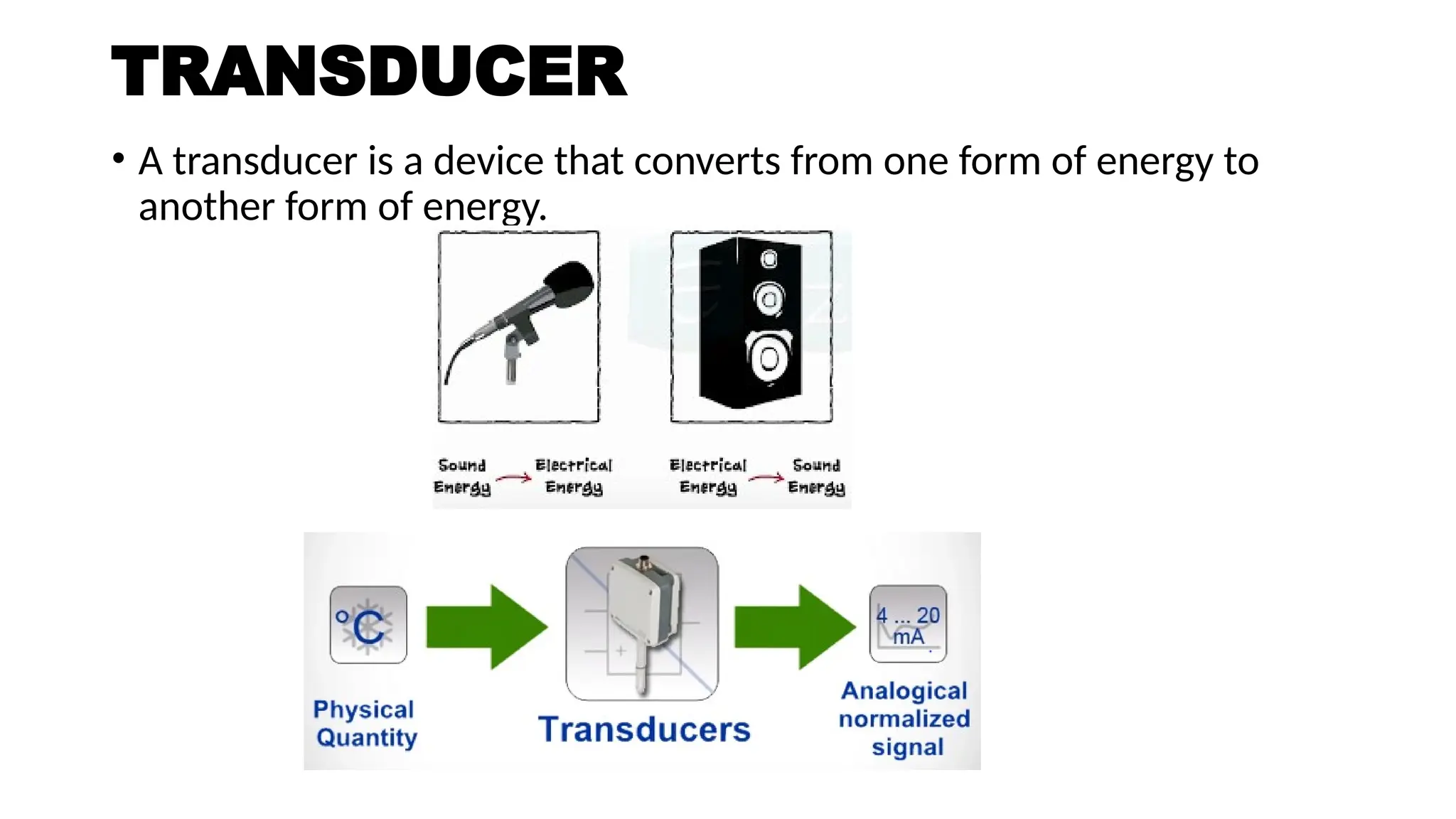
• A transducer is a device that converts from one form of energy to
another form of energy.
Recommended transducer requirements for use:
• Small size and Lightweight
• High sensitivity
• Can maintain environmental conditions
• Cheap
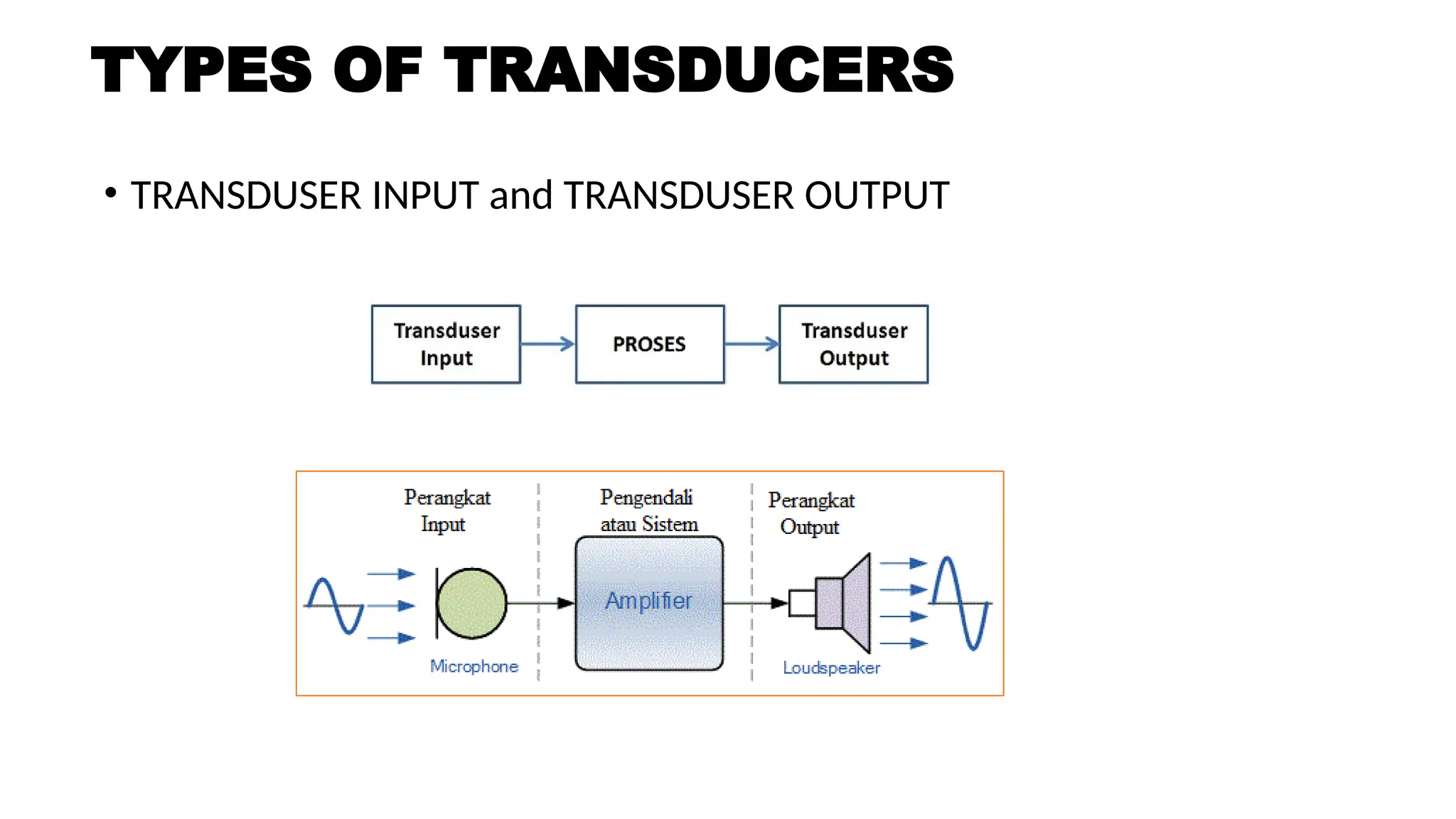
TYPES OF TRANSDUCERS
• TRANSDUSER INPUT and TRANSDUSER OUTPUT
TRANSDUSER INPUT
• Transducers that can convert physical energy into electrical signals or
resistance (which are then also converted to voltage or electrical
signals).
• This physical energy can be in the form of light, pressure, temperature
or sound waves. For example, a microphone can convert sound waves
into electrical signals that can be transmitted via electrical cables.
• Input Transducers are often also called Sensors.
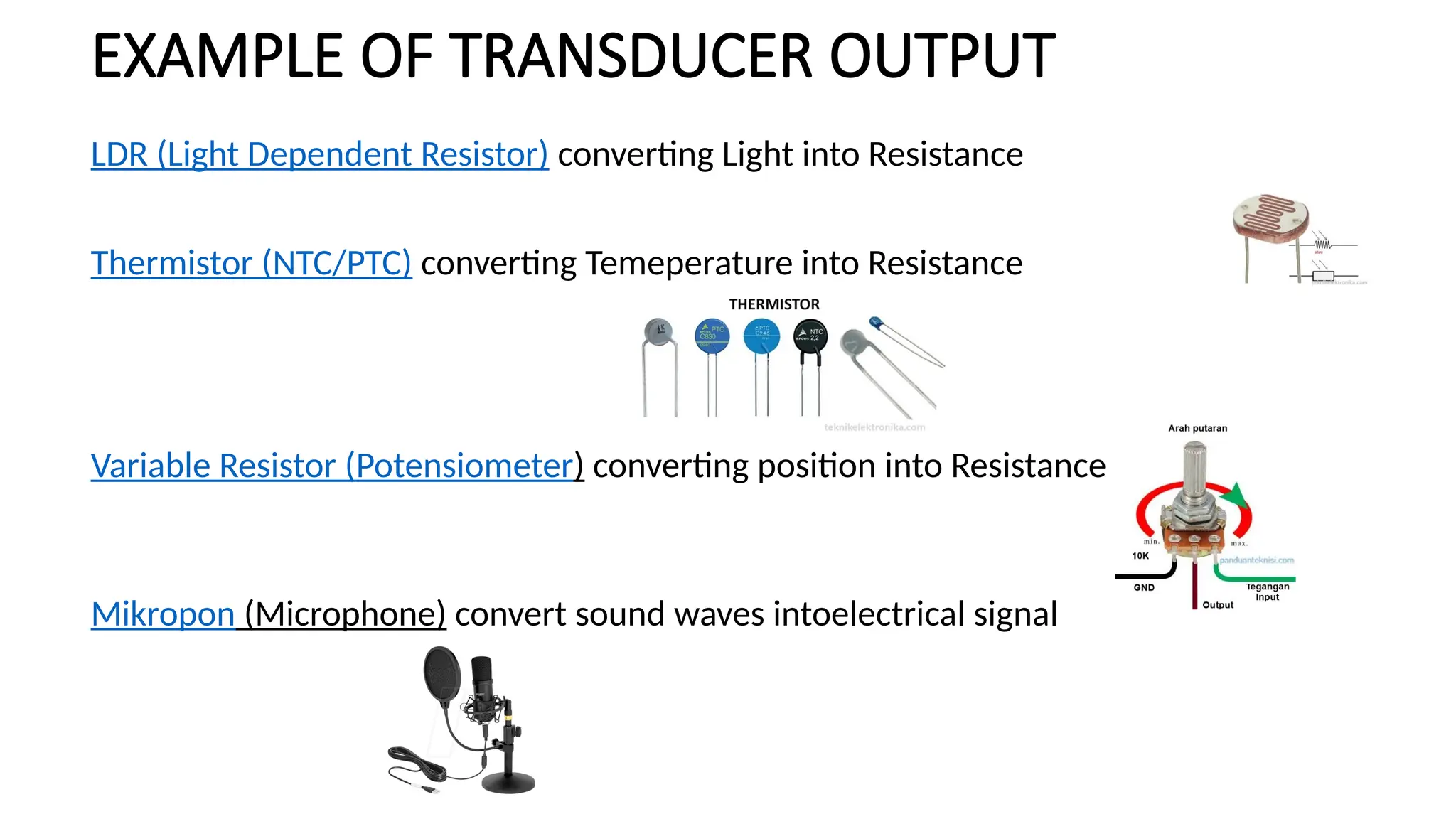
EXAMPLE OF TRANSDUCER OUTPUT
LDR (Light Dependent Resistor) converting Light into Resistance
Thermistor (NTC/PTC) converting Temeperature into Resistance
Variable Resistor (Potensiometer) converting position into Resistance
Mikropon (Microphone) convert sound waves intoelectrical signal
TRANSDUCER OUTPUT
• Output Transducer is a transducer that can convert electrical signals
into a form of physical energy (Physical Energy). For example,
loudspeaker
• Loudspeakers convert electrical signals into sounds that humans can
hear.
• Output transducers are often also called actuators.
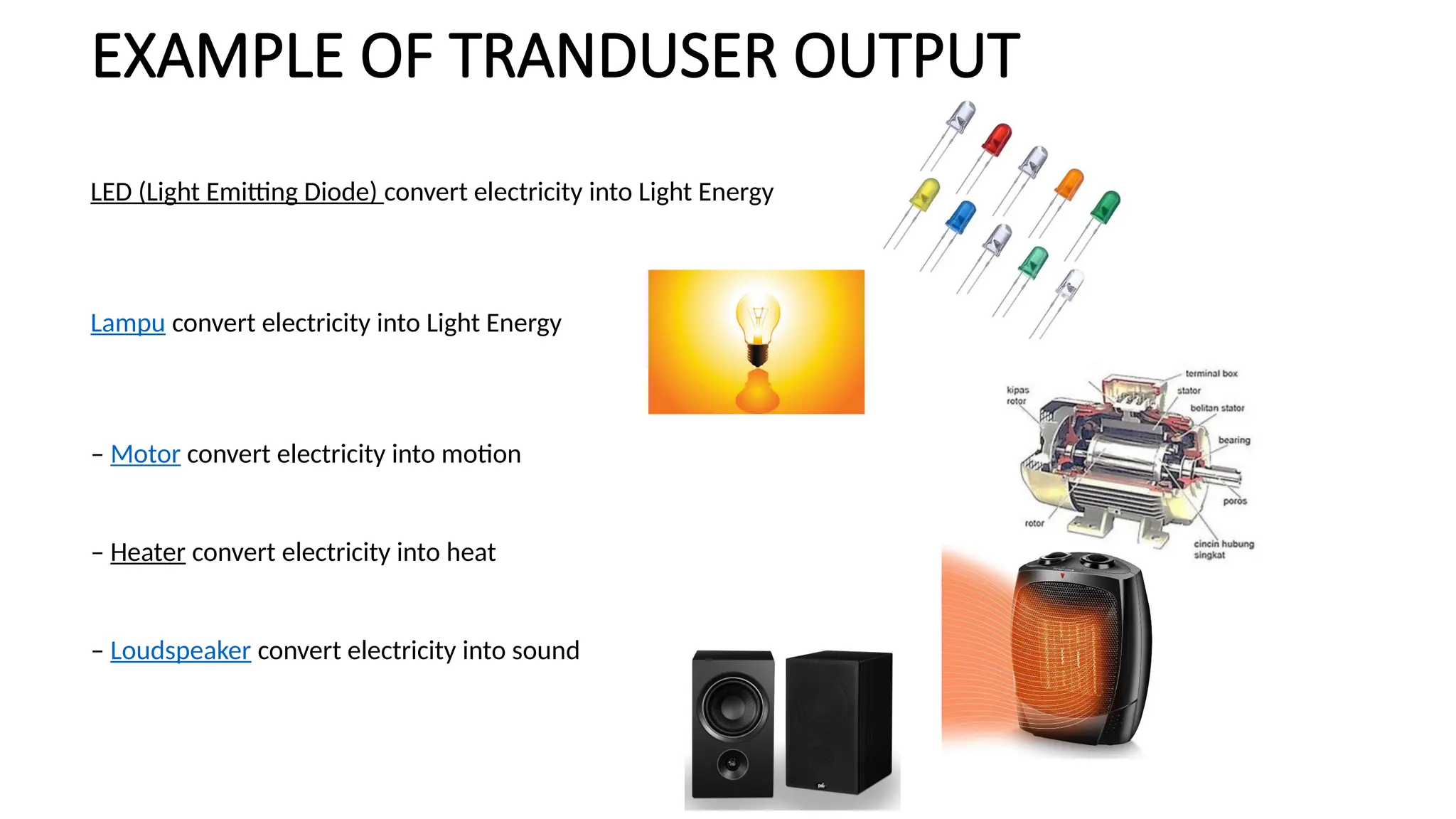
EXAMPLE OF TRANDUSER OUTPUT
LED (Light Emitting Diode) convert electricity into Light Energy
Lampu convert electricity into Light Energy
– Motor convert electricity into motion
– Heater convert electricity into heat
– Loudspeaker convert electricity into sound
Pressure Sensor
APPLICATION EXAMPLES AND EXPLANATIONS
Pressure Sensor
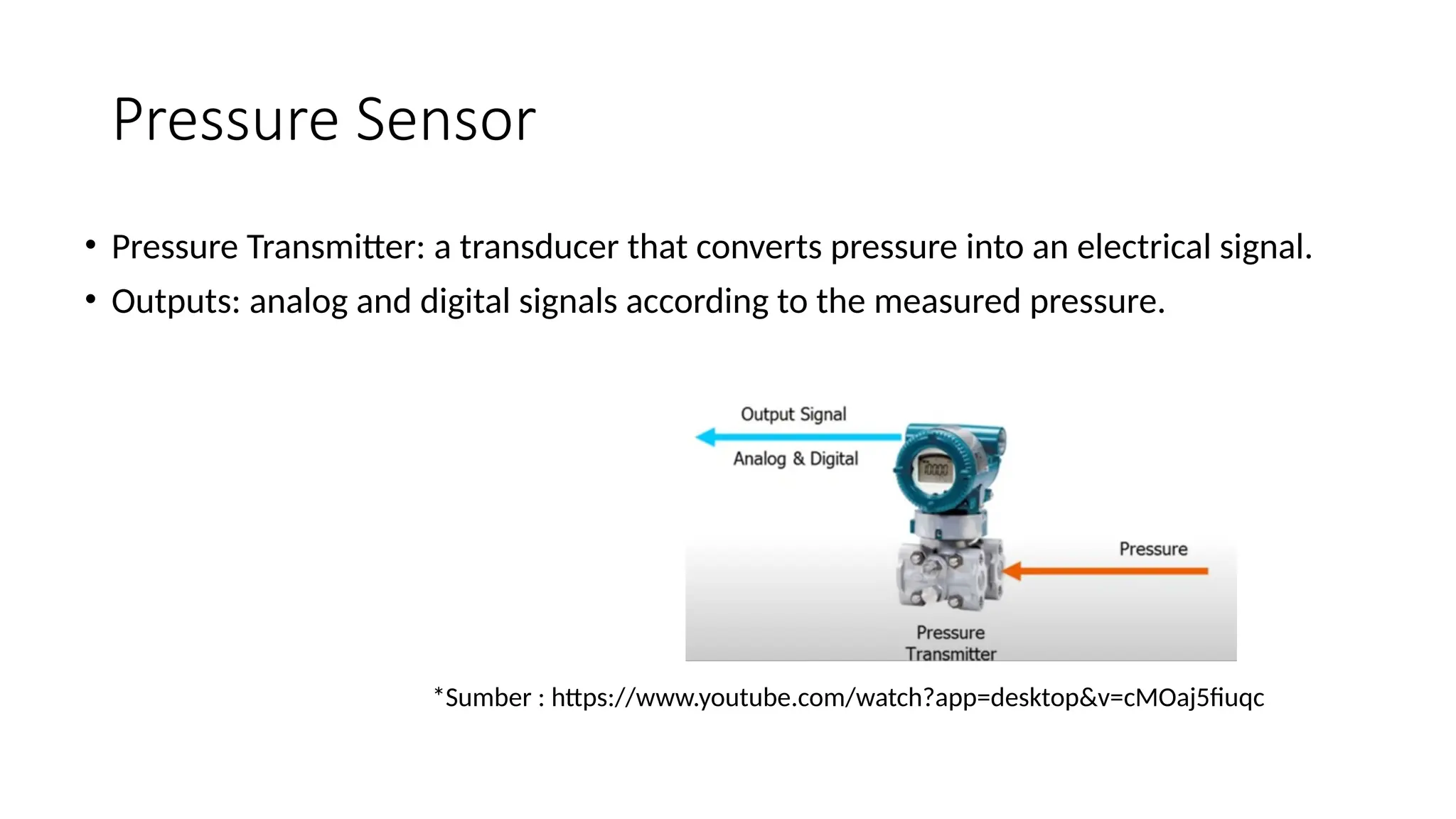
• Pressure Transmitter: a transducer that converts pressure into an electrical signal.
• Outputs: analog and digital signals according to the measured pressure.
*Sumber : https://www.youtube.com/watch?app=desktop&v=cMOaj5fiuqc
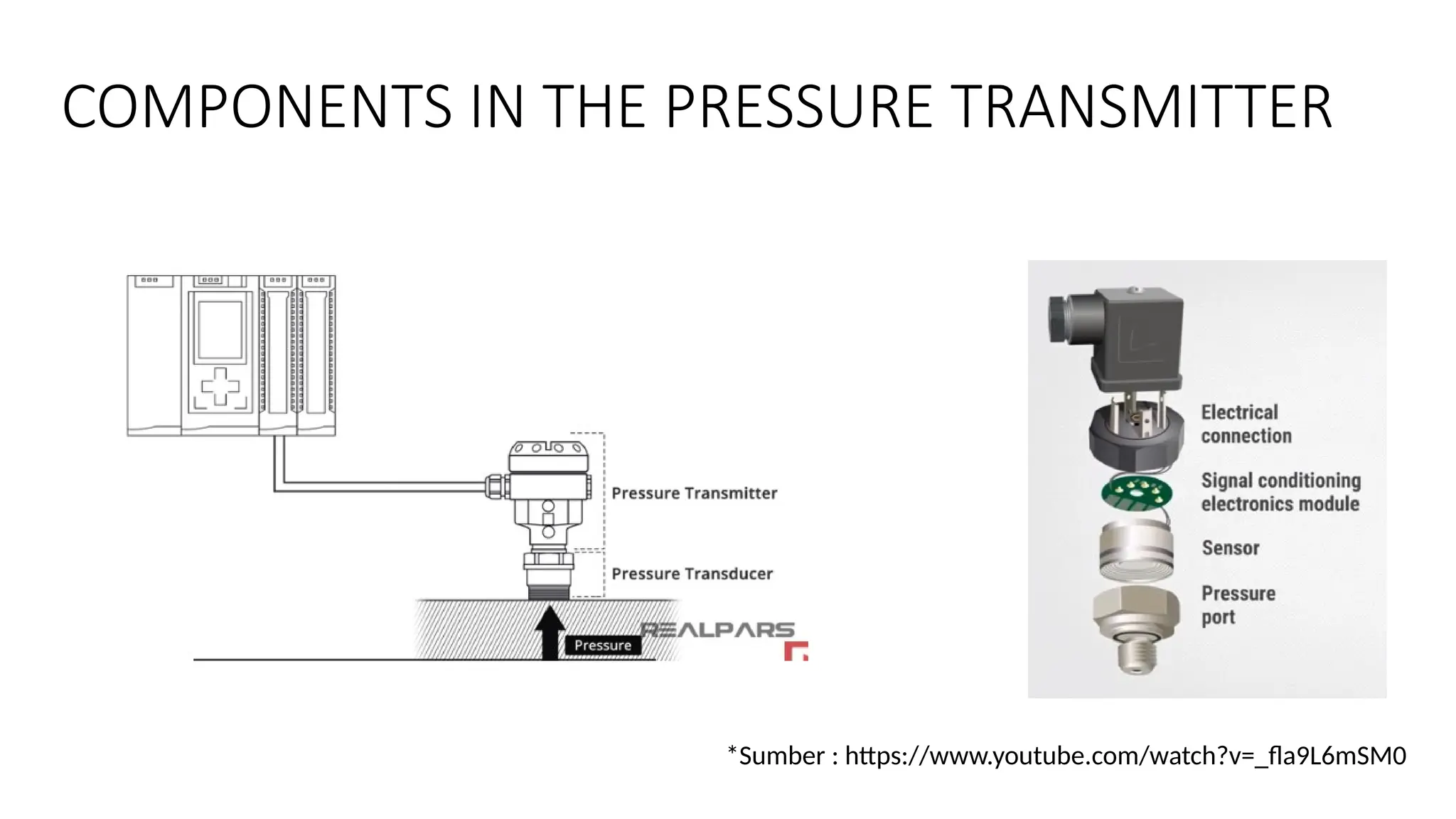
COMPONENTS IN THE PRESSURE TRANSMITTER
*Sumber : https://www.youtube.com/watch?v=_fla9L6mSM0
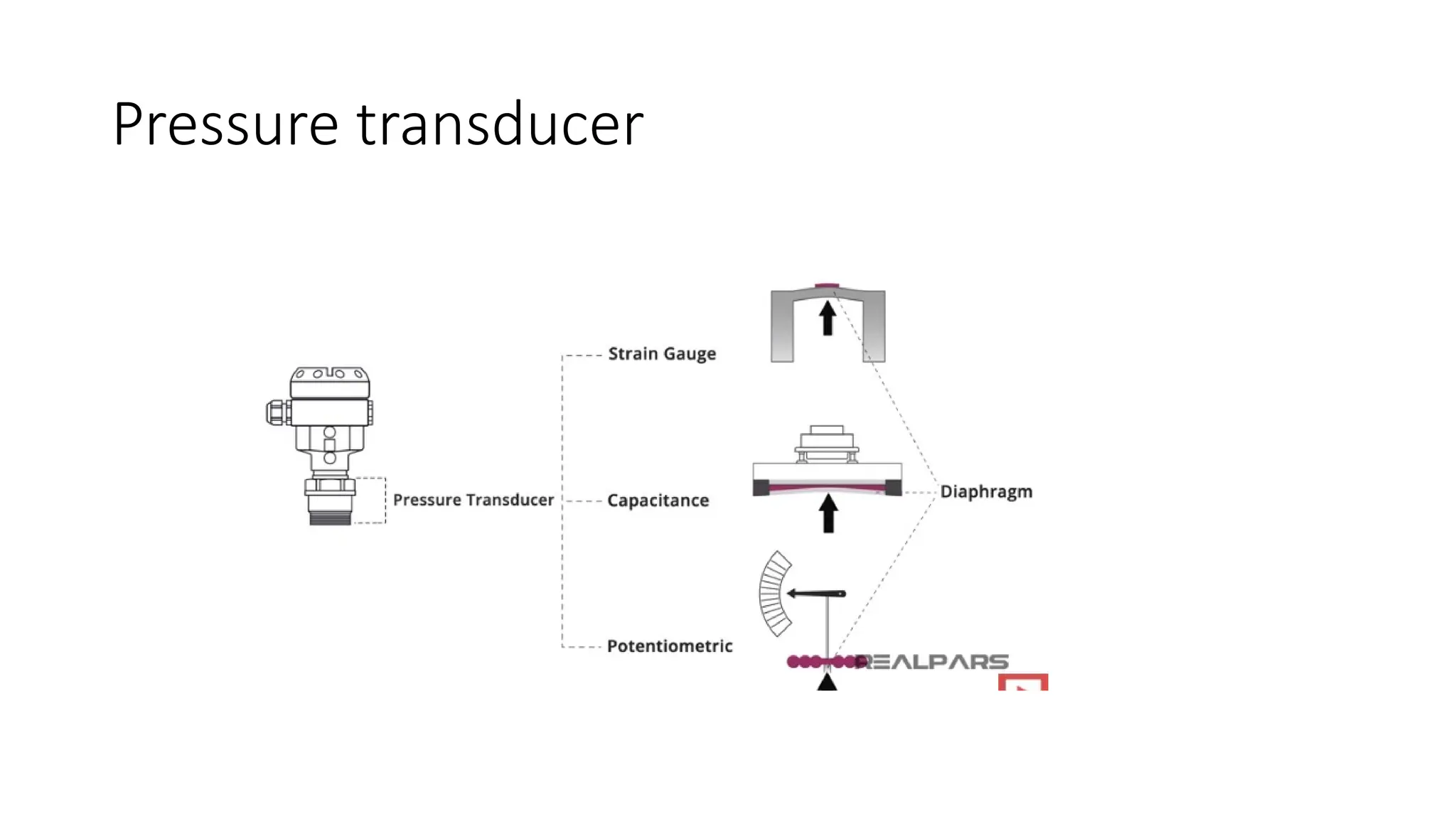
Pressure transducer
Industries that use pressure transmitters
• Oil and Gas (Oil and Gas)
• Refining
• Petrochemical (Petrochemical)
• Chemistry
 Water
 Paper Pulp
 Pharmacy (Pharma)
 Food etc.
*Sumber : https://www.youtube.com/watch?
app=desktop&v=cMOaj5fiuqc
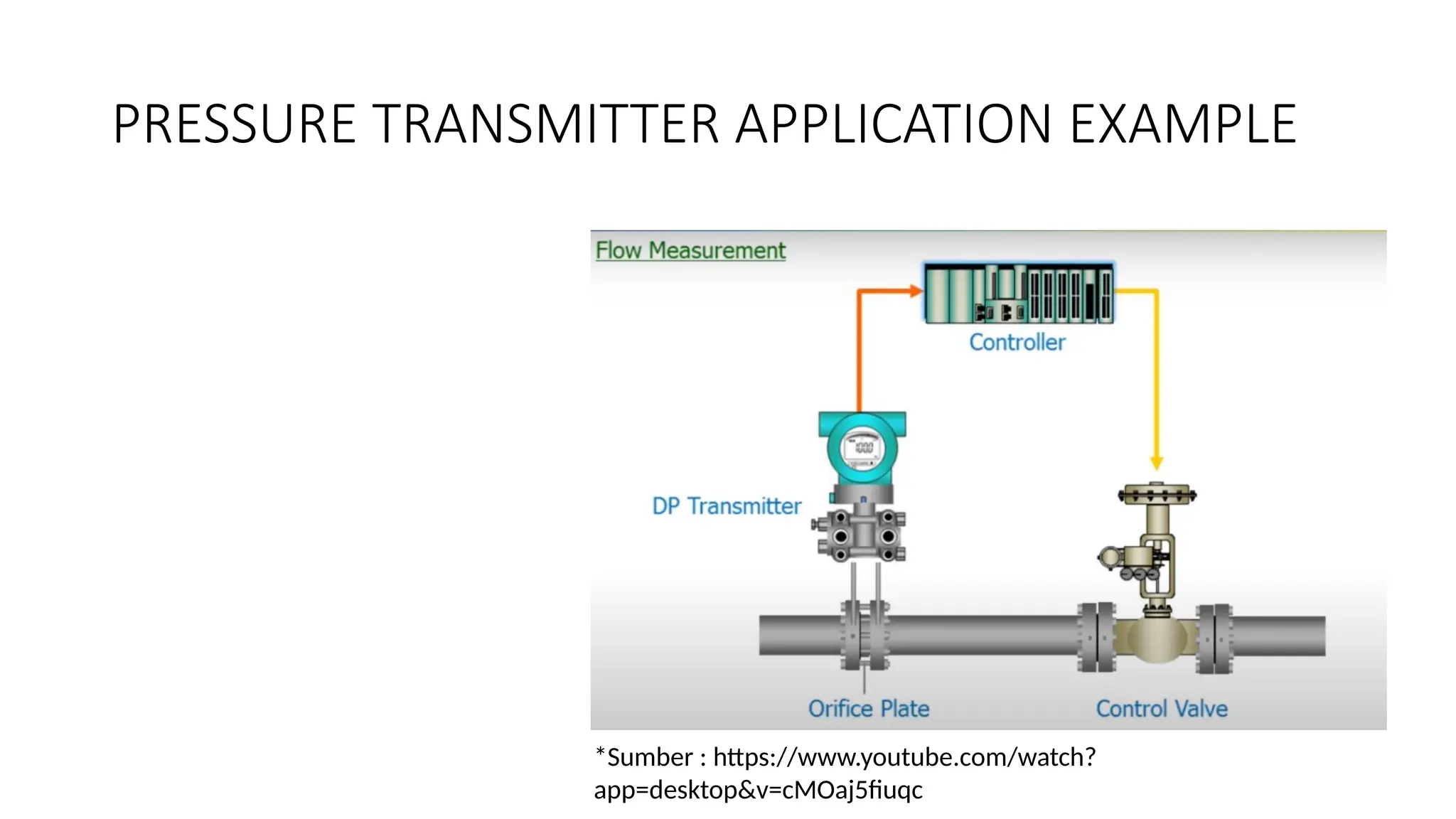
PRESSURE TRANSMITTER APPLICATION EXAMPLE
*Sumber : https://www.youtube.com/watch?
app=desktop&v=cMOaj5fiuqc
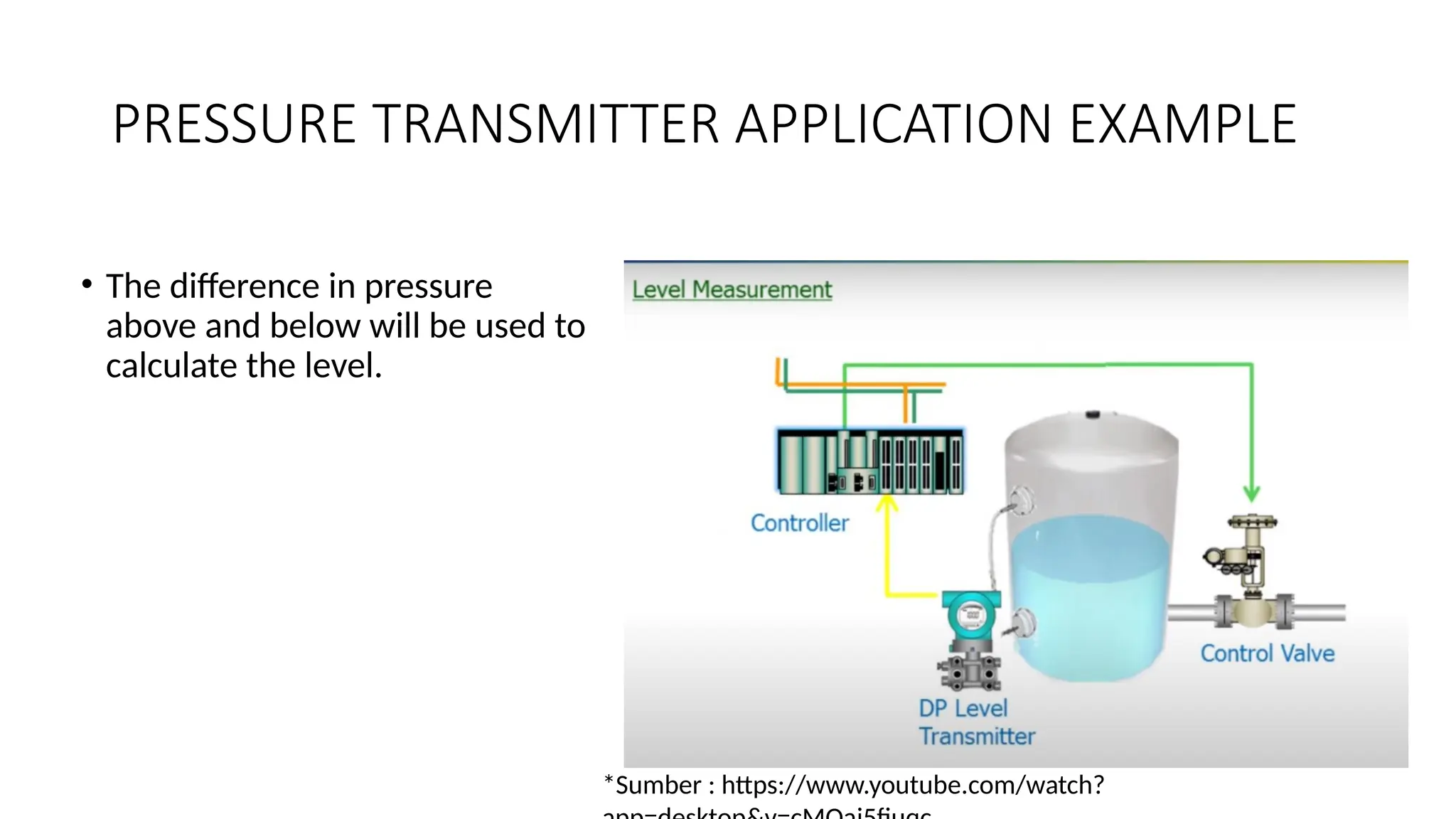
PRESSURE TRANSMITTER APPLICATION EXAMPLE
• The difference in pressure
above and below will be used to
calculate the level.
*Sumber : https://www.youtube.com/watch?
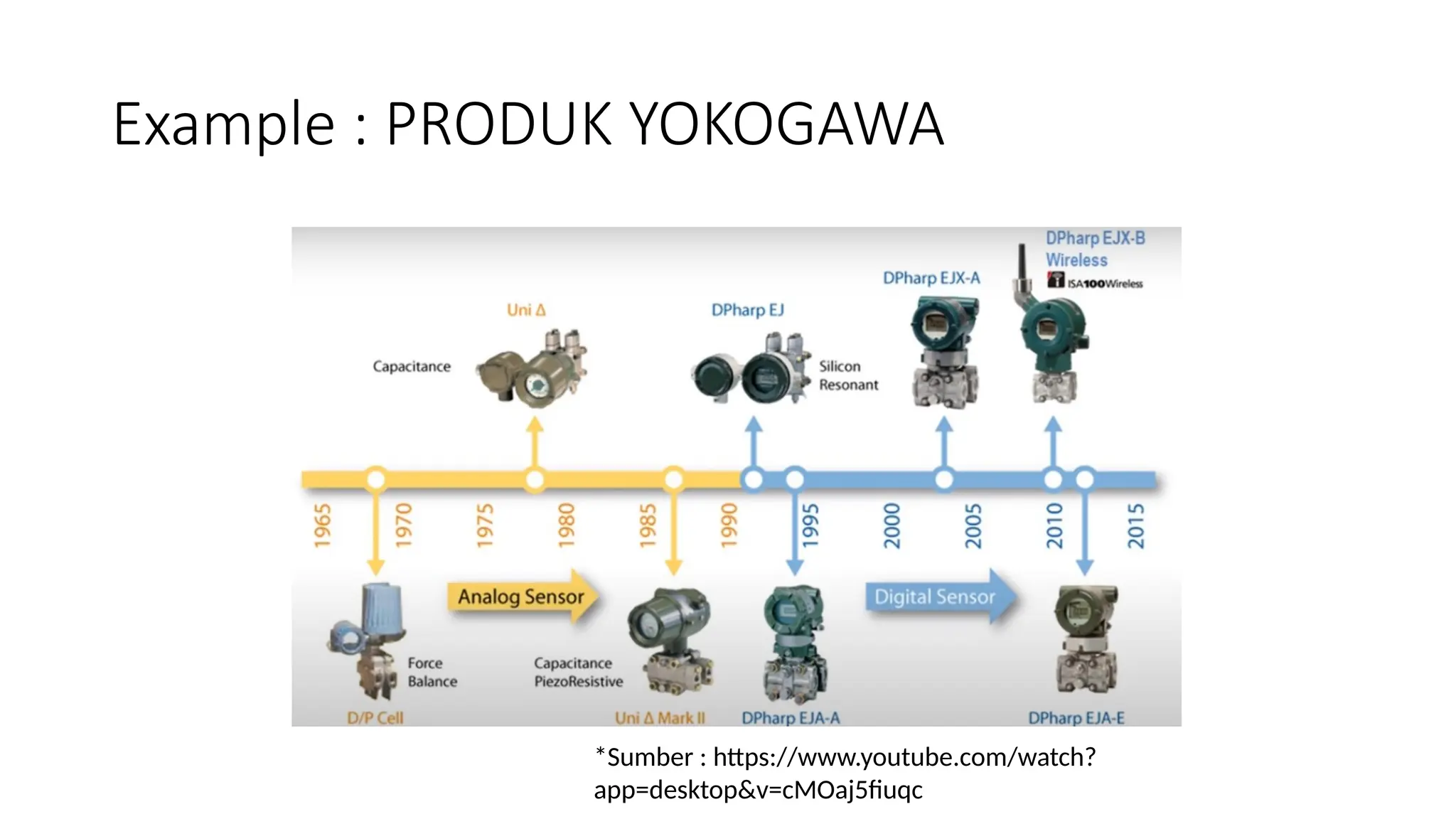
Example : PRODUK YOKOGAWA
*Sumber : https://www.youtube.com/watch?
app=desktop&v=cMOaj5fiuqc
SENSOR_TRANSDUCER_AND_TRANSMITTER[1].pptx

SENSOR_TRANSDUCER_AND_TRANSMITTER[1].pptx

  • 1.
    Sensor, Transducer andTransmitter By: RAHMA NUR AMALIA, S.T., M.T.
  • 2.
    OUTLINE • Sensor • Typesof Sensor • Transducer • Transmitter
  • 3.
    SENSOR COMES FROMTHE WORD "SENSE" (FEEL and SENSE) FEEL HEAR SMELL TASTE SEE
  • 4.
  • 5.
    Industrial Revolution * Sumber: Kasyful Amron, ST, MSc-CSCE (Fakultas Ilmu Komputer, Universitas Brawijaya)
  • 6.
    Sensors used inindustry: • Suhu (Temperature) • Level • Jarak (Distance) • Aliran (Flow rate) • Kelembaban (Humidity) • Torsi (Torque) • Densitas (Density)  Disipasi Daya (Power Dissipation)  Kecepatan (Speed)  Tegangan (Voltage)  Arus (Current)  Viskositas (Viskocity)  Tekanan (Pressure)
  • 7.
    THE USE OFSENSORS IN PROCESS CONTROL MEASURES PROCESS VARIABLES OR PHYSICAL QUANTITIES
  • 8.
    The Definition ofSensor • Sensors are devices that produce output signals for the purpose of sensing physical phenomena. • A sensor is a device that receives and responds to physical signals. These signals are produced by some type of energy such as heat, light, motion or chemical reactions • The sensor detects one or more input signals, these input signals are converted into analog or digital representation. • In general, sensors convert a recognized signal into an electrical signal (current or voltage).
  • 9.
    CLASSIFICATION OF SENSORS (BASEDON USE IN THE CONTROL PROCESS) Requires an external source power to operate
  • 10.
    ACTIVE AND PASSIVESENSOR • Active Sensor : A type of sensor that produces an output signal without the help of an external excitation voltage. Usually referred to as a sensor that produces its own signal (Self generating sensor) EXAMPLE : Photovoltaic cells, Thermocouples, Piezoelectric device
  • 11.
    • Passive Sensor: A type of sensor that produces an output signal with the help of an external excitation voltage. Requires extra stimulation or extra tension. EXAMPLE : RTD, Strain Gauge ACTIVE AND PASSIVE SENSOR
  • 12.
    CLASSIFICATION OF SENSORS (BASEDON SIGNAL PROCESSING) DIGITAL SENSOR (ON/OFF SIGNAL) ANALOG SENSOR (RANGE VALUE)
  • 13.
    DIGITAL SENSOR Digital sensorsproduce discrete output signals. Represented in 'bits' for serial transmission and 'bytes' for parallel transmission. Digital output in the form of logic 1 and logic 0 (ON or OFF). Digital sensors consist of sensors, cables and transmitters. Cables are used for long distance transmission. LIMIT SWITCH OFF CONDITION LOGIC 0 ON CONDITION LOGIC 1
  • 14.
    EXAMPLES OF DIGITALSENSOR APPLICATIONS POSITION (WATER LEVEL) HIGH /FULL LOW /EMPTY
  • 15.
    EXAMPLES OF DIGITALSENSOR APPLICATIONS CONDITION (POWER ON AND OFF) POWER OFF POWER ON
  • 16.
    VARIOUS EXAMPLES OFDIGITAL SENSORS
  • 17.
    ANALOG SENSOR • Sensorsthat produce continuous signals with time response with analog output are called analog sensors. • In general, an analog voltage in the range 0-5V or current is produced as output. • Analog sensors change physical variables into signals that can be understood by a control system (eg PLC) such as voltage or current. • These physical variables such as temperature, pressure, speed, displacement, etc.
  • 18.
    These physical variablesmust be converted into electrical quantities in the form of industry standard current and voltage (4-20mA, 12-24 V) before being processed by the controller.
  • 19.
    VARIOUS EXAMPLES OFANALOG SENSORS TEMPERATUR TEKANAN KELEMBAPAN JARAK
  • 20.
    APPLICATIONS IN THEANALOG SENSOR AND DIGITAL SENSOR INDUSTRY DIGITAL ANALOG
  • 21.
    TRANSDUCER • A transduceris a device that converts from one form of energy to another form of energy.
  • 22.
    Recommended transducer requirementsfor use: • Small size and Lightweight • High sensitivity • Can maintain environmental conditions • Cheap
  • 23.
    TYPES OF TRANSDUCERS •TRANSDUSER INPUT and TRANSDUSER OUTPUT
  • 24.
    TRANSDUSER INPUT • Transducersthat can convert physical energy into electrical signals or resistance (which are then also converted to voltage or electrical signals). • This physical energy can be in the form of light, pressure, temperature or sound waves. For example, a microphone can convert sound waves into electrical signals that can be transmitted via electrical cables. • Input Transducers are often also called Sensors.
  • 25.
    EXAMPLE OF TRANSDUCEROUTPUT LDR (Light Dependent Resistor) converting Light into Resistance Thermistor (NTC/PTC) converting Temeperature into Resistance Variable Resistor (Potensiometer) converting position into Resistance Mikropon (Microphone) convert sound waves intoelectrical signal
  • 26.
    TRANSDUCER OUTPUT • OutputTransducer is a transducer that can convert electrical signals into a form of physical energy (Physical Energy). For example, loudspeaker • Loudspeakers convert electrical signals into sounds that humans can hear. • Output transducers are often also called actuators.
  • 27.
    EXAMPLE OF TRANDUSEROUTPUT LED (Light Emitting Diode) convert electricity into Light Energy Lampu convert electricity into Light Energy – Motor convert electricity into motion – Heater convert electricity into heat – Loudspeaker convert electricity into sound
  • 28.
  • 29.
    Pressure Sensor • PressureTransmitter: a transducer that converts pressure into an electrical signal. • Outputs: analog and digital signals according to the measured pressure. *Sumber : https://www.youtube.com/watch?app=desktop&v=cMOaj5fiuqc
  • 30.
    COMPONENTS IN THEPRESSURE TRANSMITTER *Sumber : https://www.youtube.com/watch?v=_fla9L6mSM0
  • 31.
  • 32.
    Industries that usepressure transmitters • Oil and Gas (Oil and Gas) • Refining • Petrochemical (Petrochemical) • Chemistry  Water  Paper Pulp  Pharmacy (Pharma)  Food etc. *Sumber : https://www.youtube.com/watch? app=desktop&v=cMOaj5fiuqc
  • 33.
    PRESSURE TRANSMITTER APPLICATIONEXAMPLE *Sumber : https://www.youtube.com/watch? app=desktop&v=cMOaj5fiuqc
  • 34.
    PRESSURE TRANSMITTER APPLICATIONEXAMPLE • The difference in pressure above and below will be used to calculate the level. *Sumber : https://www.youtube.com/watch?
  • 35.
    Example : PRODUKYOKOGAWA *Sumber : https://www.youtube.com/watch? app=desktop&v=cMOaj5fiuqc