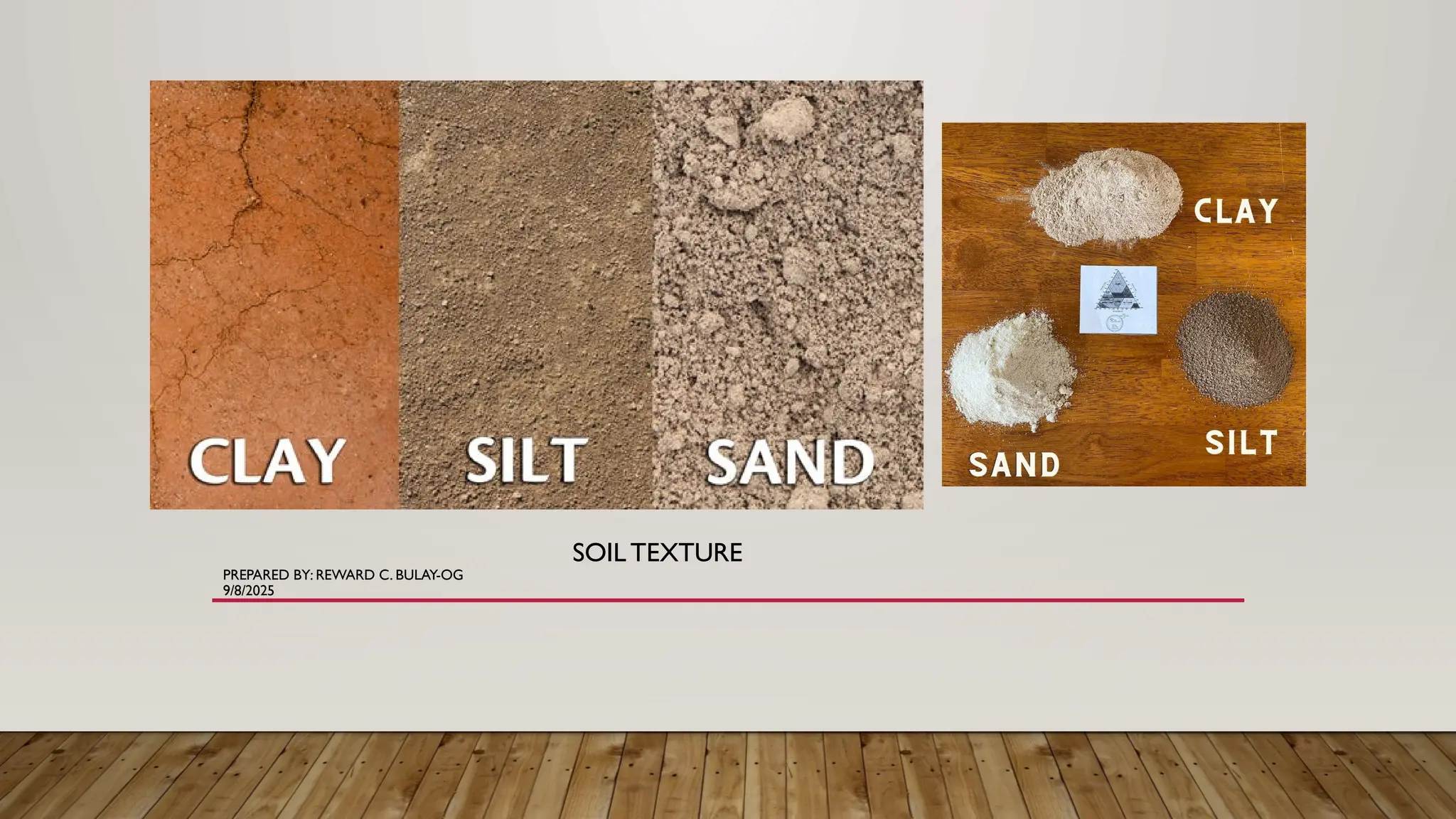
A soil texture lecture defines soil texture as the relative proportions of sand, silt, and clay particles, which dictates its physical properties like water retention, aeration, drainage, and fertility, impacting agriculture and ecosystems.
OBJECTIVES:
1. Identify anddescribe the different soil particle sizes (sand, silt, and clay)
and their physical characteristics.
2. Classify soils using the Soil Texture Triangle into the 12 soil texture
classes based on the proportion of sand, silt, and clay.
3. Analyze the relationship between soil texture, water movement,
nutrient availability, and crop suitability through observation and
computation activities.
3.
SOILTEXTURE
• SoilTexture
• Soiltexture refers to the relative
proportion of sand, silt, and clay particles
in a soil sample.These particles differ in size:
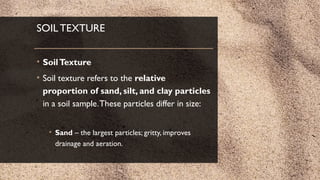
• Sand – the largest particles; gritty, improves
drainage and aeration.
SOIL TEXTURE
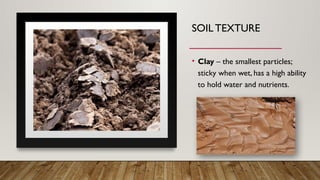
• Clay– the smallest particles;
sticky when wet, has a high ability
to hold water and nutrients.
6.
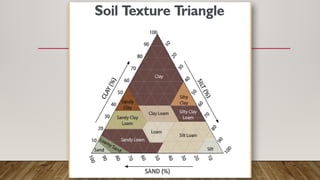
• The soiltexture triangle is used to classify soil into 12 texture classes (such as
sandy loam, clay loam, or silt loam) based on the percentage of sand, silt, and clay.
Soil texture strongly affects:
• Water movement and retention (sandy soils drain quickly, clay soils hold more
water).
• Nutrient availability (clay-rich soils retain nutrients better).
• Root growth and farming practices (loamy soils are considered best for crops
because they balance sand, silt, and clay).
8.
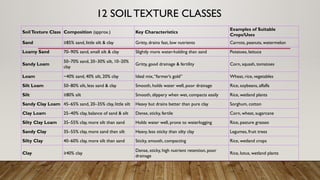
12 SOILTEXTURE CLASSES
SoilTextureClass Composition (approx.) Key Characteristics
Examples of Suitable
Crops/Uses
Sand ≥85% sand, little silt & clay Gritty, drains fast, low nutrients Carrots, peanuts, watermelon
Loamy Sand 70–90% sand, small silt & clay Slightly more water-holding than sand Potatoes, lettuce
Sandy Loam
50–70% sand, 20–30% silt, 10–20%
clay
Gritty, good drainage & fertility Corn, squash, tomatoes
Loam ~40% sand, 40% silt, 20% clay Ideal mix,“farmer’s gold” Wheat, rice, vegetables
Silt Loam 50–80% silt, less sand & clay Smooth, holds water well, poor drainage Rice, soybeans, alfalfa
Silt ≥80% silt Smooth, slippery when wet, compacts easily Rice, wetland plants
Sandy Clay Loam 45–65% sand, 20–35% clay, little silt Heavy but drains better than pure clay Sorghum, cotton
Clay Loam 25–40% clay, balance of sand & silt Dense, sticky, fertile Corn, wheat, sugarcane
Silty Clay Loam 35–55% clay, more silt than sand Holds water well, prone to waterlogging Rice, pasture grasses
Sandy Clay 35–55% clay, more sand than silt Heavy, less sticky than silty clay Legumes, fruit trees
Silty Clay 40–60% clay, more silt than sand Sticky, smooth, compacting Rice, wetland crops
Clay ≥40% clay
Dense, sticky, high nutrient retention, poor
drainage
Rice, lotus, wetland plants
9.
DOS INTHE LABORATORY
•Listen carefully to your teacher’s instructions before starting.
• Wear proper safety gear (lab gown, gloves, goggles if needed).
• Handle equipment with care and use them only for their intended purpose.
• Label samples and chemicals properly to avoid confusion.
• Dispose of waste materials in the correct container.
• Report accidents or spills immediately to the teacher.
• Keep your workspace clean and organized.
• Wash your hands thoroughly after completing the experiment.
10.
DON’TS INTHE LABORATORY
•Do not eat, drink, or chew gum inside the lab.
• Do not run, shout, or play around while in the laboratory.
• Do not touch equipment or chemicals without permission.
• Do not leave experiments unattended.
• Do not ignore safety rules or warning signs.
• Do not clutter your lab table with unnecessary things.
PROCEDURE
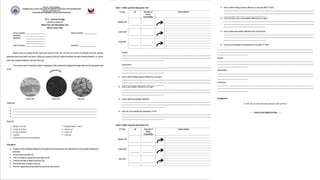
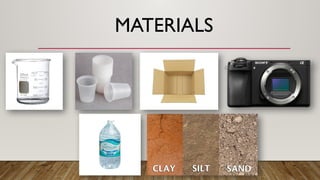
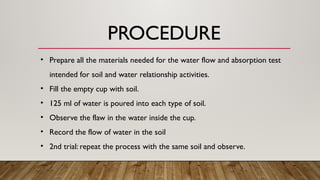
• Prepare allthe materials needed for the water flow and absorption test
intended for soil and water relationship activities.
• Fill the empty cup with soil.
• 125 ml of water is poured into each type of soil.
• Observe the flaw in the water inside the cup.
• Record the flow of water in the soil
• 2nd trial: repeat the process with the same soil and observe.
14.
PURPOSE OFTHE ACTIVITY
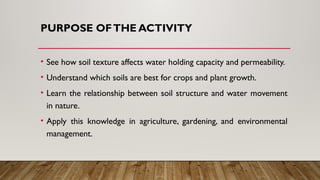
•See how soil texture affects water holding capacity and permeability.
• Understand which soils are best for crops and plant growth.
• Learn the relationship between soil structure and water movement
in nature.
• Apply this knowledge in agriculture, gardening, and environmental
management.
15.
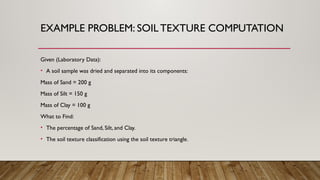
EXAMPLE PROBLEM: SOILTEXTURE COMPUTATION
Given (Laboratory Data):
• A soil sample was dried and separated into its components:
Mass of Sand = 200 g
Mass of Silt = 150 g
Mass of Clay = 100 g
What to Find:
• The percentage of Sand, Silt, and Clay.
• The soil texture classification using the soil texture triangle.
16.
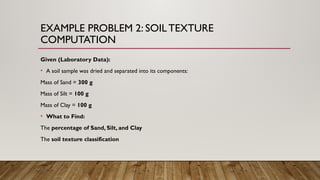
EXAMPLE PROBLEM 2:SOILTEXTURE
COMPUTATION
Given (Laboratory Data):
• A soil sample was dried and separated into its components:
Mass of Sand = 300 g
Mass of Silt = 100 g
Mass of Clay = 100 g
• What to Find:
The percentage of Sand, Silt, and Clay
The soil texture classification
Editor's Notes
#1 If you were a farmer, which soil would you choose for planting rice: sandy, clayey, or loamy soil? Why?
Which soil do you think holds the most water: sand, silt, or clay?
Carrots grow best in sandy soil. Why do you think that is?”
“Loam is called ‘farmer’s gold.’ What do you think makes it so valuable?”
“If you could compare yourself to a soil type (sand, silt, or clay), which one would you be and why?”
#3 Sand – the largest particles
Soil is made of different particle sizes: sand, silt, and clay.
Sand particles are the biggest (0.05–2 mm in diameter). You can often see them with your eyes, and they feel gritty when rubbed between your fingers.
Why does sand improve drainage and aeration?
Because sand grains are large, they don’t pack tightly together.
This leaves large pores (spaces) between particles.
Water drains quickly through these spaces, so sandy soils dry out faster.
The same spaces allow air to enter, which helps plant roots “breathe” (aeration).
Example
Imagine pouring water into a jar of marbles (large particles). The water drains quickly, and air fills the gaps.
This is similar to sandy soil.
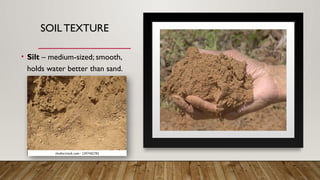
#4 Silt – medium-sized particles
Size: Silt particles are smaller than sand but larger than clay (0.002–0.05 mm).
Feel: If you rub silt between your fingers, it feels smooth or floury (like baby powder).
Water holding: Because the particles are smaller, they fit more closely together, leaving smaller pores than sand.
This means silt holds water better than sand, but it doesn’t drain as fast.
Aeration: Since pores are smaller, there’s less air movement compared to sandy soil.
Why does this matter?
Silt-rich soils are good at storing water for plants, but if there’s too much, they can become compacted and reduce root breathing.
Analogy
Imagine a jar filled with sugar grains (medium-sized). Water doesn’t drain as quickly as with marbles (sand) but doesn’t stay stuck like in flour (clay).
#5 Clay – the smallest particles
Size: Clay particles are tiny (less than 0.002 mm). You cannot see individual clay particles with the naked eye.
Feel: When wet, clay feels sticky and plastic-like (you can mold it). When dry, it becomes hard and compact.
Pores: Because the particles are so small, they pack tightly together, leaving very tiny pores.
Water moves very slowly → poor drainage.
But clay can hold a lot of water and nutrients → very fertile if managed well.
Why does this matter?
Clay soils can store nutrients (like potassium, calcium, and magnesium) much better than sand or silt.
However, if too wet, they become waterlogged; if too dry, they harden and crack — both can stress plants.
Analogy
Imagine a jar filled with flour. When you pour water in, it stays trapped and doesn’t drain quickly. That’s like clay soil holding water.
Examples in farming
Crops that can tolerate wet conditions grow well in clay, such as rice, lotus, and some grasses.
With good management (plowing, adding organic matter), clay can also grow sugarcane, wheat, and maize.
#6 1. Water Movement and Retention
Sandy soils:
Large particles = big spaces (pores) between them.
Water drains quickly → soil dries out fast.
Farmers need to water sandy soils more often.
Example crops: carrots, peanuts, watermelon (they like dry, loose soil).
Clay soils:
Tiny particles = very small spaces.
Water drains slowly → soil stays wet for a long time.
Can cause waterlogging (too much water around roots).
Example crops: rice, lotus (they thrive in water).
Loamy soils:
Balanced mix of sand, silt, and clay.
Hold enough water for plants but still drain well.
Example crops: corn, wheat, vegetables.
2. Nutrient Availability
Sandy soils Are Poor at holding nutrients, which means fertilizers wash away easily.
Clay soils Are Excellent at holding nutrients due to their tiny particles and negative charges that attract nutrients.
Silt and Loam: Medium to high nutrient availability, making them fertile for most crops.
💡 Farmers often add organic matter (compost, manure) to sandy soils to improve nutrient and water retention.
3. Root Growth and Farming Practices
Sandy soils: Roots can grow deep because the soil is loose.
Clay soils: Roots may struggle in compacted clay, especially when it’s dry and hard.
Loamy soils: Provide the best conditions — not too hard, not too loose, and plenty of nutrients.
💡 That’s why loam is called the “farmer’s gold” — it’s ideal for most crops.
✅ Summary for students:
Soil texture determines how water moves, how nutrients are stored, and how roots grow.
Sand = good air, poor water/nutrients.
Clay = holds water/nutrients, poor drainage.
Loam = best balance → best for farming.
In short, soil texture helps us understand how soil behaves and is a key factor in agriculture, gardening, and environmental science.
#7 Porosity measures the total volume of empty, void space within a material, indicating its capacity to hold fluids.
Permeability, on the other hand, measures the ease and rate at which those fluids can move through interconnected pore spaces, effectively describing the material's ability to transmit fluids.
You can have high porosity but low permeability if the pores are not connected, but high permeability generally requires both high porosity and well-connected pores.
Factors: Determined by grain size, shape, sorting, and compaction. - porosity
Factors: Depends on the connectivity and size of the pore spaces. - permeability
#8 ALFALFA - a perennial flowering plant in the legume family, cultivated worldwide as a high-quality forage for livestock and as alfalfa sprouts for human consumption.
Sorghum (scientific name Sorghum bicolor) is a drought-tolerant cereal grain from the grass family, cultivated for human food, animal feed, and biofuels.
"Lotus“ - can refer to several different things, including the lotus flower, an aquatic plant symbolizing purity and rebirth
#14 In short: We do the test to know how soil type influences water supply for plants and to make better decisions in farming and ecology.