Efficient extracellular secretion of an
          endoglucanase and a b-glucosidase in
                          E. coli

           Shefali Gupta, Nidhi Adlakha, Syed Shams
                            Yazdani

Laura Ortiz
Sergio Ramírez

Medicine students
Molecular Biology
INTRODUCTION


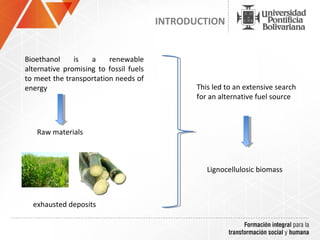
Bioethanol     is   a    renewable
alternative promising to fossil fuels
to meet the transportation needs of
energy                                         This led to an extensive search
                                               for an alternative fuel source


   Raw materials


                                                  Lignocellulosic biomass


  exhausted deposits
INTRODUCTION


The enzymatic hydrolysis step is
                                                    enzymes are responsible
considered crucial impediment to the
                                                    for hydrolysis
commercialization of bioethanol from
lignocellulosic biomass


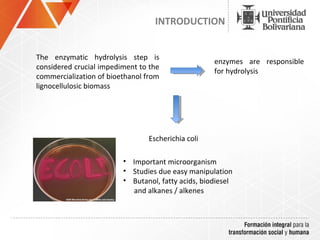
                                Escherichia coli

                         • Important microorganism
                         • Studies due easy manipulation
                         • Butanol, fatty acids, biodiesel
                           and alkanes / alkenes
INTRODUCTION


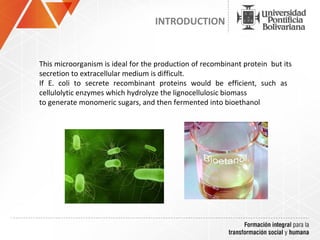
This microorganism is ideal for the production of recombinant protein but its
secretion to extracellular medium is difficult.
If E. coli to secrete recombinant proteins would be efficient, such as
cellulolytic enzymes which hydrolyze the lignocellulosic biomass
to generate monomeric sugars, and then fermented into bioethanol
INTRODUCTION

                              produce a series of
Paenibacillus sp
                              cellulolytic enzymes

                                β-1 ,4-endoglucanase


                                β-glucosidase


     Through plasmids want to obtain recombinant E.coli
     expected if these cellulolytic enzymes are synthesized and
     secrete


                           BIOETHANOL
GENERALITIES


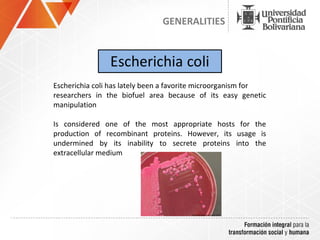
Escherichia coli has lately been a favorite microorganism for
researchers in the biofuel area because of its easy genetic
manipulation

Is considered one of the most appropriate hosts for the
production of recombinant proteins. However, its usage is
undermined by its inability to secrete proteins into the
extracellular medium
ENZYMES


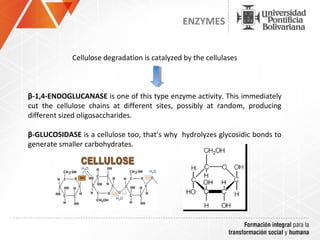
             Cellulose degradation is catalyzed by the cellulases


β-1,4-ENDOGLUCANASE is one of this type enzyme activity. This immediately
cut the cellulose chains at different sites, possibly at random, producing
different sized oligosaccharides.

β-GLUCOSIDASE is a cellulose too, that’s why hydrolyzes glycosidic bonds to
generate smaller carbohydrates.
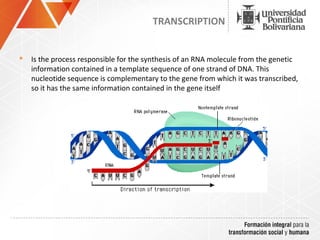
TRANSCRIPTION


   Is the process responsible for the synthesis of an RNA molecule from the genetic
    information contained in a template sequence of one strand of DNA. This
    nucleotide sequence is complementary to the gene from which it was transcribed,
    so it has the same information contained in the gene itself
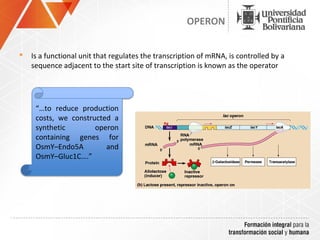
OPERON


   Is a functional unit that regulates the transcription of mRNA, is controlled by a
    sequence adjacent to the start site of transcription is known as the operator


     “…to reduce production
     costs, we constructed a
     synthetic        operon
     containing genes for
     OsmY–Endo5A         and
     OsmY–Gluc1C….”
RELATIONSHIP
OBJECTIVE


   Determine the genetic and environmental parameters for the optimal secretion of
    enzymes β-1,4-endoglucanase (Endo5A) and β-glucosidase (Gluc1C) to the culture
    medium from recombinant E. coli to see its capacity to be a source of bioethanol
MATERIALES Y MÉTODOS

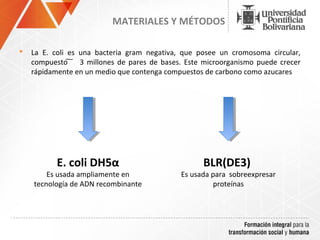
   La E. coli es una bacteria gram negativa, que posee un cromosoma circular,
    compuesto ͠ 3 millones de pares de bases. Este microorganismo puede crecer
    rápidamente en un medio que contenga compuestos de carbono como azucares


           E. coli DH5α                            BLR(DE3)
        Es usada ampliamente en              Es usada para sobreexpresar
    tecnología de ADN recombinante                    proteínas
MATERIALES Y MÉTODOS


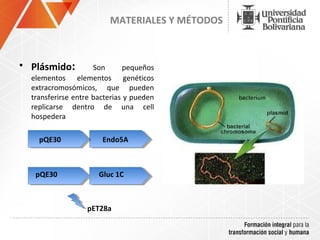
• Plásmido:          Son      pequeños
  elementos elementos genéticos
  extracromosómicos, que pueden
  transferirse entre bacterias y pueden
  replicarse dentro de una cell
  hospedera

    pQE30              Endo5A


   pQE30              Gluc 1C


                  pET28a
MATERIALES Y MÉTODOS


                     EXPRESIÓN Y
                   RECOMBINANTES
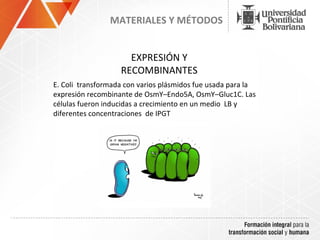
E. Coli transformada con varios plásmidos fue usada para la
expresión recombinante de OsmY–Endo5A, OsmY–Gluc1C. Las
células fueron inducidas a crecimiento en un medio LB y
diferentes concentraciones de IPGT
MATERIALES Y MÉTODOS


         •   ENDOGLUCANASA                           •   B-GLUCOSIDASA

•   Midiendo la cantidad de la reducción   •   Midiendo la cantidad de p-nitrofenol
    de azúcar liberado durante la              liberado durante la incubación con p-
    incubación con carboximetilcelulosa        nitrofenil-β-D-glucopiranósido como
    como sustrato                              sustrato

•   1U de actividad enzimática :           •   1U de actividad : cantidad de enzima
    cantidad de enzima que libera 1mol         requerida para liberar 1mol de p-
    de azúcar reductor por minuto              nitrofenol por minuto
MATERIALES Y MÉTODOS


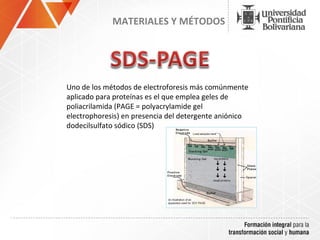
Uno de los métodos de electroforesis más comúnmente
aplicado para proteínas es el que emplea geles de
poliacrilamida (PAGE = polyacrylamide gel
electrophoresis) en presencia del detergente aniónico
dodecilsulfato sódico (SDS)
RESULTADOS


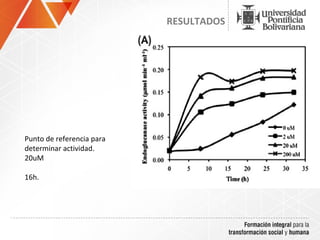
Punto de referencia para
determinar actividad.
20uM

16h.
RESULTADOS


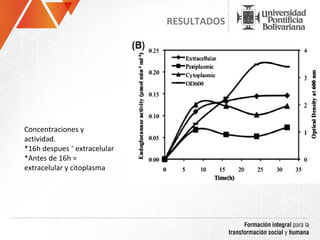
Concentraciones y
actividad.
*16h despues ˃ extracelular
*Antes de 16h =
extracelular y citoplasma
RESULTADOS


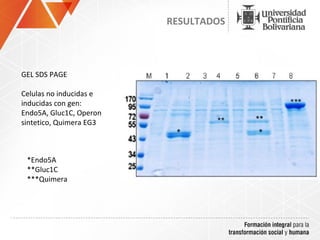
GEL SDS PAGE

Celulas no inducidas e
inducidas con gen:
Endo5A, Gluc1C, Operon
sintetico, Quimera EG3


 *Endo5A
 **Gluc1C
 ***Quimera
RESULTADOS


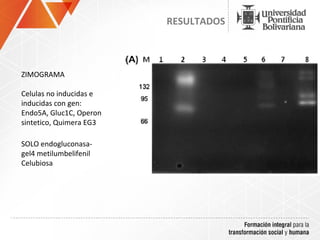
ZIMOGRAMA

Celulas no inducidas e
inducidas con gen:
Endo5A, Gluc1C, Operon
sintetico, Quimera EG3

SOLO endogluconasa-
gel4 metilumbelifenil
Celubiosa
RESULTADOS


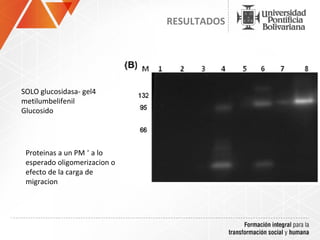
SOLO glucosidasa- gel4
metilumbelifenil
Glucosido


 Proteinas a un PM ˃ a lo
 esperado oligomerizacion o
 efecto de la carga de
 migracion
DISCUSSION
CONCLUSIONS


     OsmY (hyperosmotically
      OsmY (hyperosmotically
 inducible periplasmic protein)
  inducible periplasmic protein)
  is very important in efficient
   is very important in efficient
    extracellular secretion of
     extracellular secretion of
enzymes endogluconase and β-
 enzymes endogluconase and β-
            glucosidase
             glucosidase

                                    It has to follow doing many
                                     It has to follow doing many
                                      studies about bioethanol
                                       studies about bioethanol
                                       production from E.coli.
                                        production from E.coli.
CONCLUSIONS


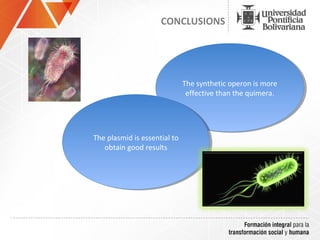
                               The synthetic operon is more
                                The synthetic operon is more
                                effective than the quimera.
                                 effective than the quimera.


The plasmid is essential to
 The plasmid is essential to
   obtain good results
    obtain good results
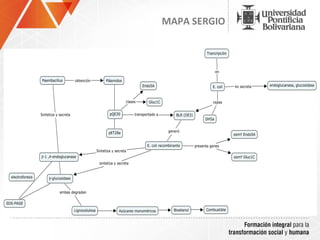
MAPA SERGIO
MAPA LAURA
GRACIAS!!!

Seminario biologia molecular

  • 1.
    Efficient extracellular secretionof an endoglucanase and a b-glucosidase in E. coli Shefali Gupta, Nidhi Adlakha, Syed Shams Yazdani Laura Ortiz Sergio Ramírez Medicine students Molecular Biology
  • 2.
    INTRODUCTION Bioethanol is a renewable alternative promising to fossil fuels to meet the transportation needs of energy This led to an extensive search for an alternative fuel source Raw materials Lignocellulosic biomass exhausted deposits
  • 3.
    INTRODUCTION The enzymatic hydrolysisstep is enzymes are responsible considered crucial impediment to the for hydrolysis commercialization of bioethanol from lignocellulosic biomass Escherichia coli • Important microorganism • Studies due easy manipulation • Butanol, fatty acids, biodiesel and alkanes / alkenes
  • 4.
    INTRODUCTION This microorganism isideal for the production of recombinant protein but its secretion to extracellular medium is difficult. If E. coli to secrete recombinant proteins would be efficient, such as cellulolytic enzymes which hydrolyze the lignocellulosic biomass to generate monomeric sugars, and then fermented into bioethanol
  • 5.
    INTRODUCTION produce a series of Paenibacillus sp cellulolytic enzymes β-1 ,4-endoglucanase β-glucosidase Through plasmids want to obtain recombinant E.coli expected if these cellulolytic enzymes are synthesized and secrete BIOETHANOL
  • 6.
    GENERALITIES Escherichia coli haslately been a favorite microorganism for researchers in the biofuel area because of its easy genetic manipulation Is considered one of the most appropriate hosts for the production of recombinant proteins. However, its usage is undermined by its inability to secrete proteins into the extracellular medium
  • 7.
    ENZYMES Cellulose degradation is catalyzed by the cellulases β-1,4-ENDOGLUCANASE is one of this type enzyme activity. This immediately cut the cellulose chains at different sites, possibly at random, producing different sized oligosaccharides. β-GLUCOSIDASE is a cellulose too, that’s why hydrolyzes glycosidic bonds to generate smaller carbohydrates.
  • 8.
    TRANSCRIPTION  Is the process responsible for the synthesis of an RNA molecule from the genetic information contained in a template sequence of one strand of DNA. This nucleotide sequence is complementary to the gene from which it was transcribed, so it has the same information contained in the gene itself
  • 9.
    OPERON  Is a functional unit that regulates the transcription of mRNA, is controlled by a sequence adjacent to the start site of transcription is known as the operator “…to reduce production costs, we constructed a synthetic operon containing genes for OsmY–Endo5A and OsmY–Gluc1C….”
  • 10.
  • 11.
    OBJECTIVE  Determine the genetic and environmental parameters for the optimal secretion of enzymes β-1,4-endoglucanase (Endo5A) and β-glucosidase (Gluc1C) to the culture medium from recombinant E. coli to see its capacity to be a source of bioethanol
  • 12.
    MATERIALES Y MÉTODOS  La E. coli es una bacteria gram negativa, que posee un cromosoma circular, compuesto ͠ 3 millones de pares de bases. Este microorganismo puede crecer rápidamente en un medio que contenga compuestos de carbono como azucares E. coli DH5α BLR(DE3) Es usada ampliamente en Es usada para sobreexpresar tecnología de ADN recombinante proteínas
  • 13.
    MATERIALES Y MÉTODOS •Plásmido: Son pequeños elementos elementos genéticos extracromosómicos, que pueden transferirse entre bacterias y pueden replicarse dentro de una cell hospedera pQE30 Endo5A pQE30 Gluc 1C pET28a
  • 14.
    MATERIALES Y MÉTODOS EXPRESIÓN Y RECOMBINANTES E. Coli transformada con varios plásmidos fue usada para la expresión recombinante de OsmY–Endo5A, OsmY–Gluc1C. Las células fueron inducidas a crecimiento en un medio LB y diferentes concentraciones de IPGT
  • 15.
    MATERIALES Y MÉTODOS • ENDOGLUCANASA • B-GLUCOSIDASA • Midiendo la cantidad de la reducción • Midiendo la cantidad de p-nitrofenol de azúcar liberado durante la liberado durante la incubación con p- incubación con carboximetilcelulosa nitrofenil-β-D-glucopiranósido como como sustrato sustrato • 1U de actividad enzimática : • 1U de actividad : cantidad de enzima cantidad de enzima que libera 1mol requerida para liberar 1mol de p- de azúcar reductor por minuto nitrofenol por minuto
  • 16.
    MATERIALES Y MÉTODOS Unode los métodos de electroforesis más comúnmente aplicado para proteínas es el que emplea geles de poliacrilamida (PAGE = polyacrylamide gel electrophoresis) en presencia del detergente aniónico dodecilsulfato sódico (SDS)
  • 17.
    RESULTADOS Punto de referenciapara determinar actividad. 20uM 16h.
  • 18.
    RESULTADOS Concentraciones y actividad. *16h despues˃ extracelular *Antes de 16h = extracelular y citoplasma
  • 19.
    RESULTADOS GEL SDS PAGE Celulasno inducidas e inducidas con gen: Endo5A, Gluc1C, Operon sintetico, Quimera EG3 *Endo5A **Gluc1C ***Quimera
  • 20.
    RESULTADOS ZIMOGRAMA Celulas no inducidase inducidas con gen: Endo5A, Gluc1C, Operon sintetico, Quimera EG3 SOLO endogluconasa- gel4 metilumbelifenil Celubiosa
  • 21.
    RESULTADOS SOLO glucosidasa- gel4 metilumbelifenil Glucosido Proteinas a un PM ˃ a lo esperado oligomerizacion o efecto de la carga de migracion
  • 22.
  • 23.
    CONCLUSIONS OsmY (hyperosmotically OsmY (hyperosmotically inducible periplasmic protein) inducible periplasmic protein) is very important in efficient is very important in efficient extracellular secretion of extracellular secretion of enzymes endogluconase and β- enzymes endogluconase and β- glucosidase glucosidase It has to follow doing many It has to follow doing many studies about bioethanol studies about bioethanol production from E.coli. production from E.coli.
  • 24.
    CONCLUSIONS The synthetic operon is more The synthetic operon is more effective than the quimera. effective than the quimera. The plasmid is essential to The plasmid is essential to obtain good results obtain good results
  • 25.
  • 26.
  • 27.