R. V. PARANKAR COLLEGE OF ENGINEERING
& TECHNOLOGY, Arvi
Department of Civil Engineering
A SEMINAR ON:
“INTRODUCTION TO FIBER REINFORCED POLYMER BARS”
GUIDED BY:
Prof. P.P. Pande
PRESENTED BY:
Mr. Akash Akhare
CONTENTS
• INTRODUCTION
• COMPONENTS OF FRP
• TYPES OF FIBER REINFORCED POLYMER BARS
• TYPES OF SURFACE DEFORMATION
• FRP BAR SHAPES
• FRP BAR COSTING
• CONCLUSION
INTRODUCTION
 FRP materials were developed in early 1940s for military and aerospace
applications.
 FRP bars are known as alternative to eliminate the corrosion problem.
 FRP is a sustainable material.
 7times stronger than steel.
 FRP is light weight & has excellent corrosion resistance.
 General composition
Fiber [Carbon, Glass, Aramid,Basalt]
+
Resin [ Polymer, Epoxy, Vinyl Ester]
=
FIBER REINFORCED POLYMER
FRP COMPONETS MATERIALS
 FIBERS
 Resins(Matrix)
Primary Function:-
To transfer stress between Reinforcing fibers and to protect them
from mechanical and environmental damage.
Types:-
(a) Thermoplastic:
1) Solid at room temperature (Recycled plastic pellets)
(b) Thermoset:
1) Most common for structural uses
2) Liquid state at room temperature
Common Thermoset Resin Types
 Epoxy resin
1)Epoxies have high strength, good dimensional stability, relatively good
high-temperature properties
2)Commonly used in aerospace applications.
 Vinyl ester resin
1)Very high chemical resistance
2)Highest cost than polyesters
3)It reduced moisture absorption and shrinkage as compared with polyesters
 Polyester resin
1)Lowest Cost
2)Numerous specific types of polyesters are available for use
3)Easy to use
TYPES OF FIBRE REINFORCED POLYMER BARS (FRP)
 GLASS FIBRE REINFORCED POLYMER BARS (GFRP)
 CARBON FIBRE REINFORCED POLYMER (CFRP)
 ARAMID FIBRE REINFORCED POLYMER (AFRP)
 BASALT FIBRE REINFORCED POLYMER (BFRP)
GLASS FIBER REINFORCED POLYMER BARS (GFRP)
 Consists of thermosetting resins & glass fiber
 High strength , Light-weight, durability
 Most commonly used
CARBON FIBRE REINFORCED POLYMER (CFRP)
 Carbon fiber bars have a high modulus of elasticity, 200-800 Gpa
 Carbon fiber bars are more expansive than glass fibers bars
 Carbon fiber are more brittle.
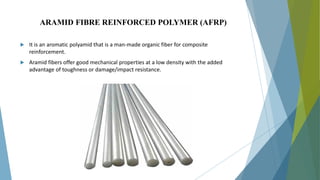
ARAMID FIBRE REINFORCED POLYMER (AFRP)
 It is an aromatic polyamid that is a man-made organic fiber for composite
reinforcement.
 Aramid fibers offer good mechanical properties at a low density with the added
advantage of toughness or damage/impact resistance.
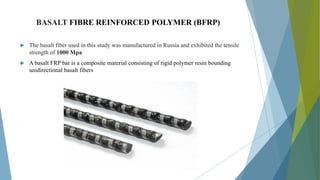
BASALT FIBRE REINFORCED POLYMER (BFRP)
 The basalt fiber used in this study was manufactured in Russia and exhibited the tensile
strength of 1000 Mpa
 A basalt FRP bar is a composite material consisting of rigid polymer resin bounding
unidirectional basalt fibers
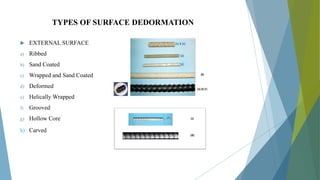
TYPES OF SURFACE DEDORMATION
 EXTERNAL SURFACE
a) Ribbed
b) Sand Coated
c) Wrapped and Sand Coated
d) Deformed
e) Helically Wrapped
f) Grooved
g) Hollow Core
h) Carved
FRP BAR SHAPES
 Straight Bars
 Bent Bars
 Spirals
 Twisted Strands
FRP BAR COSTING
1)Glass Fiber Reinforced Polymer bars
 Diameter 6mm – Rs 15.00/-
 8mm -Rs 24.5/-
 10mm-Rs 34.00/-
 12mm-Rs 43.00/-
 18mm-Rs 110.00/-
 One Rebar length 12 meter
2)Carbon Fiber Reinforced Polymer bars
 Rs 600/meter
3)Basalt Fiber Reinforced Polymer bars
 Rs 486/meter (dia-8mm)
 Rs 834/meter (dia-12mm)
4)Aramid Fiber Reinforced Polymer bars
Rs 700/meter



CONCLUSION
 FRP is seeing a huge surge in usage due to it being lightweight but incredibly strong.
 Entire life cycle economic with compared to traditional but it has more benefits.
 FRP bars are corrosion resistance.
REFERENCES
1)ASTM D7205-06, Fiber reinforced polymer matrix composite bars, ASTM
International, 2003
2)IRJET, “Experimental study of replacement of steel bars with FRP bars, Vishal
Deshmukh, Phadatre N.
3)Design Manual, “Reinforcing concrete structure with Fiber reinforced polymers,
Prepared by ISIS CANADA Research Network
4)Conference: III. International workshop on earthquake and sustainable materials
(IWESM)at: ESKISEHIR – TURKIYE “GFRP bars for RC structures-A Review”:
Ferhat Aydin
5)“Evaluation of concrete structures reinforced with fiber reinforced polymers bars: a
review” Masoud Abedini1, Ebrahim Akhlaghi
H.V.S. Ganga Rao, N. Taly, P.V. Vijay
Reinforced Concrete Design with FRP Composites
CRC Press - Taylor & Francis Group, Boca Raton, FL (2007)
6)International Federation for Structural Concrete (fib). Bulletin 40: FRP reinforcement for
RC structures, 2007.
7)Nanni, A. De Luca, H. Zadeh, Reinforced Concrete with FRP Bars, CRC Press - Taylor &
Francis Group, Boca Raton, FL, 2014. doi:10.1201/b16669.
8)ACI Committee 440, ACI 440.1R-15: Guide for the design and construction of structural
concrete reinforced with FRP bars, Farmington Hills, MI, 2015.
doi:10.1061/40753(171)158.
THANK
YOU!

Seminar ppt.pdf

  • 1.
    R. V. PARANKARCOLLEGE OF ENGINEERING & TECHNOLOGY, Arvi Department of Civil Engineering A SEMINAR ON: “INTRODUCTION TO FIBER REINFORCED POLYMER BARS” GUIDED BY: Prof. P.P. Pande PRESENTED BY: Mr. Akash Akhare
  • 2.
    CONTENTS • INTRODUCTION • COMPONENTSOF FRP • TYPES OF FIBER REINFORCED POLYMER BARS • TYPES OF SURFACE DEFORMATION • FRP BAR SHAPES • FRP BAR COSTING • CONCLUSION
  • 3.
    INTRODUCTION  FRP materialswere developed in early 1940s for military and aerospace applications.  FRP bars are known as alternative to eliminate the corrosion problem.  FRP is a sustainable material.  7times stronger than steel.  FRP is light weight & has excellent corrosion resistance.
  • 4.
     General composition Fiber[Carbon, Glass, Aramid,Basalt] + Resin [ Polymer, Epoxy, Vinyl Ester] = FIBER REINFORCED POLYMER
  • 5.
  • 6.
     Resins(Matrix) Primary Function:- Totransfer stress between Reinforcing fibers and to protect them from mechanical and environmental damage. Types:- (a) Thermoplastic: 1) Solid at room temperature (Recycled plastic pellets) (b) Thermoset: 1) Most common for structural uses 2) Liquid state at room temperature
  • 7.
    Common Thermoset ResinTypes  Epoxy resin 1)Epoxies have high strength, good dimensional stability, relatively good high-temperature properties 2)Commonly used in aerospace applications.  Vinyl ester resin 1)Very high chemical resistance 2)Highest cost than polyesters 3)It reduced moisture absorption and shrinkage as compared with polyesters  Polyester resin 1)Lowest Cost 2)Numerous specific types of polyesters are available for use 3)Easy to use
  • 8.
    TYPES OF FIBREREINFORCED POLYMER BARS (FRP)  GLASS FIBRE REINFORCED POLYMER BARS (GFRP)  CARBON FIBRE REINFORCED POLYMER (CFRP)  ARAMID FIBRE REINFORCED POLYMER (AFRP)  BASALT FIBRE REINFORCED POLYMER (BFRP)
  • 9.
    GLASS FIBER REINFORCEDPOLYMER BARS (GFRP)  Consists of thermosetting resins & glass fiber  High strength , Light-weight, durability  Most commonly used
  • 10.
    CARBON FIBRE REINFORCEDPOLYMER (CFRP)  Carbon fiber bars have a high modulus of elasticity, 200-800 Gpa  Carbon fiber bars are more expansive than glass fibers bars  Carbon fiber are more brittle.
  • 11.
    ARAMID FIBRE REINFORCEDPOLYMER (AFRP)  It is an aromatic polyamid that is a man-made organic fiber for composite reinforcement.  Aramid fibers offer good mechanical properties at a low density with the added advantage of toughness or damage/impact resistance.
  • 12.
    BASALT FIBRE REINFORCEDPOLYMER (BFRP)  The basalt fiber used in this study was manufactured in Russia and exhibited the tensile strength of 1000 Mpa  A basalt FRP bar is a composite material consisting of rigid polymer resin bounding unidirectional basalt fibers
  • 13.
    TYPES OF SURFACEDEDORMATION  EXTERNAL SURFACE a) Ribbed b) Sand Coated c) Wrapped and Sand Coated d) Deformed e) Helically Wrapped f) Grooved g) Hollow Core h) Carved
  • 14.
    FRP BAR SHAPES Straight Bars  Bent Bars  Spirals  Twisted Strands
  • 15.
    FRP BAR COSTING 1)GlassFiber Reinforced Polymer bars  Diameter 6mm – Rs 15.00/-  8mm -Rs 24.5/-  10mm-Rs 34.00/-  12mm-Rs 43.00/-  18mm-Rs 110.00/-  One Rebar length 12 meter 2)Carbon Fiber Reinforced Polymer bars  Rs 600/meter 3)Basalt Fiber Reinforced Polymer bars  Rs 486/meter (dia-8mm)  Rs 834/meter (dia-12mm) 4)Aramid Fiber Reinforced Polymer bars Rs 700/meter   
  • 16.
    CONCLUSION  FRP isseeing a huge surge in usage due to it being lightweight but incredibly strong.  Entire life cycle economic with compared to traditional but it has more benefits.  FRP bars are corrosion resistance.
  • 17.
    REFERENCES 1)ASTM D7205-06, Fiberreinforced polymer matrix composite bars, ASTM International, 2003 2)IRJET, “Experimental study of replacement of steel bars with FRP bars, Vishal Deshmukh, Phadatre N. 3)Design Manual, “Reinforcing concrete structure with Fiber reinforced polymers, Prepared by ISIS CANADA Research Network 4)Conference: III. International workshop on earthquake and sustainable materials (IWESM)at: ESKISEHIR – TURKIYE “GFRP bars for RC structures-A Review”: Ferhat Aydin
  • 18.
    5)“Evaluation of concretestructures reinforced with fiber reinforced polymers bars: a review” Masoud Abedini1, Ebrahim Akhlaghi H.V.S. Ganga Rao, N. Taly, P.V. Vijay Reinforced Concrete Design with FRP Composites CRC Press - Taylor & Francis Group, Boca Raton, FL (2007) 6)International Federation for Structural Concrete (fib). Bulletin 40: FRP reinforcement for RC structures, 2007. 7)Nanni, A. De Luca, H. Zadeh, Reinforced Concrete with FRP Bars, CRC Press - Taylor & Francis Group, Boca Raton, FL, 2014. doi:10.1201/b16669. 8)ACI Committee 440, ACI 440.1R-15: Guide for the design and construction of structural concrete reinforced with FRP bars, Farmington Hills, MI, 2015. doi:10.1061/40753(171)158.
  • 19.