Pokhara University
School of Health and Allied Sciences
Simvastatin for the Prevention
of Exacerbations in Moderate-
to-Severe COPD
Anita Yadav
First Semester, MPharm(Clinical Pharmacy)
School of Health and Allied Sciences
Pokhara University, Dhungepatan, Pokhara Lekhnath-30, Kaski,
Nepal
Pokhara University
School of Health and Allied Sciences
Topics under discussion
• Introduction
• Methods
• Results
• Discussion
• Conclusion
• References
August 8, 2017 2
Pokhara University
School of Health and Allied Sciences
Introduction
• Chronic Obstructive Pulmonary Disease (COPD) is the
third leading cause of death in the United States.
• It is characterized by acute exacerbations that are
associated with increased hospitalizations and costs
of care, worsened quality of life, and increased
mortality.
• Effective therapies for the treatment or prevention of
exacerbations are limited.
August 8, 2017 3
Pokhara University
School of Health and Allied Sciences
August 8, 2017 4
• Statins are 3-hydroxy-3-methylglutaryl coenzyme A
(HMG-CoA) reductase inhibitors that reduce the risks
of acute cardiac events and death.
• Although widely used for their lipidlowering effects,
statins are also reported to have anti-inflammatory
effects.
• Multiple retrospective studies have shown that
statins are beneficial in COPD.
Pokhara University
School of Health and Allied Sciences
• The Prospective Randomized Placebo-Controlled
Trial of Simvastatin in the Prevention of COPD
Exacerbations (STATCOPE) was a prospective,
multicenter trial conducted by the National Heart,
Lung, and Blood Institute (NHLBI) COPD Clinical
Research Network.
August 8, 2017 INS 591: Presentation 5
Pokhara University
School of Health and Allied Sciences
Materials and Methods
Study Design and oversight
• In this randomized, parallel-group, placebo-
controlled trial, participants were randomly assigned
in a 1:1 ratio to receive simvastatin orally at a dose
of 40 mg or an identical-appearing placebo once
daily.
• Participants were recruited from 45 sites (29 sites in
the United States and 16 in Canada).
• Written informed consent was obtained from all
participants. The institutional review board at each
center approved the study protocol.
August 8, 2017 6
Pokhara University
School of Health and Allied Sciences
• The study drugs, simvastatin and placebo, were
purchased, prepared, and supplied by Temple University
School of Pharmacy.
Participant Population
• Have moderate or severe COPD
• supplemental oxygen
• Be 40 to 80 years of age Inclusion Criteria
• Be a current or ex-smoker
• Not have active heart disease
or high cholesterol
• Not be taking statins Exclusion Criteria
• Not have diabetesAugust 8, 2017
7
Pokhara University
School of Health and Allied Sciences
Outcomes
• The primary outcome was the effect of simvastatin
on the exacerbation rate, which was defined as the
number of exacerbations per person-year.
• Secondary outcomes included the time to the first
exacerbation, the severity of exacerbations, the
number of acute cardiovascular events, quality of
life, and changes in spirometric variables.
August 8, 2017 8
Pokhara University
School of Health and Allied Sciences
Study visits
• Participants were followed at clinic visits every
months and by means of monthly telephone
contacts.
• Spirometric variable and quality of life assessed with
the use of the St. George’s Respiratory Questionnaire
[SGRQ] and the Medical Outcomes Study 36-Item
Short-Form Health Survey [SF-36] were measured at
baseline and at 12,24, and 36 months.
August 8, 2017 9
Pokhara University
School of Health and Allied Sciences
INTERIM ANALYSIS, STOPPING GUIDELINES, AND
MONITORING PLAN
• The data and safety monitoring board met
approximately every 6 months to review recruitment
and follow-up rates, study-drug adherence, safety,
and efficacy results.
• The rates of moderate and severe exacerbations did
not differ significantly and the numbers of deaths
were similar (27 deaths in the simvastatin group and
26 in the placebo group). The data and safety
monitoring board therefore voted to stop STATCOPE.
August 8, 2017 10
Pokhara University
School of Health and Allied Sciences
STATISTICAL ANALYSIS
• Performed with the use of Kaplan–Meier methods,
• Curves were compared with the use of the log-rank
test.
August 8, 2017 11
Pokhara University
School of Health and Allied Sciences
August 8, 2017 12
RESULTS
ENROLLMENT AND FOLLOW-UP
• Enrollment began March 4, 2010 to October 11,
2013.
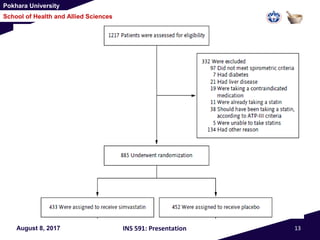
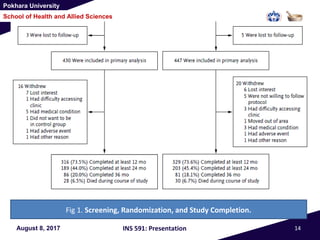
• Screening for the study, randomization, and follow
up of the participants are shown in Figure 1.
Pokhara University
School of Health and Allied Sciences
August 8, 2017 INS 591: Presentation 13
Pokhara University
School of Health and Allied Sciences
August 8, 2017 INS 591: Presentation 14
Fig 1. Screening, Randomization, and Study Completion.
Pokhara University
School of Health and Allied Sciences
August 8, 2017 15
CHARACTERISTICS OF THE PARTICIPANTS
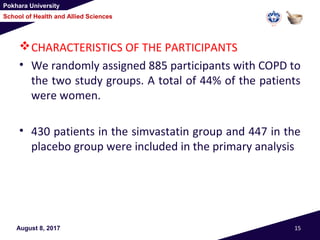
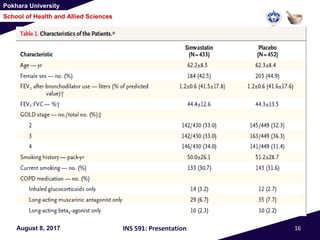
• We randomly assigned 885 participants with COPD to
the two study groups. A total of 44% of the patients
were women.
• 430 patients in the simvastatin group and 447 in the
placebo group were included in the primary analysis
Pokhara University
School of Health and Allied Sciences
August 8, 2017 INS 591: Presentation 16
Pokhara University
School of Health and Allied Sciences
August 8, 2017 INS 591: Presentation 17
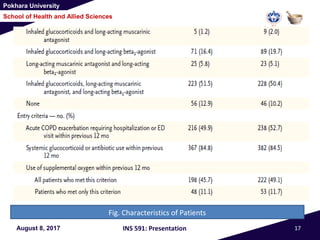
Fig. Characteristics of Patients
Pokhara University
School of Health and Allied Sciences
August 8, 2017 18
COPD EXACERBATIONS
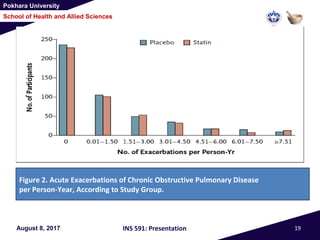
• A total of 1982 acute COPD exacerbations occurred
during the study: 965 exacerbations among the 430
patients in the simvastatin group and 1017
exacerbations among the 447 patients in the placebo
group.
• The COPD exacerbation rates were similar in the
simvastatin and placebo groups: (P = 0.54) (Fig. 2).
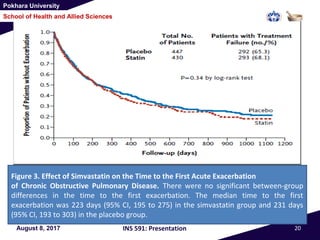
• The median number of days to the first exacerbation
was also similar in the two groups: 223 days in the
simvastatin group and 231 days in the placebo group (P
= 0.34) (Fig. 3)
Pokhara University
School of Health and Allied Sciences
August 8, 2017 INS 591: Presentation 19
Figure 2. Acute Exacerbations of Chronic Obstructive Pulmonary Disease
per Person-Year, According to Study Group.
Pokhara University
School of Health and Allied Sciences
August 8, 2017 INS 591: Presentation 20
Figure 3. Effect of Simvastatin on the Time to the First Acute Exacerbation
of Chronic Obstructive Pulmonary Disease. There were no significant between-group
differences in the time to the first exacerbation. The median time to the first
exacerbation was 223 days (95% CI, 195 to 275) in the simvastatin group and 231 days
(95% CI, 193 to 303) in the placebo group.
Pokhara University
School of Health and Allied Sciences
SECONDARY OUTCOMES
• There was no effect of simvastatin on lung function
as assessed spirometrically. Likewise, simvastatin
had no effect on the general or respiratory specific
quality of life, as assessed by the SF-36 and SGRQ,
respectively.
August 8, 2017 21
Pokhara University
School of Health and Allied Sciences
ADVERSE EVENTS
• The most common adverse events, aside from
exacerbations, were pneumonia and other respiratory
and cardiovascular events.
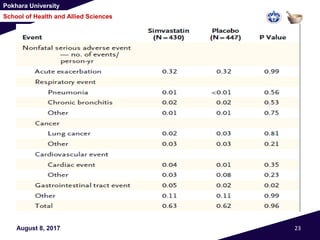
• Except for nonfatal serious adverse events involving
the gastrointestinal tract, which were more frequent
with simvastatin than with placebo (in 30 patients
[0.05 events per personyear] vs. 17 patients [0.02
events per person-year], P = 0.02) (Table 2)
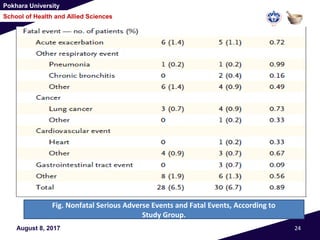
• There were 28 deaths in the simvastatin group and 30
in the placebo group (P = 0.89).
August 8, 2017 22
Pokhara University
School of Health and Allied Sciences
August 8, 2017 23
Pokhara University
School of Health and Allied Sciences
August 8, 2017 24
Fig. Nonfatal Serious Adverse Events and Fatal Events, According to
Study Group.
Pokhara University
School of Health and Allied Sciences
PERMANENT DISCONTINUATION OF STUDY DRUG AND
STUDY WITHDRAWAL
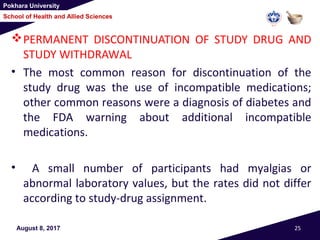
• The most common reason for discontinuation of the
study drug was the use of incompatible medications;
other common reasons were a diagnosis of diabetes and
the FDA warning about additional incompatible
medications.
• A small number of participants had myalgias or
abnormal laboratory values, but the rates did not differ
according to study-drug assignment.
August 8, 2017 25
Pokhara University
School of Health and Allied Sciences
Discussion
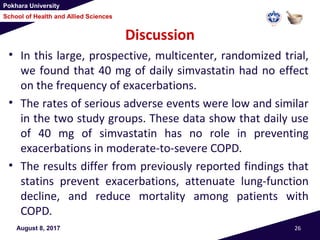
• In this large, prospective, multicenter, randomized trial,
we found that 40 mg of daily simvastatin had no effect
on the frequency of exacerbations.
• The rates of serious adverse events were low and similar
in the two study groups. These data show that daily use
of 40 mg of simvastatin has no role in preventing
exacerbations in moderate-to-severe COPD.
• The results differ from previously reported findings that
statins prevent exacerbations, attenuate lung-function
decline, and reduce mortality among patients with
COPD.
August 8, 2017 26
Pokhara University
School of Health and Allied Sciences
Conclusion
• In conclusion, simvastatin at a dose of 40 mg daily, in
addition to usual care, did not reduce the exacerbation rate
or prolong the time to the first exacerbation among
patients with moderateto- severe COPD who were at high
risk for exacerbations.
• Furthermore, simvastatin had no effect on lung function,
quality of life, the rate of severe adverse events, or
mortality.
• Thus, these data did not show a therapeutic benefit of
statins in patients with moderate-to-severe COPD.
August 8, 2017 27
Pokhara University
School of Health and Allied Sciences
References
• Criner GJ, Connett JE, Aaron SD, Albert RK, Bailey
WC, Casaburi R, Cooper JAD, Curtis JL, Dransfield MT,
Han MK, Make B, Marchetti N, Martinez FJ,
Niewoehner DE, Scanlon PD, Sciurba FC, Scharf SM,
Sin DD, Voelker H, Washko GR, Woodruff PG, and
Lazarus SC(2014) Simvastatin for the Prevention of
Exacerbations in Moderate-to-Severe COPD, N Engl J
Med, 370(23), 2201-2210.
August 8, 2017 INS 591: Presentation 28
Pokhara University
School of Health and Allied Sciences
Thank You
August 8, 2017 INS 591: Presentation 29

Seminar first semester Simvastation in COPD

  • 1.
    Pokhara University School ofHealth and Allied Sciences Simvastatin for the Prevention of Exacerbations in Moderate- to-Severe COPD Anita Yadav First Semester, MPharm(Clinical Pharmacy) School of Health and Allied Sciences Pokhara University, Dhungepatan, Pokhara Lekhnath-30, Kaski, Nepal
  • 2.
    Pokhara University School ofHealth and Allied Sciences Topics under discussion • Introduction • Methods • Results • Discussion • Conclusion • References August 8, 2017 2
  • 3.
    Pokhara University School ofHealth and Allied Sciences Introduction • Chronic Obstructive Pulmonary Disease (COPD) is the third leading cause of death in the United States. • It is characterized by acute exacerbations that are associated with increased hospitalizations and costs of care, worsened quality of life, and increased mortality. • Effective therapies for the treatment or prevention of exacerbations are limited. August 8, 2017 3
  • 4.
    Pokhara University School ofHealth and Allied Sciences August 8, 2017 4 • Statins are 3-hydroxy-3-methylglutaryl coenzyme A (HMG-CoA) reductase inhibitors that reduce the risks of acute cardiac events and death. • Although widely used for their lipidlowering effects, statins are also reported to have anti-inflammatory effects. • Multiple retrospective studies have shown that statins are beneficial in COPD.
  • 5.
    Pokhara University School ofHealth and Allied Sciences • The Prospective Randomized Placebo-Controlled Trial of Simvastatin in the Prevention of COPD Exacerbations (STATCOPE) was a prospective, multicenter trial conducted by the National Heart, Lung, and Blood Institute (NHLBI) COPD Clinical Research Network. August 8, 2017 INS 591: Presentation 5
  • 6.
    Pokhara University School ofHealth and Allied Sciences Materials and Methods Study Design and oversight • In this randomized, parallel-group, placebo- controlled trial, participants were randomly assigned in a 1:1 ratio to receive simvastatin orally at a dose of 40 mg or an identical-appearing placebo once daily. • Participants were recruited from 45 sites (29 sites in the United States and 16 in Canada). • Written informed consent was obtained from all participants. The institutional review board at each center approved the study protocol. August 8, 2017 6
  • 7.
    Pokhara University School ofHealth and Allied Sciences • The study drugs, simvastatin and placebo, were purchased, prepared, and supplied by Temple University School of Pharmacy. Participant Population • Have moderate or severe COPD • supplemental oxygen • Be 40 to 80 years of age Inclusion Criteria • Be a current or ex-smoker • Not have active heart disease or high cholesterol • Not be taking statins Exclusion Criteria • Not have diabetesAugust 8, 2017 7
  • 8.
    Pokhara University School ofHealth and Allied Sciences Outcomes • The primary outcome was the effect of simvastatin on the exacerbation rate, which was defined as the number of exacerbations per person-year. • Secondary outcomes included the time to the first exacerbation, the severity of exacerbations, the number of acute cardiovascular events, quality of life, and changes in spirometric variables. August 8, 2017 8
  • 9.
    Pokhara University School ofHealth and Allied Sciences Study visits • Participants were followed at clinic visits every months and by means of monthly telephone contacts. • Spirometric variable and quality of life assessed with the use of the St. George’s Respiratory Questionnaire [SGRQ] and the Medical Outcomes Study 36-Item Short-Form Health Survey [SF-36] were measured at baseline and at 12,24, and 36 months. August 8, 2017 9
  • 10.
    Pokhara University School ofHealth and Allied Sciences INTERIM ANALYSIS, STOPPING GUIDELINES, AND MONITORING PLAN • The data and safety monitoring board met approximately every 6 months to review recruitment and follow-up rates, study-drug adherence, safety, and efficacy results. • The rates of moderate and severe exacerbations did not differ significantly and the numbers of deaths were similar (27 deaths in the simvastatin group and 26 in the placebo group). The data and safety monitoring board therefore voted to stop STATCOPE. August 8, 2017 10
  • 11.
    Pokhara University School ofHealth and Allied Sciences STATISTICAL ANALYSIS • Performed with the use of Kaplan–Meier methods, • Curves were compared with the use of the log-rank test. August 8, 2017 11
  • 12.
    Pokhara University School ofHealth and Allied Sciences August 8, 2017 12 RESULTS ENROLLMENT AND FOLLOW-UP • Enrollment began March 4, 2010 to October 11, 2013. • Screening for the study, randomization, and follow up of the participants are shown in Figure 1.
  • 13.
    Pokhara University School ofHealth and Allied Sciences August 8, 2017 INS 591: Presentation 13
  • 14.
    Pokhara University School ofHealth and Allied Sciences August 8, 2017 INS 591: Presentation 14 Fig 1. Screening, Randomization, and Study Completion.
  • 15.
    Pokhara University School ofHealth and Allied Sciences August 8, 2017 15 CHARACTERISTICS OF THE PARTICIPANTS • We randomly assigned 885 participants with COPD to the two study groups. A total of 44% of the patients were women. • 430 patients in the simvastatin group and 447 in the placebo group were included in the primary analysis
  • 16.
    Pokhara University School ofHealth and Allied Sciences August 8, 2017 INS 591: Presentation 16
  • 17.
    Pokhara University School ofHealth and Allied Sciences August 8, 2017 INS 591: Presentation 17 Fig. Characteristics of Patients
  • 18.
    Pokhara University School ofHealth and Allied Sciences August 8, 2017 18 COPD EXACERBATIONS • A total of 1982 acute COPD exacerbations occurred during the study: 965 exacerbations among the 430 patients in the simvastatin group and 1017 exacerbations among the 447 patients in the placebo group. • The COPD exacerbation rates were similar in the simvastatin and placebo groups: (P = 0.54) (Fig. 2). • The median number of days to the first exacerbation was also similar in the two groups: 223 days in the simvastatin group and 231 days in the placebo group (P = 0.34) (Fig. 3)
  • 19.
    Pokhara University School ofHealth and Allied Sciences August 8, 2017 INS 591: Presentation 19 Figure 2. Acute Exacerbations of Chronic Obstructive Pulmonary Disease per Person-Year, According to Study Group.
  • 20.
    Pokhara University School ofHealth and Allied Sciences August 8, 2017 INS 591: Presentation 20 Figure 3. Effect of Simvastatin on the Time to the First Acute Exacerbation of Chronic Obstructive Pulmonary Disease. There were no significant between-group differences in the time to the first exacerbation. The median time to the first exacerbation was 223 days (95% CI, 195 to 275) in the simvastatin group and 231 days (95% CI, 193 to 303) in the placebo group.
  • 21.
    Pokhara University School ofHealth and Allied Sciences SECONDARY OUTCOMES • There was no effect of simvastatin on lung function as assessed spirometrically. Likewise, simvastatin had no effect on the general or respiratory specific quality of life, as assessed by the SF-36 and SGRQ, respectively. August 8, 2017 21
  • 22.
    Pokhara University School ofHealth and Allied Sciences ADVERSE EVENTS • The most common adverse events, aside from exacerbations, were pneumonia and other respiratory and cardiovascular events. • Except for nonfatal serious adverse events involving the gastrointestinal tract, which were more frequent with simvastatin than with placebo (in 30 patients [0.05 events per personyear] vs. 17 patients [0.02 events per person-year], P = 0.02) (Table 2) • There were 28 deaths in the simvastatin group and 30 in the placebo group (P = 0.89). August 8, 2017 22
  • 23.
    Pokhara University School ofHealth and Allied Sciences August 8, 2017 23
  • 24.
    Pokhara University School ofHealth and Allied Sciences August 8, 2017 24 Fig. Nonfatal Serious Adverse Events and Fatal Events, According to Study Group.
  • 25.
    Pokhara University School ofHealth and Allied Sciences PERMANENT DISCONTINUATION OF STUDY DRUG AND STUDY WITHDRAWAL • The most common reason for discontinuation of the study drug was the use of incompatible medications; other common reasons were a diagnosis of diabetes and the FDA warning about additional incompatible medications. • A small number of participants had myalgias or abnormal laboratory values, but the rates did not differ according to study-drug assignment. August 8, 2017 25
  • 26.
    Pokhara University School ofHealth and Allied Sciences Discussion • In this large, prospective, multicenter, randomized trial, we found that 40 mg of daily simvastatin had no effect on the frequency of exacerbations. • The rates of serious adverse events were low and similar in the two study groups. These data show that daily use of 40 mg of simvastatin has no role in preventing exacerbations in moderate-to-severe COPD. • The results differ from previously reported findings that statins prevent exacerbations, attenuate lung-function decline, and reduce mortality among patients with COPD. August 8, 2017 26
  • 27.
    Pokhara University School ofHealth and Allied Sciences Conclusion • In conclusion, simvastatin at a dose of 40 mg daily, in addition to usual care, did not reduce the exacerbation rate or prolong the time to the first exacerbation among patients with moderateto- severe COPD who were at high risk for exacerbations. • Furthermore, simvastatin had no effect on lung function, quality of life, the rate of severe adverse events, or mortality. • Thus, these data did not show a therapeutic benefit of statins in patients with moderate-to-severe COPD. August 8, 2017 27
  • 28.
    Pokhara University School ofHealth and Allied Sciences References • Criner GJ, Connett JE, Aaron SD, Albert RK, Bailey WC, Casaburi R, Cooper JAD, Curtis JL, Dransfield MT, Han MK, Make B, Marchetti N, Martinez FJ, Niewoehner DE, Scanlon PD, Sciurba FC, Scharf SM, Sin DD, Voelker H, Washko GR, Woodruff PG, and Lazarus SC(2014) Simvastatin for the Prevention of Exacerbations in Moderate-to-Severe COPD, N Engl J Med, 370(23), 2201-2210. August 8, 2017 INS 591: Presentation 28
  • 29.
    Pokhara University School ofHealth and Allied Sciences Thank You August 8, 2017 INS 591: Presentation 29