Labour Market Indicators Library
NetWork
KILM-STAT
EASMAT- EMAC-EMAO-ETM Costa Rica
A contribution to strengthening ILO’s knowledge of
employment outcomes of different policies.
Policy support for ILO constituents (Government,
Employers’ and Workers’ organisations);
Our constituents are better equipped to formulate and
monitor employment related policies.
Labour Market Indicators Library NetWork
In countries with poor labour market
information system
Problems with indicators are related to :
• Timeliness
– Lag between collection of information and their release in
national and international repositories.
• Relevance
– Lack of information and indicators to monitor employment
and labour markets trends.
• Accuracy
– Information available may not be adequate to build
indicators (data and meta information).
• Comparability
– Comparability accross countries/regions is limited because of
the lack of uniformised definitions.
Increase the availability
and timeliness of LMI
Strengthening coordination between ILO field offices and
Headquarters in the field of LMI.
• Enhancing flow of available information between ILO field offices
and Headquarters and its utilization.
• Increasing access to current indicators and methodological
information:
- from national sources by Headquarters;
- from international sources by ILO field offices.
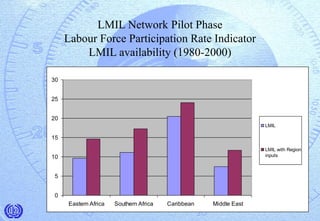
LMIL Network Pilot Phase
Labour Force Participation Rate Indicator
LMIL availability (1980-2000)
0
5
10
15
20
25
30
Eastern Africa Southern Africa Caribbean Middle East
LMIL
LMIL with Region
inputs
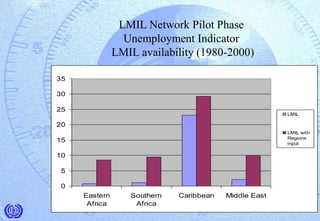
LMIL Network Pilot Phase
Unemployment Indicator
LMIL availability (1980-2000)
0
5
10
15
20
25
30
35
Eastern
Africa
Southern
Africa
Caribbean Middle East
LMIL
LMIL with
Regions
input
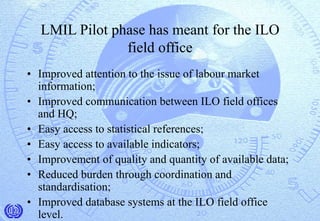
LMIL Pilot phase has meant for the ILO
field office
• Improved attention to the issue of labour market
information;
• Improved communication between ILO field offices
and HQ;
• Easy access to statistical references;
• Easy access to available indicators;
• Improvement of quality and quantity of available data;
• Reduced burden through coordination and
standardisation;
• Improved database systems at the ILO field office
level.
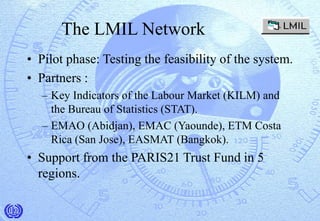
The LMIL Network
• Pilot phase: Testing the feasibility of the system.
• Partners :
– Key Indicators of the Labour Market (KILM) and
the Bureau of Statistics (STAT).
– EMAO (Abidjan), EMAC (Yaounde), ETM Costa
Rica (San Jose), EASMAT (Bangkok).
• Support from the PARIS21 Trust Fund in 5
regions.
Strategy
To consolidate a knowledge-based network by providing
appropriate products and technical expertise, while at the same
time increasing the availability and timeliness of labour market
indicators.
The LMIL Network is to assist ILO field offices in
strengthening national and regional capacities to access,
analyse and disseminate LMI with a view to assessing
employment trends.
An Internet-based database system has been developed to
support the LMIL Network.
Project Components
1. Defining a set of regional indicators to be
assembled and disseminated;
2. Organising 3-day training workshops;
3. Developing information dissemination tools;
4. Developing an Internet-based information
system to support the LMIL Network;
5. Creating and updating the LMIL Database.
1. Defining a set of regional indicators
to be assembled and disseminated
• Under the responsibility of the ILO field office
with the assistance of the HQ;
• Might be based on existing ILO reports and
LMI assessments;
• Is to be related to the PRSP indicators as much
as possible.
2. Organising 3-day training workshops
• Under the responsibility of the ILO field office with
the assistance of the Turin Training Centre and
Headquarters.
• Standard training package is being developed and are
to be adapted to the region labour market situation;
• 15 nationals (policy makers and/or technical staff);
• The training might be linked to ongoing and upcoming
activities.
3. Developing information
dissemination tools
• Under the responsibility of the ILO field office with
the assistance of the HQ;
• One module of the training package focus on
developing information dissemination tools;
• The workshop will give an opportunity to discuss this
project component among participants.
• Dissemination tools to be developed at
regional/national level and designed according to local
needs.
4. Internet-based information system to
support the LMIL Network
• Core framework of indicators;
• Local consultants will focus on identifying
sources of information and will input the LMIL
dataset;
• Indicators and methodological information from
1980 to present.
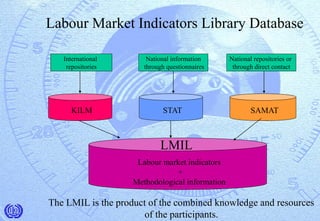
KILM STAT SAMAT
Labour Market Indicators Library Database
LMIL
Labour market indicators
+
Methodological information
The LMIL is the product of the combined knowledge and resources
of the participants.
International
repositories
National information
through questionnaires
National repositories or
through direct contact
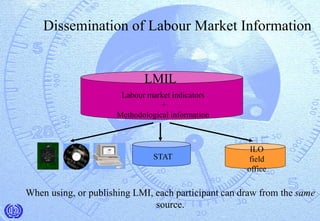
LMIL
Labour market indicators
+
Methodological information
STAT
ILO
field
office
When using, or publishing LMI, each participant can draw from the same
source.
Dissemination of Labour Market Information
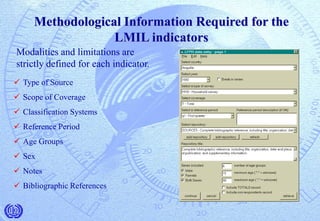
Methodological Information Required for the
LMIL indicators
 Type of Source
 Scope of Coverage
 Classification Systems
 Reference Period
 Age Groups
 Sex
 Notes
 Bibliographic References
Modalities and limitations are
strictly defined for each indicator.
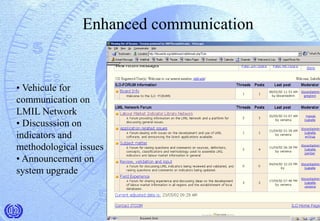
Enhanced communication
• Vehicule for
communication on
LMIL Network
• Discusssion on
indicators and
methodological issues
• Announcement on
system upgrade
Obstacles Encountered
• Internet connections and speed of download.
• Delays in incorporating new indicators and region
oriented indicators as well as urban/rural
breakdown.
• User-friendly interface and documentation to the
system.
• Difficulty to assemble the all required meta data.
• Resources to gather data from national level in many
countries.
Ongoing work
• Widening the geographical coverage by expanding the
LMIL Network to additional regions.
• Refining and widening the scope of indicators.
• Developing region-oriented indicators.
• Refining methodological guidelines and conducting
trainings.
• Reshaping the LMIL software and make it more user-
friendly
• Reinforcing the network of LMIL focal points.
• Support to technical assistance activities.
Labour Market Indicators Library
NetWork
KILM-STAT
EASMAT- EMAC-EMAO-ETM Costa Rica

552.ppt

  • 1.
    Labour Market IndicatorsLibrary NetWork KILM-STAT EASMAT- EMAC-EMAO-ETM Costa Rica
  • 2.
    A contribution tostrengthening ILO’s knowledge of employment outcomes of different policies. Policy support for ILO constituents (Government, Employers’ and Workers’ organisations); Our constituents are better equipped to formulate and monitor employment related policies. Labour Market Indicators Library NetWork
  • 3.
    In countries withpoor labour market information system Problems with indicators are related to : • Timeliness – Lag between collection of information and their release in national and international repositories. • Relevance – Lack of information and indicators to monitor employment and labour markets trends. • Accuracy – Information available may not be adequate to build indicators (data and meta information). • Comparability – Comparability accross countries/regions is limited because of the lack of uniformised definitions.
  • 4.
    Increase the availability andtimeliness of LMI Strengthening coordination between ILO field offices and Headquarters in the field of LMI. • Enhancing flow of available information between ILO field offices and Headquarters and its utilization. • Increasing access to current indicators and methodological information: - from national sources by Headquarters; - from international sources by ILO field offices.
  • 5.
    LMIL Network PilotPhase Labour Force Participation Rate Indicator LMIL availability (1980-2000) 0 5 10 15 20 25 30 Eastern Africa Southern Africa Caribbean Middle East LMIL LMIL with Region inputs
  • 6.
    LMIL Network PilotPhase Unemployment Indicator LMIL availability (1980-2000) 0 5 10 15 20 25 30 35 Eastern Africa Southern Africa Caribbean Middle East LMIL LMIL with Regions input
  • 7.
    LMIL Pilot phasehas meant for the ILO field office • Improved attention to the issue of labour market information; • Improved communication between ILO field offices and HQ; • Easy access to statistical references; • Easy access to available indicators; • Improvement of quality and quantity of available data; • Reduced burden through coordination and standardisation; • Improved database systems at the ILO field office level.
  • 8.
    The LMIL Network •Pilot phase: Testing the feasibility of the system. • Partners : – Key Indicators of the Labour Market (KILM) and the Bureau of Statistics (STAT). – EMAO (Abidjan), EMAC (Yaounde), ETM Costa Rica (San Jose), EASMAT (Bangkok). • Support from the PARIS21 Trust Fund in 5 regions.
  • 9.
    Strategy To consolidate aknowledge-based network by providing appropriate products and technical expertise, while at the same time increasing the availability and timeliness of labour market indicators. The LMIL Network is to assist ILO field offices in strengthening national and regional capacities to access, analyse and disseminate LMI with a view to assessing employment trends. An Internet-based database system has been developed to support the LMIL Network.
  • 10.
    Project Components 1. Defininga set of regional indicators to be assembled and disseminated; 2. Organising 3-day training workshops; 3. Developing information dissemination tools; 4. Developing an Internet-based information system to support the LMIL Network; 5. Creating and updating the LMIL Database.
  • 11.
    1. Defining aset of regional indicators to be assembled and disseminated • Under the responsibility of the ILO field office with the assistance of the HQ; • Might be based on existing ILO reports and LMI assessments; • Is to be related to the PRSP indicators as much as possible.
  • 12.
    2. Organising 3-daytraining workshops • Under the responsibility of the ILO field office with the assistance of the Turin Training Centre and Headquarters. • Standard training package is being developed and are to be adapted to the region labour market situation; • 15 nationals (policy makers and/or technical staff); • The training might be linked to ongoing and upcoming activities.
  • 13.
    3. Developing information disseminationtools • Under the responsibility of the ILO field office with the assistance of the HQ; • One module of the training package focus on developing information dissemination tools; • The workshop will give an opportunity to discuss this project component among participants. • Dissemination tools to be developed at regional/national level and designed according to local needs.
  • 14.
    4. Internet-based informationsystem to support the LMIL Network • Core framework of indicators; • Local consultants will focus on identifying sources of information and will input the LMIL dataset; • Indicators and methodological information from 1980 to present.
  • 15.
    KILM STAT SAMAT LabourMarket Indicators Library Database LMIL Labour market indicators + Methodological information The LMIL is the product of the combined knowledge and resources of the participants. International repositories National information through questionnaires National repositories or through direct contact
  • 16.
    LMIL Labour market indicators + Methodologicalinformation STAT ILO field office When using, or publishing LMI, each participant can draw from the same source. Dissemination of Labour Market Information
  • 17.
    Methodological Information Requiredfor the LMIL indicators  Type of Source  Scope of Coverage  Classification Systems  Reference Period  Age Groups  Sex  Notes  Bibliographic References Modalities and limitations are strictly defined for each indicator.
  • 18.
    Enhanced communication • Vehiculefor communication on LMIL Network • Discusssion on indicators and methodological issues • Announcement on system upgrade
  • 19.
    Obstacles Encountered • Internetconnections and speed of download. • Delays in incorporating new indicators and region oriented indicators as well as urban/rural breakdown. • User-friendly interface and documentation to the system. • Difficulty to assemble the all required meta data. • Resources to gather data from national level in many countries.
  • 20.
    Ongoing work • Wideningthe geographical coverage by expanding the LMIL Network to additional regions. • Refining and widening the scope of indicators. • Developing region-oriented indicators. • Refining methodological guidelines and conducting trainings. • Reshaping the LMIL software and make it more user- friendly • Reinforcing the network of LMIL focal points. • Support to technical assistance activities.
  • 21.
    Labour Market IndicatorsLibrary NetWork KILM-STAT EASMAT- EMAC-EMAO-ETM Costa Rica