
Selsun blue
By : wadah fadil
content
1- selsun history
2- description
3-indication
4-pharmacodynamic
5-dandruff
6- tinea versicolor
7-tinea capitis
8-mechanism of action
9-proper use of selsun
10-general dosing information
11-pregnancy & breast feeding
12-absorption
13-toxicity
14-safety and hazard
-
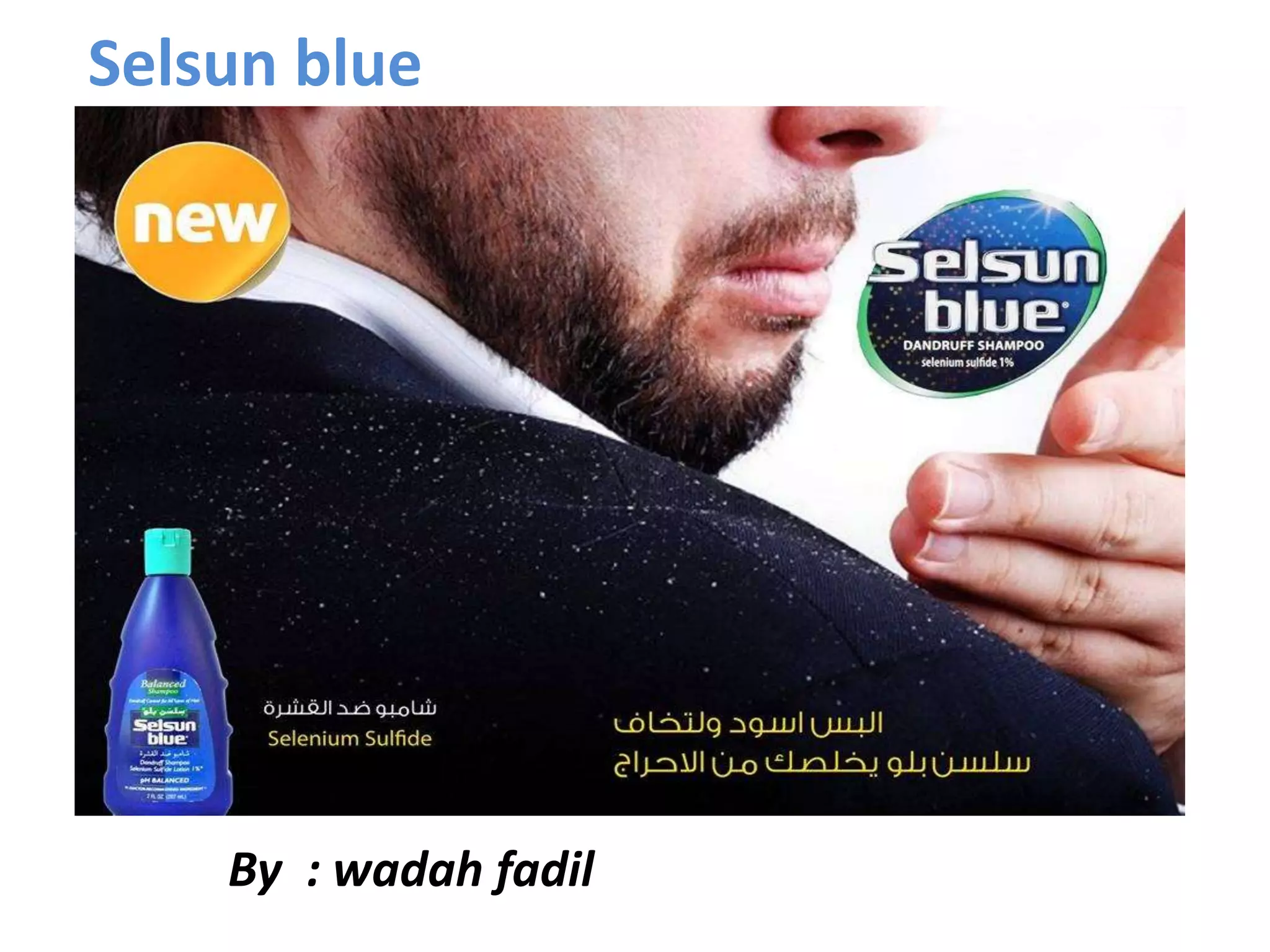
Selsun Blue is an over-the-counter brand
of dandruff shampoo now owned by Sanofi .
First made by Abbott Laboratories , the brand
was bought by Chattem in 2002. Chattem was
acquired by Sanofi in 2010.
Selsun Blue has been marketed as a more
effective alternative to brand leader head &
Shoulder due to its superior performance in
randomized trials
Description
Selenium Sulfide is an antifungal agent as well as a cytostatic
agent, slowing the growth of hyper proliferative cells in
seborrhea. Selenium Sulfide is the active ingredient often used in
shampoos for the treatment of dandruff, seborrheic dermatitis
and tinea capitis, a fungal infection that is primarily a disease of
preadolescent children.
This compound belongs to the class of inorganic compounds
known as homogeneous other non-metal compounds.
Indication
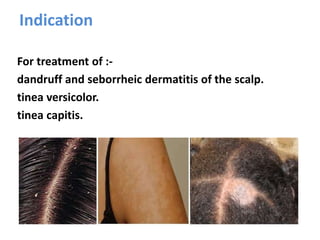
For treatment of :-
dandruff and seborrheic dermatitis of the scalp.
tinea versicolor.
tinea capitis.
Pharmacodynamics
Selenium sulfide is an antifungal agent often used in
shampoos for the treatment of dandruff and seborrheic
dermatitis. Selenium sulfide is highly active in inhibiting
the growth of P. ovale.
It is also a proven cytostatic agent, slowing the growth
of both hyper proliferative and normal cells in dandruff
and seborrheic dermatitis.
A 0.6% micronized form of selenium sulfide is also safe
and effective for dandruff.
dandruff
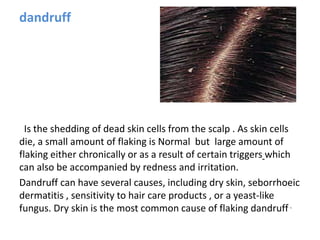
Is the shedding of dead skin cells from the scalp . As skin cells
die, a small amount of flaking is Normal but large amount of
flaking either chronically or as a result of certain triggers which
can also be accompanied by redness and irritation.
Dandruff can have several causes, including dry skin, seborrhoeic
dermatitis , sensitivity to hair care products , or a yeast-like
fungus. Dry skin is the most common cause of flaking dandruff .
Dandruff scale is a cluster of corneocytes, which have retained a
large degree of cohesion with one another . A corneocyte is a
protein complex that is made of tiny threads of keratin. The size
and abundance of scales are differ from one site to another and
over time. Parakeratotic cells often make up part of dandruff.
-
-
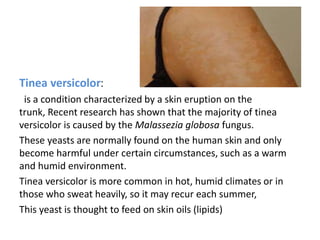
:Tinea versicolor
is a condition characterized by a skin eruption on the
trunk, Recent research has shown that the majority of tinea
versicolor is caused by the Malassezia globosa fungus.
These yeasts are normally found on the human skin and only
become harmful under certain circumstances, such as a warm
and humid environment.
Tinea versicolor is more common in hot, humid climates or in
those who sweat heavily, so it may recur each summer,
This yeast is thought to feed on skin oils (lipids)
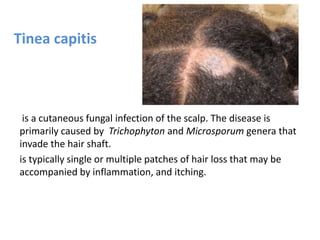
Tinea capitis
is a cutaneous fungal infection of the scalp. The disease is
primarily caused by Trichophyton and Microsporum genera that
invade the hair shaft.
is typically single or multiple patches of hair loss that may be
accompanied by inflammation, and itching.
-
In a randomized, clinical trial of 54 pediatric patients with
culture-proven tinea capitis, Givens, and Baker (1995) found that
when used twice weekly, both the 1% and 2.5% preparations of
selenium sulfide shampoos to eliminate the shedding of viable
spores. When the 1% and 2.5% preparations of selenium sulfide
were compared to each other, there was no difference between
the two in the time required to produce a negative culture. This
finding led the researchers to conclude that the 1% selenium
sulfide shampoo, which is commercially available, is an equally
effective but less expensive alternative sporicidal adjunct to the
oral treatment of tinea capitis(Medscape).
(http://www.medscape.com/viewarticle/707621_6)
Mechanism of action
Topical selenium sulfide may act by an antimitotic action,
resulting in a reduction in the turnover of epidermal cells. It also
has local irritant, antibacterial, and mild antifungal activity, which
may contribute to its effectiveness.
An antimitotic mechanism of action is suggested by data
showing that selenium sulfide decreases the rate of
incorporation of radioactively labeled thymidine into the DNA of
dermal epithelial cells.
-
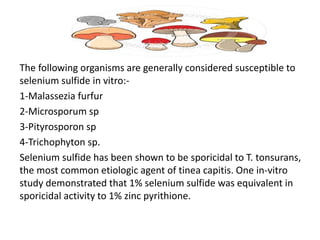
The following organisms are generally considered susceptible to
selenium sulfide in vitro:-
1-Malassezia furfur
2-Microsporum sp
3-Pityrosporon sp
4-Trichophyton sp.
Selenium sulfide has been shown to be sporicidal to T. tonsurans,
the most common etiologic agent of tinea capitis. One in-vitro
study demonstrated that 1% selenium sulfide was equivalent in
sporicidal activity to 1% zinc pyrithione.
Proper use of selsun
using the 1% selsun shampoo at least 2 times a week.
To proper administration of the selsun for dandruff or seborrheic dermatitis
Before using—wetting hair and scalp with lukewarm water then
applying enough to scalp (approximately 1 or 2 teaspoonfuls) to work up
lather
Allowing lather to remain on scalp for 2 to 3 minutes then rinsing with water.
If using on blond, gray, or chemically treated (bleached, tinted) hair, rinsing
hair well for at least 5 minutes after using selsun to lessen chance of hair
discoloration.
-
Proper administration of the selsun for tinea versicolor by
applying it to affected areasof body, except face and genitals
then working up lather using a small amount of water, then
allowing medication to remain on skin for 10 minutes and rinsing
body well to remove all medication.
The same administration way for tinea capitis treatment as that
for tinea versicolor.
General Dosing Information
Selenium sulfide should not be used when acute inflammation
or exudate or blister or oozing is present, because an increase in
absorption may occur.
Discoloration of the hair may occur following use of selenium
sulfide, especially if used on hair that is light, blond, or gray or on
hair that has been chemically treated (i.e., bleached, tinted). The
discoloration may be minimized or avoided by thoroughly rinsing
the hair for at least 5 minutes after treatment.
Pregnancy and breast feeding
Pregnancy—
Studies have not been done in humans. However, problems in humans have
not been documented when selenium sulfide is used on the scalp.
It is recommended that selenium sulfide not be used for the treatment of
tinea versicolor in pregnant women.
FDA Pregnancy Category C (for tinea versicolor).
Absorption
There is no substantial absorption through intact skin.
Absorption has been reported in patients with open
lesions on the scalp
Toxicity
No documented reports of serious toxicity in
humans resulting from acute ingestion of
selenium sulfide, however, acute toxicity studies
in animals suggest that ingestion of large
amounts could result in potential human
toxicity.
Safety and Hazards
Symptoms of exposure to this compound include vomiting,
anorexia. It may also cause a garlic odor of the breath, metallic
taste, weakness, sweating. Sensitization may occur. Repeated
use may cause loss of hair. It may also cause eye injuries. Other
symptoms may include skin burns, dermatitis, increased oiliness
or dryness of hair.
This compound is highly toxic by ingestion. It is also toxic by
inhalation. With this type of compound there is a danger of
cumulative effects. When heated to decomposition it emits very
toxic fumes of sulfur oxides and selenium.
Thank you
-

selsun blue

  • 1.
    Selsun blue By :wadah fadil
  • 2.
    content 1- selsun history 2-description 3-indication 4-pharmacodynamic 5-dandruff 6- tinea versicolor 7-tinea capitis 8-mechanism of action 9-proper use of selsun 10-general dosing information 11-pregnancy & breast feeding 12-absorption 13-toxicity 14-safety and hazard
  • 3.
    - Selsun Blue isan over-the-counter brand of dandruff shampoo now owned by Sanofi . First made by Abbott Laboratories , the brand was bought by Chattem in 2002. Chattem was acquired by Sanofi in 2010. Selsun Blue has been marketed as a more effective alternative to brand leader head & Shoulder due to its superior performance in randomized trials
  • 4.
    Description Selenium Sulfide isan antifungal agent as well as a cytostatic agent, slowing the growth of hyper proliferative cells in seborrhea. Selenium Sulfide is the active ingredient often used in shampoos for the treatment of dandruff, seborrheic dermatitis and tinea capitis, a fungal infection that is primarily a disease of preadolescent children. This compound belongs to the class of inorganic compounds known as homogeneous other non-metal compounds.
  • 5.
    Indication For treatment of:- dandruff and seborrheic dermatitis of the scalp. tinea versicolor. tinea capitis.
  • 6.
    Pharmacodynamics Selenium sulfide isan antifungal agent often used in shampoos for the treatment of dandruff and seborrheic dermatitis. Selenium sulfide is highly active in inhibiting the growth of P. ovale. It is also a proven cytostatic agent, slowing the growth of both hyper proliferative and normal cells in dandruff and seborrheic dermatitis. A 0.6% micronized form of selenium sulfide is also safe and effective for dandruff.
  • 7.
    dandruff Is the sheddingof dead skin cells from the scalp . As skin cells die, a small amount of flaking is Normal but large amount of flaking either chronically or as a result of certain triggers which can also be accompanied by redness and irritation. Dandruff can have several causes, including dry skin, seborrhoeic dermatitis , sensitivity to hair care products , or a yeast-like fungus. Dry skin is the most common cause of flaking dandruff .
  • 8.
    Dandruff scale isa cluster of corneocytes, which have retained a large degree of cohesion with one another . A corneocyte is a protein complex that is made of tiny threads of keratin. The size and abundance of scales are differ from one site to another and over time. Parakeratotic cells often make up part of dandruff. -
  • 9.
    - :Tinea versicolor is acondition characterized by a skin eruption on the trunk, Recent research has shown that the majority of tinea versicolor is caused by the Malassezia globosa fungus. These yeasts are normally found on the human skin and only become harmful under certain circumstances, such as a warm and humid environment. Tinea versicolor is more common in hot, humid climates or in those who sweat heavily, so it may recur each summer, This yeast is thought to feed on skin oils (lipids)
  • 10.
    Tinea capitis is acutaneous fungal infection of the scalp. The disease is primarily caused by Trichophyton and Microsporum genera that invade the hair shaft. is typically single or multiple patches of hair loss that may be accompanied by inflammation, and itching.
  • 11.
    - In a randomized,clinical trial of 54 pediatric patients with culture-proven tinea capitis, Givens, and Baker (1995) found that when used twice weekly, both the 1% and 2.5% preparations of selenium sulfide shampoos to eliminate the shedding of viable spores. When the 1% and 2.5% preparations of selenium sulfide were compared to each other, there was no difference between the two in the time required to produce a negative culture. This finding led the researchers to conclude that the 1% selenium sulfide shampoo, which is commercially available, is an equally effective but less expensive alternative sporicidal adjunct to the oral treatment of tinea capitis(Medscape). (http://www.medscape.com/viewarticle/707621_6)
  • 12.
    Mechanism of action Topicalselenium sulfide may act by an antimitotic action, resulting in a reduction in the turnover of epidermal cells. It also has local irritant, antibacterial, and mild antifungal activity, which may contribute to its effectiveness. An antimitotic mechanism of action is suggested by data showing that selenium sulfide decreases the rate of incorporation of radioactively labeled thymidine into the DNA of dermal epithelial cells.
  • 13.
    - The following organismsare generally considered susceptible to selenium sulfide in vitro:- 1-Malassezia furfur 2-Microsporum sp 3-Pityrosporon sp 4-Trichophyton sp. Selenium sulfide has been shown to be sporicidal to T. tonsurans, the most common etiologic agent of tinea capitis. One in-vitro study demonstrated that 1% selenium sulfide was equivalent in sporicidal activity to 1% zinc pyrithione.
  • 14.
    Proper use ofselsun using the 1% selsun shampoo at least 2 times a week. To proper administration of the selsun for dandruff or seborrheic dermatitis Before using—wetting hair and scalp with lukewarm water then applying enough to scalp (approximately 1 or 2 teaspoonfuls) to work up lather Allowing lather to remain on scalp for 2 to 3 minutes then rinsing with water. If using on blond, gray, or chemically treated (bleached, tinted) hair, rinsing hair well for at least 5 minutes after using selsun to lessen chance of hair discoloration.
  • 15.
    - Proper administration ofthe selsun for tinea versicolor by applying it to affected areasof body, except face and genitals then working up lather using a small amount of water, then allowing medication to remain on skin for 10 minutes and rinsing body well to remove all medication. The same administration way for tinea capitis treatment as that for tinea versicolor.
  • 16.
    General Dosing Information Seleniumsulfide should not be used when acute inflammation or exudate or blister or oozing is present, because an increase in absorption may occur. Discoloration of the hair may occur following use of selenium sulfide, especially if used on hair that is light, blond, or gray or on hair that has been chemically treated (i.e., bleached, tinted). The discoloration may be minimized or avoided by thoroughly rinsing the hair for at least 5 minutes after treatment.
  • 17.
    Pregnancy and breastfeeding Pregnancy— Studies have not been done in humans. However, problems in humans have not been documented when selenium sulfide is used on the scalp. It is recommended that selenium sulfide not be used for the treatment of tinea versicolor in pregnant women. FDA Pregnancy Category C (for tinea versicolor).
  • 18.
    Absorption There is nosubstantial absorption through intact skin. Absorption has been reported in patients with open lesions on the scalp
  • 19.
    Toxicity No documented reportsof serious toxicity in humans resulting from acute ingestion of selenium sulfide, however, acute toxicity studies in animals suggest that ingestion of large amounts could result in potential human toxicity.
  • 20.
    Safety and Hazards Symptomsof exposure to this compound include vomiting, anorexia. It may also cause a garlic odor of the breath, metallic taste, weakness, sweating. Sensitization may occur. Repeated use may cause loss of hair. It may also cause eye injuries. Other symptoms may include skin burns, dermatitis, increased oiliness or dryness of hair. This compound is highly toxic by ingestion. It is also toxic by inhalation. With this type of compound there is a danger of cumulative effects. When heated to decomposition it emits very toxic fumes of sulfur oxides and selenium.
  • 21.