

© Dantherm A/S
Dehumidification– Selection Guide
Part 2/4 – Using the Mollier hx-diagram
© Dantherm A/S
What is the Mollier hx-diagram?
2
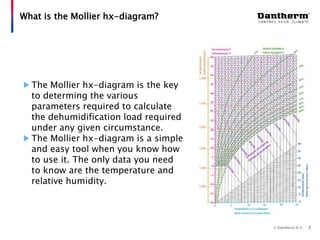
The Mollier hx-diagram is the key
to determing the various
parameters required to calculate
the dehumidification load required
under any given circumstance.
The Mollier hx-diagram is a simple
and easy tool when you know how
to use it. The only data you need
to know are the temperature and
relative humidity.
© Dantherm A/S
How to use the Mollier diagram?
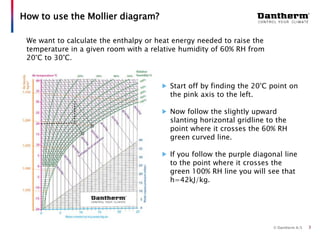
Start off by finding the 20°C point on
the pink axis to the left.
Now follow the slightly upward
slanting horizontal gridline to the
point where it crosses the 60% RH
green curved line.
If you follow the purple diagonal line
to the point where it crosses the
green 100% RH line you will see that
h=42kJ/kg.
3
We want to calculate the enthalpy or heat energy needed to raise the
temperature in a given room with a relative humidity of 60% RH from
20°C to 30°C.
© Dantherm A/S 4
Continued..
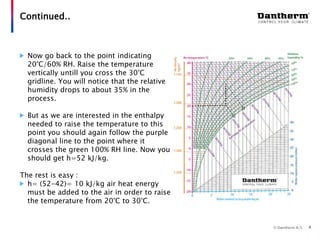
Now go back to the point indicating
20°C/60% RH. Raise the temperature
vertically untill you cross the 30°C
gridline. You will notice that the relative
humidity drops to about 35% in the
process.
But as we are interested in the enthalpy
needed to raise the temperature to this
point you should again follow the purple
diagonal line to the point where it
crosses the green 100% RH line. Now you
should get h=52 kJ/kg.
The rest is easy :
h= (52-42)= 10 kJ/kg air heat energy
must be added to the air in order to raise
the temperature from 20°C to 30°C.
© Dantherm A/S
Continued…
5
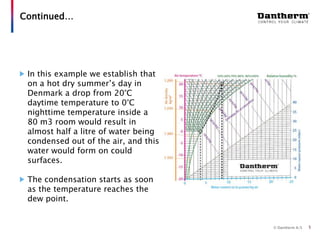
In this example we establish that
on a hot dry summer’s day in
Denmark a drop from 20°C
daytime temperature to 0°C
nighttime temperature inside a
80 m3 room would result in
almost half a litre of water being
condensed out of the air, and this
water would form on could
surfaces.
The condensation starts as soon
as the temperature reaches the
dew point.
© Dantherm A/S
Continued…
6
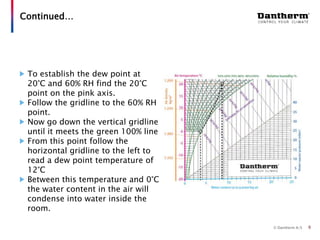
To establish the dew point at
20°C and 60% RH find the 20°C
point on the pink axis.
Follow the gridline to the 60% RH
point.
Now go down the vertical gridline
until it meets the green 100% line
From this point follow the
horizontal gridline to the left to
read a dew point temperature of
12°C
Between this temperature and 0°C
the water content in the air will
condense into water inside the
room.
© Dantherm A/S
Continued…
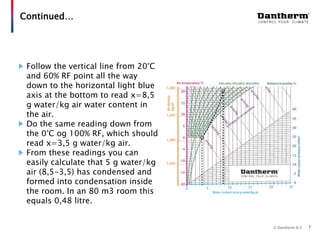
Follow the vertical line from 20°C
and 60% RF point all the way
down to the horizontal light blue
axis at the bottom to read x=8,5
g water/kg air water content in
the air.
Do the same reading down from
the 0°C og 100% RF, which should
read x=3,5 g water/kg air.
From these readings you can
easily calculate that 5 g water/kg
air (8,5-3,5) has condensed and
formed into condensation inside
the room. In an 80 m3 room this
equals 0,48 litre.
7
© Dantherm A/S
To calculate your dehumidification need using the Mollier hx-
diagram click here.
For further information we refer to our Selection Guide. You can
find it here.
You are welcome to contact our sales department for
dehumidification on tel. +45 96143700 in any cases.
Further information
8
© Dantherm A/S
THANK YOU FOR YOUR ATTENTION!
Visit our webpage www.dantherm.com

Dantherm Selection guide 2/4 - Using the Mollier hx-diagram

  • 1.
    © Dantherm A/S Dehumidification–Selection Guide Part 2/4 – Using the Mollier hx-diagram
  • 2.
    © Dantherm A/S Whatis the Mollier hx-diagram? 2 The Mollier hx-diagram is the key to determing the various parameters required to calculate the dehumidification load required under any given circumstance. The Mollier hx-diagram is a simple and easy tool when you know how to use it. The only data you need to know are the temperature and relative humidity.
  • 3.
    © Dantherm A/S Howto use the Mollier diagram? Start off by finding the 20°C point on the pink axis to the left. Now follow the slightly upward slanting horizontal gridline to the point where it crosses the 60% RH green curved line. If you follow the purple diagonal line to the point where it crosses the green 100% RH line you will see that h=42kJ/kg. 3 We want to calculate the enthalpy or heat energy needed to raise the temperature in a given room with a relative humidity of 60% RH from 20°C to 30°C.
  • 4.
    © Dantherm A/S4 Continued.. Now go back to the point indicating 20°C/60% RH. Raise the temperature vertically untill you cross the 30°C gridline. You will notice that the relative humidity drops to about 35% in the process. But as we are interested in the enthalpy needed to raise the temperature to this point you should again follow the purple diagonal line to the point where it crosses the green 100% RH line. Now you should get h=52 kJ/kg. The rest is easy : h= (52-42)= 10 kJ/kg air heat energy must be added to the air in order to raise the temperature from 20°C to 30°C.
  • 5.
    © Dantherm A/S Continued… 5 Inthis example we establish that on a hot dry summer’s day in Denmark a drop from 20°C daytime temperature to 0°C nighttime temperature inside a 80 m3 room would result in almost half a litre of water being condensed out of the air, and this water would form on could surfaces. The condensation starts as soon as the temperature reaches the dew point.
  • 6.
    © Dantherm A/S Continued… 6 Toestablish the dew point at 20°C and 60% RH find the 20°C point on the pink axis. Follow the gridline to the 60% RH point. Now go down the vertical gridline until it meets the green 100% line From this point follow the horizontal gridline to the left to read a dew point temperature of 12°C Between this temperature and 0°C the water content in the air will condense into water inside the room.
  • 7.
    © Dantherm A/S Continued… Followthe vertical line from 20°C and 60% RF point all the way down to the horizontal light blue axis at the bottom to read x=8,5 g water/kg air water content in the air. Do the same reading down from the 0°C og 100% RF, which should read x=3,5 g water/kg air. From these readings you can easily calculate that 5 g water/kg air (8,5-3,5) has condensed and formed into condensation inside the room. In an 80 m3 room this equals 0,48 litre. 7
  • 8.
    © Dantherm A/S Tocalculate your dehumidification need using the Mollier hx- diagram click here. For further information we refer to our Selection Guide. You can find it here. You are welcome to contact our sales department for dehumidification on tel. +45 96143700 in any cases. Further information 8
  • 9.
    © Dantherm A/S THANKYOU FOR YOUR ATTENTION! Visit our webpage www.dantherm.com