SELECTING THE DRILLING
METHOD AND EQUIPMENT:
MD
WASIUDDIN
M.Tech
Under the guidance : PROF
Introduction
 Drilling equipment and methods are used
by the construction and mining industries
to drill holes in both rock and earth.
Purposes for which drilling are performed,
vary a great deal from general to highly
specialized applications.
Classification:
 Mechanical:Percussion,rotary,rotary-
percussion
 Thermal: Flame, plasma, hot fluid, freezing
 Hydraulic: Jet, erosion, cavitation
 Sonic: High frequency vibration
 Chemical: Microblast, dissolution
 Electrical: Electric arc, magnetic induction
Seismic: Laser ray
 Nuclear: Fusion, fission
TYPES OF DRILLING
OPERATIONS USED IN ROCK
BREAKAGE
 Manual drilling
 Mechanized drilling
further can be classified in :
 bench drilling
 drilling for drifting and tunneling
 production drilling
 drilling for raises
 rock Supports
Factors for Drill selection:
 Site condition or Type of rock Blasting
 requirement design
 Drill ability factor
 Operating Variables
 Performance parameters
 Machine availability
 Cost or Maintenance.
PRINCIPLES OF DRILLING:
◦ Methods of rock drilling used in mines today
are mechanical and driven by either impact or
simple rotation
◦ Alternative methods, employing heat, flame,
high pressure water, or high voltage electric
discharges, for example, are used only in
particular situations or in laboratory studies.
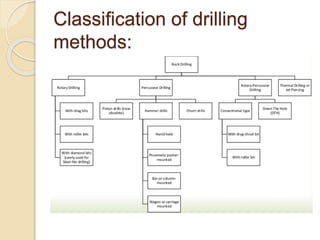
Classification of drilling
methods:
Rotary Drilling
 Rotary drilling can be subdivided :
 Rotary cutting : It creates the hole by shear forces,
breaking the rock's tensile strength.
 Rotary crushing : It breaks the rock by high point
load, accomplished by a toothed drill bit, which is
pushed downwards with high force.
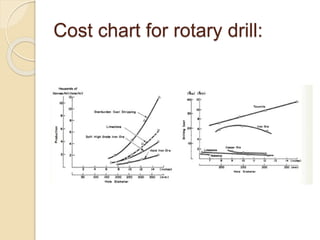
Cost chart for rotary drill:
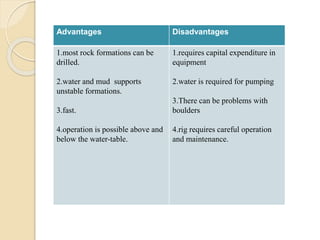
Advantages Disadvantages
1.most rock formations can be
drilled.
2.water and mud supports
unstable formations.
3.fast.
4.operation is possible above and
below the water-table.
1.requires capital expenditure in
equipment
2.water is required for pumping
3.There can be problems with
boulders
4.rig requires careful operation
and maintenance.
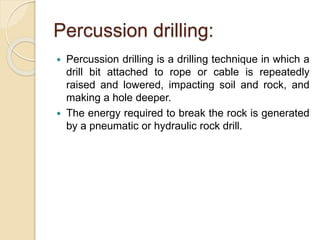
Percussion drilling:
 Percussion drilling is a drilling technique in which a
drill bit attached to rope or cable is repeatedly
raised and lowered, impacting soil and rock, and
making a hole deeper.
 The energy required to break the rock is generated
by a pneumatic or hydraulic rock drill.
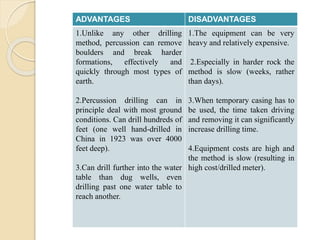
ADVANTAGES DISADVANTAGES
1.Unlike any other drilling
method, percussion can remove
boulders and break harder
formations, effectively and
quickly through most types of
earth.
2.Percussion drilling can in
principle deal with most ground
conditions. Can drill hundreds of
feet (one well hand-drilled in
China in 1923 was over 4000
feet deep).
3.Can drill further into the water
table than dug wells, even
drilling past one water table to
reach another.
1.The equipment can be very
heavy and relatively expensive.
2.Especially in harder rock the
method is slow (weeks, rather
than days).
3.When temporary casing has to
be used, the time taken driving
and removing it can significantly
increase drilling time.
4.Equipment costs are high and
the method is slow (resulting in
high cost/drilled meter).
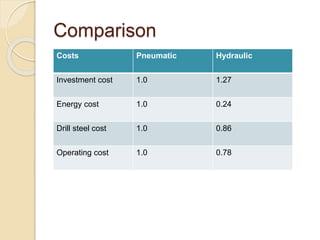
Cost chart for percussion Drill:
Comparison
Costs Pneumatic Hydraulic
Investment cost 1.0 1.27
Energy cost 1.0 0.24
Drill steel cost 1.0 0.86
Operating cost 1.0 0.78
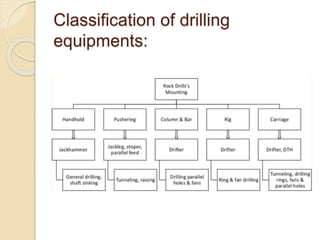
Classification of drilling
equipments:
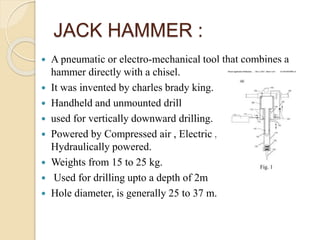
JACK HAMMER :
 A pneumatic or electro-mechanical tool that combines a
hammer directly with a chisel.
 It was invented by charles brady king.
 Handheld and unmounted drill
 used for vertically downward drilling.
 Powered by Compressed air , Electric ,
Hydraulically powered.
 Weights from 15 to 25 kg.
 Used for drilling upto a depth of 2m
 Hole diameter, is generally 25 to 37 m.
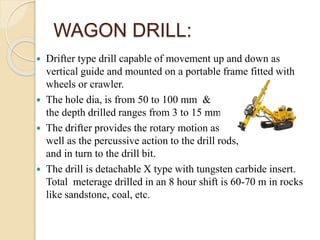
WAGON DRILL:
 Drifter type drill capable of movement up and down as
vertical guide and mounted on a portable frame fitted with
wheels or crawler.
 The hole dia, is from 50 to 100 mm &
the depth drilled ranges from 3 to 15 mm.
 The drifter provides the rotary motion as
well as the percussive action to the drill rods,
and in turn to the drill bit.
 The drill is detachable X type with tungsten carbide insert.
Total meterage drilled in an 8 hour shift is 60-70 m in rocks
like sandstone, coal, etc.
Thank You .

SELECTING THE DRILLING METHOD AND EQUIPMENT ( MD WASIUDDIN).pptx

  • 1.
    SELECTING THE DRILLING METHODAND EQUIPMENT: MD WASIUDDIN M.Tech Under the guidance : PROF
  • 2.
    Introduction  Drilling equipmentand methods are used by the construction and mining industries to drill holes in both rock and earth. Purposes for which drilling are performed, vary a great deal from general to highly specialized applications.
  • 3.
    Classification:  Mechanical:Percussion,rotary,rotary- percussion  Thermal:Flame, plasma, hot fluid, freezing  Hydraulic: Jet, erosion, cavitation  Sonic: High frequency vibration  Chemical: Microblast, dissolution  Electrical: Electric arc, magnetic induction Seismic: Laser ray  Nuclear: Fusion, fission
  • 4.
    TYPES OF DRILLING OPERATIONSUSED IN ROCK BREAKAGE  Manual drilling  Mechanized drilling further can be classified in :  bench drilling  drilling for drifting and tunneling  production drilling  drilling for raises  rock Supports
  • 5.
    Factors for Drillselection:  Site condition or Type of rock Blasting  requirement design  Drill ability factor  Operating Variables  Performance parameters  Machine availability  Cost or Maintenance.
  • 6.
    PRINCIPLES OF DRILLING: ◦Methods of rock drilling used in mines today are mechanical and driven by either impact or simple rotation ◦ Alternative methods, employing heat, flame, high pressure water, or high voltage electric discharges, for example, are used only in particular situations or in laboratory studies.
  • 7.
  • 8.
    Rotary Drilling  Rotarydrilling can be subdivided :  Rotary cutting : It creates the hole by shear forces, breaking the rock's tensile strength.  Rotary crushing : It breaks the rock by high point load, accomplished by a toothed drill bit, which is pushed downwards with high force.
  • 9.
    Cost chart forrotary drill:
  • 10.
    Advantages Disadvantages 1.most rockformations can be drilled. 2.water and mud supports unstable formations. 3.fast. 4.operation is possible above and below the water-table. 1.requires capital expenditure in equipment 2.water is required for pumping 3.There can be problems with boulders 4.rig requires careful operation and maintenance.
  • 11.
    Percussion drilling:  Percussiondrilling is a drilling technique in which a drill bit attached to rope or cable is repeatedly raised and lowered, impacting soil and rock, and making a hole deeper.  The energy required to break the rock is generated by a pneumatic or hydraulic rock drill.
  • 12.
    ADVANTAGES DISADVANTAGES 1.Unlike anyother drilling method, percussion can remove boulders and break harder formations, effectively and quickly through most types of earth. 2.Percussion drilling can in principle deal with most ground conditions. Can drill hundreds of feet (one well hand-drilled in China in 1923 was over 4000 feet deep). 3.Can drill further into the water table than dug wells, even drilling past one water table to reach another. 1.The equipment can be very heavy and relatively expensive. 2.Especially in harder rock the method is slow (weeks, rather than days). 3.When temporary casing has to be used, the time taken driving and removing it can significantly increase drilling time. 4.Equipment costs are high and the method is slow (resulting in high cost/drilled meter).
  • 13.
    Cost chart forpercussion Drill:
  • 14.
    Comparison Costs Pneumatic Hydraulic Investmentcost 1.0 1.27 Energy cost 1.0 0.24 Drill steel cost 1.0 0.86 Operating cost 1.0 0.78
  • 15.
  • 16.
    JACK HAMMER : A pneumatic or electro-mechanical tool that combines a hammer directly with a chisel.  It was invented by charles brady king.  Handheld and unmounted drill  used for vertically downward drilling.  Powered by Compressed air , Electric , Hydraulically powered.  Weights from 15 to 25 kg.  Used for drilling upto a depth of 2m  Hole diameter, is generally 25 to 37 m.
  • 17.
    WAGON DRILL:  Driftertype drill capable of movement up and down as vertical guide and mounted on a portable frame fitted with wheels or crawler.  The hole dia, is from 50 to 100 mm & the depth drilled ranges from 3 to 15 mm.  The drifter provides the rotary motion as well as the percussive action to the drill rods, and in turn to the drill bit.  The drill is detachable X type with tungsten carbide insert. Total meterage drilled in an 8 hour shift is 60-70 m in rocks like sandstone, coal, etc.
  • 18.