Seeing Through Statistics 4th Edition Utts Test Bank
Seeing Through Statistics 4th Edition Utts Test Bank
Seeing Through Statistics 4th Edition Utts Test Bank
Seeing Through Statistics 4th Edition Utts Test Bank
Seeing Through Statistics 4th Edition Utts Test Bank
1.
Visit https://testbankmall.com todownload the full version and
explore more testbank or solutions manual
Seeing Through Statistics 4th Edition Utts Test
Bank
_____ Click the link below to download _____
https://testbankmall.com/product/seeing-through-
statistics-4th-edition-utts-test-bank/
Explore and download more testbank or solutions manual at testbankmall.com
2.
Here are somerecommended products that we believe you will be
interested in. You can click the link to download.
Test Bank for Introductory Statistics: Exploring the World
through Data : 0321891937
https://testbankmall.com/product/test-bank-for-introductory-
statistics-exploring-the-world-through-data-0321891937/
Test Bank for Seeing Sociology An Introduction, 2nd
Edition : Ferrante
https://testbankmall.com/product/test-bank-for-seeing-sociology-an-
introduction-2nd-edition-ferrante/
The Art of Seeing 8th Edition Zelanski Fisher Test Bank
https://testbankmall.com/product/the-art-of-seeing-8th-edition-
zelanski-fisher-test-bank/
Test Bank for Seeing Sociology: An Introduction, 3rd
Edition, Joan Ferrante
https://testbankmall.com/product/test-bank-for-seeing-sociology-an-
introduction-3rd-edition-joan-ferrante/
3.
Discovering Statistics usingIBM SPSS Statistics Field 4th
Edition Test Bank
https://testbankmall.com/product/discovering-statistics-using-ibm-
spss-statistics-field-4th-edition-test-bank/
Test Bank for Gardners Art through the Ages A Concise
Global History, 4th Edition
https://testbankmall.com/product/test-bank-for-gardners-art-through-
the-ages-a-concise-global-history-4th-edition/
Test Bank For Applied Statistics: From Bivariate Through
Multivariate Techniques Second Edition by Rebecca (Becky)
M. (Margaret) Warner
https://testbankmall.com/product/test-bank-for-applied-statistics-
from-bivariate-through-multivariate-techniques-second-edition-by-
rebecca-becky-m-margaret-warner/
Fundamentals of Statistics Sullivan III 4th Edition Test
Bank
https://testbankmall.com/product/fundamentals-of-statistics-sullivan-
iii-4th-edition-test-bank/
Test Bank for Research Methods and Statistics 4th Edition
: Jackson
https://testbankmall.com/product/test-bank-for-research-methods-and-
statistics-4th-edition-jackson/
5.
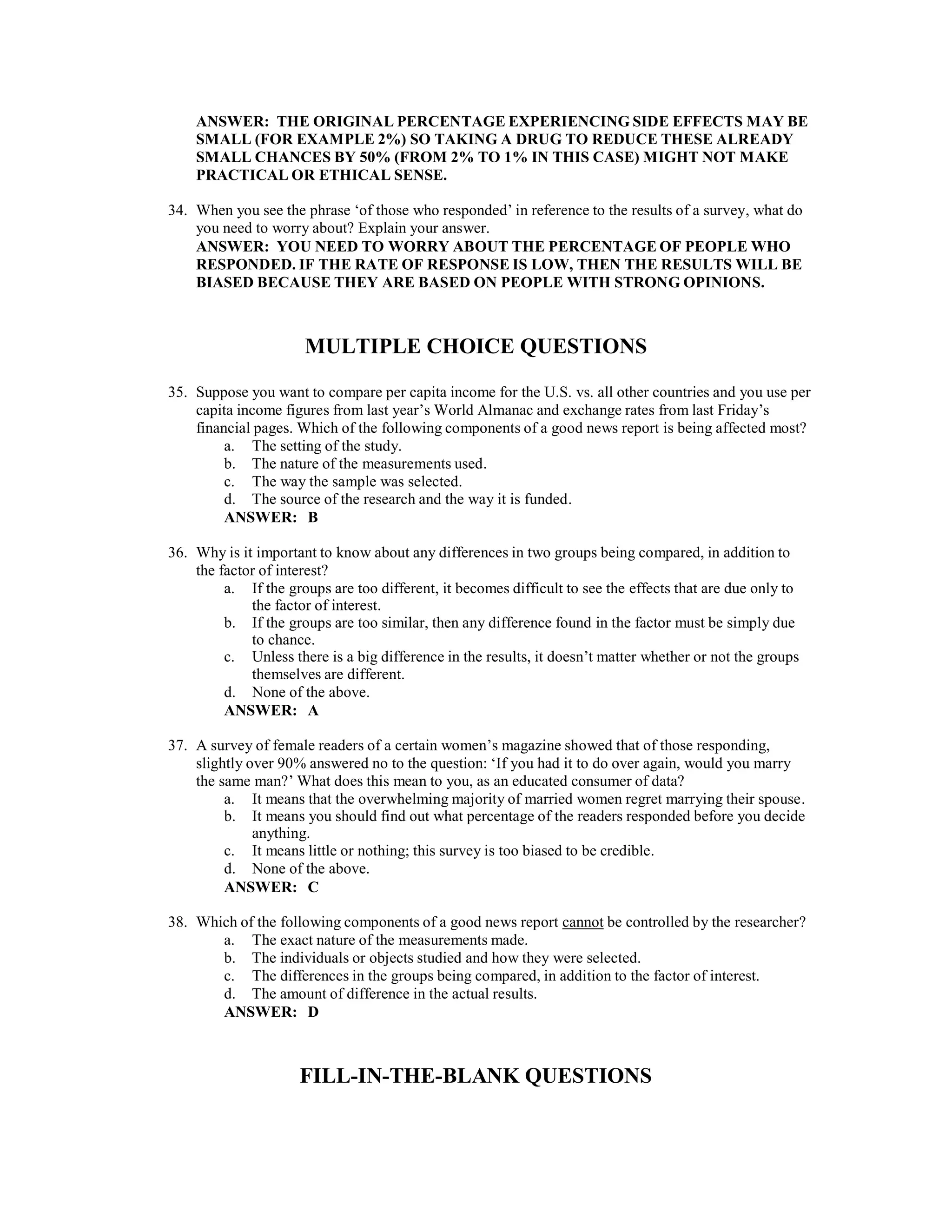
c. The numberof deaths in each state in a given year due to accidents.
d. All of the above.
6.
ANSWER: D
7. Howyou determine whether or not to believe a statistic you come across depends on what?
a. How the data were collected.
b. How the data were measured.
c. How the data were summarized.
d. All of the above.
ANSWER: D
8. Which of the following is true about statistics?
a. Numbers don’t lie. All statistics have to be believed.
b. Statistics can be made to say whatever you want them to say. No statistic should be
believed.
c. Any statistic that is based on data is likely to be correct.
d. All statistics should be carefully scrutinized before determining whether or not they can
be believed. Some are correct, and some are not.
ANSWER: D
FILL-IN-THE-BLANK QUESTIONS
9. is a collection of numbers or other pieces of information to which meaning has been
attached (such as your height in inches or your gender).
ANSWER: DATA
10. The we can attach to data and to the resulting conclusions depends on how well the
information was acquired and summarized.
ANSWER: MEANING (BELIEVABILITY, OR CREDIBILITY)
SECTION 2.2
ORIGINS OF NEWS STORIES
FREE RESPONSE QUESTIONS
11. Give one example of where a news story involving a statistical study can originate.
ANSWER: ANY OF THE FOLLOWING ARE OK: ACADEMIC CONFERENCES;
SCHOLARLY JOURNALS; PRESS RELEASES.
12. What is one of the problems with news stories based on conference presentations?
ANSWER: THERE IS UNLIKELY TO BE A CORRESPONDINGWRITTEN REPORT
BY THE RESEARCHERS AT THE TIME OF THE PRESENTATION, MAKING IT
DIFFICULT TO OBTAIN MORE INFORMATION.
13. One source of news stories about statistical studies involves in-depth research reports provided by
government and private agencies. Name one disadvantage of these types of reports.
ANSWER: THEY ARE NOT NECESSARILY PEER-REVIEWED OR CHECKED BY
NEUTRAL EXPERTS ON THE TOPIC.
7.
14. Suppose youhear a news story about a Harvard University study on teenage binge drinking and
you want to find out more information. Who or what source can you contact (besides the writer of
the news article)?
ANSWER: THE NEWS OFFICE OF THE LEAD RESEARCHER’S INSTITUTION; OR
THE JOURNAL ARTICLE THAT THE RESEARCH ORIGINALLY APPEARED IN (IF
ONE IS MENTIONED); OR THE LEAD RESEARCHER.
MULTIPLE CHOICE QUESTIONS
15. Which of the following describes possible origins of news stories?
a. Academic conferences
b. Scholarly journals
c. Government and private agency reports
d. All of the above
ANSWER: D
16. How do reporters find stories based on statistical studies in their areas of interest?
a. Routinely reading scholarly journals.
b. Attending academic conferences.
c. Watching for government reports.
d. All of the above.
ANSWER: D
17. Which of the following would give a news reporter the best and most comprehensive foundation
for a news story involving a statistical study?
a. A press release gives everything they need because it’s written just for them.
b. Another newspaper article written by a competitor.
c. An article in a peer-reviewed scholarly journal, accompanied by a press release.
d. A conference presentation given by the researchers themselves.
ANSWER: C
18. Which of the following would not necessarily be considered a good source for a news story?
a. A peer-reviewed journal
b. A government report
c. A press release
d. Another newspaper story
ANSWER: D
FILL-IN-THE-BLANK QUESTIONS
19. A(n) summarizes the information from a study so that journalists don’t have to be as
versed in the technical aspects of the research to write a good story.
ANSWER: PRESS RELEASE
20. Every academic discipline holds a(n) , usually annually, in which researchers can
share their results with others. Reporters routinely attend them to look for interesting news stories.
ANSWER: CONFERENCE
SECTION 2.3
8.
HOW TO BEA STATISTICS SLEUTH: SEVEN CRITICAL
COMPONENTS
FREE RESPONSE QUESTIONS
21. Your book lists three major reasons that studies are conducted. Name one of them.
ANSWER: ANY OF THE FOLLOWING IS ACCEPTABLE: 1) TO COLLECT DATA IN
ORDER TO MAKE A DECISION; 2) TO ASK AND ANSWER QUESTIONS ABOUT THE
WORLD AROUND US; OR 3) TO CONVINCE CONSUMERS THAT A CERTAIN
PROGRAM OR PRODUCT WORKS BETTER THAN THE COMPETITION.
22. Explain why it is important to find out not only who conducted a study, but also who funded the
study.
ANSWER: IF THE STUDY WAS FUNDED BY AN ORGANIZATION THAT WOULD
LIKELY HAVE A STRONG PREFERENCE FOR A CERTAIN OUTCOME, THERE
MAY BE A CONFLICT OF INTEREST THAT COMPROMISES THE RESULTS. YOU
MUST BE SURE PROPER SCIENTIFIC PROCEDURES WERE CONDUCTED.
23. In the case of a cola taste test, explain why it is important that both the researchers and the
participants be blind as to which brands are which.
ANSWER: ANY CLUES MIGHT BIAS THE RESPONDENTS TO CHOOSE THE
BRAND THAT (THEY THINK) THE RESEARCHERS WANT THEM TO CHOOSE.
24. Give an example of how the timing of a survey can easily bias the results of a study.
ANSWER: ANY ACCEPTABLE ANSWER OK. EXAMPLES: A SURVEY ASKING
OPINIONS ON GUN CONTROL IMMEDIATELY FOLLOWING A SCHOOL
SHOOTING INCIDENT; EMPLOYMENT SURVEY QUESTIONS ASKED IN A
TELEPHONE SURVEY GIVEN BETWEEN 9AM AND 5PM DURING THE WEEK.
MULTIPLE CHOICE QUESTIONS
25. Which of the following is not an important component of a good news report regarding a
statistical study?
a. The source of the research.
b. Who paid for the research.
c. The extent or size of any claimed effects or differences.
d. All of the above are important components.
ANSWER: D
26. Why is it important to know how the individuals or objects in a study were selected?
a. It is important to know to whom the results can be extended.
b. It is important for determining whether or not there is bias in the results.
c. Both a) and b) are true.
d. It is not important to know how the individuals were selected; only the size of the sample
matters.
ANSWER: C
9.
27. Suppose agroup of students who reported smoking marijuana was found to have lower test scores
than a group of students who reported they don’t smoke marijuana. What is the most that can be
concluded with regard to the population of all students?
a. Smoking marijuana causes lower test scores.
b. Smoking marijuana may be related to lower test scores.
c. Students who smoke marijuana have lower test scores than students who don’t.
d. None of the above.
ANSWER: B
28. Which of the following components of a good news report does not pertain to the issue of bias?
a. Knowing the source of the research and of the funding.
b. Knowing how the individuals or objects studies were selected.
c. Understanding any differences in the groups being compared, in addition to the factor of
interest.
d. All of these relate to the issue of bias.
ANSWER: D
FILL-IN-THE-BLANK QUESTIONS
29. Surveys relying on voluntary responses are likely to be because only those who feel
strongly about the issues are likely to respond.
ANSWER: BIASED
30. In a survey, both the wording and the of the questions can influence answers.
ANSWER: ORDERING; OR TIMING
SECTION 2.4
FOUR HYPOTHETICAL EXAMPLES OF BAD REPORTS
FREE RESPONSE QUESTIONS
31. A psychology student conducts a study to measure the amount of motivation students have for
their math courses. She hands out a survey in every math class at her school on the day before
spring break. What is the problem with her sampling process?
ANSWER: STUDENTS WHO ARE MOST LIKELY TO BE IN MATH CLASS THE DAY
BEFORE SPRING BREAK WILL BE MORE MOTIVATED THAN THOSE WHO ARE
GONE THAT DAY. THIS WILL BIAS THE RESULTS.
32. A social worker wants to determine the extent to which people remember a tragedy (like
September 11). She conducts a survey of a random sample of students in the General Psychology
101 course at her university. To whom can these results be generalized?
ANSWER: ONLY THOSE STUDENTS AT THAT UNIVERSITY WHO TOOK
GENERAL PSYCHOLOGY 101, OR STUDENTS SIMILAR TO THEM.
33. Suppose you find out that a certain drug reduces side effects of a certain therapy by 50 percent.
Assuming the study was conducted properly, explain why this statistic of 50% may not be as
meaningful as it sounds.
10.
ANSWER: THE ORIGINALPERCENTAGE EXPERIENCING SIDE EFFECTS MAY BE
SMALL (FOR EXAMPLE 2%) SO TAKING A DRUG TO REDUCE THESE ALREADY
SMALL CHANCES BY 50% (FROM 2% TO 1% IN THIS CASE) MIGHT NOT MAKE
PRACTICAL OR ETHICAL SENSE.
34. When you see the phrase ‘of those who responded’ in reference to the results of a survey, what do
you need to worry about? Explain your answer.
ANSWER: YOU NEED TO WORRY ABOUT THE PERCENTAGE OF PEOPLE WHO
RESPONDED. IF THE RATE OF RESPONSE IS LOW, THEN THE RESULTS WILL BE
BIASED BECAUSE THEY ARE BASED ON PEOPLE WITH STRONG OPINIONS.
MULTIPLE CHOICE QUESTIONS
35. Suppose you want to compare per capita income for the U.S. vs. all other countries and you use per
capita income figures from last year’s World Almanac and exchange rates from last Friday’s
financial pages. Which of the following components of a good news report is being affected most?
a. The setting of the study.
b. The nature of the measurements used.
c. The way the sample was selected.
d. The source of the research and the way it is funded.
ANSWER: B
36. Why is it important to know about any differences in two groups being compared, in addition to
the factor of interest?
a. If the groups are too different, it becomes difficult to see the effects that are due only to
the factor of interest.
b. If the groups are too similar, then any difference found in the factor must be simply due
to chance.
c. Unless there is a big difference in the results, it doesn’t matter whether or not the groups
themselves are different.
d. None of the above.
ANSWER: A
37. A survey of female readers of a certain women’s magazine showed that of those responding,
slightly over 90% answered no to the question: ‘If you had it to do over again, would you marry
the same man?’ What does this mean to you, as an educated consumer of data?
a. It means that the overwhelming majority of married women regret marrying their spouse.
b. It means you should find out what percentage of the readers responded before you decide
anything.
c. It means little or nothing; this survey is too biased to be credible.
d. None of the above.
ANSWER: C
38. Which of the following components of a good news report cannot be controlled by the researcher?
a. The exact nature of the measurements made.
b. The individuals or objects studied and how they were selected.
c. The differences in the groups being compared, in addition to the factor of interest.
d. The amount of difference in the actual results.
ANSWER: D
FILL-IN-THE-BLANK QUESTIONS
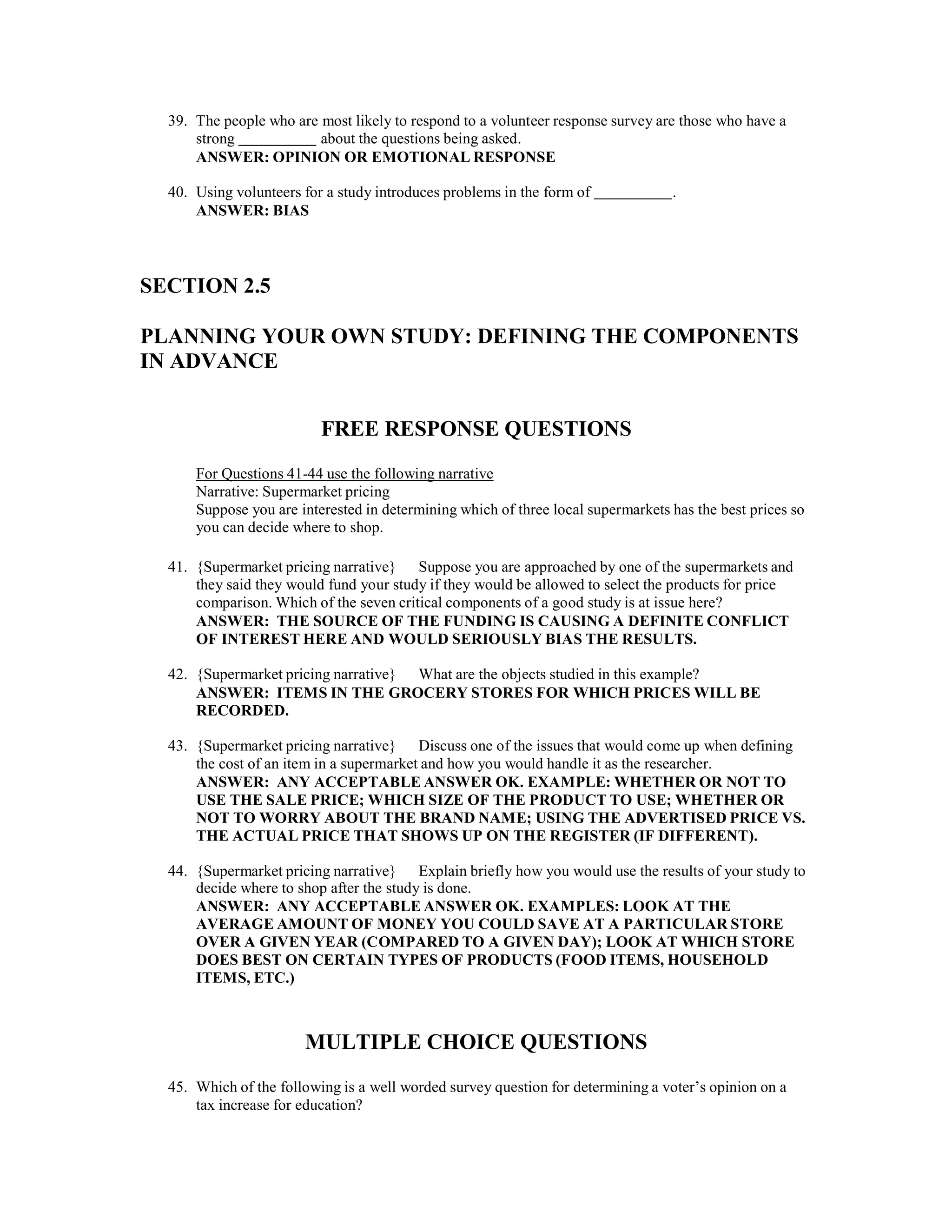
11.
39. The peoplewho are most likely to respond to a volunteer response survey are those who have a
strong about the questions being asked.
ANSWER: OPINION OR EMOTIONAL RESPONSE
40. Using volunteers for a study introduces problems in the form of .
ANSWER: BIAS
SECTION 2.5
PLANNING YOUR OWN STUDY: DEFINING THE COMPONENTS
IN ADVANCE
FREE RESPONSE QUESTIONS
For Questions 41-44 use the following narrative
Narrative: Supermarket pricing
Suppose you are interested in determining which of three local supermarkets has the best prices so
you can decide where to shop.
41. {Supermarket pricing narrative} Suppose you are approached by one of the supermarkets and
they said they would fund your study if they would be allowed to select the products for price
comparison. Which of the seven critical components of a good study is at issue here?
ANSWER: THE SOURCE OF THE FUNDING IS CAUSING A DEFINITE CONFLICT
OF INTEREST HERE AND WOULD SERIOUSLY BIAS THE RESULTS.
42. {Supermarket pricing narrative} What are the objects studied in this example?
ANSWER: ITEMS IN THE GROCERY STORES FOR WHICH PRICES WILL BE
RECORDED.
43. {Supermarket pricing narrative} Discuss one of the issues that would come up when defining
the cost of an item in a supermarket and how you would handle it as the researcher.
ANSWER: ANY ACCEPTABLE ANSWER OK. EXAMPLE: WHETHER OR NOT TO
USE THE SALE PRICE; WHICH SIZE OF THE PRODUCT TO USE; WHETHER OR
NOT TO WORRY ABOUT THE BRAND NAME; USING THE ADVERTISED PRICE VS.
THE ACTUAL PRICE THAT SHOWS UP ON THE REGISTER (IF DIFFERENT).
44. {Supermarket pricing narrative} Explain briefly how you would use the results of your study to
decide where to shop after the study is done.
ANSWER: ANY ACCEPTABLE ANSWER OK. EXAMPLES: LOOK AT THE
AVERAGE AMOUNT OF MONEY YOU COULD SAVE AT A PARTICULAR STORE
OVER A GIVEN YEAR (COMPARED TO A GIVEN DAY); LOOK AT WHICH STORE
DOES BEST ON CERTAIN TYPES OF PRODUCTS (FOOD ITEMS, HOUSEHOLD
ITEMS, ETC.)
MULTIPLE CHOICE QUESTIONS
45. Which of the following is a well worded survey question for determining a voter’s opinion on a
tax increase for education?
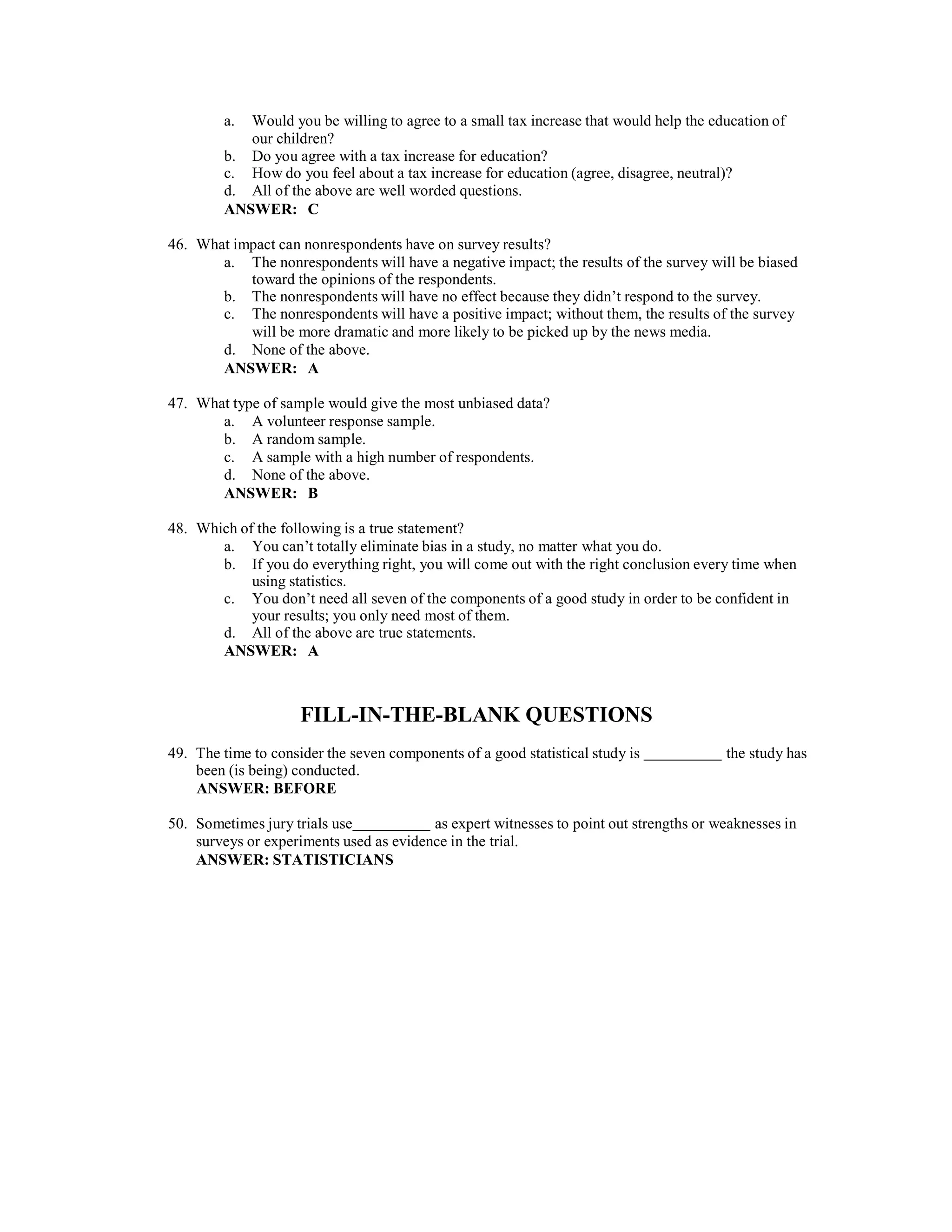
12.
a. Would yoube willing to agree to a small tax increase that would help the education of
our children?
b. Do you agree with a tax increase for education?
c. How do you feel about a tax increase for education (agree, disagree, neutral)?
d. All of the above are well worded questions.
ANSWER: C
46. What impact can nonrespondents have on survey results?
a. The nonrespondents will have a negative impact; the results of the survey will be biased
toward the opinions of the respondents.
b. The nonrespondents will have no effect because they didn’t respond to the survey.
c. The nonrespondents will have a positive impact; without them, the results of the survey
will be more dramatic and more likely to be picked up by the news media.
d. None of the above.
ANSWER: A
47. What type of sample would give the most unbiased data?
a. A volunteer response sample.
b. A random sample.
c. A sample with a high number of respondents.
d. None of the above.
ANSWER: B
48. Which of the following is a true statement?
a. You can’t totally eliminate bias in a study, no matter what you do.
b. If you do everything right, you will come out with the right conclusion every time when
using statistics.
c. You don’t need all seven of the components of a good study in order to be confident in
your results; you only need most of them.
d. All of the above are true statements.
ANSWER: A
FILL-IN-THE-BLANK QUESTIONS
49. The time to consider the seven components of a good statistical study is the study has
been (is being) conducted.
ANSWER: BEFORE
50. Sometimes jury trials use as expert witnesses to point out strengths or weaknesses in
surveys or experiments used as evidence in the trial.
ANSWER: STATISTICIANS
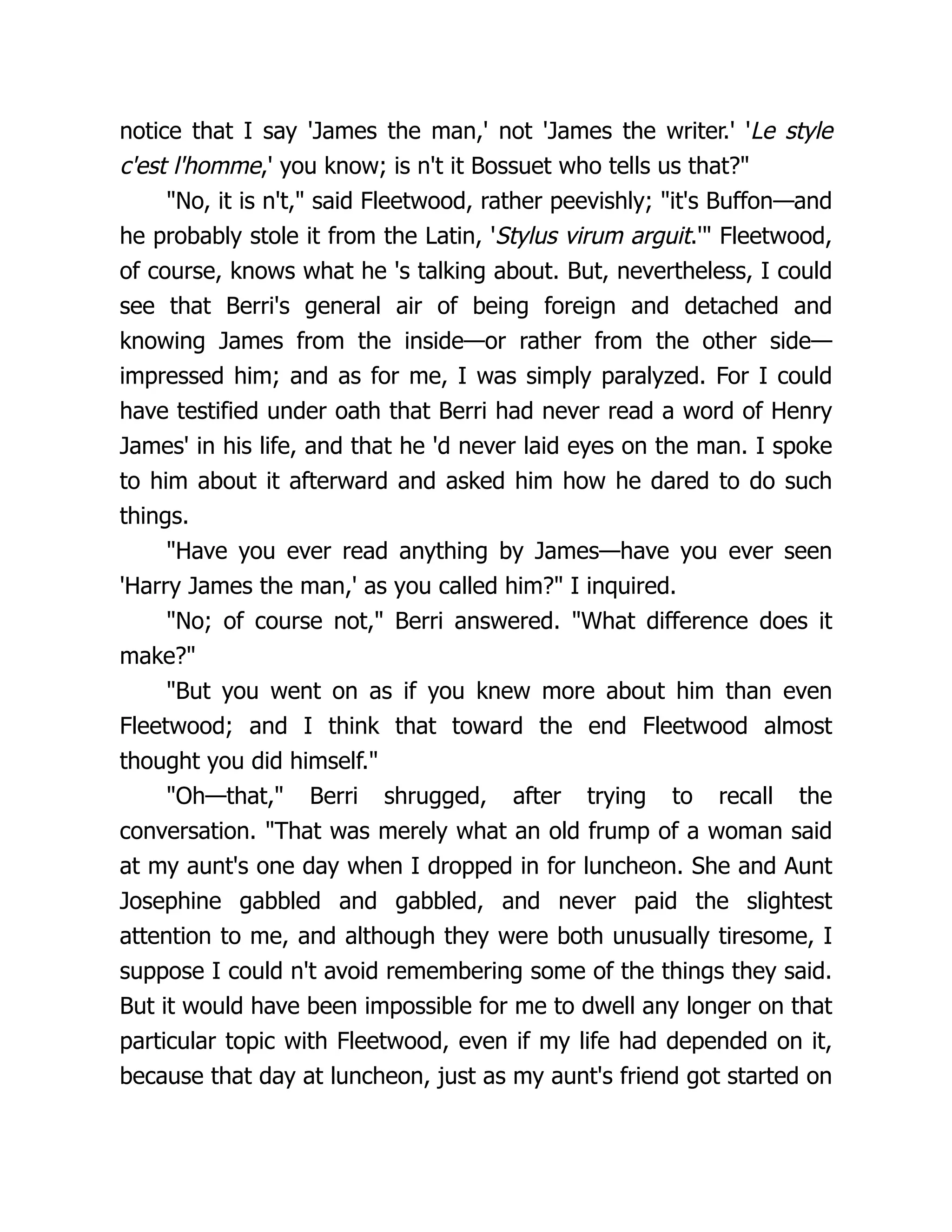
notice that Isay 'James the man,' not 'James the writer.' 'Le style
c'est l'homme,' you know; is n't it Bossuet who tells us that?"
"No, it is n't," said Fleetwood, rather peevishly; "it's Buffon—and
he probably stole it from the Latin, 'Stylus virum arguit.'" Fleetwood,
of course, knows what he 's talking about. But, nevertheless, I could
see that Berri's general air of being foreign and detached and
knowing James from the inside—or rather from the other side—
impressed him; and as for me, I was simply paralyzed. For I could
have testified under oath that Berri had never read a word of Henry
James' in his life, and that he 'd never laid eyes on the man. I spoke
to him about it afterward and asked him how he dared to do such
things.
"Have you ever read anything by James—have you ever seen
'Harry James the man,' as you called him?" I inquired.
"No; of course not," Berri answered. "What difference does it
make?"
"But you went on as if you knew more about him than even
Fleetwood; and I think that toward the end Fleetwood almost
thought you did himself."
"Oh—that," Berri shrugged, after trying to recall the
conversation. "That was merely what an old frump of a woman said
at my aunt's one day when I dropped in for luncheon. She and Aunt
Josephine gabbled and gabbled, and never paid the slightest
attention to me, and although they were both unusually tiresome, I
suppose I could n't avoid remembering some of the things they said.
But it would have been impossible for me to dwell any longer on that
particular topic with Fleetwood, even if my life had depended on it,
because that day at luncheon, just as my aunt's friend got started on
15.
'James the man,'I happened to glance up and notice that she was
wearing an entirely different kind of wig from the ratty old thing she
'd flourished in before she went abroad. She had brought back a
new one that was—why, it was an architectural marvel; it looked like
the dome of a mosque, and covered her whole head, from eyebrows
to neck, with little cut-out places for her ears to peek through. It
hypnotized me all through luncheon, and I never heard a word
about 'James the man,'—so of course when I got that far with
Fleetwood I had to change the subject. Don't you remember that we
began to discuss Bernhardt's conception of Hamlet rather abruptly? I
'll never trust that old woman again—after making the mistake about
Buffon. Why, she's positively illiterate!"
Fleetwood told me a lot about Mazuret's—that 's the name of
the restaurant—which made me glad that we had come across it
accidentally,—found it out for ourselves. It's very famous. All sorts of
people—writers and painters and actors and exiled noblemen—used
to make a kind of headquarters of it and dine there whenever they
happened to be in town. Fleetwood has been going there for years,
and always sits at the same table. (That's the proper thing to do;
you must have a favorite table, and when you come in and find it
occupied, you must scowl and shrug and complain to the waiters in
a loud voice that the place is going to the dogs. Then everybody in
the room takes it for granted that you 're a writer or a painter, an
actor or an exiled nobleman, and looks interested and sympathetic.
We saw several performances of this kind.) But the place, of course,
"isn't what it used to be." I'm seven or eight years too late, as usual.
Some of the poets have become very successful—which means,
Fleetwood says, that they 're doing newspaper work in New York;
16.
some of thepainters and actors are beyond the reach of criticism—
which means that they 're dead; and some of the noblemen are
confident that their respective governments are about to recall them
to posts of responsibility and honor—which means that they are in
jail.
It was more entertaining, Fleetwood says, in the days of
Leontine,—the shrewd, vivacious, businesslike Frenchwoman who,
when Monsieur Mazuret became too ill, and Madame too old, used
to make change and scold the waiters and say good evening to you,
and whose red-striped gingham shirt-waists fitted her like models
from Paquin. It was Leontine who brought back the wonderful wall-
paper from Paris (through the glass door it looked like a painting)
that represents a hunting scene, with willowy ladies in preposterous
pink velvet riding-habits and waving plumes, and gentlemen blowing
tasselled horns, and hounds and stags—all plunging through a
perfectly impenetrable forest, whose improbable luxuriance Berri
brilliantly accounted for by saying that it was evidently "Paris green."
"Attend now—I tell you something," Leontine used to say
confidentially when the evening was drawing to a close, and but one
or two stragglers were left in the dining-room.
"These peoples—they stay so long sometimes; I tell to them
that they must go. But non—they will not go; and they stay, and
they stay, and they stay. And all at once the—what you call?—the
chasse—she begin to move! The horses—he gallop; the ladies—she
scream of laughing; the gentlemen—he make toot, toot, toot,
tooooo! The dogs—Ah-h h-h! The—the—cet animal-là—the deer?—
the deer—Ah-h-h-h!" Carried away by these midnight memories,
Leontine would become a galloping horse, a screaming lady, a
17.
master of hounds,a savage pack, and a terrified monarch of the
glen—all at once. Then, overpowered by the weird horror of it, she
would cover her face with her apron and run coquettishly as if for
protection to another table.
There was another tale—the description of a thunderstorm—a
regular cloud-burst, it must have been—that, one afternoon,
overtook Madame and Leontine in the Place de la Madeleine,
Leontine personifying the truly Gallic elements—the lightning (reels
backward—eyes covered with hands)—the thunder (fingers in ears—
eyes rolling—mouth open and emitting groans)—the rain hissing
back from the asphalt in a million silver bubbles (skirts lifted—tip-
toes—mon dieus—shrieks—hasty exit to kitchen)—Leontine bringing
this incoherent scene vividly before one, was worth one's eating a
worse dinner, Fleetwood says, than the dinner at Mazuret's. But
Monsieur is dead, and Madame just dried up and blew away, and
Leontine is married, and—although I don't know when I 've enjoyed
a dinner so much—"the place isn't what it used to be."
While Fleetwood was telling me all this, I noticed that Berri
called one of the waiters and spoke to him in French. I don't know
what he said, as he talked very fast—and anyhow it did n't sound
much like the kind of French I 've been used to. The waiter
disappeared, and in half an hour or so a messenger boy came in and
gave Berri a little envelope which he put in his pocket without saying
anything. Then, when we had finished dinner and were just about to
push away from the table, Berri exclaimed,—
"Now we 'll all go to the theatre."
"My dear young man, if you could see the work I have to do this
night," Fleetwood protested with a gesture that seemed to express
18.
mountains of uncorrectedthemes, "you would realize, for once in
your life, what work really is."
"But I have the tickets," Berri explained; and he brought forth
the little envelope that the messenger boy had given him.
"No—no—no!" Fleetwood answered decidedly, and started for
the door. But Berri detained him.
"By inflicting our company on you we 've spoiled the evening for
you, I know; but you won't spoil it for me by depriving us of yours,"
he begged in his engaging way.
"'Sweet invocation of a child: most pretty and pathetical,'"
Fleetwood laughed, and backed into the vestibule. We followed and
surrounded him, so to speak, each taking hold of an arm. Then we
all walked through the alley toward Tremont Street, Fleetwood
quavering apprehensively from time to time, "Now you 'll take me to
my car and then bid me adieu, like two good boys, won't you?" while
we agreed to everything he said and clung to him like sheriffs. Berri
was giggling hysterically, but although I thought the situation rather
amusing, I did n't see anything so terribly funny about it until we got
to the parting of the ways and Fleetwood stopped. Then I noticed
that, in addition to the three great red roses that Berri had bought
for our button-holes, Fleetwood had a fourth one, with a long,
flexible stem, growing apparently out of the top of his head. He was
so unconscious of the absurd, lanky thing nodding solemnly over
him whenever he spoke, that when he held out his hand, exclaiming
tremulously,—
"'And so,' in the words of Jessica, 'Farewell; I will not have my
father see me talk with thee,'" and the rose emphasized every word
19.
as if itwere imitating him, I gave an uncontrollable whoop, and Berri
doubled up on a near-by doorstep.
"I only would that my father were alive at the present moment
to see me talking with thee," Berri gasped. "I don't know anything
he would have enjoyed more."
Fleetwood looked hurt and mystified and vaguely suspicious,
and he stood there merely long enough to say,—
"'You break jests as braggarts do their blades, which, God be
thanked, hurt not.'" Then, as Berri was still sitting on the doorstep
and I was leaning against the wall, he made a sudden dash for the
other side of the street. We caught him, of course, grasped his arms
once more, and walked him off to the theatre, pretending all the
time that we did n't notice his struggles and how furious he was at
having to go with us. Berri kept up an incessant stream of
conversation, saying things that, to an outsider, would have given
the impression that the theatre-party was Fleetwood's, and that we
were the ones who were being dragged reluctantly away from the
Cambridge car. Just before we got to the theatre the solemn rose in
Fleetwood's hat toppled over and dangled against his face. This also
we pretended not to see, and as we had him firmly by the arms, he
was unable to reach up and throw it away; so we made a
spectacular entrance through the brightly lighted doorway, with
Fleetwood ineffectually blowing at the rose and shaking his head like
an angry bull. A party of four or five fellows—students—who had
been unable to get tickets were turning away from the box-office as
we appeared, and they naturally stopped to look at us.
This was in the nature of a last straw, for Fleetwood almost
tearfully broke out with,—
20.
"You dreadful, dreadfulboys, my reputation is ruined; they 'll
think I 've been drinking." Even Berri began to see that we had gone
somewhat far, for he plucked the rose from Fleetwood's cheek,
exclaiming,—
"Good gracious, man! where did you get this? You must n't go
to the theatre looking that way. Just because Bernhardt plays Hamlet
is no reason why you should undertake to do Ophelia;" and then he
threw it on the floor. Fleetwood rolled his eyes hopelessly.
Well, we never got home until almost four in the morning. A
man whose seat was behind ours at the play tapped Fleetwood on
the shoulder as soon as we had sat down, and after a whispered
conversation he got up and went away. Then Fleetwood told us the
man was a dramatic critic—an acquaintance of his—who had been
sent to write up the play for a morning paper, but that, as he did n't
understand French and was n't much of a Shakespearian scholar and
wanted to go to a progressive peanut party in West Roxbury
anyhow, he had asked Fleetwood to do the thing for him. Fleetwood
used to be on a paper himself, and was delighted to renew old
times.
So all during the performance he made notes on the margin of
his program and chuckled to himself. The occupation, I think,
diverted his mind from Berri and me and helped him to forgive us.
Afterward we went to Newspaper Row and waited for hours in a
bare, rather dirty little room while Fleetwood, standing at a high
desk under an electric light in the corner, wrote his review. He spent
much more time in groaning, "My facility is gone—my hand has lost
its cunning," than in actual writing. By the time he was ready to
leave we were all famished; so before catching the owl car from
21.
Bowdoin Square westopped at an all-night restaurant that
Fleetwood used to patronize when he was a reporter, and had
buckwheat cakes and maple syrup. I 've never tasted anything so
good.
The Cambridge car was interesting, but fearful. It was jammed
with people, and I wondered where so many could have come from
that hour of the morning. They could n't all have been dramatic
critics. The majority of those who got seats went sound asleep, and
as the conductor could n't very well wake them up at every street,
he found out beforehand where they wanted to get off, and then
hung little tags on their coats that told their destination.
When we were saying good-by to Fleetwood in the Square,
Berri laughed and asked,—
"Have you decided yet what you 're going to do to me, Mr.
Fleetwood? I know you would like to give me E on my thesis, but I
don't think I deserve quite that." Instead of answering him, however,
Mr. Fleetwood ran away, exclaiming,—
"Don't talk shop,—don't talk shop; good-night,—good-night!"
Berri has begun to get awfully scared about the thesis,—not
that he's afraid that Fleetwood will give it a low mark, but because it
does n't look at present as if there would be anything to mark at all.
I found him in his room the other day with a pile of books and a
scratch-block on his table. But he had n't taken a note, and his
attitude was one of utter despair. Of course he can't possibly write it
unless he stays here during the holidays, for they begin day after to-
morrow.
22.
XI
I don't thinkI 've had a pen in my hand, except when I wrote a note
to Berri, for more than two weeks. In the first place I left in such a
hurry to meet the family in New York that, among the various things
I forgot to pack at the last minute, my diary was one. (Even if I had
taken it, I probably shouldn't have found time to record all we did.)
Then, as I was with mamma and papa and Mildred during the entire
vacation, there was no necessity for writing letters.
I did n't go to Washington with Berri for two reasons. The family
naturally wanted me to spend the holidays with them, and I could n't
help feeling that, if I refused Berri's kind invitation, he would be
much more likely to stay, part of the time at least, in Cambridge and
write his thesis. In a way I was right; for when I told him I simply
could n't go with him, he said sort of listlessly,—
"Well, then I suppose I ought to stay here and finish that thing,
oughtn't I?" which was an optimistic way of letting me know that it
had n't even been begun. I did n't know what to answer exactly,
because if I 'd agreed with him he would have thought me
unsympathetic and looked hurt, and if I had advised him to let the
whole matter slide, and forget about it, and have a good time (which
was, of course, what he wanted me to do), I felt sure that he would
eventually blame me for giving him bad advice. That's Berri all over.
So I merely remarked, "You 'll have to be the judge; it 's too serious
a matter for any one else to meddle with," and felt like a nasty little
prig as I said it. He was restless and gloomy after that, and took a
long walk all alone, during which I 'm convinced that he very nearly
made up his mind to stay in Cambridge and slave. I say very nearly,
23.
because he didn'tbring himself quite to the point of telling anybody
about it. But the next afternoon (college closed with the last lecture
of that day), when I turned into our street on the way to my room,
there was a cab with a steamer trunk on it standing in front of our
house; and as I opened the front door, Berri and a dress-suit case
clattered down the stairs. He stopped just long enough to shake
hands and exclaim, "Good-by, Granny—have a good time—I left a
note for you on your desk. The train goes in less than an hour."
Then he rushed out of the gate and jumped into the cab, slamming
the door after him with that sharp, thrilling "Now they're off" clack
that cabs, and cabs only, possess. That was the last I saw of him.
New York was a pleasing delirium of theatres and operas and
automobile rides up and down Fifth Avenue, with just enough rows
between Mildred and me, and papa and me and Mildred and
mamma (the other possible combinations never scrap), to make us
realize that the family tie was the same dear old family tie and had
n't been in any way severed by my long absence. It took us three
days to persuade mamma to ride in an automobile,—a triumph that
we all lived bitterly to repent; for she ever afterwards refused to be
transported from place to place by any other means,—which was not
only inconvenient, but ruinous. She justified her extravagance by
declaring that in an emergency she preferred to be the smasher to
the smashed. I met lots of fellows I knew on the street, and some of
them took me home with them to luncheon or to that curious five-
o'clock-sit-around-and-don't-know-what-to-do-with-the-cup meal
they call "tea." Meeting their families was very nice, and I felt as if I
knew the fellows ever so much better than I did in Cambridge.
24.
One incident mighthave ended in a tragedy if I hadn't
happened to preserve a certain letter of mamma's. ("Never write
anything and never burn anything—isn't it Talleyrand who tells us
that?" as the friend of Berri's aunt would say.) It was the real reason
of our spending the last two days of the vacation in Boston, and
came about in the following way.
One day at luncheon (we were going to a matinée afterwards) I
glanced at my watch to see how late we were, and mamma noticed,
for the first time, that I was carrying a cheap nickel-plated alarm-
clock sort of an affair instead of the gold-faced heirloom that has
been reposing for lo! these many weeks in Mr. Hirsch's pawn-shop.
Since our meeting she hadn't referred to this painful subject, and as
I had become used to the dollar watch on the end of my chain, it
never occurred to me to say anything about it. That day she looked
at the watch and then at me, and finally she murmured, "Why,
Tommy!" with the expression of one who seems to see the
foundations of Truth, Respectability, and Honor crumbling to dust;
and she finished her luncheon in silence, breathing in a resigned
kind of way and studying the table-cloth with eyes like smitten
forget-me nots. On the way upstairs I lagged behind, and Mildred
said to me,—
"Mamma has on her early-Christian-martyr look. What on
earth's the matter now?" But I was unable to enlighten her. Mamma
had known from the first that the watch had been pawned; I could
n't imagine why she was so upset.
All was explained, however, when I went to her room. Some
time ago she had sent me a draft for thirty dollars. It came in a
cheerful letter (no letter containing a draft for thirty dollars is sad)
25.
about nothing inparticular. I remembered that at the time the
postscript had puzzled me, for it said, "Of course I have told your
father nothing about this," and there was no clew in the body of the
letter to what "this" referred. The draft wasn't mentioned. It seems
that mamma was under the impression she had written me several
pages on the evils of extravagance, the horrors of debt, and the
general desirability of redeeming one's watch as soon as possible,—
which she hadn't at all. Not being a mind-reader, I assumed that her
draft was a spontaneous outburst of maternal esteem, had it cashed
with a loving grateful heart, and spent the money in three days.
Therefore, when she caught sight of my tin timepiece (it keeps much
better time, by the way, than the heirloom ever did), she had
distressing visions of me indulging in a perfect carnival of
embezzlement, and finally ending up with shorn locks, striped
clothes, and a chain on my leg.
I never realized before that the human brain is perfectly
capable, under certain circumstances, of harboring two distinct
beliefs at the same time,—the truth of either one of which
necessarily excludes the other. (There is probably a more technical
way of stating this, but I haven't got that far in my philosophy
course as yet.) Now, when I solemnly declared to mamma that she
had never mentioned her check in connection with my watch or
anything else in fact, I am sure she believed me. She said she
believed me, and seemed greatly relieved. But, on the other hand,
although she knew I was telling the truth, and rejoiced in the fact, I
am certain that she was unable at the same time to abandon her
equally strong conviction that she had written and sent precisely the
letter she had intended to. I don't pretend to explain this mental
26.
phenomenon, and Idiscreetly refrained from discussing it with
mamma, for in the midst of our talk I began to have a dim, delicious
suspicion that her letter was at that moment reposing in my inside
pocket. (When I am away from home, I always carry several plainly
addressed letters in order that there may be as little trouble as
possible in case anything should happen to me. I remembered
having put the letter with the postscript into my coat-pocket instead
of my desk, as I wished to refer to it when I next wrote home.) So,
when mamma finally said, "Well, I believe you," and then added with
an air of abstraction, "But I wish you had saved that letter," I thrust
my hand into my pocket, glanced at several envelopes, and
exclaimed dramatically as I showed her one of them,—
"Madam, your most idle whim is my inexorable law." Then we all
went to the matinée.
But that wasn't the end of the watch. Mamma made me give
her the pawn-ticket, and insisted on going home by way of Boston
for the purpose of redeeming it herself. The reason of this change in
the family plans was not explained to Mildred and papa; but they
were docile, and seemed to think it would be very nice to see my
rooms before leaving for home.
There was no opportunity to visit Mr. Hirsch when we arrived
yesterday, as we spent most of the day in exploring Cambridge. But
this morning (they all left for the West this afternoon), while Mildred
was packing and papa had gone to see about tickets, mamma, with
her head swathed in a thick black veil, and I slipped out to go to the
pawnbroker's. I have an idea that by going herself instead of simply
sending me mamma had a vague but noble belief that she was
rescuing me somehow from moral shipwreck. And then, no doubt,
27.
the mere factof one's venturing out incognito, as it were, to wrest
ancestral relics from usurious fingers is not without a certain charm.
Well, of course we met papa at the door of the hotel. The ticket-
office was just around the corner, and he had engaged berths and
tickets with a rapidity that was as unfortunate as it was incredible,
for he greeted us with, "Starting for a walk? I'm just in time," and
proceeded to join the expedition with evident pleasure. Mamma
lingered uneasily on the sidewalk a moment, and then said,—
"We 're not going for amusement, dear; we 're going to shop.
You know how that always tires you." But papa, who was in good
spirits at the prospect of leaving for home, quite unsuspiciously
ignored the suggestion and replied cheerily,—
"Well, I think I 'll go along, I might want to buy something
myself."
I exclaimed, "How jolly!" in a sepulchral tone, and we started.
Now, mamma in the role of a gay deceiver is sublime. The fact
that she is trying to play a part and perhaps setting "an awful
example" makes her miserable, although she sometimes succeeds in
concealing the fact until afterwards. I saw that we were in for a
delightful morning, and would probably end by missing the train. We
loitered unscrupulously in front of shop windows, apparently
entranced by everything from hardware to cigars. We sauntered in
and out of countless dry-goods places in quest of dark-blue ribbon of
such an unusual shade that Boston had never seen its like; we
paused for half an hour, now and then, to inquire the price of
diamond tiaras and alabaster clocks set with rhinestones; we bought
a bouquet of frost-bitten roses (I had to carry it) from a one-armed
man, and tarried to hear his reminiscences of life in a sawmill; we
28.
went to pianolarecitals, phonograph exhibits, and assisted at an
auction sale of bar-room furniture. And papa wearied not. Mamma
and I were nearly dead, but he not only wasn't bored,—he seemed
to be having the time of his life. We could n't devise anything too
silly and futile and tiresome for him to enjoy, and as the time before
the train left was beginning to grow ominously short, mamma at last
resorted to heroic measures.
I don't think she had formed any definite plan when she
abruptly led us into the subway; but our going there was probably
not unconnected in her imagination with the boundless opportunities
for losing oneself in the sewers of Paris and the catacombs of Rome.
The subway may or may not resemble these historic places,—I'm
sure I don't know,—but, at any rate, after we had been there five or
six minutes we lost papa.
We all three had stood aimlessly watching the cars whizz up to
the platform and away again into the subterranean dusk, until papa
(this was his first sign of impatience) mildly remarked, "I think, dear,
that as you and Tommy seem to be rather attached to this place, I 'll
buy a newspaper." Then he strolled off, and mamma clutched me.
We watched him approach the news-stand and pick up a magazine.
His back was partly turned.
"It 's our only chance," said mamma hoarsely, with a half-guilty,
half-affectionate glance towards the news-stand. I understood and,
seizing her hand, ran with her to the nearest car. An instant later we
were buzzing through the bowels of the earth in quite the opposite
direction from the pawn-shop.
To tell the truth, the only thing I knew about the locality of Mr.
Hirsch's establishment was that we should never reach it unless we
29.
got out andtook a car going the other way. This we did, and when I
thought we had gone far enough on the return trip and we emerged
once more into the daylight, we seemed to be miles from the place
—the only place—from which I could have found my way. So we
jumped into a cab and told the man to drive as quickly as he could
to that place. (I had to describe it at some length, as I don't as yet
know the names of many streets here.) He was very intelligent,
however, and it was n't his fault that, after we had jolted along for
four or five blocks, the horse fell down. We left him lifting one of the
poor thing's nervous hind legs in and out of the tangled harness. He
looked as if he were trying to solve some kind of a gigantic, hopeless
puzzle. We hurried on for about a quarter of a mile, and then I
suddenly discovered that we had been in the right street all the
time. It was one of those queer streets that never look familiar when
you 're going the other way. I confess it took a great deal of courage
to impart this discovery to mamma; but she appreciated the fact
that we had very little time to lose, and did n't stop to point out to
me that if I ever become a business man, I 'll be a failure. The horse
was on his feet again when we got back to the cab, so we jumped in
once more, and after an interminable drive (half of me was out of
the window most of the time, like a Punch-and-Judy doll, directing
the cabman) we finally drew up in front of the pawn-shop. It was
then that we really distinguished ourselves.
"I've come for my watch," I said to Mr. Hirsch. He gave me the
look of a bird of prey. It reminded me of an eagle I had seen once,—
an eagle that had been stuffed by an amateur. He held out his hand
and spoke a solitary, fateful word. Mamma's face—in the excitement
30.
of the momentshe had pushed up her veil—became dim with
horror; her features for an instant were positively incoherent.
"The ticket?" she whispered gropingly. "It's in the bottom of my
trunk."
Mildred and papa and a group of porters, peering up and down
the street like a concourse of Sister Annes, were on the curbstone in
front of the hotel when we got back. The baggage was piled on a
wagon, papa looked haggard and years older than when I had last
seen him, and Mildred gave us a haughty stare as we alighted.
Mamma was hustled wildly from the cab to the carriage, and I had
time merely to peck hastily at their tense faces and gasp good-by. As
the carriage swung around the corner, mamma appeared for a
moment at the window, exclaiming, "I 'll send it to you in my first
letter," and then sank from view. This afternoon, when I returned to
my peaceful little abode in Cambridge, who should be in his room
but Berri? He was at his desk, bending earnestly over a big pad of
thesis paper.
"You've finished it, after all," I said, for the floor near his chair
was littered with neat manuscript.
"Yes, it's finished,—fifty beastly pages of it," Berri answered, as
he jumped up to meet me. I wanted to ask him all about it,—how he
had managed to do it during the gayeties of Washington, and if it
had taken much time. But he said rather wearily,—
"Oh, don't let's talk about it; I 'm so sick of it," and began at
once to question me about my trip to New York. We chatted for
about half an hour, and then I got up to go into my room and
unpack my trunk. Thesis paper is n't like the ordinary paper on
which themes are written; it has a margin on all four sides, and as I
31.
had never usedany, I went over to Berri's desk to examine a sheet
of his.
"Why, you 've had the thing type-written," I exclaimed; for there
was a pile of type-written notes in front of the thesis paper. "Why
don't you hand it in that way instead of copying it again? Your hand
is so hard to read."
Berri wrinkled his forehead in a queer, annoyed kind of way;
then he looked confused and blushed a little, and finally he gave an
uncomfortable laugh.
"Oh, Granny, you 're so brutally guileless," he murmured. "Why
can't you just see and understand things? It sounds so much worse
than it really is, when you make me say it in so many words." Even
then I didn't altogether grasp the situation.
"You mean that somebody helped you?" I asked. That did n't
seem to me worth making such a fuss about, somehow.
"Well, that's a very refined and ladylike way of putting it," he
answered. "I got a man in the Law School to write it for me, and
paid him ten dollars for his trouble."
I had never thought much about this sort of thing, and it was
impossible all at once to know just where I stood in the matter. I
didn't know what to say, and I think I blurted out,—
"Oh, Berri, I 'm so sorry."
"Well, I 'm sorry you know about it," Berri mused drearily. "No, I
'm not, either," he added quickly, after a moment; "I 'm darned glad,
—for now that you know, you can do what you like; I 'm not playing
the hypocrite, anyhow. Only, don't talk to me about it. I 've thought
the whole thing over from every point of view; it's the only thing I
can do. I 'm willing to run the risks, and I 'm going to do it."
32.
It was impossibleto go back to other topics after that, so I went
into my room and unpacked my trunk. I don't believe I ever
unpacked so carefully and put everything away so neatly before.
Mrs. Chester came in and complimented me as I was finishing. It
must have been because I was thinking.
With all my thinking, however, I can't say that I 've got much
farther than I was when Berri first told me. I simply know that he
oughtn't to have done it, and am very, very sorry that he has. If he
tried to defend himself in any way, I could have it out with him; but
he does n't. When he finished copying the thesis, he came into my
room and said, "I 'm going over to drop this through Fleetwood's
door; do you want to go along?" and I went with him, hoping that at
the last minute he might, in his unexpected way, change his mind.
On the way over he did burst out with,—
"You see, it's this way: If I didn't know Fleetwood so well, I
should n't do it; I shouldn't care. But he'll think, if I fail to hand in
the written work, that I'm presuming on the fact that we 've
breakfasted together at The Holly Tree and gone to the theatre and
all that. I hate that kind of thing." I tried to make him see that
Fleetwood would n't look at it in this way at all, and that even if he
did it would be his fault, not Berri's. But Berri answered: "You need
n't go on to tell me how dishonest it is,—I know all that. I 'm not
worse than lots of other people, though;" and by that time we had
reached Fleetwood's door. I put my hand on his arm as he was
about to drop the thesis through Fleetwood's letter-slide and said,
"Please don't, Berri; wait until to-morrow morning, anyhow;" but he
pushed the roll through the door, and as it fell with a thud inside, he
laughed and answered,—
33.
"Too late. NowI'm going to forget about it." He went to town
for dinner, and I had mine about an hour ago at Mrs. Brown's. I was
the only one there. In a few minutes I have to go out again, as I
promised——
Later.
Just as I had written that far, the front door opened and slammed
and the tin steps clattered as they only do when Duggie is coming
up. The loneliness of the house, and the feeling that college opened
to-morrow, and Duggie on the stairs all took me back to my first
evening in Cambridge. The only difference was that instead of going
to his own room Duggie this time came bursting into mine.
"I came to say good-by," he exclaimed; and when I got over my
astonishment, he went on to tell me that he had decided during the
vacation to go away—to Europe—and stay until Class Day. He had
never told me before that he had taken his degree in three years,
and that it would n't have been necessary for him to come back this
year at all if he had n't wanted to. He has been entitled to his
degree for months; but of course he is anxious to graduate with his
own class in the spring. He has n't talked to any one about going
abroad, as he was n't sure of it until a few days ago.
"I 'm leaving on the midnight train to-night," he said, "and I
came out here on the chance of your having got back. My family are
all in the country, I left them this afternoon." I wanted to tell him
how sorry I was that he was leaving us, and how glad I was that he
could go; but somehow I don't think I showed what I really felt. The
time was so short (I had promised Duncan Duncan to help him with
34.
some Advocate editorialsat half past eight), and those things never
seem to sound the way I should like to have them. But in a way I
had an opportunity to let him know how I felt toward him, for while
we were sitting there, he laughed and said,—
"As you won't stay and talk to me, I think you might at least do
the next best thing. You know I 've always wanted to read this, and
now that I 'm going away, you ought to let me." Then he took my
diary from the mantelpiece and pretended to read the first page.
My first impulse was to ask him not to. If he had been going to
stay in Cambridge, I should n't have let him, of course; but as he
was leaving in a few hours and seemed anxious to read the thing,
and as it really did n't make any difference whether he did or not, I
finally let him.
"I don't see why you want to, and you probably won't get
beyond the first few pages, but you may," I said.
So I left him by the fire with the diary in his hand. I thought
perhaps I should find a note about it when I got back this evening,
but I didn't.
XII
Poor Berri! I felt so sorry for him. I do yet, in fact; for although
things can't possibly turn out in the way he thinks they may, I can't
tell him so, and he lives in a state of perpetual dread. But it won't
last long now; Duggie's steamer must have almost reached
Southampton by this time, and it won't take more than a week or
35.
eight days forBerri to hear from Duggie himself. I came very near
giving the thing away at one time. It's hard not to, although I realize
that Duggie was wise when he asked me to let matters take their
course.
It just happened that the next day after Berri had delivered his
thesis, the talk at luncheon turned on cheating at exams and
handing in written work that is n't your own. The sentiment against
cheating seemed to be strong, partly from a sense of honor and
partly from a sense of risk. As a matter of fact, I don't see how
fellows can very well manage to cheat here—during an examination,
that is to say—even if they want to. There are always a lot of
proctors prowling up and down the room, ready to jump on anybody
who has suspicious-looking bits of paper on his desk, or who seems
to be unduly interested in his lap or the condition of his cuffs. And
then, besides, assuming that the instructor occasionally gets
absorbed in a newspaper and the proctors stroll to the windows to
watch the muckers throwing snowballs in the Yard, how could a
student prepare himself for this rare opportunity? It may be different
in courses that involve the exact sciences, where certain definite
formulas copied on a small bit of paper might be of use; but in the
sort of things I take, one would have to conceal upon oneself the
Encyclopædia Britannica, Ploetz's Epitome of History,
Geschmitzenmenger's Ancient Art, or the Dictionary of Biography, in
order to accomplish any really effective deception.
With written work it seems to be easier. If a man hands in a
theme or a thesis in his own hand, the instructors are more or less
forced to accept it as original, unless of course it was taken outright
from a book and they happen to be familiar with the book. From
36.
what the fellowsat the table said, there must be more of this sort of
thing done than I had imagined; although, since Berri opened my
eyes, I could believe almost anything. One of the fellows told about
a student—a Junior—he had heard of who succeeded in getting
himself fired two or three years ago in a rather complicated way. He
was engaged, and his lady-love sent him a poem in one of her
letters, saying that she had written it for him. The letter arrived
while he was struggling with a daily theme; so he murmured to
himself, "Tush! I 'll copy Araminta's pretty verses and send them in
as my own; as they have just gushed from her surcharged heart into
her letter, no one will be the wiser." A few days later the omnivorous
Advocate asked permission to print them, and as they had received
words of praise from the instructor, and as the fellow by that time
had no doubt begun to believe he had written them himself, he
allowed them to be published under his name. Somebody sent a
copy of the Advocate to Araminta, who replied with an indignant
letter to her futur; and while he was trying to think up an
explanation of the matter with which to pacify her, somebody else
came out in the Crimson with a most withering communication,
asking how the Advocate dared to print as original a poem that had
been written by his grandfather, the late Donovan H. Dennison,
whose complete poetical works ("Dan Cupid and other Idyls") could
be found in the college library at any time. Whereupon the student,
disgusted at his lady-love's dishonesty in palming off the late
Donovan H. Dennison's verses as original, broke his engagement;
and the college, disgusted with the student for precisely the same
reason, "separated" him (to use the suave official phrase) from the
University.
37.
There was, asI said, a great deal of talk at luncheon that day
about cheating. Some of the men seemed to think the presence of
proctors during an exam was insulting; but, as Bertie Stockbridge
remarked,—and this struck me as unanswerable,—"If you don't
cheat yourself and don't want to, what difference does it make
whether they 're there or not? And if you do cheat, why, of course,
proctors are necessary." In the matter of dishonest written work the
same honorable sentiments were expressed. Everybody was sincere,
but I could n't help realizing a little that they could not have had
very much temptation as yet. If it had n't been for Berri, I probably
should have laid down the law as loudly as the rest. But he sat there
eating in silence, irritated and oppressed by so much high-minded
babbling, and I hated to hurt him by adding to it. Usually he is one
of the last to leave the table. That day, however, he hurried through
his luncheon and slipped away alone.
Oh dear! (How silly those two words look written down, and yet
it was what was passing through my mind as I wrote them.) I
suppose that what I really mean is, How tiresome it is that a
person's acts don't begin and end with himself! There doesn't seem
to be any limit to the reach of their influence. It would be so much
more simple and easy if you knew just where the consequences of a
mistake or an indiscretion, or whatever you choose to call it, began
and ended. Now, for instance, take Berri and the thesis. Of course, I
think it was all wrong, and was sorry he handed it in; but I wasn't
going to let it make any difference in my feelings toward Berri. As far
as I am concerned, I don't think it has made a difference. Yet the
beastly thing cast a sort of gloom over the house. For Berri after
luncheon that day rather avoided the table in general and me in
38.
particular. What hisobject was in doing this, I don't know. It was
probably just a feeling on his part; but it made me feel as if I 'd
been putting myself on a moral pedestal somehow, and that Berri
saw in me a perpetual accusation. Our relations became
indescribably changed and sort of formal, and I did n't see how I
could make them different. What could I have done? There was
nothing, under the circumstances, for me to say. He stopped in my
room that night to warm himself for a minute before going to bed,
but I don't think he said anything except that it was snowing
outside.
The next day we had the blizzard. People here usually assume
that in the part of the country I come from we have nine months of
winter and three of cold weather. But nevertheless I had to come to
the staid and temperate East to see the kind of a winter storm you
read about in books,—the regular old "Wreck of the Hesperus" kind,
in which the crew are "swept like icicles from the deck," and able-
bodied men get hopelessly lost and are frozen to death in their own
front yards. I was to have dined in town that night with Hemington,
who had tickets for a Paderewski recital. But he did n't turn up, so I
joined some fellows who found me in the restaurant eating alone,
and afterwards went to the theatre with them. It was snowing when
we left the restaurant; in fact, great, wet cottony flakes had been
falling at intervals all day. (It reminded me of those marvellous paper
weights I haven't seen for years and years,—glass globes filled with
water in which a white, powdery sediment swirls and drifts and
finally settles in the most lifelike way on a beautiful little tin
landscape. What's become of them all, I wonder?) But there was no
39.
wind, and itwas n't particularly cold, so I don't think that anybody
suspected what was going to happen before the show was over.
It took an unusually long time to get out of the theatre that
night; the people in the aisles hardly moved at all. But after we had
forced our way through the crowd, and climbed over seats, and
finally reached the narrow corridor leading to the entrance, we saw
why it was. The ones who had got to the door first were afraid to
leave. Within an hour or two the wind had risen and risen until it
screamed through the streets, blasting up the fallen snow in wild
bewildering spirals and then fiercely slapping it back again in slants
of hard, biting cold. From the door of the theatre it was impossible
to see beyond the curbstone, except when the half-obliterated lights
of a cab lurched by over the drifts. The rumor went through the
crowd that the wires were down and that all the cars had stopped.
No one seemed to know quite what to do. Just as the people nearest
the door would make up their minds to start bravely out, a thick
hurricane would strike erratically in at them, causing the ladies to
shrink back with little exclamations of dismay. Nobody's carriage had
arrived, and the few cabs that appeared ploughed laboriously past
us. Our crowd waited a few moments,—more to share the
excitement of the others than for anything else; then we turned up
our collars and plunged out.
Standing at the door of the theatre, the world outside had
seemed to me to be in a sort of insane uproar; but as soon as we
got away from the human babble, and I lifted my head and opened
my eyes and deliberately relaxed my ears, so to speak, I found the
city almost solemnly silent. Every now and then, when we came to a
cross street or turned a corner, there was, it is true, a sudden shriek
40.
and a sortof rattle of fine stinging ice particles; but as long as I
could keep myself from being confused inside of me, while we were
floundering over drifts and burrowing with our heads through the
walls of wind that blocked the way and seemed to be falling on us, I
could n't help noticing the terrible muffledness of everything. It was
as if the place were being swamped, blotted out, suffocated.
When we reached the hotel where we had dined earlier in the
evening, the other fellows went in to have something to eat, but for
several reasons I decided not to. In the first place, I promised papa
that I would try to economize, and I had already unexpectedly
squandered two dollars on a theatre ticket, owing to Hemington's
failure to appear. Then I felt that if I did n't make a dash for
Cambridge right away, I should n't get there at all. (As a matter of
fact, I never did reach there until nine the next morning, but it was
n't because I did n't try hard enough. The other fellows put up at the
hotel.) So I just shouted that I was going on, and as we were all
about half frozen, no one stopped to persuade me not to.
Well, I found a string of cars about a mile long that were rapidly
turning into Esquimau huts, and was told by one of the conductors
that something had broken down ahead, and that, as the snow-
plough could n't get by, they probably would n't move again until
morning. He thought, however, that the other line was running; and
I started to grope my way to Bowdoin Square.
I would n't go through that experience again for gold and
precious stones; and I can't imagine now why I did it in the first
place, except that I had acquired by that time a kind of pig-headed
determination to reach Cambridge, and did n't know what I was in
for. It was n't so bad while I was staggering along by the side of the
41.
blocked cars; theywere lighted, and I knew that if I changed my
mind about going on, I could pop into one of them and be safe. But
when I passed the last one and found myself after a while among
back streets choked with drifts, and could n't see my way, and fell
down twice, and got snow up my sleeves, and my face and hands
and feet pained so with cold that I could n't help crying (actually),
and I realized at last that I did n't in the least know where I was, I
began to be panic-stricken. I 'm not the huskiest person in the
world, and all at once the wind blew me smash against an iron
railing and almost into a basement of some kind. I think I should
have hunted for a door-bell and tried to get into a house if I hadn't a
moment later collided with a policeman (fell down again), who
helped me up and led me to a sheltered place behind a wall, where I
managed to collect myself and tell him what I was looking for. He
too was on his way to Bowdoin Square; so after that I just hung on
to his coat most of the time, and tried to keep my legs in motion
without really knowing much where he was leading me or whether
we were making any progress. Once there was a rip-tearing crash
over our heads. The policeman jumped aside, and then stopped to
exclaim, "Well, I never seen the likes o' that." I think a sign had
blown off a building through a plate-glass window. Farther on a
dangling wire romped in the wind. It spat dazzling blue and purple
at us until we retreated and went around another way, muttering
strange Hibernian mutters. When I opened my eyes again, we were
in front of the hotel in Bowdoin Square and the policeman was
advising me through his frozen mustache not to go to Cambridge.
He said the cars had stopped long ago. So I said good-by to him and
was just stumbling into the café, when who should come out but
42.
Berri and acabman? They had gone in to get warm before starting
across the bridge.
"I 'm not sure that we can make it," Berri said, "but the man
says he's willing to try. I 'll tell you why I don't want to stay at the
hotel when we get inside. Look out—look out!" he cried to me, as I
opened the cab door and was about to jump in. I drew back,
expecting at least to be decapitated or electrocuted, and then Berri
explained that he was afraid I might "sit on the pigeons." He entered
the cab first, and removed some indistinguishable objects from the
back seat to the narrow seat that lifts up in front. "That's why I can't
very well stay at the hotel," he went on. "As soon as these poor
exhausted little darlings begin to thaw, they 'll fly around and make
a dreadful fuss. I 'd rather have them in my own room." He had
picked up four half frozen pigeons in the street on his way to the
Square, and had carried them—two in his pockets and two in the
bosom of his overcoat—until he came across the cab. After we got
started, he lighted matches every now and then to see how they
were getting along, and we took turns at blowing on their pink feet,
all shrivelled with cold. One of them, to Berri's grief, was dead, but
by the time the cab stopped suddenly and for the last time in the
middle of the bridge (it had been going slower and slower and
tipping more perilously over mounds of snow as we proceeded), the
other three looked scared and intelligent and began to feel warm
under their wings.
The driver opened the door and said he could n't go on, as a
fallen wire was sagging across the street in front of the horse's nose.
We jumped out, and Berri was just about to seize the thing and try
to lift it over the horse's head, when I remembered the murderous
43.
ecstasy of theother one and jerked him back. Ahead of us there was
a drift almost as high as the cab itself, and the man said that even
without the wire we never could drive over or through it. So, after a
short consultation, he decided to blanket his nag and spend the rest
of the night in the cab; the horse was "dead beat," he said, and he
very much doubted if it could pull back to town against the wind
even after turning around, which was a more or less impossible
undertaking in itself. Berri and I packed up the pigeons—the dead
one included, as Berri remembered having read in the paper that
morning of a case of "suspended animation" somewhere in Texas—
and pushed on to the waiting-station at the other end of the bridge.
That was a queer night. I was simply played out when I got
inside the waiting-room, and I had n't been there more than a few
minutes when I discovered that my ear was frozen. A kind, officious
woman all but broke it off rubbing snow on it; but though it pained
excruciatingly during the night and is still sensitive and has a
tendency to stick out at right angles from my head, I think it will
recover. There must have been fifteen or twenty people cooped up
in the waiting-room and the cigar-stand (with hot soda-water and
candy facilities) next door. Some of them were cross and unhappy,
and some of them were facetious. One of them had a small dog.
Berri's pigeons created a sensation. The cigar-man gave us a box to
put them under, and Berri bought them popcorn for fear they might
be hungry during the night. The warmth of the room revived them
completely, all but the dead one.
We talked for a while; but as Berri remembered, now that the
excitement was over, to be formal and impersonal once more, it was
rather dreary. We could have slept, I think,—in fact we were asleep,
44.
when one ofthe facetious refugees woke us up to ask if we did n't
want to join him "and some other gentlemen in a game of euchre."
Disappointed at his unsuccessful efforts to interest people in this
diversion, he chased the little dog about the room, declaring that he
intended to tie a glass of chocolate around its neck and send it out
in the storm to look for travellers who had lost their way. It was
impossible after that to get to sleep again.
We had been sitting with our heads against the wall for almost
an hour, waiting for daylight, when Berri, who hadn't said anything
for ever so long, suddenly came out with,—
"Oh, Granny, I 'm so sorry I did it!" I knew what he meant at
once, although the thesis had n't been in my mind at all, and I was
just about to advise him to have a talk with Fleetwood and tell him
everything, when he added that he would have to stand by himself
now, as it was too late to draw back.
The worst of the storm was over, the cabman had come in to
get warm and tell us that his horse had frozen to death, and the
windows of the waiting-room had begun to look pale instead of
black, by the time I convinced Berri that it wasn't too late, and that
as soon as we got to Cambridge he ought to go to The Holly Tree
and wait until Fleetwood came in for his breakfast. When he finally
made up his mind to do this, I never saw any one in such a state of
impatience. He could n't sit still, and kept running to the door every
other minute to see if the snow-plough was coming over the bridge.
Once he suggested that we should walk; but although the morning
was clear and beautiful, I had had enough of struggling through
mountains of snow the night before, and refused. The plough
appeared at last, preceded by a whirling cloud and followed by a car.
45.
We set thepigeons free (Berri told them all to return with olive
branches as quickly as possible) and watched them fly to the nearest
telegraph-pole and proceed to make their toilets for the day.
It must have been about half an hour after I parted with Berri
(he went on to The Holly Tree and I came to my room) that he
bounded up the stairs, pale with excitement. He had met Fleetwood,
and after a few preliminary remarks about the blizzard (the whole
place was submerged) he had blurted out,—
"Mr. Fleetwood, I want to tell you something about my thesis; I
did n't write it." To which the instructor replied almost indifferently,—
"Yes, I noticed that. What was the trouble?" Berri just looked at
him in amazement.
"I said I did n't write it," he faltered.
"Well, I know that," Fleetwood replied a trifle sharply. He was
inclined to be "peevish," Berri said, because the morning papers had
n't been delivered.
"But I want to tell you how sorry I am," Berri added; the
situation was much worse, Berri says, than it would have been if
Fleetwood had seemed more impressed by his dishonesty. As a
matter of fact, Fleetwood merely smiled.
"Oh, I never had the vaguest idea that you would write it," he
remarked airily. "But if you don't care, I don't. It's much easier for
me to give you an E for having failed to hand it in, than it is to read
fifty or sixty pages of your impossible writing."
At this Berri said he almost reeled from his chair.
"Did n't I hand it in?" he asked, while his heart thumped
painfully. Fleetwood glanced up from his oatmeal only long enough
to say,—
46.
"I wish youwould go some place else to eat; you bother me."
But Berri insisted.
"Dear Mr. Fleetwood," he pleaded eagerly, "please answer me
just that one thing. Did n't you find my thesis pushed through your
door?" At this Fleetwood put his hands to his head, as he always
does when he 's pretending that we 're trying to drive him mad, and
moaned,—
"First you tell me you have n't written your thesis and then you
ask me if I 've picked it up on my floor. Oh, go away, go away! I
shall never be able to finish my breakfast and get back through all
that ghastly snow to my ten-o'clock lecture." Then Berri dashed out,
forgetting to pay for his breakfast, and came to find me.
Fleetwood must think that Berri isn't quite right; for he followed
the instructor around all day more or less, waiting for him at the
doors of lecture halls, intercepting him in front of the Colonial Club
at lunch-time, running after him in the Square, and calling on him
twice at his room, to ask if the thesis had turned up yet. But of
course it never had. At that time neither of us could account for its
disappearance, and Berri can't yet. He is existing in a state of
nervous dread for fear it "may have fallen behind something" in the
dark vestibule and will eventually turn up. Well, it will turn up, but
not in Fleetwood's room.
Berri spent most of the time in which he wasn't dogging
Fleetwood's footsteps discussing the thing with me. But I could n't
help him much beyond hoping that the thesis—like the love-letter or
the lost will in dramas at the Bowdoin Square Theatre—wouldn't be
found until the fifth act, after an elapse of twenty years.