Represented by:
Gyanendra Sharma
Harikant Yadav
Anupama Singh
Contents. . .
 Security market.
 S.E.B.I
 S.E.B.I Act 1992
 Companies Act 1956
 Fii
 Guidelines for fii
What is SECURITY MARKET ??
Securities market is a component of the wider financial
market where securities can be bought and sold between
subjects of the economy , on the basis of demand and supply.
Securities markets encompases equuity markets, bond markets
and derivatives markets where prices can be determined and
paticipants both professional and non professionals can meet.
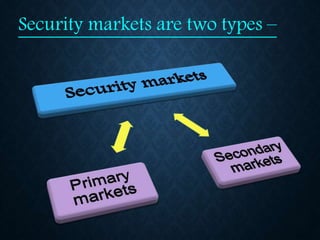
Security markets are two types –
Primary market is a market for new issues of securities.
Following are example of primary issues:
• IPO: (Initial public offering) refers to stock of company being
offered to general public for the first time.
• Seasoned issue : new issues are offered by companies that
already have floated equity.
• Companies may choose to sell securities either through public
offering or private placement.
• In private placement, the securities are offered to a some wealthy
individuals or selected financial institutions.
Trading of already issued securities among investors
occurs in the Secondary market.
• The trading of already issued securities takes place
in secondary market.
• Secondary markets helps the primary markets as they
increase the liquidity of existing securities.
• Secondary markets exists for trading of common
stocks, bonds, and puts and calls,
• Secondary markets include Brokers market, Dealers
markets.
S.E.B.I
Securities Exchange Board of India
(SEBI) was set up in 1988 to regulate the
functions of securities market. SEBI
promotes orderly and healthy
development in the stock market but
initially SEBI was not able to exercise
complete control over the stock market
transactions.
Establishment
ROLE OF SEBI
 Issuers –: for issuers it provides a market place
in which they can raise finance fairly and
easily.
Investors –: For investors it provides protection
and supply of accurate and correct information.
Intermediaries –: For intermediaries it provides
a competitive professional market.
SEBI ACT 1992
An Act to provide for the
establishment of a board to protect the
interests of investors in securities and
to promote the development of , and to
regulate, the securities market and for
matters connected therewith or
incidental there to.
Salient features of SEBI Act, 1992
 An Act to provide for the establishment of a board t protect
the interests of investors in securities and to promote the
development of, and to regulate the securities market and
for matters connected therewith or incidental thereto.
 HQ will be in Mumbai and may establish offices at other
places in India.
 Chairman and members of board will be appointed by the
central government.
 Primary duties of the board is to protect the interest of the
investors.
 The general superintendence, director and management of
affairs of the board shall vest in board of members.
Companies Act 1956
Meaning and Definition of a company :
Sec 3 (1) of the companies act 1956 defines that “ a company
means a company formed and registered under this act or an
existing company ”
A company refers to an “ association of many persons who
contribute money or money worth to a common stock and
employ it in some trade or business and who share the profit
and loss arising there from.
- Lord Justice Lindsay
Company is “ an incorporated association which is an artificial
person created by law, having separate legal entity with a
perpetual succession and common seal.
- Henry
Salient features of companies Act 1956
 A minimum standard of good behaviour and business honesty
in company promotion and management.
 Provision for greater and effective control over and voice in
the management for shareholders.
 A fair and true disclosure of the affairs of companies in their
annual published balance sheet and profit and loss accounts.
 Proper standard of accounting and auditing.
 A ceiling on the share of profits payable to managements as
remuneration for services rendered.
 A check on their transactions where there was a possibility of
conflict of duty and interest.
Companies Act 2013
A comparison with the Companies Act, 1956
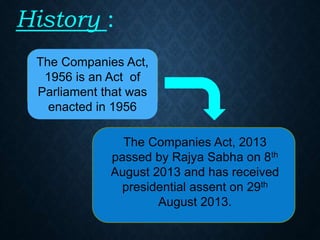
History :
The Companies Act,
1956 is an Act of
Parliament that was
enacted in 1956
The Companies Act, 2013
passed by Rajya Sabha on 8th
August 2013 and has received
presidential assent on 29th
August 2013.
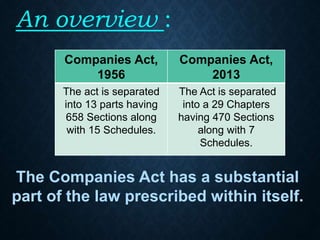
An overview :
Companies Act,
1956
Companies Act,
2013
The act is separated
into 13 parts having
658 Sections along
with 15 Schedules.
The Act is separated
into a 29 Chapters
having 470 Sections
along with 7
Schedules.
The Companies Act has a substantial
part of the law prescribed within itself.
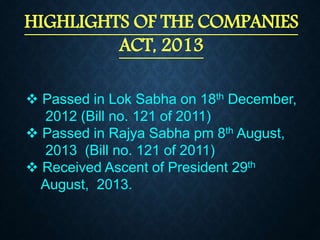
HIGHLIGHTS OF THE COMPANIES
ACT, 2013
 Passed in Lok Sabha on 18th December,
2012 (Bill no. 121 of 2011)
 Passed in Rajya Sabha pm 8th August,
2013 (Bill no. 121 of 2011)
 Received Ascent of President 29th
August, 2013.
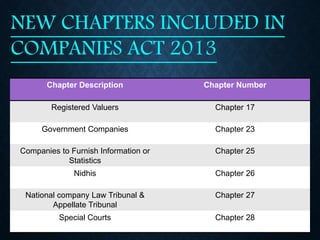
NEW CHAPTERS INCLUDED IN
COMPANIES ACT 2013
Chapter Description Chapter Number
Registered Valuers Chapter 17
Government Companies Chapter 23
Companies to Furnish Information or
Statistics
Chapter 25
Nidhis Chapter 26
National company Law Tribunal &
Appellate Tribunal
Chapter 27
Special Courts Chapter 28
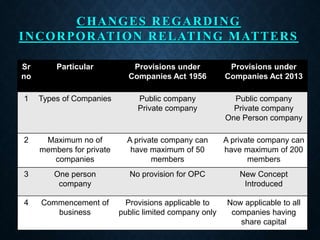
Sr
no
Particular Provisions under
Companies Act 1956
Provisions under
Companies Act 2013
1 Types of Companies Public company
Private company
Public company
Private company
One Person company
2 Maximum no of
members for private
companies
A private company can
have maximum of 50
members
A private company can
have maximum of 200
members
3 One person
company
No provision for OPC New Concept
Introduced
4 Commencement of
business
Provisions applicable to
public limited company only
Now applicable to all
companies having
share capital
CHANGES REGARDING
INCORPORATION RELATING MATTERS
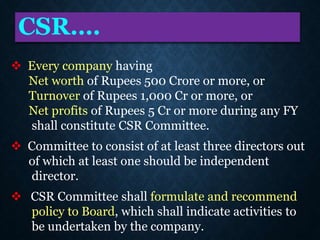
CSR….
 Every company having
Net worth of Rupees 500 Crore or more, or
Turnover of Rupees 1,000 Cr or more, or
Net profits of Rupees 5 Cr or more during any FY
shall constitute CSR Committee.
 Committee to consist of at least three directors out
of which at least one should be independent
director.
 CSR Committee shall formulate and recommend
policy to Board, which shall indicate activities to
be undertaken by the company.
 Board to ensure that at least 2% of the average net profits of
last 3 years is spent by the company on CSR activities
(Specified in schedule VII) every financial year.
 If company fails to spend such amount, reasons for not
spending to be specified in the Board's report signed by a
director and the company secretary, or where there is no
company secretary, by a company secretary in practice.
continued…
PROVISIONS CITED IN COMPANIES ACT-2013 FOR
BETTER GOVERNANCE
 New Provisions for Better Governance:
 Requirement to constitute Remuneration and Nomination
Committee and Stakeholders.
 Grievances Committee.
 Granting of More powers to Audit Committee.
 Specific Section pertaining to duties of directors.
 Mode of appointment of Independent Directors and their
tenure.
 Code of Conduct for Independent Directors.
 Rotation of Auditors and restriction on Auditor's for providing
non-audit services.
 Enhancement of liability of Auditors.
Security market

Security market

  • 1.
  • 2.
    Contents. . . Security market.  S.E.B.I  S.E.B.I Act 1992  Companies Act 1956  Fii  Guidelines for fii
  • 3.
    What is SECURITYMARKET ?? Securities market is a component of the wider financial market where securities can be bought and sold between subjects of the economy , on the basis of demand and supply. Securities markets encompases equuity markets, bond markets and derivatives markets where prices can be determined and paticipants both professional and non professionals can meet.
  • 4.
    Security markets aretwo types –
  • 5.
    Primary market isa market for new issues of securities. Following are example of primary issues: • IPO: (Initial public offering) refers to stock of company being offered to general public for the first time. • Seasoned issue : new issues are offered by companies that already have floated equity. • Companies may choose to sell securities either through public offering or private placement. • In private placement, the securities are offered to a some wealthy individuals or selected financial institutions.
  • 6.
    Trading of alreadyissued securities among investors occurs in the Secondary market. • The trading of already issued securities takes place in secondary market. • Secondary markets helps the primary markets as they increase the liquidity of existing securities. • Secondary markets exists for trading of common stocks, bonds, and puts and calls, • Secondary markets include Brokers market, Dealers markets.
  • 7.
    S.E.B.I Securities Exchange Boardof India (SEBI) was set up in 1988 to regulate the functions of securities market. SEBI promotes orderly and healthy development in the stock market but initially SEBI was not able to exercise complete control over the stock market transactions. Establishment
  • 8.
    ROLE OF SEBI Issuers –: for issuers it provides a market place in which they can raise finance fairly and easily. Investors –: For investors it provides protection and supply of accurate and correct information. Intermediaries –: For intermediaries it provides a competitive professional market.
  • 9.
    SEBI ACT 1992 AnAct to provide for the establishment of a board to protect the interests of investors in securities and to promote the development of , and to regulate, the securities market and for matters connected therewith or incidental there to.
  • 10.
    Salient features ofSEBI Act, 1992  An Act to provide for the establishment of a board t protect the interests of investors in securities and to promote the development of, and to regulate the securities market and for matters connected therewith or incidental thereto.  HQ will be in Mumbai and may establish offices at other places in India.  Chairman and members of board will be appointed by the central government.  Primary duties of the board is to protect the interest of the investors.  The general superintendence, director and management of affairs of the board shall vest in board of members.
  • 11.
    Companies Act 1956 Meaningand Definition of a company : Sec 3 (1) of the companies act 1956 defines that “ a company means a company formed and registered under this act or an existing company ” A company refers to an “ association of many persons who contribute money or money worth to a common stock and employ it in some trade or business and who share the profit and loss arising there from. - Lord Justice Lindsay Company is “ an incorporated association which is an artificial person created by law, having separate legal entity with a perpetual succession and common seal. - Henry
  • 12.
    Salient features ofcompanies Act 1956  A minimum standard of good behaviour and business honesty in company promotion and management.  Provision for greater and effective control over and voice in the management for shareholders.  A fair and true disclosure of the affairs of companies in their annual published balance sheet and profit and loss accounts.  Proper standard of accounting and auditing.  A ceiling on the share of profits payable to managements as remuneration for services rendered.  A check on their transactions where there was a possibility of conflict of duty and interest.
  • 13.
    Companies Act 2013 Acomparison with the Companies Act, 1956
  • 14.
    History : The CompaniesAct, 1956 is an Act of Parliament that was enacted in 1956 The Companies Act, 2013 passed by Rajya Sabha on 8th August 2013 and has received presidential assent on 29th August 2013.
  • 15.
    An overview : CompaniesAct, 1956 Companies Act, 2013 The act is separated into 13 parts having 658 Sections along with 15 Schedules. The Act is separated into a 29 Chapters having 470 Sections along with 7 Schedules. The Companies Act has a substantial part of the law prescribed within itself.
  • 16.
    HIGHLIGHTS OF THECOMPANIES ACT, 2013  Passed in Lok Sabha on 18th December, 2012 (Bill no. 121 of 2011)  Passed in Rajya Sabha pm 8th August, 2013 (Bill no. 121 of 2011)  Received Ascent of President 29th August, 2013.
  • 17.
    NEW CHAPTERS INCLUDEDIN COMPANIES ACT 2013 Chapter Description Chapter Number Registered Valuers Chapter 17 Government Companies Chapter 23 Companies to Furnish Information or Statistics Chapter 25 Nidhis Chapter 26 National company Law Tribunal & Appellate Tribunal Chapter 27 Special Courts Chapter 28
  • 18.
    Sr no Particular Provisions under CompaniesAct 1956 Provisions under Companies Act 2013 1 Types of Companies Public company Private company Public company Private company One Person company 2 Maximum no of members for private companies A private company can have maximum of 50 members A private company can have maximum of 200 members 3 One person company No provision for OPC New Concept Introduced 4 Commencement of business Provisions applicable to public limited company only Now applicable to all companies having share capital CHANGES REGARDING INCORPORATION RELATING MATTERS
  • 19.
    CSR….  Every companyhaving Net worth of Rupees 500 Crore or more, or Turnover of Rupees 1,000 Cr or more, or Net profits of Rupees 5 Cr or more during any FY shall constitute CSR Committee.  Committee to consist of at least three directors out of which at least one should be independent director.  CSR Committee shall formulate and recommend policy to Board, which shall indicate activities to be undertaken by the company.
  • 20.
     Board toensure that at least 2% of the average net profits of last 3 years is spent by the company on CSR activities (Specified in schedule VII) every financial year.  If company fails to spend such amount, reasons for not spending to be specified in the Board's report signed by a director and the company secretary, or where there is no company secretary, by a company secretary in practice. continued…
  • 21.
    PROVISIONS CITED INCOMPANIES ACT-2013 FOR BETTER GOVERNANCE  New Provisions for Better Governance:  Requirement to constitute Remuneration and Nomination Committee and Stakeholders.  Grievances Committee.  Granting of More powers to Audit Committee.  Specific Section pertaining to duties of directors.  Mode of appointment of Independent Directors and their tenure.  Code of Conduct for Independent Directors.  Rotation of Auditors and restriction on Auditor's for providing non-audit services.  Enhancement of liability of Auditors.