Security as Code: DevSecOps Patterns with AWS Bk Sarthak Das
Security as Code: DevSecOps Patterns with AWS Bk Sarthak Das
Security as Code: DevSecOps Patterns with AWS Bk Sarthak Das
Security as Code: DevSecOps Patterns with AWS Bk Sarthak Das
Security as Code: DevSecOps Patterns with AWS Bk Sarthak Das
1.
Read Anytime AnywhereEasy Ebook Downloads at ebookmeta.com
Security as Code: DevSecOps Patterns with AWS Bk
Sarthak Das
https://ebookmeta.com/product/security-as-code-devsecops-
patterns-with-aws-bk-sarthak-das/
OR CLICK HERE
DOWLOAD EBOOK
Visit and Get More Ebook Downloads Instantly at https://ebookmeta.com
2.
BK Sarthak Das
&Virginia Chu
Security
as Code
DevSecOps Patterns with AWS
3.
SECURITY
“An excellent guide.
Securityas Code takes
you from abstract
concept to the working
technology, people, and
processes. If you need to
actually do the work of
shifting security left, this
book is for you.”
—FritzKunstler
Principal,AWSGlobalServicesSecurity
“The ultimate hands-on
security guide for DevOps
roles, covering tooling
and processes.”
—Michael Hausenblas
Solution Engineering Lead, AWS
Security as Code
Twitter: @oreillymedia
linkedin.com/company/oreilly-media
youtube.com/oreillymedia
DevOps engineers, developers, and security engineers have
ever-changing roles to play in today’s cloud native world. In
order to build secure and resilient applications, you have to
be equipped with security knowledge. Enter security as code.
In this book, authors BK Sarthak Das and Virginia Chu
demonstrate how to use this methodology to secure
any application and infrastructure you want to deploy.
With Security as Code, you’ll learn how to create a secure
environment using CI/CD tooling from AWS and open source
providers. You’ll also see how a containerized application can
be deployed as infrastructure as code (IaC) within AWS.
This practical guide also provides common patterns and
methods to develop secure and resilient infrastructure.
• Learn the tools of the trade using Kubernetes and the AWS
Code Suite
• Set up IaC and run scans to detect misconfigured resources
in your code
• Create secure logging patterns with CloudWatch and
other tools
• Restrict system access to authorized users with role-based
access control (RBAC)
• Inject faults to test the resiliency of your application with
AWS Fault Injection Simulator or open source tooling
• Learn how to pull everything together into one deployment
BK Sarthak Das works at Google as a
security engineer and was previously
at AWS as a senior security architect.
Virginia Chu is a principal DevSecOps
engineer at AWS who began her career
as a Linux system administrator and
developer.
US $55.99 CAN $69.99
ISBN: 978-1-098-12746-6
4.
BK Sarthak Dasand Virginia Chu
Security as Code
DevSecOps Patterns with AWS
Boston Farnham Sebastopol Tokyo
Beijing Boston Farnham Sebastopol Tokyo
Beijing
Security Controls 24
BetterThan a Cure: Implementing Preventive Controls 26
Implementation 28
Summary 33
4. Logging and Monitoring. . . . . . . . . . . . . . . . . . . . . . . . . . . . . . . . . . . . . . . . . . . . . . . . . . . . . 35
What Are Logging and Monitoring—and Why Do They Matter? 35
Attack Styles 36
Advanced Persistent Threat Attacks 37
Ransomware Strains 38
Passive and Active Attacks 38
Log Types 40
Log Storage 41
Detecting Anomalies 44
Remediation with AWS Config 48
Correlating User Activity with CloudTrail 51
Network Monitoring with an Amazon VPC 53
Summary 55
5. Controlling Access Through Automation. . . . . . . . . . . . . . . . . . . . . . . . . . . . . . . . . . . . . . . 57
The Principle of Least Privilege 58
Fine-Tuning Access Controls 60
Use a Tagging System 60
Clarify Team Responsibilities 61
Prevent and Detect 62
The IAM Pipeline 63
Summary 66
6. Fault Injection Test. . . . . . . . . . . . . . . . . . . . . . . . . . . . . . . . . . . . . . . . . . . . . . . . . . . . . . . . . 67
Distributed Systems 67
Adaptive Security Controls 68
The True Cost of Downtime 69
Methods for Minimizing Downtime 69
Chaos Engineering 70
Basic Principles 71
Advanced Principles 74
Chaos Engineering in AWS Environments 76
Chaos Engineering at Automatoonz 78
AWS Fault Injection Simulator Experiment Examples 78
Kubernetes Pod Stress Testing 79
Throttling EC2 API Calls 80
Stress Testing the CPU on an EC2 Instance 81
iv | Table of Contents
8.
Terminating an EC2Instance 82
Removing Ingress and Egress Rules from a Security Group 83
Detaching an EBS Volume from an EC2 Instance 84
Summary 85
7. People and Processes. . . . . . . . . . . . . . . . . . . . . . . . . . . . . . . . . . . . . . . . . . . . . . . . . . . . . . . 87
People: Team Structures and Roles 87
Security Engineers 88
Developers 88
Compliance Team 89
Product Manager 90
Team Structure 90
Processes: Practices and Communication 92
Communicate to the Right People, Consistently 92
Make Product Owners Accountable for Their Security Findings 93
Build Threat Modeling into Your Processes 93
Build Roadmaps to Reach Your DevSecOps Goals 95
What Next? 95
Summary 96
Index. . . . . . . . . . . . . . . . . . . . . . . . . . . . . . . . . . . . . . . . . . . . . . . . . . . . . . . . . . . . . . . . . . . . . . . . 99
Table of Contents | v
10.
Preface
The authors ofthis book work with enterprise AWS customers who have business-
critical applications running in the cloud, so we think about security on a daily
basis. In recent years, we’ve noticed that the term DevSecOps pops up in nearly every
security strategy discussion. Everyone wants it, but not as many people understand
it—and it seems like almost nobody knows where to start or what to do.
DevSecOps is a relatively new field, and few books are available to guide those who
want to learn more about it. We decided to write this book to help fill that gap by
showing you how and where to get started on DevSecOps in AWS.
This book is not an enterprise-grade solution kit for copying and pasting into pro‐
duction (and since every project and organization has different needs, we sincerely
hope you would never do that!). Instead, it’s designed to introduce you to the building
blocks of the DevSecOps mindset, and to guide you along the way with practical
examples. We use popular open source tools where possible, to show you that it’s not
always necessary to buy expensive products to do security the right way.
We use a fictitious company called Automatoonz to illustrate some of the real-world
issues you’re likely to face in your DevSecOps journey. As we discuss a problem, the
Automatoonz team works on it too, giving you a sense of how real teams approach
solving the problem at hand. Although the scenarios are fictionalized, these examples
come from our extensive personal experience, and we think they’ll resonate with you.
The solutions we provide in this book are intended as guidance on the art of the
possible.
Who Is This Book For?
This book is for AWS security engineers, DevOps engineers, security analysts, secu‐
rity engineering managers, and other practitioners and leaders at intermediate and
senior levels who want to automate more of their security. We recommend that
readers have some practical AWS development knowledge and familiarity with Git
vii
11.
before starting thisbook: ideally, enough to do basic coding and debugging within
AWS. In Chapter 2, for example, we use CloudFormation, Python, and Kubernetes to
demonstrate Infrastructure as Code. You should also be comfortable navigating Git
repositories.
What Do You Need To Get Started?
In practical terms, aside from intermediate knowledge of AWS, to follow the exercises
in this book you will need an AWS account where you can deploy. You will also need
to install the following, if you do not already have them:
• AWS Command Line Interface (AWS CLI) (latest version)
•
• Access to an AWS account
•
• Docker (Community Edition)
•
• Python (version 3.x.x or higher)
•
• Git (latest version)
•
• Kubectl (latest version)
•
• Kubernetes (version 1.21 or higher)
•
Chapter 2 has a detailed walkthrough of setting up all these tools.
You will also need access to the book’s GitHub repository, which includes code
samples and other supplemental materials.
What’s in This Book?
We’ve tried to ensure that the seven chapters in this book are as independent as
possible from one another, so that you can pick it up at any point. However, we
recommend that you start from the beginning.
Chapter 1 will introduce you to what DevSecOps is, why it is important, and what
kind of mindset you’ll need to get started. Chapter 2 helps you install the software
you’ll need for the rest of the book, then walks you through a sample application built
with secure configurations to ensure you have your toolkit working. In Chapter 3,
you’ll learn how to validate Infrastructure as Code to make your resources secure.
Chapter 4 looks at how to set up appropriate logging and monitoring to identify and
debug issues with your infrastructure.
In Chapter 5, you’ll learn about controlling access through automation, including
assessing your organization’s identity and access management (IAM) policies and
refining them according to the principle of least privilege. Chapter 6 is all about
testing: we’ll introduce you to the practice of Chaos Engineering, show you how
viii | Preface
12.
to use itto make your infrastructure more resilient, and discuss how to focus on
possible points of failure. Finally, in Chapter 7, we wrap up with a look at the roles
and processes that should be part of any DevSecOps team.
Conventions Used in This Book
The following typographical conventions are used in this book:
Italic
Indicates new terms, URLs, email addresses, filenames, and file extensions.
Constant width
Used for program listings, as well as within paragraphs to refer to program
elements such as variable or function names, databases, data types, environment
variables, statements, and keywords.
Constant width bold
Shows commands or other text that should be typed literally by the user.
Constant width italic
Shows text that should be replaced with user-supplied values or by values deter‐
mined by context.
This element signifies a tip or suggestion.
This element signifies a general note.
This element indicates a warning or caution.
Using Code Examples
Code examples are available for download at https://oreil.ly/SaCgh.
If you have a technical question or a problem using the code examples, please send
email to bookquestions@oreilly.com.
Preface | ix
13.
This book ishere to help you get your job done. In general, if example code is
offered with this book, you may use it in your programs and documentation. You
do not need to contact us for permission unless you’re reproducing a significant
portion of the code. For example, writing a program that uses several chunks of code
from this book does not require permission. Selling or distributing examples from
O’Reilly books does require permission. Answering a question by citing this book
and quoting example code does not require permission. Incorporating a significant
amount of example code from this book into your product’s documentation does
require permission.
We appreciate, but generally do not require, attribution. An attribution usually
includes the title, author, publisher, and ISBN. For example: “Security as Code: Dev‐
SecOps Patterns with AWS by BK Sarthak Das and Virginia Chu (O’Reilly). Copyright
2023 Virginia Chu and BK Sarthak Das, 978-1-098-12746-6.”
If you feel your use of code examples falls outside fair use or the permission given
above, feel free to contact us at permissions@oreilly.com.
O’Reilly Online Learning
For more than 40 years, O’Reilly Media has provided technol‐
ogy and business training, knowledge, and insight to help
companies succeed.
Our unique network of experts and innovators share their knowledge and expertise
through books, articles, and our online learning platform. O’Reilly’s online learning
platform gives you on-demand access to live training courses, in-depth learning
paths, interactive coding environments, and a vast collection of text and video from
O’Reilly and 200+ other publishers. For more information, visit https://oreilly.com.
How to Contact Us
Please address comments and questions concerning this book to the publisher:
O’Reilly Media, Inc.
1005 Gravenstein Highway North
Sebastopol, CA 95472
800-998-9938 (in the United States or Canada)
707-829-0515 (international or local)
707-829-0104 (fax)
We have a web page for this book, where we list errata, examples, and any additional
information. You can access this page at https://oreil.ly/SecurityAsCode.
x | Preface
14.
Email bookquestions@oreilly.com tocomment or ask technical questions about this
book.
For news and information about our books and courses, visit https://oreilly.com.
Find us on LinkedIn: https://linkedin.com/company/oreilly-media.
Follow us on Twitter: https://twitter.com/oreillymedia.
Watch us on YouTube: https://youtube.com/oreillymedia.
Acknowledgments
There are numerous people who are responsible for this book.
We would like to take the time to thank our amazing and wonderful team at O’Reilly
Media (Sarah Grey, development editor; Nicole Taché, freelance editor; and Clare
Laylock, production editor) for their professionalism, commitment, and guidance in
publishing a book. We learned that writing a book is not easy or trivial.
Our grateful and humble thanks go to our technical reviewer Joe Milligan. It has been
an honor to collaborate with him.
BK would like to thank his close friends and family for being supportive throughout
the process of writing this book.
Virginia would like to thank her family, four-legged sounding board, and close
friends for their support and patience throughout this adventure. Special thanks to
her mentor Michael Hausenblas for inspiring her to work on this book.
Finally, we would like to thank all the wonderful contributors and developers for the
tools we have used in our book.
Preface | xi
16.
CHAPTER 1
Introduction toDevSecOps
We did not start our careers in security, but we both know that delivering software
is of utmost importance to developers. “Delivering software” in this context means
delivering something that does what it is supposed to do. This could refer to the code
being stable, or the software meeting the functional requirements (for example, a
calculator can add, multiply, subtract, and divide numbers) and performance expect‐
ations without any issues (for example, a chat application allows more than 10 people
to send messages to each other simultaneously).
Building quality software, however, requires good coding practices, resilient architec‐
tures, and security. It’s common for security to be added into the software after it
has been built, but the shift-left approach recommends moving security to much
earlier in the development life cycle, building it in from the start. We will discuss that
approach in this chapter, focusing on Security as Code (SaC). In this approach, our
infrastructure’s security policies—detection, prevention, remediation—are all defined
as code.
We will also discuss DevSecOps in this chapter, focusing on the three major players in
software development:
Development
Is your code doing what it is meant to do?
Operations
What is this code running on? Do you have the required skills/time to maintain
this going forward? Can the provisioned infrastructure handle the expected
workload?
Testing
Can the code survive unexpected use cases? How does the code respond to
something you didn’t account for?
1
17.
The primary focusof this book is how to integrate security into your development
process through cloud infrastructure. Declaring infrastructure in files is also known
as Infrastructure as Code (IaC). Kief Morris provides a helpful definition in his book
Infrastructure as Code, 2nd edition (O’Reilly):
Infrastructure as Code is an approach to infrastructure automation based on practices
from software development. It emphasizes consistent, repeatable routines for provi‐
sioning and changing systems and their configuration. You make changes to code, then
use automation to test and apply those changes to your systems.
Using IaC and declaring the security aspects of that infrastructure is Security as Code
(SaC). SaC is not entirely different from IaC, but rather focuses on enabling security
controls using templates.
This chapter introduces the basic concepts of SaC, and Chapter 2 provides setup
and instructions to get you started. After that, the chapters are organized by security
domains. Some chapters are exclusive to a single domain; others address multiple
domains in a single stage of the buildout. Each domain has its own unique set of
questions. For instance:
Data protection (Chapter 3)
Is everything encrypted? Does the encryption approach follow data classification
policies? Do we have data classification implemented?
Infrastructure security (Chapter 3)
As we are running our application in the cloud, is all the infrastructure deployed
securely? Is our S3 bucket publicly accessible when it should not be? Can we
prevent deployment of our resources when something is missing?
Application security (Chapter 3)
Is the code we’re running secure? How many active vulnerabilities are there in
our code? Did we release code with a critical vulnerability?
Logging and monitoring (Chapter 4)
Do we know what to monitor? When does an observation become an anomaly?
Are the right application security indicators in place to inform us of any mishap?
Identity and access management (Chapter 5)
Who has access to what? Does anyone have any elevated privileges? Can someone
elevate their own or others’ privileges?
Incident response (Chapter 6)
How do we react to incidents? Can we replace part of the offending application
when something goes wrong?
2 | Chapter 1: Introduction to DevSecOps
18.
Throughout the chapters,we will use Amazon Web Services (AWS) native security
services and best practices to baseline the environment we are deploying. When
we assume certain operational and team structures, we explicitly call out those
assumptions.
Before DevOps: The Software Development Life Cycle
When you are new in your career, writing a piece of code that does exactly what was
asked is a joy of its own. With time, however, we’ve realized writing quality code does
not stop at making 2 + 2 = 4. What if the user enters “2 + a”? How should your
software behave?
Well, that’s the responsibility of the Quality and Testing engineers, isn’t it? Wrong.
We’ve seen back-and-forth between developers and testers that was time-consuming
and created unhealthy expectations from both teams. Let’s take the example of the
calculator input of “2 + a”. If, as a coder, you did not think of this use case because
it was not part of the requirements, and your tester or QA team did not record it as
a test case, you would be shipping broken code to your customers. This broken code
would be your final product. A codebase that doesn’t work as expected is not a joy for
the end user to work with.
Code needs to be hosted on some infrastructure to be built and deployed. Is it
going to run on a server in your datacenter, on a virtual machine in the cloud, on a
container, or on someone’s laptop? Depending on your answer, you have another set
of responsibilities related to infrastructure. Once you set up your infrastructure, you
will need to answer a new series of questions, including:
• Are the coders developing this on the exact same platform on which it will be
•
deployed?
• Who is setting up all the infrastructure?
•
• Does the infrastructure fail open or fail safe, in the case of an error?
•
That set of questions needs another set of tests to make sure that the application code
is being run correctly on the right platform, and that the platform is not misbehaving.
In traditional software development, only developers take care of development, which
means their prime directive is writing code to a specification. The operations team
handles the environment and method of deployment, and the change management
procedures. Testers take the output of the developers and the operations team and
make sure the near-final product does not break. These three roles are not mutually
exclusive, but each team needs to wait for input from the previous team to start its
work.
Before DevOps: The Software Development Life Cycle | 3
19.
A very commonrepresentation of this flow is the Software Development Life Cycle
(SDLC) model (see Figure 1-1). In practice, the waterfall model of the SDLC might
operate something like this: developers create code quickly, based on functional
requirements. The code is sent for testing, errors are found, and the code is sent
back to developers. The developers fix the code and send it for another round of
testing. Once the testing is complete, the code is handed off to the operations team
for maintenance.
Figure 1-1. Software Development Life Cycle: waterfall model (https://oreil.ly/KtVv0)
Siloed teams operating in a hands-off style, similar to the SDLC in Figure 1-1, have
their disadvantages. Each team has its own toolset and handles a very specific piece of
the SDLC, and is typically unaware of the toolsets of the other teams. This makes it
difficult to get quality software out the door on time.
The waterfall model leads to a lot of back-and-forth between teams, as we’ve noted.
The back-and-forth is made worse when you have not delivered anything because
your code has not passed your testing teams. So, a whole lot of time and effort is lost
without producing any tangible outcomes.
Enter DevOps. In order to reduce time to market and improve the quality of
software, the concept of DevOps was introduced. In their book Effective DevOps
(O’Reilly), authors Jennifer Davis and Ryn Daniels define DevOps as:
4 | Chapter 1: Introduction to DevSecOps
20.
A cultural movementthat changes how individuals think about their work, values the
diversity of work done, supports intentional processes that accelerate the rate by which
businesses realize value, and measures the effect of social and technical change. It is
a way of thinking and a way of working that enables individuals and organizations to
develop and maintain sustainable work practices. It is a cultural framework for sharing
stories and developing empathy, enabling people and teams to practice their crafts in
effective and lasting ways.
In a DevOps model, the development, testing, and operations teams don’t work in
silos, but are the same group. If we were to visualize the DevOps model, it would look
like a homogeneous blob of roles. Kief Morris writes in Infrastructure as Code that the
goal of DevOps is:
To reduce barriers and friction between organizational silos—development, opera‐
tions, and other stakeholders involved in planning, building, and running software.
Although technology is the most visible, and in some ways simplest face of DevOps,
it’s culture, people, and processes that have the most impact on flow and effectiveness.
Technology and engineering practices like Infrastructure as Code should be used to
support efforts to bridge gaps and improve collaboration.
We want to emphasize this point: DevOps is not solely enabled by technology. It is
effective only when people, processes, and technology are working together. There is a
common misconception that if you use tools that are used in CI/CD systems, you’re
automatically practicing DevOps. This is flawed thinking. What enables DevOps is
collaboration.
Recommendations for Further Reading
The basics of DevOps, modern architectures, and application security are all outside
the scope of this book, but we recommend the following references if you want to
learn more:
DevOps
• Effective DevOps by Jennifer Davis and Ryn Daniels (O’Reilly)
• Understanding Agile DevOps by Jim Bird (O’Reilly)
• DevOps Tools for Java Developers by Stephen Chin, Melissa McKay, Ixchel Ruiz,
and Baruch Sadogursky (O’Reilly)
Modern architectures
• Building Microservices, 2nd edition, by Sam Newman (O’Reilly)
• Building Event-Driven Microservices by Adam Bellemare (O’Reilly)
• Fundamentals of Software Architecture by Mark Richards and Neal Ford
(O’Reilly)
Before DevOps: The Software Development Life Cycle | 5
21.
Application security
• ShiftingLeft for Application Security by Peter Conrad (O’Reilly)
• Agile Application Security by Laura Bell, Michael Brunton-Spall, Rich Smith, and
Jim Bird (O’Reilly)
What Is DevSecOps?
DevSecOps is not a “new version” of DevOps, but rather a conscious effort to add
security into your DevOps framework. Like with DevOps, there are numerous defi‐
nitions of and approaches to DevSecOps. For the purposes of this book, we define
DevSecOps as the ability to implement and deploy SaC in software.
We will be leaning heavily on APIs, cloud services, and other open source projects
to implement SaC. When a part of your SDLC becomes “as code,” your team should
have the openness to build things.
As your organization begins to implement DevSecOps, there are two important
things your team will need to outline: tools and security guidelines.
First, how will you write your IaC? In other words, what tools will you use? This
could be a tool like AWS CloudFormation or Terraform. There are numerous services
and products available from vendors and the open source community that you can
use to build and integrate SaC into your pipeline. As we mentioned, this book will use
AWS and open source projects to demonstrate the why and how of doing DevSecOps,
instead of fixating on a particular tool’s licensing or procurement. We chose to focus
on AWS in this book since it is currently the most popular cloud infrastructure
vendor, controlling 33% of the market. However, the book’s underlying principles will
be useful to all readers.
Second, what are your company’s security “rules of the road”? What has your security
team designated as “definitely don’t do this” rules? Understanding why the security
team provides certain guidance helps you understand the concerns underlying the
rules.
In DevSecOps, you are building security directly into your software development
pipeline (see Figure 1-2). In step 1, the developer lints their code locally and makes
sure its formatting follows the team’s conventions and standards. They then commit
the code to the repository. In step 2, the build system of the pipeline scans for errors
and any other vulnerabilities and misconfigurations. The security of the pipeline is
built into this stage. Finally, in step 3, the code is (possibly) ready for deployment.
The last hurdle is a decision gate—a mechanism that checks for errors. If any errors
are found, deployment is canceled and the developer is informed. If the code has no
errors, the deployment goes through.
6 | Chapter 1: Introduction to DevSecOps
22.
Figure 1-2. Buildingsecurity into a DevOps pipeline
Steps 1 and 2 happen every time. The top version of step 3 only occurs when the
linters and scanners discover no errors. Both the lower version of step 3 and step 4
only occur when the linters and scanners discover an issue.
The code that is deployed is not the only thing that needs to be secured. You also need
to protect the security checks you are implementing within the DevOps pipeline.
Imagine for a moment that anyone who commits code can turn security checks on
and off. Would it be secure?
We have seen teams bypass their security checks because an “urgent” code change
was needed and it was faster to deploy without security. That is a recipe for disaster.
Situations where a real emergency justifies a nonsecured code change should be
recorded and remediated. There should not be a bypass function for deployments.
Introducing Automatoonz
Security is a broad topic. Its subfields include physical security, application security,
cryptography, training, and many more. We will limit our scope in this book to
a subset of security domains, which we’ll explore by following the journey of an
imaginary company we’ll call Automatoonz.
Automatoonz is an animation company that’s recently been getting into web toons
and series creation. The company operates on AWS and is currently trying to build
security into its development and deployment processes. It wants to be lean and
secure, but the company is relatively new in the space and doesn’t have the funding
to hire more security engineers. Thus, its aim is to automate as much security as
possible.
Introducing Automatoonz | 7
23.
Because Automatoonz operateson AWS, there are some security responsibilities it
doesn’t have to worry about, such as physical security. AWS refers to this as the shared
responsibility model.
Cloud Infrastructure: Secure by Default
In cloud infrastructure, every resource is created through an API call. Each API call
has parameters that configure your resource exactly as you want it. The software
development kit (SDK) you use will also automatically generate a default configura‐
tion, to provide maximum customization options.
For example, if you are using the AWS SDK for Python (Boto3) to create an Amazon
S3 bucket, the only required parameter is a name for the bucket. The SDK does not
ask you for encryption, nor does it require you to ensure the bucket is not publicly
accessible. If you want to enforce encryption on the contents of the bucket, you
should do so upon deployment. This is what is referred to as Secure by Default.
Secure by Default does not mean you should lock down everything you possibly can.
It’s often said that the safest computer system is the one that’s unplugged. But, if you
make your system so secure that it’s practically unusable—well, people won’t use it.
They’ll look for workarounds, potentially compromising security in the process. In
this book, we aim to demonstrate usable security—a balance between usability and
security.
In an IaC paradigm, you can templatize your resources—make declarative code
for patterns you come across and create templates that developers can work from,
in order to keep the codebase consistent. For example, if you are building a web
server within AWS, you should be able to standardize the architecture for future
deployments. If the architecture is defined only in a diagram, you’ll need to codify
that diagram as IaC. To do so, you’ll need to create declarative templates so that the
same web server pattern can be deployed repeatedly with zero deviation.
What does templatization provide in terms of security? Let’s revisit the S3 bucket
example. At Automatoonz, the legal team is tasked with ensuring that all of the com‐
pany’s data is encrypted at rest, meaning that data stored in any persistent storage has
to be encrypted through a cryptographic key, which is only accessible to authorized
users. In cloud computing, you can define encryption at rest through API flags in
your IaC templates. This also helps standardize a Secure by Default posture for your
infrastructure.
Of course, the legal team informs the developers of this requirement, and the devel‐
opers need to apply the right checks and balances to adhere to the policy. If there is
an IaC template for the bucket, the developers must check it before it is sent to AWS
endpoints for resource creation. This will prevent the unencrypted bucket from ever
being created.
8 | Chapter 1: Introduction to DevSecOps
24.
At a veryhigh level, Figure 1-3 shows what we are trying to achieve. The developer
on the left creates an AWS CloudFormation template, which in turn creates an S3
bucket. This goes to a decision gate. If encryption is not enabled, the decision gate
shuts down deployment. Only after the template is fixed can the deployment go
through.
Figure 1-3. Decision gate that rejects unencrypted S3 bucket templates
Move Fast, Secure Fast: The Importance of Automation
When you drive a car, there are certain rules of the road that you must obey. Not
adhering to these rules can lead to mishaps, serious accidents, and legal trouble. In
security, we have similar invariable rules. Sometimes the rules are driven by regula‐
tory or compliance requirements; other times they’re intended to create engineering
excellence. Regardless of the reason, every team is expected to follow these rules.
How can developers ensure they consistently follow rules related to security? Recall
our earlier discussion of IaC, and its ability to define cloud resources in a declarative
manner. Herein lies our answer. If we can set predictable flags and/or parameters for
cloud resources, we can allow operations such as creating new resources or deploying
new code to go through only if certain things are present.
When you want to move at the speed of the cloud, you want to secure things at
the speed of the cloud as well. This means automating as much of your security as
possible. There is a manual way of doing the check shown in Figure 1-3, in which the
developer looks at their code and prevents a misconfiguration. But remember the old
adage, “Humans are the weakest link in security”? You ideally want to automate these
checks. To automate a security check—a central idea in DevSecOps—there are certain
attributes to consider:
Idempotence
The security check should yield the same results no matter how many times you
pass the template in question.
Move Fast, Secure Fast: The Importance of Automation | 9
25.
Baseline
The security checkshould apply to all or most resources. If a security check only
applies to one variant of a resource, which appears in less than 30% of your
deployments, you will get a lot of noise and failures while doing the check.
Recommendation
You found a security misconfiguration. That’s cool, but did you tell the build
system what to do? If you leave your end users without a fix, you are adding
to their work. Your scans should recommend fixes when a misconfiguration is
found.
We will be using these attributes as we build our pipeline throughout the book. One
thing we want to reiterate: automation does not solve everything. Without the right
owners and processes, all the automation in the world will not amount to anything.
These security checks need to be maintained, and the developer should give feedback
to improve efficiency.
DevSecOps Culture
Technology is not a silver bullet. Culture plays a role, too. DevOps at its core is built
on a culture, and its tools are only useful when people use them in the right ways.
We have seen organizations acquire every possible tool that claims to solve security
issues, yet not even configure half of them. Why aren’t the teams using these security
tools? Do they lack training? Are the tools overkill, or too expensive to roll out to the
entire organization?
We highly recommend answering one simple question before you buy any security
tool: What security problem are you trying to solve? Answers like “make things secure”
and “improve my security” are as vague as it gets. Try to boil it down to a single
sentence. If that doesn’t give you a clear answer, consider writing a risk statement. A
risk statement looks something like this:
Lack of X leads to loss of Y because of Z.
X = a security function, like access control or logging
Y = the impact if your security control is not implemented (i.e., what is at stake?)
Z = how your security control prevents a security event
We won’t go into detail on procurement, but it is crucial to understand what security
problem a tool is meant to solve before buying it. A lot of enterprise-grade tools offer
free trials or demos. If your team has a builder mindset, you may want to explore
the vast expanse of open source cloud security tools, many of which have made their
mark in the industry and continue to get better.
10 | Chapter 1: Introduction to DevSecOps
26.
Once you’ve selecteda tool, who will maintain it? Will it need to be updated regu‐
larly? Your tool should have a clear owner on the operational side. Let’s say you
get a cloud security posture management (CSPM) tool, and the security team has
integrated every cloud account to be ingested. The security team receives alerts from
the accounts, but takes no action because it expects the cloud account owner to act
on those alerts. But the cloud account owner thinks the security team is handling it.
Without a clear process for addressing the alerts, the teams have no plan of action.
Simple tools like responsibility assignment matrices (or RACI charts) and runbooks
can take care of this. We discuss these tools in more detail in Chapter 7.
Summary
Now that we have introduced DevSecOps and clarified the scope of the book, let’s
start implementing DevSecOps into our pipeline!
The subsequent chapters will begin by setting up the infrastructure for Automatoonz
and iteratively building security capabilities into the application development process.
We will primarily focus on the technology and tooling, but we will call out any people
and process must-haves, derived from our experience.
A quick recap of key takeaways from this chapter:
• DevSecOps is a variant of DevOps that includes security in its iterative DevOps
•
model.
• If you can prevent misconfigured resources from being created, you can create
•
security hygiene and educate developers.
• Automating security checks requires idempotence, baselines, and recommenda‐
•
tions. Chapters 3 and 4 address this topic in more detail.
• Automating security checks alone will not solve security problems. Establish
•
people and processes to own and operate the automation.
• Establish why you’re implementing a security tool before rolling it out.
•
Summary | 11
28.
CHAPTER 2
Setting UpYour Environment
Now that you’re excited and engaged, you’re ready to experiment and create some‐
thing in your AWS account. We’ll use free, publicly accessible sample code to
demonstrate how you can create or destroy objects or resources with the “magic”
of automation.
In this chapter, we’ll show you how to set up your local environment with some
simple commands. As we discussed in Chapter 1, AWS will be the cloud provider of
choice for our Automatoonz adventure in this book.
When you are finished running through the chapter, you will have a fully automated
Amazon Elastic Kubernetes Service (EKS) cluster and an AWS Lambda container
image pipeline on which to deploy a simple Python application.
Remember to set up and test your account credentials, and test
your access. Also, don’t forget to destroy the sample resources you
created in your account to avoid inadvertent billing.
What You’ll Need
Here is a list of tools you’ll need to follow along with the exercises and activities in
this book:
AWS CLI
An open source tool that enables you to interact with AWS services in the
assigned account by using commands in your terminal. For more information,
visit the official site. Please use the latest version.
13
29.
AWS CloudFormation
A servicethat helps you provision and configure your AWS resources based
on a template file written in JSON or YAML. The files are used to deploy and
provision infrastructure resources tracked as code. For more information, visit
the official site.
Docker (Community Edition)
A software platform, or platform as a service (PaaS), that bundles software into
units called containers. These containers allow you to build, test, and deploy
applications. For more information, visit the official site. Please use the latest
version.
Python
An open source, interpreted, object-oriented, high-level programming language
with dynamic semantics. For more information, visit the official site. Please use
version 3.x.x or higher.
Git
An open source, distributed version control system for different file types. For
more information, visit the official site. Please use the latest version.
Kubernetes
An open source system for automating deployment, scaling, and management of
containerized applications. For more information, visit the official site. Please use
version 1.21 or higher.
Kubectl
An open source Kubernetes command-line tool that allows users to interact with
Kubernetes clusters. For more information, visit the official site. Please use the
latest version.
Installing and Verifying Your Setup
You can use package managers to download the latest versions of tools, or curl
to directly download the installation packages. Then, extract the installer file and
run the install script. This section provides commands for the Darwin, Linux, and
Windows operating systems.
Installing the AWS CLI
Run the appropriate commands to install the AWS CLI, which allows you to interact
with your AWS account and manage IaC. (See the official AWS documentation for
more details.)
14 | Chapter 2: Setting Up Your Environment
30.
Darwin:
> brew installawscli
Linux:
> curl "https://awscli.amazonaws.com/awscli-exe-linux-<CPU_architecture>.zip"
-o "awscliv2.zip"
> unzip awscliv2.zip
> sudo ./aws/install
Windows:
> choco install awscli
After the installation, complete the configuration to associate your AWS account
(see the documentation). This lets you run the sample code provided in the GitHub
repository that accompanies this book.
Installing the Docker Engine
Run the appropriate commands to install the Docker engine. The Docker CLI allows
you to interact with your Dockerfile.
Darwin:
> brew install docker
Linux:
> curl -fsSL https://get.docker.com -o get-docker.sh
> sudo sh get-docker.sh
Windows:
> choco install docker-engine
After the installation is complete, test for a response from the Docker CLI.
Checking Your Python Version
Run the appropriate commands to check if Python version 3.x.x or higher has been
installed. Python will be used in the AWS Lambda container in the sample code.
Darwin:
> python3 --version
Linux:
> python3 --version
Installing and Verifying Your Setup | 15
31.
Windows:
> python --version
IfPython 3.x.x is not installed, visit the official site for more information.
Installing Git
Run the appropriate commands to install Git, the distributed version control system.
The Git CLI allows you to interact with Git repositories.
Darwin:
> brew install git
Linux:
> sudo yum install git -y
Windows:
> choco install git
After installation, complete the configuration to associate your personal settings.
Then, run a command to test for a response from the Git CLI. For more information
or troubleshooting, visit the official site.
Installing Kubernetes
Run the appropriate commands to install the Kubernetes CLI, which will allow you to
interact with Git repositories.
Darwin:
> brew install kubectl
Linux:
> curl -LO https://dl.k8s.io/release/$(curl -L -s
https://dl.k8s.io/release/stable.txt)/bin/linux/amd64/kubectl
> sudo install -o root -g root -m 0755 kubectl /usr/local/bin/kubectl
Windows:
> choco install kubernetes-cli
After the installation is complete, test for a response from the Kubernetes CLI. For
more information or troubleshooting, visit the official site.
Now that you’ve installed and verified your tools, it’s time to create a pipeline.
16 | Chapter 2: Setting Up Your Environment
32.
Creating Your FirstBare-Bones Pipeline
Begin creating your pipeline by downloading the latest version of the sample code:
> git clone https://github.com/bksarthak/devsecops-book
This command will create an AWS Service Catalog portfolio to hold all the AWS
Service Catalog infrastructure and cluster products:
> aws cloudformation create-stack
--template-body file://template/ServiceCatalogPortfolio.yml
--stack-name EKSPortfolio
--parameters file://parameter/ServiceCatalog.json
--capabilities CAPABILITY_NAMED_IAM
--region <INPUT_YOUR_REGION>
Next, upload all the AWS Service Catalog files and the AWS Lambda function code:
> aws s3 cp service_catalog_products/
s3://<s3_bucket_for_sc_products_lambda_function>/
--recursive
--exclude "*"
--include "*.yml"
--include "*.zip"
-–region <INPUT_YOUR_REGION>
Then, add the AWS Service Catalog networking product:
> aws cloudformation create-stack
--template-body file://template/ServiceCatalogProduct.yml
--stack-name EKSNetwork
--parameters file://parameter/NetworkProduct.json
--region <INPUT_YOUR_REGION>
The following command will add the AWS identity and access management (IAM)
product role resource, which integrates with the AWS Service Catalog:
> aws cloudformation create-stack
--template-body file://template/ServiceCatalogProduct.yml
--stack-name EKSIAM
--parameters file://parameter/IAMProduct.json
--region <INPUT_YOUR_REGION>
Next, add the AWS Service Catalog EKS Cluster product:
> aws cloudformation create-stack
--template-body file://template/ServiceCatalogProduct.yml
--stack-name EKSCluster
--parameters file://parameter/EKSProduct.json
--region <INPUT_YOUR_REGION>
Creating Your First Bare-Bones Pipeline | 17
33.
Add the AWSService Catalog EKS Nodegroup product:
> aws cloudformation create-stack
--template-body file://template/eks_nodegroup.yml
--stack-name EKSNodegroup
--parameters file://parameter/EKSNodeGroupProduct.json
--region <INPUT_YOUR_REGION>
Add the AWS Service Catalog EKS Lambda product:
> aws cloudformation create-stack
--template-body file://template/ServiceCatalogProduct.yml
--stack-name EKSLambda
--parameters file://parameter/EKSLambdaProduct.json
--region <INPUT_YOUR_REGION>
Add the AWS Service Catalog EKS Virtual Private Cloud (VPC) endpoint product:
> aws cloudformation create-stack
--template-body file://template/ServiceCatalogProduct.yml
--stack-name EKSVPCendpoint
--parameters file://parameter/VPCEndpointProduct.json
--region <INPUT_YOUR_REGION>
And add the AWS Service Catalog EKS control plane logging product:
> aws cloudformation create-stack
--template-body file://template/ServiceCatalogProduct.yml
--stack-name EKSLog
--parameters file://parameter/EKSLoggingProduct.json
--region <INPUT_YOUR_REGION>
If you want to run the steps to create an AWS Service Catalog portfolio and products,
run these two bash scripts as a shortcut:
> chapter-2/scripts/eks-sc-portfolio.sh # create portfolio
> chapter-2/scripts/eks-sc-products.sh # create Service Catalog products
Now provision the AWS Service Catalog all products resource into your AWS
account:
Note: Please update any placeholder fields in all shell scripts.
Key=S3BucketPath,Value=<s3_bucket_for_sc_products_lambda_function>
PROFILE=<INPUT_YOUR_AWS_PROFILE>
REGION=<INPUT_YOUR_REGION>
Run this command to deploy your resources:
> chapter-2/scripts/eks-provision.sh
Summary
Figure 2-1 diagrams the environment you are deploying in your AWS account.
18 | Chapter 2: Setting Up Your Environment
34.
Figure 2-1. Infrastructureas Code pipeline
Let’s look at the pieces of this pipeline, corresponding to the numbers in Figure 2-1:
1. Your laptop or terminal to upload and download code
1.
2. AWS Service Catalog (manages logical products and modularized code)
2.
3. AWS IAM role to allow access to the EKS cluster
3.
4. Amazon CloudWatch, for logging and metrics
4.
5. AWS Lambda container images and Amazon ECR
5.
6. EKS managed cluster
6.
7. Python application deployed in the EKS cluster
7.
Summary | 19
35.
Take a fewminutes to look around and get familiar with your environment. Now that
you’ve set up your infrastructure, you can apply the concepts and sample code from
the later chapters.
20 | Chapter 2: Setting Up Your Environment
36.
CHAPTER 3
Securing YourInfrastructure
As we saw in Chapter 2, cloud infrastructure can be spun up and down considerably
faster than traditional datacenter infrastructure. Cloud providers use declarative lan‐
guages to help end users configure the infrastructure they spin up. For example, AWS
uses CloudFormation templates.
In this book, for the sake of simplicity, we’ll be using CloudFormation code. How‐
ever, you should know that there are other IaC tools—such as Cloud Development
Kit (CDK) and Hashicorp’s Terraform—that use different writing and deployment
formats, but achieve the same goal of creating infrastructure through code.
What Makes Infrastructure Secure?
What does it mean to “secure” your infrastructure? IaC is code, and just like you
secure your application’s code, you need to plan to secure your IaC. The top three
priorities involved in securing IaC are, in order of importance:
1. Preventing unwanted access to your code
1.
2. Detecting misconfigurations in the infrastructure to be deployed
2.
3. Preventing misconfigured code from being deployed
3.
In this chapter, we’ll explore all three priorities in detail.
21
37.
We are assumingthat you have an intermediate understanding of
how to use Git-based version control and will not be covering Git
troubleshooting or branching strategy. For more on those topics,
we recommend reading Head First Git by Raju Gandhi (O’Reilly)
or the Git documentation.
We also delve into topics like identity and access management
(IAM). We recommend reading the AWS documentation to under‐
stand IAM, if you are not familiar with it.
Hands Off! Preventing Unwanted Access with
IAM Permissions
Always store your IaC files in a remote, versioned repository as you integrate
changes. AWS has its own native Git-based version control system, known as Code‐
Commit, which we’ll be using throughout this book. Now, how do you secure this
repository from unwanted access?
Identity and access management (IAM) is the core method of assigning permissions
to resources in AWS accounts. Anyone who needs to create, update, or delete files
within your CodeCommit repository should—at the bare minimum—have the per‐
missions laid out in the IAM policy. This policy allows CodeCommit actions to be
taken in your specific repository only if it is in the correct region: in the following
example, for instance, only end users in the us-east-2 region can perform these
actions.
The second of the following two statements allows you to list all CodeCommit
repositories within your AWS account. We have separated the two statements because
you cannot use ListRepositories for a specific resource:
{
"Version": "2012-10-17",
"Statement": [
{
"Effect": "Allow",
"Action": "codecommit:*",
"Resource": "arn:aws:codecommit:us-east-2:111111111111:*",
"Condition": {
"StringEquals": {
"aws:RequestedRegion": "us-east-2"
}
}
},
{
"Effect": "Allow",
"Action": "codecommit:ListRepositories",
"Resource": "*",
"Condition": {
22 | Chapter 3: Securing Your Infrastructure
38.
"StringEquals": {
"aws:RequestedRegion": "us-east-2"
}
}
}
]
}
ThisIAM policy is a starting point for working with CodeCommit repositories. You
can optionally pare these permissions down if you want to limit a user’s actions to a
specific repository. You can see an example in the book’s supplemental materials on
GitHub.
Detecting Misconfigurations
The next step in securing your IaC is to detect any misconfigurations written into it.
To explain more about misconfigurations, let’s shift our focus back to our fictional
company, Automatoonz.
Automatoonz is working to become a fast-moving, developer-focused organization
in which security is baked into the development life cycle. Since security has often
been treated as an afterthought within their organization, prioritizing it will help
front-load initial security patterns and work, allowing the development team to scale
with less friction in the future.
The developers are planning to use Amazon EC2 instances to deploy and host an
application to be used by customers. Lupe, from the Automatoonz security team,
asks the developer team to make sure the volumes attached to the EC2 instances are
encrypted. However, Jake, a newly hired DevSecOps engineer, accidentally forgets to
encrypt one of the volumes. This mistake is identified during an internal audit, and
the developer team rushes to fix it.
Afterward, the developer and security teams want to make sure this mistake never
happens again. Rather than depending on human consistency, the teams agree to use
automation to find errors in the IaC. They need to decide on some “rules of the road”
to ensure that their automations meet compliance standards and pass audits.
Identifying a Standard
Both teams want to find a baseline standard to secure the IaC—ideally one they can
implement quickly. After some research, they find the Center for Internet Security
(CIS), a cloud provider–agnostic consortium that provides baseline configurations
for different scenarios through its CIS Benchmarks resource. CIS’s configurations are
considered the industry standard and are updated regularly. The Automatoonz teams
decide to use CIS Benchmarks and note that they’ll need to track updates to keep up
Detecting Misconfigurations | 23
39.
with any changes.Now they need to decide which level of hardening they want as the
baseline for their environment.
Threat Modeling
The CIS Benchmarks are a good starting point, but they don’t account for all security
considerations. In order to create a custom security action plan, Lupe suggests devel‐
oping a threat model of the application.
Threat modeling is a design tool that helps teams enumerate the possible vulnerabili‐
ties in any given application. There are many ways to build a threat model. One of
the more popular frameworks is STRIDE, a threat modeling tool that helps identify
security risks early in the development cycle. STRIDE includes six categories of
security risks, shown in Table 3-1.
Table 3-1. STRIDE’s security risk categories
STRIDE
category
Definition What does it mean for Automatoonz?
Spoofing Pretending to be someone you are not by
using someone else’s credentials
Ability to assume the role of CodePipeline to deploy the
CloudFormation stack without checks
Tampering Unauthorized changes made to the system
(either infrastructure or application)
Direct changes to the application and infrastructure are
made without going through the CodePipeline
Repudiation Users denying that they have made changes
without other users being able to disprove
them
Any changes to the infrastructure cannot be traced back
to a log entry
Information
disclosure
Exposure of information to users who should
not have access to the information
Permissions granted to the end users provide visibility
into the underlying infrastructure and logs
Denial of service Valid users are not allowed to carry out tasks Developers are not able to commit their code to
CodeCommit
Elevation of
privilege
Unprivileged user gains access to privileged
operations
Users can deploy and spin up resources without going
through the CodePipeline checks
While Table 3-1 is not an exhaustive list of possible threats, they are the ones we’ll
worry about for our purposes in this chapter. In the next section, we’ll focus on
various security controls that can protect Automatoonz from these security risks.
Security Controls
There are three types of security controls in AWS, as shown in Figure 3-1: preven‐
tive, corrective, and detective. AWS offers misconfiguration detection services like
SecurityHub, GuardDuty, and Config. While these are valuable, they are all detective
security controls: they only detect misconfigurations after a resource is created.
24 | Chapter 3: Securing Your Infrastructure
40.
It’s also importantto have preventive controls to prevent the developers from launch‐
ing misconfigured resources. Time is the bad actor’s best friend: the longer a miscon‐
figured resource is up, the more time they have to poke around the account to find
weak points, run different attacks, and gain access to sensitive data.
The third kind of security control is corrective controls, which fixes a misconfiguration
to bring the system back to its known good state. Developers should aim to have
all three controls in place to secure their IaC. In the context of Automatoonz, we
will focus on implementing preventive controls and automation first, then detective
controls.
Figure 3-1. Different types of security controls
The design goal is to automatically trigger deployments when IaC is pushed to the
CodeCommit repository. The workflow will begin with Automatoonz developers
committing their code. A commit invokes a build stage, which only deploys into the
VPC if the code is up to security standards and considered safe. In the build stage,
the security standards and expectations are codified in the form of checks. If the code
passes these checks, it is deployed into the environment.
The Automatoonz developers (Aisha and Dave) already have a VPC and associated
subnets set up, and have built security groups and other resources to meet their
needs. However, what they build is not always secure, which has led to some uncom‐
fortable conversations with the security team.
The developers are using an existing CodeCommit repository to store their code.
This will be the starting point for their DevSecOps journey. Having versioned IaC
helps the team collaborate on code, roll back deployments, and integrate with testing
functions. The developers can integrate their unit tests in the pipeline (which we’ll
demonstrate later in this and other chapters) to enhance automation and debugging.
However, it emerges that someone has created a security group that has port 22 access,
open to the internet. This is a problem: bad actors could find this port and use it as an
Detecting Misconfigurations | 25
41.
attack vector tobrute-force their way into Automatoonz’s AWS VPC network. What
should the teams do?
Ideally, they should monitor the main branch, since the code there has been merged
after human approval and/or reviews. When someone commits code to the Code‐
Commit repository, a pipeline is executed. As part of this pipeline, the team can select
the exact branch they want to monitor for changes. Let’s create the pipeline to do that.
Better Than a Cure: Implementing Preventive Controls
A pipeline (as defined by Red Hat) is a “set of steps which must be performed to create
a new version of the application”—which, in this case, is Automatoonz’s IaC. Follow
along with the steps described here to set up your pipeline using AWS developer
tools.
To begin, you’ll need to set up your CodeCommit repository. You can find the code in
the book’s GitHub repository (as ch3-codecommitrepo.yml), but we’ll reproduce it here
as well:
AWSTemplateFormatVersion: "2010-09-09"
Description: Template to create CodeCommit repository, CodePipeline
Parameters:
CodeCommitName:
Type: String
Default: AutomatoonzRepo
Resources:
CodecommitRepo:
Type: AWS::CodeCommit::Repository
Properties:
RepositoryName: !Ref CodeCommitName
RepositoryDescription: Repo created for Automatoonz team infra code
Tags:
- Key: Team
Value: Automatoonz
Running this code sets up a CodeCommit repository with the default name
AutomatoonzRepo. (If you want to change your repository name, you can do so while
launching the CloudFormation stack or pass parameters in the command below.)
This is a new, empty repository. As we progress through the steps, you’ll add more
functionalities into this configuration file to deploy different resources.
To deploy the repository, run this command:
> aws cloudformation create-stack
--stack-name devsecops-repo
--template-body file://ch3-codecommitrepo.yml
26 | Chapter 3: Securing Your Infrastructure
FOOTNOTES:
311 Josephus, Bell.Iud. iii. 5.
312 He was not, however, an ‘unmilitary historian’ in the sense
that, for instance, Ephoros was. Ephoros made elaborate accounts
of military operations an important feature of his work, although
he was quite lacking in military knowledge (Polybius, xii. 25);
Tacitus never pretends to concern himself with more than the
moral and social aspects of war. The same attitude may be
observed both in Dio and Herodian (ii. 15, 6). This attitude was
perfectly justifiable, since there existed, as we learn from this
passage in Herodian and from Lucian (De Hist. Conscrib.), a
technical literature which would probably satisfy our needs. That
we do not possess it is the fault, not of Tacitus and Dio, but of the
Middle Ages.
313 This was still the case at Argentorate in 357; cf. Ammianus,
xvi. 12.
314 Tac. Ann. ii. 16.
315 Tac. Ann. ii. 52 ‘Legio medio, leves cohortes duaeque alae
in cornibus locantur’.
316 Tac. Ann. xiii. 38 ‘Socias cohortes et auxilia regum pro
cornibus, medio sextam legionem constituit’. The defensive
formation described in xiii. 40 is slightly different, since the
legions in the centre formed a square.
317 Tac. Ann. xiv. 34 ‘Igitur legionarius frequens ordinibus, levis
circum armatura, conglobatus pro cornibus eques adstitit’.
318 Tac. Hist. iii. 21 ‘Cohortes auxiliorum in cornibus, latera ac
terga equite circumdata’.
319 The legionaries were to occupy the centre, the auxiliary
infantry high ground on the wings, the cavalry to wait in the rear.
320 Dio, lxxiv. 7.
321 Tac. Agr. 35 ‘Legiones pro vallo stetere, ingens victoriae
decus citra Romanum sanguinem bellandi, et auxilium, si
pellerentur’. It was not necessary for Tacitus to invent this not
very creditable excuse. The tactics are those adopted with equal
44.
success against aHighland army by the Duke of Cumberland at
the battle of Culloden in 1746. The same idea of checking the
impetus of a Celtic charge by successive obstacles has often been
suggested as the reason for the seven ditches which protect the
exposed side of the fort at Whitley Castle, and the lilia at Rough
Castle on the Antonine Wall.
322 They are particularly noticeable in the battle shown on
Cichorius, Die Traiansäule, Pl. 45, and to judge from the column,
the auxilia did more than their usual share of fighting in this war.
323 In spite of the boasting of Antonius Primus, the
achievements of the Pannonian cavalry in 69 were limited to a
reckless advance followed by a disorderly retreat. Cf. Tac. Hist. iii.
2 with iii. 16. In the second century, however, we find heavy
cavalry, contarii, who must have been intended for shock tactics.
324 For Haltern see Schuchhardt, Führer durch die
Ausgrabungen von Haltern. It is, however, perhaps incorrect to
limit the garrison to auxiliaries: for Hofheim cf. Ritterling, Das
frührömische Lager bei Hofheim, 1912. It was occupied from
about 40 to 60.
325 See Pelham, Essays in Roman History, p. 191.
326 e.g. Friedberg has an area of (roughly) 10 acres, Okarben
of 14, Heddernheim of 13, and Kesselstadt of 35. A cohort of 500
infantry was usually allowed about 5 acres.
327 See Macdonald, The Roman forts at Barr Hill, pp. 11-15;
Curle, A Roman Frontier-post, pp. 29, 349.
328 xi. 6344 ‘P. Cornelio P. f. Sab(atina) Cicatriculae prim(o)
pil(o) bis, praefect(o) equit(um), praef(ecto) clas(sis), praef(ecto)
cohortium quattuor civium Romanor(um) in Hispania, trib(uno)
mil(itum)’.
329 iii. 14147².
330 W. D. Z. xxi. 186, where this theory of the first-century
frontier system is further developed.
331 See Pelham, op. cit., p. 199. The forts on the North British
frontier range in area from 2½ to 5½ acres, the largest
(Amboglanna) being designed to hold a cohors miliaria peditata.
The German forts seem to have been on a rather larger scale, and
ran up to 15 acres, which is the area allowed at Aalen to an ala
miliaria. It is not meant, of course, that forts of this type did not
45.
exist in thefirst century, but it was not until the reign of Hadrian
that the dispersion of the auxilia in separate units was adopted as
a general policy.
332 Cf. iii. 3385 ‘(Commodus) ripam omnem burgis a solo
extructis item praesidis per loca opportuna ad clandestinos
latrunculorum transitus oppositis munivit’. This is from the Danube
frontier.
333 Historia Augusta, Vita Hadriani, 12 ‘In plurimis locis in
quibus barbari non fluminibus sed limitibus dividuntur, stipitibus
magnis in modum muralis saepis funditus iactis atque conexis
barbaros separavit’.
334 The best recent account of this frontier in English is
Pelham’s essay, ‘The Roman Frontier in Germany,’ in the work
already cited.
335 Recent researches have, however, made it very doubtful
whether a turf wall ever preceded the stone wall along the whole
line.
336 For this wall see the admirable account by Dr. George
Macdonald, The Roman Wall in Scotland, Glasgow, 1911.
337 The best description of the internal arrangements of a
mile-castle is given by Mr. F. G. Simpson, in the Transactions of
the Cumberland and Westmoreland Archaeological Society, vol. xi,
New Series.
338 The German Limes-Commission has not yet published its
report on these works and the course of the frontier line in
general. On the Walldürn-Welzheim section, which was built by
Pius, the towers are at intervals of from 250 to 400 metres.
Pelham, op. cit., p. 204.
339 The view with which I find myself in most agreement is
that of Delbrück, Geschichte der Kriegskunst, ii. 155-60.
340 See Pelham, op. cit., p. 201 and appendix.
341 The torches which project from the upper stories of the
block-houses represented on the Trajan column have often been
noted as indicating some method of fire-signalling.
342 The palisade was not, of course, a board fence which could
be torn down in a few minutes. It was made of oak-trees split in
halves and bedded in a ditch four and a half feet deep. See
Pelham, op. cit., p. 200. Some idea of its appearance can be
46.
gathered from therepresentation at the beginning of the reliefs
on the Marcus column.
343 Oman, Art of War in the Middle Ages, p. 209. He quotes
Nicephorus Περὶ παραδρομῆς πολέμου.
344 The stone wall on the Raetian frontier is of very inferior
construction.
345 The garrisons were: at Netherby, the Cohors I Aelia
Hispanorum M. E., vii. 954, 963, 964, 965; at Bremenium, the
Cohors I Fida Vardullorum M. E. and exploratores, vii. 1030, 1043;
at Habitancium, the Cohors I Vangionum M. E., exploratores and
Raeti Gaesati 1002, 1003. The latest inscription at Netherby dates
from the reign of Severus Alexander; at Bremenium, the most
advanced of the Dere Street forts, from the reign of Gordian III.
346 iii. 600. See Appendix.
347 Cf. Historia Augusta, Vita Marci, 12 ‘Dum Parthicum bellum
geritur, natum est Marcomannicum, quod diu eorum, qui aderant,
arte suspensum est’.
348 The only changes which we know of are that Legio V
Macedonica was transferred from Moesia Inferior to Dacia in the
reign of Marcus and that Legio III Augusta was sent by Gordian
III as a punishment from Africa to the Rhine, whence, however, it
returned in 253. Cagnat, L’Armée romaine d’Afrique, pp. 156-61.
349 The date of this section of the Notitia is disputed, but it can
hardly be earlier than the end of the third century. The diplomata
are xxix (98), xxxii (103), xxxiv (105), xliii (124), lv (ante 138), lvii
(146).
350 Cf. D. ii and iii. 3664, D. lviii and iii. 3331, and D. lx and iii.
11333. These regiments may of course have been temporarily
absent, but the evidence is fairly continuous in each case. The
Cohors V Lucensium et Callaecorum, for example, appears on
diplomata for 60, 84, 85, 133, 138/48, 148, 149 and 154.
3511 I. G. R. R. i. 1348, ib. 1363, iii. 14147², D. xv, iii. 14147¹.
In the last, which dates from 39, the number of the cohort is not
given, and possibly another in the same series is meant.
352 For the date of the Egyptian section of the Notitia see my
article, The Garrison of Egypt, in the account of the excavations at
Karanóg by the Eckley B. Cox Junior Expedition to Nubia
published by the University Museum, Philadelphia.
47.
353 iii. 4379(3 Ulpii, 2 Aelii), 4360 (Aelius), 4369, 4370
(Aurelii), 11081.
354 iii. 1371, 1372, 1374, 1379; A. E. 1903. 66.
355 vii. 818 (Severus Antoninus), 819 (Gordian III), 820
(Postumus), 823 (Tetricus). Another inscription (808) dates from
the reign of Maximin.
356 Tac. Ann. iv. 47; id. Hist. ii. 22.
357 Cf. Dio’s remarks on the impression made by the provincial
legionaries in Rome in the reign of Septimius Severus, lxxiv. 2.
The following sketch applies only to the troops on the Western
frontiers, concerning whose life we have considerable evidence.
The locally raised troops in the East started as a rule at a higher
level of culture, but possibly a similar advance was made by
Trajan’s regiments of Paphlagonians, Galatians, and Arabians,
although here Hellenization, not Romanization, was of course the
goal.
358 For the importance of Mithras in the army, cf. Cumont, Les
Mystères de Mithra. Toutain, Les Cultes païens dans l’Empire
romain, cc. ii and iv, gives a classified list of the inscriptions of
Mithra and Dolichenus.
359 H. Jacobi, Führer durch das Römerkastell Saalburg, 1908,
gives a summary of the latest results.
360 Excavations so far have been confined to the fort itself, in
which the buildings were in an exceedingly good state of
preservation, and the Mithraeum.
361 xiii. 7800 ‘Petronius Athenodorus prae(fectus) coh(ortis) I
Fl(aviae) horologium ab horis intermissum et vetustate colabsum
suis inpendis restituit’. The date is 218.
362 Herodian iii. 8, 5.
363 _Rheinisches Museum_, xlviii. 616 ff.
364 viii. 18067.
365 _A. E._ 1910. 75.
366 Cagnat, _L’Armée romaine d’Afrique_, pp. 380-3 and 505-7.
367 e.g. D. iii (64), a wife, son, and daughter; D. xcviii (105), a
wife, son, and two daughters; D. xxxvii (110), three sons. See
above, p. 32.
48.
368 iii. 3271.The approximate date of the inscription is
sufficiently indicated by the names employed.
369 This very comprehensive dedication comes from the shrine
of Mandoulis, the source of many military inscriptions.
370 The possibility that cives had already been admitted into
the auxiliary regiments before this date has already been
discussed. See above, p. 33.
371 iii. 10316 and _A. E._ 1910. 144.
372 The campaigns between Severus and his rivals (193-7)
were fought out by vexillations; hence at the end of the war we
find all the regiments on both sides, so far as they can be traced,
in their old quarters.
373 Historia Augusta, Vita Alex. Sev. 58 ‘Sola, quae de hostibus
capta sunt, limitaneis ducibus et militibus donavit, ita ut eorum
essent, si heredes eorum militarent, nec umquam ad privatos
pertinerent, dicens attentius eos militaturos, si etiam sua rura
defenderent’. The theory of the self-sufficiency of each provincial
garrison could not be more clearly expressed.
49.
SECTION IV
ARMS ANDARMOUR
The chief sources of information are the sculptured reliefs on the
sepulchral monuments of the soldiers themselves and on the
columns of Trajan and Marcus. Excavations have also yielded
specimens, very badly damaged in most cases, of the weapons and
armour in use at different periods. The literary authorities contain
little that is valuable, with the exception of Arrian’s description of
cavalry uniform and equipment in his own day.374
On sepulchral monuments of cavalry soldiers dating from the first
century375 the deceased is usually represented on horseback in the
act of spearing a fallen enemy. It may be assumed, therefore, that
the armour and weapons represented are those actually used in
warfare, in other words that these men are in ‘service uniform’. At
this period the cavalry uniform consisted of a tunic, breeches
reaching a little below the knee, both probably of leather, and the
caligae or military boots. Over the tunic was worn a leather
breastplate with extra shoulder-pieces to guard against a down cut.
Metal breastplates however, although rare, are not unknown. Scale
armour is worn by a trooper of the Ala Longiniana represented on an
early Rhenish relief,376 and also appears on two African reliefs of
early date representing equites of the Cohors VI Dalmatarum.377
The shield is usually an oblong with the longer sides slightly curved,
but occasionally an angle in these longer sides transforms it into an
elongated hexagon. This shield was borrowed from the Celtic or
Teutonic tribes, as is shown by its frequent appearance on the reliefs
in the hands of the fallen barbarian. To judge from these reliefs it
measured about one foot by three, and was probably of wood
covered with leather.
The helmet, which was of metal, had a projection behind to cover
the neck in the manner of the English cavalry helmet of the
50.
seventeenth century. Itwas also furnished with an extra band of
metal or a peak in front to protect the forehead and large cheek-
pieces which clasped over the chin. On the monument of a trooper
of the Ala Noricorum,378 a very good example of this class, the
cheek-pieces are highly ornamented and the top of the helmet is
ridged to represent hair. The crest does not appear, probably
because it was not worn on active service.379 It is equally absent
from the battle-scenes of the Trajan column, although the ring to
which it was fastened is shown. Some fine plumes are, however,
represented on the helmet of a standard-bearer of the Ala Petriana
on a British relief, which probably dates from the end of the first
century.380
The long broadsword or spatha, the characteristic weapon of the
auxiliaries,381 which was probably, like the shield, of Celtic origin,382
was worn on the right side suspended from the left shoulder by a
sword belt (balteus). The hilt ended in a large knob-shaped pommel,
and the sheath was often highly ornamented.
The lance with which the soldier strikes his prostrate adversary
appears to have had a shaft about six feet long and a broad head.
Two more spears often appear on these sepulchral reliefs in the
hands of an attendant in the background. These are probably the
throwing spears which were carried, according to Josephus,383 in a
quiver on the back, and could not therefore, owing to the position of
the rider, be represented in their proper place. Concerning the
horses one can say little except that they can hardly have been so
small as they are represented. The saddle has a high pommel and
cantle and is sometimes covered with a fringed cloth, and the
junctures of the harness are ornamented with metal plates
(phalerae). Like all ancient cavalry the auxiliaries rode without
stirrups.
From these reliefs, therefore, we can construct a fairly complete
picture of the auxiliary cavalryman of the pre-Flavian period. His
equipment as he appears on the column of Trajan is essentially the
51.
same, except thathe now wears a shirt of chain-mail over his tunic
instead of the leather breastplate, and that his shield has changed
from an oblong to a narrow oval.384 It is hardly necessary now to
defend the accuracy of the column in matters of detail, but it may be
mentioned that there is further testimony for each of these
changes.385
Chain-mail appears on the Adam Klissi reliefs and is mentioned by
Arrian,386 and the oval shield is shown on a Rhenish relief dating
from the end of the first century.387 The varied scenes represented
on the column enable one also to notice further points, such as the
manner in which the shield is slung at the side of the saddle when
troops are on the march,388 and the use of the military cloak
(sagum) which hung down the back and could not therefore appear
on the sepulchral reliefs.389
In addition to this service uniform there was, as Arrian’s
description shows, a sort of parade uniform in which the mail shirts
were replaced by brightly coloured tunics, and lighter shields and
spears were carried than those used in war.390 It was with this
uniform and on ceremonial occasions that some of the soldiers wore
those curious helmets with a mask decorating the face of which
several specimens have been found.391 The fine scale armour which
has been found at Newstead and elsewhere probably also formed
part of this parade uniform. It is, indeed, always worn by the
Praetorians on the Marcus column, but the auxilia still appear in
chain-mail as on the column of Trajan.392 Specially elaborate suits of
this armour were, however, worn by the regiments of catafractarii
who appear in the army list in the second century.393 The last
change which we can trace was the alteration of the shape of the
shield from oval to round, which probably took place in the third
century. An eques of the Cohors I Thracum is represented on a
Danubian sepulchral monument with a shield of this form,394 and
the contemporary reliefs on the arch of Constantine show that it was
practically universal a century later.
52.
The equipment describedabove was worn by the majority of the
auxiliary cavalry, but it was by no means universal. The horse
archers, if one may judge by a soldier of the Ala I Augusta
Ituraeorum represented on a Danubian relief, carried no shield, and
possibly no body armour, and wore a leather cap in place of a
helmet.395 Arrian also mentions that some regiments carried a
specially heavy spear (κοντός), and devoted themselves to shock
tactics.396 The numeri, too, did not adopt the Roman uniform, but
kept to their own dress and weapons. The Moors of Lusius Quietus
are represented on the column wearing nothing but a short tunic;
their weapons consist of a spear and a small round buckler (cetra),
and they ride their horses without saddle or bridle, guiding them
simply by a halter round the neck.397 The regiments of Sarmatae
enrolled by Marcus also presumably wore their national costume,
which is perhaps represented in a fragmentary relief in the Chester
Museum.398
The equipment of the auxiliary infantry in the first century is more
difficult to determine. Not only did the soldiers of the cohorts erect
fewer sculptured monuments than the cavalry troopers, but on these
reliefs the deceased is not represented in the act of fighting, so that
we cannot be certain that he appears in full service uniform. One of
the best of the early monuments is the tombstone of a soldier of
Cohors IV Dalmatarum from the Rhine.399 The deceased is dressed
in a short tunic, which is looped up at the sides so as to hang down
in front in a series of folds. The sagum covers his shoulders and
hangs down his back. A long spatha and a short dagger are
suspended from two waist-belts (cingula) at his right and left side
respectively. He has no body armour except a kind of sporran
composed of strips of metal which extends from the middle of his
belt to the bottom of his tunic. His legs are bare, and he wears no
helmet. In his right hand he holds two long spears and in his left an
oblong rectangular shield, which is not curved like the legionary
scutum but flat as a board. On two other reliefs a soldier of the
Cohors I Pannoniorum400 and an archer of the Cohors I
53.
Sagittariorum401 are representedin a similar costume, except that
the Pannonian wears the paenula instead of the sagum, and that the
archer carries a bow and arrows in place of the shield and spears.
If these soldiers are fully equipped they have surprisingly little
defensive armour, but on other monuments, notably those of a
private of the Cohors II Raetorum,402 and a standard-bearer of the
Cohors V Asturum,403 a leather breastplate appears similar to that
worn by the cavalry at this period. On the Trajan column too, the
auxiliary infantry are furnished like the cavalry with metal helmet
and chain-mail shirt and wear the short tunic and bracae.404
Professor von Domaszewski would like to see in all this a
development of the auxiliaries from light into heavy infantry,405 and
it is true that in his account of the German campaigns in the reign of
Tiberius, Tacitus emphasizes their character as light-armed
troops.406 But even on the Trajan column they are still lighter armed
than the legionaries, and the evidence of the monuments is far from
decisive. The tombstones of legionaries of the same period represent
them wearing a leather breastplate, although there is no reason to
suppose that the so-called lorica segmentata was not yet in use. On
the whole it seems safer to fall back on the hypothesis that on some
of these monuments the deceased is represented in a parade
uniform with which, as in the case of that described by Arrian, the
breastplate was not worn. The tunic with its elaborate folds may also
form part of this costume, since we know from the cavalry reliefs
that the short leather tunics and bracae were already in use.
The Trajanic reliefs show several varieties of uniforms in addition
to the ordinary type described above. The flying column which the
emperor leads down the Danube includes men who wear, instead of
the ordinary helmet, an animal’s skin arranged over the head and
shoulders in the manner usually confined to standard-bearers, and
others whose helmets are of a curious Teutonic pattern.407 These
may belong to regular cohorts which had been allowed to retain
something of their national costume, but a barbarian who appears in
54.
this scene andelsewhere clad only in long loose breeches and a
sagum, and whose chief weapon is a knotted club, must represent a
numerus. Others of these irregular regiments are probably
represented by the archers clad in long tunics and pointed caps or
wearing helmet and shirt of scale armour who appear in one or two
scenes.408 They are certainly to be distinguished from the archers of
the cohortes sagittariorum, who appear in a uniform which only
differs from that of the ordinary auxiliary infantry in the absence of
the shield.409 The most exceptional uniform is that of the slingers,
who are dressed simply in tunics with no armour but a shield.410
Cichorius411 wishes to recognize in them men from the Balearic
Islands, but although the Baleares were employed by the Republic
we have no inscriptions of a Cohors Balearum under the Empire.
Moreover, if there existed cohorts of slingers with this distinctive
uniform we should expect to find cohortes funditorum or libritorum
on the analogy of the cohortes sagittariorum. It appears, on the
contrary, from a passage in Hadrian’s speech to the African army
that slinging formed part of the general training of all the auxilia.412
Like the cavalry, the auxiliary infantry are represented on the Marcus
column in a uniform essentially the same as that worn eighty years
previously, and no further developments can be traced. The most
striking fact which emerges from this inquiry is the general
uniformity of the equipment of nine-tenths of the auxiliary regiments
in the second century. We learn from casual references in Tacitus
that this uniformity had always been the ideal of the Roman War
Office,413 and from the military point of view there was doubtless
much to recommend it.
It has, however, more significance if we regard it as one phase in
that extension of a uniform material culture through at any rate the
western half of the Empire which marks the first and second
centuries.
55.
FOOTNOTES:
374 Arrian, Tactica,4 and 34-41.
375 The chronology of the Rhenish reliefs has been worked out
by Weynand (B. J. B. 108/9), and the Danubian monuments have
been similarly treated by Hofman (Sonderschrift des
Oesterreichischen Archäologischen Institutes in Wien, Band v,
1905).
376 Figured by Lehner in the first part of his illustrated
catalogue of the Bonn Museum, Plate vii, no. 3.
377 Figured by Cagnat, L’Armée romaine d’Afrique, p. 238.
378 Frontispiece.
379 It may also be omitted on the reliefs from considerations of
space, which are also probably the cause of the frequent omission
of the helmet.
380 J. R. S. ii. (1912) Fig. 8. As it was found at Hexham, and
probably comes from Corbridge, it cannot well have been erected
before about 85.
381 See Tac. Ann. xii. 35 (describing an engagement with
Caratacus) ‘et si auxiliaribus resisterent, gladiis ac pilis
legionariorum, si huc verterent, spathis et hastis auxiliarium
sternebantur’.
382 Professor Baldwin Brown considers it to be a development
of the iron broadsword of the La Tène period (Arts and Crafts of
our Teutonic Forefathers, p. 118).
383 Josephus, Bell. Iud. iii. 5, 6.
384 The best representation of cavalry is Cichorius, Pl. 28.
385 I do not mean to imply that the details are correctly
represented in every case. The swords, for instance, are often
omitted, particularly in the earlier scenes. Doubtless several artists
were employed, and all were not equally conscientious.
386 Arrian, Tactica, 4 θώρακα πεπλεγμένον, 41 θώραξι
σιδηροῖς.
387 B. J. B. lxxxi. 104. The soldier’s name, T. Flavius Bassus,
gives a terminus post quem for the dating of the relief.
388 Cichorius, Pl. 65 (equites singulares).
56.
389 It issometimes replaced by the scarf (focale).
390 Arrian, op. cit. 34.
391 I agree with Mr. Curle that the passage in Arrian (ἴσα πάντη
τοῖς προσώποις πεποίηται τῶν ἱππέων) refers to helmets of this
kind. See his discussion of the Newstead example, A Roman
Frontier-post, Pl. 24, 27, 29, 30.
392 Von Domaszewski and Petersen, Die Marcussäule, Pl. 27,
52.
393 An Ala Gallorum et Pannoniorum catafractata existed in the
reign of Hadrian, xi. 5632.
394 Hofman, Fig. 46. (Cf. iii. 4316.) He assigns it to the third
century.
395 Hofman, Fig. 23. The deceased is represented shooting
very dexterously at a target.
396 Arrian, Tactica, 4. It appears from this passage that in the
reign of Hadrian the cavalry did not carry spears of two sizes for
thrusting and throwing in the time of Josephus (see above), but
one or more of medium length suitable for both purposes. The
contarii were a special class of regiments; the best known of
which was the Ala contariorum miliaria stationed in Pannonia (see
Appendix).
397 Cichorius, Pl. 44, 45.
398 Haverfield, Catalogue of Inscribed Stones in Grosvenor
Museum, no. 137.
399 Lehner, Pl. v, no. 3.
400 Lindenschmidt, Tracht und Bewaffnung des römischen
Heeres, Pl. vi, no. 2.
401 Lehner, Pl. no. 2.
402 Lehner, Pl. vi, no. 3. This monument may be slightly later in
date than the others, since the soldier carries an oval shield.
403 Lehner, Pl. vi, no. 4.
404 The details are brought out most clearly on Cichorius, Pl.
52.
405 Rangordnung, p. 59: ‘Sie (the numeri) dienen zur
Ergänzung der zur schweren Infanterie umgeschaffenen
Auxiliarcohorten.’
57.
406 Tac. Ann.i. 51 ‘leves cohortes’, ii. 52 ‘legio medio leves
cohortes duaeque alae in cornibus locantur’. Similarly iii. 39, iv.
73.
407 Cichorius, Pl. 27. For the helmet with metal ribs see
Baldwin Brown, Arts and Crafts, Pl. xxx, Fig. 118. For the skins of
animals worn by German auxiliaries see Tac. Hist. ii. 88.
408 Cichorius, Pl. 47, 50 and 80. They carry the Asiatic
παλίντονα τόξα and may well be Palmyreni. Cichorius decides that
those who wear scale armour are probably Iazyges, but his
reasons seem insufficient.
409 Cichorius, Pl. 19.
410 Cichorius, Pl. 47, 50.
411 Cichorius, ii. 311.
412 viii. 18042 ‘Addidistis ut et lapides fundis mitteretis et
missilibus confligeretis’. This is addressed to the ‘equites cohortis
VI Commagenorum’.
413 Cf. Tac. Ann. xii. 16 ‘Bosporani … nostris in armis’, with
Hist. iii. 47.
58.
CONCLUSION
THE BREAK-UP OFTHE AUGUSTAN SYSTEM
In the preceding pages we have traced the history of the auxilia
through the two centuries which followed the death of Augustus. At
the end of this period, as at the beginning, the distinction between
legions and auxilia still appears as one of the fundamental principles
of the military system of the Empire. But during it the growth of
certain tendencies, operative not only in the army but through the
Empire as a whole, had profoundly altered the original scheme by
which levies of uncivilized provincials, drawn from every province,
were to support the contingents of the ruling race. Before a century
had elapsed the legionaries were no longer Italians nor the
auxiliaries barbarians. As a result, among other things, of the steady
extension of civic rights, the legionaries were drawn from the
provinces, and as a peaceful civilization developed, the recruiting-
area for legions and auxilia alike gradually contracted to the frontier
districts. Finally, at the close of the period, the distinction between
civis and peregrinus was swept away by the legislation of 212.
From the military point of view also the character of the army had
undergone a no less fundamental change. The concentrated striking
force of the days of Augustus, which was ready to plunge year after
year into the heart of Germany, had been transformed into a frontier
guard, scattered over a wide front and accustomed to act
permanently on the defensive, every unit of which was fixed
immovably, generation after generation, in the same position. This
system, exposed, it is only fair to say, to a strain far more severe
than its designers had ever contemplated, broke down completely
during the course of the third century, and although, after fifty years
of anarchy, the Empire rid itself temporarily of internal and external
enemies, the military organization was never restored on the old
lines. It is our business in this concluding section to trace the stages
in this collapse, and to suggest reasons for the change in military
policy traceable in the work of Diocletian and his successors.
59.
It has alreadybeen noted that the frontier system adopted in the
second century had obvious defects.
It can easily be seen that if the strongly guarded frontier line were
broken through at any point the internal provinces were exposed to
the greatest danger. In themselves they possessed no means of
making a stand against an invader. Their garrisons were small, cut
down in fact to the minimum quantity required for police duty, and
the provincial militia, which we hear of during the first century,
seems no longer to have existed except in Mauretania. In fact, now
that the army was recruited almost entirely in the frontier provinces,
the profession of arms must have been more unfamiliar to the
inhabitants of Western Europe and Asia Minor than it has ever been
since, and many a citizen of the prosperous little towns of Gaul,
Africa, or the Hellenized districts of the East can never have set eyes
on the imperial uniform. The situation was clearly a dangerous one,
and the lesson of the Marcomannian War must have made it clear
that this system could only continue if the frontier troops were
supported by a strong and mobile striking force, ready to move at a
moment’s notice to any threatened point.
In the second century the only available regiments not occupied in
frontier defence or police duty consisted of the Household Troops at
Rome, i.e. the ten Praetorian cohorts and the Equites Singulares.
The Guards were in fact employed by Domitian, Trajan, and Marcus
on the Danube frontier, but their numbers were small, their duties
were not calculated to increase their military efficiency, and they
were rightly looked down upon by the trained veterans of the
frontiers.414 The gravity of the situation was grasped by Septimius
Severus, who took advantage of the discredit in which the
Praetorians were involved by their support of Didius Julianus to
disband the old cohorts, which had been recruited in Italy and the
‘civilized’ provinces of Noricum, Macedonia, and Spain, and replace
them by a corps d’élite selected from the legions.415
This force, still too small to be effective, was further strengthened
by an increase in the number of the Equites Singulares,416 and the
60.
addition of oneof Severus’s new legions, the Secunda Parthica,
which was henceforth stationed at Alba.417 His successors continued
the same policy: under Severus Alexander we find an officer of the
Household Troops bearing the title praepositus equitum itemque
peditum iuniorum Maurorum,418 a title which implies the existence
of at least two regiments of this character, and the Osroeni sagittarii,
who were among this emperor’s following at the time of his murder,
were so numerous that they attempted to set up a rival to Maximin
and were temporarily disbanded.419
Had the construction of a field army on these lines proceeded in
time of peace, it would necessarily have involved a reorganization of
the whole system to meet the increase in expenditure. As it was, the
fifty years of civil war and barbarian invasion which followed the
accession of Maximin saw the old order irreparably ruined. The great
Illyrian emperors who saved civilization for another century, and
spent themselves in marching ceaselessly from province to province,
cutting down the hydra heads of revolt and striving to repel the
recurring assaults of Goth or Persian, could neither hope to maintain
the old frontier lines nor spare time to collect vexillations after the
second-century manner when each new danger threatened.
Sweeping together Household Troops and fragments of the broken
frontier armies and enlisting thousands of barbarian mercenaries,
they strove to keep a concentrated force at their disposal which they
moved constantly backwards and forwards across the Empire as
each internal or external crisis demanded. It was this field army
which shared in the imperial triumphs and received such rewards as
the exhausted finances could bestow. In comparison with it such
units of the old frontier troops, legions and auxilia alike, as
maintained their old positions (and we shall see that many did so)
sank steadily in prestige and importance. When finally the barbarian
fury had temporarily spent its force, and a cessation of internal
warfare granted Diocletian and Constantine breathing space in which
to reorganize the civil and military administration of the Empire, the
provisional reconstruction brought into being by these fifty years of
61.
stress and disasterwas formally recognized and incorporated in the
new order. The distinction between first and second class troops is
no longer between legions and auxilia as in the days of Augustus,
but between the Palatini and Comitatenses on the one hand, who
followed in war the emperor himself and the new heads of the
military hierarchy, the magistri peditum and equitum, and were kept
concentrated at strategic points within the Empire in time of peace,
and on the other the Limitanei or Ripenses, who formed, under the
duces limitum, a territorial frontier guard, membership in which was
now hereditary in law as well as practice.420
At this point we might legitimately take leave of our subject, for
although the names of many of the old auxiliary regiments still
appear in the fourth and fifth centuries among the Limitanei, there is
nothing in either character or status to distinguish them from such of
the old legions as had survived in a similar capacity. The title
‘auxilia’, on the other hand, is now applied to corps of new creation
and barbarian origin which figure on the roll of the field army.
But the very fact that so many of the old corps still figure on the
army list tempts us to consider the circumstances under which they
survived and to take a brief survey of the changed conditions under
which they continued their existence. It is fortunate that for the
history of the Roman army during the fourth century we possess two
authorities of considerable merit, the historian Ammianus Marcellinus
and the Notitia Dignitatum. Ammianus, himself a soldier, is
practically the first historian of the Empire since Josephus to give us
a first-hand account of military operations.421 The Notitia Dignitatum
purports to give us, what we do not possess for any earlier period, a
complete list of the regiments composing the imperial army. It is
true that this list appears to be a compilation drawing from evidence
of very different dates, but there can be no doubt that it represents
for most provinces the general state of things prevailing in the fourth
century.
The most significant fact which strikes us in these authorities is
the barbaric character of both troops and officers. The majority of
62.
the officers mentionedby Ammianus, even those of highest rank,
are of Teutonic origin, many being drawn even from the Franks, who
are usually reckoned among the more uncivilized of the Empire’s
assailants. The same picture is presented by the Notitia. Corps which
must at any rate have been originally raised from barbarian tribes,
who normally dwelt beyond the frontier, abound among the Palatini
and Comitatenses, and are to be found in smaller number among
the Limitanei. Thus barbarian Atecotti from Caledonia figure as
auxilia palatina in the field armies of Illyricum, Italy, and Gaul;422
cavalry drawn from the Alani appear as a vexillatio palatina in
Italy,423 and Marcomanni as a vexillatio comitatensis among the
troops assigned to the comes Africae.424 Among the troops of the
second class we find in the garrison of Egypt Vandals, Iuthungi, and
Quadi from the Danube, Franks and Chamavi from the Lower Rhine,
Tzanni and Abasgi from the Caucasus,425 and much the same
elements appear in the garrison of Phoenicia.426 In regard to these
troops it may be urged that, since they are organized in cohorts and
alae after the old model, they seem to have been incorporated at
latest towards the end of the third century, and that such corps,
since they can hardly have obtained fresh drafts from their original
recruiting-grounds, may have undergone the same transformation as
the regiments of Spaniards and Gauls which were sent to Egypt and
Syria in the first century. In the case in question this argument may
possibly hold good,427 but in other parts of the Empire it was no
longer necessary to send recruiting agents beyond the borders to
find barbarian troops. In recording the presence of a praefectus
Sarmatarum gentilium in almost every considerable town in North
Italy,428 and of similar officers commanding German laeti in all the
provinces of Gaul, the Notitia429 is but confirming the abundant
evidence of other authorities as to the settlement of barbarians
within the Empire during the third and fourth centuries.430
This wholesale use of barbarians was largely due to the hasty
constructive measures which the stress of the third-century invasions
63.
demanded. The normalrecruiting-grounds of the army were the first
to be desolated, and after a costly campaign it was easier to fill the
depleted ranks by enlisting barbarian prisoners than to raise and
train levies from the unwarlike provinces of the interior. In the same
way it seemed statesmanlike to settle other prisoners on the
deserted fields, who, secure themselves in their tenure, might aid in
repelling their successors. Thus the number of barbarian contingents
was constantly increasing, and behind the banners of Aurelian or
Probus the Teutonic war-band marched side by side with regiments
which could claim a record extending back to the reign of Augustus.
The only considerable levies made within the Empire after 250 were
carried out in the Illyrian provinces of which most of the emperors
were natives, and are represented by the fifty or sixty regiments of
Dalmatian cavalry which appear in the Notitia stationed in almost
every province.431
But side by side with the new creations, such as the Felices
Honoriani and the Comites Taifali, the names of many of the old
corps still figure on the fourth-century army list. The legions had
naturally come off best; the most determined barbarian raid seldom
took a legionary fortress, and if it did, a detachment serving with the
field army would probably survive to keep the name of the corps in
existence. It is not surprising, therefore, to find that of the thirty
legions which existed before the reign of Severus, twenty-seven still
appear in the Notitia.432 From the way in which they are mentioned,
however, we can gather many evidences of the storm through which
the army had passed. Many detachments, severed from the main
body on some special service, were never able to regain it, and are
found where the fortunes of war had stranded them. Thus Legio VII
Gemina not only appears in its proper place, divided between the
field army and the territorial forces of Spain, but is also mentioned
as a Legio Comitatensis in the field army of the East, and a Legio
Pseudo-comitatensis in Gaul.433 The old Dacian legion, XIII Gemina,
is represented by several detachments guarding that part of the
Danube which was allotted to the new province of Dacia Ripensis,
64.
but appears alsoin Egypt.434 Legio II Italica, which had guarded
Noricum since the days of Marcus, is included also as a Legio
Comitatensis in the field army of Africa.435
The auxiliary regiments naturally did not fare so well. The small
detachments drafted off for service in the field army probably soon
lost their identity, and the castella, which contained the regimental
head-quarters, must have often been taken and destroyed. Still, as
the appendix shows, over fifty regiments survived long enough to be
included in the Notitia. Naturally the chances of surviving had varied
on different frontiers. The section of the Notitia which deals with the
northern frontier of Britain contains so many names of pre-
Diocletianic regiments that it has sometimes been thought to
represent the earliest stratum in the whole work. There seems,
however, no reason to doubt that the original garrison, although in
attenuated numbers, succeeded in maintaining itself until well into
the fourth century. We know from archaeological evidence that even
the mile-castles were not abandoned until the reign of
Constantine.436 An almost equally large proportion of old regiments
is present in the garrison of Cappadocia, which had been spared the
full force of the Persian attack.437 In Egypt, too, most of the old
regiments still survive, although they are largely outnumbered by
recent formations.438 The garrison of this important corn-producing
province, more essential than ever since the foundation of
Constantinople, had evidently been increased to guard against
renewed attacks from the Blemmyes on the Upper Nile, who had
raided it successfully in the third century. The Rhine frontier, on the
other hand, seems to have been swept of its old garrison from end
to end. Two of its legions have disappeared, and the other two,
which are included in the field army, probably only survive thanks to
their names being preserved by detachments which were absent
when the fortresses were stormed.439 It is not until we reach Raetia
and the protection of the Upper Danube that any of the old auxiliary
regiments appear. On the Middle and Lower Danube, however, the
scene of repeated invasions and civil wars during the third century,
65.
few of theold troops survived. The struggle was probably a long
one: we know from epigraphical evidence that several forts were still
holding out towards the end of the century, and excavation may
show that many barbarian raids retired without doing any serious
damage. But the attack was constantly renewed, and it is not
surprising to find that three new cavalry formations have replaced
the Cohors Hemesenorum at Intercisa,440 and that detachments of
Equites Dalmatae are now responsible for practically the whole
stretch of frontier between Belgrade and Buda-Pesth.441 Only the
Cohors I Thracum C. R. and the Cohors III Alpinorum, the latter of
the old Dalmatian army, remain to remind us of the corps which
defended this frontier in the second century.442 On the Lower
Danube, where the Goths had crossed in force, and in the oriental
provinces which had felt the heavy hand of Persian invader and
Palmyrene usurper, we are only greeted by similar survivals.443 The
section dealing with Cyrenaica is lost, so that we know as little of its
garrison now as in the previous period. In Africa the frontier had
been reorganized in a number of small districts, each under an
officer styled praepositus limitis, and although we have a list of these
districts, we are not told by what troops they were guarded.444 Only
for Tingitana are we given a slightly fuller schedule in which a few
old names appear.445
The isolation of these remnants of the old imperial army among
the flood of Teutonic and other barbarian immigrants shows that the
new régime inaugurated by Diocletian was foredoomed to failure.
The Empire had trusted to a professional army recruited from a
comparatively small section of its inhabitants, and when this army
succumbed to the strain of civil war and foreign invasion, and the old
recruiting-grounds were wasted, few of the provinces of the interior,
which for nearly two centuries had practically ceased to furnish
soldiers, held any reserve of military material. By admitting this and
calling upon the barbarian to occupy and defend the wasted frontier
lands, the civilization of the ancient world showed that it had lost the
vitality which might have assimilated these new elements as Gaul,
66.
Spaniard, and Africanhad been assimilated in the past. A succession
of able rulers and the overpowering prestige of the past kept the
framework intact for a century after Diocletian’s death. Then when
the final catastrophe came, and the Western provinces sank into the
Dark Ages, a national revival headed by the still virile races of Asia
Minor saved the once despised provinces of the East from being
involved in a common ruin. It is with Zeno the Isaurian, not with
Diocletian, that the true renascence of the Empire begins.
But the auxiliary regiments which survived into the fourth century
need not only suggest to us, by the smallness of their numbers and
their isolation among their barbarian comrades, the nearness of the
end. The reflection that many of these regiments had held the
position assigned to them and preserved a continuous military
record for over three hundred years may serve also to remind us of
the greatness of the services rendered by the army of the Empire to
the cause of civilization.



![978-1-098-12746-6
[LSI]
Security as Code
by BK Sarthak Das and Virginia Chu
Copyright © 2023 Virginia Chu and BK Sarthak Das. All rights reserved.
Printed in the United States of America.
Published by O’Reilly Media, Inc., 1005 Gravenstein Highway North, Sebastopol, CA 95472.
O’Reilly books may be purchased for educational, business, or sales promotional use. Online editions are
also available for most titles (http://oreilly.com). For more information, contact our corporate/institutional
sales department: 800-998-9938 or corporate@oreilly.com.
Acquisitions Editors: Jennifer Pollock, Simina Calin
Development Editor: Sarah Grey
Production Editor: Clare Laylock
Copyeditor: Nicole Taché
Proofreader: Rachel Head
Indexer: Sam Arnold-Boyd
Interior Designer: David Futato
Cover Designer: Karen Montgomery
Illustrator: Kate Dullea
January 2023: First Edition
Revision History for the First Edition
2023-01-03: First Release
See http://oreilly.com/catalog/errata.csp?isbn=9781098127466 for release details.
The O’Reilly logo is a registered trademark of O’Reilly Media, Inc. Security as Code, the cover image, and
related trade dress are trademarks of O’Reilly Media, Inc.
The views expressed in this work are those of the authors and do not represent the publisher’s views.
While the publisher and the authors have used good faith efforts to ensure that the information and
instructions contained in this work are accurate, the publisher and the authors disclaim all responsibility
for errors or omissions, including without limitation responsibility for damages resulting from the use
of or reliance on this work. Use of the information and instructions contained in this work is at your
own risk. If any code samples or other technology this work contains or describes is subject to open
source licenses or the intellectual property rights of others, it is your responsibility to ensure that your use
thereof complies with such licenses and/or rights.
This work is part of a collaboration between O’Reilly and NGINX. See our statement of editorial
independence.](https://image.slidesharecdn.com/76614-250326181020-95c13cda/85/Security-as-Code-DevSecOps-Patterns-with-AWS-Bk-Sarthak-Das-5-320.jpg)
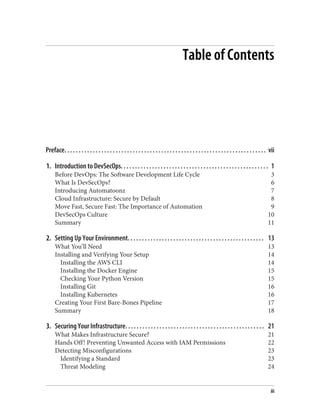










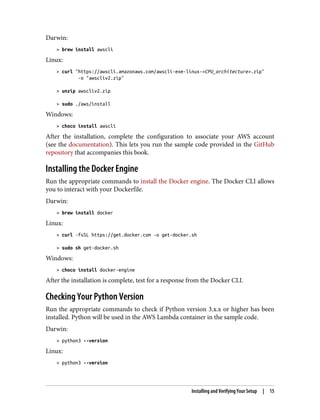
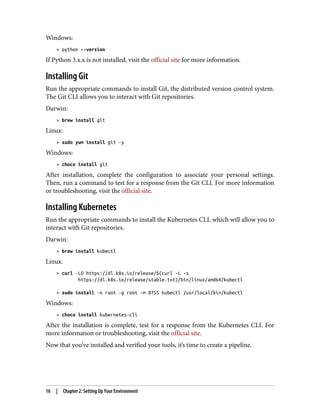
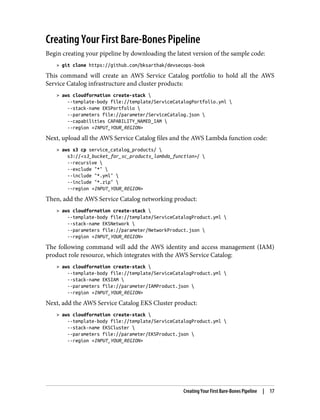
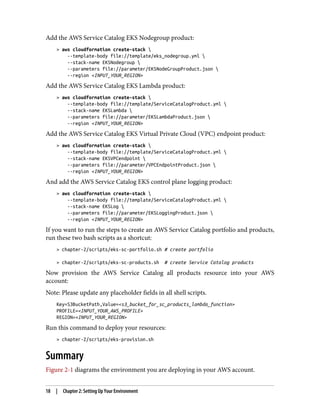
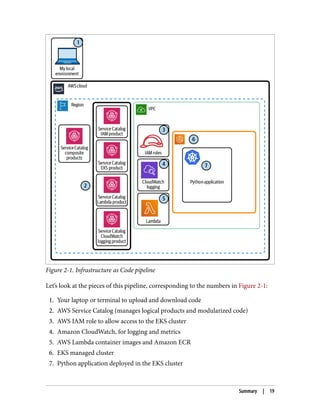


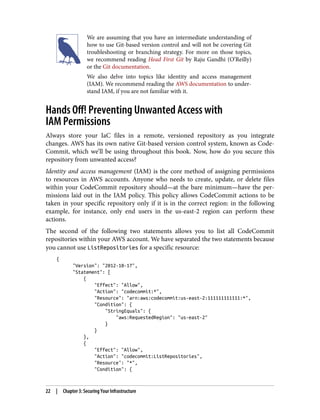
!["StringEquals": {
"aws:RequestedRegion": "us-east-2"
}
}
}
]
}
This IAM policy is a starting point for working with CodeCommit repositories. You
can optionally pare these permissions down if you want to limit a user’s actions to a
specific repository. You can see an example in the book’s supplemental materials on
GitHub.
Detecting Misconfigurations
The next step in securing your IaC is to detect any misconfigurations written into it.
To explain more about misconfigurations, let’s shift our focus back to our fictional
company, Automatoonz.
Automatoonz is working to become a fast-moving, developer-focused organization
in which security is baked into the development life cycle. Since security has often
been treated as an afterthought within their organization, prioritizing it will help
front-load initial security patterns and work, allowing the development team to scale
with less friction in the future.
The developers are planning to use Amazon EC2 instances to deploy and host an
application to be used by customers. Lupe, from the Automatoonz security team,
asks the developer team to make sure the volumes attached to the EC2 instances are
encrypted. However, Jake, a newly hired DevSecOps engineer, accidentally forgets to
encrypt one of the volumes. This mistake is identified during an internal audit, and
the developer team rushes to fix it.
Afterward, the developer and security teams want to make sure this mistake never
happens again. Rather than depending on human consistency, the teams agree to use
automation to find errors in the IaC. They need to decide on some “rules of the road”
to ensure that their automations meet compliance standards and pass audits.
Identifying a Standard
Both teams want to find a baseline standard to secure the IaC—ideally one they can
implement quickly. After some research, they find the Center for Internet Security
(CIS), a cloud provider–agnostic consortium that provides baseline configurations
for different scenarios through its CIS Benchmarks resource. CIS’s configurations are
considered the industry standard and are updated regularly. The Automatoonz teams
decide to use CIS Benchmarks and note that they’ll need to track updates to keep up
Detecting Misconfigurations | 23](https://image.slidesharecdn.com/76614-250326181020-95c13cda/85/Security-as-Code-DevSecOps-Patterns-with-AWS-Bk-Sarthak-Das-38-320.jpg)