SECURE QR CODE SCANNER TO DETECT MALICIOUS URL USING MACHINE LEARNING.pdf
1.
A MAJOR PROJECTREPORT
ON
“SECURE QR CODE SCANNER TO DETECT
MALICIOUS URL USING MACHINE LEARNING”
Submitted to
SRI INDU COLLEGE OF ENGINEERING AND TECHNOLOGY
In partial fulfillment of the requirements for the award of degree of
BACHELOR OF TECHNOLOGY
In
COMPUTER SCIENCE AND ENGINEERING
Submitted by
Y.CHANDANA [20D41A05M6]
T.SRUTHI [20D41A05L0]
E.VAMSHI [20D41A05N0]
D. SRIKANTH [18D45A0501]
Under the esteemed guidance of
Mr. BUKYA SURESH
(Assistant Professor)
DEPARTMENT OF COMPUTER SCIENCE AND ENGINEERING
SRI INDU COLLEGE OF ENGINEERING AND TECHNOLOGY
(An Autonomous Institution under UGC, Accredited by NBA, Affiliated to JNTUH)
Sheriguda (V), Ibrahimpatnam (M), Rangareddy Dist – 501 510
(2023-2024)
2.
i
SRI INDU COLLEGEOF ENGINEERING AND TECHNOLOGY
(An Autonomous Institution under UGC, Accredited by NBA, Affiliated to JNTUH)
DEPARTMENT OF COMPUTER SCIENCE AND ENGINEERING
CERTIFICATE
Certified that the Major project entitled “SECURE QR CODE SCANNER TO DETECT
MALICIOUS URL USING MACHINE LEARNING” is a bonafide work carried out by
Y.CHANDANA [20D41A05M6],T.SRUTHI [20D41A05L0], E.VAMSHI [20D41A05N0],
D.SRIKANTH [18D45A0501] in partial fulfillment for the award of degree of Bachelor of
Technology in Computer Science and Engineering of SICET, Hyderabad for the academic
year 2023-2024.The project has been approved as it satisfies academic requirements in respect
of the work prescribed for IV Year, II-Semester of B. Tech course.
INTERNAL GUIDE HEAD OF THE DEPARTMENT
(Mr. B. SURESH) (Prof .Ch.GVN.Prasad)
(Assistant Professor)
EXTERNAL EXAMINER
3.
ii
ACKNOWLEDGEMENT
The satisfaction thataccompanies the successful completion of the task would be put
incomplete without the mention of the people who made it possible, whose constant guidance
and encouragement crown all the efforts with success. We are thankful to Principal Dr.
G. SURESH for giving us the permission to carry out this project. We are highly indebted to
Prof. Ch.GVN.PRASAD, Head of the Department of Computer Science and Engineering,
for providing necessary infrastructure andlabs and also valuable guidance at every stageof this
project. We are grateful to our internal project guide Mr. B. SURESH, Assistant Professor
for his constant motivation and guidance given by him during the execution of this project
work. We would like to thank the Teaching & Non-Teaching staff of Department of Computer
Science and engineering for sharing their knowledge with us, last but not least we express our
sincere thanks to everyone who helped directly or indirectly for the completion of this project.
Y.CHANDANA [20D41A05M6]
T.SRUTHI [20D41A05L0]
E.VAMSHI [20D41A05N0]
D.SRIKANTH [18D45A0501]
4.
iii
ABSTRACT
Q-R codes areutilised for a variety of purposes, including accessing online web-pages and making
a settlement. The Internet facilitates a wide range of illegal acts, including unsolicited e-marketing,
financial embezzlement, and malicious distribution. Even though all the users identify the presence
of Q-R codes visually, the information stored in those codes can only be accessed through an
allocated Q-R code decoder. Q-R codes have also been shown to be used as an effective attack
vector, For example techniques include social engineering, phishing, pharming, etc. Harmful codes
are distributed under false pretences in congested areas, or malicious Q-R codes are pasted over
current ones on billboards. Finally, consumers rely on decoder operating system to determine a
random Q-R code is whether malicious or benign.
For the purpose of this report, we consider the identification of malicious Q-R codes as a two-way
classification problem in this research, and we test the effectiveness of many well-known M-L
algorithms, including namely K-Nearest Neighbour, Random Forest, Binary LSTM and Support
Vector Machine. This implies that the proposed method might be deemed an optimal and user-
friendly QR code security solution. We created a prototype to test our recommendations and found
it to be secure and usable in protecting users from harmful QR Codes.
5.
iv
CONTENTS
S. No. ChaptersPage No.
i. List of Figures..............................................................................................vi
ii. List of Screenshots .............................................................................….…vii
1. INTRODUCTION
1.1 INTRODUCTION OF PROJECT ..............................................................................01
1.2 LITERATURE SURVEY......................................................................................... 02
1.3 MODULES ................................................................................................................06
2. SYSTEM ANALYSIS
2.1 EXISTING SYSTEM & ITS DISADVANTAGES ................................................ 07
2.2 PROPOSED SYSTEM & ITS ADVANTAGES.....................................................08
2.3 SYSTEM REQUIREMENTS...................................................................................10
3. SYSTEM STUDY
3.1 FEASIBILITY STUDY............................................................................................11
4. SYSTEM DESIGN
4.1 ARCHITECTURE ......................................................................................................14
4.2 UML DIAGRAMS .....................................................................................................15
4.2.1 USECASE DIAGRAM................................................................................ 15
4.2.2 CLASS DIAGRAM......................................................................................16
4.2.3 ACTIVITY DIAGRAM…………………………………………………….17
4.2.4 SEQUENCE DIAGRAM…………………………………………………...18
4.2.5 DEPLOYMENT DIAGRAM …………………………………………… 19
4.2.6 DATA FLOW DIAGRAM…………………………………………………20
5.TECHNOLOGIES USED
5.1 WHAT IS PYTHON?.............................................................................................21
5.1.1 ADVANTAGES & DISADVANTAGES OF PYTHON......................... 21
6.
v
5.1.2 HISTORY ......................................................................................................25
5.2WHAT IS MACHINE LEARNING ?..................................................................25
5.2.1 CATEGORIES OF ML................................................................................ 26
5.2.2 NEED FOR ML…………………………………………………………….26
5.2.3 CHALLENGES IN ML…………………………………………………….27
5.2.4 APPLICATIONS………………………………………………………... 27
5.2.5 HOW TO START LEARNING …………………………………………...27
5.2.6 ADVANTAGES & DISADVANTAGES OF ML .....................................29
5.3 PYTHON DEVELOPMENT STEPS ........................................................................30
5.4 MODULES USED IN PYTHON ..............................................................................40
5.5 INSTALL PYTHON STEP BY STEP IN WINDOWS & MAC ..............................42
6. IMPLEMENTATION
6.1 SOFTWARE ENVIRONMENT……………………………………………………. 47
6.1.1 PYTHON.....................................................................................................47
6.1.2 SAMPLE CODE.........................................................................................47
7. SYSTEM TESTING
7.1 FUNCTIONAL TESTING .........................................................................................60
7.2 NON FUNCTIONAL TESTING................................................................................64
8. SCREENSHOTS......................................................................................67
9. CONCLUSION......................................................................................... 77
10. REFERENCES…………………………………………………………..78
7.
vi
LIST OF FIGURES
FigNo Name Page No
Fig.1 Architecture diagram 14
Fig.2 Use case diagram 16
Fig.3 Class diagram 17
Fig.4 Activity diagram 17
Fig.5 sequence diagram 18
Fig.6 Deployment diagram 20
Fig.7 Data flow diagram 20
8.
vii
SCREENSHOTS
Fig No NamePage No
Screen1 Home page 67
Screen 2 Admin page 67
Screen 3 Admin Dashboard
68
Screen 4 Pending users
68
Screen 5 All users
69
Screen 6 Upload dataset
69
Screen 7 Algorithms page
70
Screen 8 SVM
70
Screen 9 Logistic page
71
Screen10 KNN
71
Screen 11 Random Forest
72
Screen 12 Graph
72
Screen 13 User page
73
Screen 14 Register page
73
Screen 15 OTP page
74
Screen 16 User dashboard
74
Screen 17 Profile page
75
Screen 18 URL page
75
Screen 19 Result page when bad
76
Screen 20 Result page when good
76
9.
1
1.INTRODUCTION
1.1 INTRODUCTION TOPROJECT:
Quick Response codes have found their way into our daily lives as a result of the Internet's
undeniable omnipresence. QR codes are data-encoding two-dimensional matrix barcodes. They
were originally designed to track automobile parts, but they have since been adapted for a wide
range of applications. The most typical application is to encode a link or other textual information
so that it can be accessed quickly without requiring the user to write the URL manually. Covid-19
has impacted the expansion of internet business like e-commerce and e-banking, primarily because
QR-code payment streamlines and secures the payment process's correct execution, saves time,
and eliminates data entry problems. Unfortunately, technical breakthroughs are sometimes
accompanied by state-of-the-art methods for exploiting users. Phishing website that heist any type
of personal data, a spammer can use are prominent instances of such attacks. QR Codes have been
widely exploited and abused to take advantage of consumers' vulnerabilities. According to data on
the rise in the number of dangerous QR Code distributions over time, indicates an clear necessity
to research, implement procedures or ways to prevent and detect them.
In a survey Katharina Krombholz et. al. [1] provides a detailed summary of current studies on QR
code usability and security in a survey. They determined the most significant use case as well as
the corresponding attack routes. According to the paper, in addition to their many benefits, Social
engineers have used QR codes as an attack vector. Malicious links are encoded by attackers in QR
code, for example, redirect to run fraudulent code or phishing sites. Social engineering is the most
commonly reported assault scenario. Social engineering is a strategy used in information
technology (IT) security to manipulate people into revealing secret information to the social
engineer.
Katharina Krombholz et al. [2] recognise the importance of QR code security and give a thorough
assessment of quick response code reader vulnerability, with an emphasis on practical security
techniques. The initial portion of this research concentrated on the decoder software, while another
phase is focused upon a user. Their findings reveal and underline the need for security
enhancements to ensure a secure user experience when scanning QR codes. Based on an
examination of privacy and security problems in mobile software, they suggested a design set of
guidelines for an application that takes security, privacy, and usability into account. They
demonstrated that when security, privacy, and usability are all taken into account, mobile-phone
software can efficiently safe guard consumers from harmful quick response code.
10.
2
Heider and Flaminia[3] have done a study that gives a thorough review of QR code scanning
applications in terms of security, usability, and privacy. They identified the shortcomings and
found that: Many of these QR code scanners does not meet the consumer privacy and security
needs.
Several papers in the literature address this issue from the perspective of Machine Learning. In
other words, they construct a list of URLs categorised as harmful or safe along with characterise
each uniform resource locator using fixed group of criteria. Classification algorithms are then
supposed to learn the border between the decision classes. The extensive literature on classification
models provides a variety of alternative solutions and approaches to classification challenges.
Among the most common classifiers are K-nearest neighbors, Random Forest, Support Vector
Machine, and Bidirectional LSTM, each with its own set of pros and disadvantages.Scammers use
a variety of cyber techniques, such as luring consumers to press on phished link, that can causes
the system to be compromised. QR codes make it simple to accomplish this. To assist in identifying
malicious websites, the online security community has launched blacklisting services. While
blacklisting a URL has been shown results effectively in some situations, an scammer can readily
trick the system by modifying more or one components of the link. Many harmful websites are
never banned, either they were never or incorrectly assessed or they are too new.
1.2 LITERATURE SURVEY
TITLE: “QR Code Security: A Survey of Attacks and Challenges for Usable Security”,
ABSTRACT: QR (Quick Response) codes are two-dimensional barcodes with the ability to
encode different types of information. Because of their high information density and robustness,
QR codes have gained popularity in various fields of application. Even though they offer a broad
range of advantages, QR codes pose significant security risks. Attackers can encode malicious
links that lead e.g. to phishing sites. Such malicious QR codes can be printed on small stickers
and replace benign ones on billboard advertisements. Although many real world examples of QR
code based attacks have been reported in the media, only little research has been conducted in this
field and almost no attention has been paid on the interplay of security and human-computer
interaction. In this work, we describe the manifold use cases of QR codes. Furthermore, we
analyze the most significant attack scenarios with respect to the specific use cases. Additionally,
we systemize the research that has already been conducted and identified usable security and
security awareness as the main research challenges. Finally we propose design requirements with
respect to the QR code itself, the reader application and usability aspects in order to support further
research into to making QR code processing both secure and usable.
11.
3
TITLE: “QR CodeSecurity - How Secure and Usable Apps Can Protect Users Against Malicious
QR Code’
ABSTRACT: QR codes have emerged as a popular medium to make content instantly accessible.
With their high information density and robust error correction, they have found their way to the
mobile ecosystem. However, QR codes have also proven to be an efficient attack vector, e.g. To
perform phishing attacks. Attackers distribute malicious codes under false pretenses in busy places
or paste malicious QR codes over already existing ones on billboards. Ultimately, people depend
on reader software to ascertain if a given QR code is benign or malicious. In this paper, we present
a comprehensive analysis of QR code security. We determine why users are still susceptible to
QR code based attacks and why currently deployed smartphone apps are unable to mitigate these
attacks. Based on our findings, we present a set of design recommendations to build usable and
secure mobile applications. To evaluate our guidelines, we implemented a prototype and found
that secure and usable apps can effectively protect users from malicious QR codes.
TITLE: “Evaluating Security, Privacy and Usability Features of QR Code Readers”,
ABSTRACT: The widespread use of smartphones is boosting the market take-up of dedicated
applications and among them, barcode scanning applications. Several barcodes scanners are
available but show security and privacy weaknesses. In this paper, we provide a comprehensive
security and privacy analysis of 100 barcode scanner applications. According to our analysis,
there are some apps that provide security services including checking URLs and adopting
cryptographic solutions, and other apps that guarantee user privacy by supporting least privilege
permission lists. However, there are also apps that deceive the users by providing security and
privacy protections that are weaker than what is claimed. We analyzed 100 barcode scanner
applications and we categorized them based on the real security features they provide, or on their
popularity. From the analysis, we extracted a set of recommendations that developers should
follow in order to build usable, secure and privacy-friendly barcode scanning applications. Based
on them, we also implemented BarSec Droid, a proof of concept Android application for barcode
scanning. We then conducted a user experience test on our app and we compared it with DroidLa,
the most popular/secure QR code reader app. The results show that our app has nice features,
such as ease of use, provides security trust, is effective and efficient.
TITLE: “Detecting Malicious URLs using Machine Learning Techniques”
ABSTRACT: The World Wide Web supports a wide range of criminal activities such as spam-
advertised e-commerce, financial fraud and malware dissemination. Although the precise
motivations behind these schemes may differ, the common denominator lies in the fact that
unsuspecting users visit their sites.
12.
4
These blacklists arein turn constructed by an array of techniques including manual reporting,
honeypots, and web crawlers combined with site analysis heuristics. Inevitably, many malicious
sites are not blacklisted either because they are too recent or were never or incorrectly evaluated.
In this paper, we address the detection of malicious URLs as a binary classification problem and
study the performance of several well-known classifiers, namely Naïve Bayes, Support Vector
Machines, Multi-Layer Perceptron, Decision Trees, Random Forest and k-Nearest Neighbors.
Furthermore, we adopted a public dataset comprising 2.4 million URLs (instances) and 3.2
million features.
TITLE: “Malicious URL Detection based on Machine Learning”,
ABSTRACT: Cyber security is a very important requirement for users. With the rise in Internet
usage in recent years, cyber security has become a serious concern for computer systems. When
a user accesses a malicious Web site, it initiates a malicious behavior that has been pre-
programmed. As a result, there are numerous methods for locating potentially hazardous URLs
on the Internet. Traditionally, detection was based heavily on the usage of blacklists. Blacklists,
on the other hand, are not exhaustive and cannot detect newly created harmful URLs. Recently,
machine learning methods have received a lot of importance as a way to improve the majority
of malicious URL detectors. The main goal of this research is to compile a list of significant
features that can be utilized to detect and classify the majority of malicious URLs. To increase
the effectiveness of classifiers for detecting malicious URLs, this study recommends utilizing
host-based and lexical aspects of the URLs. Malicious and benign URLs were classified using
machine learning classifiers such as AdaBoost and Random Forest algorithms. The experiment
shows that Random Forest performs really well when checked using voting classifier on
AdaBoost and Random Forest Algorithms. The Random Forest achieves about 99% accuracy.
TITLE: “Malicious URL Detection: A Comparative Study”
ABSTRACT: Malicious uniform resource locator (URL), i.e., Malicious websites are one of the
most common cybersecurity threats. They host gratuitous content (spam, malware, inappropriate
ads, spoofing, etc.) and tempt unwary users to become victims of scams (financial loss, private
information disclosure, malware installation, extortion, fake shopping site, unexpected prize etc.)
and cause loss of billions of rupees each year. The visit to these sites can be driven by email,
advertisements, web search or links from other websites. In each case, the user must click on the
malicious URL. The rising cases of phishing, spamming and malware has generated an urgent
need for a reliable solution which can classify and identify the malicious URLs.
TITLE: “Malicious Qr-Code Threats and Vulnerability of Blockchain”,
13.
5
ABSTRACT: Today’s rapidlychanging world, is observing fast development of QR-code and
Blockchain technologies.
It is worth noting that these technologies have also received a boost for sharing. The user gets
the opportunity to receive / send funds, issue invoices for payment and transfer, for example,
Bitcoin using QR-code.
The following vulnerabilities were considered: fake QR generators, stickers for cryptomats,
phishing using QR-codes, create Malicious QR-Codes for Hack Phones and Other Scanners. The
possibility of creating the following malicious QR codes while using the QRGen tool was
considered: SQL Injections, XSS (Cross-Site Scripting), Command Injection, Format String,
XXE (XML External Entity), String Fuzzing, SSI (Server-Side Includes) Injection, LFI (Local
File Inclusion) / Directory Traversal.
TITLE: “Design of an efficient image protection method based on QR code”
ABSTRACT: This paper presents the design and the verification of an efficient image protection
method based on the QR code, which is a type of two-dimensional barcode widely used in
various fields. For this purpose, we design a new image protection system consisting of a secure
image generator and a secure image recognizer. One adds a new pre-processing block to the
typical QR code generator and the other combines the existing QR code reader with a new post-
processing block. The new architecture provides image de-identification. It is also flexible,
allowing the use of text-based compression and encryption
TITLE: “Quick Response Code Validation and Phishing Detection Tool”
ABSTRACT: A Quick Response (QR) Code is a type of barcode that can be read by the digital
devices and which stores the information in a square-shaped. The QR Code readers can extract
data from the patterns which are presented in the QR Code matrix. A QR Code can be acting as
an attack vector that can harm indirectly. In such case a QR Code can carry malicious or phishing
URLs and redirect users to a site which is well conceived by the attacker and pretends to be an
authorized one. Once the QR Code is decoded the commands are triggered and executed, causing
damage to information, operating system and other possible sequence the attacker expects to gain.
TITLE: “A Construction of Fake QR Codes Based on Error-Correcting Codes”
ABSTRACT: QR codes are used for various applications, such as access to web pages and to
make a settlement. Although users can visually recognize the existence of the QR codes, they
need to use dedicated QR code decoder for reading the stored information in the codes. A
malicious one creates a fake QR code by making bad use of this feature and guides users to a
malicious web page with a careless operation by the users.
14.
6
1.3 MODULES
QR CodeParsing Module:
This module is responsible for extracting data from scanned QR codes. It involves the
implementation of computer vision techniques to interpret visual information and retrieve the
encoded content. The parsed data is then passed on to subsequent modules for analysis.
Machine Learning Analysis Module:
The heart of the system, this module employs machine learning algorithms to analyze the parsed
QR code data. It categorizes URLs as either benign or potentially malicious based on the learned
patterns from a diverse dataset. The module should be adaptive, continuously updating its models
to address evolving cybersecurity threats.
Anomaly Detection Module:
Focused on identifying irregularities or unexpected patterns in the QR code content, this module
enhances the system's capability to detect sophisticated attack vectors. By flagging anomalies,
the system can raise alerts and take preventive measures against potential threats that may not
conform to known malicious patterns.
Threat Intelligence Integration Module:
This module integrates with external threat intelligence databases to cross-reference URLs
against known malicious domains. By leveraging up-to-date threat information, the system can
enhance its accuracy in identifying URLs associated with active cyber threats, providing an
additional layer of defense.
User Interface and Feedback Module:
The user interface module is responsible for presenting a user-friendly experience. It provides
clear and immediate feedback to users after scanning a QR code, indicating the security status of
the content. This module also includes features for user education, offering information about
potential risks associated with QR codes and promoting responsible usage.
15.
7
2.SYSTEM ANALYSIS
2.1 ExistingSystem
In general, QR codes are divided into sections that are dedicated for specific uses. Some areas
of the Quick Response code are working and by error correction it cannot be recovered. Black
and white modules are used to encode the data. If you use the QR code as an attack vector, you
can change the QR code partially or completely. Partial changes occur when individual modules
being flipped from black to white and conversely. Malicious mods are generally of two different
type. Primary method modifies both black white pixels, while the other method only allows white
pixel to black pixel changes. limitations in 5 point.
LIMITATIONS
Dependency on Training Data Quality:
The effectiveness of machine learning algorithms in distinguishing between benign and
malicious URLs heavily relies on the quality and representativeness of the training dataset. If the
training data is biased or lacks diversity, the system may struggle to accurately identify new and
evolving threats.
Dynamic Nature of Threats:
Malicious actors constantly evolve their techniques, making it challenging for any static system
to keep up with emerging threats. The system may face limitations in detecting sophisticated and
novel attack vectors that were not present in the training data, leading to potential false negatives.
False Positives and User Trust:
Striking a balance between sensitivity and specificity is a challenge. A system with high
sensitivity might detect more threats but may also produce more false positives, causing
inconvenience to users. Balancing this trade-off is crucial to maintaining user trust and
preventing unnecessary rejection of legitimate QR codes.
QR Code Obfuscation Techniques:
Malicious actors may employ advanced obfuscation techniques to hide the true intent of a QR
code. This could include encoding URLs in a way that appears benign at first glance but reveals
malicious content after decoding. The system may struggle to detect such obfuscated URLs,
posing a challenge to its efficacy.
Limited Offline Functionality:
The system's dependency on real-time analysis and connectivity could be a limitation in
environments with poor or no internet connectivity
16.
8
2.2 PROPOSED SYSTEM
Theproposed Secure QR Code Scanner system to detect malicious URLs using Machine Learning
aims to address the inherent vulnerabilities associated with QR code usage in a dynamic and
evolving digital landscape. This system leverages cutting-edge machine learning algorithms,
including computer vision and natural language processing, to conduct real-time analysis of QR
codes. The system will be designed to intelligently interpret the content encoded within QR codes,
distinguishing between benign and potentially malicious URLs. Anomaly detection mechanisms
will be incorporated to identify deviations from expected patterns, enhancing the system's ability
to recognize sophisticated attack vectors. The proposed system also envisions integration with
threat intelligence databases to cross-reference URLs against known malicious domains, ensuring
a proactive defense against emerging threats. To mitigate the risk of false positives, the system
will prioritize a balance between sensitivity and specificity, providing users with clear and
immediate feedback after scanning a QR code. User education features will be integrated to
inform individuals about potential risks associated with QR codes, fostering a more informed and
secure user experience. Continuous updates and adaptation to emerging threats will be key
components of the proposed system to ensure robust and effective security measures.
ADVANTAGES
Real-time Threat Detection:
The system operates in real-time, enabling immediate analysis of QR codes as they are scanned.
This rapid response time enhances the ability to detect and prevent users from interacting with
potentially malicious content, reducing the window of exposure to cyber threats.
Adaptive Machine Learning Models:
Leveraging machine learning algorithms, the system continuously learns and adapts to evolving
threat landscapes. This adaptability allows the system to stay ahead of emerging attack vectors
and improve its accuracy over time, providing robust protection against new and sophisticated
threats.
Comprehensive Analysis with Computer Vision:
Integration of computer vision techniques allows the system to extract and comprehensively
analyze visual and textual information within QR codes. This multi-faceted approach enhances
the system's capability to identify malicious content, even when hidden through various
obfuscation techniques.
Anomaly Detection for Advanced Threats:
The incorporation of anomaly detection mechanisms enables the system to identify deviations
17.
9
from expected behavior,allowing it to detect and mitigate advanced threats that may not be
apparent through traditional signature-based methods. This proactive approach enhances the
overall security posture.
User-Friendly Feedback and Education:
The system provides clear and immediate feedback to users after scanning a QR code, indicating
whether the content is considered safe or potentially malicious. This user-friendly approach
empowers individuals to make informed decisions and fosters a safer digital environment.
Additionally, user education features help raise awareness about QR code security, promoting
responsible and secure usage.
18.
10
2.3 SYSTEM REQUIREMENTS:
HARDWAREREQUIREMENTS:
Processor i3 Processor 5th
Gen
Hard Disk 500 GB
RAM 4 GB
SOFTWARE REQUIREMENTS:
Operating System Windows 10/11
Programming Language Python 3.10
Domain Machine Learning
Integrated Development Environment
(IDE)
Visual Studio Code
Front End Technologies HTML5, CSS3, Java Script
Back End Technologies or Framework Django
Database (RDBMS) MySQL
Database Software WAMP or XAMPP Server
Web Server or Deployment Server
Django Application Development
Server
Design/Modelling Rational Rose
19.
11
3.SYSTEM STUDY
3.1 FEASIBILITYSTUDY
A feasibility study assesses the operational, technical and economic merits of the proposed
project. The feasibility study is intended to be a preliminary review of the facts to see if it is
worthy of proceeding to the analysis phase. From the systems analyst perspective, the feasibility
analysis is the primary tool for recommending whether to proceed to the next phase or to
discontinue the project.
The feasibility study is a management-oriented activity. The objective of a feasibility study is to
find out if an information system project can be done and to suggest possible alternative
solutions.
• 1. TECHNICAL FEASIBILITY
• 2. OPERATIONAL FEASIBILITY
• 3. ECONOMIC FEASIBILITY
TECHNICAL FEASIBILITY
A large part of determining resources has to do with assessing technical feasibility. It considers
the technical requirements of the proposed project. The technical requirements are then compared
to the technical capability of the organization. The systems project is considered technically
feasible if the internal technical capability is sufficient to support the project requirements.
The analyst must find out whether current technical resources can be upgraded or added to in a
manner that fulfils the request under consideration. This is where the expertise of system
analysts is beneficial, since using their own experience and their contact with vendors they will
• Is the project feasible within the limits of current technology?
• Does the technology exist at all?
• Is it available within given resource constraints?
• Is it a practical proposition?
• Manpower- programmers, testers & debuggers
• Software and hardware
• Are the current technical resources sufficient for the new system?
• Can they be upgraded to provide to provide the level of technology necessary for the
new system?
• Do we possess the necessary technical expertise, and is the schedule reasonable?
• Can the technology be easily applied to current problems?
• Does the technology have the capacity to handle the solution?
20.
12
OPERATIONAL FEASIBILITY:
Operational feasibilityis dependent on human resources available for the project and involves
projecting whether the system will be used if it is developed and implemented.
Operational feasibility is a measure of how well a proposed system solves the problems, and
takes advantage of the opportunities identified during scope definition and how it satisfies the
requirements identified in the requirements analysis phase of system development.
Operational feasibility reviews the willingness of the organization to support the proposed
system. This is probably the most difficult of the feasibilities to gauge. In order to determine
this feasibility, it is important to understand the management commitment to the proposed
project. If the request was initiated by management, it is likely that there is management support
and the system will be accepted and used. However, it is also important that the employee base
will be accepting of the change.
The essential questions that help in testing the operational feasibility of a system include the
following:
• Does current mode of operation provide adequate throughput and response time?
• Does current mode provide end users and managers with timely, pertinent, accurate and
useful formatted information?
• Does current mode of operation provide cost-effective information services to the
business?
• Could there be a reduction in cost and or an increase in benefits?
• Does current mode of operation offer effective controls to protect against fraud and to
guarantee accuracy and security of data and information?
• Does current mode of operation make maximum use of available resources, including
people, time, and flow of forms?
• Does current mode of operation provide reliable services
• Are the services flexible and expandable?
• Are the current work practices and procedures adequate to support the new system?
• If the system is developed, will it be used?
• Manpower problems
• Labour objections
• Manager resistance
• Organizational conflicts and policies
• Does management support the project?
• Are the users not happy with current business practices?
21.
13
• Will itreduce the time (operation) considerably?
• Have the users been involved in the planning and development of the project?
• Will the proposed system really benefit the organization?
• Does the overall response increase?
• Will accessibility of information be lost?
• Will the system affect the customers in considerable way?
• Legal aspects
• How do the end-users feel about their role in the new system?
• What end-users or managers may resist or not use the system?
• How will the working environment of the end-user change?
• Can or will end-users and management adapt to the change?
ECONOMIC FEASIBILITY
Economic analysis could also be referred to as cost/benefit analysis. It is the most frequently
used method for evaluating the effectiveness of a new system. In economic analysis the
procedure is to determine the benefits and savings that are expected from a candidate system
and compare them with costs. If benefits outweigh costs, then the decision is made to design
and implement the system. An entrepreneur must accurately weigh the cost versus benefits
before taking an action.
Possible questions raised in economic analysis are:
• Is the system cost effective?
• Do benefits outweigh costs?
• The cost of doing full system study
• The cost of business employee time
• Estimated cost of hardware
• Estimated cost of software/software development
• Is the project possible, given the resource constraints?
The economic feasibility will review the expected costs to see if they are in-line with the projected
budget or if the project has an acceptable return on investment. At this point, the projected costs
will only be a rough estimate. The exact costs are not required to determine economic feasibility.
It is only required to determine if it is feasible that the project costs will fall within the target
budget or return on investment. A rough estimate of the project schedule is required to determine
if it would be feasible to complete the systems project within a required timeframe. The required
timeframe would need to be set by the organization.
15
4.2 UML DIAGRAMS
UMLstands for Unified Modeling Language. UML is a standardized general-purpose modeling
language in the field of object-oriented software engineering. The standard is managed, and was
created by, the Object Management Group.
The goal is for UML to become a common language for creating models of object oriented
computer software. In its current form UML is comprised of two major components: a Meta-
model and a notation. In the future, some form of method or process may also be added to; or
associated with, UML.
The Unified Modeling Language is a standard language for specifying, Visualization,
Constructing and documenting the artifacts of software system, as well as for business modeling
and other non-software systems.
The UML represents a collection of best engineering practices that have proven successful in the
modeling of large and complex systems.
The UML is a very important part of developing objects oriented software and the software
development process. The UML uses mostly graphical notations to express the design of
software projects.
GOALS:
The Primary goals in the design of the UML are as follows:
1. Provide users a ready-to-use, expressive visual modeling Language so that they can develop
and exchange meaningful models.
2. Provide extendibility and specialization mechanisms to extend the core concepts.
3. Be independent of particular programming languages and development process.
4. Provide a formal basis for understanding the modeling language.
5. Encourage the growth of OO tools market.
6. Support higher level development concepts such as collaborations, frameworks, patterns
and components.
7. Integrate best practices.
4.2.1 USE CASE DIAGRAM:
A use case diagram in the Unified Modeling Language (UML) is a type of behavioral diagram
defined by and created from a Use-case analysis. Its purpose is to present a graphical overview
of the functionality provided by a system in terms of actors, their goals (represented as use
cases), and any dependencies between those use cases. The main purpose of a use case diagram
is to show what system functions are performed for which actor.
24.
16
Admin
Fig 2
User:
Fig 3
4.2.2CLASS DIAGRAM:
In software engineering, a class diagram in the Unified Modeling Language (UML) is a type of
static structure diagram that describes the structure of a system by showing the system's classes,
their attributes, operations (or methods), and the relationships among the classes. It explains
which class contains information.
25.
17
Fig 4
4.2.3 ACTIVITYDIAGRAM:
Activity diagrams are graphical representations of workflows of stepwise activities and actions
with support for choice, iteration and concurrency. In the Unified Modeling Language, activity
diagrams can be used to describe the business and operational step-by-step workflows of
components in a system. An activity diagram shows the overall flow of control.
Admin
Fig 5
26.
18
User:
Fig 6
4.2.4 SEQUENCEDIAGRAM:
A sequence diagram in Unified Modeling Language (UML) is a kind of interaction diagram that
shows how processes operate with one another and in what order. It is a construct of a Message
Sequence Chart. Sequence diagrams are sometimes called event diagrams, event scenarios, and
timing diagrams.
Admin
Fig 7
27.
19
User:
Fig 8
4.2.5 DEPLOYEMENTDIAGRAM:
Deployment Diagram is a type of diagram that specifies the physical hardware on which the
software system will execute. It also determines how the software is deployed on the underlying
hardware. It maps software pieces of a system to the device that are going to execute it.The
deployment diagram maps the software architecture created in design to the physical system
architecture that executes it. In distributed systems, it models the distribution of the software
across the physical nodes.
There are two forms of a deployment diagram.
• Description
• It contains nodes, the relationship between nodes and artifacts.
• Instance form
• It contains node instance, the relationship between node instances and artifact instance.
• An underlined name represents node instances.
28.
20
Fig 9
4.2.6 DATAFLOW DIAGRAM:
1. The DFD is also called as bubble chart. It is a simple graphical formalism that can be used to
represent a system in terms of input data to the system, various processing carried out on this
data, and the output data is generated by this system.
2. The data flow diagram (DFD) is one of the most important modeling tools.. These components
are the system process, the data used by the process, an external entity that interacts with the
system and the information flows in the system.
3. DFD shows how the information moves through the system and how it is modified by a series
of transformations. It is a graphical technique that depicts information flow and the
transformations that are applied as data moves from input to output.
Fig 10
29.
21
5.TECHNOLOGIES
5.1 WHAT ISPYTHION
Below are some facts about Python.
Python is currently the most widely used multi-purpose, high-level programming language.
Python allows programming in Object-Oriented and Procedural paradigms. Pythonprograms
generally are smaller than other programming languages like Java.
Programmers have to type relatively less and indentation requirement of the language,
makes them readable all the time.
Python language is being used by almost all tech-giant companies like – Google, Amazon,
Facebook, Instagram, Dropbox, Uber… etc.
The biggest strength of Python is huge collection of standard library which can be used forthe
following –
• Machine Learning
• GUI Applications (like Kivy, Tkinter, PyQt etc. )
• Web frameworks like Django (used by YouTube, Instagram, Dropbox)
• Image processing (like Opencv, Pillow)
• Web scraping (like Scrapy, BeautifulSoup, Selenium)
• Test frameworks
• Multimedia
5.1.1 ADVANTAGES & DIADVANTAGES OF PYTHON
Advantages of Python :-
Let’s see how Python dominates over other languages.
1. Extensive Libraries
Python downloads with an extensive library and it contain code for various purposes like
regular expressions, documentation-generation, unit-testing, web browsers, threading,
databases, CGI, email, image manipulation, and more. So, we don’t have to write the complete
code for that manually.
30.
22
2. Extensible
As wehave seen earlier, Python can be extended to other languages. You can write some of
your code in languages like C++ or C. This comes in handy, especially in projects.
3. Embeddable
Complimentary to extensibility, Python is embeddable as well. You can put your Python code
in your source code of a different language, like C++. This lets us add scripting capabilities
to our code in the other language.
4. Improved Productivity
The language’s need to be in simplicity and extensive libraries render programmers more
productive than languages like Java and C++ do. Also, the fact that you need to write less and
get more things done.
5. IOT Opportunities
Since Python forms the basis of new platforms like Raspberry Pi, it finds the future bright for
the Internet Of Things. This is a way to connect the language with the real world.
6. Simple and Easy
When working with Java, you may have to create a class to print ‘Hello World’. But in Python,
just a print statement will do. It is also quite easy to learn, understand, and code.This is why
when people pick up Python, they have a hard time adjusting to other more verbose languages
like Java.
7. Readable
Because it is not such a verbose language, reading Python is much like reading English. This is
the reason why it is so easy to learn, understand, and code. It also does not need curlybraces to
define blocks, and indentation is mandatory. This further aids the readability ofthe code.
1. Object-Oriented
This language supports both the procedural and object-oriented programming paradigms. While
functions help us with code reusability, classes and objects let us modelthe real world. A class
allows the encapsulation of data and functions into one.
31.
23
2. Free andOpen-Source
Like we said earlier, Python is freely available. But not only can you download Pythonfor
free, but you can also download its source code, make changes to it, and even distributeit.
3. Portable
When you code your project in a language like C++, you may need to make some changesto it
if you want to run it on another platform. But it isn’t the same with Python. Here, youneed to
code only once, and you can run it anywhere. This is called Write Once Run Anywhere
(WORA).
Advantages of Python Over Other Languages
1. Less Coding
Almost all of the tasks done in Python requires less coding when the same task is done in
other languages. Python also has an awesome standard library support, so you don’t have to
search for any third-party libraries to get your job done. This is the reason that many people
suggest learning Python to beginners.
2. Affordable
Python is free therefore individuals, small companies or big organizations can leverage the
free available resources to build applications. Python is popular and widely used so it gives
you better community support.
The 2019 Github annual survey showed us that Python has overtaken Java in the most
popular programming language category.
1. Python is for Everyone
Python code can run on any machine whether it is Linux, Mac or Windows. Programmers
need to learn different languages for different jobs but with Python, you can professionally
build web apps, perform data analysis and machine learning, automate things, do web
scraping and also build games and powerful visualizations. It is an all-rounder programming
language.
32.
24
Disadvantages of Python
Sofar, we’ve seen why Python is a great choice for your project. But if you choose it, you
should be aware of its consequences as well. Let’s now see the downsides of choosing Python
over another language.
1. Speed Limitations
We have seen that Python code is executed line by line. But since Python is interpreted, itoften
results in slow execution. This, however, isn’t a problem unless speed is a focal pointfor the
project. In other words, unless high speed is a requirement, the benefits offered byPython are
enough to distract us from its speed limitations.
2. Weak in Mobile Computing and Browsers
While it serves as an excellent server-side language, Python is much rarely seen on the client-
side. Besides that, it is rarely ever used to implement smartphone-based applications. One such
application is called Carbonnelle.
The reason it is not so fa mous despite the existence of Brython is that it isn’t that secure.
3. Design Restrictions
As you know, Python is dynamically-typed. This means that you don’t need to declare the
type of variable while writing the code. It uses duck-typing. But wait, what’s that? Well,
it just means that if it looks like a duck, it must be a duck. While this is easy on the
programmers during coding, it can raise run-time errors.
4. Underdeveloped Database Access Layer
Compared to more widely used technologies like JDBC (Java DataBase
Connectivity) and ODBC (Open DataBase Connectivity), Python’s database access layers
are a bit underdeveloped. Consequently, it is less often applied in huge enterprises.
5. Simple
No, we’re not kidding. Python’s simplicity can indeed be a problem. Take my example. I
don’t do Java, I’m more of a Python person. To me, its syntax is so simple that the verbosityof
Java code seems unnecessary. This was all about the Advantages and Disadvantages of
Python Programming Language.
33.
25
6. Design Restrictions
Asyou know, Python is dynamically-typed. This means that you don’t need to declare the
type of variable while writing the code. It uses duck-typing. But wait, what’s that? Well,
it just means that if it looks like a duck, it must be a duck. While this is easy on the
programmers during coding, it can raise run-time errors.
7. Underdeveloped Database Access Layers
Compared to more widely used technologies like JDBC (Java DataBase
Connectivity) and ODBC (Open DataBase Connectivity), Python’s database access layers
are a bit underdeveloped. Consequently, it is less often applied in huge enterprises.
5.1.2 HISTORY OF PYTHON
What do the alphabet and the programming language Python have in common? Right, both
start with ABC. If we are talking about ABC in the Python context, it's clear that the
programming language ABC is meant. ABC is a general-purpose programming language
and programming environment, which had been developed in the Netherlands, Amsterdam,
at the CWI (Centrum Wiskunde &Informatica). The greatest achievement of ABC was to
influence the design of Python. Python was conceptualized in the late 1980s. Guido van
Rossum worked that time in a project at the CWI, called Amoeba, a distributed operating
system. In an interview with Bill Venners1
, Guido van Rossum said: "In the early 1980s, I
worked as an implementer on a team building a language called ABC at Centrum Wiskunde
en Informatica (CWI). I don't know how well people know ABC's influence on Python. . I
created a basic syntax, used indentation for statement grouping instead ofcurly braces or
begin-end blocks, and developed a small number of powerful data types: a hash table (or
dictionary, as we call it), a list, strings, and numbers”.
5.2 WHAT IS MACHINE LEARNING
Before we take a look at the details of various machine learning methods, let's start by
looking at what machine learning is, and what it isn't. Machine learning is often categorized
as a subfield of artificial intelligence, but I find that categorization can often be misleading
at first brush. The study of machine learning certainly arose from research in this context,
but in the data science application of machine learning methods, it's more helpful to think
of machine learning as a means of building models of data.
34.
26
5.2.1 Categories OfMachine Learning
At the most fundamental level, machine learning can be categorized into two main types:
supervised learning and unsupervised learning.
Supervised learning involves somehow modeling the relationship between measuredfeatures
of data and some label associated with the data; once this model is determined, itcan be used
to apply labels to new, unknown data. This is further subdivided into classification tasks
and regression tasks: in classification, the labels are discrete categories,while in regression,
the labels are continuous quantities. We will see examples of both types of supervised
learning in the following section.
Unsupervised learning involves modeling the features of a dataset without reference to any
label, and is often described as "letting the dataset speak for itself." These models include
tasks such as clustering and dimensionality reduction. Clustering algorithms identify distinct
groups of data, while dimensionality reduction algorithms search for more succinct
representations of the data. We will see examples of both types of unsupervised learning in
the following section.
5.2.2 Need for Machine Learning
Human beings, at this moment, are the most intelligent and advanced species on earth because
they can think, evaluate and solve complex problems. On the other side, AI is stillin its initial
stage and haven’t surpassed human intelligence in many aspects. Then the question is that
what is the need to make machine learn? The most suitable reason for doingthis is, “to make
decisions, based on data, with efficiency and scale”.
Lately, organizations are investing heavily in newer technologies like Artificial Intelligence,
Machine Learning and Deep Learning to get the key information from data toperform several
real-world tasks and solve problems. We can call it data-driven decisionstaken by machines,
particularly to automate the process. These data-driven decisions can be used, instead of using
programing logic, in the problems that cannot be programmed inherently. The fact is that we
can’t do without human intelligence, but other aspect is thatwe all need to solve real-world
problems with efficiency at a huge scale. That is why the need for machine learning arises.
5.2.3 Challenges in Machines Learning
While Machine Learning is rapidly evolving, making significant strides with cybersecurityand
autonomous cars, this segment of AI as whole still has a long way to go.
Quality of data − Having good-quality data for ML algorithms is one of the biggest
35.
27
challenges. Use oflow-quality data leads to the problems related to data preprocessing and
feature extraction.
Time-Consuming task − Another challenge faced by ML models is the consumption of time
especially for data acquisition, feature extraction and retrieval.
Lack of specialist persons − As ML technology is still in its infancy stage, availability of
expert resources is a tough job.
No clear objective for formulating business problems − Having no clear objective and well
-defined goal for business problems is another key challenge for ML because this technology
is not that mature yet.
5.2.4 Applications of Machines Learning :-
Machine Learning is the most rapidly growing technology and according to researchers we
are in the golden year of AI and ML. It is used to solve many real-world complex problems
which cannot be solved with traditional approach. Following are some real-world applications
of ML −
• Emotion analysis
• Sentiment analysis
• Error detection and prevention
• Weather forecasting and prediction
• Stock market analysis and forecasting.
How to Start Learning Machine Learning?
Arthur Samuel coined the term “Machine Learning” in 1959 and defined it as a “Field of
study that gives computers the capability to learn without being explicitly programmed”.
And that was the beginning of Machine Learning! In modern times, Machine Learning is one
of the most popular (if not the most!) career choices. According to Indeed, Machine Learning
Engineer Is The Best Job of 2019 with a 344% growth and an average base salary of $146,085per
year.
5.2.5 How to start learning ML?
This is a rough roadmap you can follow on your way to becoming an insanely talented Machine
Learning Engineer. Of course, you can always modify the steps according to your needs to reach
your desired end-goal!
36.
28
Step 1 –Understand the Prerequisites
In the case, you are a genius, you could start ML directly but normally, there are someprerequisites that
you need to know which include Linear Algebra, Multivariate Calculus, Statistics, and Python. And if you
don’t know these, never fear! You don’t need Ph.D.degreein these topics to get started but you do need a
basic understanding.
Learn Linear Algebra and Multivariate Calculus
Both Linear Algebra and Multivariate Calculus are important in Machine Learning.
However, the extent to which you need them depends on your role as a data scientist. Learn
Statistics Data plays a huge role in Machine Learning. In fact, around 80% of your time as
an ML expert will be spent collecting and cleaning data. And statistics is a field that handles
the collection, analysis, and presentation of data. So it is no surprise that you need to learn
it!!!Some of the key concepts in statistics that are important are Statistical Significance,
Probability Distributions, Hypothesis Testing, Regression, etc. Learn PythonSome people
prefer to skip Linear Algebra, Multivariate Calculus and Statistics and learn them as they go
along with trial and error.
Step 2 – Learn Various ML Concepts
Now that you are done with the prerequisites, you can move on to actually learning ML
(Which is the fun part!!!) It’s best to start with the basics and then move on to more
complicated stuff. Some of the basic concepts in ML are:
(a) Terminologies of Machine Learning
• Model – A model is a specific representation learned from data by applying some
machine learning algorithm. A model is also called a hypothesis.
• Feature – A feature is an individual measurable property of the data. A set of numeric
features can be conveniently described by a feature vector. Feature vectors are fed as input to
the model. For example, in order to predict a fruit, there may be features like color, smell, taste,
etc.
• Target (Label) – A target variable or label is the value to be predicted by our model.
For the fruit example discussed in the feature section, the label with each set of input would be
the name of the fruit like apple, orange, banana, etc.
(b) Terminologies of Machine Learning
• Model – A model is a specific representation learned from data by applying some machine
learning algorithm. A model is also called a hypothesis.
• Feature – A feature is an individual measurable property of the data.
37.
29
(c) Types ofMachine Learning
• Supervised Learning – This involves learning from a training dataset with labeled data
using classification and regression models. This learning process continues until the
required level of performance is achieved.
• Unsupervised Learning – This involves using unlabelled data and then finding the
underlying structure in the data in order to learn more and more about the data itself using
factor and cluster analysis models.
• Semi-supervised Learning – This involves using unlabelled data like Unsupervised
Learning with a small amount of labeled data. Using labeled data vastly increases the
learning accuracy and is also more cost-effective than Supervised Learning.
• Reinforcement Learning – This involves learning optimal actions through trial and error.
So the next action is decided by learning behaviors that are based on the currentstate and
that will maximize the reward in the future.
5.2.6 ADVANTAGES & DISADVANTAGES OF
ML Advantages of Machine learning :-
1. Easily identifies trends and patterns -
Machine Learning can review large volumes of data and discover specific trends and patterns
that would not be apparent to humans. For instance, for an e-commerce website like
Amazon,it serves to understand the browsing behaviors and purchase histories of its users
to help caterto the right products, deals, and reminders relevant to them.
2. No human intervention needed (automation)
With ML, you don’t need to babysit your project every step of the way. Since it means
givingmachines the ability to learn, it lets them make predictions and also improve the
algorithms on their own. A common example of this is anti-virus softwares. they learn to
filter new threatsas they are recognized. ML is also good at recognizing spam.
3.Continuous Improvement
As ML algorithms gain experience, they keep improving in accuracy and efficiency. This
lets them make better decisions. Say you need to make a weather forecast model. As the
amount of data you have keeps growing, your algorithms learn to make more accurate
predictions faster.
38.
30
4. Wide Applications
Youcould be an e-tailer or a healthcare provider and make ML work for you. Where it does
apply, it holds the capability to help deliver a much more personal experience to customers
while also targeting the right customers.
Disadvantages of Machine Learning :-
1.Data Acquisition
Machine Learning requires massive data sets to train on, and these should be
inclusive/unbiased, and of good quality. There can also be times where they must wait for
new data to be generated.
2. Time and Resources
ML needs enough time to let the algorithms learn and develop enough to fulfill their purpose
with a considerable amount of accuracy and relevancy. It also needs massive resources to
function. This can mean additional requirements of computer power for you.
3. Interpretation of Results
Another major challenge is the ability to accurately interpret results generated by the
algorithms. You must also carefully choose the algorithms for your purpose.
4. High error-susceptibility
Machine Learning is autonomous but highly susceptible to errors. Suppose you train an
algorithm with data sets small enough to not be inclusive. You end up with biased predictions
coming from a biased training set. This leads to irrelevant advertisements being displayed to
customers. In the case of ML, such blunders can set off a chain of errors that can go undetected
for long periods of time. And when they do get noticed, it takes quite some time to recognize
the source of the issue, and even longer to correct it.
5.3 PYTHON DEVELOPMENT STEPS
Guido Van Rossum published the first version of Python code (version 0.9.0) at alt.sources in
February 1991. This release included already exception handling, functions, and the coredata
types of list, dict, str and others. It was also object oriented and had a module system. Python
version 1.0 was released in January 1994.
39.
31
This release includedlist comprehensions, a full garbage collector and it was supporting
Unicode Python flourished for another 8 years in the versions 2.x before the nextmajor release
as Python 3.0 (also known as "Python 3000" and "Py3K") was released. Python 3 is not
backwards compatible with Python 2.x. The emphasis in Python 3 had been on the removal of
duplicate programming constructs and modules, thus fulfilling or coming close to fulfilling the
13th law of the Zen of Python: "There should be one -- and preferably only one -- obvious way
to do it. Some changes in Python 7.3:
• Print is now a function
• Views and iterators instead of lists
• The rules for ordering comparisons have been simplified. E.g. a heterogeneous list cannot
be sorted, because all the elements of a list must be comparable to each other.
• There is only one integer type left, i.e. int. long is int as well.
• The division of two integers returns a float instead of an integer. "//" can be used to have
the "old" behaviour.
• Text Vs. Data Instead Of Unicode Vs. 8-bit
Purpose :-
We demonstrated that our approach enables successful segmentation of intra-retinal
layers—even with low-quality images containing speckle noise, low contrast, and different
intensity ranges throughout—with the assistance of the ANIS feature.
Python
Python is an interpreted high-level programming language for general-purpose
programming. Created by Guido van Rossum and first released in 1991, Python has a
design philosophy that emphasizes code readability, notably using significant whitespace.
Python features a dynamic type system and automatic memory management. It supports
multiple programming paradigms, including object-oriented, imperative, functional and
procedural, and has a large and comprehensive standard library.
• Python is Interpreted − Python is processed at runtime by the interpreter. You do not need to
compile your program before executing it. This is similar to PERL and PHP.
40.
32
Install Python onWindows
First, download the latest version of Python from the download page.
Second, double-click the installer file to launch the setup wizard.
In the setup window, you need to check the Add Python 3.8 to PATH and click Install Now to
begin the installation.
It’ll take a few minutes to complete the setup.
41.
33
Once the setupcompletes, you’ll see the following window:
Verify the installation
To verify the installation, you open the Run window and type cmd and press Enter:
42.
34
In the CommandPrompt, type python command as follows:
If you see the output like the above screenshot, you’ve successfully installed Python on your
computer.
To exit the program, you type Ctrl-Z and press Enter.
If you see the following output from the Command Prompt after typing the python command:
Likely, you didn’t check the Add Python 3.8 to PATH checkbox when you install Python.
Install Python on macOS
It’s recommended to install Python on macOS using an official installer. Here are the steps:
• First, download a Python release for macOS.
• Second, run the installer by double-clicking the installer file.
• Third, follow the instruction on the screen and click the Next button until the installer
completes.
Install Python on Linux
Before installing Python 3 on your Linux distribution, you check whether Python 3 was already
installed by running the following command from the terminal:If you see a response with the
version of Python, then your computer already has Python 3 installed. Otherwise, you can
install Python 3 using a package management system.
For example, you can install Python 3.10 on Ubuntu using apt:
To install the newer version, you replace 3.10 with that version.
43.
35
A quick introductionto the Visual Studio CodeVisual Studio Code is a lightweight source code
editor. The Visual Studio Code is often called VS Code. The VS Code runs on your desktop.
It’s available for Windows, macOS, and Linux.
Setting up Visual Studio Code
To set up the VS Code, you follow these steps:
First, navigate to the VS Code official website and download the VS code based on your
platform (Windows, macOS, or Linux).
Second, launch the setup wizard and follow the steps.
Once the installation completes, you can launch the VS code application:
Install Python Extension
To make the VS Code works with Python, you need to install the Python extension from the
Visual Studio Marketplace.
44.
36
• First, clickthe Extensions tab.
• Second, type the python extension pack keyword on the search input.
• Third, click the Python extension pack. It’ll show detailed information on the right pane.
• Finally, click the Install button to install the Python extension
Now, you’re ready to develop the first program in Python.
Creating a new Python project
First, create a new folder called helloworld.
Second, launch the VS code and open the helloworld folder.
Third, create a new app.py file and enter the following code and save the file:
print('Hello, World!')
Code language: Python (python)
The print() is a built-in function that displays a message on the screen. In this example, it’ll
show the message 'Hello, Word!'.
What is a function
After that, type the following command to execute the app.py file:
python app.py
Code language: Python (python)
If you use macOS or Linux, you use python3 command instead:
python3 app.py
Code language: CSS (css)
If everything is fine, you’ll see the following message on the screen:
Hello, World!
Code language: Python (python)
45.
37
If you useVS Code, you can also launch the Terminal within the VS code by:
• Accessing the menu Terminal > New Terminal
• Or using the keyboard shortcut Ctrl+Shift+`.
Typically, the backtick key (`) locates under the Esc key on the keyboard.
Python IDLE
Python IDLE is the Python Integration Development Environment (IDE) that comes with the
Python distribution by default.
The Python IDLE is also known as an interactive interpreter. It has many features such as:
• Code editing with syntax highlighting
• Smart indenting
• And auto-completion
In short, the Python IDLE helps you experiment with Python quickly in a trial-and-error
manner.
The following shows you step by step how to launch the Python IDLE and use it to execute the
Python code:
First, launch the Python IDLE program:
A new Python Shell window will display as follows:
46.
38
Now, you canenter the Python code after the cursor >>> and press Enter to execute it.
For example, you can type the code print('Hello, World!') and press Enter, you’ll see the
message Hello, World! immediately on the screen:
Python Syntax
Whitespace and indentation
If you’ve been working in other programming languages such as Java, C#, or C/C++, you know
that these languages use semicolons (;) to separate the statements.
However, Python uses whitespace and indentation to construct the code structure.
• First, you’ll never miss the beginning or ending code of a block like in other programming
languages such as Java or C#.
• Second, the coding style is essentially uniform. If you have to maintain another developer’s
code, that code looks the same as yours.
• Third, the code is more readable and clearer in comparison with other programming
languages.
Comments
The comments are as important as the code because they describe why a piece of code was written.
When the Python interpreter executes the code, it ignores the comments.
In Python, a single-line comment begins with a hash (#) symbol followed by the comment. For
example: Continuation of statements
Python uses a newline character to separate statements. It places each statement on one line.
47.
39
However, a longstatement can span multiple lines by using the backslash () character.
Identifiers
Identifiers are names that identify variables, functions, modules, classes, and other objects in
Python.
The name of an identifier needs to begin with a letter or underscore (_). The following characters
can be alphanumeric or underscore.
Python identifiers are case-sensitive. For example, the counter and Counter are different
identifiers.
In addition, you cannot use Python keywords for naming identifiers.
Keywords
Some words have special meanings in Python. They are called keywords.
The following shows the list of keywords in Python:
False class finally is return
None continue for lambda try
True def from nonlocal while
and del global not with
as elif if or yield
assert else import pass
break except in raise
Python is a growing and evolving language. So, its keywords will keep increasing and changing.
Python provides a special module for listing its keywords called keyword.
To find the current keyword list, you use the following code:
import keyword
print(keyword.kwlist)
String literals
48.
40
Python uses singlequotes ('), double quotes ("), triple single quotes (''') and triple-double
quotes (""") to denote a string literal.
The string literal need to be surrounded with the same type of quotes. For example, if you use a
single quote to start a string literal, you need to use the same single quote to end it.
The following shows some examples of string literals:
s = 'This is a string'
print(s)
s = "Another string using double quotes"
print(s)
s = ''' string can span
multiple line '''
print(s)
5.4 MODULES USED IN PROJECT
Tensorflow
TensorFlow is a free and open-source software library for dataflow and differentiable
programming across a range of tasks. It is a symbolic math library, and is also used for machine
learning applications such as neural networks. It is used for both research and production at
Google.
TensorFlow was developed by the Google Brain team for internal Google use. It was released
under the Apache 2.0 open-source license on November 9, 2015.
Numpy
Numpy is a general-purpose array-processing package. It provides a high-performance
multidimensional array object, and tools for working with these arrays.
It is the fundamental package for scientific computing with Python. It contains various
features including these important ones:
• A powerful N-dimensional array object
• Sophisticated (broadcasting) functions
• Tools for integrating C/C++ and Fortran code.
49.
41
Pandas
Pandas is anopen-source Python Library providing high-performance data manipulation and
analysis tool using its powerful data structures. Python was majorly used for data munging and
preparation. It had very little contribution towards data analysis. Pandas solved this problem.
Using Pandas, we can accomplish five typical steps in the processingand analysis of data,
regardless of the origin of data load, prepare, manipulate, model, andanalyze. Python with
Pandas is used in a wide range of fields including academic and commercial domains including
finance, economics, Statistics, analytics, etc.
Matplotlib
Matplotlib is a Python 2D plotting library which produces publication quality figures in a variety
of hardcopy formats and interactive environments across platforms. Matplotlib canbe used in
Python scripts, the Python and IPython shells, the Jupyter Notebook, web application servers,
and four graphical user interface toolkits. Matplotlib tries to make easythings easy and hard
things possible. You can generate plots, histograms, power spectra, bar charts, error charts,
scatter plots, etc., with just a few lines of code. For examples, see the sample plots and thumbnail
gallery.
For simple plotting the pyplot module provides a MATLAB-like interface, particularly when
combined with IPython. For the power user, you have full control of line styles, fontproperties,
axes properties, etc. via an object oriented interface or via a set of functions familiar to
MATLAB users.
Scikit – learn
Scikit-learn provides a range of supervised and unsupervised learning algorithms via a
consistent interface in Python. It is licensed under a permissive simplified BSD license andis
distributed under many Linux distributions, encouraging academic and commercial use.Python
Python is an interpreted high-level programming language for general-purpose programming.
Created by Guido van Rossum and first released in 1991, Python has a design philosophy that
emphasizes code readability, notably using significant whitespace.
Python features a dynamic type system and automatic memory management. It supports multiple
programming paradigms, including object-oriented, imperative, functional and procedural, and
has a large and comprehensive standard library
50.
42
• Python isInterpreted − Python is processed at runtime by the interpreter. You do not need to
compile your program before executing it. This is similar to PERL and PHP.
• Python is Interactive − you can actually sit at a Python prompt and interact with the interpreter
directly to write your programs.
Python also acknowledges that speed of development is important. Readable and terse codeis
part of this, and so is access to powerful constructs that avoid tedious repetition of code.
Maintainabilityalso ties into this maybe an all but uselessmetric,but it does say somethingabout
how much code you have to scan, read and/or understand to troubleshoot problems or tweak
behaviors.
5.5 INSTALL PYTHON STEP-BY-STEP IN WINDOWS AND MAC
Python a versatile programming language doesn’t come pre-installed on your computer
devices. Python was first released in the year 1991 and until today it is a very popular high-
level programming language. Its style philosophy emphasizes code readability with its
notable use of great whitespace.
The object-oriented approach and language construct provided by Python enables
programmers to write both clear and logical code for projects. This software does not come
pre-packaged with Windows.
How to Install Python on Windows and Mac :
There have been several updates in the Python version over the years. The question is how to
install Python? It might be confusing for the beginner who is willing to start learningPython but
this tutorial will solve your query. The latest or the newest version of Python isversion 3.7.4 or
in other words, it is Python 3.
Note: The python version 3.7.4 cannot be used on Windows XP or earlier devices.
Before you start with the installation process of Python. First, you need to know about your
System Requirements. Based on your system type i.e. operating system and based processor,
you must download the python version. My system type is a Windows 64-bit operating
system. So the steps below are to install python version 3.7.4 on Windows 7 device or to install
Python 3. Download the Python Cheatsheet here. The steps on how to install Python on
Windows 10, 8 and 7 are divided into 4 parts to help understand better.
Download the Correct version into the system
51.
43
Step 1: Goto the official site to download and install python using Google Chrome orany
other web browser. OR Click on the following link: https://www.python.org
Now, check for the latest and the correct version for your operating system.
Step 2: Click on the Download Tab.
Step 3: You can either select the Download Python for windows 3.7.4 button in Yellow
Color or you can scroll further down and click on download with respective to their version.
Here, we are downloading the most recent python version for windows 3.7.4
52.
44
Step 4: Scrolldown the page until you find the Files option.
Step 5: Here you see a different version of python along with the operating system.
• To download Windows 32-bit python, you can select any one from the three options:
Windows x86 embeddable zip file, Windows x86 executable installer or Windows x86
webbased installer.
• To download Windows 64-bit python, you can select any one from the three options:
Windows x86-64 embeddable zip file, Windows x86-64 executable installer or Windows x8664
web-based installer.
Here we will install Windows x86-64 web-based installer. Here your first part regarding which
version of python is to be downloaded is completed. Now we move ahead with thesecond part
in installing python i.e. Installation
Note: To know the changes or updates that are made in the version you can click on the
Release Note Option.
Installation of Python
Step 1: Go to Download and Open the downloaded python version to carry out theinstallation
process.
53.
45
Step 2: Beforeyou click on Install Now, Make sure to put a tick on Add Python 3.7 to PATH.
Step 3: Click on Install NOW After the installation is successful. Click on Close.
With these above three steps on python installation, you have successfully and correctly
installed Python. Now is the time to verify the installation. Note: The installation process
might take a couple of minutes.
Verify the Python Installation
Step 1: Click on Start
Step 2: In the Windows Run Command, type “cmd” .
Step 3: Open the Command prompt option
Step 4: Let us test whether the python is correctly installed. Type python –V and press Enter.
Step 5: You will get the answer as 3.7.4
54.
46
Step 4: Letus test whether the python is correctly installed. Type python –V and press
Enter.
Step 5: You will get the answer as 3.7.4
Note: If you have any of the earlier versions of Python already installed. You must
firstuninstall the earlier version and then install the new one.
Step 1: Click on Start
Step 2: In the Windows Run command, type “python idle”.
Step 3: Click on IDLE (Python 3.7 64-bit) and launch the program
Step 4: To go ahead with working in IDLE you must first save the file. Click on File >
Clickon Save
Step 5: Name the file and save as type should be Python files. Click on SAVE. Here I have
named the files as Hey World.
Step 6: Now for e.g. enter print
55.
47
6. IMPLEMENTATION
6.1 SOFTWAREENVIRONMENT
6.1.1 PYTHON
Python is a general-purpose interpreted, interactive, object-oriented, and high-level
programming language. An interpreted language, Python has a design philosophy that
emphasizes code readability (notably using whitespace indentation to delimit code blocks rather
than curly brackets or keywords), and a syntax that allows programmers to express concepts in
fewer lines of code than might be used in languages such as C++or Java. It provides constructs
that enable clear programming on both small and large scales. Python interpreters are available
for many operating systems. C, Python, the reference implementation of Python, is open source
software and has a community-based development model, as do nearly all of its variant
implementations. C, Python is managed by the non-profit Python Software Foundation. Python
features a dynamic type system and automatic memory management. Interactive Mode
Programming.
6.1.2 SAMPLE CODE:
from django.shortcuts import render,redirect,get_object_or_404
from adminapp.models import *
import pandas as pd
from sklearn.linear_model import LogisticRegression
from sklearn.metrics import accuracy_score,f1_score, recall_score, precision_score
from mainapp.models import *
from userapp.models import *
from django.contrib import messages
from django.core.paginator import Paginator
# import encode
59
sv = Dataset.objects.filter(algo='SVM').first()
sv_ac= sv.Accuracy * 100 if sv else 0 # Handle the case when sv is None
nb = Dataset.objects.filter(algo='KNeighborsClassifier').first()
nb_ac = nb.Accuracy * 100 if nb else 0 # Handle the case when nb is None
lr = Dataset.objects.filter(algo='Logistic Regression').first()
lr_ac = lr.Accuracy * 100 if lr else 0 # Handle the case when lr is None
rf = Dataset.objects.filter(algo='Random Forest').first()
rf_ac = rf.Accuracy * 100 if rf else 0 # Handle the case when rf is None
context = {
'lr_ac': lr_ac,
'nb_ac': nb_ac,
'rf_ac': rf_ac,
'sv_ac': sv_ac,
}
return render(request, 'admin/admin-graphanalysis.html', context)
68.
60
7.SYSTEM TESTING
Types ofSoftware Testing: Different Testing Types with Details
We, as testers, are aware of the various types of Software Testing like Functional Testing, Non-
Functional Testing, Automation Testing, Agile Testing, and their sub-types, etc.Each type of
testing has its own features, advantages, and disadvantages as well. However, in this tutorial,
we have covered mostly each and every type of software testing which we usually use in our
day-to-day testing life.
Different Types of Software Testing
7.1 Functional Testing
There are four main types of functional testing.
#1) Unit Testing:
Unit testing is a type of software testing which is done on an individual unit or component to
test its corrections. Typically, Unit testing is done by the developer at the application
development phase. Each unit in unit testing can be viewed as a method, function, procedure,
or object. Developers often use test automation tools such as NUnit, Xunit, JUnit for the test
execution.Unit testing is important because we can find more defects at the unit test level.
For example, there is a simple calculator application. The developer can write the unit test to
check if the user can enter two numbers and get the correct sum for addition functionality.
a) White Box Testing
White box testing is a test technique in which the internal structure or code of an application is
visible and accessible to the tester. In this technique, it is easy to find loopholes in the design of
69.
61
an application orfault in business logic. Statement coverage and decision coverage/branch coverage
are examples of white box test techniques.
b) Gorilla Testing
Gorilla testing is a test technique in which the tester and/or developer test the module of the
application thoroughly in all aspects. Gorilla testing is done to check how robust your application
is.
For example, the tester is testing the pet insurance company’s website, which provides the service
of buying an insurance policy, tag for the pet, Lifetime membership. The tester can focus on any
one module, let’s say, the insurance policy module, and test it thoroughly with positive and negative
test scenarios.
#2) Integration Testing
Integration testing is a type of software testing where two or more modules of an application are
logically grouped together and tested as a whole. The focus of this type of testing is to find the
defect on interface, communication, and data flow among modules. Top-down or Bottom-up
approach is used while integrating modules into the whole system.
a) Gray box testing
As the name suggests, gray box testing is a combination of white-box testing and black-box testing.
Testers have partial knowledge of the internal structure or code of an application.
#3) System Testing
System testing is types of testing where tester evaluates the whole system against the specified
requirements.
a) End to End Testing
It involves testing a complete application environment in a situation that mimics real-world use,
such as interacting with a database, using network communications, or interacting with other
hardware, applications, or systems if appropriate.
For example, a tester is testing a pet insurance website. End to End testing involves testing of
buying an insurance policy, LPM, tag, adding another pet, updating credit card information on
users’ accounts, updating user address information, receiving order confirmation emails and policy
documents.
b) Black Box Testing
Blackbox testing is a software testing technique in which testing is performed without knowing
the internal structure, design, or code of a system under test. Testers should focus only on the input
and output of test objects.
70.
62
c) Smoke Testing
Smoketesting is performed to verify that basic and critical functionality of the system under test
is working fine at a very high level.
Whenever a new build is provided by the development team, then the Software Testing team
validates the build and ensures that no major issue exists. The testing team will ensure that the
build is stable, and a detailed level of testing will be carried out further.
For example, tester is testing pet insurance website. Buying an insurance policy, adding another
pet, providing quotes are all basic and critical functionality of the application. Smoke testing for
this website verifies that all these functionalities are working fine before doing any in-depth
testing.
d) Sanity Testing
Sanity testing is performed on a system to verify that newly added functionality or bug fixes are
working fine. Sanity testing is done on stable build. It is a subset of the regression test.
For example, a tester is testing a pet insurance website. There is a change in the discount for
buying a policy for second pet. Then sanity testing is only performed on buying insurance policy
module.
e) Happy path Testing
The objective of Happy Path Testing is to test an application successfully on a positive flow. It
does not look for negative or error conditions. The focus is only on valid and positive inputs
through which the application generates the expected output.
f) Monkey Testing
Monkey Testing is carried out by a tester, assuming that if the monkey uses the application, then
how random input and values will be entered by the Monkey without any knowledge or
understanding of the application.
The objective of Monkey Testing is to check if an application or system gets crashed by providing
random input values/data. Monkey Testing is performed randomly, no test cases are scripted, and
it is not necessary to be aware of the full functionality of the system.
#4) Acceptance Testing
Acceptance testing is a type of testing where client/business/customer test the software with real
time business scenarios.The client accepts the software only when all the features and
functionalities work as expected.
71.
63
a) Alpha Testing
Alphatesting is a type of acceptance testing performed by the team in an organization to find as
many defects as possible before releasing software to customers.
For example, the pet insurance website is under UAT. UAT team will run real-time scenarios like
buying an insurance policy, buying annual membership, changing the address, ownership transfer
of the pet in a same way the user uses the real website. The team can use test credit card information
to process payment-related scenarios.
b) Beta Testing
Beta Testing is a type of software testing which is carried out by the clients/customers. It is
performed in the Real Environment before releasing the product to the market for the actual end-
users.
Beta Testing is carried out to ensure that there are no major failures in the software or product, and
it satisfies the business requirements from an end-user perspective. Beta Testing is successful when
the customer accepts the software.
Usually, this testing is typically done by the end-users. This is the final testing done before
releasing the application for commercial purposes. Usually, the Beta version of the software or
product released is limited to a certain number of users in a specific area.
So, the end-user uses the software and shares the feedback with the company. The company then
takes necessary action before releasing the software worldwide.
c) Operational acceptance testing (OAT)
Operational acceptance testing of the system is performed by operations or system administration
staff in the production environment. The purpose of operational acceptance testing is to make sure
that the system administrators can keep the system working properly for the users in a real-time
environment.
The focus of the OAT is on the following points:
• Testing of backup and restore.
• Installing, uninstalling, upgrading software.
• The recovery process in case of natural disaster.
72.
64
7.2 Non-Functional Testing
Thereare four main types of functional testing.
#1) Security Testing
It is a type of testing performed by a special team. Any hacking method can penetrate the
system.Security Testing is done to check how the software, application, or website is secure from
internal and/or external threats. This testing includes how much software is secure from malicious
programs, viruses and how secure & strong the authorization and authentication processes are.It
also checks how software behaves for any hacker’s attack & malicious programs and how software
is maintained for data security after such a hacker attack.
a) Penetration Testing
Penetration Testing or Pen testing is the type of security testing performed as an authorized
cyberattack on the system to find out the weak points of the system in terms of security.Pen testing
is performed by outside contractors, generally known as ethical hackers. That is why it is also
known as ethical hacking. Contractors perform different operations like SQL injection, URL
manipulation, Privilege Elevation, session expiry, and provide reports to the organization.
#2) Performance Testing
Performance testing is testing of an application’s stability and response time by applying load.
The word stability means the ability of the application to withstand in the presence of load.
Response time is how quickly an application is available to users. Performance testing is done with
the help of tools. Loader.IO, JMeter, LoadRunner, etc. are good tools available in the market.
a) Load testing
Load testing is testing of an application’s stability and response time by applying load, which is
equal to or less than the designed number of users for an application.
For example, your application handles 100 users at a time with a response time of 3 seconds, then
load testing can be done by applying a load of the maximum of 100 or less than 100 users. The
goal is to verify that the application is responding within 3 seconds for all the users.
b) Stress Testing
Stress testing is testing an application’s stability and response time by applying load, which is
more than the designed number of users for an application.
For example, your application handles 1000 users at a time with a response time of 4 seconds,
then stress testing can be done by applying a load of more than 1000 users. Test the application
with 1100,1200,1300 users and notice the response time.
73.
65
c) Scalability Testing
Scalabilitytesting is testing an application’s stability and response time by applying load, which
is more than the designed number of users for an application.
For example, your application handles 1000 users at a time with a response time of 2 seconds,
then scalability testing can be done by applying a load of more than 1000 users and gradually
increasing the number of users to find out where exactly my application is crashing.
Let’s say my application is giving response time as follows:
• 1000 users -2 sec
• 1400 users -2 sec
• 4000 users -3 sec
• 5000 users -45 sec
• 5150 users- crash – This is the point that needs to identify in scalability testing
d) Volume testing (flood testing)
Volume testing is testing an application’s stability and response time by transferring a large
volume of data to the database. Basically, it tests the capacity of the database to handle the data.
e) Endurance Testing (Soak Testing)
Endurance testing is testing an application’s stability and response time by applying load
continuously for a longer period to verify that the application is working fine.
For example, car companies soak testing to verify that users can drive cars continuously for hours
without any problem.
#3) Usability Testing
Usability testing is testing an application from the user’s perspective to check the look and feel
and user-friendliness.
For example, there is a mobile app for stock trading, and a tester is performing usability testing.
Testers can check the scenario like if the mobile app is easy to operate with one hand or not, scroll
bar should be vertical, background colour of the app should be black and price of and stock is
displayed in red or green colour.
a) Exploratory testing
Exploratory Testing is informal testing performed by the testing team.
b) Cross browser testing
Cross browser testing is testing an application on different browsers, operating systems, mobile
devices to see look and feel and performance.
74.
66
Why do weneed cross-browser testing? The answer is different users use different operating
systems, different browsers, and different mobile devices. The goal of the company is to get a good
user experience regardless of those devices.Browser stack provides all the versions of all the
browsers and all mobile devices to test the application. For learning purposes, it is good to take
the free trial given by browser stack for a few days.
c) Accessibility Testing
The aim of Accessibility Testing is to determine whether the software or application is accessible
for disabled people or not.
Here, disability means deafness, colour blindness, mentally disabled, blind, old age, and other
disabled groups. Various checks are performed, such as font size for visually disabled, colour and
contrast for colour blindness, etc.
#4) Compatibility testing
This is a testing type in which it validates how software behaves and runs in a different
environment, web servers, hardware, and network environment.
77
9.CONCLUSION
To summarise, phishingis an online platform used to steal personal details from internet users,
including personal information as well as details related to online transactions, such as credit card
information and net banking passwords.QR Codes are being used to carry out phishing attacks. It's
because QR codes are more adaptable, convenient, and visually appealing. However, a lack of focus
on QR Code security leads to issues like confidential data loss and inadequate prevention against
malicious assaults. The development of QR code phishing detection tools raises the security of quick
response codes to a higher level and prevent attackers from abusing QR Codes.
This research is essentially for users who scan QR codes into their day to day activity, such as
employees or students , and this tool will ensure that their personal details is not compromised or is
not leaked while scanning a quick response code. The present detection methodology has the
advantage of detecting aberrant and harmful links embedded in QR codes that can be utilised as a
vector attack. Before being presented, this phishing detection tool for QR code was built and tested.
The protocols that have been utilised to ensure that the scanning is done precisely and that the
phishing and malicious page is detected, that are Telnet, NNTP,HTTPs, HTTP,RTSP, SFTP,FTP
and Gopher. Support Vector Machines, Random Forest, Binary LSTM, and k_Nearest Neighbor
algorithms were used. The project was also built to check domain, subdomain, IP addresses, preffix
and if any symbol is present is also sacnned before producing results. This solution has aided in the
detection and security of the application, allowing for safer scanning. This programme will allow
users to read QR codes more quickly and safeguard them from fraudulent URLs. QR Codes can be
used by an attacker to commit fraud. Whenever a user scan the quick response code, they may
unintentionally be directed towards a bogus website. With the development of this phishing
detection tool, users will be able to perform secure scans and improve the security of their QR codes.
![A MAJOR PROJECT REPORT
ON
“SECURE QR CODE SCANNER TO DETECT
MALICIOUS URL USING MACHINE LEARNING”
Submitted to
SRI INDU COLLEGE OF ENGINEERING AND TECHNOLOGY
In partial fulfillment of the requirements for the award of degree of
BACHELOR OF TECHNOLOGY
In
COMPUTER SCIENCE AND ENGINEERING
Submitted by
Y.CHANDANA [20D41A05M6]
T.SRUTHI [20D41A05L0]
E.VAMSHI [20D41A05N0]
D. SRIKANTH [18D45A0501]
Under the esteemed guidance of
Mr. BUKYA SURESH
(Assistant Professor)
DEPARTMENT OF COMPUTER SCIENCE AND ENGINEERING
SRI INDU COLLEGE OF ENGINEERING AND TECHNOLOGY
(An Autonomous Institution under UGC, Accredited by NBA, Affiliated to JNTUH)
Sheriguda (V), Ibrahimpatnam (M), Rangareddy Dist – 501 510
(2023-2024)](https://image.slidesharecdn.com/secureqrcodescannertodetectmaliciousurlusingmachinelearning-250228091406-2b3153fc/85/SECURE-QR-CODE-SCANNER-TO-DETECT-MALICIOUS-URL-USING-MACHINE-LEARNING-pdf-1-320.jpg)
![i
SRI INDU COLLEGE OF ENGINEERING AND TECHNOLOGY
(An Autonomous Institution under UGC, Accredited by NBA, Affiliated to JNTUH)
DEPARTMENT OF COMPUTER SCIENCE AND ENGINEERING
CERTIFICATE
Certified that the Major project entitled “SECURE QR CODE SCANNER TO DETECT
MALICIOUS URL USING MACHINE LEARNING” is a bonafide work carried out by
Y.CHANDANA [20D41A05M6],T.SRUTHI [20D41A05L0], E.VAMSHI [20D41A05N0],
D.SRIKANTH [18D45A0501] in partial fulfillment for the award of degree of Bachelor of
Technology in Computer Science and Engineering of SICET, Hyderabad for the academic
year 2023-2024.The project has been approved as it satisfies academic requirements in respect
of the work prescribed for IV Year, II-Semester of B. Tech course.
INTERNAL GUIDE HEAD OF THE DEPARTMENT
(Mr. B. SURESH) (Prof .Ch.GVN.Prasad)
(Assistant Professor)
EXTERNAL EXAMINER](https://image.slidesharecdn.com/secureqrcodescannertodetectmaliciousurlusingmachinelearning-250228091406-2b3153fc/85/SECURE-QR-CODE-SCANNER-TO-DETECT-MALICIOUS-URL-USING-MACHINE-LEARNING-pdf-2-320.jpg)
![ii
ACKNOWLEDGEMENT
The satisfaction that accompanies the successful completion of the task would be put
incomplete without the mention of the people who made it possible, whose constant guidance
and encouragement crown all the efforts with success. We are thankful to Principal Dr.
G. SURESH for giving us the permission to carry out this project. We are highly indebted to
Prof. Ch.GVN.PRASAD, Head of the Department of Computer Science and Engineering,
for providing necessary infrastructure andlabs and also valuable guidance at every stageof this
project. We are grateful to our internal project guide Mr. B. SURESH, Assistant Professor
for his constant motivation and guidance given by him during the execution of this project
work. We would like to thank the Teaching & Non-Teaching staff of Department of Computer
Science and engineering for sharing their knowledge with us, last but not least we express our
sincere thanks to everyone who helped directly or indirectly for the completion of this project.
Y.CHANDANA [20D41A05M6]
T.SRUTHI [20D41A05L0]
E.VAMSHI [20D41A05N0]
D.SRIKANTH [18D45A0501]](https://image.slidesharecdn.com/secureqrcodescannertodetectmaliciousurlusingmachinelearning-250228091406-2b3153fc/85/SECURE-QR-CODE-SCANNER-TO-DETECT-MALICIOUS-URL-USING-MACHINE-LEARNING-pdf-3-320.jpg)
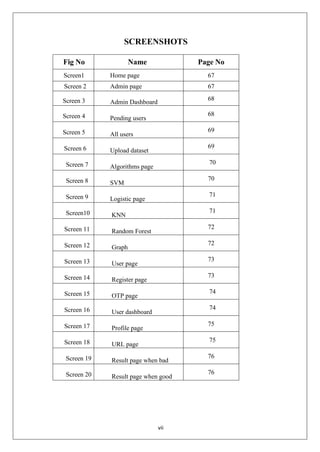
![1
1.INTRODUCTION
1.1 INTRODUCTION TO PROJECT:
Quick Response codes have found their way into our daily lives as a result of the Internet's
undeniable omnipresence. QR codes are data-encoding two-dimensional matrix barcodes. They
were originally designed to track automobile parts, but they have since been adapted for a wide
range of applications. The most typical application is to encode a link or other textual information
so that it can be accessed quickly without requiring the user to write the URL manually. Covid-19
has impacted the expansion of internet business like e-commerce and e-banking, primarily because
QR-code payment streamlines and secures the payment process's correct execution, saves time,
and eliminates data entry problems. Unfortunately, technical breakthroughs are sometimes
accompanied by state-of-the-art methods for exploiting users. Phishing website that heist any type
of personal data, a spammer can use are prominent instances of such attacks. QR Codes have been
widely exploited and abused to take advantage of consumers' vulnerabilities. According to data on
the rise in the number of dangerous QR Code distributions over time, indicates an clear necessity
to research, implement procedures or ways to prevent and detect them.
In a survey Katharina Krombholz et. al. [1] provides a detailed summary of current studies on QR
code usability and security in a survey. They determined the most significant use case as well as
the corresponding attack routes. According to the paper, in addition to their many benefits, Social
engineers have used QR codes as an attack vector. Malicious links are encoded by attackers in QR
code, for example, redirect to run fraudulent code or phishing sites. Social engineering is the most
commonly reported assault scenario. Social engineering is a strategy used in information
technology (IT) security to manipulate people into revealing secret information to the social
engineer.
Katharina Krombholz et al. [2] recognise the importance of QR code security and give a thorough
assessment of quick response code reader vulnerability, with an emphasis on practical security
techniques. The initial portion of this research concentrated on the decoder software, while another
phase is focused upon a user. Their findings reveal and underline the need for security
enhancements to ensure a secure user experience when scanning QR codes. Based on an
examination of privacy and security problems in mobile software, they suggested a design set of
guidelines for an application that takes security, privacy, and usability into account. They
demonstrated that when security, privacy, and usability are all taken into account, mobile-phone
software can efficiently safe guard consumers from harmful quick response code.](https://image.slidesharecdn.com/secureqrcodescannertodetectmaliciousurlusingmachinelearning-250228091406-2b3153fc/85/SECURE-QR-CODE-SCANNER-TO-DETECT-MALICIOUS-URL-USING-MACHINE-LEARNING-pdf-9-320.jpg)
![2
Heider and Flaminia [3] have done a study that gives a thorough review of QR code scanning
applications in terms of security, usability, and privacy. They identified the shortcomings and
found that: Many of these QR code scanners does not meet the consumer privacy and security
needs.
Several papers in the literature address this issue from the perspective of Machine Learning. In
other words, they construct a list of URLs categorised as harmful or safe along with characterise
each uniform resource locator using fixed group of criteria. Classification algorithms are then
supposed to learn the border between the decision classes. The extensive literature on classification
models provides a variety of alternative solutions and approaches to classification challenges.
Among the most common classifiers are K-nearest neighbors, Random Forest, Support Vector
Machine, and Bidirectional LSTM, each with its own set of pros and disadvantages.Scammers use
a variety of cyber techniques, such as luring consumers to press on phished link, that can causes
the system to be compromised. QR codes make it simple to accomplish this. To assist in identifying
malicious websites, the online security community has launched blacklisting services. While
blacklisting a URL has been shown results effectively in some situations, an scammer can readily
trick the system by modifying more or one components of the link. Many harmful websites are
never banned, either they were never or incorrectly assessed or they are too new.
1.2 LITERATURE SURVEY
TITLE: “QR Code Security: A Survey of Attacks and Challenges for Usable Security”,
ABSTRACT: QR (Quick Response) codes are two-dimensional barcodes with the ability to
encode different types of information. Because of their high information density and robustness,
QR codes have gained popularity in various fields of application. Even though they offer a broad
range of advantages, QR codes pose significant security risks. Attackers can encode malicious
links that lead e.g. to phishing sites. Such malicious QR codes can be printed on small stickers
and replace benign ones on billboard advertisements. Although many real world examples of QR
code based attacks have been reported in the media, only little research has been conducted in this
field and almost no attention has been paid on the interplay of security and human-computer
interaction. In this work, we describe the manifold use cases of QR codes. Furthermore, we
analyze the most significant attack scenarios with respect to the specific use cases. Additionally,
we systemize the research that has already been conducted and identified usable security and
security awareness as the main research challenges. Finally we propose design requirements with
respect to the QR code itself, the reader application and usability aspects in order to support further
research into to making QR code processing both secure and usable.](https://image.slidesharecdn.com/secureqrcodescannertodetectmaliciousurlusingmachinelearning-250228091406-2b3153fc/85/SECURE-QR-CODE-SCANNER-TO-DETECT-MALICIOUS-URL-USING-MACHINE-LEARNING-pdf-10-320.jpg)

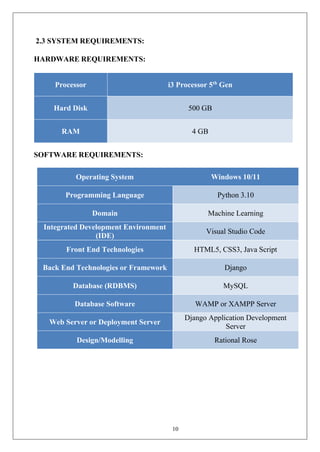

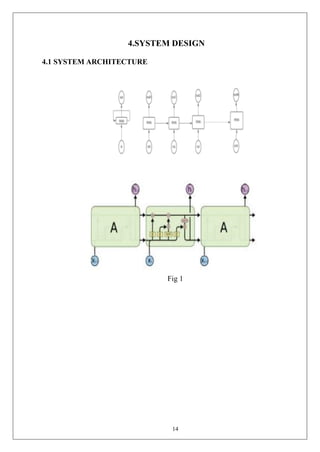
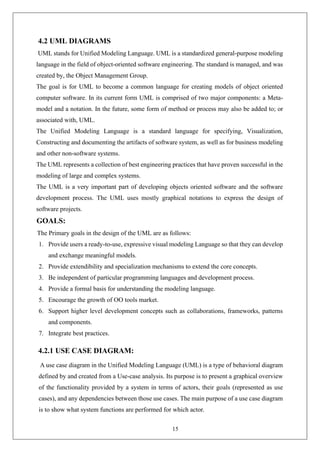
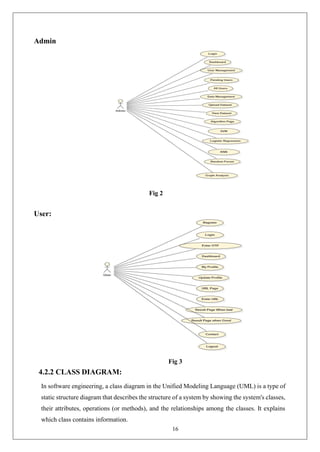
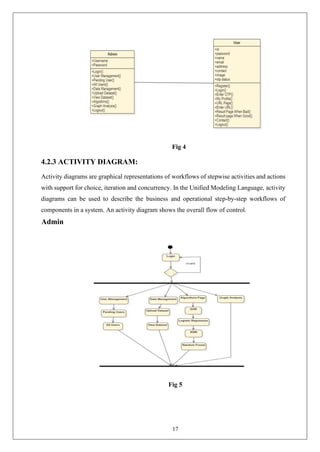
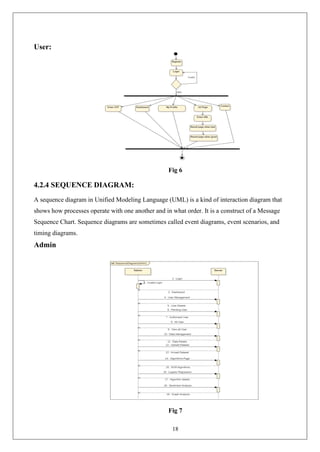
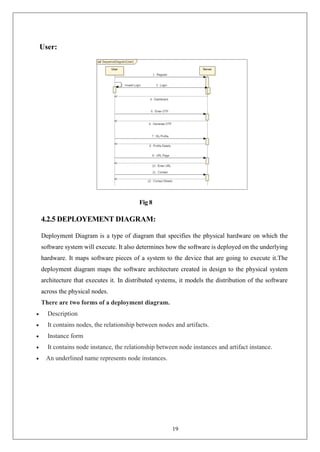
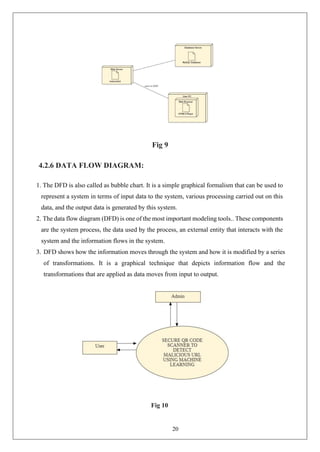
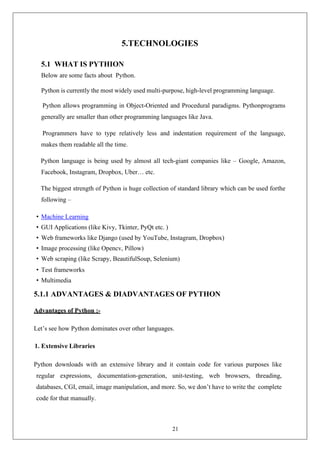
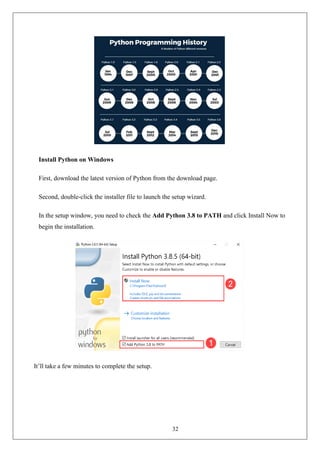
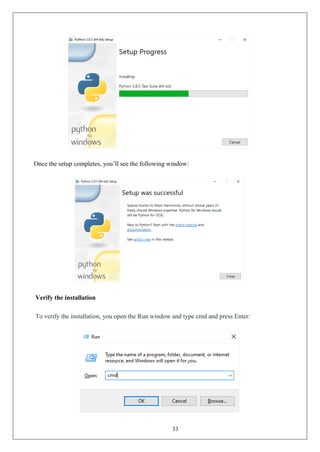
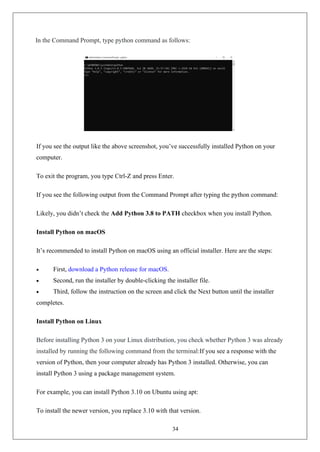
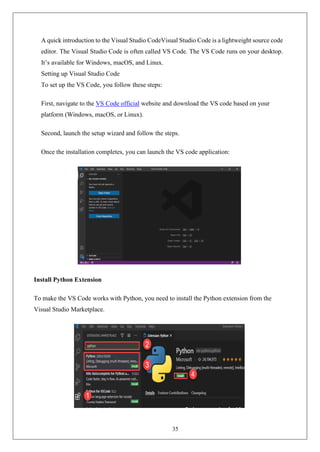
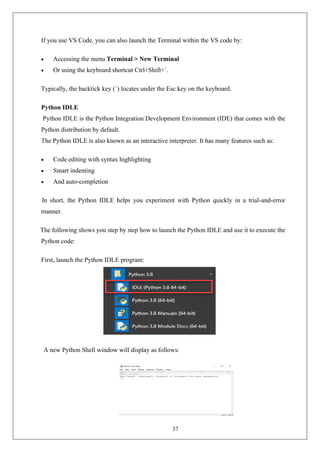
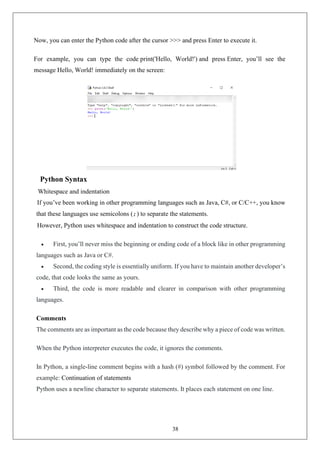
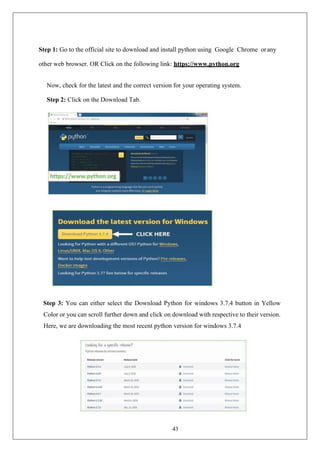
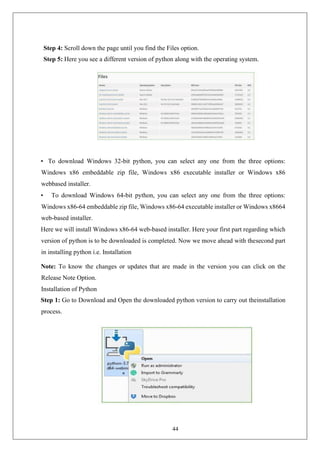
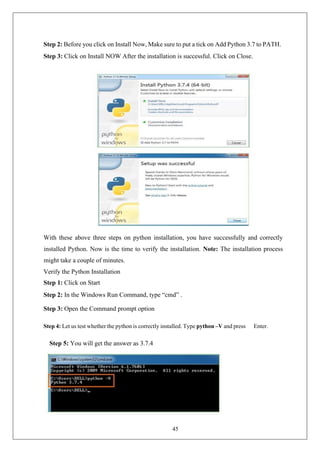
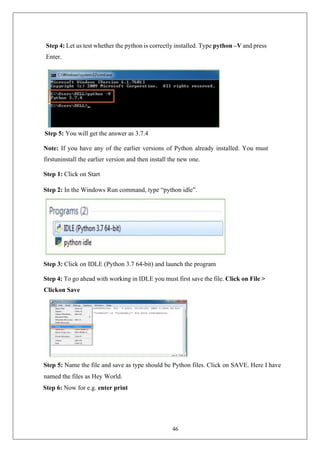
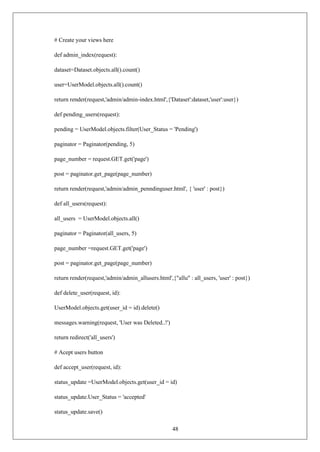
![49
messages.success(request, 'User was accepted..!')
return redirect('pending_users')
# Remove user button
def reject_user(request, id):
status_update2 = UserModel.objects.get(user_id = id)
status_update2.User_Status = 'removed'
status_update2.save()
messages.warning(request, 'User was Rejected..!')
return redirect('pending_users')
def admin_add_data(request):
if request.method == 'POST':
dataset = request.FILES['dataset']
data = Dataset.objects.create(data_set = dataset)
data = data.data_id
print(type(data),'type')
return redirect('admin_run_algorithm',data)
return render(request,'admin/admin-add-data.html')
def delete_dataset(request, id):
dataset = Dataset.objects.get(user_id = id).delete()
messages.warning(request, 'Dataset was deleted..!')
return redirect('viewdataset')
from django.urls import reverse
def admin_score(request, id):
data = Dataset.objects.get(data_id=id)
admin_run_algorithm_url = reverse('admin_run_algorithm', args=[data.data_id])
return render(request, 'admin/admin-score.html', {'i': data, 'admin_run_algorithm_url':admin_run_algorithm_url})](https://image.slidesharecdn.com/secureqrcodescannertodetectmaliciousurlusingmachinelearning-250228091406-2b3153fc/85/SECURE-QR-CODE-SCANNER-TO-DETECT-MALICIOUS-URL-USING-MACHINE-LEARNING-pdf-57-320.jpg)
![50
def admin_run_algorithm(request,data):
data = Dataset.objects.get(data_id = data)
print(data,type(data),'sssss')
file = str(data.data_set)
df = pd.read_csv('./media/'+ file)
table = df.to_html(table_id='data_table')
print(df.iloc[0,[1]])
print(len(df))
for i in range(len(df)):
print(df.iloc[i,[1]],'loop')
print(df[0:5],type(df),'database tablesssssssssss')
return render(request,'admin/admin-run-algorithm.html',{'i':data,'t':table})
def LogisticRegression(request,id):
Accuracy = None
Precision = None
Recall = None
F1_Score = None
data = Dataset.objects.get(data_id=id)
id = data.data_id
file = str(data.data_set)
df = pd.read_csv('./media/media/url_10k.csv')
from sklearn.model_selection import train_test_split
#converting text into Numbers
from sklearn.feature_extraction.text import TfidfVectorizer
vectorizer = TfidfVectorizer()
from sklearn.feature_extraction.text import TfidfVectorizer](https://image.slidesharecdn.com/secureqrcodescannertodetectmaliciousurlusingmachinelearning-250228091406-2b3153fc/85/SECURE-QR-CODE-SCANNER-TO-DETECT-MALICIOUS-URL-USING-MACHINE-LEARNING-pdf-58-320.jpg)
![51
def makeTokens(f):
tkns_BySlash=str(f.encode('utf-8')).split('/')
total_Tokens=[]
for i in tkns_BySlash:
tokens=str(i).split('-')
tkns_ByDot=[]
for j in range(0,len(tokens)):
temp_Tokens=str(tokens[j]).split('.')
tkns_ByDot=tkns_ByDot + temp_Tokens
total_Tokens=total_Tokens + tokens + tkns_ByDot
total_Tokens= list(set(total_Tokens))
if 'com' in total_Tokens:
total_Tokens.remove('com')
return total_Tokens
vectorizer=TfidfVectorizer(tokenizer=makeTokens)
X=vectorizer.fit_transform(df["url"])
print(X.shape,'fgtretyuiokjhnbgffrry')
y=df["label"]
print(X.shape,y.shape,'sdgsdfg')
X_train,X_test,y_train,y_test=train_test_split(X,y,test_size=0.2,random_state=42)
print(X_train.shape,'kkkkkkkkkkkkkkkkkkkkkkkkkkkkkkkkk')
print(y_train.shape,'ffffffffffffkkkkkkkkkkkkkkkkkkkkkkkkkkkkkkkkk')
#Machinelearning
from sklearn.linear_model import LogisticRegression
model_name = LogisticRegression()
model_name.fit(X_train,y_train)](https://image.slidesharecdn.com/secureqrcodescannertodetectmaliciousurlusingmachinelearning-250228091406-2b3153fc/85/SECURE-QR-CODE-SCANNER-TO-DETECT-MALICIOUS-URL-USING-MACHINE-LEARNING-pdf-59-320.jpg)
![52
prediction = model_name.predict(X_test)
Accuracy=(accuracy_score(prediction,y_test))
Precision=(precision_score(prediction,y_test,average = 'macro'))
Recall=(recall_score(prediction,y_test,average = 'macro'))
F1_Score=(f1_score(prediction,y_test,average = 'macro'))
print(Accuracy,Precision,Recall,F1_Score,'Scoreeeeeeeeeeeee lr')
data.Accuracy = Accuracy
data.Precision = Precision
data.Recall = Recall
data.F1_Score = F1_Score
data.algo = "Logistic Regression"
data.save(update_fields=["Accuracy","Precision","Recall","F1_Score","algo"])
data.save()
return redirect('admin_score',id=id)
def RandomForest(request,id):
Accuracy = None
Precision = None
Recall = None
F1_Score = None
data = Dataset.objects.get(data_id=id)
id = data.data_id
file = str(data.data_set)
# df = pd.read_csv('./media/'+ file)
df = pd.read_csv('./media/media/url_10k.csv')
from sklearn.model_selection import train_test_split
#converting text into Numbers](https://image.slidesharecdn.com/secureqrcodescannertodetectmaliciousurlusingmachinelearning-250228091406-2b3153fc/85/SECURE-QR-CODE-SCANNER-TO-DETECT-MALICIOUS-URL-USING-MACHINE-LEARNING-pdf-60-320.jpg)
![53
from sklearn.feature_extraction.text import TfidfVectorizer
def makeTokens(f):
tkns_BySlash=str(f.encode('utf-8')).split('/')
total_Tokens=[]
for i in tkns_BySlash:
tokens=str(i).split('-')
tkns_ByDot=[]
for j in range(0,len(tokens)):
temp_Tokens=str(tokens[j]).split('.')
tkns_ByDot=tkns_ByDot + temp_Tokens
total_Tokens=total_Tokens + tokens + tkns_ByDot
total_Tokens= list(set(total_Tokens))
if 'com' in total_Tokens:
total_Tokens.remove('com')
return total_Tokens
vectorizer=TfidfVectorizer(tokenizer=makeTokens)
X=vectorizer.fit_transform(df["url"])
import joblib
file=open('vc_rf.pkl','wb')
joblib.dump(X,file)
print(X.shape,'fgtretyuiokjhnbgffrry')
y=df["label"]
print(X.shape,y.shape,'sdgsdfg')
X_train,X_test,y_train,y_test=train_test_split(X,y,test_size=0.2,random_state=42)
print(X_train.shape,'kkkkkkkkkkkkkkkkkkkkkkkkkkkkkkkkk')
print(y_train.shape,'ffffffffffffkkkkkkkkkkkkkkkkkkkkkkkkkkkkkkkkk')](https://image.slidesharecdn.com/secureqrcodescannertodetectmaliciousurlusingmachinelearning-250228091406-2b3153fc/85/SECURE-QR-CODE-SCANNER-TO-DETECT-MALICIOUS-URL-USING-MACHINE-LEARNING-pdf-61-320.jpg)
![54
#Mchinelearning
from sklearn.ensemble import RandomForestClassifier
model_name = RandomForestClassifier()
model_name.fit(X_train,y_train)
prediction = model_name.predict(X_test)
Accuracy=(accuracy_score(prediction,y_test))
Precision=(precision_score(prediction,y_test,average = 'macro'))
Recall=(recall_score(prediction,y_test,average = 'macro'))
F1_Score=(f1_score(prediction,y_test,average = 'macro'))
print(Accuracy,Precision,Recall,F1_Score,'Scoreeeeeeeeeeeee lr')
data.Accuracy = Accuracy
data.Precision = Precision
data.Recall = Recall
data.F1_Score = F1_Score
data.algo = "Random Forest"
data.save(update_fields=["Accuracy","Precision","Recall","F1_Score","algo"])
data.save()
import joblib
file=open('url_rf.pkl','wb')
joblib.dump(prediction,file)
return redirect('admin_score',id=id)
def KNeighborsRegressor(request,id):
Accuracy = None
Precision = None
Recall = None
F1_Score = None](https://image.slidesharecdn.com/secureqrcodescannertodetectmaliciousurlusingmachinelearning-250228091406-2b3153fc/85/SECURE-QR-CODE-SCANNER-TO-DETECT-MALICIOUS-URL-USING-MACHINE-LEARNING-pdf-62-320.jpg)
![55
data = Dataset.objects.get(data_id=id)
id = data.data_id
file = str(data.data_set)
# df = pd.read_csv('./media/'+ file)
df = pd.read_csv('./media/media/url_10k.csv')
from sklearn.model_selection import train_test_split
from sklearn.feature_extraction.text import TfidfVectorizer
# vectorizer = TfidfVectorizer()
def makeTokens(f):
tkns_BySlash=str(f.encode('utf-8')).split('/')
total_Tokens=[]
for i in tkns_BySlash:
tokens=str(i).split('-')
tkns_ByDot=[]
for j in range(0,len(tokens)):
temp_Tokens=str(tokens[j]).split('.')
tkns_ByDot=tkns_ByDot + temp_Tokens
total_Tokens=total_Tokens + tokens + tkns_ByDot
total_Tokens= list(set(total_Tokens))
if 'com' in total_Tokens:
total_Tokens.remove('com')
return total_Tokens
vectorizer=TfidfVectorizer(tokenizer=makeTokens)
X=vectorizer.fit_transform(df["url"])
print(X.shape,'fgtretyuiokjhnbgffrry')
y=df["label"]](https://image.slidesharecdn.com/secureqrcodescannertodetectmaliciousurlusingmachinelearning-250228091406-2b3153fc/85/SECURE-QR-CODE-SCANNER-TO-DETECT-MALICIOUS-URL-USING-MACHINE-LEARNING-pdf-63-320.jpg)
![56
print(X.shape,y.shape,'sdgsdfg')
X_train,X_test,y_train,y_test=train_test_split(X,y,test_size=0.2,random_state=42)
print(X_train.shape,'kkkkkkkkkkkkkkkkkkkkkkkkkkkkkkkkk')
print(y_train.shape,'ffffffffffffkkkkkkkkkkkkkkkkkkkkkkkkkkkkkkkkk')
#Mchinelearning
from sklearn.neighbors import KNeighborsClassifier
model_name = KNeighborsClassifier()
model_name.fit(X_train,y_train)
prediction = model_name.predict(X_test)
Accuracy=(accuracy_score(prediction,y_test))
Precision=(precision_score(prediction,y_test,average = 'macro'))
Recall=(recall_score(prediction,y_test,average = 'macro'))
F1_Score=(f1_score(prediction,y_test,average = 'macro'))
print(Accuracy,Precision,Recall,F1_Score,'Scoreeeeeeeeeeeee lr')
data.Accuracy = Accuracy
data.Precision = Precision
data.Recall = Recall
data.F1_Score = F1_Score
data.algo = "KNeighborsClassifier"
data.save(update_fields=["Accuracy","Precision","Recall","F1_Score","algo"])
data.save()
return redirect('admin_score',id=id)
def SVM(request,id):
Accuracy = None
Precision = None
Recall = None](https://image.slidesharecdn.com/secureqrcodescannertodetectmaliciousurlusingmachinelearning-250228091406-2b3153fc/85/SECURE-QR-CODE-SCANNER-TO-DETECT-MALICIOUS-URL-USING-MACHINE-LEARNING-pdf-64-320.jpg)
![57
F1_Score = None
data = Dataset.objects.get(data_id=id)
id = data.data_id
file = str(data.data_set)
# df = pd.read_csv('./media/'+ file)
df = pd.read_csv('./media/media/url_10k.csv')
from sklearn.model_selection import train_test_split
from sklearn.feature_extraction.text import TfidfVectorizer
# vectorizer = TfidfVectorizer()
def makeTokens(f):
tkns_BySlash=str(f.encode('utf-8')).split('/')
total_Tokens=[]
for i in tkns_BySlash:
tokens=str(i).split('-')
tkns_ByDot=[]
for j in range(0,len(tokens)):
temp_Tokens=str(tokens[j]).split('.')
tkns_ByDot=tkns_ByDot + temp_Tokens
total_Tokens=total_Tokens + tokens + tkns_ByDot
total_Tokens= list(set(total_Tokens))
if 'com' in total_Tokens:
total_Tokens.remove('com')
return total_Tokens
vectorizer=TfidfVectorizer(tokenizer=makeTokens
X=vectorizer.fit_transform(df["url"])
print(X.shape,'fgtretyuiokjhnbgffrry')](https://image.slidesharecdn.com/secureqrcodescannertodetectmaliciousurlusingmachinelearning-250228091406-2b3153fc/85/SECURE-QR-CODE-SCANNER-TO-DETECT-MALICIOUS-URL-USING-MACHINE-LEARNING-pdf-65-320.jpg)
![58
y=df["label"]
print(X.shape,y.shape,'sdgsdfg')
X_train,X_test,y_train,y_test=train_test_split(X,y,test_size=0.2,random_state=42)
print(X_train.shape,'kkkkkkkkkkkkkkkkkkkkkkkkkkkkkkkkk')
print(y_train.shape,'ffffffffffffkkkkkkkkkkkkkkkkkkkkkkkkkkkkkkkkk')
#Mchinelearning
from sklearn.svm import SVM
model_name = SVC()
model_name.fit(X_train,y_train)
prediction = model_name.predict(X_test)
Accuracy=(accuracy_score(prediction,y_test))
Precision=(precision_score(prediction,y_test,average = 'macro'))
Recall=(recall_score(prediction,y_test,average = 'macro'))
F1_Score=(f1_score(prediction,y_test,average = 'macro'))
print(Accuracy,Precision,Recall,F1_Score,'Scoreeeeeeeeeeeee lr')
data.Accuracy = Accuracy
data.Precision = Precision
data.Recall = Recall
data.F1_Score = F1_Score
data.algo = "SVM"
data.save(update_fields=["Accuracy","Precision","Recall","F1_Score","algo"])
data.save()
return redirect('admin_score',id=id)
def LSTM(request,id):
return redirect('admin_score',id=id)
def admin_graph_analysis(request):](https://image.slidesharecdn.com/secureqrcodescannertodetectmaliciousurlusingmachinelearning-250228091406-2b3153fc/85/SECURE-QR-CODE-SCANNER-TO-DETECT-MALICIOUS-URL-USING-MACHINE-LEARNING-pdf-66-320.jpg)
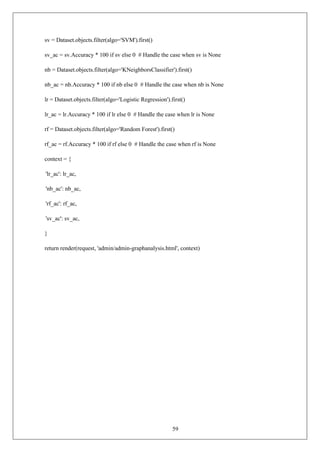
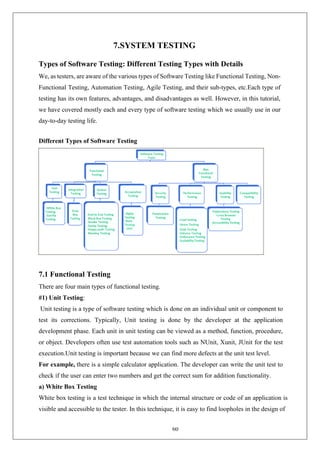
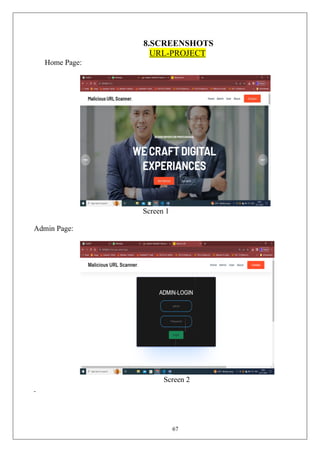
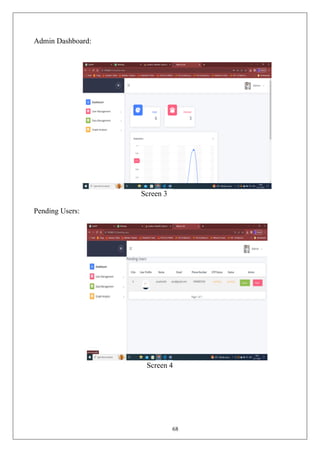
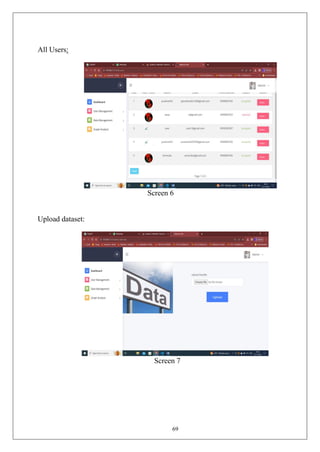
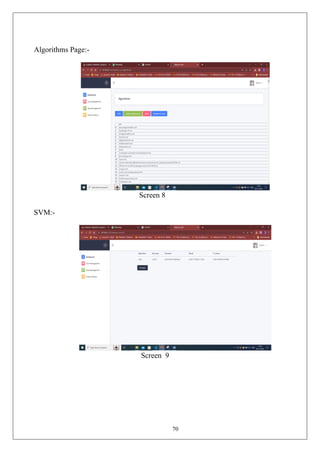
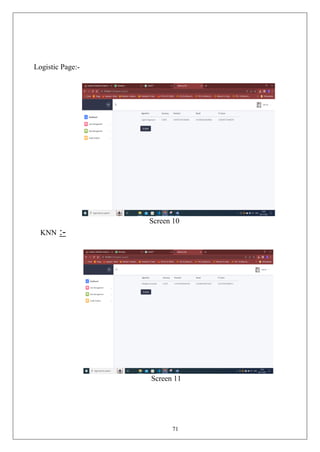
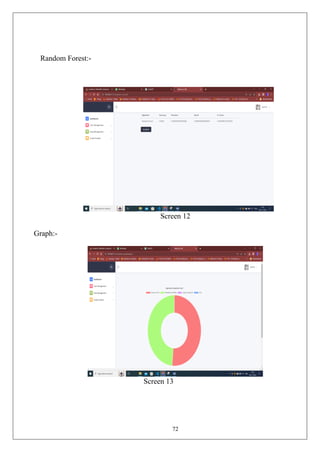
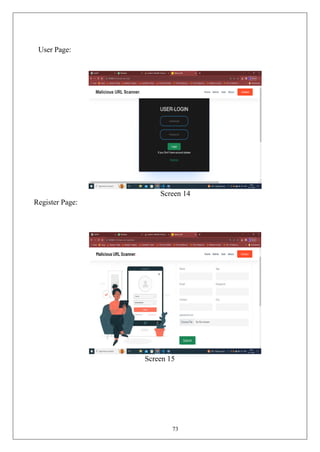
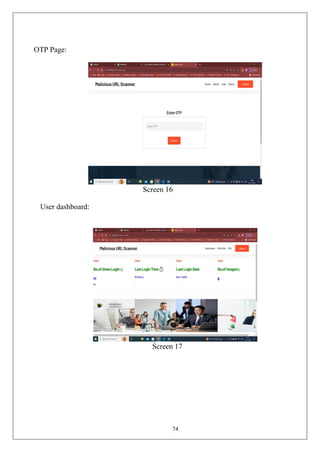
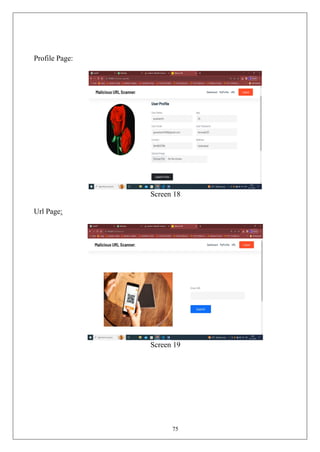
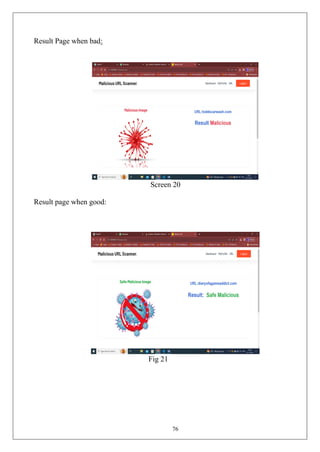
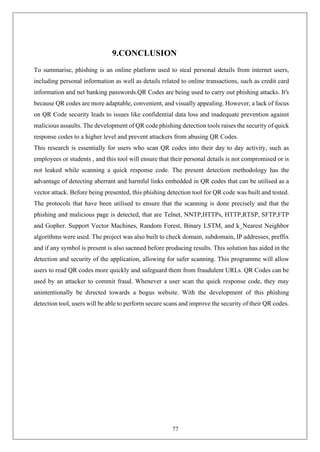
![78
10.REFERENCES
[1] Katharina Krombholz, Peter Fr¨uhwirt, Peter Kieseberg et. al. “QR Code Security: A Survey
of Attacks and Challenges for Usable Security”, In International Conference on Human Aspects
of Information Security, Privacy, and Trust.
[2] Katharina Krombholzכ, Peter Fr¨uhwirt, Thomas Rieder et.al “QR Code Security - How Secure
and Usable Apps Can Protect Users Against Malicious QR Code’, In 10th International
Conference on Availability, Reliability and Security
[3] Heider A. M. Wahsheh and Flaminia L. Luccio,“Evaluating Security, Privacy and Usability
Features of QR Code Readers”, In ICISSP 2019 - 5th International Conference on Information
Systems Security and Privacy.
[4] Frank Vanhoenshoven, Gonzalo N´apoles et. al. “Detecting Malicious URLs using Machine
Learning Techniques”,In 978-1- 5090-4240-1/16/©2016 IEEE
[5] Cho Do Xuan1 , Hoa Dinh Nguyen et. al. “Malicious URL Detection based on Machine
Learning”, In (IJACSA) International Journal of Advanced Computer Science and Applications,
Vol. 11, No. 1, 2020.
[6] Shantanu et. al. “Malicious URL Detection: A Comparative Study”, In Proceedings of the
International Conference on Artificial Intelligence and Smart Systems (ICAIS-2021) IEEE Xplore
Part Number: CFP21OAB-ART; ISBN: 978-1-7281-9537-7
[7] Andrey Averin, Natalya Zyulyarkina, “Malicious Qr-Code Threats and Vulnerability of
Blockchain”, In 978-1-7281-8075-5/20/$31.00 ©2020 IEEE.
[8] Young-Sae Kim et. al. “Design of an efficient image protection method based on QR code”, In
978-1-7281-6758-9/20/ ©2020 IEEE
[9] Safwati Ismail,Alvin Ebenazer Kumar et. al. “Quick Response Code Validation and Phishing
Detection Tool”, In 2021 IEEE 11th IEEE Symposium on Computer Applications & Industrial
Electronics (ISCAIE) | 978-1-6654-0338-2/21/©2021 IEEE.
[10] Makoto Takita, Hiroya Okuma, et. al. “A Construction of Fake QR Codes Based on Error-
Correcting Codes”, In 2018 Sixth International Symposium on Computing and Networking
(CANDAR) IEEE.](https://image.slidesharecdn.com/secureqrcodescannertodetectmaliciousurlusingmachinelearning-250228091406-2b3153fc/85/SECURE-QR-CODE-SCANNER-TO-DETECT-MALICIOUS-URL-USING-MACHINE-LEARNING-pdf-86-320.jpg)


![Secured qr code [Pankaj Jeswani and Team]](https://cdn.slidesharecdn.com/ss_thumbnails/securedqr-code-140507173624-phpapp01-thumbnail.jpg?width=640&height=640&fit=bounds)


![FAKE SOCIAL MEDIA ACCOUNT DETECTION DOCUMENTATION[6][1] (1).docx](https://cdn.slidesharecdn.com/ss_thumbnails/fakesocialmediaaccountdetectiondocumentation611-250830044225-8915adf4-thumbnail.jpg?width=640&height=640&fit=bounds)


