





Becoming a
Sector Specialist


             Part One
    Presented by Michele Martin
To begin. . .
What is the goal?


PLACEMENTS!!!!
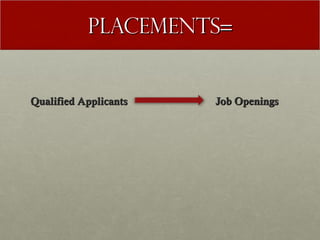
Placements=


Qualified Applicants   Job Openings
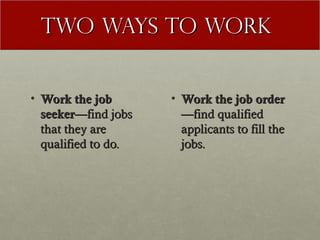
Two Ways to Work


• Work the job       • Work the job order
  seeker—find jobs     —find qualified
  that they are        applicants to fill the
  qualified to do.     jobs.
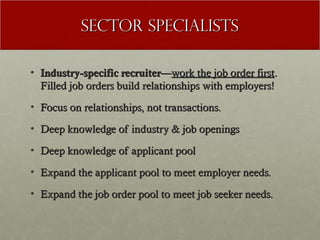
Sector Specialists

• Industry-specific recruiter—work the job order first.
  Filled job orders build relationships with employers!
• Focus on relationships, not transactions.

• Deep knowledge of industry & job openings

• Deep knowledge of applicant pool

• Expand the applicant pool to meet employer needs.

• Expand the job order pool to meet job seeker needs.
Working with Employers
      Thinking Like a Recruiter
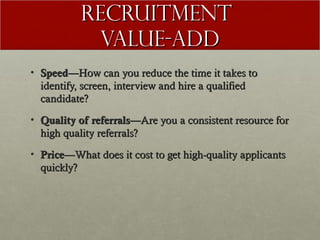
Recruitment
            Value-Add
• Speed—How can you reduce the time it takes to
  identify, screen, interview and hire a qualified
  candidate?
• Quality of referrals—Are you a consistent resource for
  high quality referrals?
• Price—What does it cost to get high-quality applicants
  quickly?
Remember


Companies will PAY for quick, high
quality referrals, so price by itself will
not provide you with a competitive
advantage.
Also. . .


Aim for relationships, not transactions.
The process
1. Initial research
2. Develop list of target employers
3. Build company profiles
4. Develop relationships
5. Build quality job postings/information
6. Work job leads
7. Follow-up
8. Track for Success
Initial research
1. Who are the employers in        3. What job openings do
   your sector?                       they have?
  •   Who is already in the
      system?                      4. Who are the key decision-
  •   Google Maps Search
                                      makers?
                                     •   C-Suite and Directors
1. Of these employers, who           •   Avoid HR if possible
   is hiring?
  •   Job postings—in system,
      on their website, on other
      boards
  •   “Follow the money”
Develop Target List
• Identify Top 25-30 employers in your sector—most
  likely for you to get placements.
• Analyze:
  • What do you already know about them?
  • What can you easily find out about them through more
    research?
  • Do you have a relationship with them?
  • What is the nature/quality of that relationship?
  • What have you done for them in the past?

• Focus your efforts!
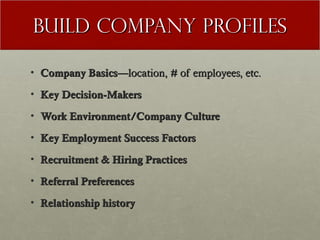
Build Company Profiles

• Company Basics—location, # of employees, etc.

• Key Decision-Makers

• Work Environment/Company Culture

• Key Employment Success Factors

• Recruitment & Hiring Practices

• Referral Preferences

• Relationship history
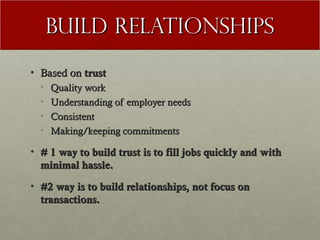
Build Relationships
• Based on trust
  •   Quality work
  •   Understanding of employer needs
  •   Consistent
  •   Making/keeping commitments

• # 1 way to build trust is to fill jobs quickly and with
  minimal hassle.
• #2 way is to build relationships, not focus on
  transactions.
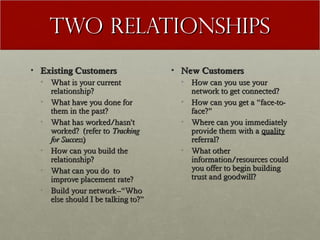
Two Relationships
• Existing Customers                • New Customers
  • What is your current              • How can you use your
    relationship?                       network to get connected?
  • What have you done for            • How can you get a “face-to-
    them in the past?                   face?”
  • What has worked/hasn’t            • Where can you immediately
    worked? (refer to Tracking          provide them with a quality
    for Success)                        referral?
  • How can you build the             • What other
    relationship?                       information/resources could
  • What can you do to                  you offer to begin building
    improve placement rate?             trust and goodwill?
  • Build your network--“Who
    else should I be talking to?”
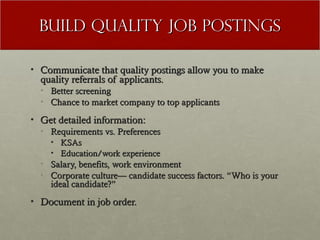
Build Quality Job Postings

• Communicate that quality postings allow you to make
  quality referrals of applicants.
  • Better screening
  • Chance to market company to top applicants

• Get detailed information:
  • Requirements vs. Preferences
    • KSAs
    • Education/work experience
  • Salary, benefits, work environment
  • Corporate culture— candidate success factors. “Who is your
    ideal candidate?”
• Document in job order.
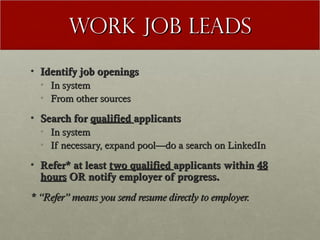
Work Job Leads
• Identify job openings
  • In system
  • From other sources

• Search for qualified applicants
  • In system
  • If necessary, expand pool—do a search on LinkedIn

• Refer* at least two qualified applicants within 48
  hours OR notify employer of progress.
* “Refer” means you send resume directly to employer.
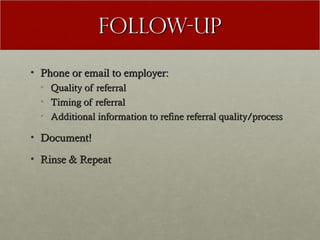
Follow-UP
• Phone or email to employer:
  • Quality of referral
  • Timing of referral
  • Additional information to refine referral quality/process

• Document!

• Rinse & Repeat
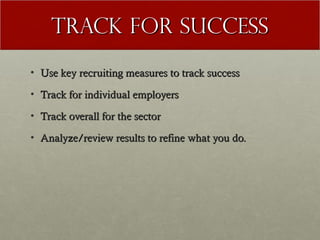
Track for Success
• Use key recruiting measures to track success

• Track for individual employers

• Track overall for the sector

• Analyze/review results to refine what you do.
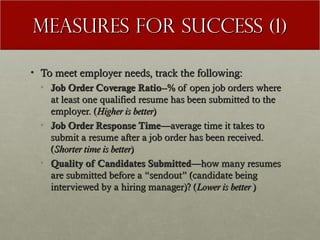
Measures for Success (1)

• To meet employer needs, track the following:
  • Job Order Coverage Ratio--% of open job orders where
    at least one qualified resume has been submitted to the
    employer. (Higher is better)
  • Job Order Response Time—average time it takes to
    submit a resume after a job order has been received.
    (Shorter time is better)
  • Quality of Candidates Submitted—how many resumes
    are submitted before a “sendout” (candidate being
    interviewed by a hiring manager)? (Lower is better )
Measures for Success
            (2)
• To meet employer needs, track the following:
  • Sendout to Placement Ratio—The number of sendouts it
    takes to get a placement (3 or 4:1 is good)
  • Job Order Fill Ratio—Ratio of job orders written to job
    orders filled. (Higher is better)
  • Time to Fill Ratio—Length of time from receiving a job
    order to filling it. (Lower is better)
Troubleshooting
• What if your job order coverage ratio is low?

• What if your job order response time is high?

• What if your ratio of resumes submitted to sendouts is
  low?
• What if your sendout to placement ratio is low?

• What if your job order fill ratio is low?

• What if your time to fill is high?
Ongoing
    Relationship-Building
• Track and share industry-related articles targeted to
  your employers’ needs.
• Connect with them on LinkedIn to keep track of and
  acknowledge professional accomplishments.
• Email “tickler” file—keep in ongoing contact.

• Refer high quality applicants even if there are no
  current job openings.

Sector specialist training part one

  • 1.
    Becoming a Sector Specialist Part One Presented by Michele Martin
  • 2.
  • 3.
    What is thegoal? PLACEMENTS!!!!
  • 4.
  • 5.
    Two Ways toWork • Work the job • Work the job order seeker—find jobs —find qualified that they are applicants to fill the qualified to do. jobs.
  • 6.
    Sector Specialists • Industry-specificrecruiter—work the job order first. Filled job orders build relationships with employers! • Focus on relationships, not transactions. • Deep knowledge of industry & job openings • Deep knowledge of applicant pool • Expand the applicant pool to meet employer needs. • Expand the job order pool to meet job seeker needs.
  • 7.
    Working with Employers Thinking Like a Recruiter
  • 8.
    Recruitment Value-Add • Speed—How can you reduce the time it takes to identify, screen, interview and hire a qualified candidate? • Quality of referrals—Are you a consistent resource for high quality referrals? • Price—What does it cost to get high-quality applicants quickly?
  • 9.
    Remember Companies will PAYfor quick, high quality referrals, so price by itself will not provide you with a competitive advantage.
  • 10.
    Also. . . Aimfor relationships, not transactions.
  • 11.
    The process 1. Initialresearch 2. Develop list of target employers 3. Build company profiles 4. Develop relationships 5. Build quality job postings/information 6. Work job leads 7. Follow-up 8. Track for Success
  • 12.
    Initial research 1. Whoare the employers in 3. What job openings do your sector? they have? • Who is already in the system? 4. Who are the key decision- • Google Maps Search makers? • C-Suite and Directors 1. Of these employers, who • Avoid HR if possible is hiring? • Job postings—in system, on their website, on other boards • “Follow the money”
  • 13.
    Develop Target List •Identify Top 25-30 employers in your sector—most likely for you to get placements. • Analyze: • What do you already know about them? • What can you easily find out about them through more research? • Do you have a relationship with them? • What is the nature/quality of that relationship? • What have you done for them in the past? • Focus your efforts!
  • 14.
    Build Company Profiles •Company Basics—location, # of employees, etc. • Key Decision-Makers • Work Environment/Company Culture • Key Employment Success Factors • Recruitment & Hiring Practices • Referral Preferences • Relationship history
  • 15.
    Build Relationships • Basedon trust • Quality work • Understanding of employer needs • Consistent • Making/keeping commitments • # 1 way to build trust is to fill jobs quickly and with minimal hassle. • #2 way is to build relationships, not focus on transactions.
  • 16.
    Two Relationships • ExistingCustomers • New Customers • What is your current • How can you use your relationship? network to get connected? • What have you done for • How can you get a “face-to- them in the past? face?” • What has worked/hasn’t • Where can you immediately worked? (refer to Tracking provide them with a quality for Success) referral? • How can you build the • What other relationship? information/resources could • What can you do to you offer to begin building improve placement rate? trust and goodwill? • Build your network--“Who else should I be talking to?”
  • 17.
    Build Quality JobPostings • Communicate that quality postings allow you to make quality referrals of applicants. • Better screening • Chance to market company to top applicants • Get detailed information: • Requirements vs. Preferences • KSAs • Education/work experience • Salary, benefits, work environment • Corporate culture— candidate success factors. “Who is your ideal candidate?” • Document in job order.
  • 18.
    Work Job Leads •Identify job openings • In system • From other sources • Search for qualified applicants • In system • If necessary, expand pool—do a search on LinkedIn • Refer* at least two qualified applicants within 48 hours OR notify employer of progress. * “Refer” means you send resume directly to employer.
  • 19.
    Follow-UP • Phone oremail to employer: • Quality of referral • Timing of referral • Additional information to refine referral quality/process • Document! • Rinse & Repeat
  • 20.
    Track for Success •Use key recruiting measures to track success • Track for individual employers • Track overall for the sector • Analyze/review results to refine what you do.
  • 21.
    Measures for Success(1) • To meet employer needs, track the following: • Job Order Coverage Ratio--% of open job orders where at least one qualified resume has been submitted to the employer. (Higher is better) • Job Order Response Time—average time it takes to submit a resume after a job order has been received. (Shorter time is better) • Quality of Candidates Submitted—how many resumes are submitted before a “sendout” (candidate being interviewed by a hiring manager)? (Lower is better )
  • 22.
    Measures for Success (2) • To meet employer needs, track the following: • Sendout to Placement Ratio—The number of sendouts it takes to get a placement (3 or 4:1 is good) • Job Order Fill Ratio—Ratio of job orders written to job orders filled. (Higher is better) • Time to Fill Ratio—Length of time from receiving a job order to filling it. (Lower is better)
  • 23.
    Troubleshooting • What ifyour job order coverage ratio is low? • What if your job order response time is high? • What if your ratio of resumes submitted to sendouts is low? • What if your sendout to placement ratio is low? • What if your job order fill ratio is low? • What if your time to fill is high?
  • 24.
    Ongoing Relationship-Building • Track and share industry-related articles targeted to your employers’ needs. • Connect with them on LinkedIn to keep track of and acknowledge professional accomplishments. • Email “tickler” file—keep in ongoing contact. • Refer high quality applicants even if there are no current job openings.