Department of Immunology,
Facultyof Medicine, Shahid Beheshti University of Medical Sciences
smmhashemi@yahoo.com
smmhashemi@sbmu.ac.ir
12/27/2016
Hashemi S.M.
2
TOP FREE MEDICALAPPLICATIONS
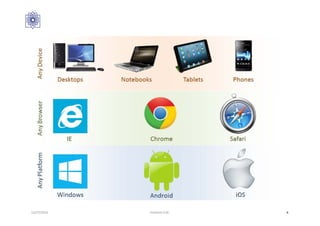
There are numerous free medical apps for iPhones, iPads, and android smartphones which fall into
many categories of medical applications. Following are 20 from the medical application website,
www.imedicalapps.com, a website started by superstar first year Emergency Medicine resident,
Iltifat Husain, MD of Wake Forest University, who plans on a further career in Medical Infomatics.
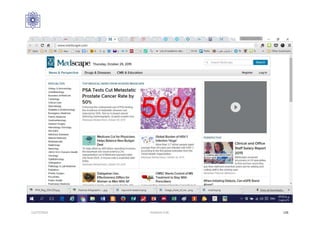
Medscape
• Medscape from WebMD (medscape.com) is one of the top downloaded medical apps amongst health professionals. Has the
most obscure diseases listed, and super comprehensive. Also, offers free CME’s to physicians.
Micromedex
• “Micromedex is the most reliable, trusted name in evidence-based clinical reference. We lead the industry because of our
unmatched editorial process, reliable content, and innovative user-friendly enhancements. And now Micromedex 2.0 has
been revamped to make finding evidence-based drug information and clinical answers much faster and easier.
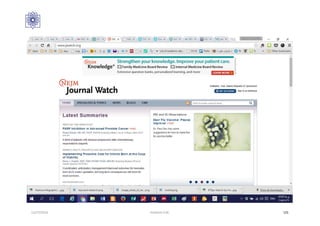
New England Journal of Medicine
• An App from one of the most trusted, staid journals in Medicine. But, departing from their staid, conservative roots, the
NEJM jumped full-force into the digital revolution with a recently unveiled daily feed, called “First Physician’s Watch“, which
is conveniently sent to your email address every morning, with the latest breaking news in the medical world. Next thing you
know, the boe ties come off, as do the Oxford loafers, and it’s boogie time!er players in a group forum if you are stuck on a
tough or rare case.
12/27/2016 Hashemi S.M. 9
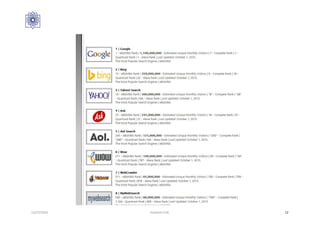
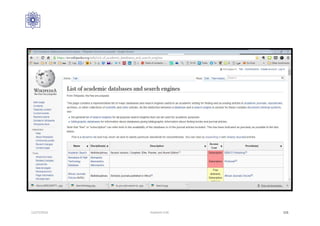
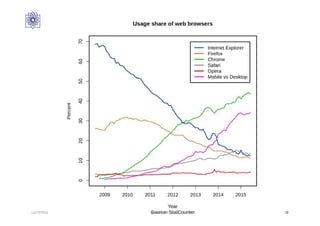
The world's mostpopular search engines are:
12/27/2016 Hashemi S.M. 11
East Asia and Russia[edit]
East Asian countries and Russia constitute a few places where Google is not the most popular search engine.
Yandex commands a marketshare of 61.9 percent in Russia, compared to Google's 28.3 percent.[21] In China, Baidu is the
most popular search engine.[22] South Korea's homegrown search portal, Naver, is used for 70 per cent online searches in
the country.[23] Yahoo! Japan and Yahoo! Taiwan are the most popular avenues for internet search in Japan and Taiwan,
respectively.[24]
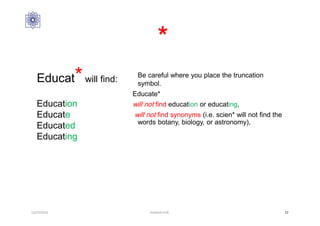
*
12/27/2016 Hashemi S.M.22
Educat*will find:
Education
Educate
Educated
Educating
Be careful where you place the truncation
symbol.
Educate*
will not find education or educating,
will not find synonyms (i.e. scien* will not find the
words botany, biology, or astronomy),
12/27/2016 Hashemi S.M.29
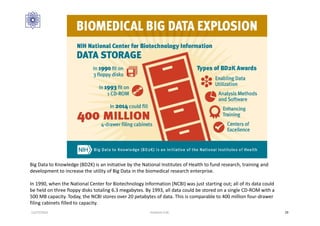
Big Data to Knowledge (BD2K) is an initiative by the National Institutes of Health to fund research, training and
development to increase the utility of Big Data in the biomedical research enterprise.
In 1990, when the National Center for Biotechnology Information (NCBI) was just starting out; all of its data could
be held on three floppy disks totaling 6.3 megabytes. By 1993, all data could be stored on a single CD-ROM with a
500 MB capacity. Today, the NCBI stores over 20 petabytes of data. This is comparable to 400 million four-drawer
filing cabinets filled to capacity.
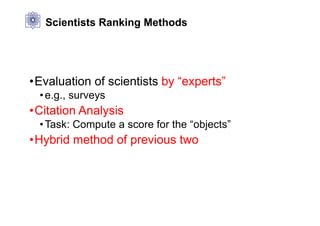
Scientists Ranking Methods
•Evaluationof scientists by “experts”
•e.g., surveys
•Citation Analysis
•Task: Compute a score for the “objects”
•Hybrid method of previous two
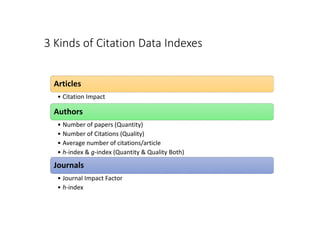
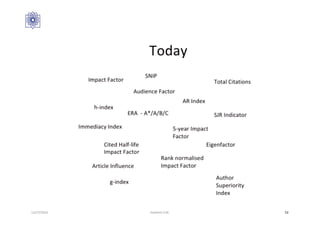
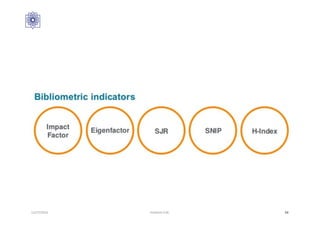
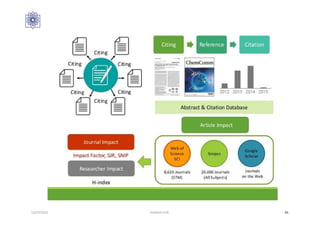
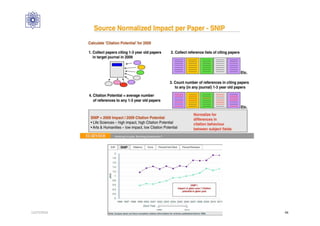
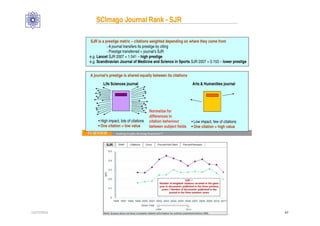
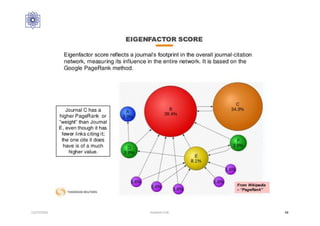
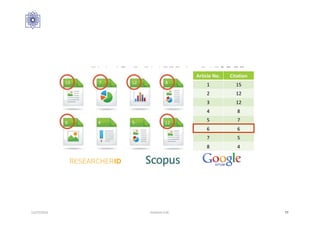
3 Kinds ofCitation Data Indexes
Articles
• Citation Impact
Authors
• Number of papers (Quantity)
• Number of Citations (Quality)
• Average number of citations/article
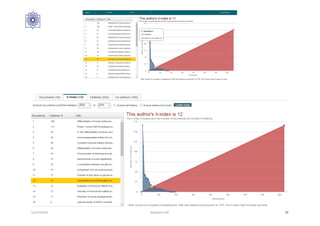
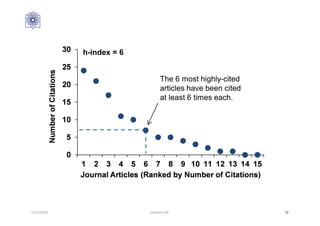
• h-index & g-index (Quantity & Quality Both)
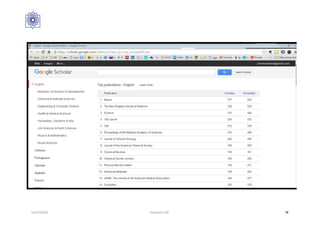
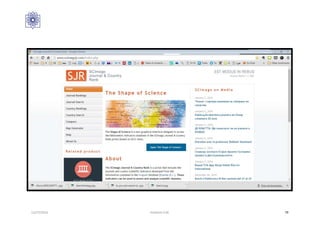
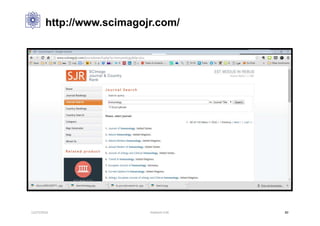
Journals
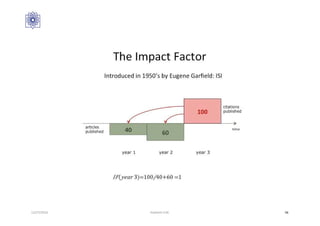
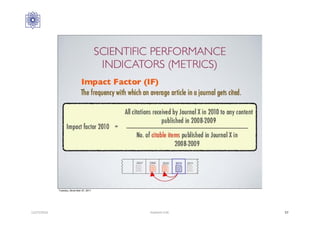
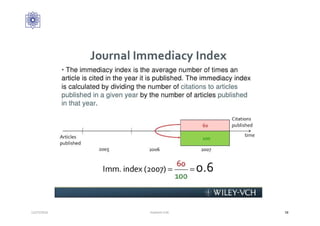
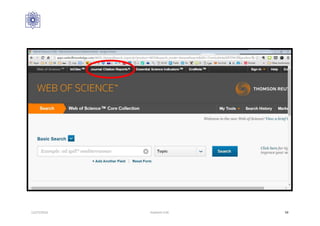
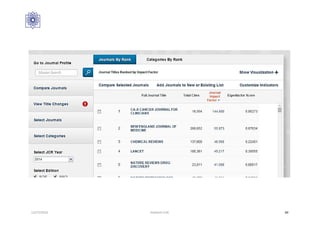
• Journal Impact Factor
• h-index
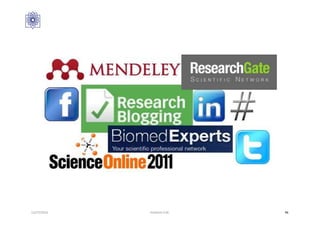
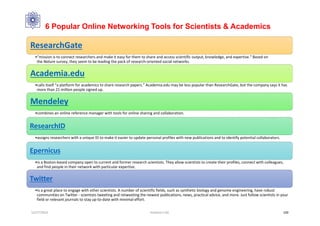
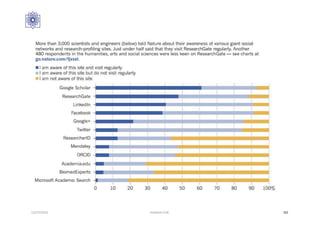
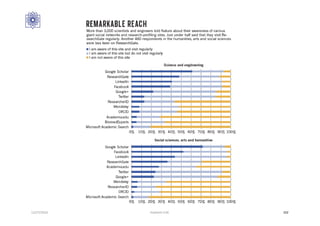
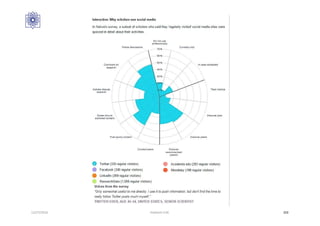
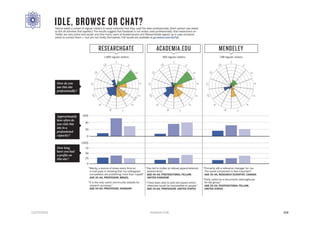
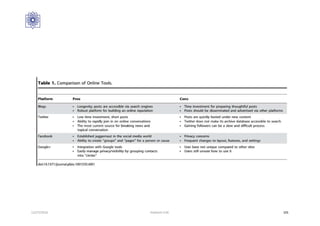
6 Popular OnlineNetworking Tools for Scientists & Academics
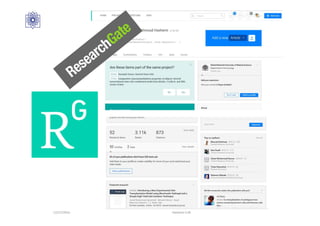
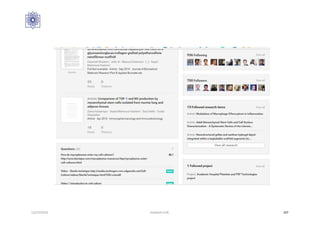
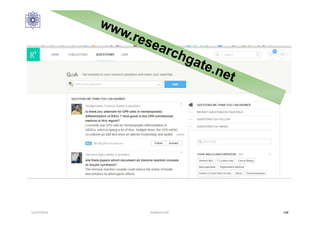
ResearchGate
•“mission is to connect researchers and make it easy for them to share and access scientific output, knowledge, and expertise.” Based on
the Nature survey, they seem to be leading the pack of research-oriented social networks.
Academia.edu
•calls itself “a platform for academics to share research papers.” Academia.edu may be less popular than ResearchGate, but the company says it has
more than 21 million people signed up.
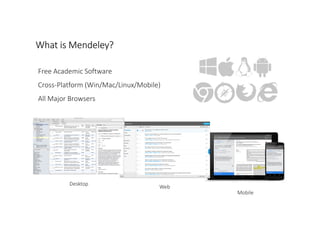
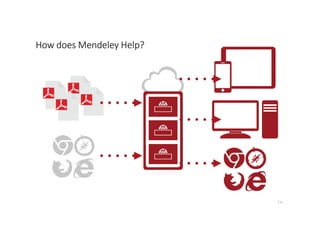
Mendeley
•combines an online reference manager with tools for online sharing and collaboration.
ResearchID
•assigns researchers with a unique ID to make it easier to update personal profiles with new publications and to identify potential collaborators.
Epernicus
•is a Boston-based company open to current and former research scientists. They allow scientists to create their profiles, connect with colleagues,
and find people in their network with particular expertise.
Twitter
•is a great place to engage with other scientists. A number of scientific fields, such as synthetic biology and genome engineering, have robust
communities on Twitter - scientists tweeting and retweeting the newest publications, news, practical advice, and more. Just follow scientists in your
field or relevant journals to stay up-to-date with minimal effort.
12/27/2016 Hashemi S.M. 100



![The world's most popular search engines are:
12/27/2016 Hashemi S.M. 11
East Asia and Russia[edit]
East Asian countries and Russia constitute a few places where Google is not the most popular search engine.
Yandex commands a marketshare of 61.9 percent in Russia, compared to Google's 28.3 percent.[21] In China, Baidu is the
most popular search engine.[22] South Korea's homegrown search portal, Naver, is used for 70 per cent online searches in
the country.[23] Yahoo! Japan and Yahoo! Taiwan are the most popular avenues for internet search in Japan and Taiwan,
respectively.[24]](https://image.slidesharecdn.com/random-250605115929-951b806c/85/Search-strategies-and-methods-in-databases-11-320.jpg)