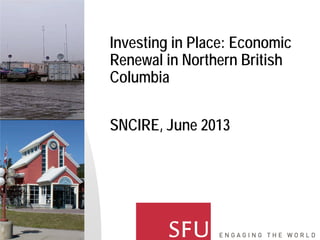
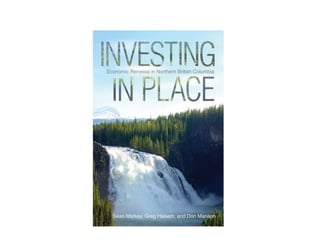
Investing in Place: Economic
Renewal in Northern British
Columbia
SNCIRE, June 2013
My Research in the NW
• New Economic Vision: 2003-2005
• Planning to Implementation: 2005-2006
• Industry Impact and Benefits: 2008-2012
• NEV II: 2009-2010
• Greg Halseth, Don Manson, Laura Ryser at
the Community Development Institute at
UNBC.
Outline
1. Rural BC in Context
2. Solutions in Community
3. Solutions in Region
4. Solutions in Industry
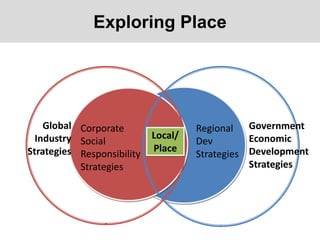
Exploring Place
Regional
Dev
Strategies
Corporate
Social
Responsibility
Strategies
Global
Industry
Strategies
Local/
Place
Government
Economic
Development
Strategies
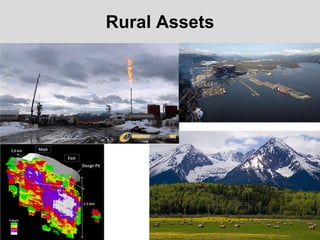
Rural Assets
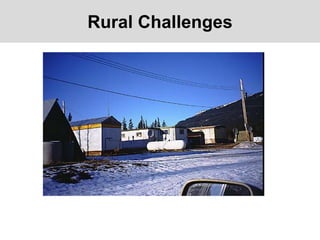
Rural Challenges
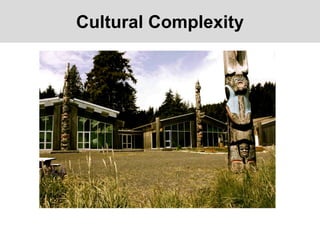
Cultural Complexity
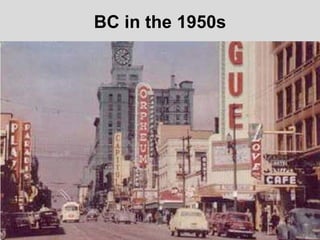
BC in the 1950s
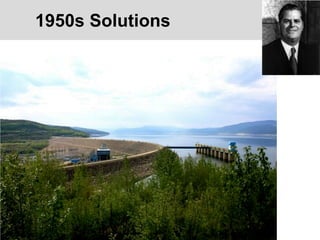
1950s Solutions
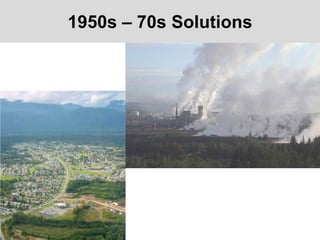
1950s – 70s Solutions
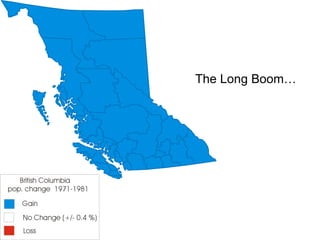
The Long Boom…
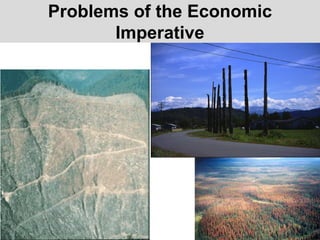
Problems of the Economic
Imperative
Space Economy
• Post-WWII Resource Boom
– Access to resources - “open the north”
– Connect producing areas to export points
– Significant (coordinated) infrastructure
investment
• Exploit Comparative Advantage
• Capital and community (uniform);
social relations stabilize industry
Space Restructuring
• Early 1980s recession
• Shift in Fordist compromise: flexibility
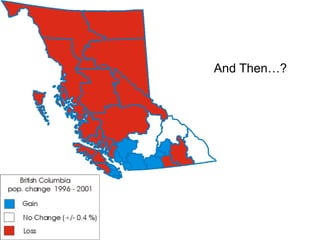
• Restructuring and population loss
• Continuation of resource wealth
extraction
• Severing of community linkages
• Removal of spatial commitment to
equity
And Then…?
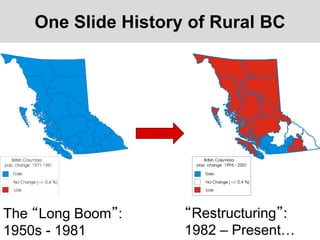
One Slide History of Rural BC
The “Long Boom”:
1950s - 1981
“Restructuring”:
1982 – Present…
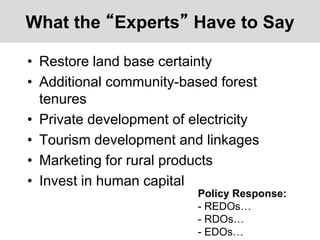
What the “Experts” Have to Say
• Restore land base certainty
• Additional community-based forest
tenures
• Private development of electricity
• Tourism development and linkages
• Marketing for rural products
• Invest in human capital
Policy Response:
- REDOs…
- RDOs…
- EDOs…
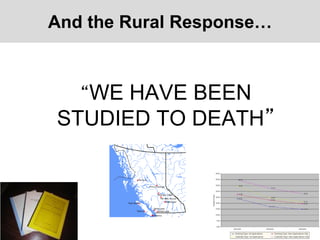
And the Rural Response…
“WE HAVE BEEN
STUDIED TO DEATH”
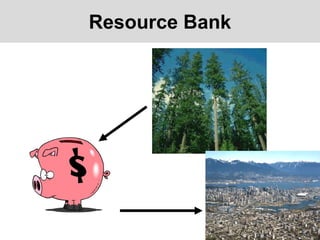
Resource Bank
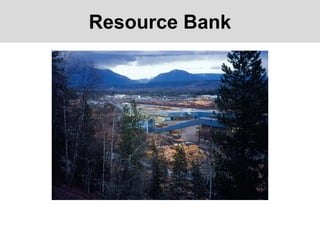
Resource Bank
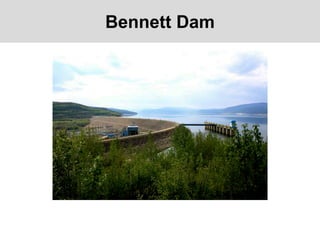
Bennett Dam
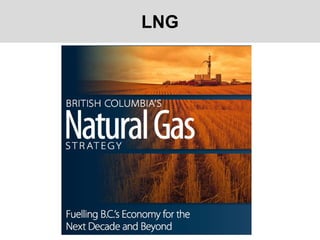
LNG
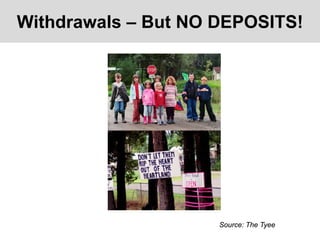
Withdrawals – But NO DEPOSITS!
Source: The Tyee
SOLUTIONS IN…
COMMUNITY
Defining “Place”
►Place-based development is a holistic
and targeted intervention that seeks to
reveal, utilize and enhance the unique
natural, physical, and/or human
capacity endowments present within a
particular location for the development
of the community or region...
►Thank you, academia…
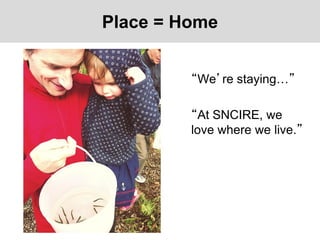
Place = Home
• “We’re staying…”
• “At SNCIRE, we
love where we live.”
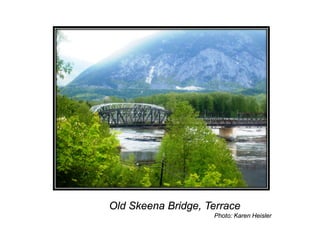
Old Skeena Bridge, Terrace
Photo: Karen Heisler
Place Economy
• Place Economy
– Shift from comparative to competitive
advantage
– Place-based policy/planning: Territorial
–Community and regional
development
–Integrated planning
• Challenge:
–Enabling vs. Abandonment Policy
Context
–Capacity variability
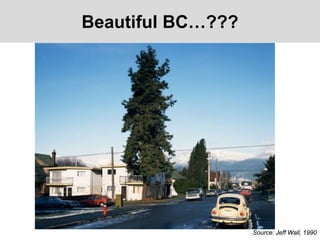
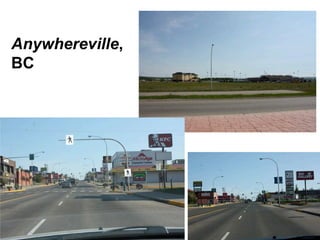
Beautiful BC…???
Source: Jeff Wall, 1990
Anywhereville,
BC
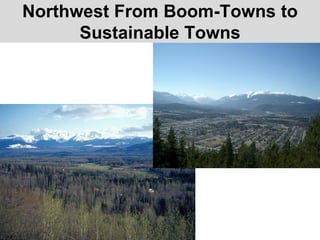
Northwest From Boom-Towns to
Sustainable Towns
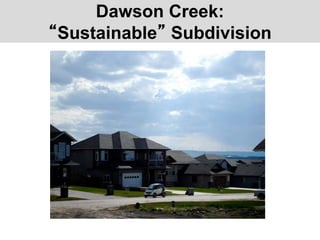
Dawson Creek:
“Sustainable” Subdivision
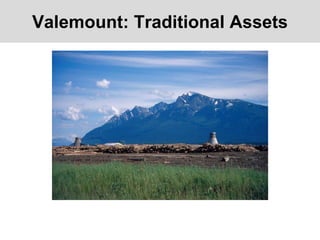
Valemount: Traditional Assets
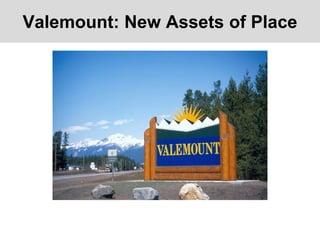
Valemount: New Assets of Place
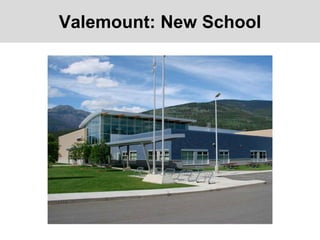
Valemount: New School
SOLUTIONS IN…
REGION
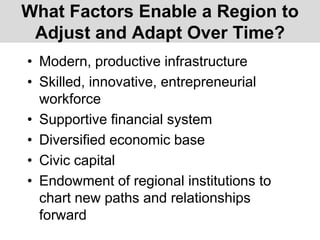
What Factors Enable a Region to
Adjust and Adapt Over Time?
• Modern, productive infrastructure
• Skilled, innovative, entrepreneurial
workforce
• Supportive financial system
• Diversified economic base
• Civic capital
• Endowment of regional institutions to
chart new paths and relationships
forward
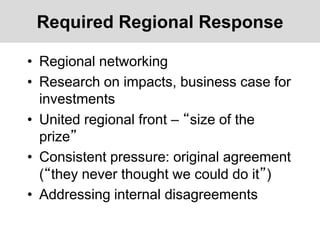
Required Regional Response
• Regional networking
• Research on impacts, business case for
investments
• United regional front – “size of the
prize”
• Consistent pressure: original agreement
(“they never thought we could do it”)
• Addressing internal disagreements
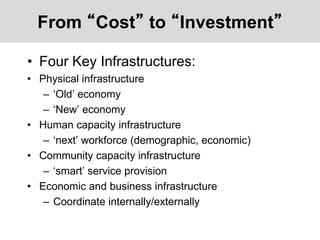
From “Cost” to “Investment”
• Four Key Infrastructures:
• Physical infrastructure
– ‘Old’ economy
– ‘New’ economy
• Human capacity infrastructure
– ‘next’ workforce (demographic, economic)
• Community capacity infrastructure
– ‘smart’ service provision
• Economic and business infrastructure
– Coordinate internally/externally
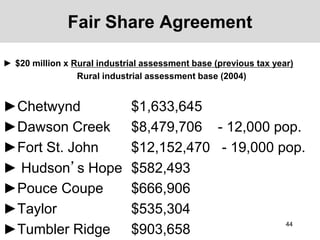
Fair Share Agreement
► $20 million x Rural industrial assessment base (previous tax year)
Rural industrial assessment base (2004)
►Chetwynd $1,633,645
►Dawson Creek $8,479,706 - 12,000 pop.
►Fort St. John $12,152,470 - 19,000 pop.
► Hudson’s Hope $582,493
►Pouce Coupe $666,906
►Taylor $535,304
►Tumbler Ridge $903,658
44
Benefits…
The recession allowed us to catch our breath, but
it didn’t really slow down much (Peace River
Business Representative).
What [the industrial tax base] does for regional
governance is it takes money out of the equation. And
when money is not part of the decision equation it makes
service decisions a lot easier. We talk about what the
services, what level of service you want to provide, how
you’re going to provide it, and then the last question is
how you’re going to pay for it. (Peace River Government
Representative).
Jurisdiction
Our biggest issue is that we are a product of the Province.
We get our authority through the Community Charter and
Municipal act – below six inches we have no authority, no
power, no say. It is frustrating for our elected official
because the local government only has authority to plan on
private land, but not crown land. The oil and gas sector
purchase subsurface rights – access across surface rights
to access this. We only have planning authority over private
lands and not crown or sub-surface, so as much as we
would like to plan for oil and gas, we have no jurisdiction.
(Peace River Government Representative).
Rapid Boom - Bust
You would like to think there is a master plan out there
for companies, but it is such a shot in the dark type
business. It is getting a little better, but it is still a shot in
the dark. There is no master plan out there, it is like an
amoeba, it just grows. It’s sorta weird, you would like to
think there is a plan, but there isn’t. (Peace River
Government Representative)
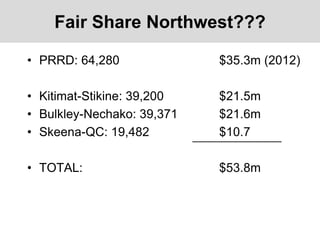
Fair Share Northwest???
• PRRD: 64,280 $35.3m (2012)
• Kitimat-Stikine: 39,200 $21.5m
• Bulkley-Nechako: 39,371 $21.6m
• Skeena-QC: 19,482 $10.7
• TOTAL: $53.8m
_______________
“We only have the
capacity to work with
the willing…”
BC Government Representative
SOLUTIONS IN…
INDUSTRY
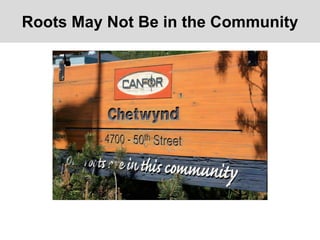
Roots May Not Be in the Community
Separating Industry-Community
►Camp Versus Town Costs
►Restructuring in the Resource Sector
►Limitations of Resource Towns and
Worker Preferences
►Demographic dynamics
►Changes in Regulatory Environments
►Labour Supply
►Location of resources…
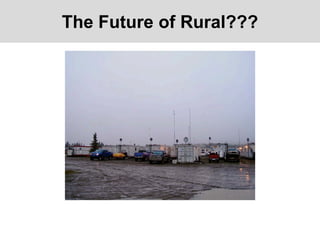
The Future of Rural???
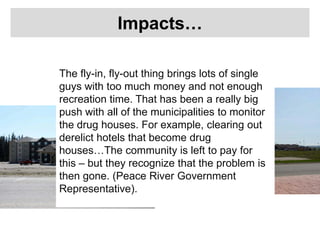
Impacts…
The fly-in, fly-out thing brings lots of single
guys with too much money and not enough
recreation time. That has been a really big
push with all of the municipalities to monitor
the drug houses. For example, clearing out
derelict hotels that become drug
houses…The community is left to pay for
this – but they recognize that the problem is
then gone. (Peace River Government
Representative).
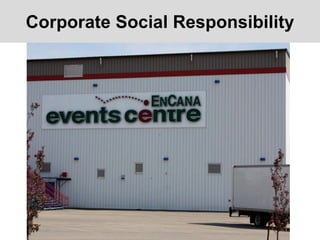
Corporate Social Responsibility
Implications: CSR
• CSR as neoliberal (non)policy response?
• Companies are selectively distributing
benefits to specific communities as strategic
business investments to secure support for
their projects, rather than distributing benefits
equitably to all impacted communities
throughout the region
• Jurisdictional confusion, frustration (First
Nation, municipal, regional, provincial,
federal)
Shared Wealth
• Advance CSR to fully reconceived
business model
• Investment Mentality:
– Transportation infrastructure
– Local training
– Productivity and quality of local businesses
– Long-term security of ecosystem integrity
• Driven by self-interest!
Key Messages
• You’re not alone
• Vision / Coordinated Policy / Investment
vs. Resource Bank
• Regional Collaboration is Everything
• CSR, social license is NOT Enough
• You have more power than you think
you do
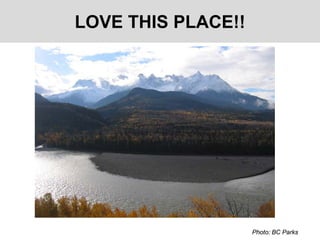
Photo: BC Parks
LOVE THIS PLACE!!
Thank You
Sean Markey
Simon Fraser University
spmarkey@sfu.ca

Investing in Place: Economic Renewal in N BC

  • 1.
    Investing in Place:Economic Renewal in Northern British Columbia SNCIRE, June 2013
  • 2.
    My Research inthe NW • New Economic Vision: 2003-2005 • Planning to Implementation: 2005-2006 • Industry Impact and Benefits: 2008-2012 • NEV II: 2009-2010 • Greg Halseth, Don Manson, Laura Ryser at the Community Development Institute at UNBC.
  • 3.
    Outline 1. Rural BCin Context 2. Solutions in Community 3. Solutions in Region 4. Solutions in Industry
  • 5.
  • 6.
  • 7.
  • 8.
  • 9.
    BC in the1950s
  • 10.
  • 11.
    1950s – 70sSolutions
  • 12.
  • 13.
    Problems of theEconomic Imperative
  • 14.
    Space Economy • Post-WWIIResource Boom – Access to resources - “open the north” – Connect producing areas to export points – Significant (coordinated) infrastructure investment • Exploit Comparative Advantage • Capital and community (uniform); social relations stabilize industry
  • 15.
    Space Restructuring • Early1980s recession • Shift in Fordist compromise: flexibility • Restructuring and population loss • Continuation of resource wealth extraction • Severing of community linkages • Removal of spatial commitment to equity
  • 16.
  • 19.
    One Slide Historyof Rural BC The “Long Boom”: 1950s - 1981 “Restructuring”: 1982 – Present…
  • 20.
    What the “Experts”Have to Say • Restore land base certainty • Additional community-based forest tenures • Private development of electricity • Tourism development and linkages • Marketing for rural products • Invest in human capital Policy Response: - REDOs… - RDOs… - EDOs…
  • 21.
    And the RuralResponse… “WE HAVE BEEN STUDIED TO DEATH”
  • 22.
  • 23.
  • 24.
  • 25.
  • 26.
    Withdrawals – ButNO DEPOSITS! Source: The Tyee
  • 27.
  • 28.
    Defining “Place” ►Place-based developmentis a holistic and targeted intervention that seeks to reveal, utilize and enhance the unique natural, physical, and/or human capacity endowments present within a particular location for the development of the community or region... ►Thank you, academia…
  • 29.
    Place = Home •“We’re staying…” • “At SNCIRE, we love where we live.”
  • 30.
    Old Skeena Bridge,Terrace Photo: Karen Heisler
  • 31.
    Place Economy • PlaceEconomy – Shift from comparative to competitive advantage – Place-based policy/planning: Territorial –Community and regional development –Integrated planning • Challenge: –Enabling vs. Abandonment Policy Context –Capacity variability
  • 32.
  • 33.
  • 35.
    Northwest From Boom-Townsto Sustainable Towns
  • 36.
  • 37.
  • 38.
  • 39.
  • 40.
  • 41.
    What Factors Enablea Region to Adjust and Adapt Over Time? • Modern, productive infrastructure • Skilled, innovative, entrepreneurial workforce • Supportive financial system • Diversified economic base • Civic capital • Endowment of regional institutions to chart new paths and relationships forward
  • 42.
    Required Regional Response •Regional networking • Research on impacts, business case for investments • United regional front – “size of the prize” • Consistent pressure: original agreement (“they never thought we could do it”) • Addressing internal disagreements
  • 43.
    From “Cost” to“Investment” • Four Key Infrastructures: • Physical infrastructure – ‘Old’ economy – ‘New’ economy • Human capacity infrastructure – ‘next’ workforce (demographic, economic) • Community capacity infrastructure – ‘smart’ service provision • Economic and business infrastructure – Coordinate internally/externally
  • 44.
    Fair Share Agreement ►$20 million x Rural industrial assessment base (previous tax year) Rural industrial assessment base (2004) ►Chetwynd $1,633,645 ►Dawson Creek $8,479,706 - 12,000 pop. ►Fort St. John $12,152,470 - 19,000 pop. ► Hudson’s Hope $582,493 ►Pouce Coupe $666,906 ►Taylor $535,304 ►Tumbler Ridge $903,658 44
  • 45.
    Benefits… The recession allowedus to catch our breath, but it didn’t really slow down much (Peace River Business Representative). What [the industrial tax base] does for regional governance is it takes money out of the equation. And when money is not part of the decision equation it makes service decisions a lot easier. We talk about what the services, what level of service you want to provide, how you’re going to provide it, and then the last question is how you’re going to pay for it. (Peace River Government Representative).
  • 46.
    Jurisdiction Our biggest issueis that we are a product of the Province. We get our authority through the Community Charter and Municipal act – below six inches we have no authority, no power, no say. It is frustrating for our elected official because the local government only has authority to plan on private land, but not crown land. The oil and gas sector purchase subsurface rights – access across surface rights to access this. We only have planning authority over private lands and not crown or sub-surface, so as much as we would like to plan for oil and gas, we have no jurisdiction. (Peace River Government Representative).
  • 47.
    Rapid Boom -Bust You would like to think there is a master plan out there for companies, but it is such a shot in the dark type business. It is getting a little better, but it is still a shot in the dark. There is no master plan out there, it is like an amoeba, it just grows. It’s sorta weird, you would like to think there is a plan, but there isn’t. (Peace River Government Representative)
  • 48.
    Fair Share Northwest??? •PRRD: 64,280 $35.3m (2012) • Kitimat-Stikine: 39,200 $21.5m • Bulkley-Nechako: 39,371 $21.6m • Skeena-QC: 19,482 $10.7 • TOTAL: $53.8m _______________
  • 49.
    “We only havethe capacity to work with the willing…” BC Government Representative
  • 50.
  • 51.
    Roots May NotBe in the Community
  • 52.
    Separating Industry-Community ►Camp VersusTown Costs ►Restructuring in the Resource Sector ►Limitations of Resource Towns and Worker Preferences ►Demographic dynamics ►Changes in Regulatory Environments ►Labour Supply ►Location of resources…
  • 53.
    The Future ofRural???
  • 54.
    Impacts… The fly-in, fly-outthing brings lots of single guys with too much money and not enough recreation time. That has been a really big push with all of the municipalities to monitor the drug houses. For example, clearing out derelict hotels that become drug houses…The community is left to pay for this – but they recognize that the problem is then gone. (Peace River Government Representative).
  • 55.
  • 56.
    Implications: CSR • CSRas neoliberal (non)policy response? • Companies are selectively distributing benefits to specific communities as strategic business investments to secure support for their projects, rather than distributing benefits equitably to all impacted communities throughout the region • Jurisdictional confusion, frustration (First Nation, municipal, regional, provincial, federal)
  • 57.
    Shared Wealth • AdvanceCSR to fully reconceived business model • Investment Mentality: – Transportation infrastructure – Local training – Productivity and quality of local businesses – Long-term security of ecosystem integrity • Driven by self-interest!
  • 58.
    Key Messages • You’renot alone • Vision / Coordinated Policy / Investment vs. Resource Bank • Regional Collaboration is Everything • CSR, social license is NOT Enough • You have more power than you think you do
  • 59.
  • 60.
    Thank You Sean Markey SimonFraser University spmarkey@sfu.ca