A.B. COLLEGE OF ARCHITECTURE
FINAL YEAR B.ARCH DIVISION – B
SUBJECT – B.TECH. (MATERIALS)
TOPIC – MASTIC SEALANTS
GROUP MEMBERS - 26. Siddhi Punekar
27. Sahil Sabale
28. Neha Sankpal
29. Nikita Sargar
30. Tanvi Shah
31. Nitika Shinde
32. Khushi Singh
33. Sahil Valse
34. Piyusha Yallatti
What are Sealants?
Properties of a Good Sealant
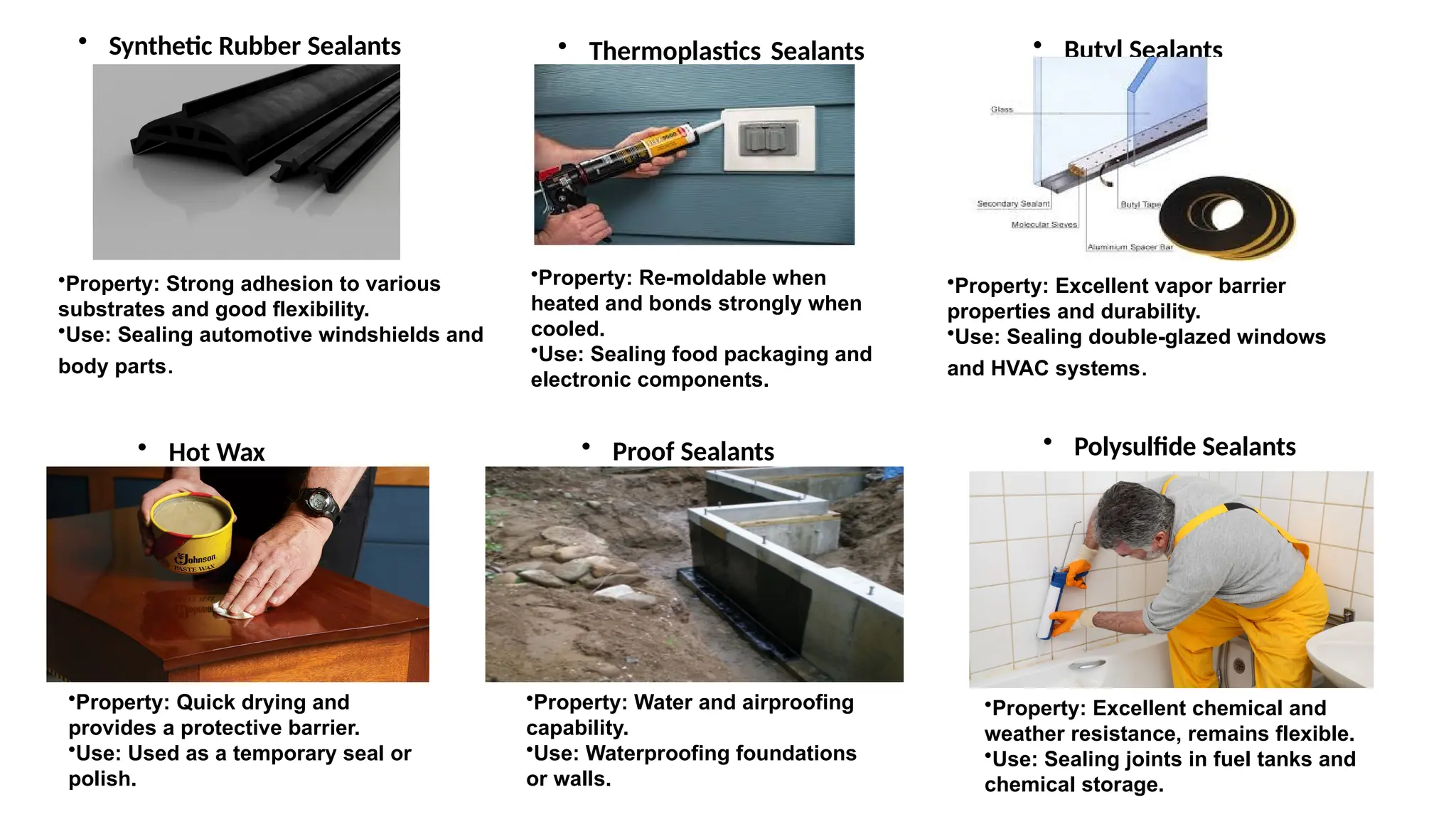
Types of Sealants
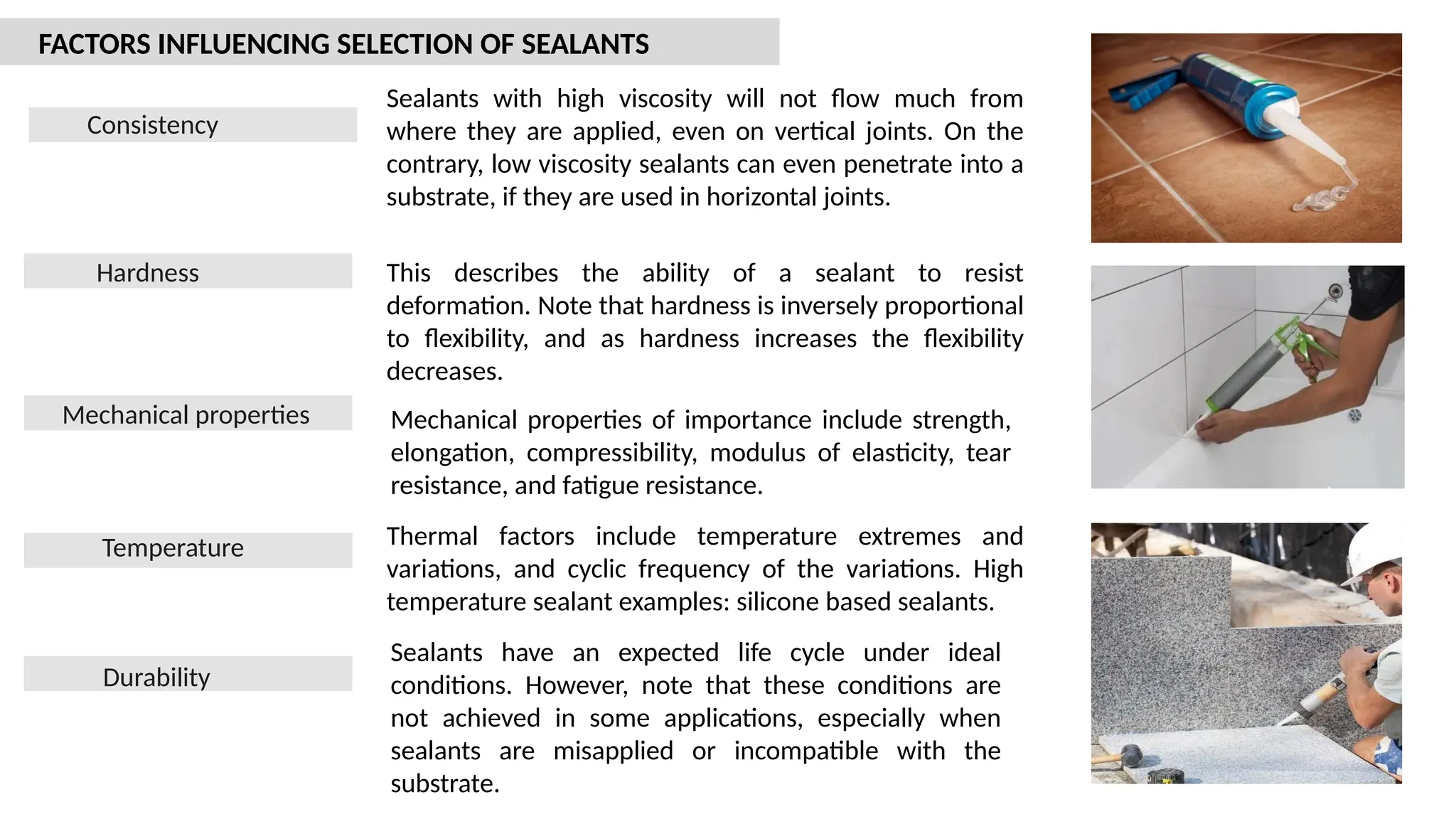
Factors influencing selection of sealants
Application of sealants
Advantages and Disadvantages
Production companies of sealants
POINTS TO BE COVERED
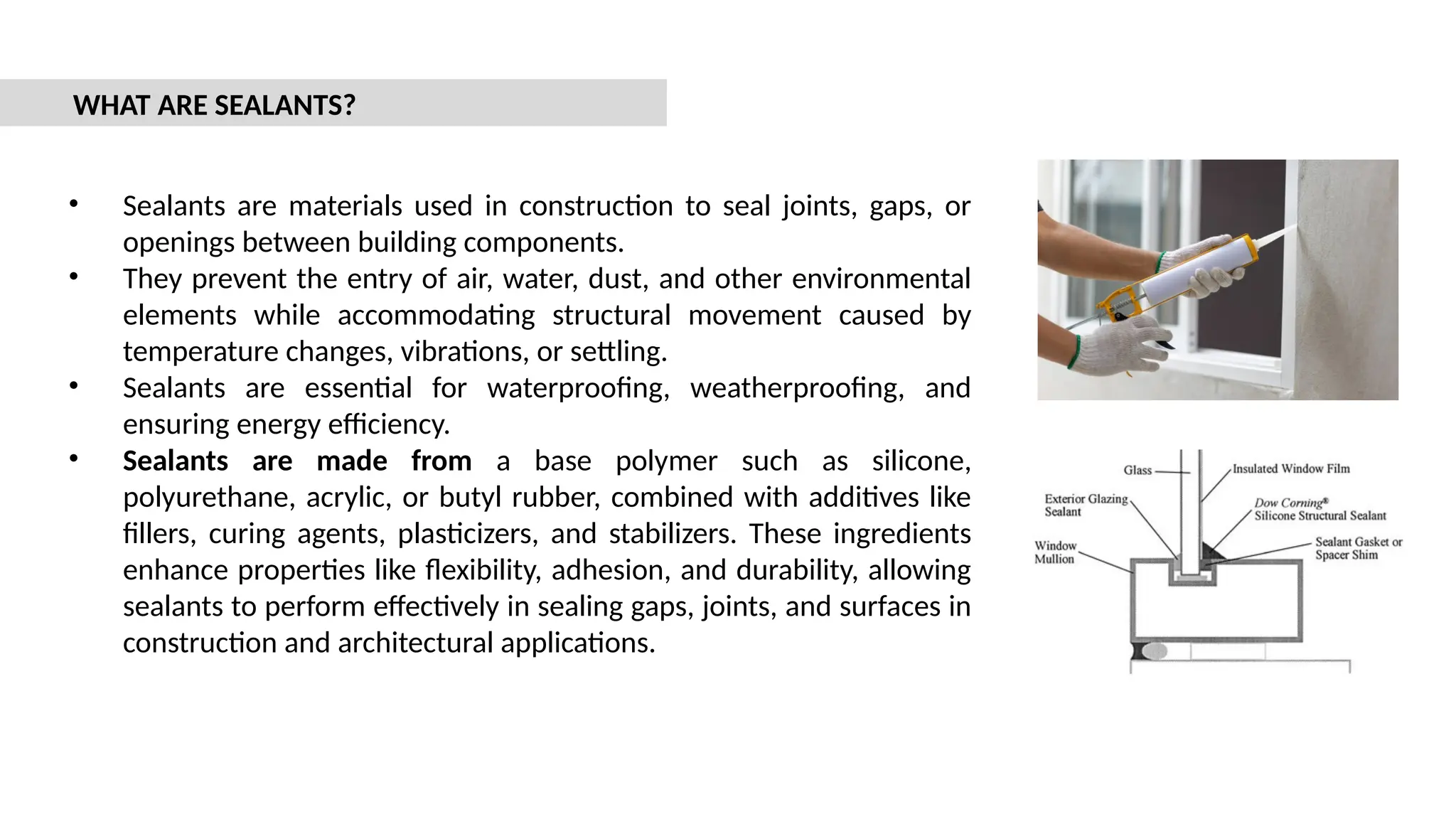
• Sealants are materials used in construction to seal joints, gaps, or
openings between building components.
• They prevent the entry of air, water, dust, and other environmental
elements while accommodating structural movement caused by
temperature changes, vibrations, or settling.
• Sealants are essential for waterproofing, weatherproofing, and
ensuring energy efficiency.
• Sealants are made from a base polymer such as silicone,
polyurethane, acrylic, or butyl rubber, combined with additives like
fillers, curing agents, plasticizers, and stabilizers. These ingredients
enhance properties like flexibility, adhesion, and durability, allowing
sealants to perform effectively in sealing gaps, joints, and surfaces in
construction and architectural applications.
WHAT ARE SEALANTS?
1. Adhesion:
The ability to bond strongly to various materials (e.g., concrete, metal, glass) for a durable seal.
2. Elasticity:
Flexibility to stretch, compress, or deform without breaking, crucial for accommodating structural movements.
3. Durability:
Long-lasting performance, even under harsh environmental conditions like UV exposure, rain, and temperature
fluctuations.
4. Waterproofing:
Creates a watertight seal to prevent water penetration, essential for both interior and exterior applications.
5. UV Resistance:
Withstands prolonged exposure to sunlight without degrading, cracking, or discoloring.
6. Chemical Resistance:
Resists oils, solvents, and other chemicals, making it suitable for industrial and specialized applications.
7. Non-Sagging:
Retains its position on vertical or overhead surfaces during application and curing.
8. Low Shrinkage:
Maintains its original volume after curing to ensure a consistent and effective seal.
9. Movement Capability:
Accommodates expansion and contraction of materials without losing adhesion or cracking.
10. Thermal Stability:
Performs effectively across a wide temperature range, maintaining flexibility and adhesion in both hot and cold
conditions.
PROPERTIES OF A GOOD SEALANT
TYPES OF CONSTRUCTION SEALANTS
• Silicone Sealants • Epoxy • Hybrid Polyurethanes Sealants • Elastic Sealants
•Property: Highly flexible and
weather-resistant.
•Use: Ideal for sealing glass
in windows and doors.
•Property: High strength and
chemical resistance.
•Use: Bonding metals,
ceramics, and concrete.
•Property: Combines flexibility and
durability with excellent adhesion.
•Use: Waterproofing and sealing
expansion joints in construction.
•Property: Excellent elongation and
elasticity, allowing movement without
cracking.
•Use: Sealing dynamic joints, such as
those in prefabricated structures.
• Varnish
•Property: Provides a glossy finish and
protects surfaces from moisture and UV.
•Use: Coating wooden surfaces like furniture
or flooring.
• Acrylic Latex Sealants
•Property: Paintable and easy to clean
with water.
•Use: Sealing cracks and gaps in
drywall or woodwork.
• Bituminous Sealants
•Property: Excellent water resistance and
durability under harsh conditions.
•Use: Waterproofing roofs and sealing
cracks in asphalt.
• Synthetic Rubber Sealants • Thermoplastics Sealants • Butyl Sealants
• Hot Wax • Proof Sealants • Polysulfide Sealants
•Property: Strong adhesion to various
substrates and good flexibility.
•Use: Sealing automotive windshields and
body parts.
•Property: Re-moldable when
heated and bonds strongly when
cooled.
•Use: Sealing food packaging and
electronic components.
•Property: Excellent vapor barrier
properties and durability.
•Use: Sealing double-glazed windows
and HVAC systems.
•Property: Quick drying and
provides a protective barrier.
•Use: Used as a temporary seal or
polish.
•Property: Water and airproofing
capability.
•Use: Waterproofing foundations
or walls.
•Property: Excellent chemical and
weather resistance, remains flexible.
•Use: Sealing joints in fuel tanks and
chemical storage.
Consistency
Hardness
Mechanical properties
Temperature
Durability
Sealants with high viscosity will not flow much from
where they are applied, even on vertical joints. On the
contrary, low viscosity sealants can even penetrate into a
substrate, if they are used in horizontal joints.
This describes the ability of a sealant to resist
deformation. Note that hardness is inversely proportional
to flexibility, and as hardness increases the flexibility
decreases.
Mechanical properties of importance include strength,
elongation, compressibility, modulus of elasticity, tear
resistance, and fatigue resistance.
Thermal factors include temperature extremes and
variations, and cyclic frequency of the variations. High
temperature sealant examples: silicone based sealants.
Sealants have an expected life cycle under ideal
conditions. However, note that these conditions are
not achieved in some applications, especially when
sealants are misapplied or incompatible with the
substrate.
FACTORS INFLUENCING SELECTION OF SEALANTS
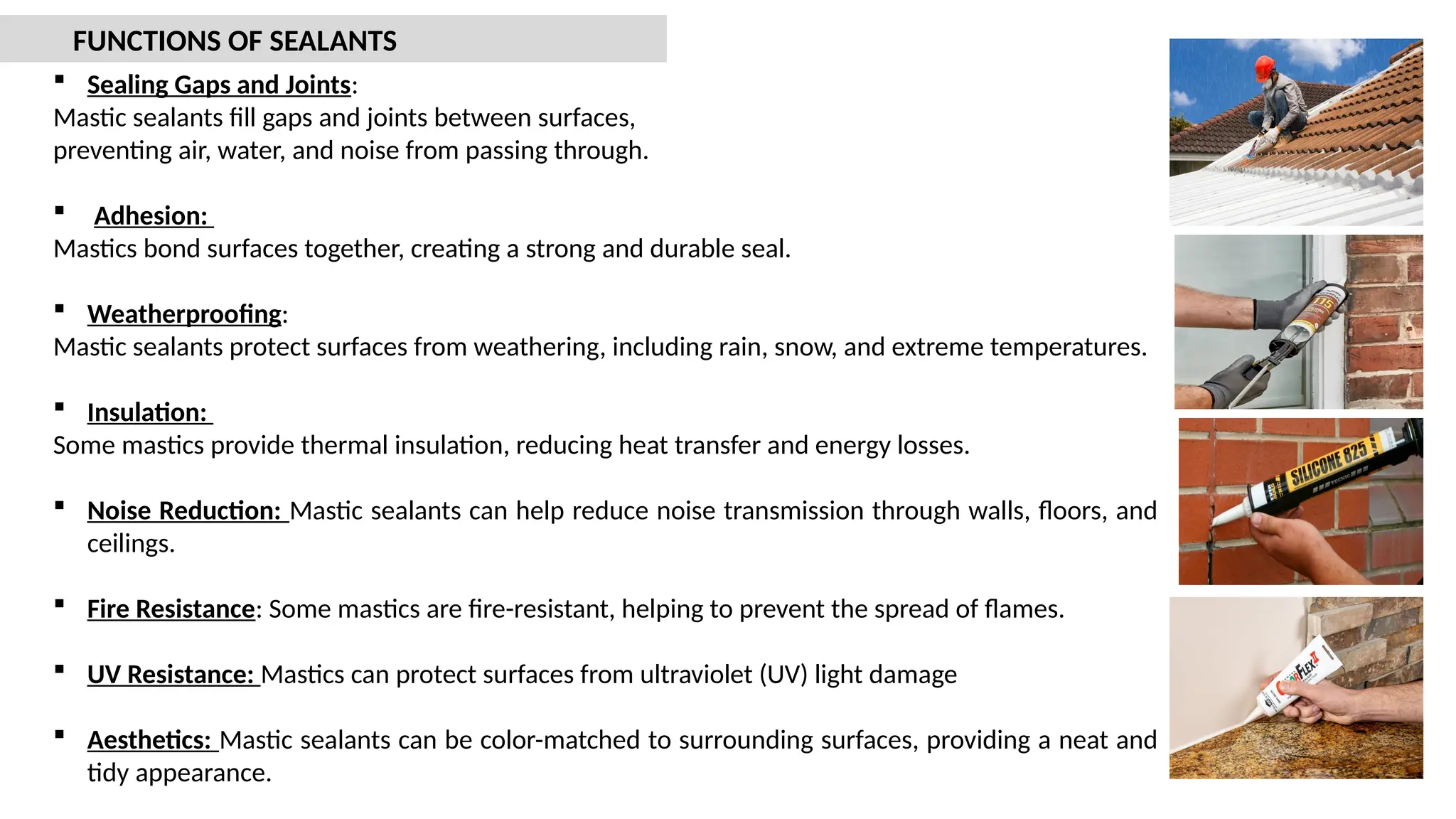
 Sealing Gaps and Joints:
Mastic sealants fill gaps and joints between surfaces,
preventing air, water, and noise from passing through.
 Adhesion:
Mastics bond surfaces together, creating a strong and durable seal.
 Weatherproofing:
Mastic sealants protect surfaces from weathering, including rain, snow, and extreme temperatures.
 Insulation:
Some mastics provide thermal insulation, reducing heat transfer and energy losses.
 Noise Reduction: Mastic sealants can help reduce noise transmission through walls, floors, and
ceilings.
 Fire Resistance: Some mastics are fire-resistant, helping to prevent the spread of flames.
 UV Resistance: Mastics can protect surfaces from ultraviolet (UV) light damage
 Aesthetics: Mastic sealants can be color-matched to surrounding surfaces, providing a neat and
tidy appearance.
FUNCTIONS OF SEALANTS
PRODUCTION COMPANIES OF SEALANTS
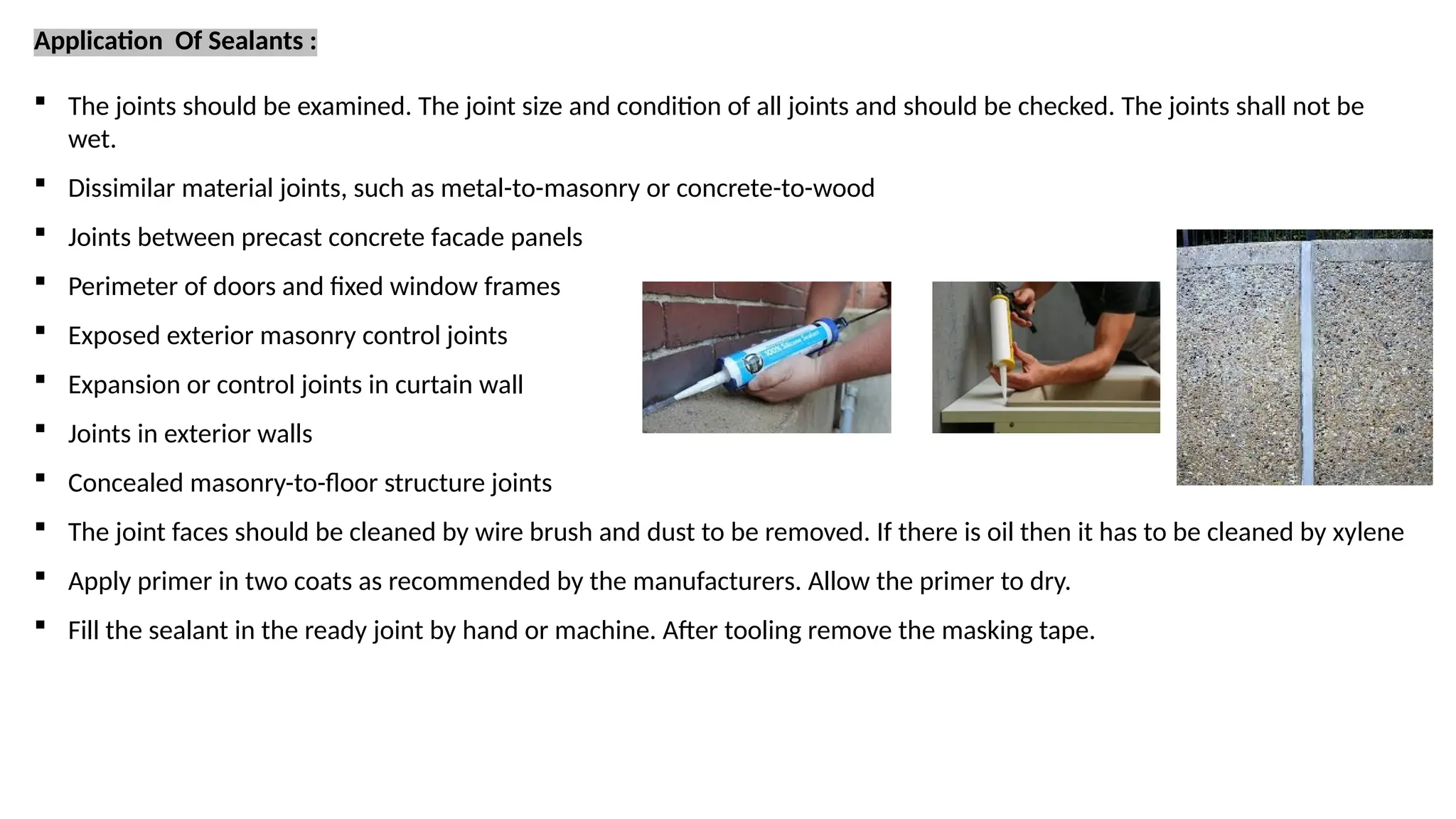
Application Of Sealants :
 The joints should be examined. The joint size and condition of all joints and should be checked. The joints shall not be
wet.
 Dissimilar material joints, such as metal-to-masonry or concrete-to-wood
 Joints between precast concrete facade panels
 Perimeter of doors and fixed window frames
 Exposed exterior masonry control joints
 Expansion or control joints in curtain wall
 Joints in exterior walls
 Concealed masonry-to-floor structure joints
 The joint faces should be cleaned by wire brush and dust to be removed. If there is oil then it has to be cleaned by xylene
 Apply primer in two coats as recommended by the manufacturers. Allow the primer to dry.
 Fill the sealant in the ready joint by hand or machine. After tooling remove the masking tape.
Advantages
• Improves Product Durability and Reliability.
• Increases Product Performance.
• Increases Design Flexibility,
• Improves Process Productivity and Reduced
Manufacturing Costs
• Increases weathering characteristics.
• Extreme temperature resistance
• Enhances Product Aesthetics.
Advantages And Disadvantages Of Sealants
Disadvantages
Deterioration from Weather: Sealants can break
down when exposed to water, sunlight, or freezing
Wrong Sealant or Poor Design: Using the wrong
type of sealant or not designing the joint properly
can cause the sealant to fail and lose its grip.
•Uncured Sealant: If the sealant isn't mixed
correctly or is too old, it won't set properly and will
lose its ability to stick, causing the joint to fail.
•Bubbles or Blisters: If air or moisture gets trapped
inside the sealant, it can cause the surface to bubble
or blister, which makes it lose its bond and fail.

SEALANTS for architecture organisation and

  • 1.
    A.B. COLLEGE OFARCHITECTURE FINAL YEAR B.ARCH DIVISION – B SUBJECT – B.TECH. (MATERIALS) TOPIC – MASTIC SEALANTS GROUP MEMBERS - 26. Siddhi Punekar 27. Sahil Sabale 28. Neha Sankpal 29. Nikita Sargar 30. Tanvi Shah 31. Nitika Shinde 32. Khushi Singh 33. Sahil Valse 34. Piyusha Yallatti
  • 2.
    What are Sealants? Propertiesof a Good Sealant Types of Sealants Factors influencing selection of sealants Application of sealants Advantages and Disadvantages Production companies of sealants POINTS TO BE COVERED
  • 3.
    • Sealants arematerials used in construction to seal joints, gaps, or openings between building components. • They prevent the entry of air, water, dust, and other environmental elements while accommodating structural movement caused by temperature changes, vibrations, or settling. • Sealants are essential for waterproofing, weatherproofing, and ensuring energy efficiency. • Sealants are made from a base polymer such as silicone, polyurethane, acrylic, or butyl rubber, combined with additives like fillers, curing agents, plasticizers, and stabilizers. These ingredients enhance properties like flexibility, adhesion, and durability, allowing sealants to perform effectively in sealing gaps, joints, and surfaces in construction and architectural applications. WHAT ARE SEALANTS?
  • 4.
    1. Adhesion: The abilityto bond strongly to various materials (e.g., concrete, metal, glass) for a durable seal. 2. Elasticity: Flexibility to stretch, compress, or deform without breaking, crucial for accommodating structural movements. 3. Durability: Long-lasting performance, even under harsh environmental conditions like UV exposure, rain, and temperature fluctuations. 4. Waterproofing: Creates a watertight seal to prevent water penetration, essential for both interior and exterior applications. 5. UV Resistance: Withstands prolonged exposure to sunlight without degrading, cracking, or discoloring. 6. Chemical Resistance: Resists oils, solvents, and other chemicals, making it suitable for industrial and specialized applications. 7. Non-Sagging: Retains its position on vertical or overhead surfaces during application and curing. 8. Low Shrinkage: Maintains its original volume after curing to ensure a consistent and effective seal. 9. Movement Capability: Accommodates expansion and contraction of materials without losing adhesion or cracking. 10. Thermal Stability: Performs effectively across a wide temperature range, maintaining flexibility and adhesion in both hot and cold conditions. PROPERTIES OF A GOOD SEALANT
  • 5.
    TYPES OF CONSTRUCTIONSEALANTS • Silicone Sealants • Epoxy • Hybrid Polyurethanes Sealants • Elastic Sealants •Property: Highly flexible and weather-resistant. •Use: Ideal for sealing glass in windows and doors. •Property: High strength and chemical resistance. •Use: Bonding metals, ceramics, and concrete. •Property: Combines flexibility and durability with excellent adhesion. •Use: Waterproofing and sealing expansion joints in construction. •Property: Excellent elongation and elasticity, allowing movement without cracking. •Use: Sealing dynamic joints, such as those in prefabricated structures. • Varnish •Property: Provides a glossy finish and protects surfaces from moisture and UV. •Use: Coating wooden surfaces like furniture or flooring. • Acrylic Latex Sealants •Property: Paintable and easy to clean with water. •Use: Sealing cracks and gaps in drywall or woodwork. • Bituminous Sealants •Property: Excellent water resistance and durability under harsh conditions. •Use: Waterproofing roofs and sealing cracks in asphalt.
  • 6.
    • Synthetic RubberSealants • Thermoplastics Sealants • Butyl Sealants • Hot Wax • Proof Sealants • Polysulfide Sealants •Property: Strong adhesion to various substrates and good flexibility. •Use: Sealing automotive windshields and body parts. •Property: Re-moldable when heated and bonds strongly when cooled. •Use: Sealing food packaging and electronic components. •Property: Excellent vapor barrier properties and durability. •Use: Sealing double-glazed windows and HVAC systems. •Property: Quick drying and provides a protective barrier. •Use: Used as a temporary seal or polish. •Property: Water and airproofing capability. •Use: Waterproofing foundations or walls. •Property: Excellent chemical and weather resistance, remains flexible. •Use: Sealing joints in fuel tanks and chemical storage.
  • 7.
    Consistency Hardness Mechanical properties Temperature Durability Sealants withhigh viscosity will not flow much from where they are applied, even on vertical joints. On the contrary, low viscosity sealants can even penetrate into a substrate, if they are used in horizontal joints. This describes the ability of a sealant to resist deformation. Note that hardness is inversely proportional to flexibility, and as hardness increases the flexibility decreases. Mechanical properties of importance include strength, elongation, compressibility, modulus of elasticity, tear resistance, and fatigue resistance. Thermal factors include temperature extremes and variations, and cyclic frequency of the variations. High temperature sealant examples: silicone based sealants. Sealants have an expected life cycle under ideal conditions. However, note that these conditions are not achieved in some applications, especially when sealants are misapplied or incompatible with the substrate. FACTORS INFLUENCING SELECTION OF SEALANTS
  • 8.
     Sealing Gapsand Joints: Mastic sealants fill gaps and joints between surfaces, preventing air, water, and noise from passing through.  Adhesion: Mastics bond surfaces together, creating a strong and durable seal.  Weatherproofing: Mastic sealants protect surfaces from weathering, including rain, snow, and extreme temperatures.  Insulation: Some mastics provide thermal insulation, reducing heat transfer and energy losses.  Noise Reduction: Mastic sealants can help reduce noise transmission through walls, floors, and ceilings.  Fire Resistance: Some mastics are fire-resistant, helping to prevent the spread of flames.  UV Resistance: Mastics can protect surfaces from ultraviolet (UV) light damage  Aesthetics: Mastic sealants can be color-matched to surrounding surfaces, providing a neat and tidy appearance. FUNCTIONS OF SEALANTS
  • 9.
  • 10.
    Application Of Sealants:  The joints should be examined. The joint size and condition of all joints and should be checked. The joints shall not be wet.  Dissimilar material joints, such as metal-to-masonry or concrete-to-wood  Joints between precast concrete facade panels  Perimeter of doors and fixed window frames  Exposed exterior masonry control joints  Expansion or control joints in curtain wall  Joints in exterior walls  Concealed masonry-to-floor structure joints  The joint faces should be cleaned by wire brush and dust to be removed. If there is oil then it has to be cleaned by xylene  Apply primer in two coats as recommended by the manufacturers. Allow the primer to dry.  Fill the sealant in the ready joint by hand or machine. After tooling remove the masking tape.
  • 11.
    Advantages • Improves ProductDurability and Reliability. • Increases Product Performance. • Increases Design Flexibility, • Improves Process Productivity and Reduced Manufacturing Costs • Increases weathering characteristics. • Extreme temperature resistance • Enhances Product Aesthetics. Advantages And Disadvantages Of Sealants Disadvantages Deterioration from Weather: Sealants can break down when exposed to water, sunlight, or freezing Wrong Sealant or Poor Design: Using the wrong type of sealant or not designing the joint properly can cause the sealant to fail and lose its grip. •Uncured Sealant: If the sealant isn't mixed correctly or is too old, it won't set properly and will lose its ability to stick, causing the joint to fail. •Bubbles or Blisters: If air or moisture gets trapped inside the sealant, it can cause the surface to bubble or blister, which makes it lose its bond and fail.