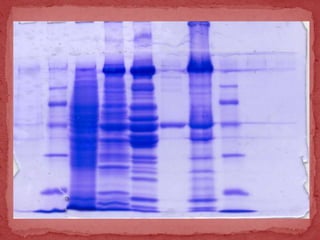
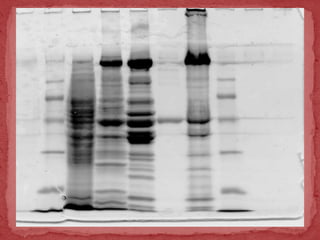
 Sodium dodecylsulphate-polyacrylamide
gel electrophoresis
 Method for separation of proteins according
to their molecular weight
 Determine protein size
 Identify protein
 Determine sample purity
 Identify existence of disulfide bonds
 Quantify amounts of protein
 Extract Protein
 Solubilize and Denature Protein
 Separate Proteins on a gel
 Stain proteins (visualization)
 Analyze and interpret results
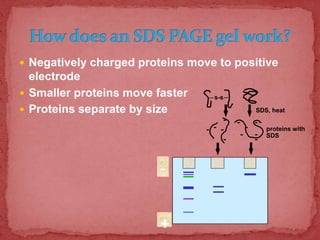
 Negatively charged proteins move to positive
electrode
 Smaller proteins move faster
 Proteins separate by size
-
+
s-s
SDS, heat
proteins with
SDS
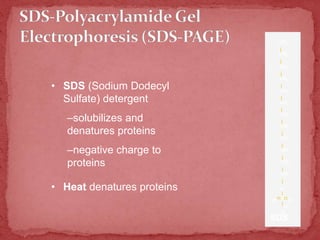
• SDS (Sodium Dodecyl
Sulfate) detergent
–solubilizes and
denatures proteins
–negative charge to
proteins
• Heat denatures proteins
O S O
O
O
-
CH2
CH2
CH2
CH2
CH2
CH2
CH2
CH2
CH2
CH2
CH2
CH3
SDS
 Negatively charged proteins move towards
the positive pole
 Migration of proteins:
-directly proportional to the overall charge of
proteins.
- inversely proportional to protein size
(molecular weight)
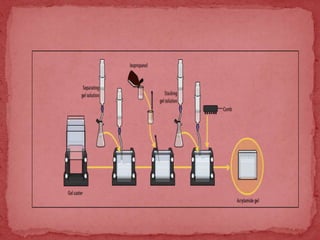
 The gels typically consist of acrylamide, bisacrylamide,
the optional denaturant (SDS or urea), and a buffer
with an adjusted pH.
 The solution may be degassed under a vacuum to
prevent the formation of air bubbles during
polymerization
 Alternatively, butanol may be added to the resolving
gel (for proteins) after it is poured, as butanol removes
bubbles and makes the surface smooth.
 A source of free radicals and a stabilizer, such
as ammonium persulfate and TEMED are added to
initiate polymerization
 The polymerization reaction creates a gel because of
the added bisacrylamide, which can form cross-links
between two polyacrylamide molecules
 The ratio of bisacrylamide to acrylamide can be varied
for special purposes, but is generally about 1 part in 35.
 The acrylamide concentration of the gel can also be
varied, generally in the range from 5% to 25%.
 Lower percentage gels are better for resolving very
high molecular weight molecules, while much
higher percentages are needed to resolve smaller
proteins.
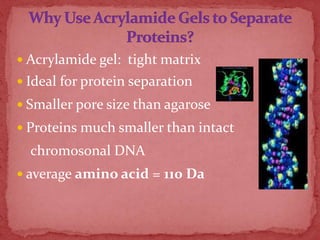
 Acrylamide gel: tight matrix
 Ideal for protein separation
 Smaller pore size than agarose
 Proteins much smaller than intact
chromosonal DNA
 average amino acid = 110 Da
Versatility in Identification
Low Cost to Use
Accuracy of Results
 Electrophorresis Has Limited Sample
Analysis
 Electrophoresis Measurements Are Not
Precise
 Only Certain Molecules Can Be Visualized
 Electrophoresis is Low Throughput

SDS PAGE SLIDESHOW POWERPOINT. SSSSSSSSS

  • 2.
     Sodium dodecylsulphate-polyacrylamide gelelectrophoresis  Method for separation of proteins according to their molecular weight
  • 3.
     Determine proteinsize  Identify protein  Determine sample purity  Identify existence of disulfide bonds  Quantify amounts of protein
  • 4.
     Extract Protein Solubilize and Denature Protein  Separate Proteins on a gel  Stain proteins (visualization)  Analyze and interpret results
  • 5.
     Negatively chargedproteins move to positive electrode  Smaller proteins move faster  Proteins separate by size - + s-s SDS, heat proteins with SDS
  • 6.
    • SDS (SodiumDodecyl Sulfate) detergent –solubilizes and denatures proteins –negative charge to proteins • Heat denatures proteins O S O O O - CH2 CH2 CH2 CH2 CH2 CH2 CH2 CH2 CH2 CH2 CH2 CH3 SDS
  • 7.
     Negatively chargedproteins move towards the positive pole  Migration of proteins: -directly proportional to the overall charge of proteins. - inversely proportional to protein size (molecular weight)
  • 8.
     The gelstypically consist of acrylamide, bisacrylamide, the optional denaturant (SDS or urea), and a buffer with an adjusted pH.  The solution may be degassed under a vacuum to prevent the formation of air bubbles during polymerization  Alternatively, butanol may be added to the resolving gel (for proteins) after it is poured, as butanol removes bubbles and makes the surface smooth.
  • 9.
     A sourceof free radicals and a stabilizer, such as ammonium persulfate and TEMED are added to initiate polymerization  The polymerization reaction creates a gel because of the added bisacrylamide, which can form cross-links between two polyacrylamide molecules  The ratio of bisacrylamide to acrylamide can be varied for special purposes, but is generally about 1 part in 35.  The acrylamide concentration of the gel can also be varied, generally in the range from 5% to 25%.
  • 10.
     Lower percentagegels are better for resolving very high molecular weight molecules, while much higher percentages are needed to resolve smaller proteins.
  • 12.
     Acrylamide gel:tight matrix  Ideal for protein separation  Smaller pore size than agarose  Proteins much smaller than intact chromosonal DNA  average amino acid = 110 Da
  • 16.
    Versatility in Identification LowCost to Use Accuracy of Results
  • 17.
     Electrophorresis HasLimited Sample Analysis  Electrophoresis Measurements Are Not Precise  Only Certain Molecules Can Be Visualized  Electrophoresis is Low Throughput