
S.Y. 2020-2021
NAVOTAS CITY PHILIPPINES
CREATIVE
WRITING
Quarter 2 – Module 4:
Explore different staging modalities
vis-a-vis envisioning the script
Creative Writing – Senior High School
Alternative Delivery Mode
Quarter 2 – Module 4: Explore different staging modalities vis-a-vis envisioning the
script.
First Edition, 2020
Republic Act 8293, section 176 states that: No copyright shall subsist in any work of
the Government of the Philippines. However, prior approval of the government agency or office
wherein the work is created shall be necessary for exploitation of such work for profit. Such
agency or office may, among other things, impose as a condition the payment of royalties.
Borrowed materials (i.e., songs, stories, poems, pictures, photos, brand names,
trademarks, etc.) included in this module are owned by their respective copyright holders.
Every effort has been exerted to locate and seek permission to use these materials from their
respective copyright owners. The publisher and authors do not represent nor claim ownership
over them.
Published by the Department of Education
Secretary: Leonor Magtolis Briones
Undersecretary: Diosdado M. San Antonio
Printed in the Philippines by ________________________
Department of Education – Navotas City
Office Address: BES Compound M. Naval St. Sipac-Almacen Navotas City
____________________________________________
Telefax: ____________________________________________
E-mail Address: ____________________________________________
Development Team of the Module
Writer: Paulynne P. Fule
Editor: Analisa I. Panaligan
Reviewers: Marco D. Meduranda
Illustrator:
Layout Artist: Paulynne P. Fule
Management Team: Alejandro G. Ibañez, OIC- Schools Division Superintendent
Isabelle S. Sibayan, OIC- Asst. Schools Division Superintendent
Loida O. Balasa, Chief, Curriculum Implementation Division
Marco D. Meduranda, EPS in English
Grace R. Nieves, EPS In Charge of LRMS
Lorena J. Mutas, ADM Coordinator
Editha O. Peregrino, Division SHS Focal Person
Shirley Eva Marie V. Mangaluz, Librarian II LRMS
Vergel Junior C. Eusebio, PDO II LRMS
02-8332-77-64
navotas.city@deped.gov.ph
CREATIVE
WRITING
Quarter 2 – Module 4:
Explore different staging modalities
vis-a-vis envisioning the script
ii
Introductory Message
For the facilitator:
Welcome to the Creative Writing for Senior High School Alternative Delivery Mode
(ADM) Module on Exploring different staging modalities vis-a-vis envisioning the
script.
This module was collaboratively designed, developed and reviewed by educators both
from public and private institutions to assist you, the teacher or facilitator in helping
the learners meet the standards set by the K to 12 Curriculum while overcoming
their personal, social, and economic constraints in schooling.
This learning resource hopes to engage the learners into guided and independent
learning activities at their own pace and time. Furthermore, this also aims to help
learners acquire the needed 21st century skills while taking into consideration their
needs and circumstances.
In addition to the material in the main text, you will also see this box in the body of
the module:
As a facilitator, you are expected to orient the learners on how to use this module.
You also need to keep track of the learners' progress while allowing them to manage
their own learning. Furthermore, you are expected to encourage and assist the
learners as they do the tasks included in the module.
Notes to the Teacher
This contains helpful tips or strategies that
will help you in guiding the learners.
iii
For the learner:
Welcome to the Creative Writing for Senior High School Alternative Delivery Mode
(ADM) Module on Exploring different staging modalities vis-a-vis envisioning the
script.
This module was designed to provide you with fun and meaningful opportunities for
guided and independent learning at your own pace and time. You will be enabled to
process the contents of the learning resource while being an active learner.
This module has the following parts and corresponding icons:
What I Need to Know This will give you an idea of the skills or
competencies you are expected to learn in the
module.
What I Know This part includes an activity that aims to
check what you already know about the
lesson to take. If you get all the answers
correct (100%), you may decide to skip this
module.
What’s In This is a brief drill or review to help you link
the current lesson with the previous one.
What’s New In this portion, the new lesson will be
introduced to you in various ways; a story, a
song, a poem, a problem opener, an activity
or a situation.
What is It This section provides a brief discussion of the
lesson. This aims to help you discover and
understand new concepts and skills.
What’s More This comprises activities for independent
practice to solidify your understanding and
skills of the topic. You may check the answers
to the exercises using the Answer Key at the
end of the module.
What I Have Learned This includes questions or blank
sentence/paragraph to be filled in to process
what you learned from the lesson.
What I Can Do This section provides an activity which will
help you transfer your new knowledge or skill
into real life situations or concerns.
Assessment This is a task which aims to evaluate your
level of mastery in achieving the learning
competency.
iv
Additional Activities In this portion, another activity will be given
to you to enrich your knowledge or skill of the
lesson learned.
Answer Key This contains answers to all activities in the
module.
At the end of this module you will also find:
The following are some reminders in using this module:
1. Use the module with care. Do not put unnecessary mark/s on any part of the
module. Use a separate sheet of paper in answering the exercises.
2. Don’t forget to answer What I Know before moving on to the other activities
included in the module.
3. Read the instruction carefully before doing each task.
4. Observe honesty and integrity in doing the tasks and checking your answers.
5. Finish the task at hand before proceeding to the next.
6. Return this module to your teacher/facilitator once you are through with it.
If you encounter any difficulty in answering the tasks in this module, do not
hesitate to consult your teacher or facilitator. Always bear in mind that you are
not alone.
We hope that through this material, you will experience meaningful learning and
gain deep understanding of the relevant competencies. You can do it!
References This is a list of all sources used in developing
this module.
1
This module was designed and written with you in mind. It is here to help you
understand the different staging modalities which need to be considered in writing a
script for play and drama. The scope of this module permits it to be used in many
different learning situations specifically in conducting a stage or theatre
presentation. The language used recognizes the diverse vocabulary level of students.
The lessons are arranged to follow the standard sequence of the course. But the order
in which you read them can be changed to correspond with the textbook you are now
using.
The module includes the lesson:
- Creating and Staging a Device Performance
After going through this module, you are expected to:
⚫ Explore different staging modalities vis-a-vis envisioning the script.
2
Directions: Choose the letter of the best answer for each question. Write the chosen
letter on a separate sheet of paper.
1. What does drama recreate as a literary art form?
A. Imagery and style.
B. Human life, emotions, dialogue, and action.
C. The use of figurative language in speech.
D. Past arguments and disputes between people.
2. It refers to the sequence of events that make up a story.
A. Conflict
B. Script
C. Setting
D. Plot
3. What does a written form of a drama call?
A. Novel
B. Play
C. Script
D. Transcript
4. What do you call the living form of a drama?
A. Cartoon
B. Documentary
C. Movie
D. Play
5. What is known as the conversation between two or more characters on
stage?
A. Monologue
B. Dialogue
C. Script
D. Soliloquy
3
Lesson
1
Creating and Staging a
Device Performance
Producing a play involves a lot of hard work and a lengthy process, but the end
results are always worth it as long as everyone does their part.
Staging is the process of selecting, designing, adapting to, or modifying the
performance space for a play or film. This includes the use or absence of stagecraft
elements as well as the structure of the stage and its components.
There are many things to consider when taking a piece of drama from page to stage,
or performing a scene you’ve devised yourself.
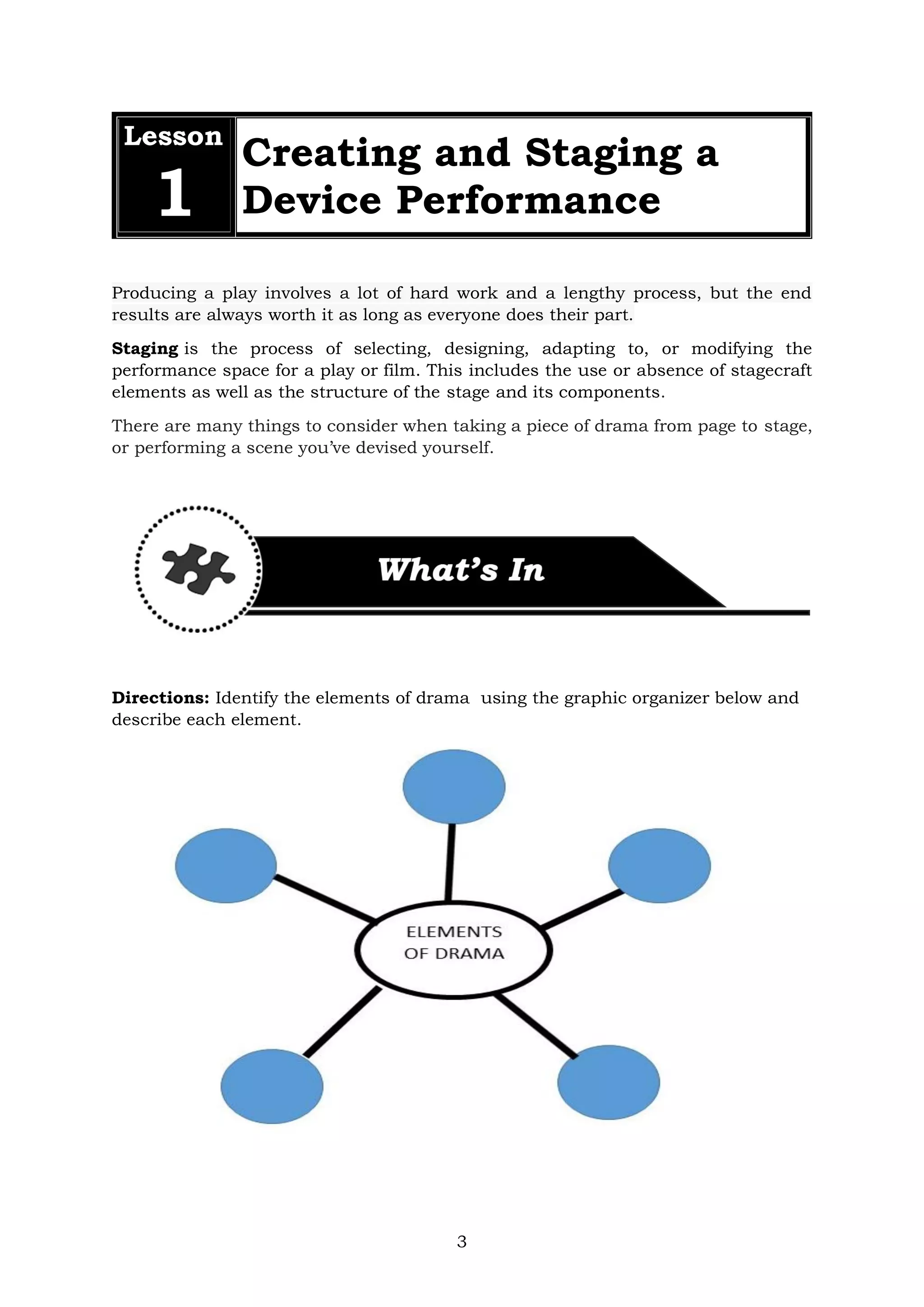
Directions: Identify the elements of drama using the graphic organizer below and
describe each element.
4
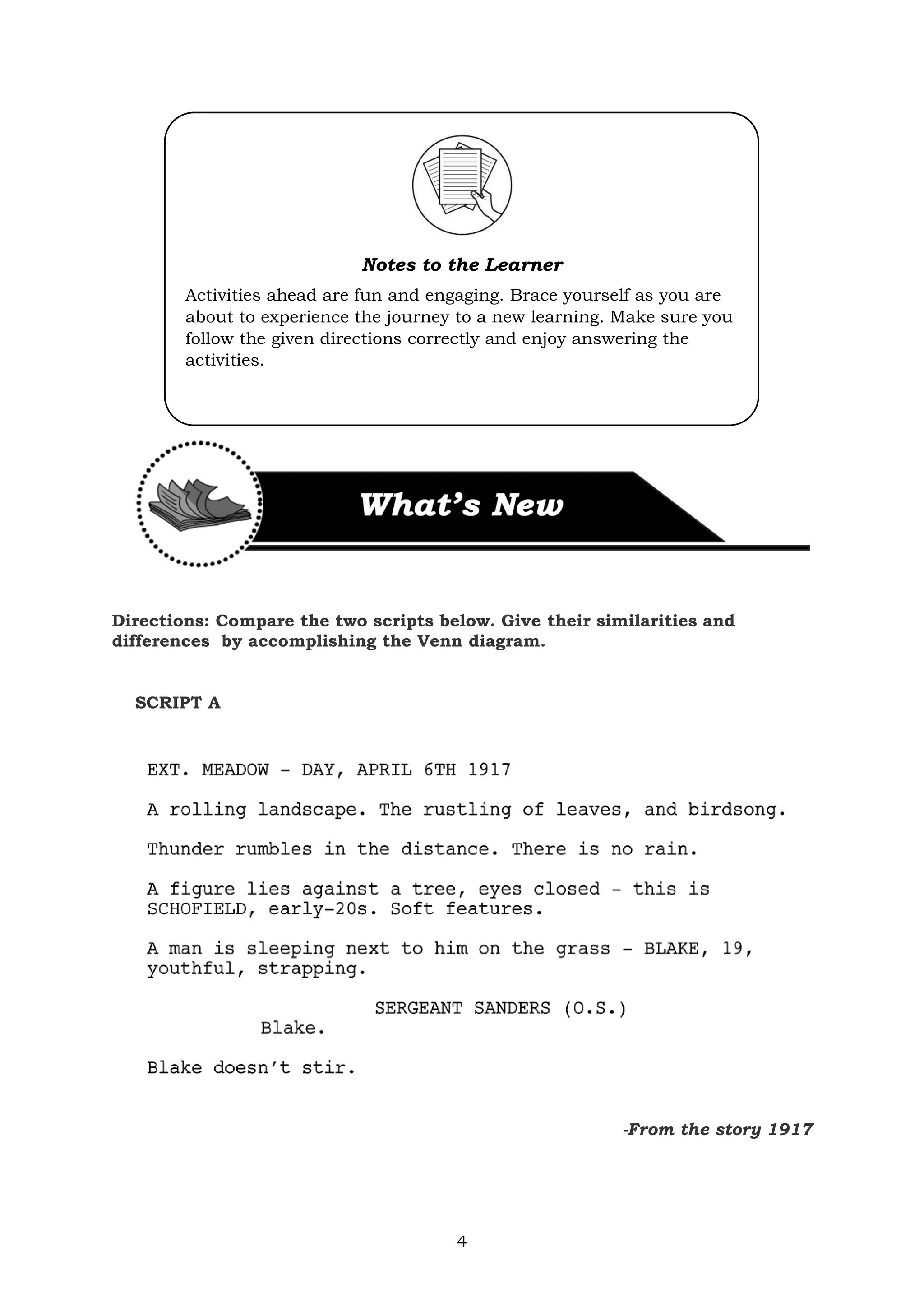
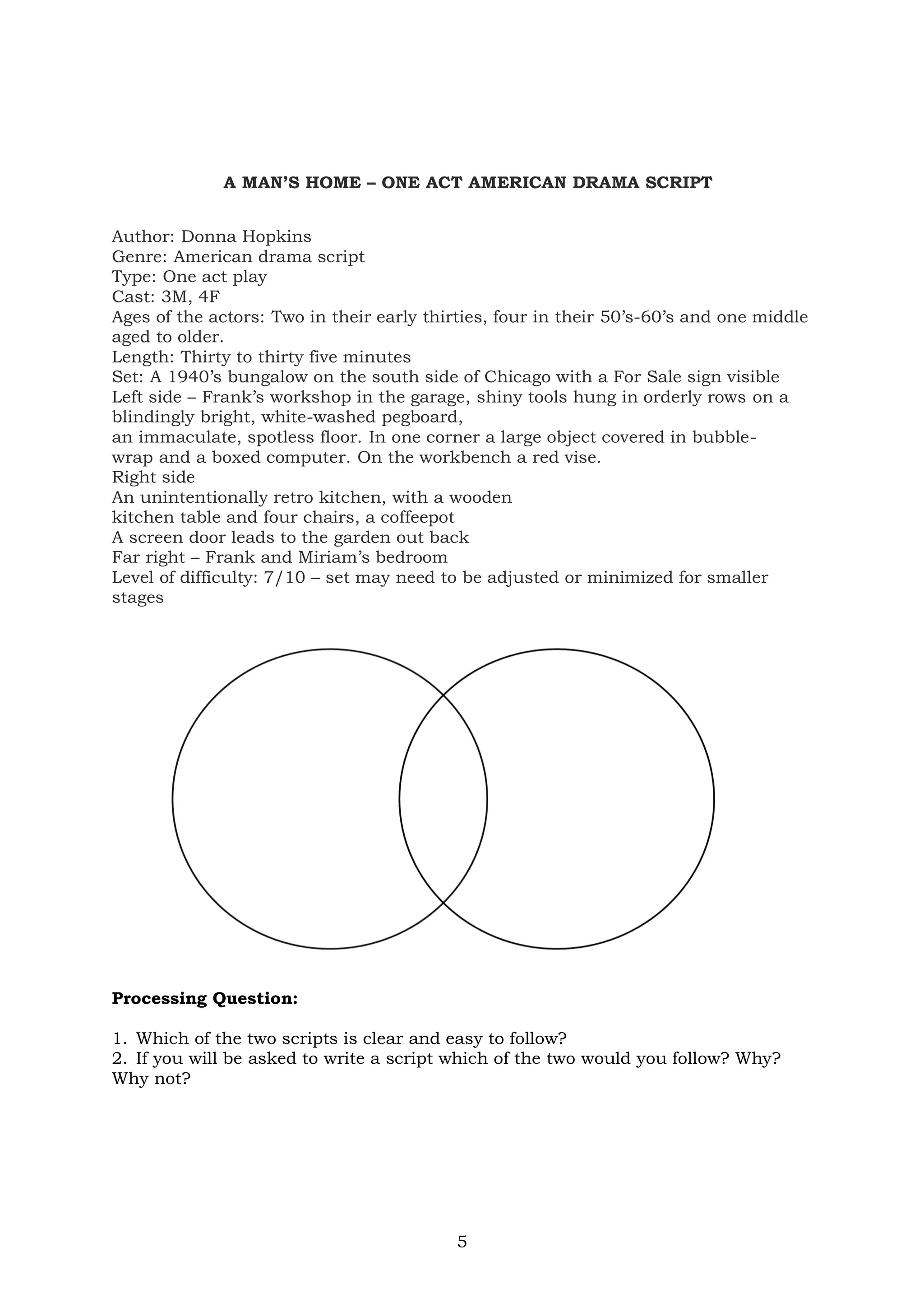
Directions: Compare the two scripts below. Give their similarities and
differences by accomplishing the Venn diagram.
SCRIPT A
-From the story 1917
Notes to the Learner
Activities ahead are fun and engaging. Brace yourself as you are
about to experience the journey to a new learning. Make sure you
follow the given directions correctly and enjoy answering the
activities.
5
A MAN’S HOME – ONE ACT AMERICAN DRAMA SCRIPT
Author: Donna Hopkins
Genre: American drama script
Type: One act play
Cast: 3M, 4F
Ages of the actors: Two in their early thirties, four in their 50’s-60’s and one middle
aged to older.
Length: Thirty to thirty five minutes
Set: A 1940’s bungalow on the south side of Chicago with a For Sale sign visible
Left side – Frank’s workshop in the garage, shiny tools hung in orderly rows on a
blindingly bright, white-washed pegboard,
an immaculate, spotless floor. In one corner a large object covered in bubble-
wrap and a boxed computer. On the workbench a red vise.
Right side
An unintentionally retro kitchen, with a wooden
kitchen table and four chairs, a coffeepot
A screen door leads to the garden out back
Far right – Frank and Miriam’s bedroom
Level of difficulty: 7/10 – set may need to be adjusted or minimized for smaller
stages
Processing Question:
1. Which of the two scripts is clear and easy to follow?
2. If you will be asked to write a script which of the two would you follow? Why?
Why not?
6
Staging Your Performance
Before you begin to set your work and rehearse in detail you should consider
the relationship between performers and audience. There are a variety of stage
shapes you can choose from to present your work. Each provides a different
experience for the audience.
Thinking carefully about where the characters are placed on the stage can
make all the difference. Avoid using too wide space which will distance the audience.
Decide how close to you they should be.
Once you’ve established the content of your work you need to consider its
structure. The order of the scenes will have a big effect on the journey on which you
take the audience. If your piece is non-naturalistic you may want to repeat scenes or
moments through the piece and slowly reveal their significance to the audience as
the piece unfolds.
You could choose to start at the beginning of the story and build in tension
towards a climax at the end of the piece. When your work runs in chronological order
like this, it is called a linear structure. If your work is inspired by Stanislavski you
should use a linear structure to ensure it is naturalistic.
If you decided to begin by presenting the outcome of the story first and then
move back in time to how it all began, this would be a non- linear structure. It
doesn’t run in a chronological time sequence but moves about in time. This builds
tension in another way. Revealing events and information bit by bit for the audience
and providing clues to what happened keeps them engaged. The work is like a jigsaw
puzzle for the audience which finally makes sense when all the pieces are in place.
Changing the structure can have a profound effect upon the shape and impact of
your drama.
Part of conducting a stage production is also considering the stage lay out or
stage modalities.
There are some practical staging considerations that playwrights need to be
aware of when constructing a play.
Beginnings and endings, “tops and tails”, the flow of one scene into another is
one such consideration. Playwrights need to know how their characters will move
from one scene into the next and what demands changes in story location and other
story variables impose on actors and stage crew, who must realize these changes
physically.
7
For example, do actors need to change their costumes or age or change their
character’s appearance in some way? How long will these changes take? Have
you “covered” these changes in your script so that the action continues while the
actors are achieving the change? If the location changes, how does the set change
and how long will this take? For example, does large furniture need to be struck?
How long will this take?
Music/sound is sometimes used to link scenes and to cover for changes.
Again, however, length of time is important. Stage time and real time are not the
same from an audience’s perspective.
Sometimes the style of the play can aid the writer in this respect. Plays that
allow the audience to watch set/costume changes and other mechanisms of
performance can increase an audience’s tolerance of the time taken between scenes
because the audience becomes involved or interested in the performance process
itself. However, the time taken should still be minimized to avoid losing the
audience’s “contact” with the story.
Generally speaking, long intervals between scenes break the tension of a play
and are therefore not desirable. The task of the the writer is to design the action of
the play in a way that will minimize the time taken between scenes to ensure a
smooth flow in an acceptable time period.
Narrative and Plot
Your devised work may have one clear storyline, or narrative, running
throughout. If there are two or more story lines in your piece, you’ll need to decide
how you deal with these separate stories when structuring your work. You could run
each story consecutively or decide that it’s more interesting to break up each story
and interweave them, cutting from one to the other. This is called a fractured
narrative. The trick is to leave each story at a point which keeps the audience
wanting to know what happens next. It’s like a jigsaw that the audience have to put
the pieces together for themselves.
Performance Checklist
In the two weeks prior to performance make sure that you have:
• Rehearsed in the space that you will be using for performance.
• Tried out work in front of an audience and responded to feedback.
• Used set and props that you will need in performance.
• Checked audience sight lines for your chosen staging.
• Practised in the costume you will wear.
• Written cue sheets for lighting and sound and briefed your operators who have
had a technical rehearsal.
• Prepared multimedia clips in the correct order and checked for technical issues.
• Analyzed your own work so far, deciding whether it meets your aims and
intentions. If the narrative or message isn’t clear, this is the time to add to or
improve work so you have devised a piece of drama you can be proud of.
8
Creating and staging a devised performance
When you stage a performance, identify the purpose of your work and the target
audience. Choose a suitable style and stage layout. Remember that rehearsals allow
you to fine tune your piece.
Stage layouts.
The pros and cons of stage layouts
Arena stage
• Pros: The audience feel included. Creates an intimate atmosphere.
• Cons: Sight lines might be an issue so there needs to be lots of movement around
the space.
Proscenium theatre
• Pros: Sight lines are excellent and work is easy to stage.
9
• Cons: The audience can feel quite removed from the action.
Thrust stage
• Pros: The audience feel included and an intimate atmosphere is created. Having
one end which is visible to all provides a ‘back’ to the stage.
• Cons: Sight lines can still be an issue.
Theatre in the round
• Pros: An intimate and exciting atmosphere. Audience feel included.
• Cons: Sight lines can be very tricky.
Traverse
• Pros: The audience on either side can clearly see work that happens at two sides.
The audience can see each other, creating intimacy.
• Cons: The opposing sides of the audience might see two entirely different shows
and sight lines are still an issue.
Promenade staging
• Pros: Can work brilliantly when locations suit the work presented. Interesting
experience for the audience.
• Cons: Moving between locations can break the tension of the piece and take some
time.
Remember you can also create an informal stage in any location. Plays have been
known to be performed in forests, supermarkets and on the beach to name but a few.
The world is your stage!
Writing Workshop
10
Directions: Work with a partner. Draft a one-act play based on the lessons
discussed. Edit with the help of your partner. Publish the script on the fb page.
Read out the play to the class.
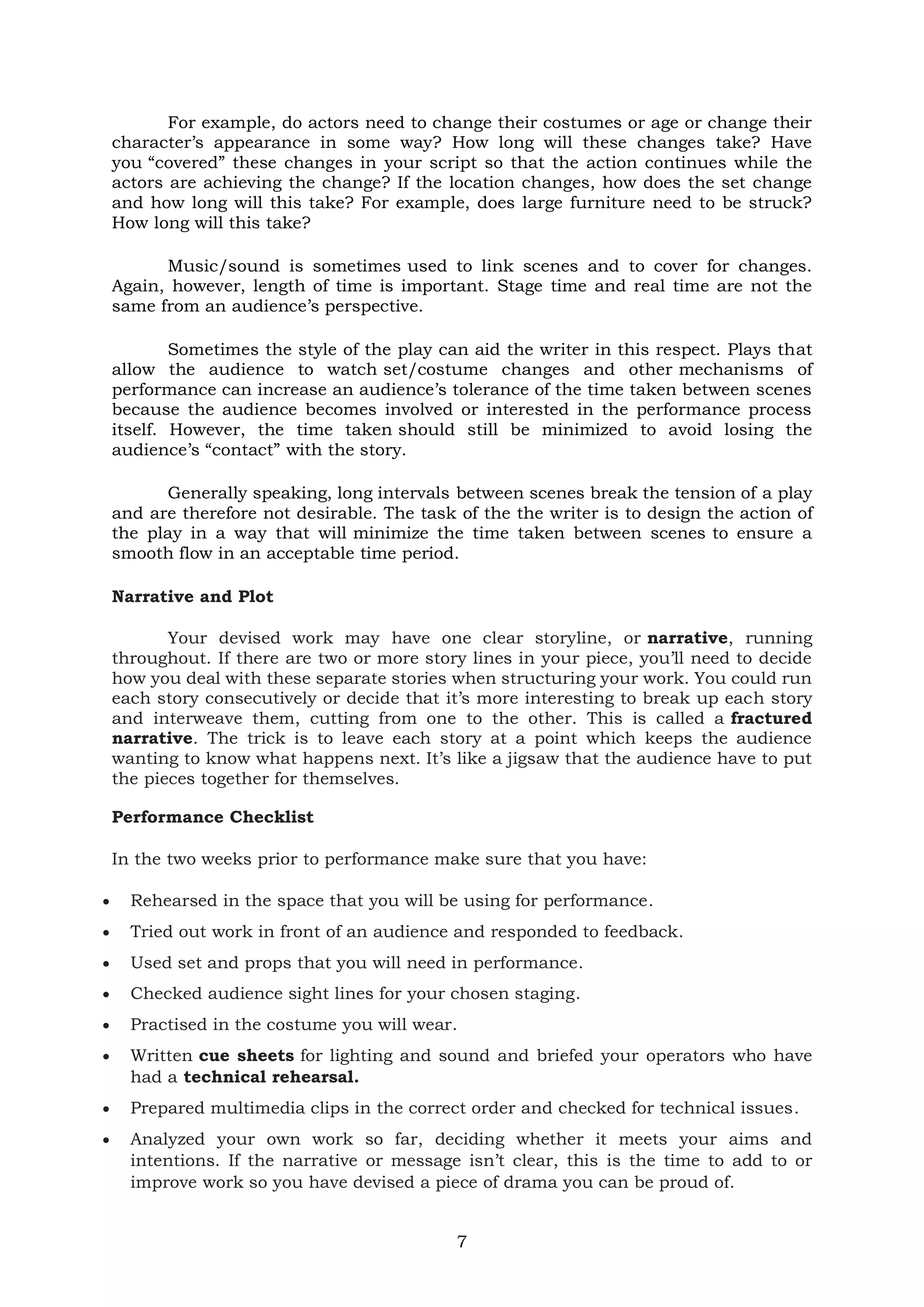
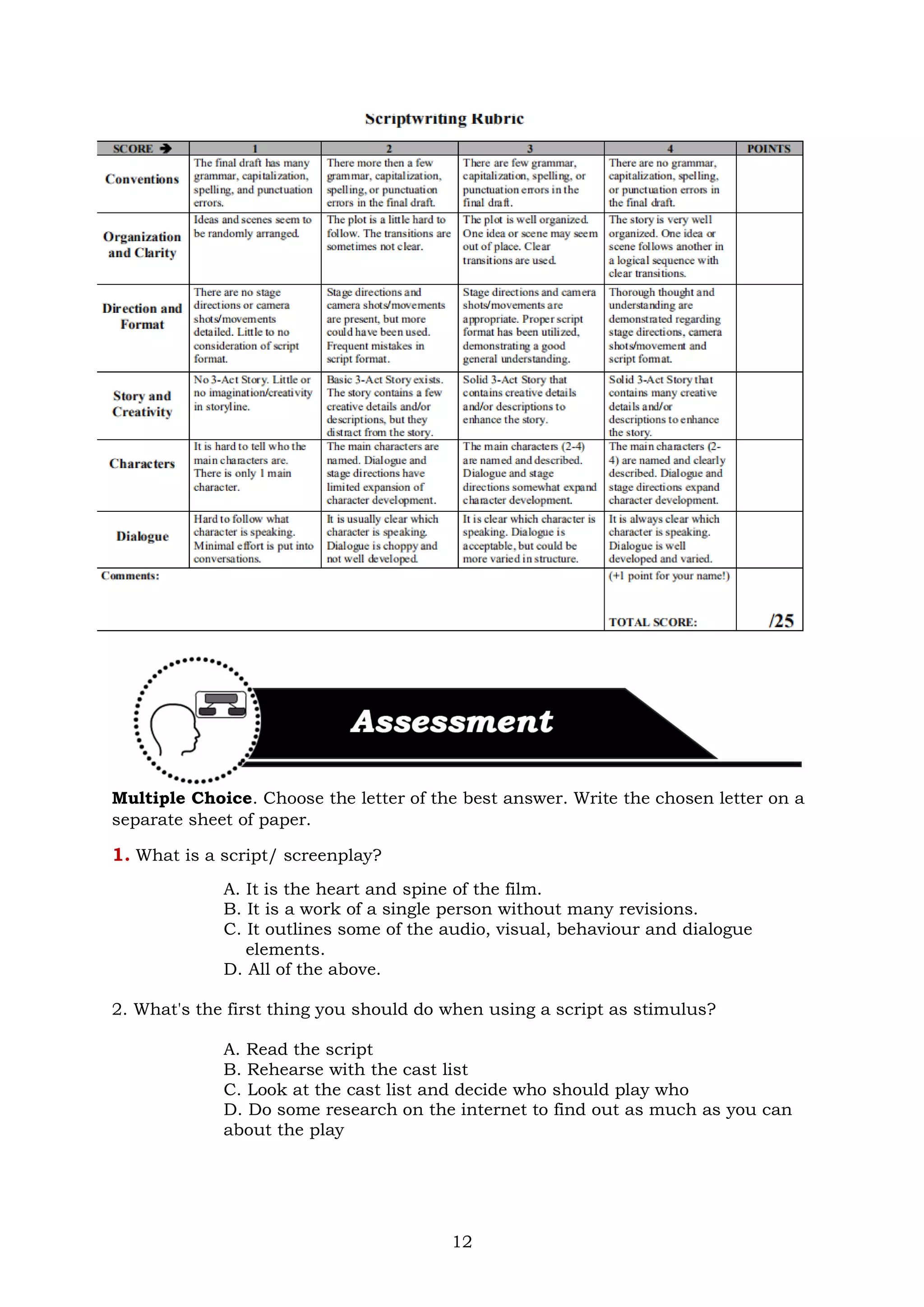
Picture 1:
Write down six possible themes that come to your mind when you see this image.
Explain each concept.
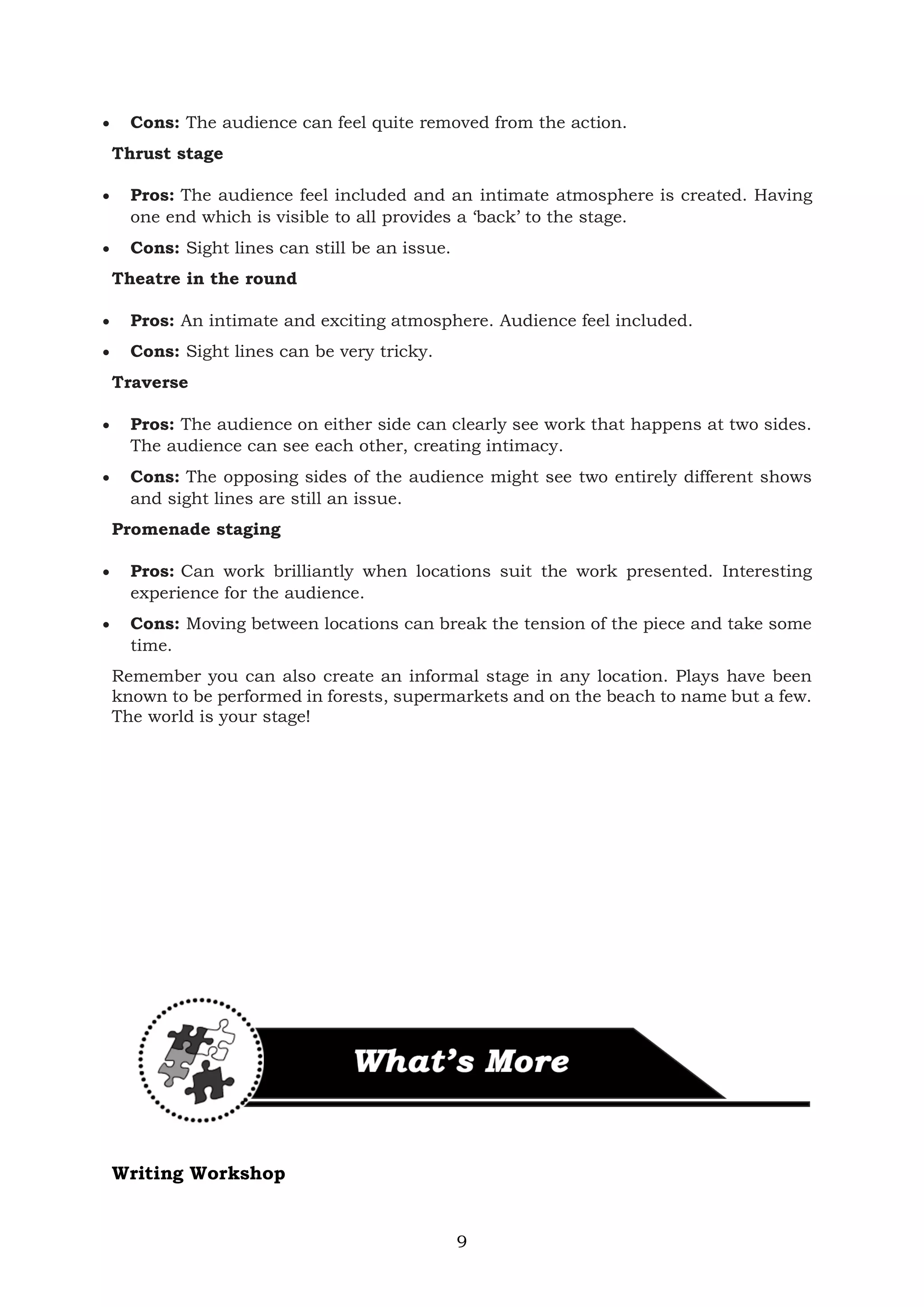
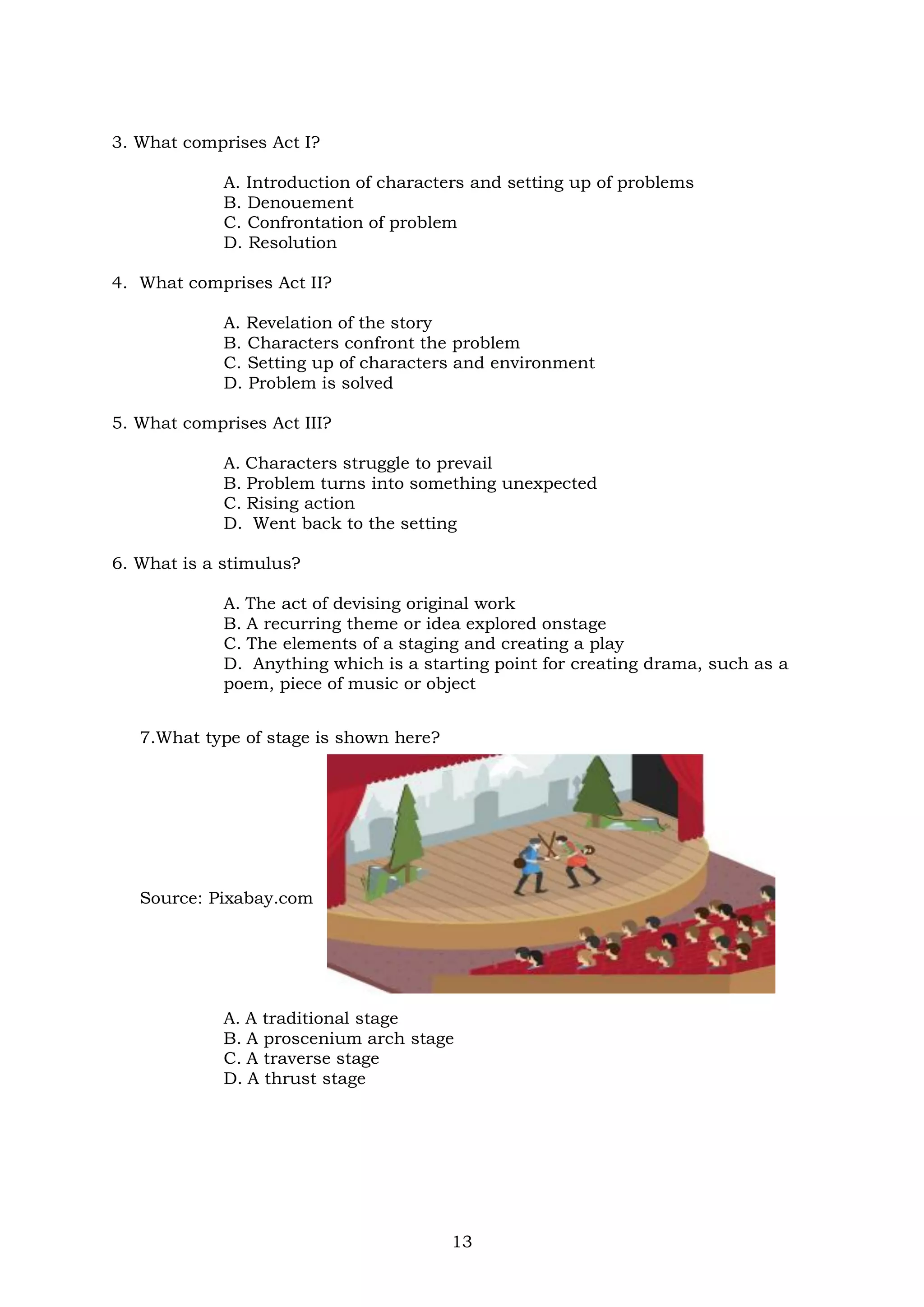
Picture 2:
Look at the image and devise a simple mind map of how it could help you create
a performance and write an outline of your initial idea.
Picture 1 Picture 2
11
Directions: List down the major points on staging modalities by accomplishing the
graphic organizer below.
Directions: In your group create a short script showing a scenario in the family or
community on how the pandemic changes the normal life of people. Illustrate also
the stage layout of your story for stage presentation.
12
Multiple Choice. Choose the letter of the best answer. Write the chosen letter on a
separate sheet of paper.
1. What is a script/ screenplay?
A. It is the heart and spine of the film.
B. It is a work of a single person without many revisions.
C. It outlines some of the audio, visual, behaviour and dialogue
elements.
D. All of the above.
2. What's the first thing you should do when using a script as stimulus?
A. Read the script
B. Rehearse with the cast list
C. Look at the cast list and decide who should play who
D. Do some research on the internet to find out as much as you can
about the play
13
3. What comprises Act I?
A. Introduction of characters and setting up of problems
B. Denouement
C. Confrontation of problem
D. Resolution
4. What comprises Act II?
A. Revelation of the story
B. Characters confront the problem
C. Setting up of characters and environment
D. Problem is solved
5. What comprises Act III?
A. Characters struggle to prevail
B. Problem turns into something unexpected
C. Rising action
D. Went back to the setting
6. What is a stimulus?
A. The act of devising original work
B. A recurring theme or idea explored onstage
C. The elements of a staging and creating a play
D. Anything which is a starting point for creating drama, such as a
poem, piece of music or object
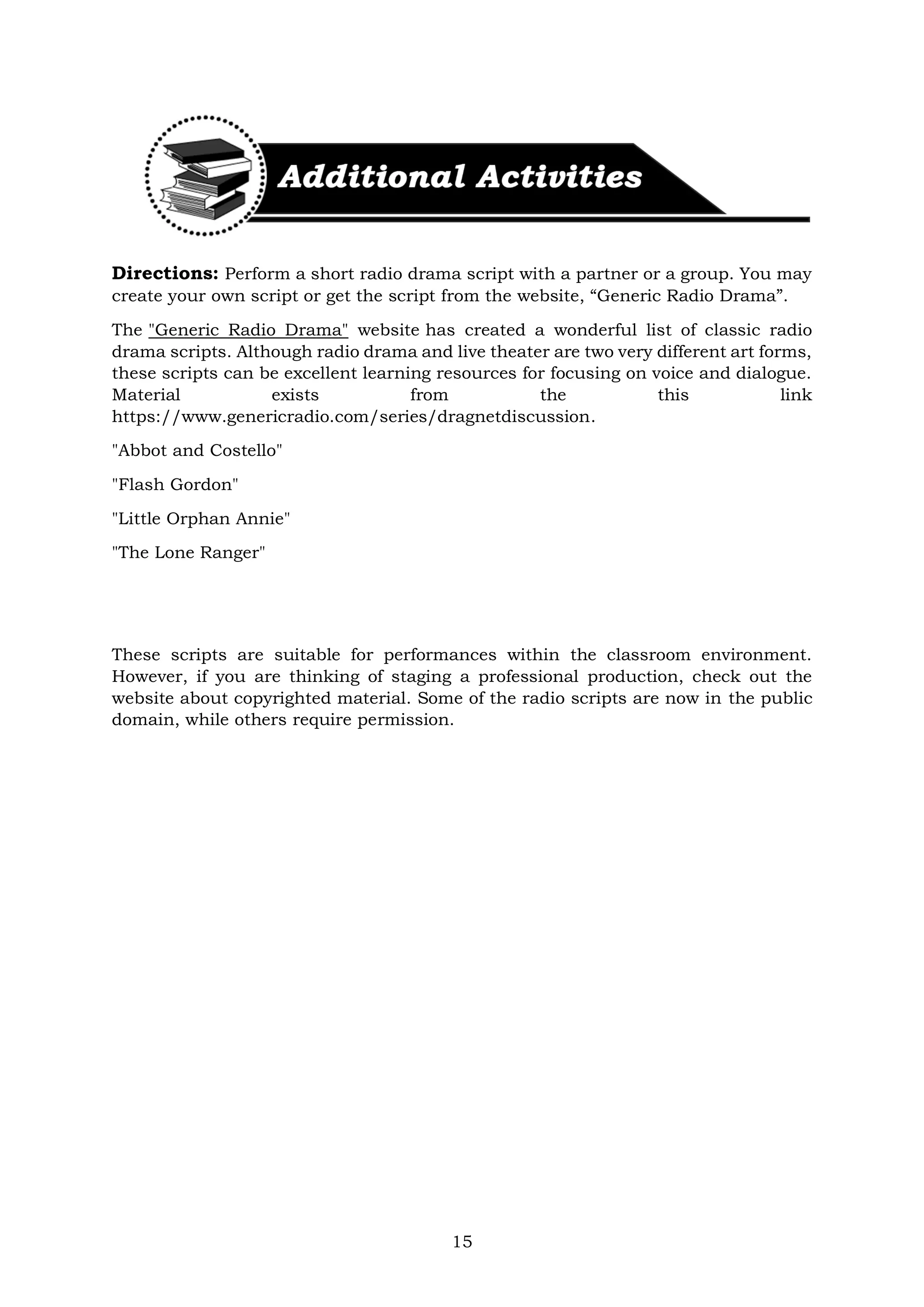
7.What type of stage is shown here?
Source: Pixabay.com
A. A traditional stage
B. A proscenium arch stage
C. A traverse stage
D. A thrust stage
14
8.Why is research important when devising drama?
A. In order to have detailed information for the programme notes
B. To check if anybody has already used your idea
C. So that you have a good understanding of the world of the play and
any themes or issues in it
D. To memorize and internalize the lines
9. What is a mind map?
A. A chart that focuses on the character’s frame of mind
B. A diagram that helps you capture ideas when brainstorming
C. A term used for a diagram noting a character’s motivation
D. A picture that reveals a character's thoughts
10. What is the theme of a story?
A. What the story is all about
B. The main plot
C. The dialogue between characters
D. A running idea that is present throughout the work
15
Directions: Perform a short radio drama script with a partner or a group. You may
create your own script or get the script from the website, “Generic Radio Drama”.
The "Generic Radio Drama" website has created a wonderful list of classic radio
drama scripts. Although radio drama and live theater are two very different art forms,
these scripts can be excellent learning resources for focusing on voice and dialogue.
Material exists from the this link
https://www.genericradio.com/series/dragnetdiscussion.
"Abbot and Costello"
"Flash Gordon"
"Little Orphan Annie"
"The Lone Ranger"
These scripts are suitable for performances within the classroom environment.
However, if you are thinking of staging a professional production, check out the
website about copyrighted material. Some of the radio scripts are now in the public
domain, while others require permission.
16
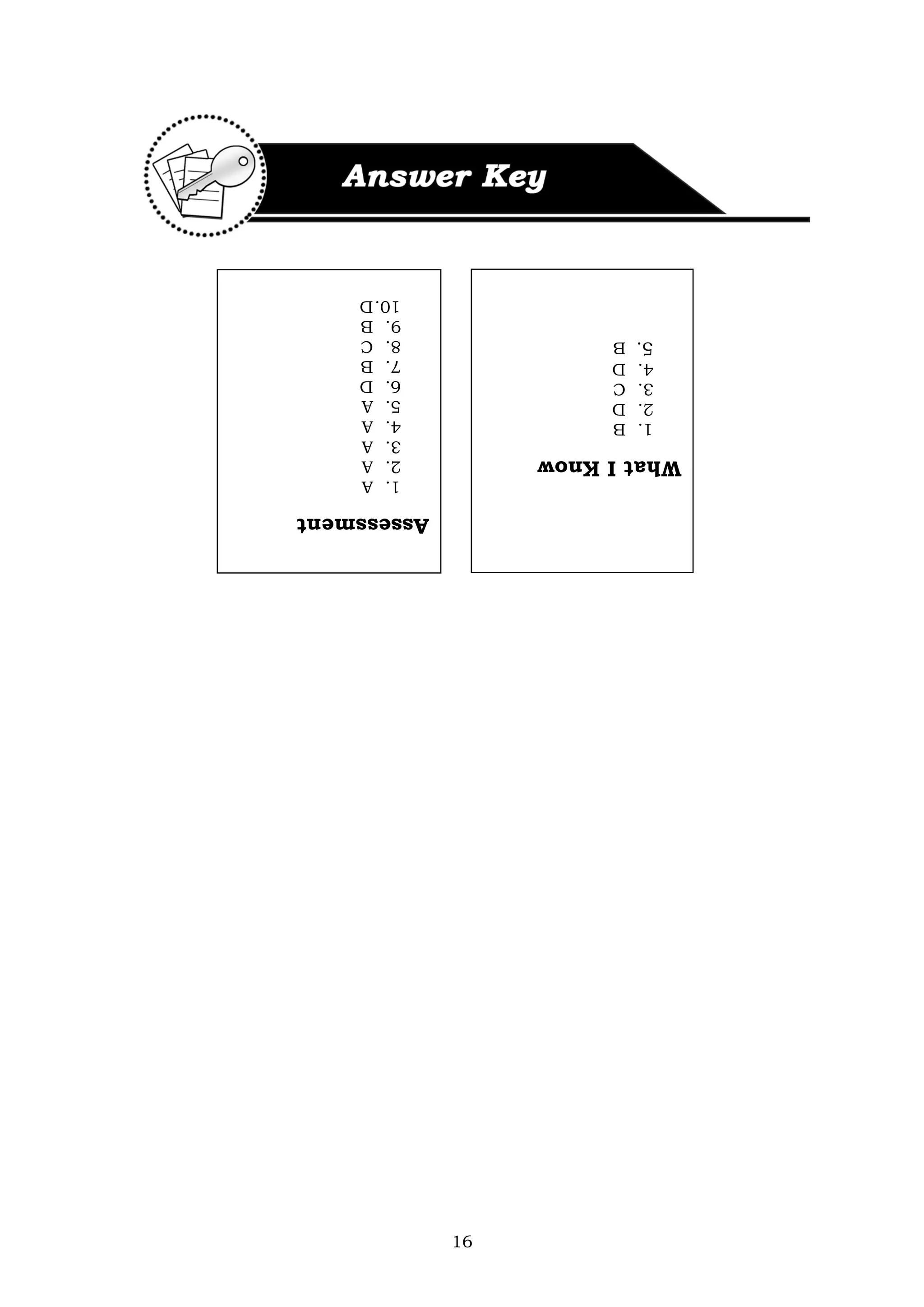
WhatIKnow
1.B
2.D
3.C
4.D
5.B
Assessment
1.A
2.A
3.A
4.A
5.A
6.D
7.B
8.C
9.B
10.D
17
References
McKnight, K. (2013). The Teacher’s big book of graphic organizers. John Wiley
& Sons, Inc.
Online Resources:
Bbc.co.uk. (2020). Responding to a stimulus. Retrieved from
https://www.bbc.co.uk/bitesize/guides/z34mvcw/revision/1. October 29,
2020.
Meduranda, M. (nd). Contemporary, Popular and Emerging Literature: A Modular
Approach with Compedium Reading. Retrieved from
C:/Users/Paulynne/Downloads/Module-5-Understanding-Drama.pdf. October 28,
2020.
Slideshare.net. (2015). One act play ppt. Retrieved from
slideshare.net/Victory30/one-act-play-ppt.October 28, 2020.
Skits-O-Mania.(2012). One Act Plays. Retrieved from
http://www.skits-o-mania.com/OneActPlays.html. Oct 28, 2020.
Roberts. S. (2017). Types of Staging in Drama. Retrieved from.
https://ourpastimes.com/types-of-staging-in-drama-12337020.html. Oct
28, 2020.
Robotham, P. (2017). 5 Common Twists and a Model for Writing Short One Act
Plays. Retrieved from https://www.weirdworldstudios.com/5-twists-for-
one-act-plays/. Oct 28, 2020.
Bradford, W. (2020, August 27). Free 1-Act Plays for Drama Class. Retrieved from
https://www.thoughtco.com/free-one-act-plays-2713599.Oct 28, 2020.
Green, T. (2020) Elements of a Drama.
https://quizizz.com/admin/quiz/5f7532d692428b001b037f3c/elements-of-
a-drama. Oct 28, 2020.
Stokpic. (2020, September 6). Assorted educational illustrations. Pixabay.
Retrieved from
https://pixabay.com/images/search/educational%20illustrations/
For inquiries or feedback, please write or call:
Department of Education – Schools Division Office Navotas
Learning Resource Management Section
Bagumbayan Elementary School Compound
M, Naval St., Sipac Almacen, Navotas City
Telefax: 02-8332-77-64
Email Address: navotas.city@deped.gov.ph

Sdo navotas creative_writing_q2_m4_explore different staging modalities vis-a-vis envisioning the script.fv(24)

  • 1.
    S.Y. 2020-2021 NAVOTAS CITYPHILIPPINES CREATIVE WRITING Quarter 2 – Module 4: Explore different staging modalities vis-a-vis envisioning the script
  • 2.
    Creative Writing –Senior High School Alternative Delivery Mode Quarter 2 – Module 4: Explore different staging modalities vis-a-vis envisioning the script. First Edition, 2020 Republic Act 8293, section 176 states that: No copyright shall subsist in any work of the Government of the Philippines. However, prior approval of the government agency or office wherein the work is created shall be necessary for exploitation of such work for profit. Such agency or office may, among other things, impose as a condition the payment of royalties. Borrowed materials (i.e., songs, stories, poems, pictures, photos, brand names, trademarks, etc.) included in this module are owned by their respective copyright holders. Every effort has been exerted to locate and seek permission to use these materials from their respective copyright owners. The publisher and authors do not represent nor claim ownership over them. Published by the Department of Education Secretary: Leonor Magtolis Briones Undersecretary: Diosdado M. San Antonio Printed in the Philippines by ________________________ Department of Education – Navotas City Office Address: BES Compound M. Naval St. Sipac-Almacen Navotas City ____________________________________________ Telefax: ____________________________________________ E-mail Address: ____________________________________________ Development Team of the Module Writer: Paulynne P. Fule Editor: Analisa I. Panaligan Reviewers: Marco D. Meduranda Illustrator: Layout Artist: Paulynne P. Fule Management Team: Alejandro G. Ibañez, OIC- Schools Division Superintendent Isabelle S. Sibayan, OIC- Asst. Schools Division Superintendent Loida O. Balasa, Chief, Curriculum Implementation Division Marco D. Meduranda, EPS in English Grace R. Nieves, EPS In Charge of LRMS Lorena J. Mutas, ADM Coordinator Editha O. Peregrino, Division SHS Focal Person Shirley Eva Marie V. Mangaluz, Librarian II LRMS Vergel Junior C. Eusebio, PDO II LRMS 02-8332-77-64 navotas.city@deped.gov.ph
  • 3.
    CREATIVE WRITING Quarter 2 –Module 4: Explore different staging modalities vis-a-vis envisioning the script
  • 4.
    ii Introductory Message For thefacilitator: Welcome to the Creative Writing for Senior High School Alternative Delivery Mode (ADM) Module on Exploring different staging modalities vis-a-vis envisioning the script. This module was collaboratively designed, developed and reviewed by educators both from public and private institutions to assist you, the teacher or facilitator in helping the learners meet the standards set by the K to 12 Curriculum while overcoming their personal, social, and economic constraints in schooling. This learning resource hopes to engage the learners into guided and independent learning activities at their own pace and time. Furthermore, this also aims to help learners acquire the needed 21st century skills while taking into consideration their needs and circumstances. In addition to the material in the main text, you will also see this box in the body of the module: As a facilitator, you are expected to orient the learners on how to use this module. You also need to keep track of the learners' progress while allowing them to manage their own learning. Furthermore, you are expected to encourage and assist the learners as they do the tasks included in the module. Notes to the Teacher This contains helpful tips or strategies that will help you in guiding the learners.
  • 5.
    iii For the learner: Welcometo the Creative Writing for Senior High School Alternative Delivery Mode (ADM) Module on Exploring different staging modalities vis-a-vis envisioning the script. This module was designed to provide you with fun and meaningful opportunities for guided and independent learning at your own pace and time. You will be enabled to process the contents of the learning resource while being an active learner. This module has the following parts and corresponding icons: What I Need to Know This will give you an idea of the skills or competencies you are expected to learn in the module. What I Know This part includes an activity that aims to check what you already know about the lesson to take. If you get all the answers correct (100%), you may decide to skip this module. What’s In This is a brief drill or review to help you link the current lesson with the previous one. What’s New In this portion, the new lesson will be introduced to you in various ways; a story, a song, a poem, a problem opener, an activity or a situation. What is It This section provides a brief discussion of the lesson. This aims to help you discover and understand new concepts and skills. What’s More This comprises activities for independent practice to solidify your understanding and skills of the topic. You may check the answers to the exercises using the Answer Key at the end of the module. What I Have Learned This includes questions or blank sentence/paragraph to be filled in to process what you learned from the lesson. What I Can Do This section provides an activity which will help you transfer your new knowledge or skill into real life situations or concerns. Assessment This is a task which aims to evaluate your level of mastery in achieving the learning competency.
  • 6.
    iv Additional Activities Inthis portion, another activity will be given to you to enrich your knowledge or skill of the lesson learned. Answer Key This contains answers to all activities in the module. At the end of this module you will also find: The following are some reminders in using this module: 1. Use the module with care. Do not put unnecessary mark/s on any part of the module. Use a separate sheet of paper in answering the exercises. 2. Don’t forget to answer What I Know before moving on to the other activities included in the module. 3. Read the instruction carefully before doing each task. 4. Observe honesty and integrity in doing the tasks and checking your answers. 5. Finish the task at hand before proceeding to the next. 6. Return this module to your teacher/facilitator once you are through with it. If you encounter any difficulty in answering the tasks in this module, do not hesitate to consult your teacher or facilitator. Always bear in mind that you are not alone. We hope that through this material, you will experience meaningful learning and gain deep understanding of the relevant competencies. You can do it! References This is a list of all sources used in developing this module.
  • 7.
    1 This module wasdesigned and written with you in mind. It is here to help you understand the different staging modalities which need to be considered in writing a script for play and drama. The scope of this module permits it to be used in many different learning situations specifically in conducting a stage or theatre presentation. The language used recognizes the diverse vocabulary level of students. The lessons are arranged to follow the standard sequence of the course. But the order in which you read them can be changed to correspond with the textbook you are now using. The module includes the lesson: - Creating and Staging a Device Performance After going through this module, you are expected to: ⚫ Explore different staging modalities vis-a-vis envisioning the script.
  • 8.
    2 Directions: Choose theletter of the best answer for each question. Write the chosen letter on a separate sheet of paper. 1. What does drama recreate as a literary art form? A. Imagery and style. B. Human life, emotions, dialogue, and action. C. The use of figurative language in speech. D. Past arguments and disputes between people. 2. It refers to the sequence of events that make up a story. A. Conflict B. Script C. Setting D. Plot 3. What does a written form of a drama call? A. Novel B. Play C. Script D. Transcript 4. What do you call the living form of a drama? A. Cartoon B. Documentary C. Movie D. Play 5. What is known as the conversation between two or more characters on stage? A. Monologue B. Dialogue C. Script D. Soliloquy
  • 9.
    3 Lesson 1 Creating and Staginga Device Performance Producing a play involves a lot of hard work and a lengthy process, but the end results are always worth it as long as everyone does their part. Staging is the process of selecting, designing, adapting to, or modifying the performance space for a play or film. This includes the use or absence of stagecraft elements as well as the structure of the stage and its components. There are many things to consider when taking a piece of drama from page to stage, or performing a scene you’ve devised yourself. Directions: Identify the elements of drama using the graphic organizer below and describe each element.
  • 10.
    4 Directions: Compare thetwo scripts below. Give their similarities and differences by accomplishing the Venn diagram. SCRIPT A -From the story 1917 Notes to the Learner Activities ahead are fun and engaging. Brace yourself as you are about to experience the journey to a new learning. Make sure you follow the given directions correctly and enjoy answering the activities.
  • 11.
    5 A MAN’S HOME– ONE ACT AMERICAN DRAMA SCRIPT Author: Donna Hopkins Genre: American drama script Type: One act play Cast: 3M, 4F Ages of the actors: Two in their early thirties, four in their 50’s-60’s and one middle aged to older. Length: Thirty to thirty five minutes Set: A 1940’s bungalow on the south side of Chicago with a For Sale sign visible Left side – Frank’s workshop in the garage, shiny tools hung in orderly rows on a blindingly bright, white-washed pegboard, an immaculate, spotless floor. In one corner a large object covered in bubble- wrap and a boxed computer. On the workbench a red vise. Right side An unintentionally retro kitchen, with a wooden kitchen table and four chairs, a coffeepot A screen door leads to the garden out back Far right – Frank and Miriam’s bedroom Level of difficulty: 7/10 – set may need to be adjusted or minimized for smaller stages Processing Question: 1. Which of the two scripts is clear and easy to follow? 2. If you will be asked to write a script which of the two would you follow? Why? Why not?
  • 12.
    6 Staging Your Performance Beforeyou begin to set your work and rehearse in detail you should consider the relationship between performers and audience. There are a variety of stage shapes you can choose from to present your work. Each provides a different experience for the audience. Thinking carefully about where the characters are placed on the stage can make all the difference. Avoid using too wide space which will distance the audience. Decide how close to you they should be. Once you’ve established the content of your work you need to consider its structure. The order of the scenes will have a big effect on the journey on which you take the audience. If your piece is non-naturalistic you may want to repeat scenes or moments through the piece and slowly reveal their significance to the audience as the piece unfolds. You could choose to start at the beginning of the story and build in tension towards a climax at the end of the piece. When your work runs in chronological order like this, it is called a linear structure. If your work is inspired by Stanislavski you should use a linear structure to ensure it is naturalistic. If you decided to begin by presenting the outcome of the story first and then move back in time to how it all began, this would be a non- linear structure. It doesn’t run in a chronological time sequence but moves about in time. This builds tension in another way. Revealing events and information bit by bit for the audience and providing clues to what happened keeps them engaged. The work is like a jigsaw puzzle for the audience which finally makes sense when all the pieces are in place. Changing the structure can have a profound effect upon the shape and impact of your drama. Part of conducting a stage production is also considering the stage lay out or stage modalities. There are some practical staging considerations that playwrights need to be aware of when constructing a play. Beginnings and endings, “tops and tails”, the flow of one scene into another is one such consideration. Playwrights need to know how their characters will move from one scene into the next and what demands changes in story location and other story variables impose on actors and stage crew, who must realize these changes physically.
  • 13.
    7 For example, doactors need to change their costumes or age or change their character’s appearance in some way? How long will these changes take? Have you “covered” these changes in your script so that the action continues while the actors are achieving the change? If the location changes, how does the set change and how long will this take? For example, does large furniture need to be struck? How long will this take? Music/sound is sometimes used to link scenes and to cover for changes. Again, however, length of time is important. Stage time and real time are not the same from an audience’s perspective. Sometimes the style of the play can aid the writer in this respect. Plays that allow the audience to watch set/costume changes and other mechanisms of performance can increase an audience’s tolerance of the time taken between scenes because the audience becomes involved or interested in the performance process itself. However, the time taken should still be minimized to avoid losing the audience’s “contact” with the story. Generally speaking, long intervals between scenes break the tension of a play and are therefore not desirable. The task of the the writer is to design the action of the play in a way that will minimize the time taken between scenes to ensure a smooth flow in an acceptable time period. Narrative and Plot Your devised work may have one clear storyline, or narrative, running throughout. If there are two or more story lines in your piece, you’ll need to decide how you deal with these separate stories when structuring your work. You could run each story consecutively or decide that it’s more interesting to break up each story and interweave them, cutting from one to the other. This is called a fractured narrative. The trick is to leave each story at a point which keeps the audience wanting to know what happens next. It’s like a jigsaw that the audience have to put the pieces together for themselves. Performance Checklist In the two weeks prior to performance make sure that you have: • Rehearsed in the space that you will be using for performance. • Tried out work in front of an audience and responded to feedback. • Used set and props that you will need in performance. • Checked audience sight lines for your chosen staging. • Practised in the costume you will wear. • Written cue sheets for lighting and sound and briefed your operators who have had a technical rehearsal. • Prepared multimedia clips in the correct order and checked for technical issues. • Analyzed your own work so far, deciding whether it meets your aims and intentions. If the narrative or message isn’t clear, this is the time to add to or improve work so you have devised a piece of drama you can be proud of.
  • 14.
    8 Creating and staginga devised performance When you stage a performance, identify the purpose of your work and the target audience. Choose a suitable style and stage layout. Remember that rehearsals allow you to fine tune your piece. Stage layouts. The pros and cons of stage layouts Arena stage • Pros: The audience feel included. Creates an intimate atmosphere. • Cons: Sight lines might be an issue so there needs to be lots of movement around the space. Proscenium theatre • Pros: Sight lines are excellent and work is easy to stage.
  • 15.
    9 • Cons: Theaudience can feel quite removed from the action. Thrust stage • Pros: The audience feel included and an intimate atmosphere is created. Having one end which is visible to all provides a ‘back’ to the stage. • Cons: Sight lines can still be an issue. Theatre in the round • Pros: An intimate and exciting atmosphere. Audience feel included. • Cons: Sight lines can be very tricky. Traverse • Pros: The audience on either side can clearly see work that happens at two sides. The audience can see each other, creating intimacy. • Cons: The opposing sides of the audience might see two entirely different shows and sight lines are still an issue. Promenade staging • Pros: Can work brilliantly when locations suit the work presented. Interesting experience for the audience. • Cons: Moving between locations can break the tension of the piece and take some time. Remember you can also create an informal stage in any location. Plays have been known to be performed in forests, supermarkets and on the beach to name but a few. The world is your stage! Writing Workshop
  • 16.
    10 Directions: Work witha partner. Draft a one-act play based on the lessons discussed. Edit with the help of your partner. Publish the script on the fb page. Read out the play to the class. Picture 1: Write down six possible themes that come to your mind when you see this image. Explain each concept. Picture 2: Look at the image and devise a simple mind map of how it could help you create a performance and write an outline of your initial idea. Picture 1 Picture 2
  • 17.
    11 Directions: List downthe major points on staging modalities by accomplishing the graphic organizer below. Directions: In your group create a short script showing a scenario in the family or community on how the pandemic changes the normal life of people. Illustrate also the stage layout of your story for stage presentation.
  • 18.
    12 Multiple Choice. Choosethe letter of the best answer. Write the chosen letter on a separate sheet of paper. 1. What is a script/ screenplay? A. It is the heart and spine of the film. B. It is a work of a single person without many revisions. C. It outlines some of the audio, visual, behaviour and dialogue elements. D. All of the above. 2. What's the first thing you should do when using a script as stimulus? A. Read the script B. Rehearse with the cast list C. Look at the cast list and decide who should play who D. Do some research on the internet to find out as much as you can about the play
  • 19.
    13 3. What comprisesAct I? A. Introduction of characters and setting up of problems B. Denouement C. Confrontation of problem D. Resolution 4. What comprises Act II? A. Revelation of the story B. Characters confront the problem C. Setting up of characters and environment D. Problem is solved 5. What comprises Act III? A. Characters struggle to prevail B. Problem turns into something unexpected C. Rising action D. Went back to the setting 6. What is a stimulus? A. The act of devising original work B. A recurring theme or idea explored onstage C. The elements of a staging and creating a play D. Anything which is a starting point for creating drama, such as a poem, piece of music or object 7.What type of stage is shown here? Source: Pixabay.com A. A traditional stage B. A proscenium arch stage C. A traverse stage D. A thrust stage
  • 20.
    14 8.Why is researchimportant when devising drama? A. In order to have detailed information for the programme notes B. To check if anybody has already used your idea C. So that you have a good understanding of the world of the play and any themes or issues in it D. To memorize and internalize the lines 9. What is a mind map? A. A chart that focuses on the character’s frame of mind B. A diagram that helps you capture ideas when brainstorming C. A term used for a diagram noting a character’s motivation D. A picture that reveals a character's thoughts 10. What is the theme of a story? A. What the story is all about B. The main plot C. The dialogue between characters D. A running idea that is present throughout the work
  • 21.
    15 Directions: Perform ashort radio drama script with a partner or a group. You may create your own script or get the script from the website, “Generic Radio Drama”. The "Generic Radio Drama" website has created a wonderful list of classic radio drama scripts. Although radio drama and live theater are two very different art forms, these scripts can be excellent learning resources for focusing on voice and dialogue. Material exists from the this link https://www.genericradio.com/series/dragnetdiscussion. "Abbot and Costello" "Flash Gordon" "Little Orphan Annie" "The Lone Ranger" These scripts are suitable for performances within the classroom environment. However, if you are thinking of staging a professional production, check out the website about copyrighted material. Some of the radio scripts are now in the public domain, while others require permission.
  • 22.
  • 23.
    17 References McKnight, K. (2013).The Teacher’s big book of graphic organizers. John Wiley & Sons, Inc. Online Resources: Bbc.co.uk. (2020). Responding to a stimulus. Retrieved from https://www.bbc.co.uk/bitesize/guides/z34mvcw/revision/1. October 29, 2020. Meduranda, M. (nd). Contemporary, Popular and Emerging Literature: A Modular Approach with Compedium Reading. Retrieved from C:/Users/Paulynne/Downloads/Module-5-Understanding-Drama.pdf. October 28, 2020. Slideshare.net. (2015). One act play ppt. Retrieved from slideshare.net/Victory30/one-act-play-ppt.October 28, 2020. Skits-O-Mania.(2012). One Act Plays. Retrieved from http://www.skits-o-mania.com/OneActPlays.html. Oct 28, 2020. Roberts. S. (2017). Types of Staging in Drama. Retrieved from. https://ourpastimes.com/types-of-staging-in-drama-12337020.html. Oct 28, 2020. Robotham, P. (2017). 5 Common Twists and a Model for Writing Short One Act Plays. Retrieved from https://www.weirdworldstudios.com/5-twists-for- one-act-plays/. Oct 28, 2020. Bradford, W. (2020, August 27). Free 1-Act Plays for Drama Class. Retrieved from https://www.thoughtco.com/free-one-act-plays-2713599.Oct 28, 2020. Green, T. (2020) Elements of a Drama. https://quizizz.com/admin/quiz/5f7532d692428b001b037f3c/elements-of- a-drama. Oct 28, 2020. Stokpic. (2020, September 6). Assorted educational illustrations. Pixabay. Retrieved from https://pixabay.com/images/search/educational%20illustrations/
  • 24.
    For inquiries orfeedback, please write or call: Department of Education – Schools Division Office Navotas Learning Resource Management Section Bagumbayan Elementary School Compound M, Naval St., Sipac Almacen, Navotas City Telefax: 02-8332-77-64 Email Address: navotas.city@deped.gov.ph