CREATIVE WRITING
Conceptualizing Character, Setting, and
Plot for One-Act Play
a. Categorize character, setting, and plot
in a one-act play;
b. Examine character, setting, and plot
from a one-act play; and
c. Value the importance of reading a play.
OBJECTIVES
Whose is that line?
In this activity, you will experience the
relationship between literary texts based from
your previous lesson on Intertextuality. Fill in
the first line with the name of the character
who popularized the given line, then write the
title of the literary text where the line is taken
from.
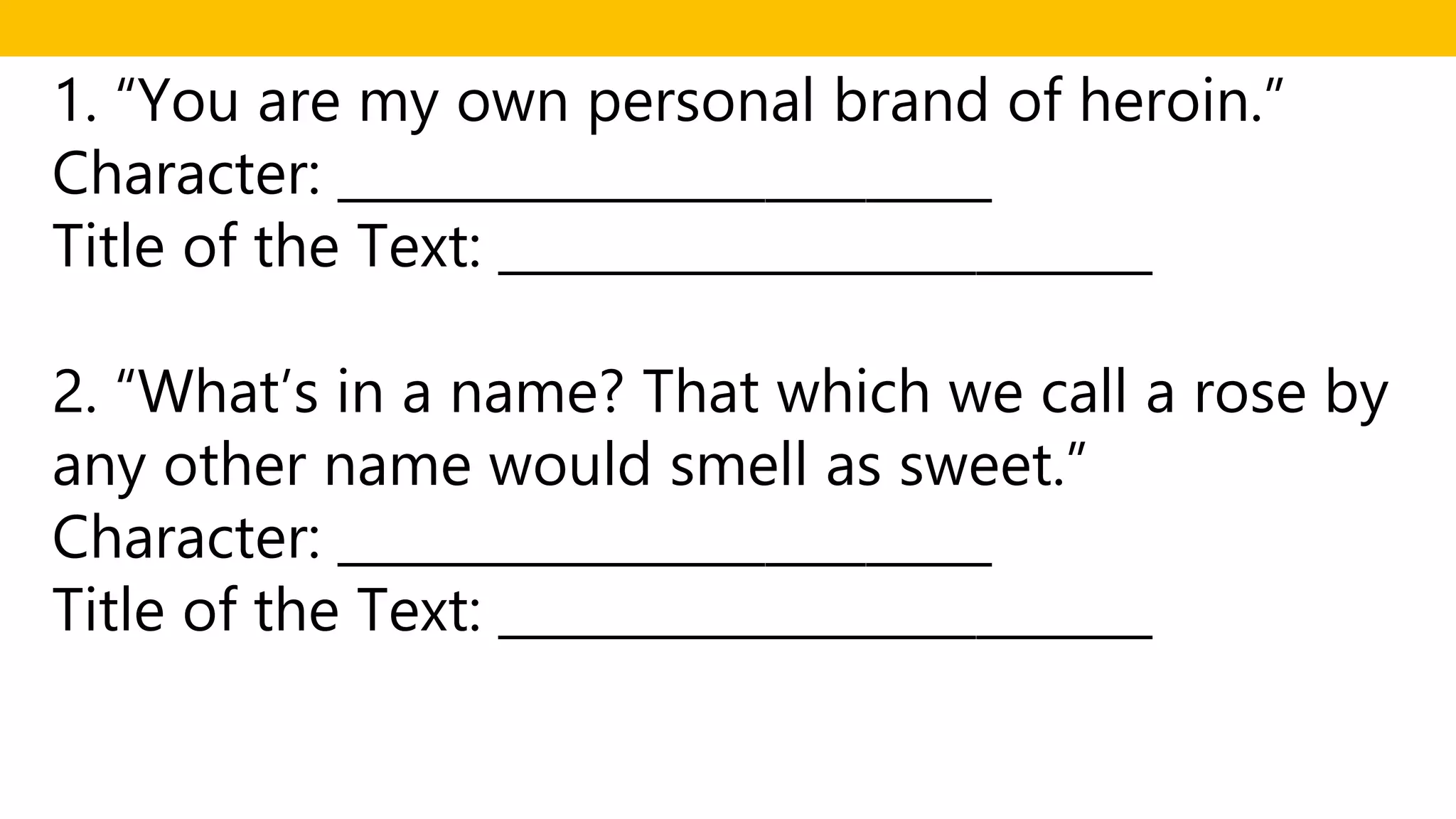
1. “You are my own personal brand of heroin.”
Character: __________________________
Title of the Text: __________________________
2. “What’s in a name? That which we call a rose by
any other name would smell as sweet.”
Character: __________________________
Title of the Text: __________________________
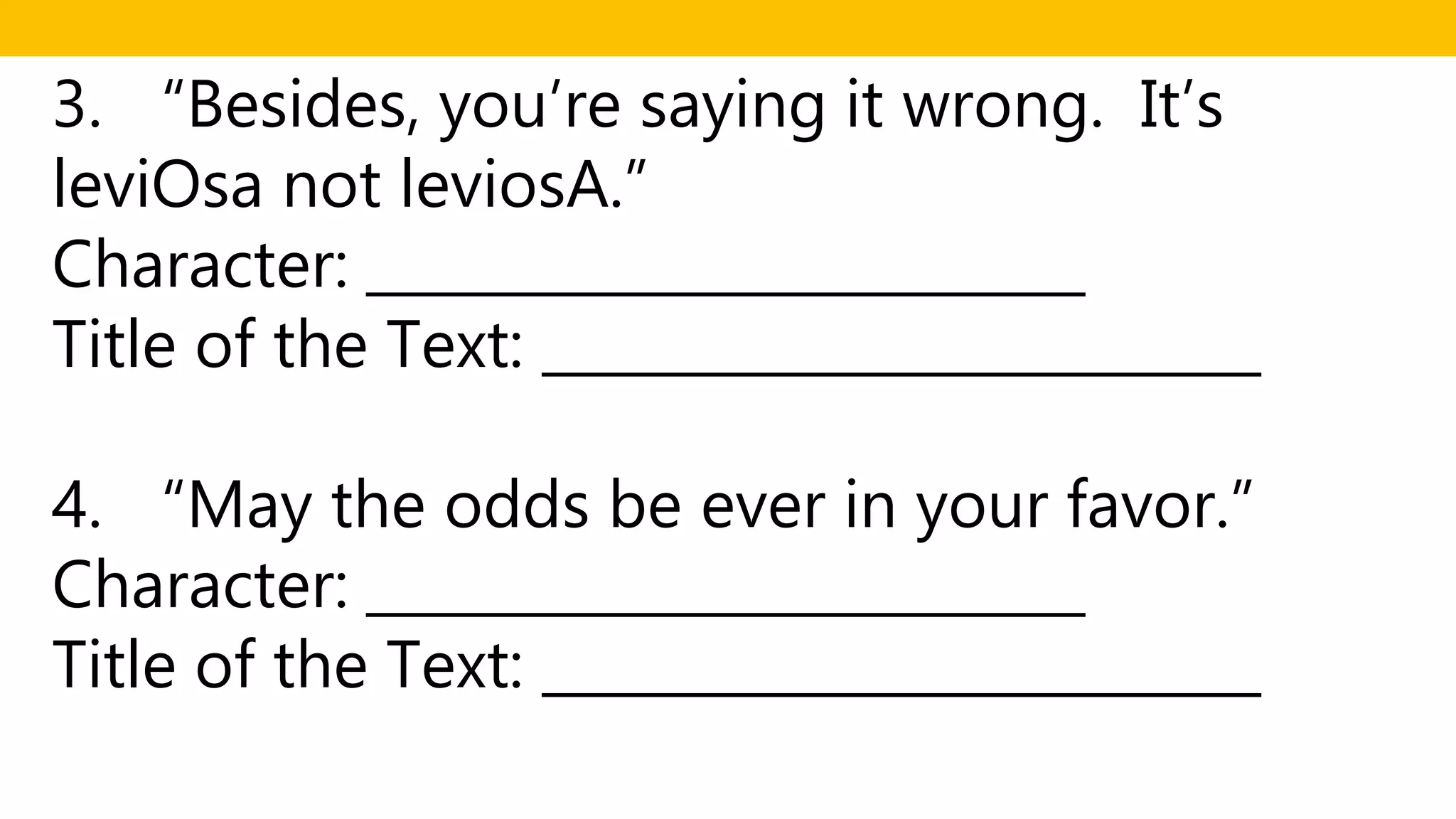
3. “Besides, you’re saying it wrong. It’s
leviOsa not leviosA.”
Character: __________________________
Title of the Text: __________________________
4. “May the odds be ever in your favor.”
Character: __________________________
Title of the Text: __________________________
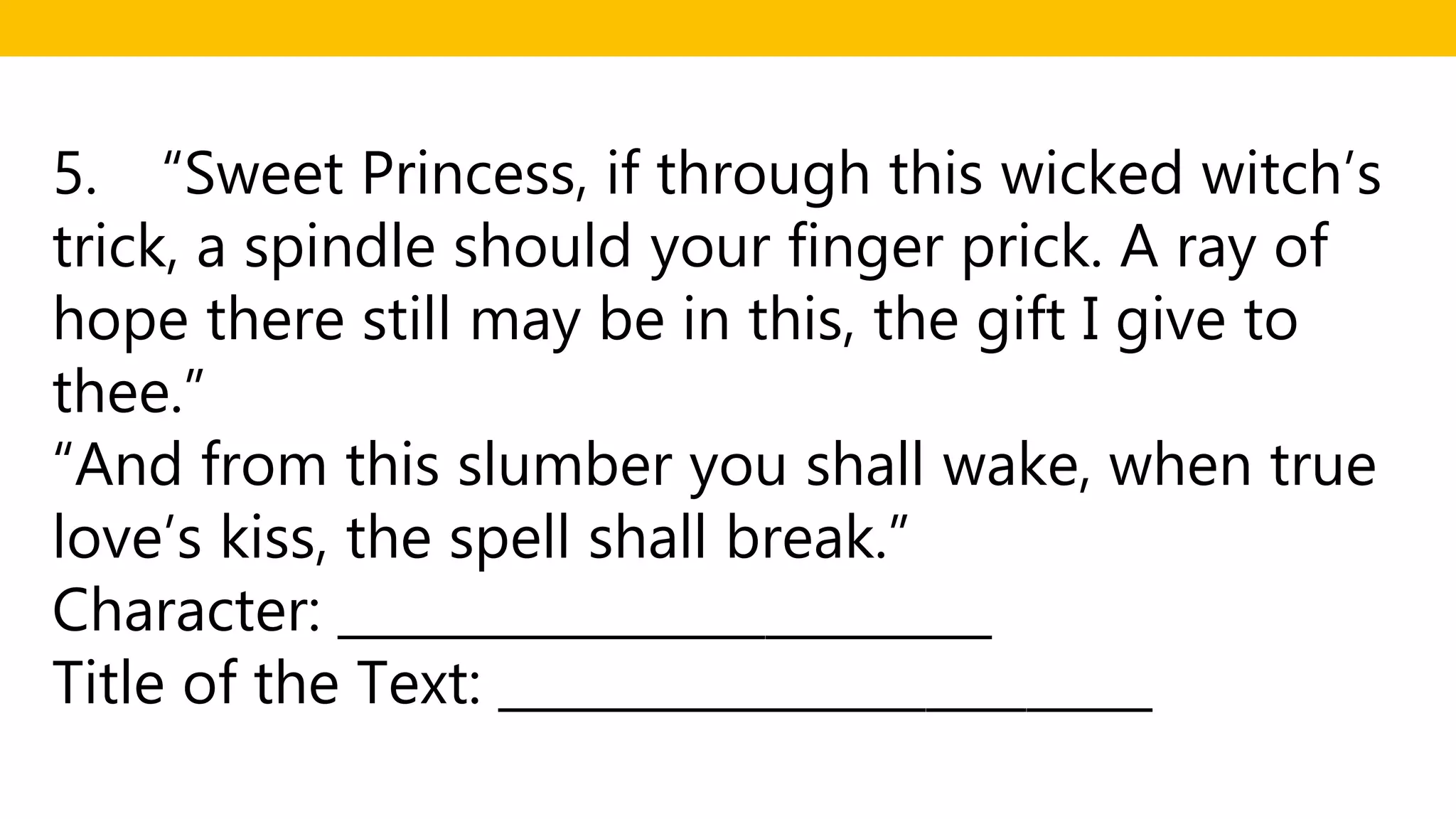
5. “Sweet Princess, if through this wicked witch’s
trick, a spindle should your finger prick. A ray of
hope there still may be in this, the gift I give to
thee.”
“And from this slumber you shall wake, when true
love’s kiss, the spell shall break.”
Character: __________________________
Title of the Text: __________________________
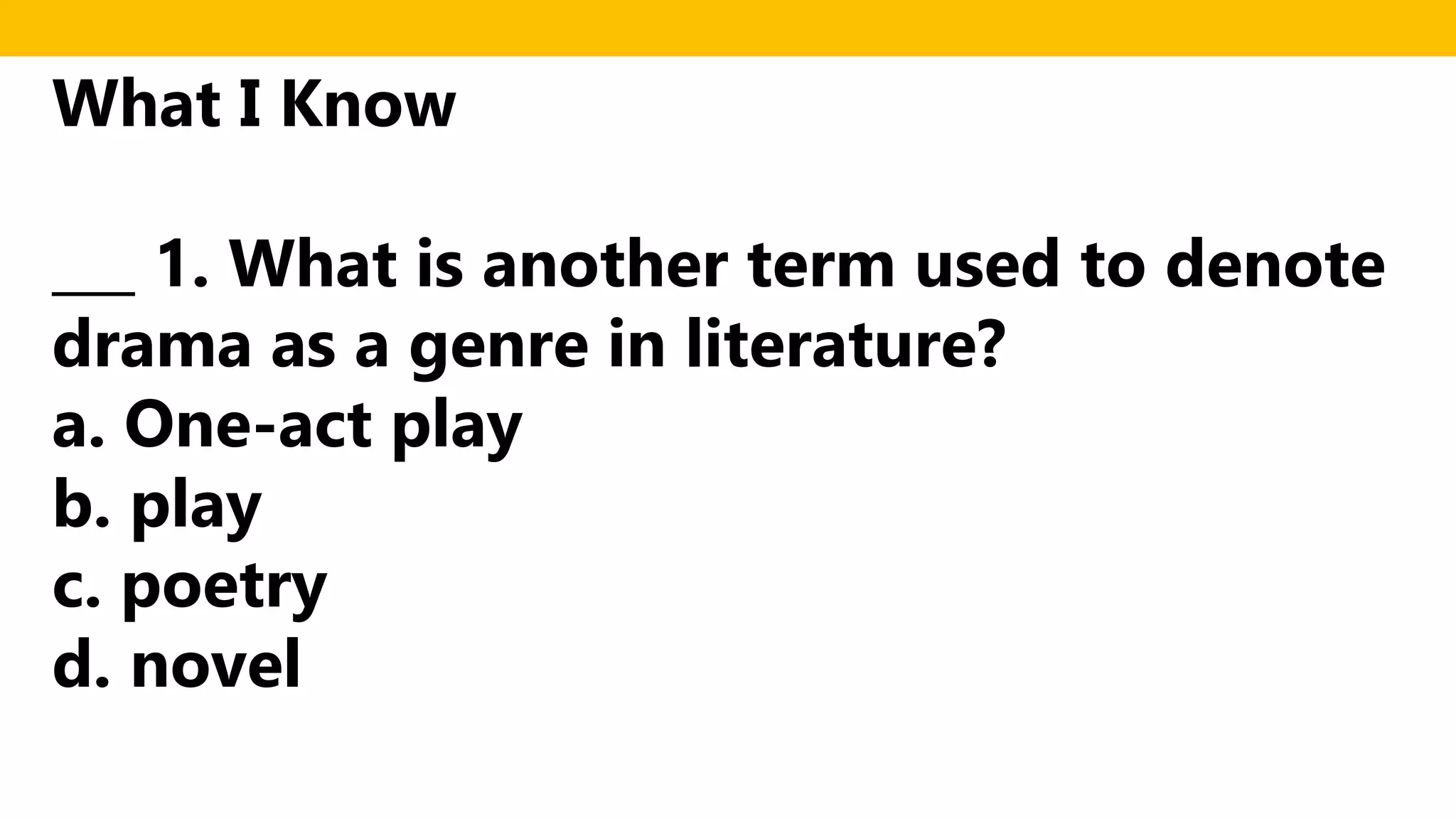
What I Know
___ 1. What is another term used to denote
drama as a genre in literature?
a. One-act play
b. play
c. poetry
d. novel
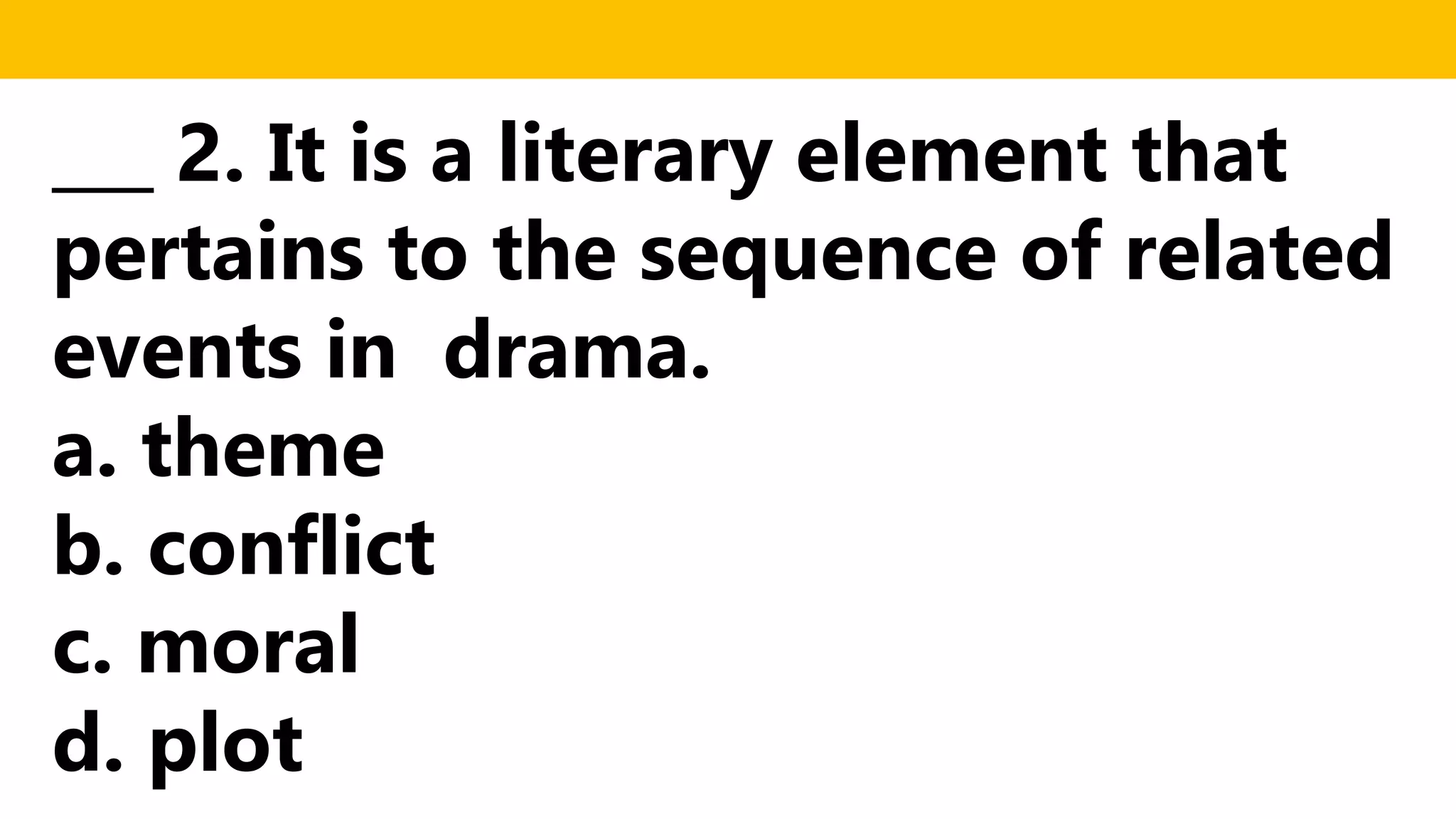
___ 2. It is a literary element that
pertains to the sequence of related
events in drama.
a. theme
b. conflict
c. moral
d. plot
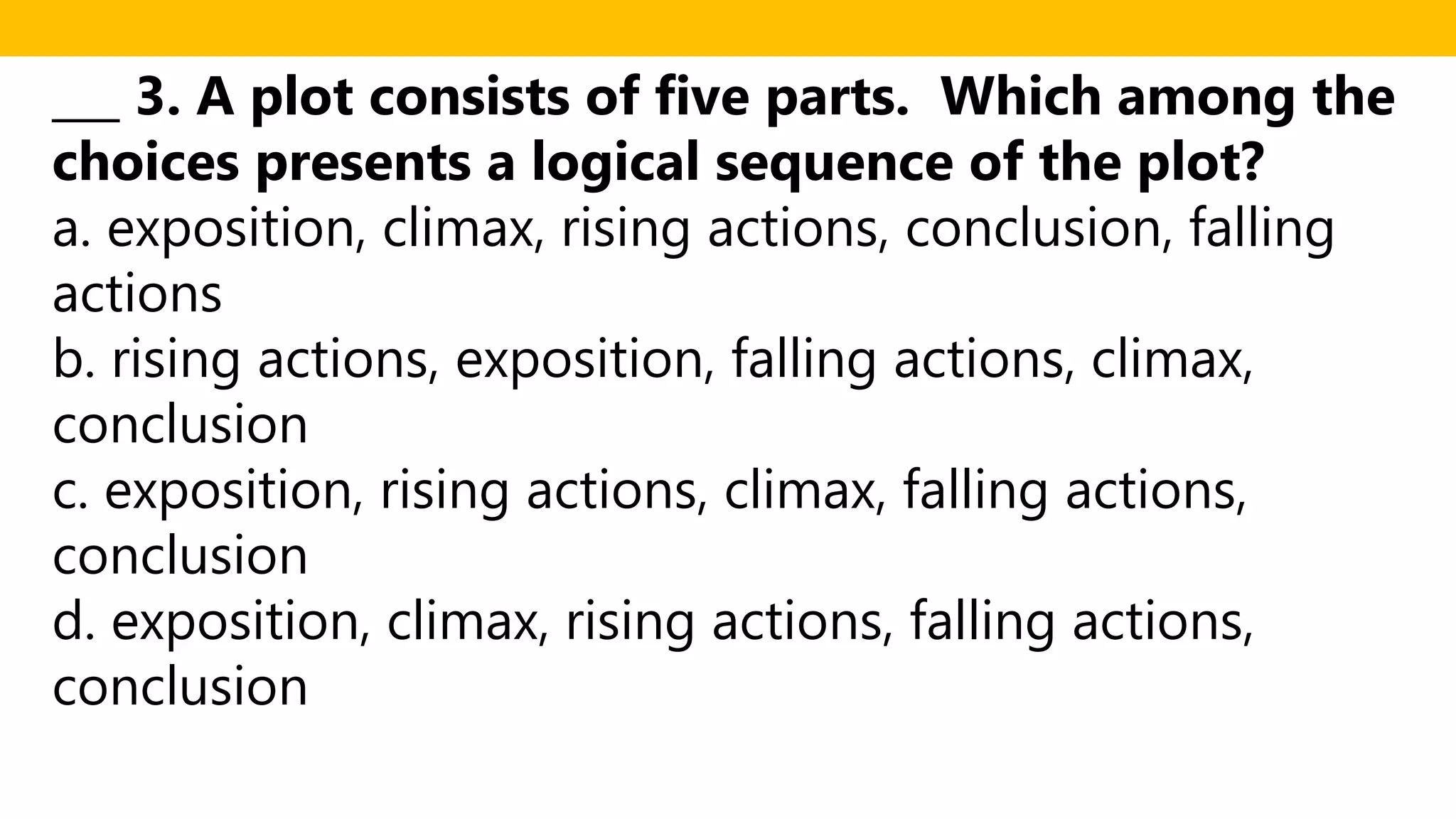
___ 3. A plot consists of five parts. Which among the

choices presents a logical sequence of the plot?
a. exposition, climax, rising actions, conclusion, falling
actions
b. rising actions, exposition, falling actions, climax,
conclusion
c. exposition, rising actions, climax, falling actions,
conclusion
d. exposition, climax, rising actions, falling actions,
conclusion
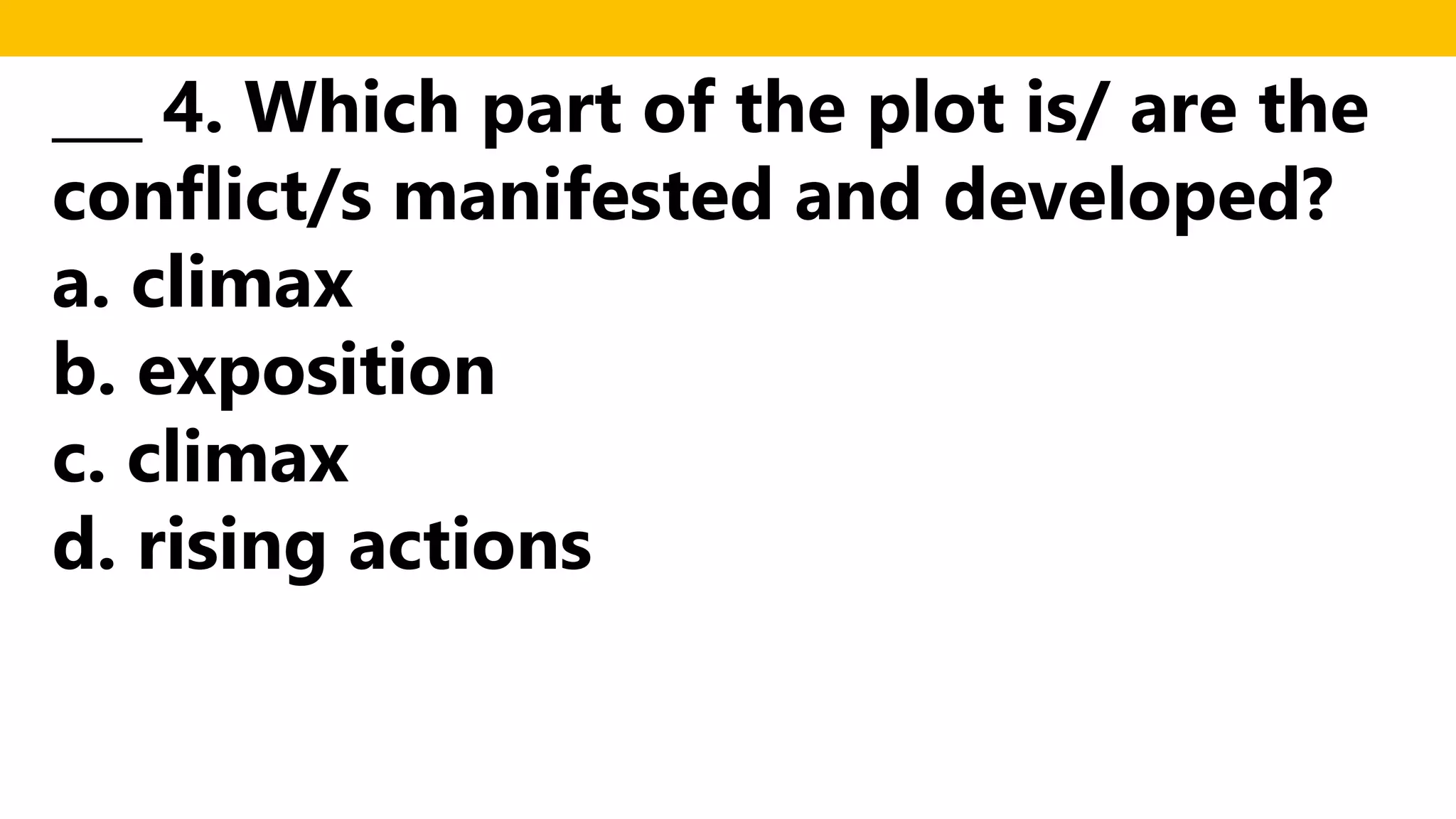
___ 4. Which part of the plot is/ are the
conflict/s manifested and developed?
a. climax
b. exposition
c. climax
d. rising actions
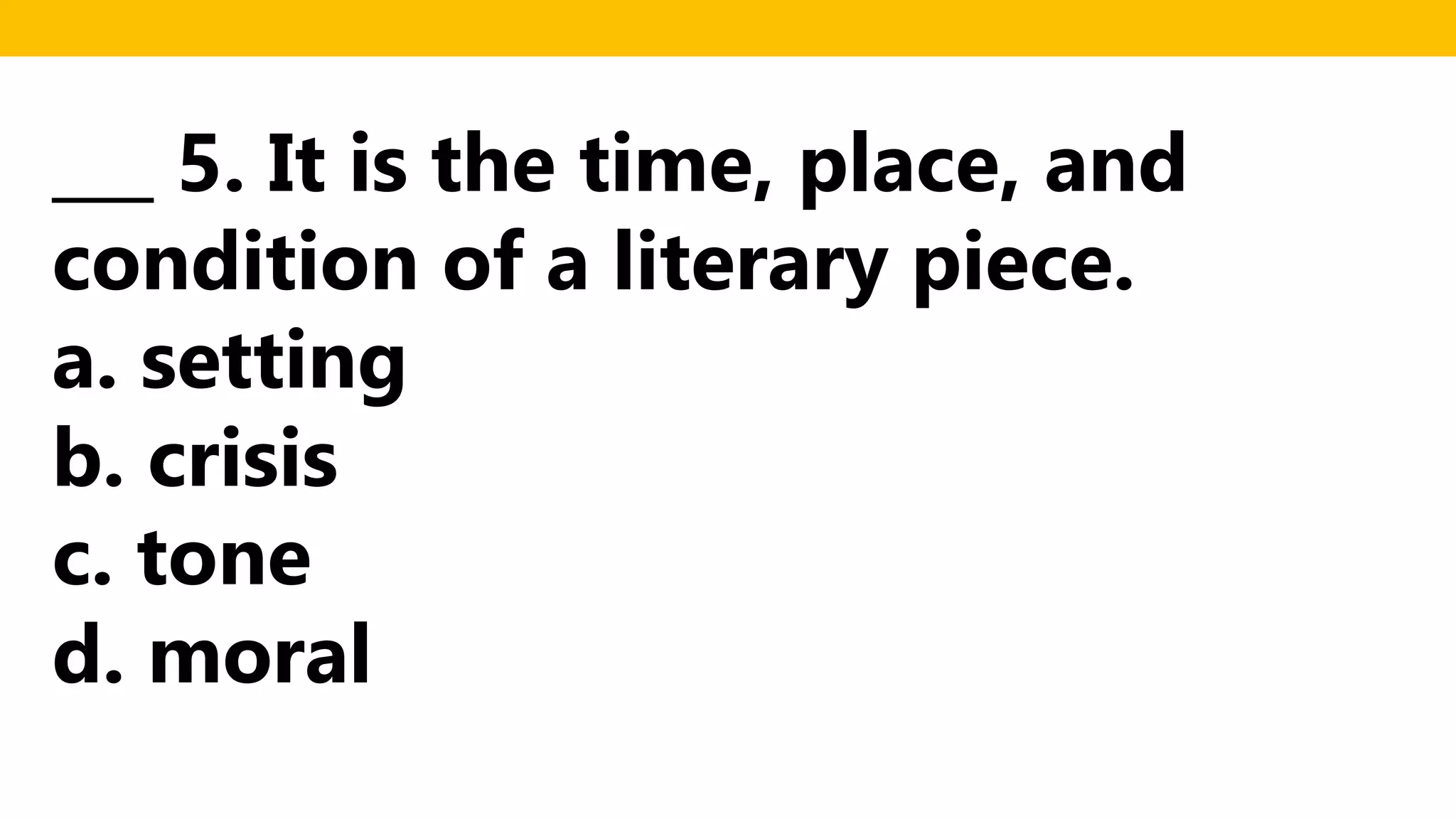
___ 5. It is the time, place, and
condition of a literary piece.
a. setting
b. crisis
c. tone
d. moral
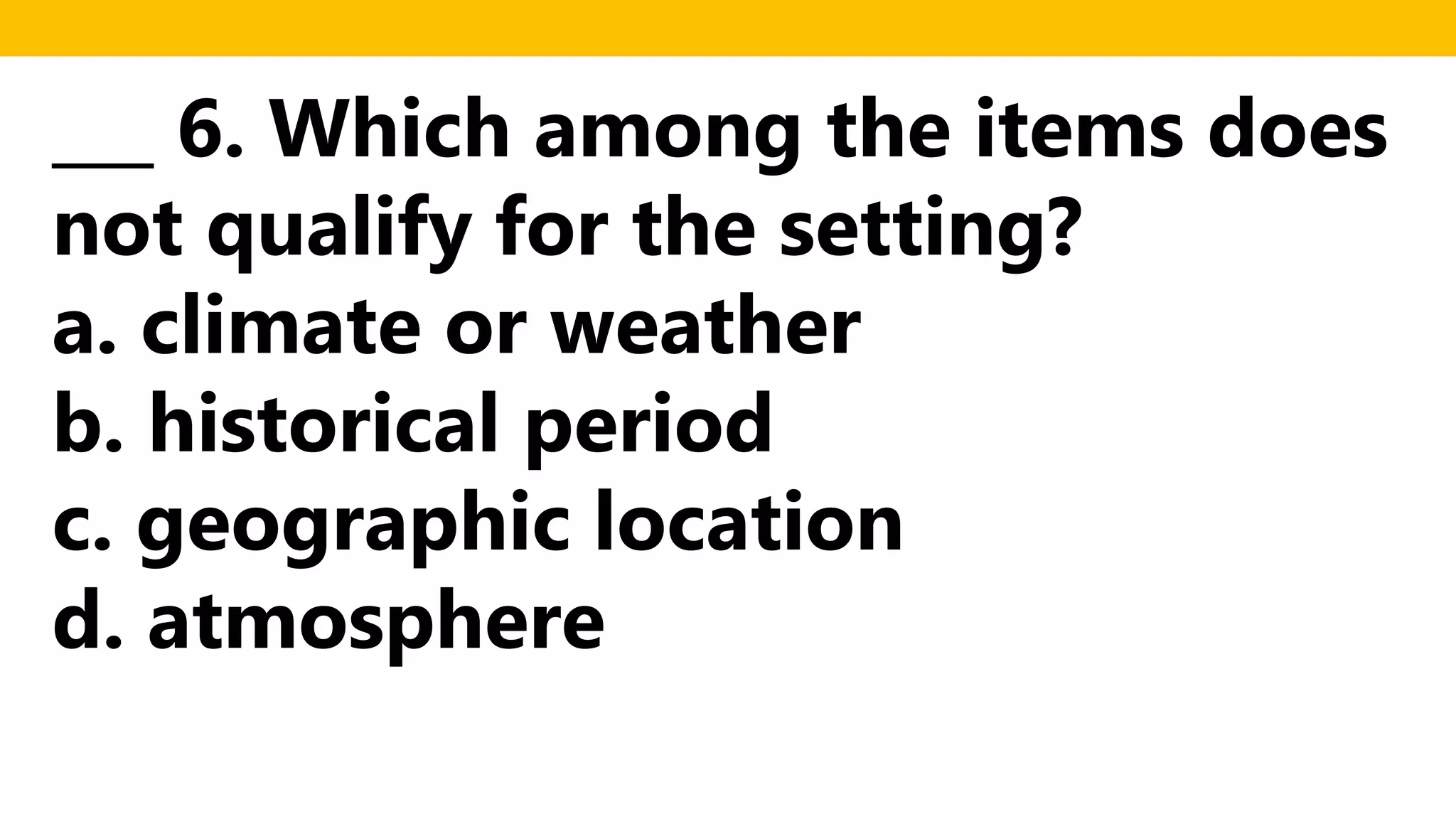
___ 6. Which among the items does
not qualify for the setting?
a. climate or weather
b. historical period
c. geographic location
d. atmosphere
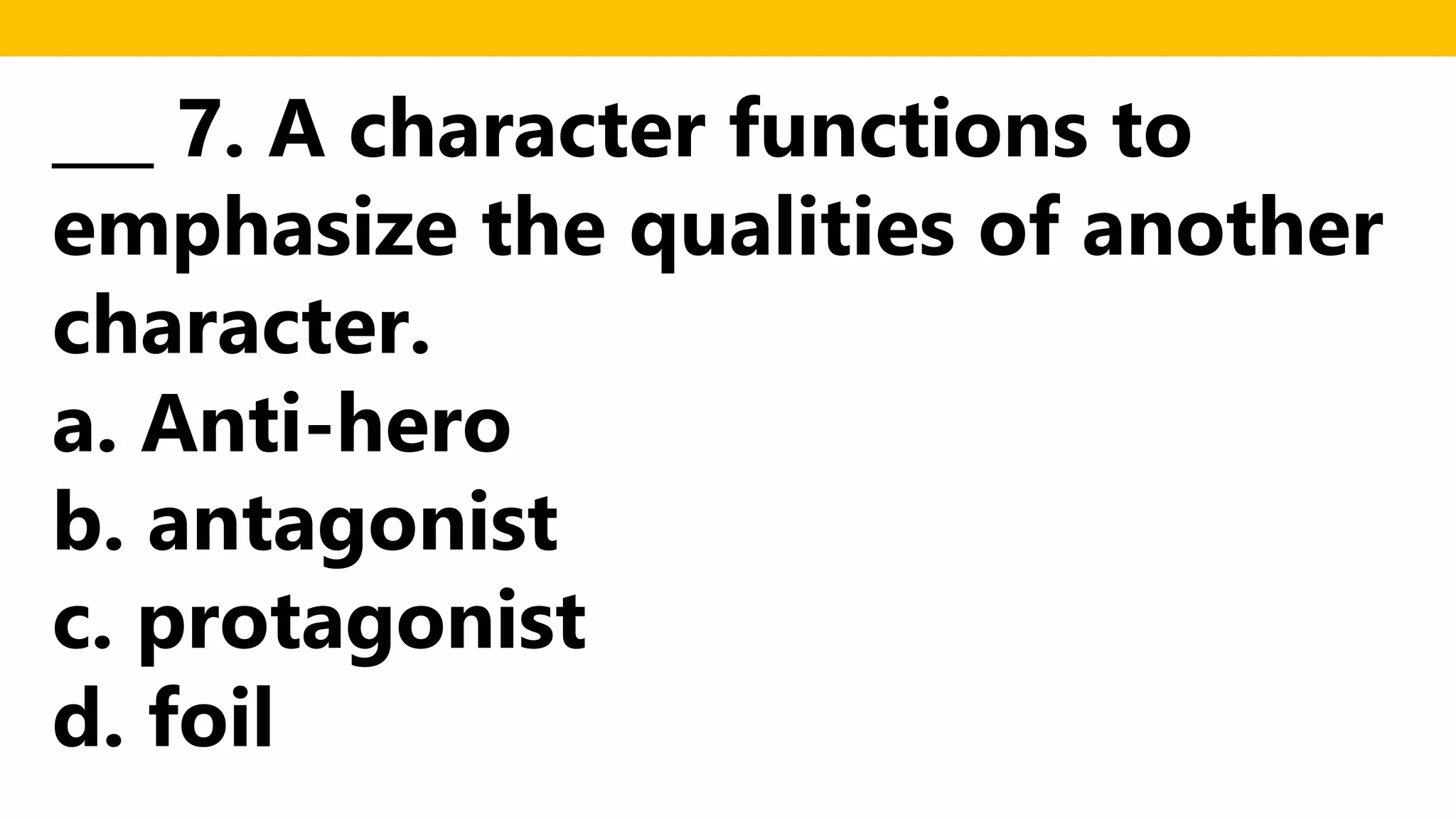
___ 7. A character functions to
emphasize the qualities of another
character.
a. Anti-hero
b. antagonist
c. protagonist
d. foil
___ 8. Who is considered to be the
one opposing the central
character?
a. foil
b. protagonist
c. anti-hero
d. antagonist
___ 9. It is a type of character that
is more realistic and shows
development or change.
a. flat
b. stock
c. square
d. round
___ 10. This character type displays
a stereotype like ‘a mean
stepmother.’
a. round
b. flat
c. stock
d. square
Literary Elements of
Drama: Character,
Setting, and Plot
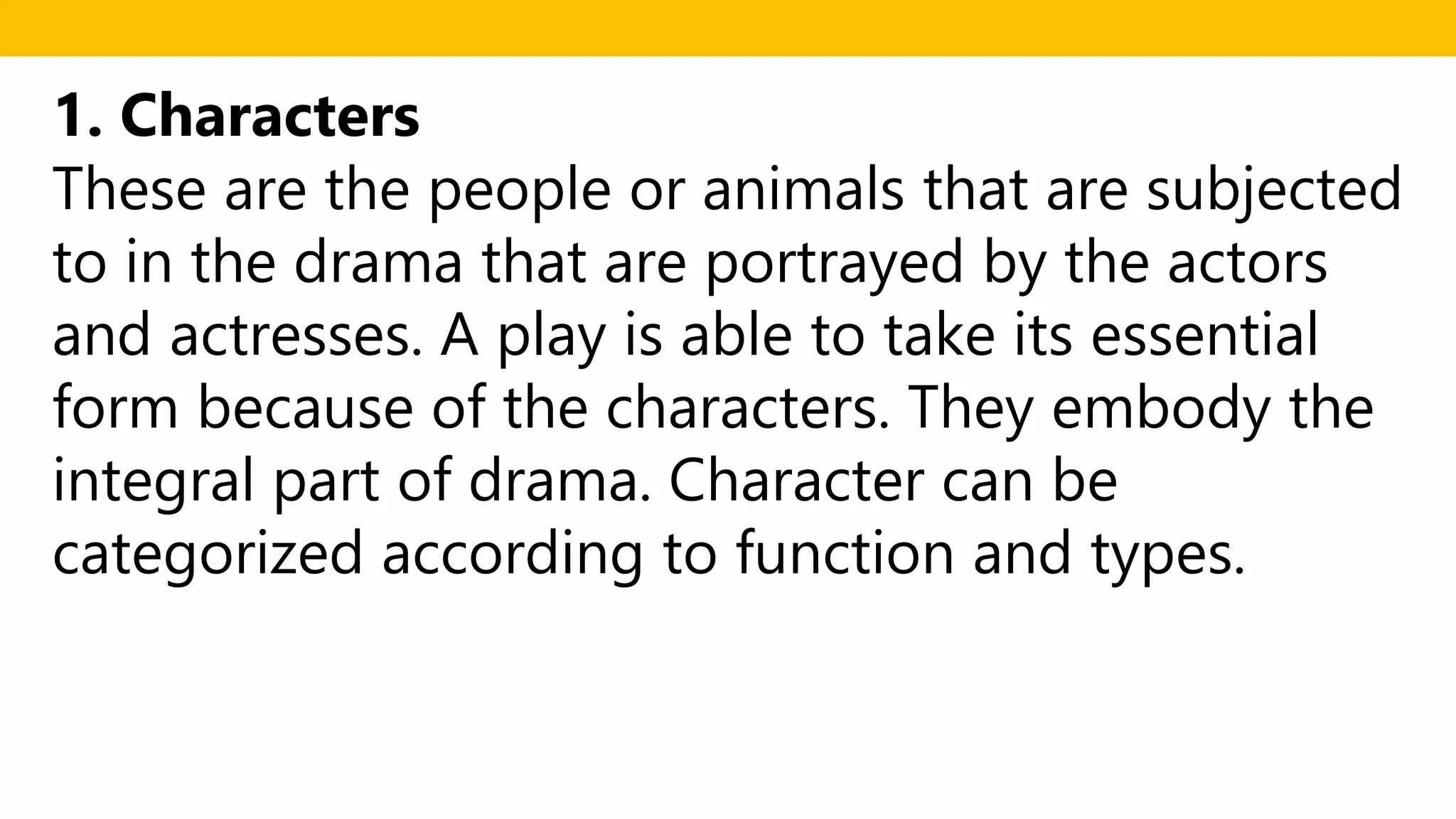
1. Characters
These are the people or animals that are subjected
to in the drama that are portrayed by the actors
and actresses. A play is able to take its essential
form because of the characters. They embody the
integral part of drama. Character can be
categorized according to function and types.
CHARACTERS IN THE DRAMA (ONE-ACT PLAY)
CHARACTERS
ACCORDING TO
FUNCTION
A. Protagonist – the main character in the play; the hero
or heroine
B. Antagonist – a major character who opposes and is
hostile to the protagonist.
C. Foil – a minor character who emphasizes the qualities of
another character
D. Anti-Hero – a minor character who is inconsistent and
usually shows failed goals
A. Round – a character who is realistic; has sufficient
motivation for his actions and behavior; experiences
change and development in the course of the play
CHARACTERS
ACCORDING TO
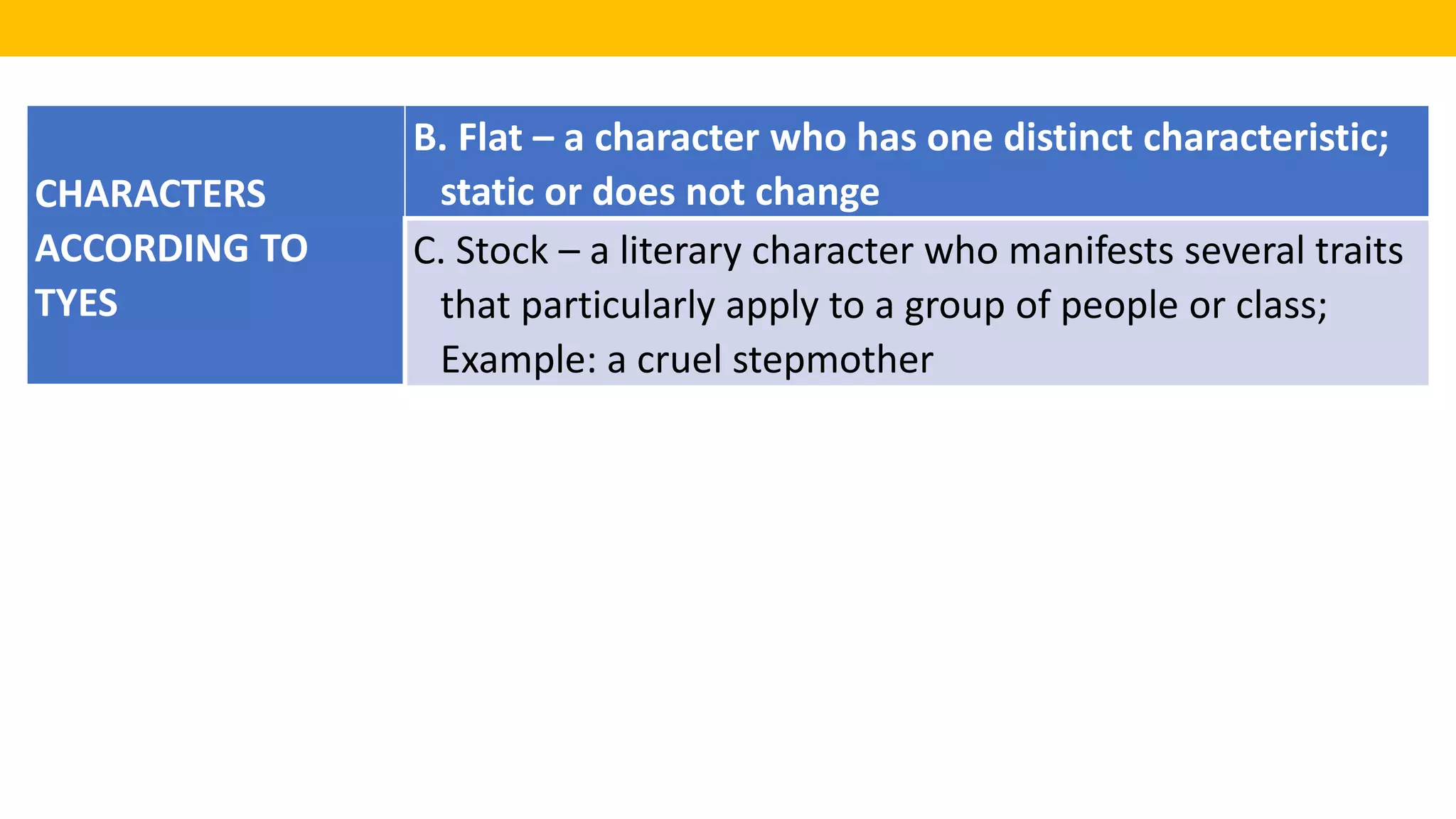
TYES
B. Flat – a character who has one distinct characteristic;
static or does not change
C. Stock – a literary character who manifests several traits
that particularly apply to a group of people or class;
Example: a cruel stepmother
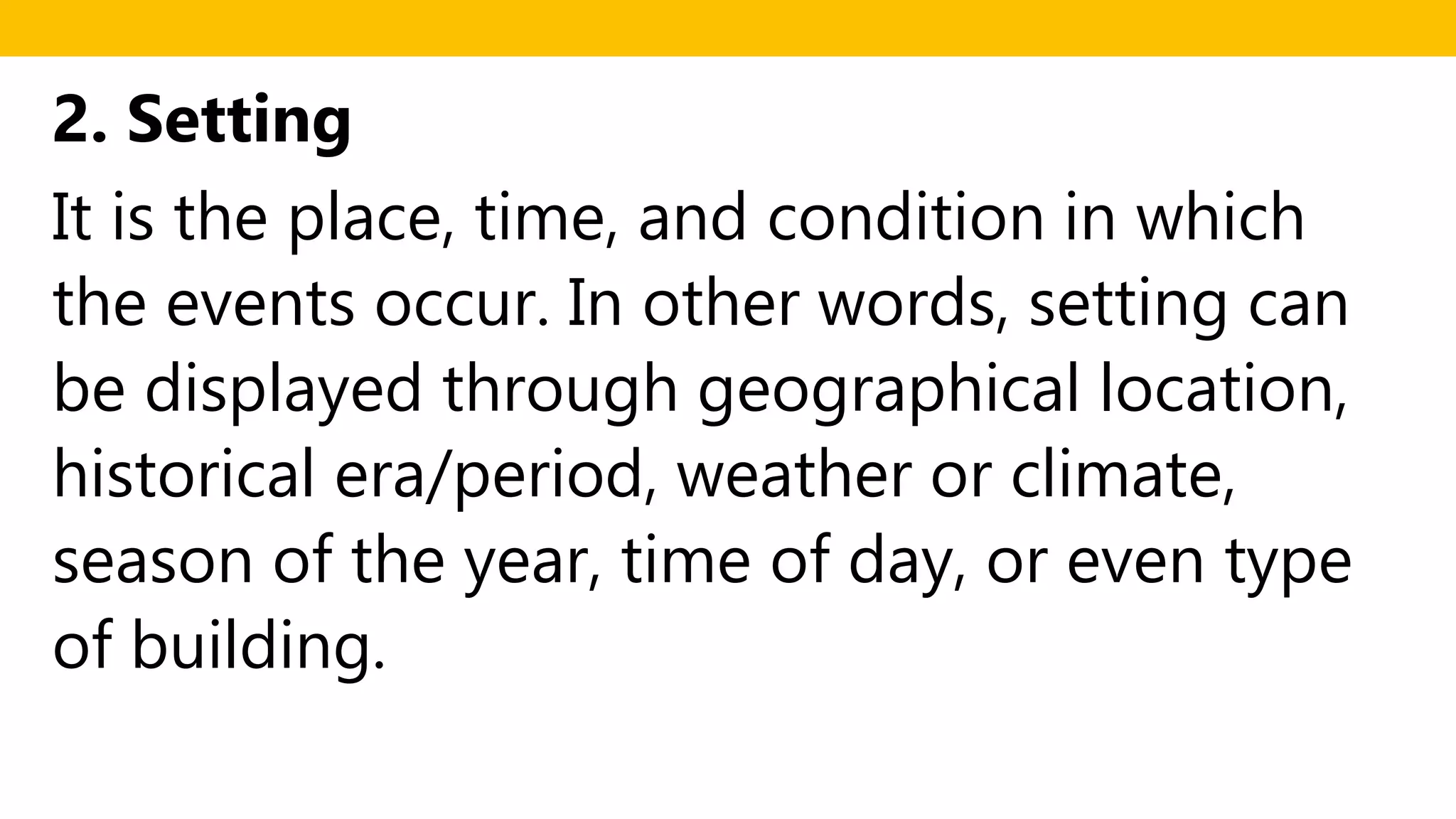
2. Setting
It is the place, time, and condition in which
the events occur. In other words, setting can
be displayed through geographical location,
historical era/period, weather or climate,
season of the year, time of day, or even type
of building.
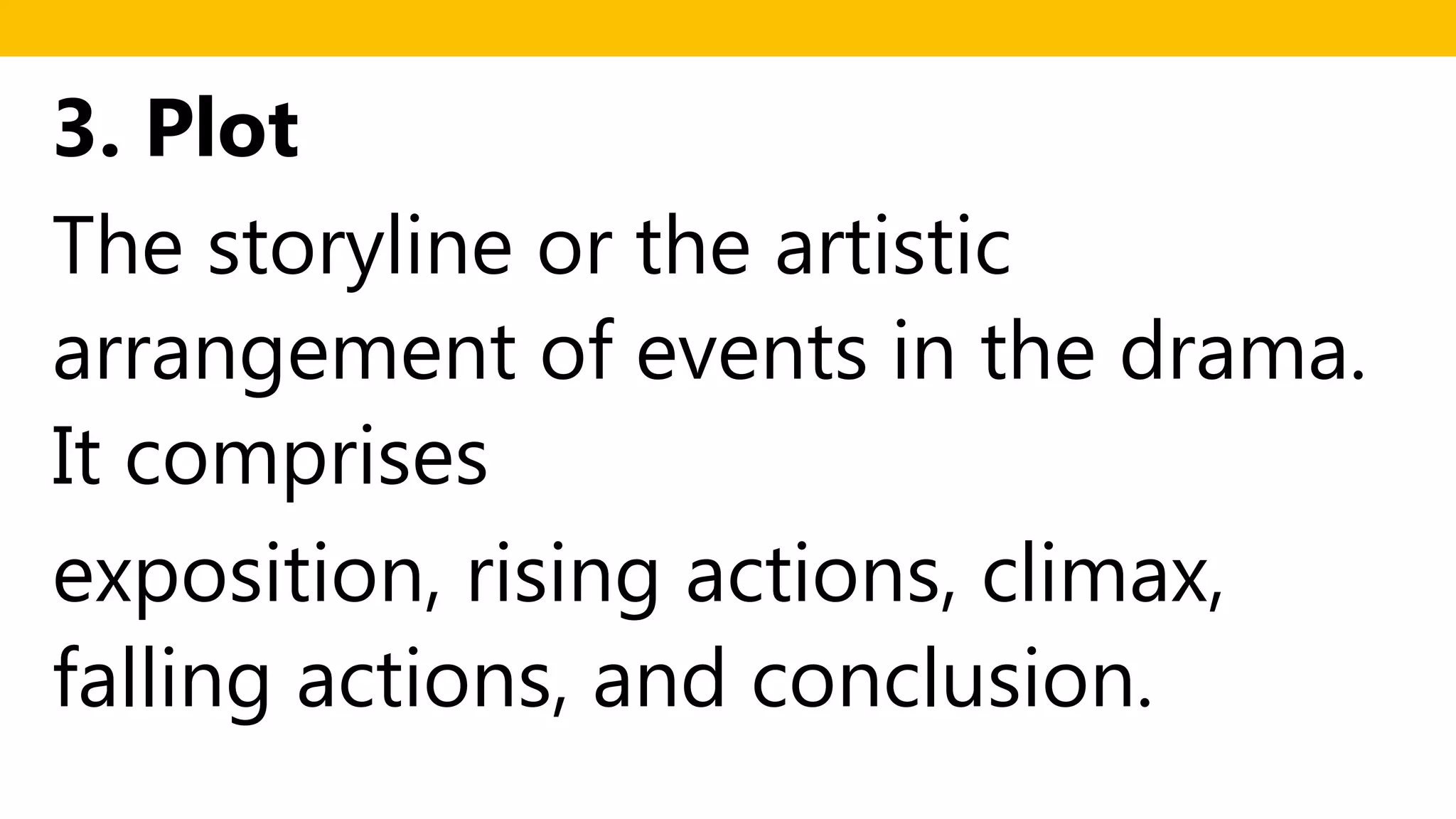
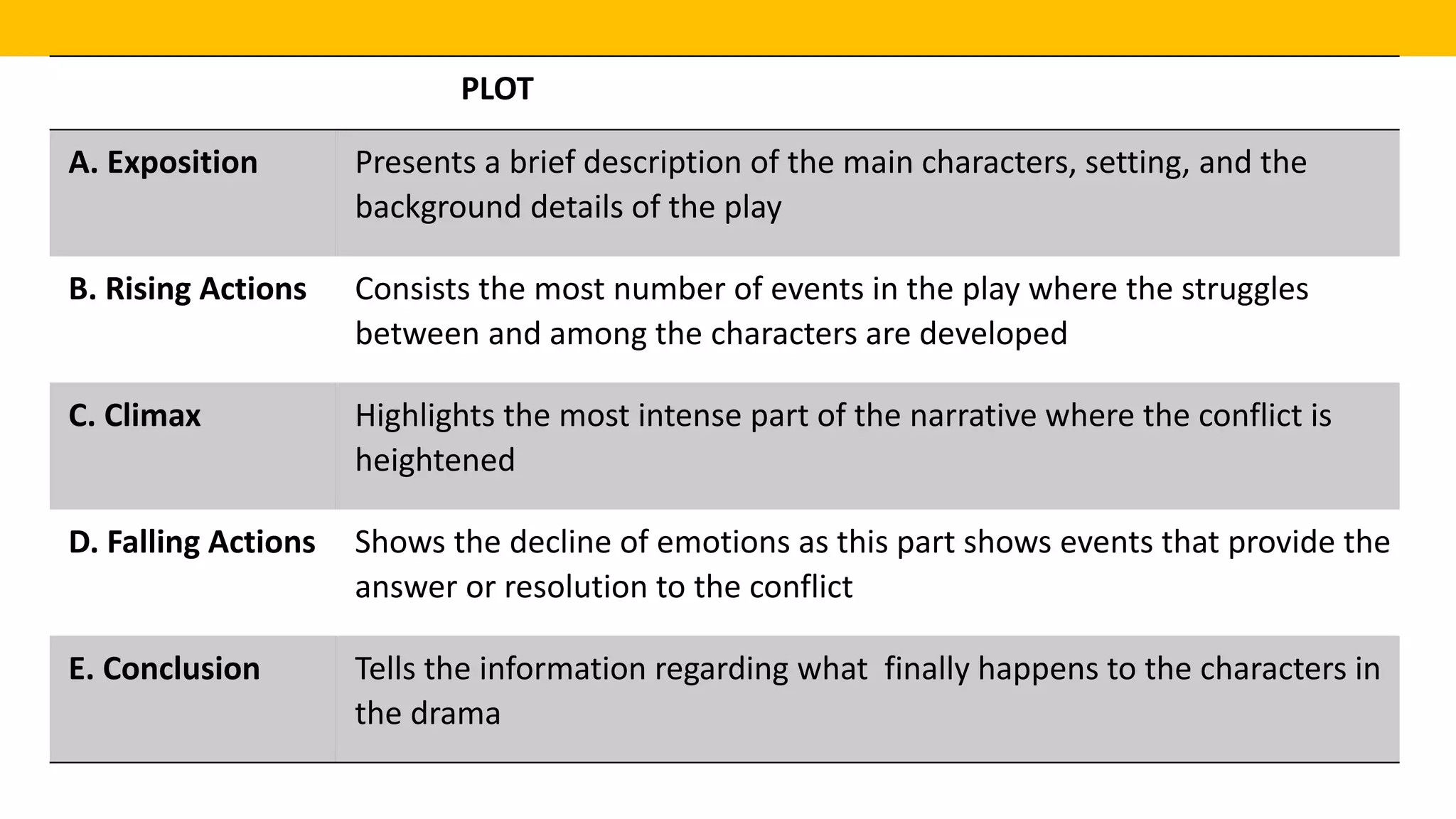
3. Plot
The storyline or the artistic
arrangement of events in the drama.
It comprises
exposition, rising actions, climax,
falling actions, and conclusion.
PLOT
A. Exposition Presents a brief description of the main characters, setting, and the
background details of the play
B. Rising Actions Consists the most number of events in the play where the struggles
between and among the characters are developed
C. Climax Highlights the most intense part of the narrative where the conflict is
heightened
D. Falling Actions Shows the decline of emotions as this part shows events that provide the
answer or resolution to the conflict
E. Conclusion Tells the information regarding what finally happens to the characters in
the drama
Master of the Play
This is now your chance to create an initial and tentative
framework of the one act play you are going to write in
the succeeding lesson.
Directions: Create your own concept of your one-act
play. Provide your initial details regarding your
characters, setting, and plot
What are the three new things
that you learned and
discovered base on our
discussion and activities?
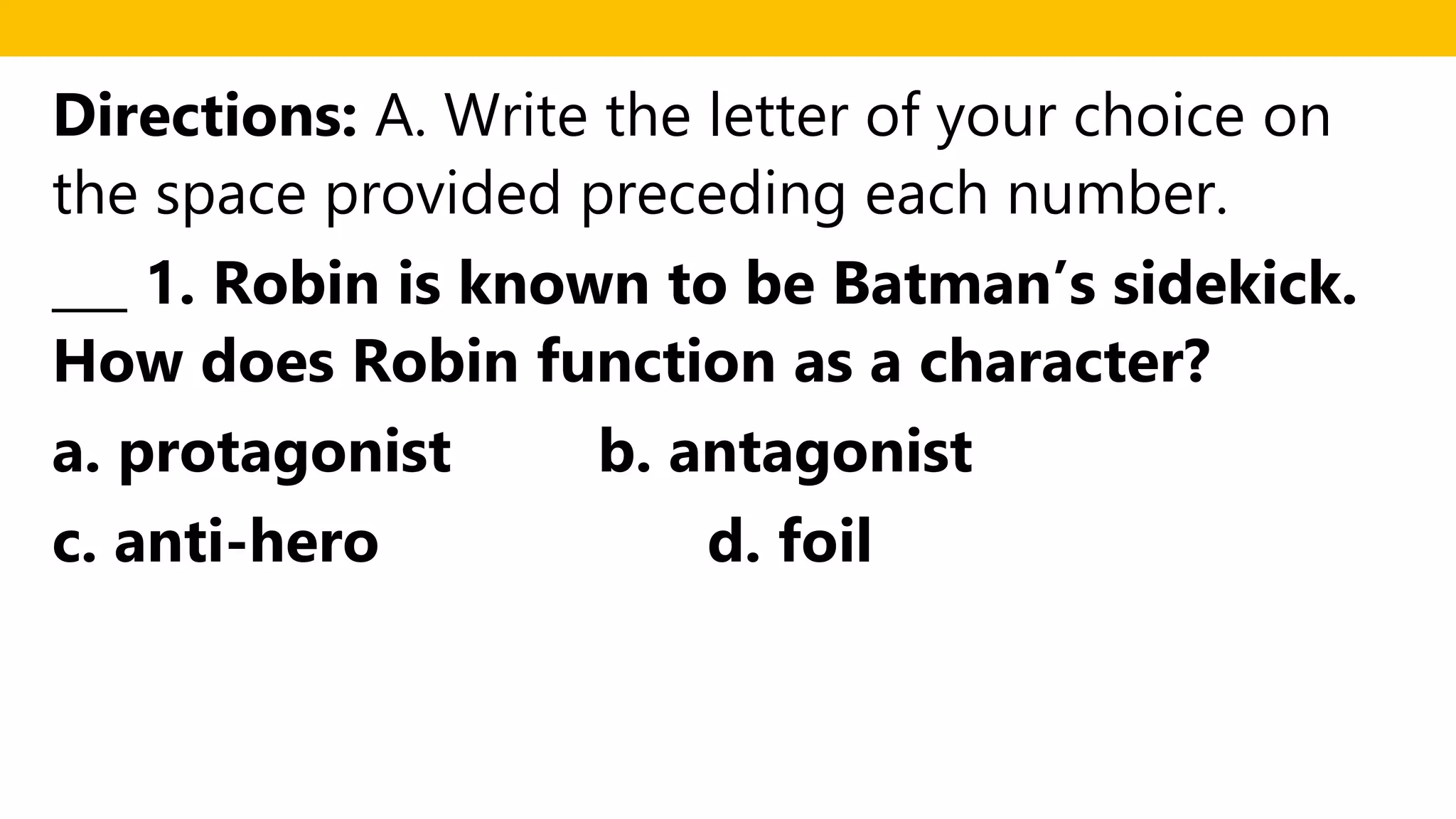
Directions: A. Write the letter of your choice on
the space provided preceding each number.
___ 1. Robin is known to be Batman’s sidekick.
How does Robin function as a character?
a. protagonist b. antagonist
c. anti-hero d. foil
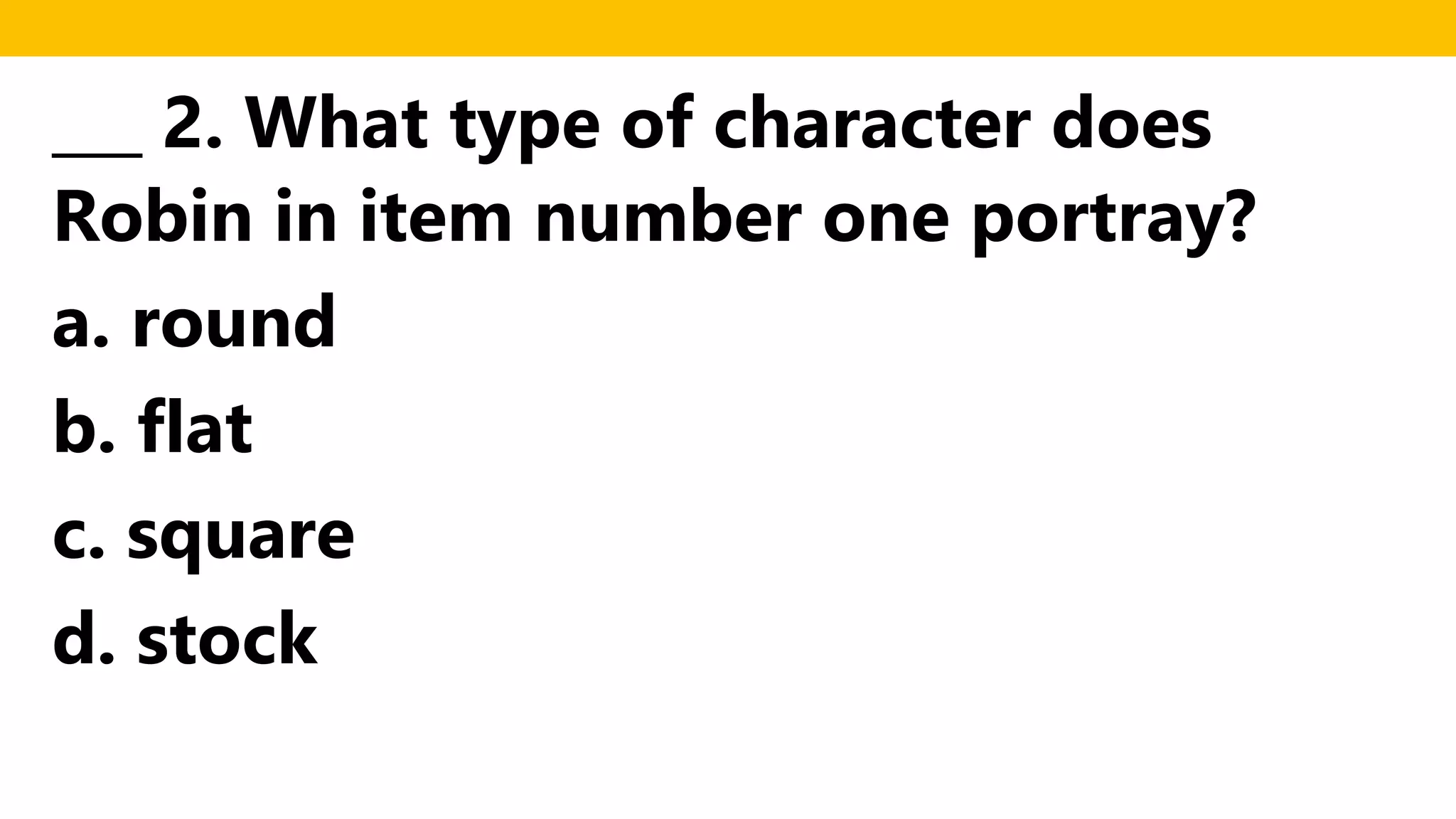
___ 2. What type of character does
Robin in item number one portray?
a. round
b. flat
c. square
d. stock
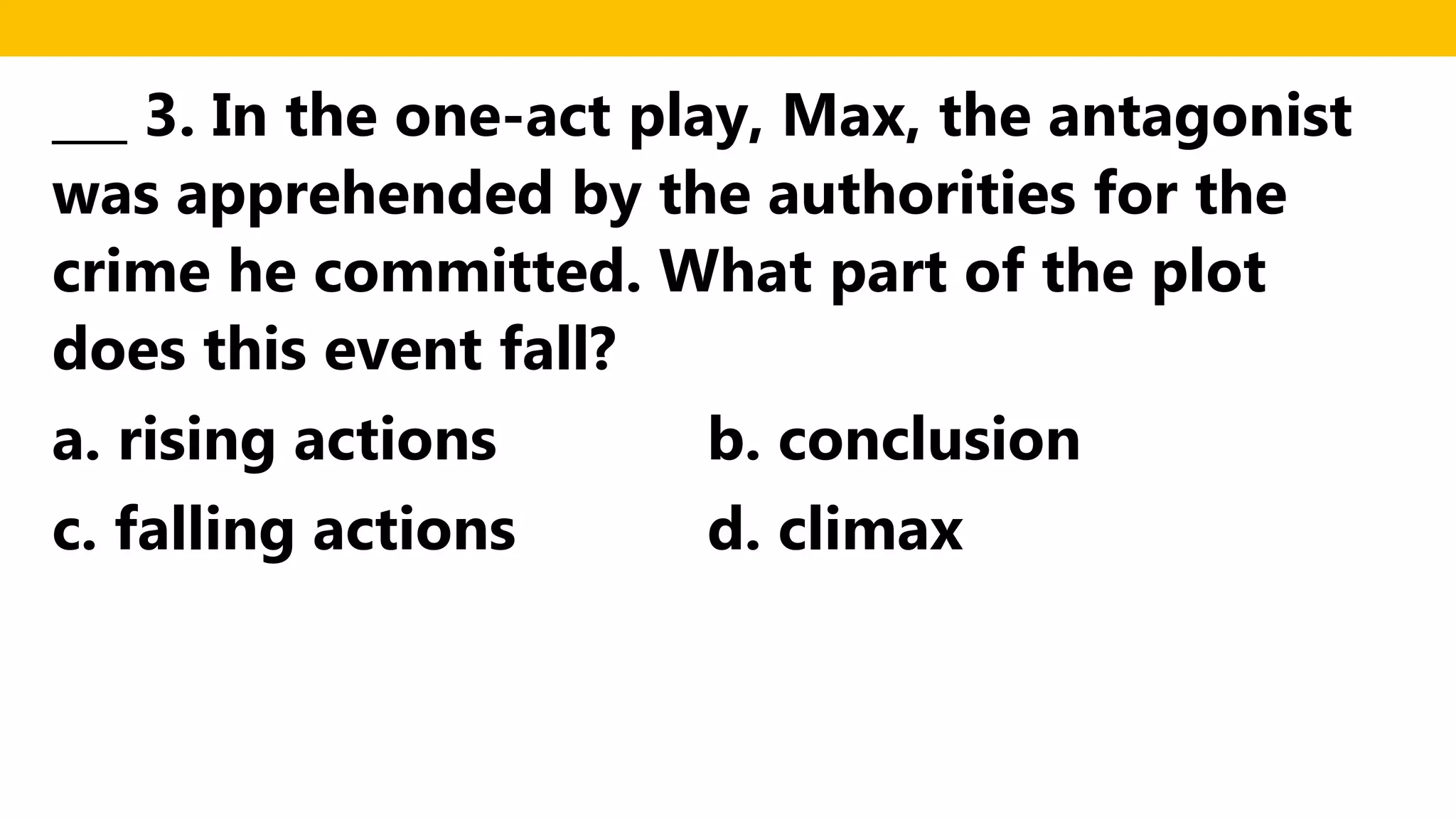
___ 3. In the one-act play, Max, the antagonist
was apprehended by the authorities for the
crime he committed. What part of the plot
does this event fall?
a. rising actions b. conclusion
c. falling actions d. climax
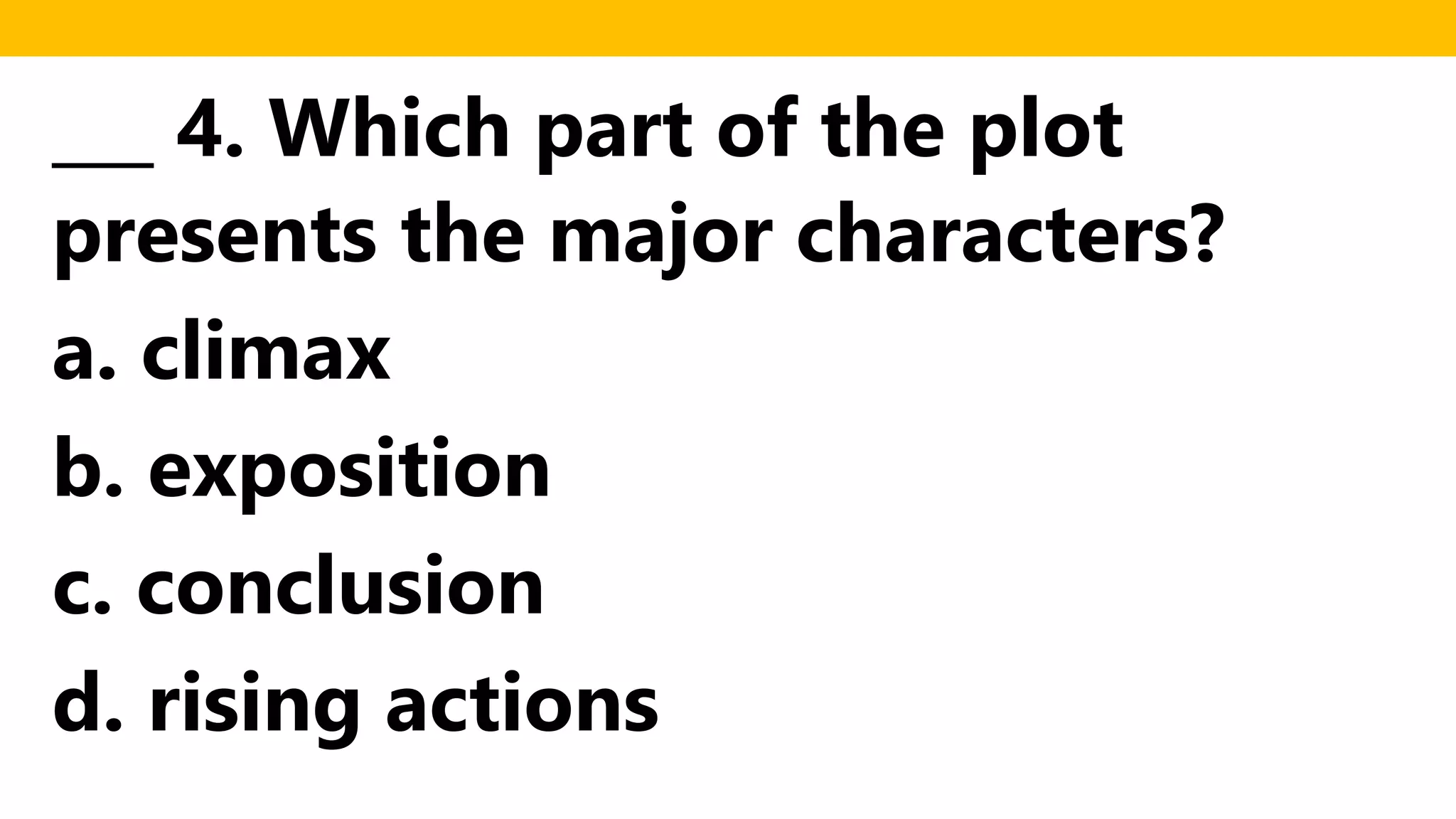
___ 4. Which part of the plot
presents the major characters?
a. climax
b. exposition
c. conclusion
d. rising actions
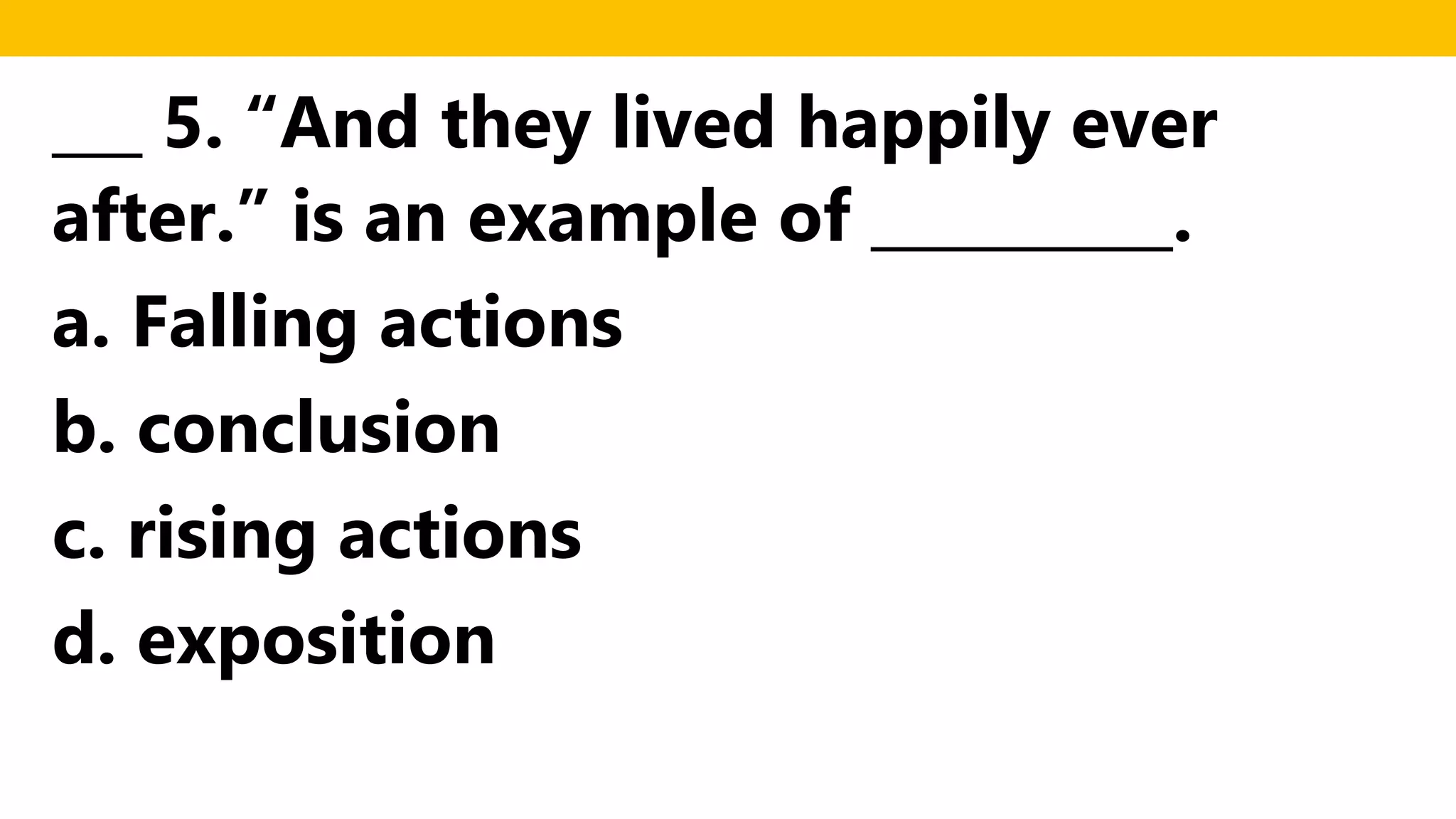
___ 5. “And they lived happily ever
after.” is an example of __________.
a. Falling actions
b. conclusion
c. rising actions
d. exposition
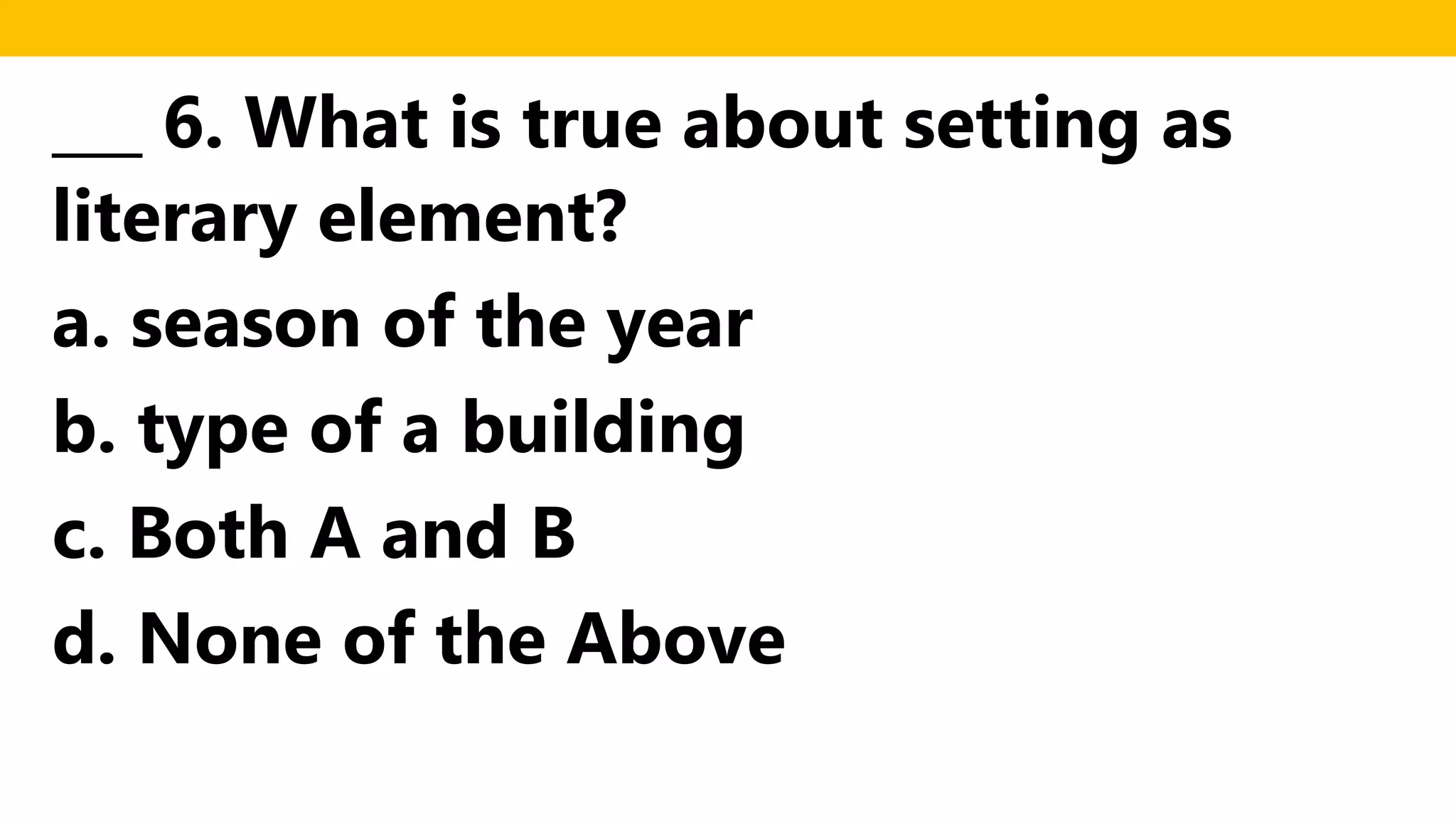
___ 6. What is true about setting as
literary element?
a. season of the year
b. type of a building
c. Both A and B
d. None of the Above
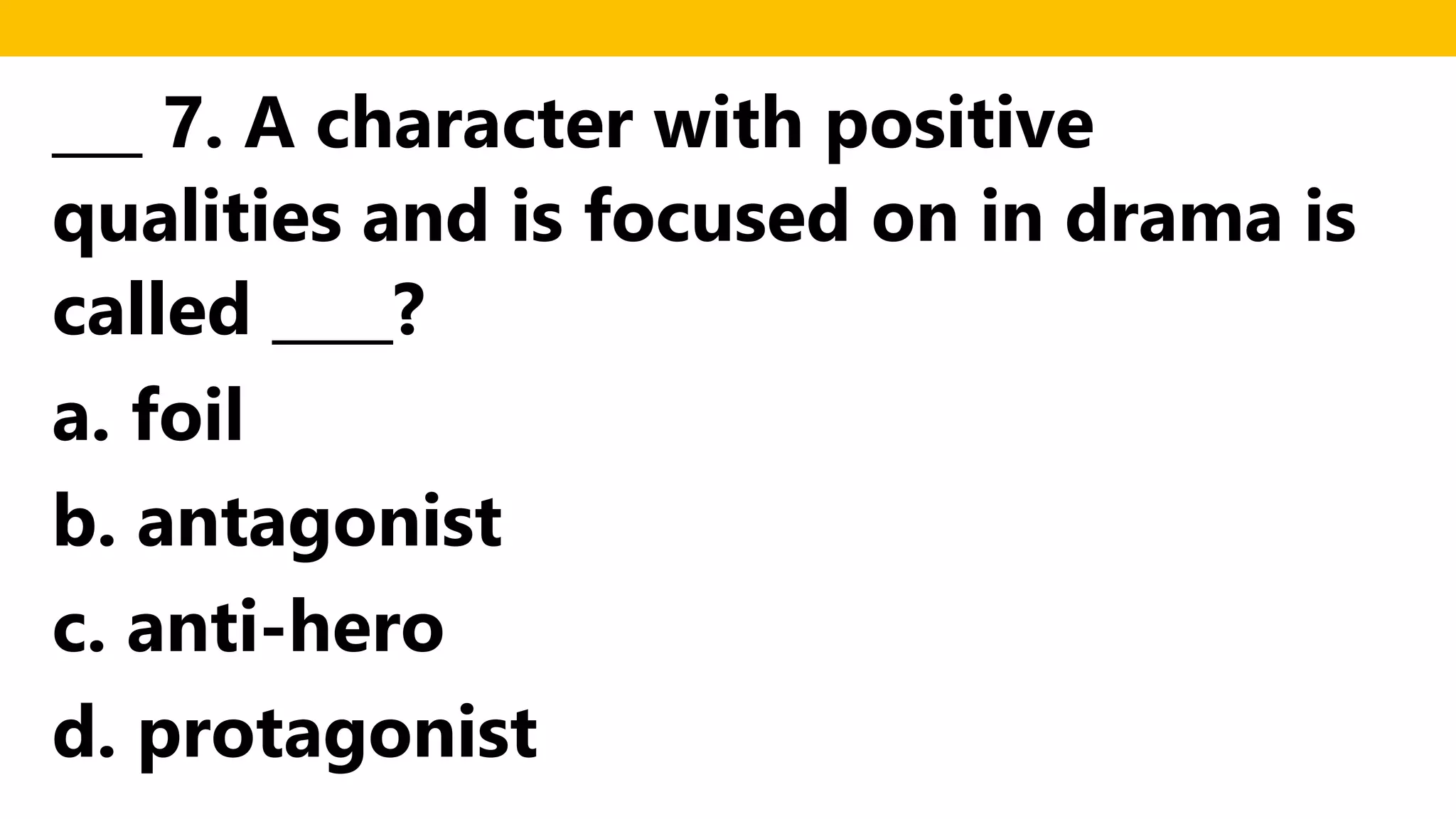
___ 7. A character with positive
qualities and is focused on in drama is
called ____?
a. foil
b. antagonist
c. anti-hero
d. protagonist
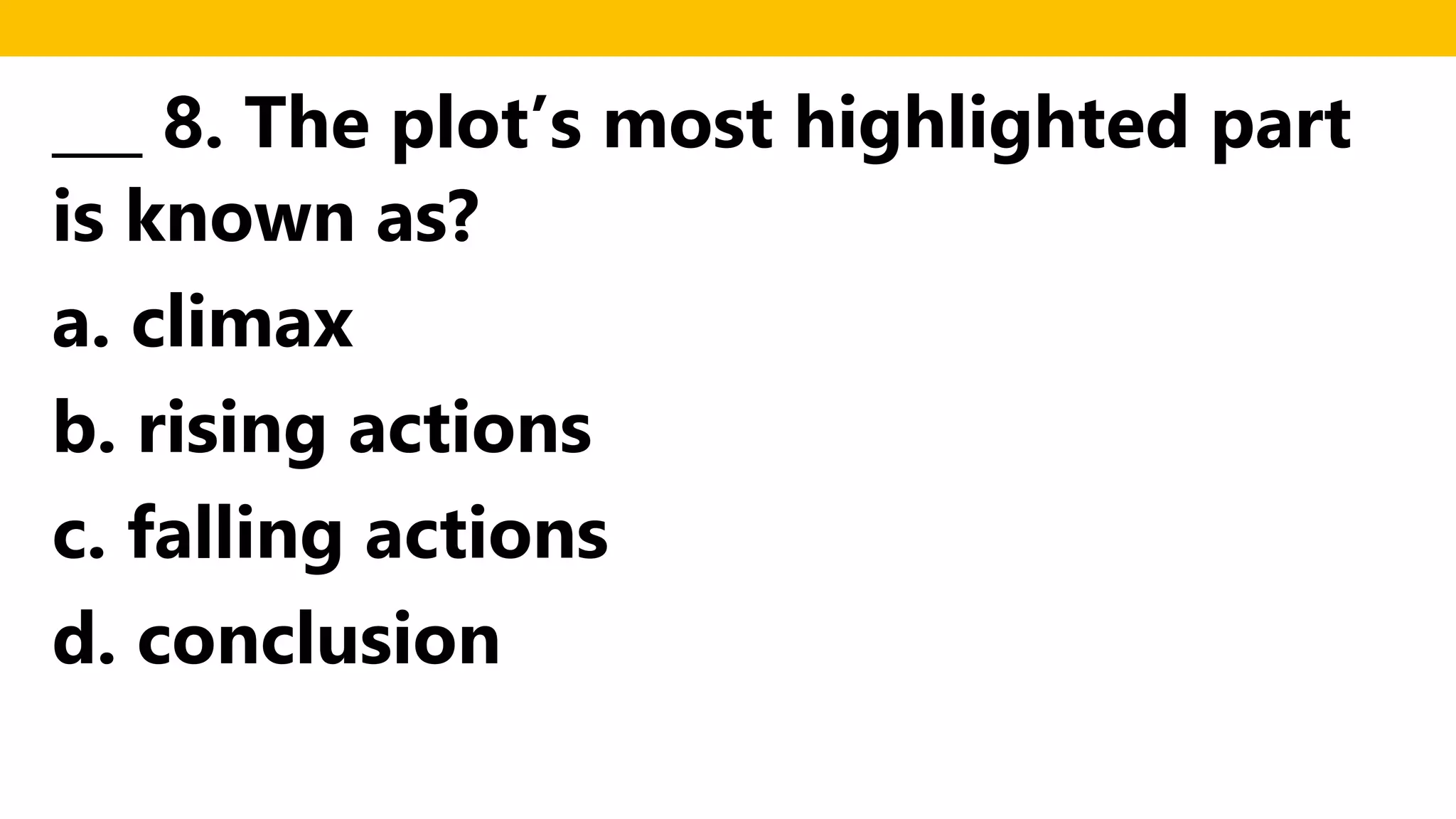
___ 8. The plot’s most highlighted part
is known as?
a. climax
b. rising actions
c. falling actions
d. conclusion
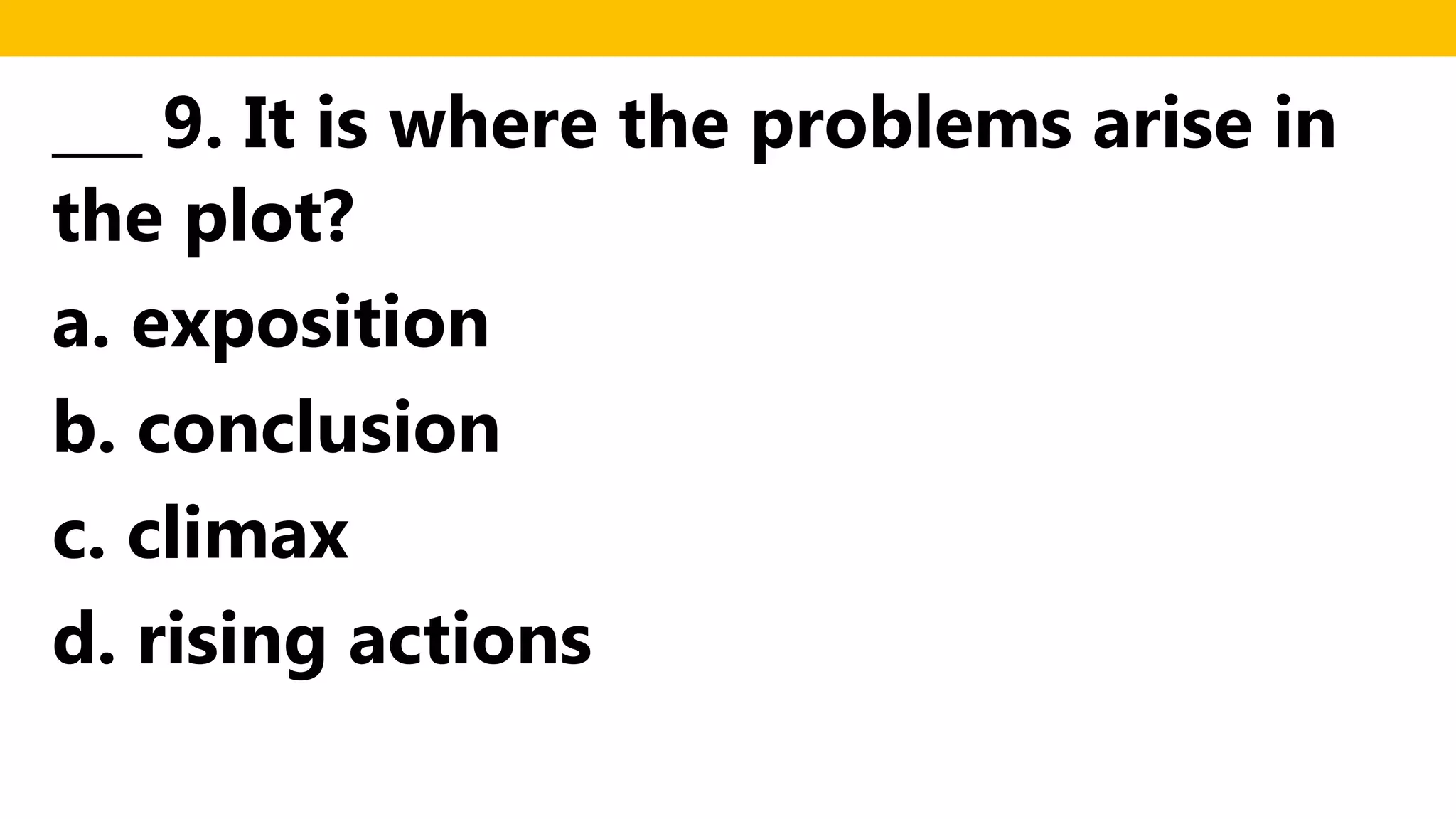
___ 9. It is where the problems arise in
the plot?
a. exposition
b. conclusion
c. climax
d. rising actions
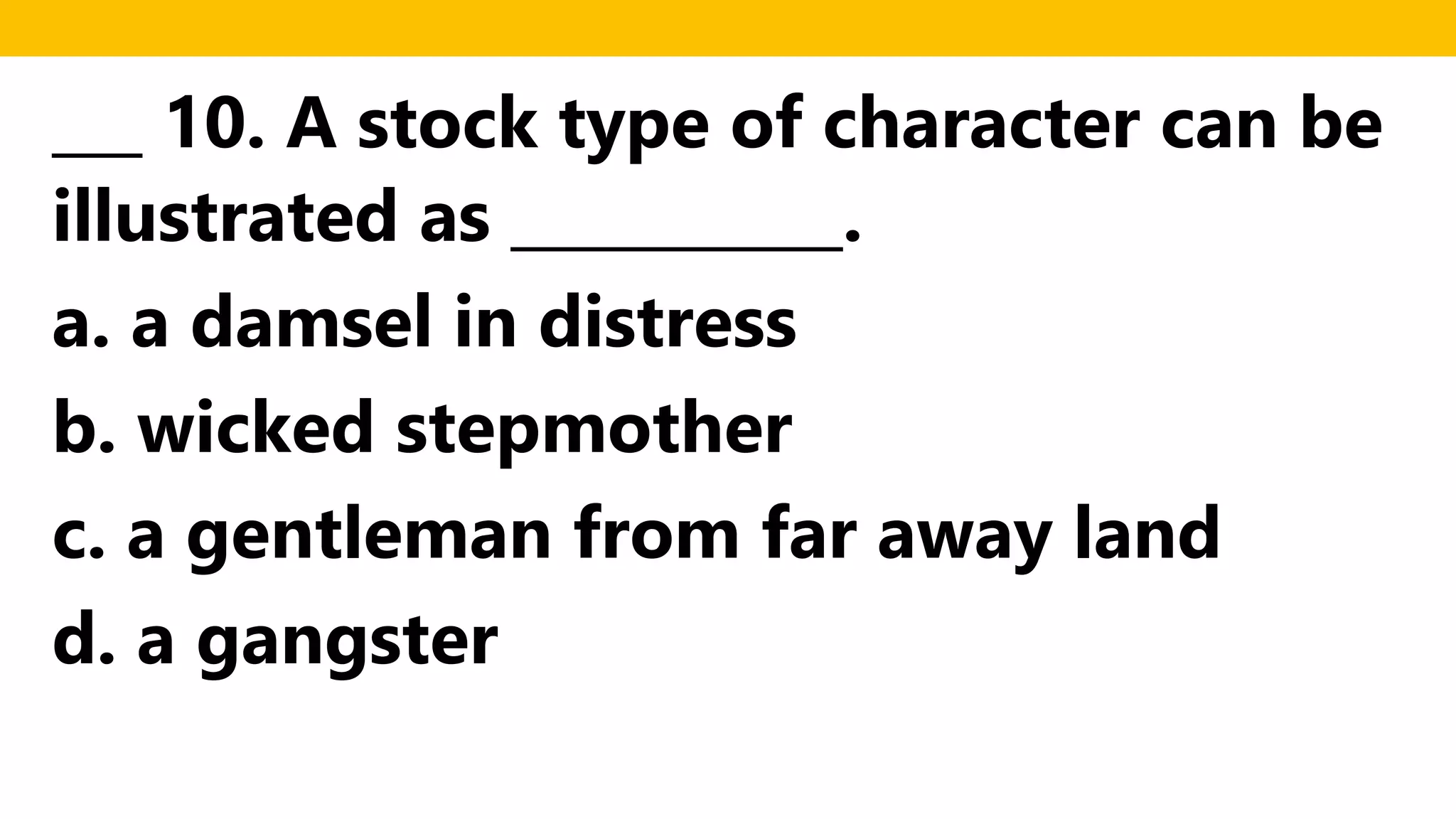
___ 10. A stock type of character can be
illustrated as ___________.
a. a damsel in distress
b. wicked stepmother
c. a gentleman from far away land
d. a gangster
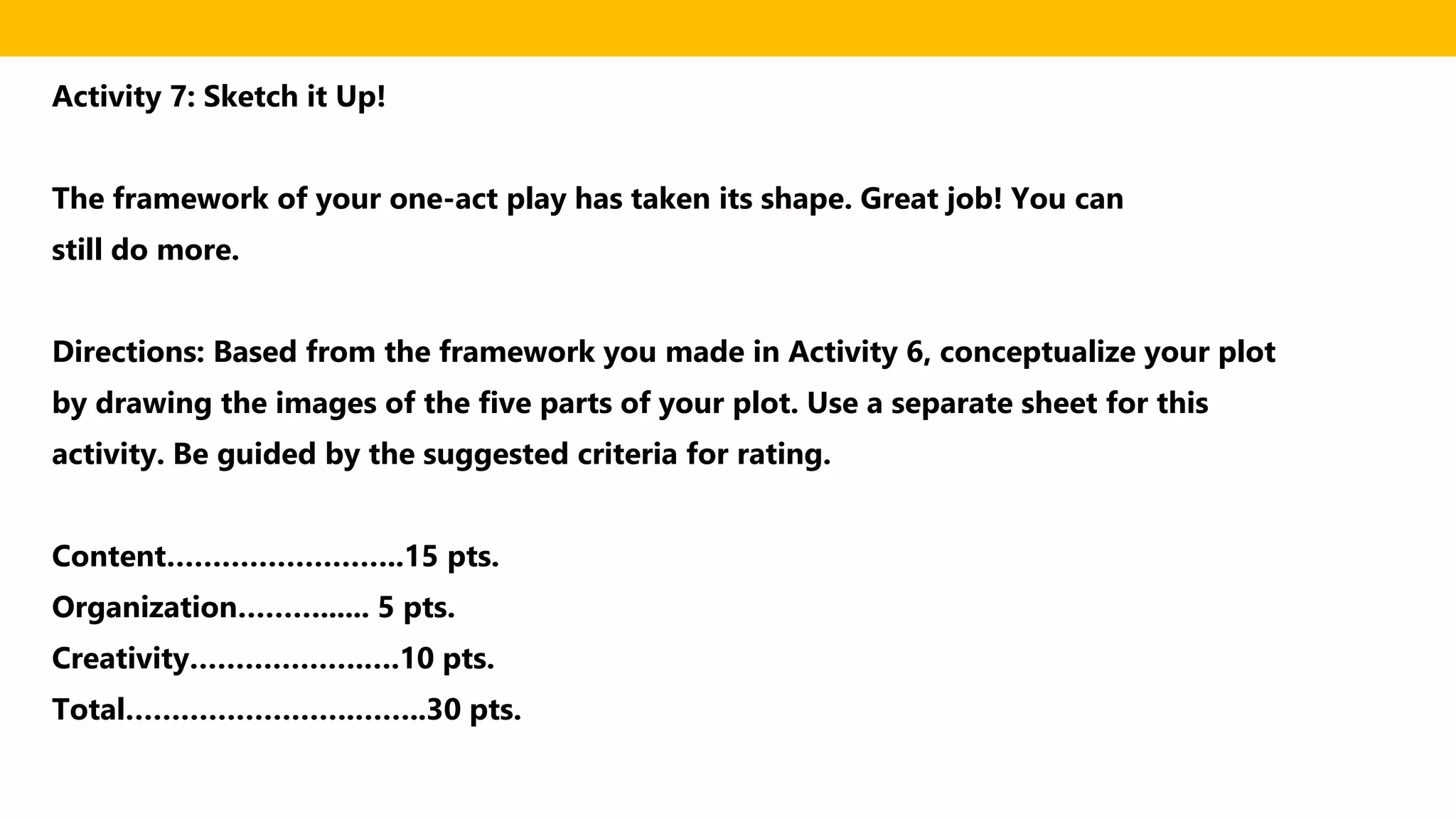
Activity 7: Sketch it Up!
The framework of your one-act play has taken its shape. Great job! You can
still do more.
Directions: Based from the framework you made in Activity 6, conceptualize your plot
by drawing the images of the five parts of your plot. Use a separate sheet for this
activity. Be guided by the suggested criteria for rating.
Content……………………..15 pts.
Organization………...... 5 pts.
Creativity……………….….10 pts.
Total…………………….……..30 pts.
Creative Writing - Conceptualizing Character, Setting, and Plot for One-Act Play

Creative Writing - Conceptualizing Character, Setting, and Plot for One-Act Play

  • 1.
    CREATIVE WRITING Conceptualizing Character,Setting, and Plot for One-Act Play
  • 2.
    a. Categorize character,setting, and plot in a one-act play; b. Examine character, setting, and plot from a one-act play; and c. Value the importance of reading a play. OBJECTIVES
  • 3.
    Whose is thatline? In this activity, you will experience the relationship between literary texts based from your previous lesson on Intertextuality. Fill in the first line with the name of the character who popularized the given line, then write the title of the literary text where the line is taken from.
  • 4.
    1. “You aremy own personal brand of heroin.” Character: __________________________ Title of the Text: __________________________ 2. “What’s in a name? That which we call a rose by any other name would smell as sweet.” Character: __________________________ Title of the Text: __________________________
  • 5.
    3. “Besides, you’resaying it wrong. It’s leviOsa not leviosA.” Character: __________________________ Title of the Text: __________________________ 4. “May the odds be ever in your favor.” Character: __________________________ Title of the Text: __________________________
  • 6.
    5. “Sweet Princess,if through this wicked witch’s trick, a spindle should your finger prick. A ray of hope there still may be in this, the gift I give to thee.” “And from this slumber you shall wake, when true love’s kiss, the spell shall break.” Character: __________________________ Title of the Text: __________________________
  • 7.
    What I Know ___1. What is another term used to denote drama as a genre in literature? a. One-act play b. play c. poetry d. novel
  • 8.
    ___ 2. Itis a literary element that pertains to the sequence of related events in drama. a. theme b. conflict c. moral d. plot
  • 9.
    ___ 3. Aplot consists of five parts. Which among the choices presents a logical sequence of the plot? a. exposition, climax, rising actions, conclusion, falling actions b. rising actions, exposition, falling actions, climax, conclusion c. exposition, rising actions, climax, falling actions, conclusion d. exposition, climax, rising actions, falling actions, conclusion
  • 10.
    ___ 4. Whichpart of the plot is/ are the conflict/s manifested and developed? a. climax b. exposition c. climax d. rising actions
  • 11.
    ___ 5. Itis the time, place, and condition of a literary piece. a. setting b. crisis c. tone d. moral
  • 12.
    ___ 6. Whichamong the items does not qualify for the setting? a. climate or weather b. historical period c. geographic location d. atmosphere
  • 13.
    ___ 7. Acharacter functions to emphasize the qualities of another character. a. Anti-hero b. antagonist c. protagonist d. foil
  • 14.
    ___ 8. Whois considered to be the one opposing the central character? a. foil b. protagonist c. anti-hero d. antagonist
  • 15.
    ___ 9. Itis a type of character that is more realistic and shows development or change. a. flat b. stock c. square d. round
  • 16.
    ___ 10. Thischaracter type displays a stereotype like ‘a mean stepmother.’ a. round b. flat c. stock d. square
  • 17.
    Literary Elements of Drama:Character, Setting, and Plot
  • 18.
    1. Characters These arethe people or animals that are subjected to in the drama that are portrayed by the actors and actresses. A play is able to take its essential form because of the characters. They embody the integral part of drama. Character can be categorized according to function and types.
  • 19.
    CHARACTERS IN THEDRAMA (ONE-ACT PLAY) CHARACTERS ACCORDING TO FUNCTION A. Protagonist – the main character in the play; the hero or heroine B. Antagonist – a major character who opposes and is hostile to the protagonist. C. Foil – a minor character who emphasizes the qualities of another character D. Anti-Hero – a minor character who is inconsistent and usually shows failed goals A. Round – a character who is realistic; has sufficient motivation for his actions and behavior; experiences change and development in the course of the play
  • 20.
    CHARACTERS ACCORDING TO TYES B. Flat– a character who has one distinct characteristic; static or does not change C. Stock – a literary character who manifests several traits that particularly apply to a group of people or class; Example: a cruel stepmother
  • 21.
    2. Setting It isthe place, time, and condition in which the events occur. In other words, setting can be displayed through geographical location, historical era/period, weather or climate, season of the year, time of day, or even type of building.
  • 22.
    3. Plot The storylineor the artistic arrangement of events in the drama. It comprises exposition, rising actions, climax, falling actions, and conclusion.
  • 23.
    PLOT A. Exposition Presentsa brief description of the main characters, setting, and the background details of the play B. Rising Actions Consists the most number of events in the play where the struggles between and among the characters are developed C. Climax Highlights the most intense part of the narrative where the conflict is heightened D. Falling Actions Shows the decline of emotions as this part shows events that provide the answer or resolution to the conflict E. Conclusion Tells the information regarding what finally happens to the characters in the drama
  • 24.
    Master of thePlay This is now your chance to create an initial and tentative framework of the one act play you are going to write in the succeeding lesson. Directions: Create your own concept of your one-act play. Provide your initial details regarding your characters, setting, and plot
  • 26.
    What are thethree new things that you learned and discovered base on our discussion and activities?
  • 27.
    Directions: A. Writethe letter of your choice on the space provided preceding each number. ___ 1. Robin is known to be Batman’s sidekick. How does Robin function as a character? a. protagonist b. antagonist c. anti-hero d. foil
  • 28.
    ___ 2. Whattype of character does Robin in item number one portray? a. round b. flat c. square d. stock
  • 29.
    ___ 3. Inthe one-act play, Max, the antagonist was apprehended by the authorities for the crime he committed. What part of the plot does this event fall? a. rising actions b. conclusion c. falling actions d. climax
  • 30.
    ___ 4. Whichpart of the plot presents the major characters? a. climax b. exposition c. conclusion d. rising actions
  • 31.
    ___ 5. “Andthey lived happily ever after.” is an example of __________. a. Falling actions b. conclusion c. rising actions d. exposition
  • 32.
    ___ 6. Whatis true about setting as literary element? a. season of the year b. type of a building c. Both A and B d. None of the Above
  • 33.
    ___ 7. Acharacter with positive qualities and is focused on in drama is called ____? a. foil b. antagonist c. anti-hero d. protagonist
  • 34.
    ___ 8. Theplot’s most highlighted part is known as? a. climax b. rising actions c. falling actions d. conclusion
  • 35.
    ___ 9. Itis where the problems arise in the plot? a. exposition b. conclusion c. climax d. rising actions
  • 36.
    ___ 10. Astock type of character can be illustrated as ___________. a. a damsel in distress b. wicked stepmother c. a gentleman from far away land d. a gangster
  • 37.
    Activity 7: Sketchit Up! The framework of your one-act play has taken its shape. Great job! You can still do more. Directions: Based from the framework you made in Activity 6, conceptualize your plot by drawing the images of the five parts of your plot. Use a separate sheet for this activity. Be guided by the suggested criteria for rating. Content……………………..15 pts. Organization………...... 5 pts. Creativity……………….….10 pts. Total…………………….……..30 pts.