Contexts of 21st Century
Philippine Literature
from the Regions
OBJECTIVES
Specifically, you are expected to:
1. connect the biographical contexts of a literary work to the author’s
background and experiences;
2. determine the linguistic contexts that enrich your understanding of a
text; and
3. analyze the sociocultural contexts embedded in a literary work.
WHAT I KNOW
Directions: Kindly get your notebook and answer the
following questions/activity.
• Fill in the Blanks
• Multiple Choice
• Identification
Now that you have already answered the pretest, it’s
time to recall what you have learned from your
previous lesson.
•Directions: Recall at least five genres of
literature that you learned from the
previous lesson.
Let us try to identify some common problems that may hinder you from
reading, understanding and appreciating a literary piece. Read the following
selection and identify the difficulties you experience while you are reading it.
Untitled Work in Progress
By MJR
In order for you to understand and appreciate a
literary text, you should know some useful techniques
and strategies. These techniques refer to your ability
to interpret the biographical, linguistic, and
sociocultural contexts which give more meaning and
impact to a reading selection.
The objective of this lesson is for you to be able to
analyze the three literary contexts mentioned above.
BIOGRAPHICAL CONTEXTS
• Before you read someone’s work, you have to learn
some background information about the author’s life,
including his or her educational background,
professional background, or socioeconomic
background, which directly or indirectly influence his
or her literary work.
Educational Background
• As you read about the life of the author, you will
also have a glimpse of his or her educational
attainment and academic achievements. Some
authors may have earned the highest educational
degree while others may have dropped out of
school for their own reasons.
Professional Background
•As you continue to read the life of the
author you will discover more, like how he
or she started his or her career in writing.
You will learn his or her milestones as a
writer.
Socioeconomic Background
•As you read about the author’s life, you will
also find out about his or her family. You
will know about his or her family
background and other significant
childhood and adulthood experiences.
• To achieve a clearer and better understanding
of biographical contexts, study the following
text. Determine the socioeconomic background
of the author by analyzing the underlined
sentences and expressions in the text.
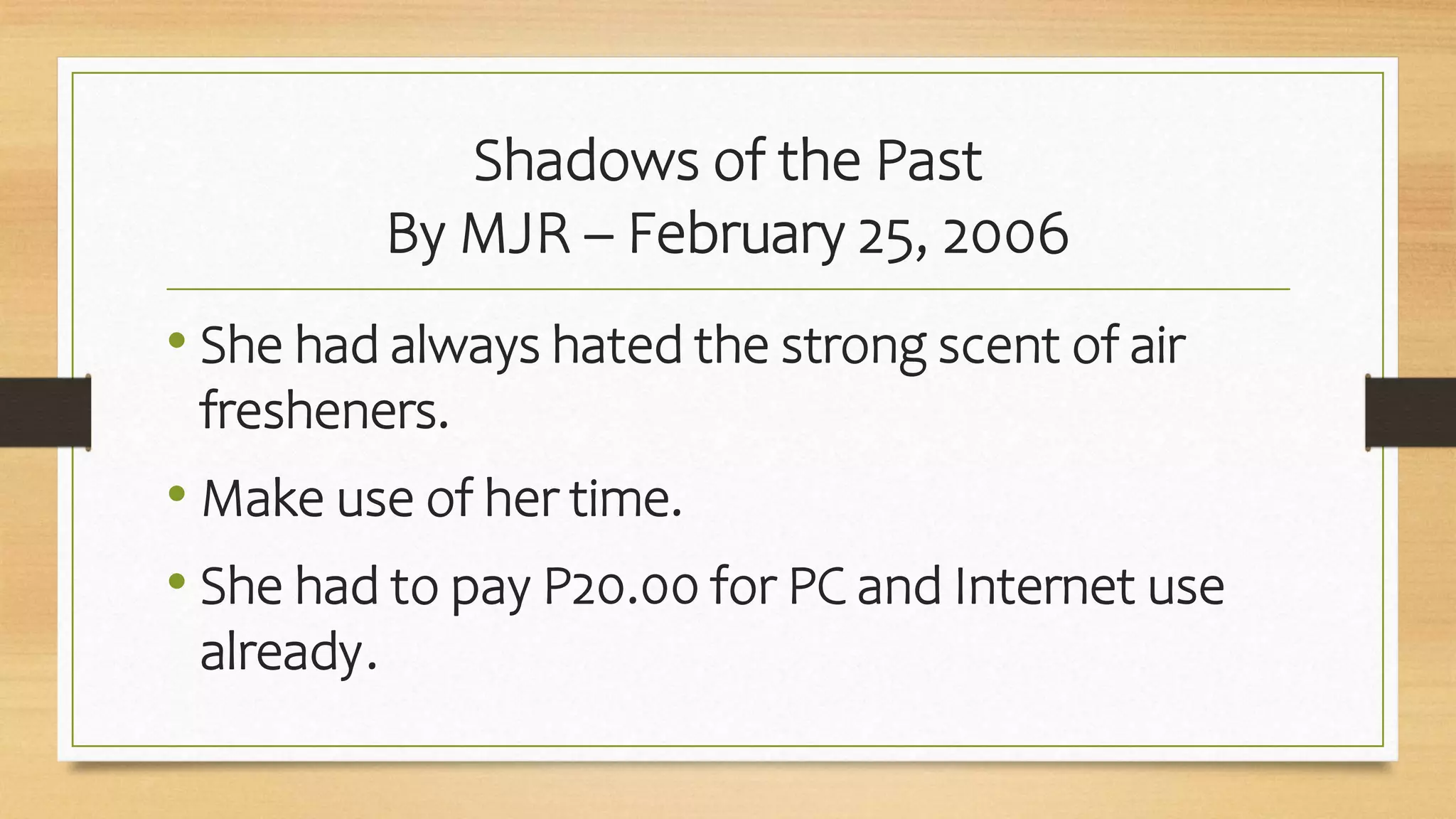
Shadows of the Past
By MJR – February 25, 2006
• She had always hated the strong scent of air
fresheners.
• Make use of her time.
• She had to pay P20.00 for PC and Internet use
already.
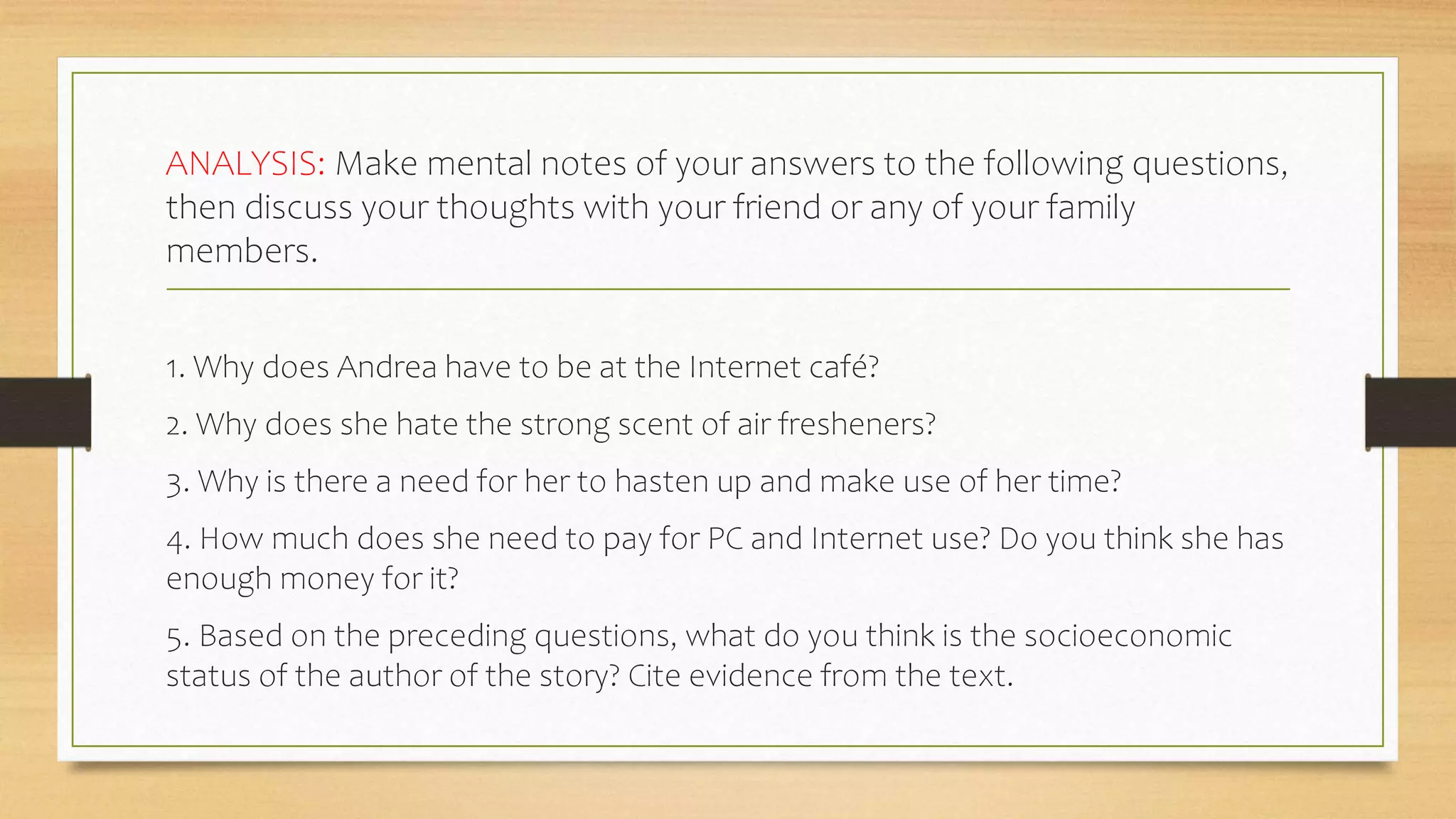
ANALYSIS: Make mental notes of your answers to the following questions,
then discuss your thoughts with your friend or any of your family
members.
1. Why does Andrea have to be at the Internet café?
2. Why does she hate the strong scent of air fresheners?
3. Why is there a need for her to hasten up and make use of her time?
4. How much does she need to pay for PC and Internet use? Do you think she has
enough money for it?
5. Based on the preceding questions, what do you think is the socioeconomic
status of the author of the story? Cite evidence from the text.
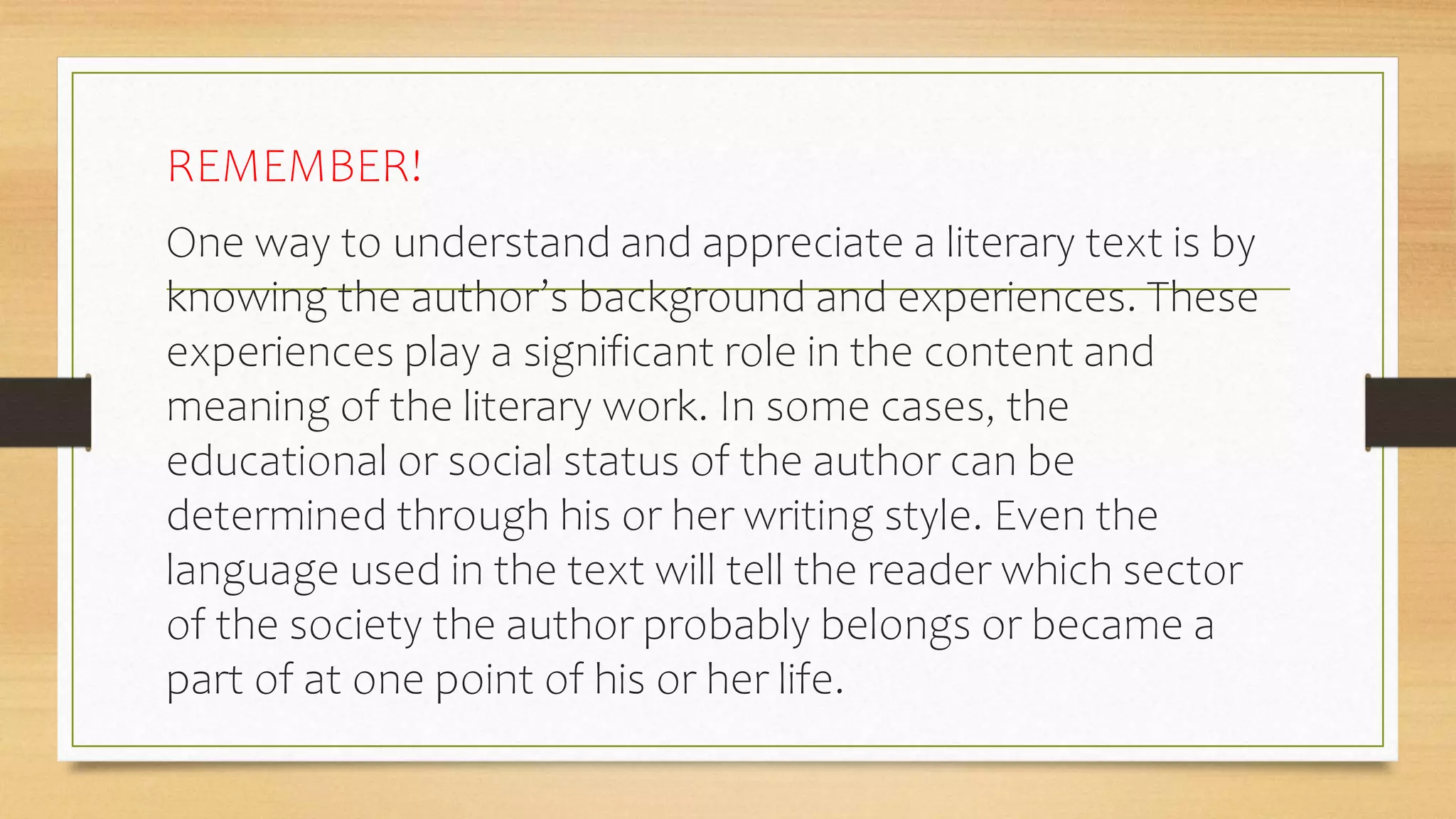
REMEMBER!
One way to understand and appreciate a literary text is by
knowing the author’s background and experiences. These
experiences play a significant role in the content and
meaning of the literary work. In some cases, the
educational or social status of the author can be
determined through his or her writing style. Even the
language used in the text will tell the reader which sector
of the society the author probably belongs or became a
part of at one point of his or her life.
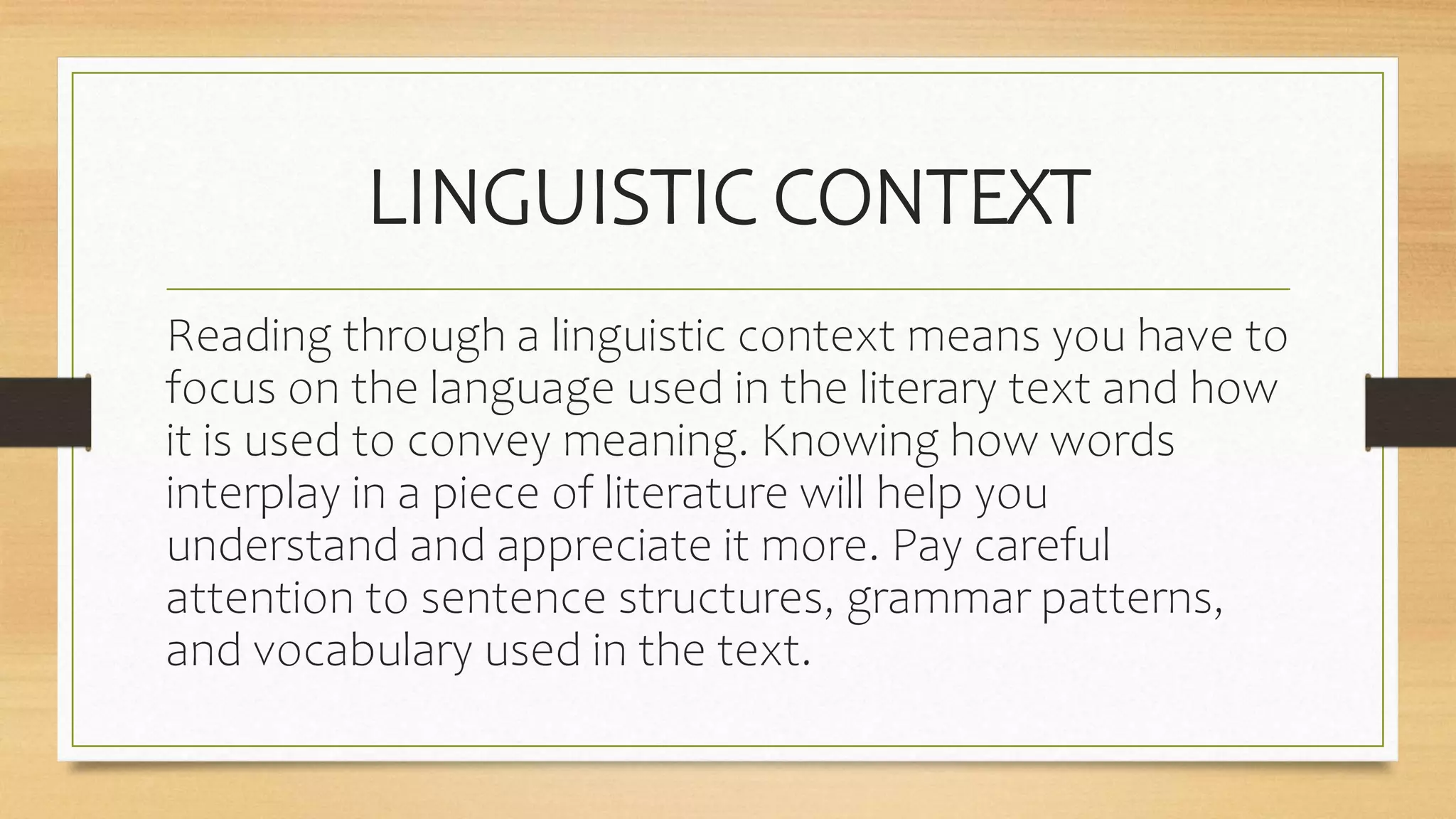
LINGUISTIC CONTEXT
Reading through a linguistic context means you have to
focus on the language used in the literary text and how
it is used to convey meaning. Knowing how words
interplay in a piece of literature will help you
understand and appreciate it more. Pay careful
attention to sentence structures, grammar patterns,
and vocabulary used in the text.
Three levels of comprehension, namely
Literal, Inferential, and Evaluative.
•Literal comprehension simply means
reading the lines. As your read a text, take
note of specific details that relate to who,
what, when, where, why, and how
questions.
• Inferential comprehension, on the other hand, refers
to reading between the lines. This means you have to
determine the meaning of certain words and
expressions within the text not by using the
dictionary, but by using context clues. Context clues
are surrounding words and phrases in the text that are
used to give meaning to unfamiliar words and phrases
such as idiomatic expressions and figures of speech.
Having the ability to read through context clues
makes reading more fun and interesting.
Evaluative comprehension takes your imagination
outside of the text. It enables you to make
generalizations, form new conclusions, or make
judgments about certain issues presented
explicitly or implicitly in the text. This level of
comprehension develops your critical thinking. To
reach this level, you have to go through the literal
and inferential levels first.
Shadows of the Past
By MJR – February 25, 2006
ANALYSIS: Determine the meaning of
the word “cramped” based on the
surrounding words and phrases in the
text.
1. Cramped means:
a. spacious b. tiny c. cold
2. Do you think Andrea enjoys going to an
Internet café? Why or why not?
REMEMBER!
Reading the text on its own, regardless of the author’s
biography and sociocultural background, will help you
understand the literary context through analyzing the
words, sentences, patterns, imagery, etc. in it.
SOCIOCULTURAL CONTEXT
In reading using the sociocultural context, you must
focus on understanding the social, economic, political
and cultural forces affecting the literary work. It
combines social and cultural elements that are
significant in understanding and appreciating a work
of literature.
Consider the following questions in analyzing the
sociocultural context embedded in the literary piece.
• How does the literary piece depict society?
• With what societal issues is it concerned?
• Does the work describe real events, or some that are
strikingly similar to real events?
Shadows of the Past
By MJR – February 25, 2006
Go over the text one more time. Think
about how the text mirrors the
Philippine society at the time the story
was written.
ANALYSIS: Make mental notes of your answers to the following questions,
then discuss your thoughts with your friend or classmate.
1. What is Andrea’s purpose for going to the Internet café?
2. What past or present societal issue among Filipino women is depicted in
the story?
3. How does the Philippine society view this issue? Is it something that is
widely practiced and accepted?
4. What is your own opinion about the issue?

MODULE 3.pptx

  • 1.
    Contexts of 21stCentury Philippine Literature from the Regions
  • 2.
    OBJECTIVES Specifically, you areexpected to: 1. connect the biographical contexts of a literary work to the author’s background and experiences; 2. determine the linguistic contexts that enrich your understanding of a text; and 3. analyze the sociocultural contexts embedded in a literary work.
  • 3.
    WHAT I KNOW Directions:Kindly get your notebook and answer the following questions/activity. • Fill in the Blanks • Multiple Choice • Identification
  • 4.
    Now that youhave already answered the pretest, it’s time to recall what you have learned from your previous lesson. •Directions: Recall at least five genres of literature that you learned from the previous lesson.
  • 5.
    Let us tryto identify some common problems that may hinder you from reading, understanding and appreciating a literary piece. Read the following selection and identify the difficulties you experience while you are reading it. Untitled Work in Progress By MJR
  • 6.
    In order foryou to understand and appreciate a literary text, you should know some useful techniques and strategies. These techniques refer to your ability to interpret the biographical, linguistic, and sociocultural contexts which give more meaning and impact to a reading selection. The objective of this lesson is for you to be able to analyze the three literary contexts mentioned above.
  • 7.
    BIOGRAPHICAL CONTEXTS • Beforeyou read someone’s work, you have to learn some background information about the author’s life, including his or her educational background, professional background, or socioeconomic background, which directly or indirectly influence his or her literary work.
  • 8.
    Educational Background • Asyou read about the life of the author, you will also have a glimpse of his or her educational attainment and academic achievements. Some authors may have earned the highest educational degree while others may have dropped out of school for their own reasons.
  • 9.
    Professional Background •As youcontinue to read the life of the author you will discover more, like how he or she started his or her career in writing. You will learn his or her milestones as a writer.
  • 10.
    Socioeconomic Background •As youread about the author’s life, you will also find out about his or her family. You will know about his or her family background and other significant childhood and adulthood experiences.
  • 11.
    • To achievea clearer and better understanding of biographical contexts, study the following text. Determine the socioeconomic background of the author by analyzing the underlined sentences and expressions in the text.
  • 12.
    Shadows of thePast By MJR – February 25, 2006 • She had always hated the strong scent of air fresheners. • Make use of her time. • She had to pay P20.00 for PC and Internet use already.
  • 13.
    ANALYSIS: Make mentalnotes of your answers to the following questions, then discuss your thoughts with your friend or any of your family members. 1. Why does Andrea have to be at the Internet café? 2. Why does she hate the strong scent of air fresheners? 3. Why is there a need for her to hasten up and make use of her time? 4. How much does she need to pay for PC and Internet use? Do you think she has enough money for it? 5. Based on the preceding questions, what do you think is the socioeconomic status of the author of the story? Cite evidence from the text.
  • 14.
    REMEMBER! One way tounderstand and appreciate a literary text is by knowing the author’s background and experiences. These experiences play a significant role in the content and meaning of the literary work. In some cases, the educational or social status of the author can be determined through his or her writing style. Even the language used in the text will tell the reader which sector of the society the author probably belongs or became a part of at one point of his or her life.
  • 15.
    LINGUISTIC CONTEXT Reading througha linguistic context means you have to focus on the language used in the literary text and how it is used to convey meaning. Knowing how words interplay in a piece of literature will help you understand and appreciate it more. Pay careful attention to sentence structures, grammar patterns, and vocabulary used in the text.
  • 16.
    Three levels ofcomprehension, namely Literal, Inferential, and Evaluative. •Literal comprehension simply means reading the lines. As your read a text, take note of specific details that relate to who, what, when, where, why, and how questions.
  • 17.
    • Inferential comprehension,on the other hand, refers to reading between the lines. This means you have to determine the meaning of certain words and expressions within the text not by using the dictionary, but by using context clues. Context clues are surrounding words and phrases in the text that are used to give meaning to unfamiliar words and phrases such as idiomatic expressions and figures of speech. Having the ability to read through context clues makes reading more fun and interesting.
  • 18.
    Evaluative comprehension takesyour imagination outside of the text. It enables you to make generalizations, form new conclusions, or make judgments about certain issues presented explicitly or implicitly in the text. This level of comprehension develops your critical thinking. To reach this level, you have to go through the literal and inferential levels first.
  • 19.
    Shadows of thePast By MJR – February 25, 2006 ANALYSIS: Determine the meaning of the word “cramped” based on the surrounding words and phrases in the text.
  • 20.
    1. Cramped means: a.spacious b. tiny c. cold 2. Do you think Andrea enjoys going to an Internet café? Why or why not?
  • 21.
    REMEMBER! Reading the texton its own, regardless of the author’s biography and sociocultural background, will help you understand the literary context through analyzing the words, sentences, patterns, imagery, etc. in it.
  • 22.
    SOCIOCULTURAL CONTEXT In readingusing the sociocultural context, you must focus on understanding the social, economic, political and cultural forces affecting the literary work. It combines social and cultural elements that are significant in understanding and appreciating a work of literature.
  • 23.
    Consider the followingquestions in analyzing the sociocultural context embedded in the literary piece. • How does the literary piece depict society? • With what societal issues is it concerned? • Does the work describe real events, or some that are strikingly similar to real events?
  • 24.
    Shadows of thePast By MJR – February 25, 2006 Go over the text one more time. Think about how the text mirrors the Philippine society at the time the story was written.
  • 25.
    ANALYSIS: Make mentalnotes of your answers to the following questions, then discuss your thoughts with your friend or classmate. 1. What is Andrea’s purpose for going to the Internet café? 2. What past or present societal issue among Filipino women is depicted in the story? 3. How does the Philippine society view this issue? Is it something that is widely practiced and accepted? 4. What is your own opinion about the issue?