What Exactly is
SDN?
And why would I want it for my business?
WHITEPAPER
Contents
Who Knows What SDN is?	 2
The Evolution of the Network	 3
Points of Demarcation	 4
Networking in Layers	 5
So Back to the Question:
What is SDN?	 6
What’s in it for Me?	 7
Conclusions	 8
Who Knows What
SDN is?
Arecently undertaken survey by Exponential-e, polling its wider audience of UK IT and
business leaders revealed that 86% of those surveyed felt they did not really know
what SDN was. Is it any wonder when there are so many conflicting opinions from the
various tech companies all vying for our IT pounds? Some would have you believe it’s a
replacement for your Network control system. To others it’s a software layer that runs
on top of your Network. For the costliest it’s a totally new type of Network built on new
equipment (which of course you need to buy). The reality is both of these things, and none
of them.
To begin we need to understand why software defined Networking is emerging. As
Networks have become increasingly complex, they’ve also become increasingly hard to
manage. In the same recent survey over 25% of those polled indicated that they were
not getting the service they required from their Network service providers; and 21%
cited problems with their internal IT resulting from a lack of “self-control” over their own
Networks; obviously compounded by the fact that the service providers controlling their
Networks aren’t giving them the service they need. The problem with Networks, is people!
WHITEPAPER | 2016 – Steven Harrison, NSD Advisory Services©
3
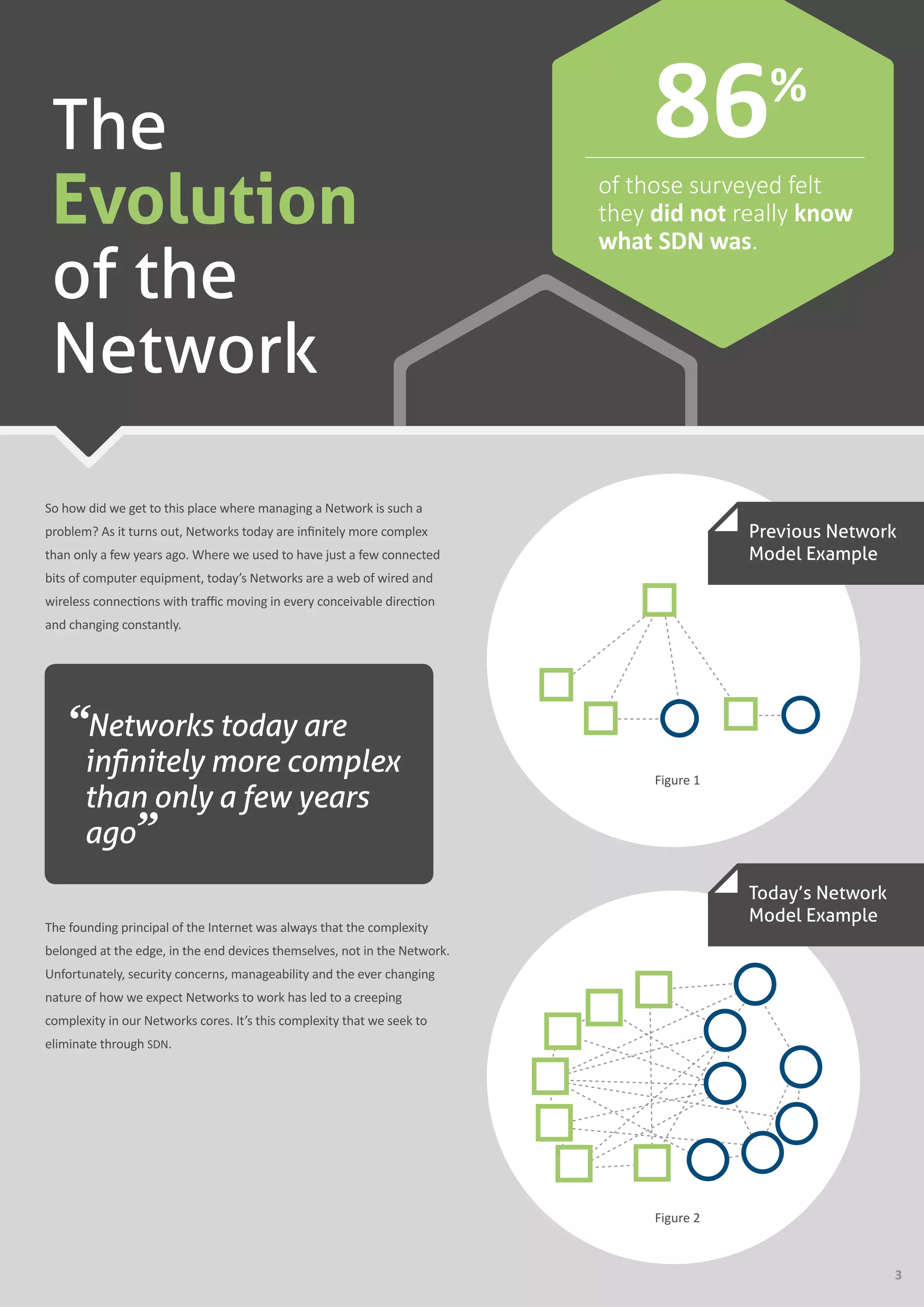
So how did we get to this place where managing a Network is such a
problem? As it turns out, Networks today are infinitely more complex
than only a few years ago. Where we used to have just a few connected
bits of computer equipment, today’s Networks are a web of wired and
wireless connections with traffic moving in every conceivable direction
and changing constantly.
The founding principal of the Internet was always that the complexity
belonged at the edge, in the end devices themselves, not in the Network.
Unfortunately, security concerns, manageability and the ever changing
nature of how we expect Networks to work has led to a creeping
complexity in our Networks cores. It’s this complexity that we seek to
eliminate through SDN.
of those surveyed felt
they did not really know
what SDN was.
86%
The
Evolution
of the
Network
“Networks today are
infinitely more complex
than only a few years
ago”
Figure 1
Figure 2
Previous Network
Model Example
Today’s Network
Model Example
DBOX
DBOX
DBOX
DBOX
Points of
Demarcation
Unsurprisingly one of the biggest advocates of SDN technology is the Network service providers. Why is this
not surprising? Recall the 25% dissatisfied with the service level of their service provider? SDN means that the
service provider can provide less service while also providing better service. How’s that possible? Well if the
human element of making changes to the Network is eliminated, and replaced with software, it’s a very small
thing indeed for access and control of that software to be placed in the hands of the end-user, thus removing
the need for the service provider to manually perform any adds / moves / changes, and thereby eliminating the
problem of unsatisfied customers. If only it were that simple.
To understand this aspect of how SDN works, it’s important to first understand the concept of “demarcation”.
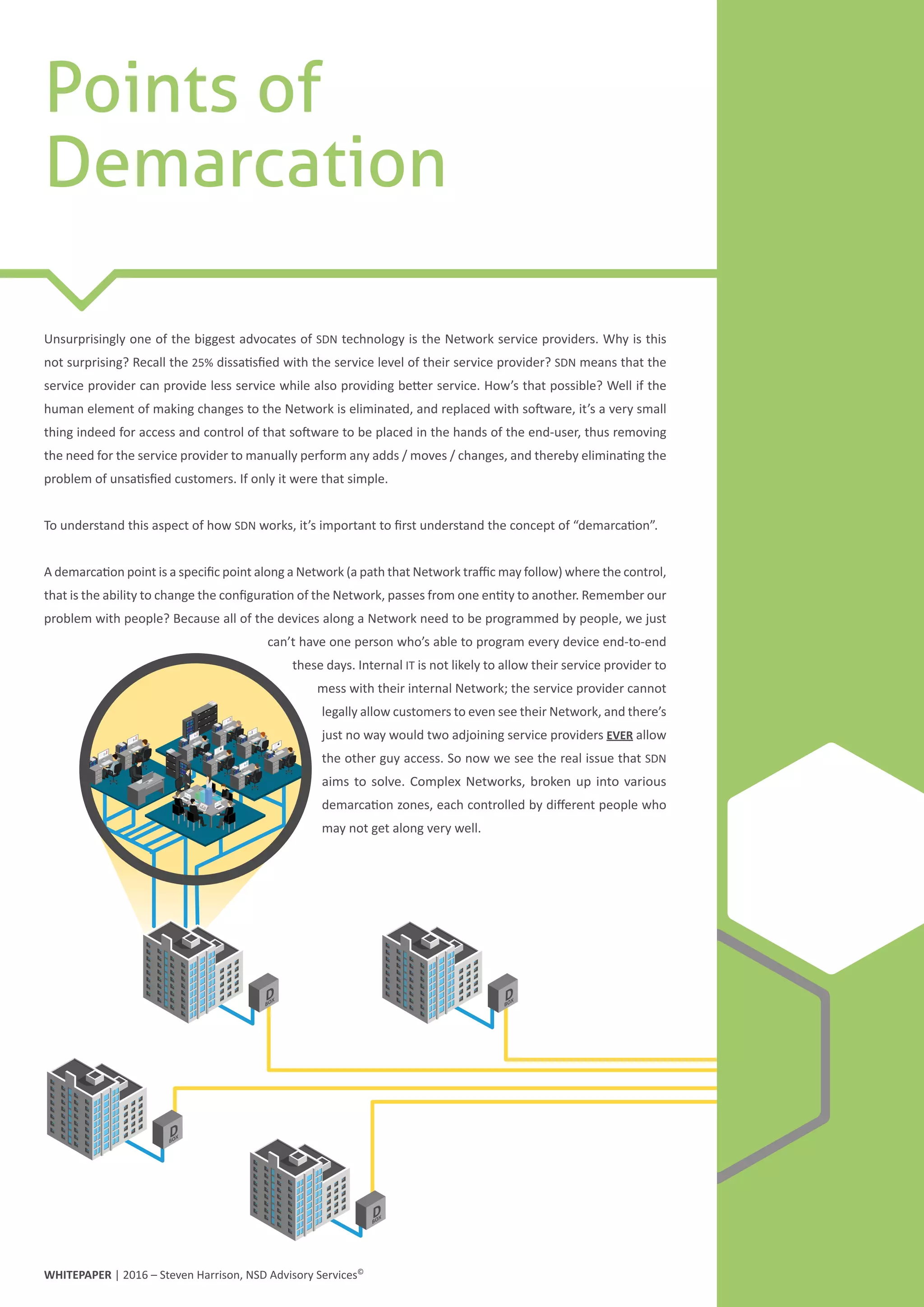
A demarcation point is a specific point along a Network (a path that Network traffic may follow) where the control,
that is the ability to change the configuration of the Network, passes from one entity to another. Remember our
problem with people? Because all of the devices along a Network need to be programmed by people, we just
can’t have one person who’s able to program every device end-to-end
these days. Internal IT is not likely to allow their service provider to
mess with their internal Network; the service provider cannot
legally allow customers to even see their Network, and there’s
just no way would two adjoining service providers EVER allow
the other guy access. So now we see the real issue that SDN
aims to solve. Complex Networks, broken up into various
demarcation zones, each controlled by different people who
may not get along very well.
WHITEPAPER | 2016 – Steven Harrison, NSD Advisory Services©
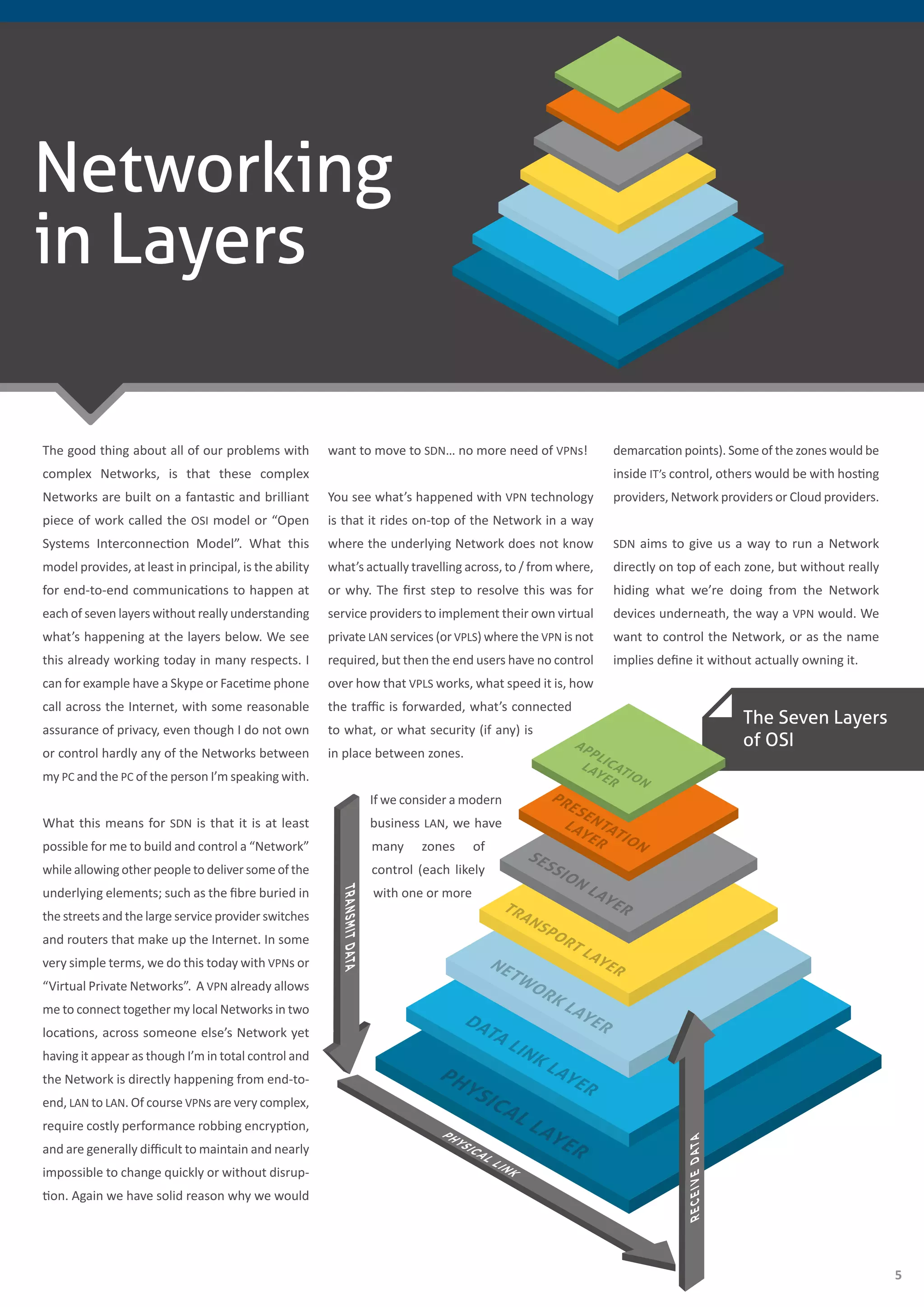
The good thing about all of our problems with
complex Networks, is that these complex
Networks are built on a fantastic and brilliant
piece of work called the OSI model or “Open
Systems Interconnection Model”. What this
model provides, at least in principal, is the ability
for end-to-end communications to happen at
each of seven layers without really understanding
what’s happening at the layers below. We see
this already working today in many respects. I
can for example have a Skype or Facetime phone
call across the Internet, with some reasonable
assurance of privacy, even though I do not own
or control hardly any of the Networks between
my PC and the PC of the person I’m speaking with.
What this means for SDN is that it is at least
possible for me to build and control a “Network”
while allowing other people to deliver some of the
underlying elements; such as the fibre buried in
the streets and the large service provider switches
and routers that make up the Internet. In some
very simple terms, we do this today with VPNs or
“Virtual Private Networks”. A VPN already allows
me to connect together my local Networks in two
locations, across someone else’s Network yet
having it appear as though I’m in total control and
the Network is directly happening from end-to-
end, LAN to LAN. Of course VPNs are very complex,
require costly performance robbing encryption,
and are generally difficult to maintain and nearly
impossible to change quickly or without disrup-
tion. Again we have solid reason why we would
want to move to SDN… no more need of VPNs!
You see what’s happened with VPN technology
is that it rides on-top of the Network in a way
where the underlying Network does not know
what’s actually travelling across, to / from where,
or why. The first step to resolve this was for
service providers to implement their own virtual
private LAN services (or VPLS) where the VPN is not
required, but then the end users have no control
over how that VPLS works, what speed it is, how
the traffic is forwarded, what’s connected
to what, or what security (if any) is
in place between zones.
If we consider a modern
business LAN, we have
many zones of
control (each likely
with one or more
demarcation points). Some of the zones would be
inside IT’s control, others would be with hosting
providers, Network providers or Cloud providers.
SDN aims to give us a way to run a Network
directly on top of each zone, but without really
hiding what we’re doing from the Network
devices underneath, the way a VPN would. We
want to control the Network, or as the name
implies define it without actually owning it.
5
Networking
in Layers
The Seven Layers
of OSI
WHITEPAPER - Name of whitepaper here
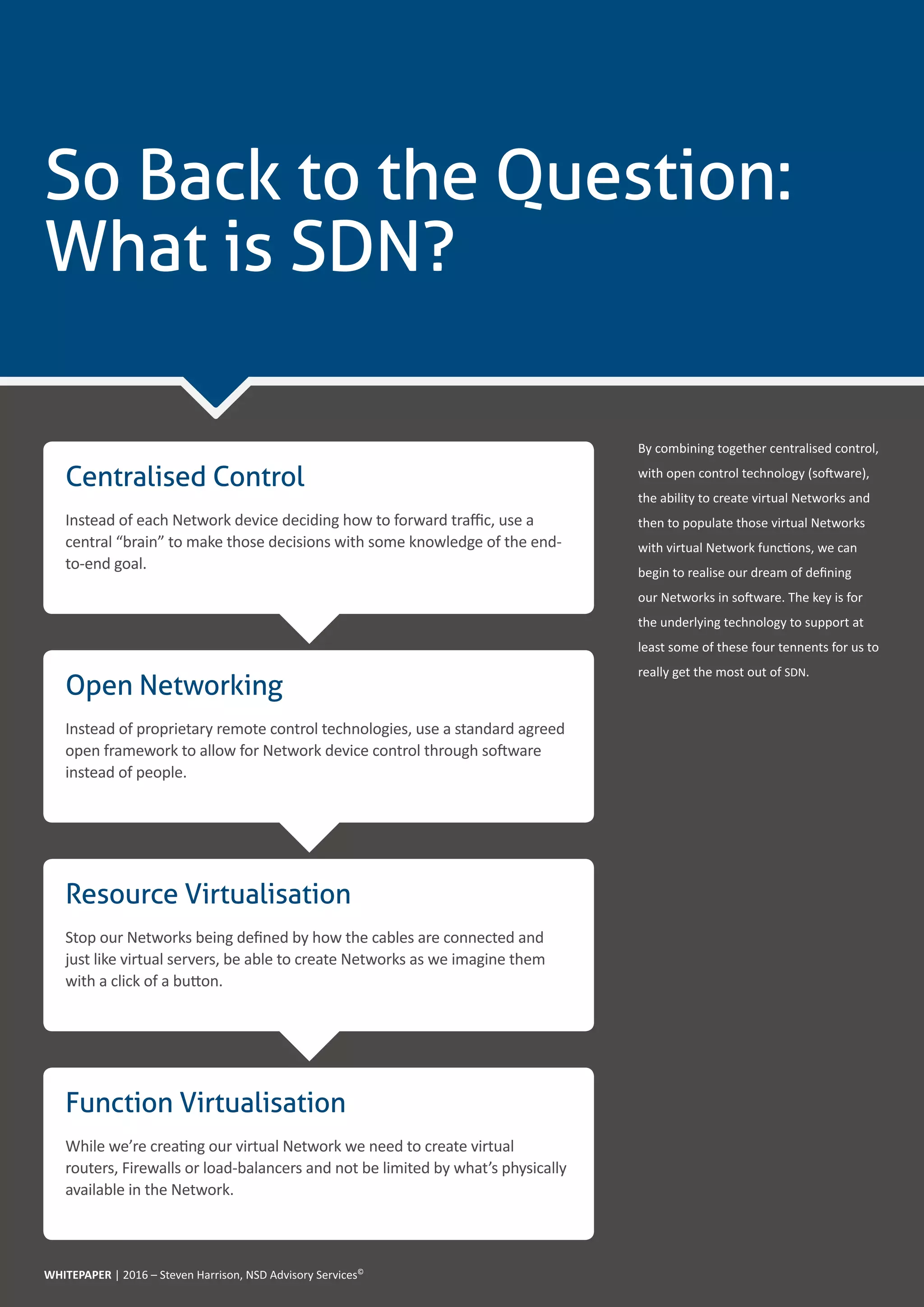
By combining together centralised control,
with open control technology (software),
the ability to create virtual Networks and
then to populate those virtual Networks
with virtual Network functions, we can
begin to realise our dream of defining
our Networks in software. The key is for
the underlying technology to support at
least some of these four tennents for us to
really get the most out of SDN.
So Back to the Question:
What is SDN?
Open Networking
Instead of proprietary remote control technologies, use a standard agreed
open framework to allow for Network device control through software
instead of people.
Resource Virtualisation
Stop our Networks being defined by how the cables are connected and
just like virtual servers, be able to create Networks as we imagine them
with a click of a button.
Function Virtualisation
While we’re creating our virtual Network we need to create virtual
routers, Firewalls or load-balancers and not be limited by what’s physically
available in the Network.
Centralised Control
Instead of each Network device deciding how to forward traffic, use a
central “brain” to make those decisions with some knowledge of the end-
to-end goal.
WHITEPAPER | 2016 – Steven Harrison, NSD Advisory Services©
77
What’s
in it
for Me?
Now that we’ve got some understanding of
why SDN has come about, and what exactly
SDN is, the real question is: “What’s in it for
me?”
If you’re a service provider the answer’s fairly
obvious. That’s why every service provider
is clamouring to get on the SDN band-wagon.
For them it means less time spent configuring,
updating, managing, connecting, touching and
everything else they do to their Network. It’s a
brilliant cost and time saving move that goes
light-years beyond just automation; it actually
changes the very nature of their business!
If you’re a user, then what? Well in truth, SDN
solves only some of your problems, but it is a
good start!
What SDN will not do is provide a panacea
for unlimited flexibility. Network devices are
not servers. To achieve the performance they
need to deliver today, they are built on a raft
of highly specialised hardware. This means
that you’ll always have some limitations on
what tasks any given Network device can
perform, and further restrictions on what
tasks it can perform well. We see examples
in things like Firewalls today. The amount of
computing resources required to run even a
10Gbps Firewall is enormous, yet the high-end
hardware based Firewall appliances can easily
run up to a terabit (1024Gbps) of fully protected
traffic. Don’t think for a minute that SDN will
eliminate Network hardware!
SDN will also not provide you with a smooth
evolution. Most of the SDN technologies in play
today will require some amount of upgrading.
There’s a path for each user, however the path
will vary. Working closely with your service
provider to agree on an SDN strategy is a must!
Lastly, SDN will not “fix” the issue of end-user
service experience. SDN provides the tools,
but not the solution. In the same way that
virtualising your servers did not instantly
make them perform better, the same is true
for SDN. Moving your Network to SDN will not
solve your Network problems, but it will make
solving them easier!
“SDN means that
hardware can
be utilised to
a much higher
level, just as
with server
virtualisation.”
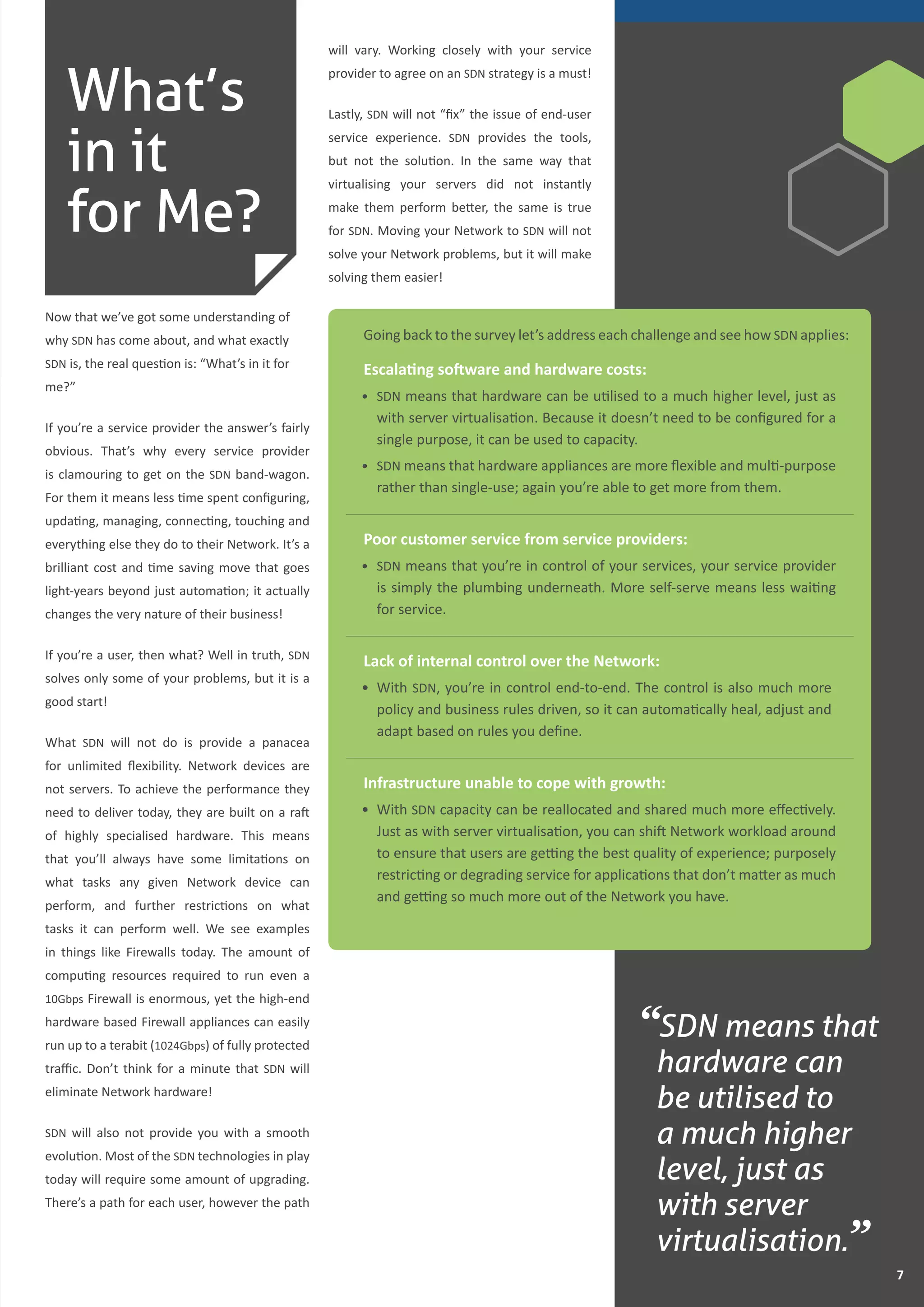
Going back to the survey let’s address each challenge and see how SDN applies:
Escalating software and hardware costs:
•	 SDN means that hardware can be utilised to a much higher level, just as
with server virtualisation. Because it doesn’t need to be configured for a
single purpose, it can be used to capacity.
•	 SDN means that hardware appliances are more flexible and multi-purpose
rather than single-use; again you’re able to get more from them.
Poor customer service from service providers:
•	 SDN means that you’re in control of your services, your service provider
is simply the plumbing underneath. More self-serve means less waiting
for service.
Lack of internal control over the Network:
•	 With SDN, you’re in control end-to-end. The control is also much more
policy and business rules driven, so it can automatically heal, adjust and
adapt based on rules you define.
Infrastructure unable to cope with growth:
•	 With SDN capacity can be reallocated and shared much more effectively.
Just as with server virtualisation, you can shift Network workload around
to ensure that users are getting the best quality of experience; purposely
restricting or degrading service for applications that don’t matter as much
and getting so much more out of the Network you have.
What’s
in it
for Me?
How can Exponential-e help you?
Connectivity:
Our privately owned Network is at the core of everything that we do.
From offering you uncontended Smart Business Internet to managing
your company’s Wide Area Network, you can rely on Exponential-e to
provide you with a reliable and low-latency backbone to your IT estate -
with the added bonus of a single end-to-end SLA.
www.exponential-e.com/connectivity
Cloud:
Whether you are a small, medium or large sized company we have a
Cloud solution to suit. Whether you are looking to implement Desktop-
as-a-Service (DaaS) or require Data Centre Connectivity, our solutions
are designed around your company’s individual needs. With our Private
Cloud operating behind your Firewall, your data does not transcend
the public Internet - negating the risk of external security or privacy
concerns.
www.exponential-e.com/cloud
Conclusion
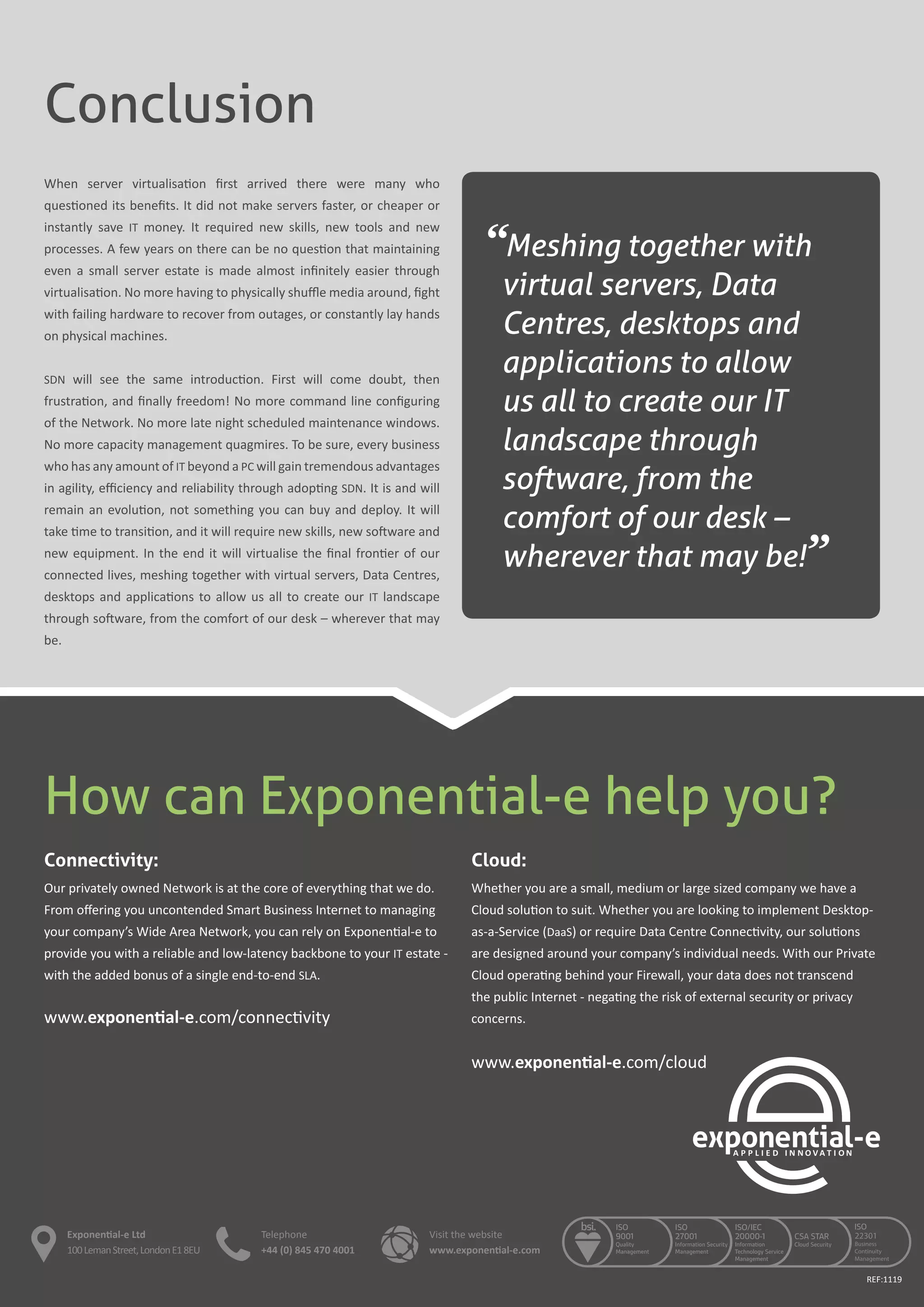
When server virtualisation first arrived there were many who
questioned its benefits. It did not make servers faster, or cheaper or
instantly save IT money. It required new skills, new tools and new
processes. A few years on there can be no question that maintaining
even a small server estate is made almost infinitely easier through
virtualisation. No more having to physically shuffle media around, fight
with failing hardware to recover from outages, or constantly lay hands
on physical machines.
SDN will see the same introduction. First will come doubt, then
frustration, and finally freedom! No more command line configuring
of the Network. No more late night scheduled maintenance windows.
No more capacity management quagmires. To be sure, every business
who has any amount of IT beyond a PC will gain tremendous advantages
in agility, efficiency and reliability through adopting SDN. It is and will
remain an evolution, not something you can buy and deploy. It will
take time to transition, and it will require new skills, new software and
new equipment. In the end it will virtualise the final frontier of our
connected lives, meshing together with virtual servers, Data Centres,
desktops and applications to allow us all to create our IT landscape
through software, from the comfort of our desk – wherever that may
be.
“Meshing together with
virtual servers, Data
Centres, desktops and
applications to allow
us all to create our IT
landscape through
software, from the
comfort of our desk –
wherever that may be!”
REF:1119
Exponential-e Ltd
100LemanStreet,LondonE18EU
Telephone
+44 (0) 845 470 4001
Visit the website
www.exponential-e.com

SDN_WhitePaper_1119_LowRes

  • 1.
    What Exactly is SDN? Andwhy would I want it for my business? WHITEPAPER
  • 2.
    Contents Who Knows WhatSDN is? 2 The Evolution of the Network 3 Points of Demarcation 4 Networking in Layers 5 So Back to the Question: What is SDN? 6 What’s in it for Me? 7 Conclusions 8 Who Knows What SDN is? Arecently undertaken survey by Exponential-e, polling its wider audience of UK IT and business leaders revealed that 86% of those surveyed felt they did not really know what SDN was. Is it any wonder when there are so many conflicting opinions from the various tech companies all vying for our IT pounds? Some would have you believe it’s a replacement for your Network control system. To others it’s a software layer that runs on top of your Network. For the costliest it’s a totally new type of Network built on new equipment (which of course you need to buy). The reality is both of these things, and none of them. To begin we need to understand why software defined Networking is emerging. As Networks have become increasingly complex, they’ve also become increasingly hard to manage. In the same recent survey over 25% of those polled indicated that they were not getting the service they required from their Network service providers; and 21% cited problems with their internal IT resulting from a lack of “self-control” over their own Networks; obviously compounded by the fact that the service providers controlling their Networks aren’t giving them the service they need. The problem with Networks, is people! WHITEPAPER | 2016 – Steven Harrison, NSD Advisory Services©
  • 3.
    3 So how didwe get to this place where managing a Network is such a problem? As it turns out, Networks today are infinitely more complex than only a few years ago. Where we used to have just a few connected bits of computer equipment, today’s Networks are a web of wired and wireless connections with traffic moving in every conceivable direction and changing constantly. The founding principal of the Internet was always that the complexity belonged at the edge, in the end devices themselves, not in the Network. Unfortunately, security concerns, manageability and the ever changing nature of how we expect Networks to work has led to a creeping complexity in our Networks cores. It’s this complexity that we seek to eliminate through SDN. of those surveyed felt they did not really know what SDN was. 86% The Evolution of the Network “Networks today are infinitely more complex than only a few years ago” Figure 1 Figure 2 Previous Network Model Example Today’s Network Model Example
  • 4.
    DBOX DBOX DBOX DBOX Points of Demarcation Unsurprisingly oneof the biggest advocates of SDN technology is the Network service providers. Why is this not surprising? Recall the 25% dissatisfied with the service level of their service provider? SDN means that the service provider can provide less service while also providing better service. How’s that possible? Well if the human element of making changes to the Network is eliminated, and replaced with software, it’s a very small thing indeed for access and control of that software to be placed in the hands of the end-user, thus removing the need for the service provider to manually perform any adds / moves / changes, and thereby eliminating the problem of unsatisfied customers. If only it were that simple. To understand this aspect of how SDN works, it’s important to first understand the concept of “demarcation”. A demarcation point is a specific point along a Network (a path that Network traffic may follow) where the control, that is the ability to change the configuration of the Network, passes from one entity to another. Remember our problem with people? Because all of the devices along a Network need to be programmed by people, we just can’t have one person who’s able to program every device end-to-end these days. Internal IT is not likely to allow their service provider to mess with their internal Network; the service provider cannot legally allow customers to even see their Network, and there’s just no way would two adjoining service providers EVER allow the other guy access. So now we see the real issue that SDN aims to solve. Complex Networks, broken up into various demarcation zones, each controlled by different people who may not get along very well. WHITEPAPER | 2016 – Steven Harrison, NSD Advisory Services©
  • 5.
    The good thingabout all of our problems with complex Networks, is that these complex Networks are built on a fantastic and brilliant piece of work called the OSI model or “Open Systems Interconnection Model”. What this model provides, at least in principal, is the ability for end-to-end communications to happen at each of seven layers without really understanding what’s happening at the layers below. We see this already working today in many respects. I can for example have a Skype or Facetime phone call across the Internet, with some reasonable assurance of privacy, even though I do not own or control hardly any of the Networks between my PC and the PC of the person I’m speaking with. What this means for SDN is that it is at least possible for me to build and control a “Network” while allowing other people to deliver some of the underlying elements; such as the fibre buried in the streets and the large service provider switches and routers that make up the Internet. In some very simple terms, we do this today with VPNs or “Virtual Private Networks”. A VPN already allows me to connect together my local Networks in two locations, across someone else’s Network yet having it appear as though I’m in total control and the Network is directly happening from end-to- end, LAN to LAN. Of course VPNs are very complex, require costly performance robbing encryption, and are generally difficult to maintain and nearly impossible to change quickly or without disrup- tion. Again we have solid reason why we would want to move to SDN… no more need of VPNs! You see what’s happened with VPN technology is that it rides on-top of the Network in a way where the underlying Network does not know what’s actually travelling across, to / from where, or why. The first step to resolve this was for service providers to implement their own virtual private LAN services (or VPLS) where the VPN is not required, but then the end users have no control over how that VPLS works, what speed it is, how the traffic is forwarded, what’s connected to what, or what security (if any) is in place between zones. If we consider a modern business LAN, we have many zones of control (each likely with one or more demarcation points). Some of the zones would be inside IT’s control, others would be with hosting providers, Network providers or Cloud providers. SDN aims to give us a way to run a Network directly on top of each zone, but without really hiding what we’re doing from the Network devices underneath, the way a VPN would. We want to control the Network, or as the name implies define it without actually owning it. 5 Networking in Layers The Seven Layers of OSI
  • 6.
    WHITEPAPER - Nameof whitepaper here By combining together centralised control, with open control technology (software), the ability to create virtual Networks and then to populate those virtual Networks with virtual Network functions, we can begin to realise our dream of defining our Networks in software. The key is for the underlying technology to support at least some of these four tennents for us to really get the most out of SDN. So Back to the Question: What is SDN? Open Networking Instead of proprietary remote control technologies, use a standard agreed open framework to allow for Network device control through software instead of people. Resource Virtualisation Stop our Networks being defined by how the cables are connected and just like virtual servers, be able to create Networks as we imagine them with a click of a button. Function Virtualisation While we’re creating our virtual Network we need to create virtual routers, Firewalls or load-balancers and not be limited by what’s physically available in the Network. Centralised Control Instead of each Network device deciding how to forward traffic, use a central “brain” to make those decisions with some knowledge of the end- to-end goal. WHITEPAPER | 2016 – Steven Harrison, NSD Advisory Services©
  • 7.
    77 What’s in it for Me? Nowthat we’ve got some understanding of why SDN has come about, and what exactly SDN is, the real question is: “What’s in it for me?” If you’re a service provider the answer’s fairly obvious. That’s why every service provider is clamouring to get on the SDN band-wagon. For them it means less time spent configuring, updating, managing, connecting, touching and everything else they do to their Network. It’s a brilliant cost and time saving move that goes light-years beyond just automation; it actually changes the very nature of their business! If you’re a user, then what? Well in truth, SDN solves only some of your problems, but it is a good start! What SDN will not do is provide a panacea for unlimited flexibility. Network devices are not servers. To achieve the performance they need to deliver today, they are built on a raft of highly specialised hardware. This means that you’ll always have some limitations on what tasks any given Network device can perform, and further restrictions on what tasks it can perform well. We see examples in things like Firewalls today. The amount of computing resources required to run even a 10Gbps Firewall is enormous, yet the high-end hardware based Firewall appliances can easily run up to a terabit (1024Gbps) of fully protected traffic. Don’t think for a minute that SDN will eliminate Network hardware! SDN will also not provide you with a smooth evolution. Most of the SDN technologies in play today will require some amount of upgrading. There’s a path for each user, however the path will vary. Working closely with your service provider to agree on an SDN strategy is a must! Lastly, SDN will not “fix” the issue of end-user service experience. SDN provides the tools, but not the solution. In the same way that virtualising your servers did not instantly make them perform better, the same is true for SDN. Moving your Network to SDN will not solve your Network problems, but it will make solving them easier! “SDN means that hardware can be utilised to a much higher level, just as with server virtualisation.” Going back to the survey let’s address each challenge and see how SDN applies: Escalating software and hardware costs: • SDN means that hardware can be utilised to a much higher level, just as with server virtualisation. Because it doesn’t need to be configured for a single purpose, it can be used to capacity. • SDN means that hardware appliances are more flexible and multi-purpose rather than single-use; again you’re able to get more from them. Poor customer service from service providers: • SDN means that you’re in control of your services, your service provider is simply the plumbing underneath. More self-serve means less waiting for service. Lack of internal control over the Network: • With SDN, you’re in control end-to-end. The control is also much more policy and business rules driven, so it can automatically heal, adjust and adapt based on rules you define. Infrastructure unable to cope with growth: • With SDN capacity can be reallocated and shared much more effectively. Just as with server virtualisation, you can shift Network workload around to ensure that users are getting the best quality of experience; purposely restricting or degrading service for applications that don’t matter as much and getting so much more out of the Network you have. What’s in it for Me?
  • 8.
    How can Exponential-ehelp you? Connectivity: Our privately owned Network is at the core of everything that we do. From offering you uncontended Smart Business Internet to managing your company’s Wide Area Network, you can rely on Exponential-e to provide you with a reliable and low-latency backbone to your IT estate - with the added bonus of a single end-to-end SLA. www.exponential-e.com/connectivity Cloud: Whether you are a small, medium or large sized company we have a Cloud solution to suit. Whether you are looking to implement Desktop- as-a-Service (DaaS) or require Data Centre Connectivity, our solutions are designed around your company’s individual needs. With our Private Cloud operating behind your Firewall, your data does not transcend the public Internet - negating the risk of external security or privacy concerns. www.exponential-e.com/cloud Conclusion When server virtualisation first arrived there were many who questioned its benefits. It did not make servers faster, or cheaper or instantly save IT money. It required new skills, new tools and new processes. A few years on there can be no question that maintaining even a small server estate is made almost infinitely easier through virtualisation. No more having to physically shuffle media around, fight with failing hardware to recover from outages, or constantly lay hands on physical machines. SDN will see the same introduction. First will come doubt, then frustration, and finally freedom! No more command line configuring of the Network. No more late night scheduled maintenance windows. No more capacity management quagmires. To be sure, every business who has any amount of IT beyond a PC will gain tremendous advantages in agility, efficiency and reliability through adopting SDN. It is and will remain an evolution, not something you can buy and deploy. It will take time to transition, and it will require new skills, new software and new equipment. In the end it will virtualise the final frontier of our connected lives, meshing together with virtual servers, Data Centres, desktops and applications to allow us all to create our IT landscape through software, from the comfort of our desk – wherever that may be. “Meshing together with virtual servers, Data Centres, desktops and applications to allow us all to create our IT landscape through software, from the comfort of our desk – wherever that may be!” REF:1119 Exponential-e Ltd 100LemanStreet,LondonE18EU Telephone +44 (0) 845 470 4001 Visit the website www.exponential-e.com