Community-driven change
Veronica Siranosian, AICP Community Project Lead Ashley Zarella Hand, LEED AP, Assoc. AIA Chair, Sustainability Committee Director, Area-Wide Workforce, Private Sector
The Sustainability Committee is dedicated to  empowering   the Downtown community to create a  culture of sustainability .  We will work with the  community   to increase  accessibility   to existing programs and services through  outreach  and public  education .  We will identify and create  opportunities   for new programming and  partnerships   to meet our goals for a more   livable ,   affordable , and  efficient   urban center. Sustainability Committee (Our mission)
2009 SDAT (Project 6: Sustainable Design Assessment Team Grant) American Institute  of Architects, Center for Communities by Design $15,000 in professional assistance $5,000 community match 10 communities selected in 2009 DLANC has paid $1,500 of the community match. Rotary of Los Angeles has committed $1,000. Typically awarded to Mayors’ offices. First time award to a community-based organization like an NC.
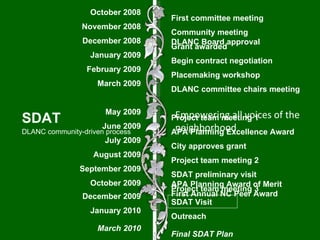
SDAT DLANC community-driven process Empowering all voices of the neighborhood October 2008 First committee meeting March 2009 DLANC committee chairs meeting May 2009 Project team meeting 1 June 2009 APA Planning Excellence Award July 2009 City approves grant August 2009 Project team meeting 2 September 2009 SDAT preliminary visit APA Planning Award of Merit First Annual NC Peer Award October 2009 Project team meeting 3 December 2009 SDAT Visit January 2010 Outreach November 2008 Community meeting DLANC Board approval December 2008 Grant awarded January 2009 Begin contract negotiation February 2009 Placemaking workshop March 2010 Final SDAT Plan
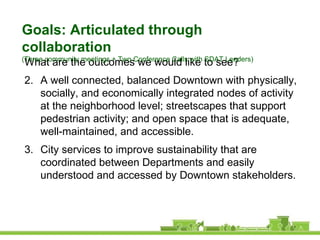
What are the outcomes we would like to see? A well connected, balanced Downtown with physically, socially, and economically integrated nodes of activity at the neighborhood level; streetscapes that support pedestrian activity; and open space that is adequate, well-maintained, and accessible. City services to improve sustainability that are coordinated between Departments and easily understood and accessed by Downtown stakeholders. Goals: Articulated through collaboration (Three community meetings + Two Conference Calls with SDAT Leaders)
Neighborhood Councils with the capacity, structure, and model to follow on how to achieve sustainability goals at the grassroots level.  An actionable strategy for improving sustainability Downtown that can be implemented by the Neighborhood Council and Steering Committee members. SDAT Goals: Organic development (Project 6: Sustainable Design Assessment Team Grant)
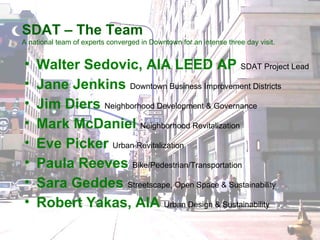
Walter Sedovic, AIA LEED AP  SDAT Project Lead Jane Jenkins  Downtown Business Improvement Districts Jim Diers  Neighborhood Development & Governance Mark McDaniel  Neighborhood Revitalization Eve Picker  Urban Revitalization Paula Reeves  Bike/Pedestrian/Transportation Sara Geddes  Streetscape, Open Space & Sustainability Robert Yakas, AIA  Urban Design & Sustainability SDAT – The Team A national team of experts converged in Downtown for an intense three day visit.
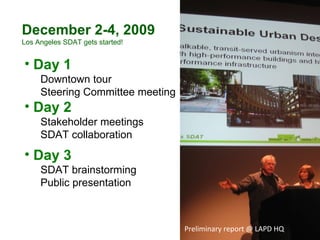
Preliminary report @ LAPD HQ Day 1 Downtown tour  Steering Committee meeting Day 2 Stakeholder meetings SDAT collaboration Day 3 SDAT brainstorming  Public presentation December 2-4, 2009 Los Angeles SDAT gets started!
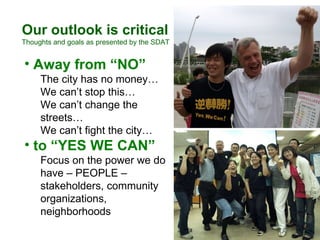
Our outlook is critical Thoughts and goals as presented by the SDAT Away from “NO” The city has no money… We can’t stop this… We can’t change the streets… We can’t fight the city… to “YES WE CAN” Focus on the power we do have – PEOPLE – stakeholders, community organizations, neighborhoods
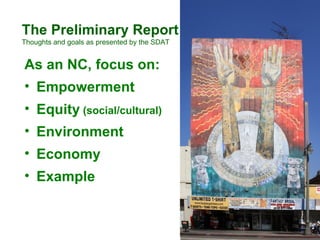
The Preliminary Report Thoughts and goals as presented by the SDAT As an NC, focus on: Empowerment Equity  (social/cultural) Environment Economy Example
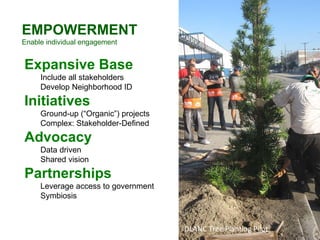
EMPOWERMENT Enable individual engagement Expansive Base Include all stakeholders Develop Neighborhood ID Initiatives Ground-up (“Organic”) projects Complex: Stakeholder-Defined Advocacy Data driven Shared vision Partnerships Leverage access to government Symbiosis DLANC Tree Planting Pilot
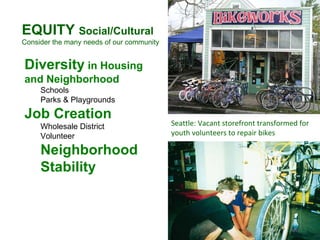
Diversity  in Housing  and Neighborhood Schools Parks & Playgrounds Job Creation Wholesale District Volunteer Neighborhood Stability Seattle: Vacant storefront transformed for youth volunteers to repair bikes EQUITY  Social/Cultural Consider the many needs of our community
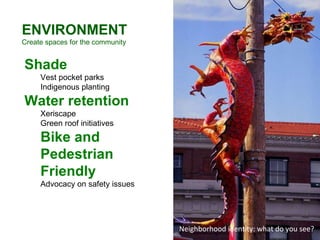
ENVIRONMENT Create spaces for the community Shade Vest pocket parks Indigenous planting Water retention Xeriscape Green roof initiatives Bike and Pedestrian Friendly Advocacy on safety issues Neighborhood identity: what do you see?
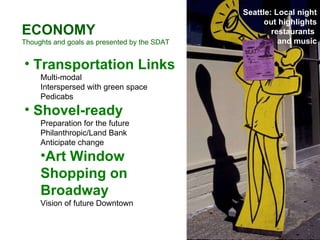
ECONOMY Thoughts and goals as presented by the SDAT Transportation Links Multi-modal Interspersed with green space Pedicabs Shovel-ready Preparation for the future Philanthropic/Land Bank  Anticipate change Art Window Shopping on Broadway Vision of future Downtown Seattle: Local night out highlights restaurants  and music
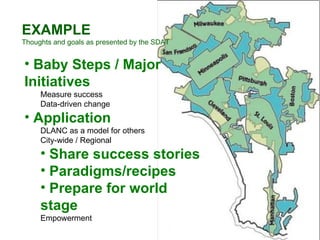
EXAMPLE Thoughts and goals as presented by the SDAT Baby Steps / Major Initiatives Measure success Data-driven change Application DLANC as a model for others City-wide / Regional Share success stories Paradigms/recipes Prepare for world stage Empowerment
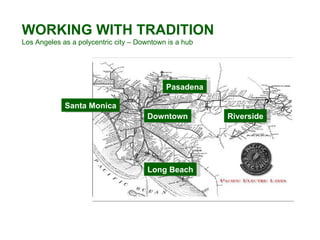
WORKING WITH TRADITION Los Angeles as a polycentric city – Downtown is a hub Downtown Riverside Pasadena Long Beach Santa Monica
Maximize existing resources for the future of your community What can you do for your neighborhood? If the future of NC funding is unclear, do we adjust?
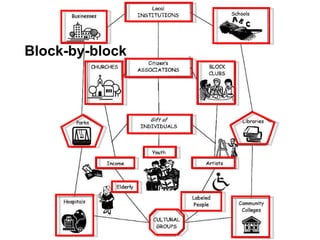
Block-by-block
AECOM American Institute of Architects American Planning Association Bike Writers Collective City of LA Bureau of Sanitation City of LA Dept. of Public Works City of LA Planning Department City of LA Urban Design Studio CK Architecture Council District 9 County of Los Angeles CRA/LA DLANC ($) DONE Fashion District BID Gilmore Associates Historic Downtown BID Melendrez Partners Metro  Rotary Club of Los Angeles ($) Skid Row Housing Trust South Park BID US Green Building Council USC STEERING COMMITTEE + Participating in the SDAT Process
AIDS Awareness American Drawing Society American Feng Shui Intitute American Institute of Architects American Institute of Certified Planners American Planning Association Bringing Back Broadway California Apartment Association Central City Association CJHC County of Los Angeles Culver City Downtown Business Association Culver City Rock & Mineral Club Downtown Center BID Grenada Hills Volleyball Historic Downtown BID HAC Issues & Solutions Los Angeles County Metropolitan Transit Authority Mason National Realtors Association NAUL Parent Teacher Association Philip Meadows HOA Right Girl (nonprofit) Santee Court SAG SCAQMD SHMDD Skid Row Groups South Park BID Teen Zone USC DT Alumni US Green Building Council Vero HOA Women’s Empowerment Group Our resources start with our membership OUR BOARD Organizations identified by our leadership
PROJECT IDEAS Some initial inspiration from the SDAT Partnership-focused Multi-modal Interspersed with green space Pedicabs Shovel-ready Preparation for the future Philanthropic/Land Bank  Anticipate change Art Window Shopping on Broadway Vision of future Downtown
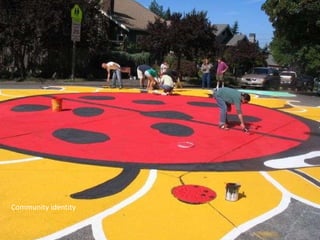
Community identity
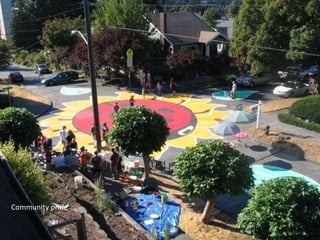
Community pride
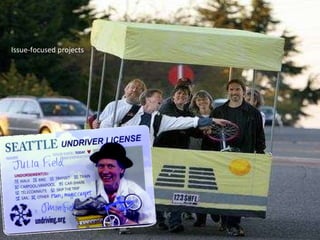
Issue-focused projects
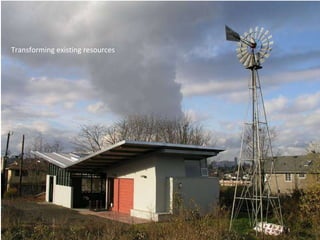
Transforming existing resources
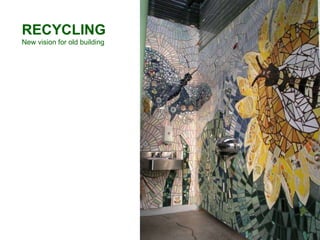
RECYCLING New vision for old building
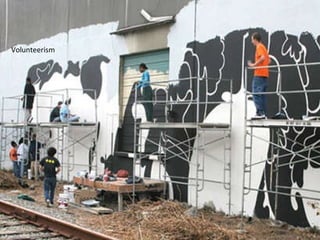
Volunteerism
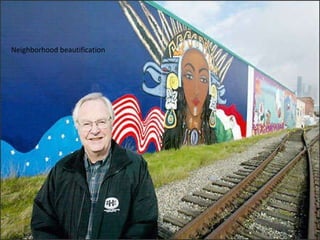
Neighborhood beautification
VISION
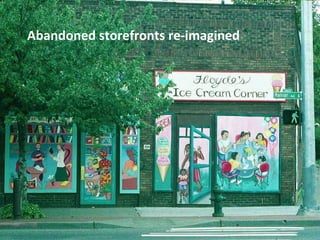
Abandoned storefronts re-imagined
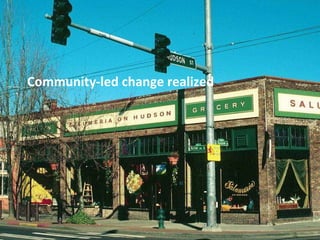
Community-led change realized
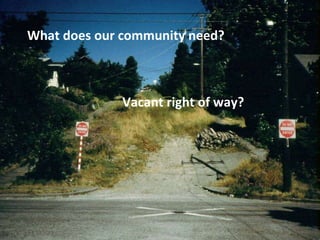
What does our community need? Vacant right of way?
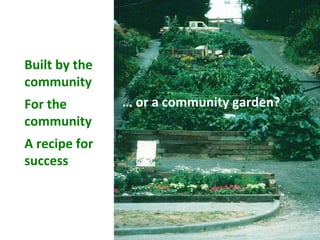
Built by the community  For the community  A recipe for success …  or a community garden?
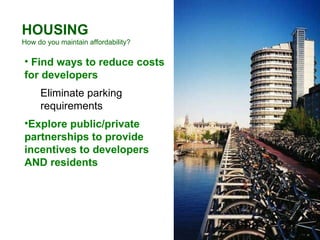
HOUSING How do you maintain affordability? Find ways to reduce costs for developers Eliminate parking requirements Explore public/private partnerships to provide incentives to developers AND residents
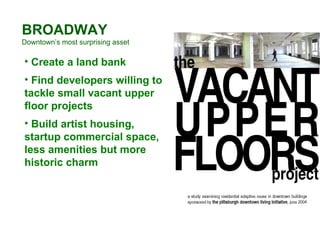
BROADWAY Downtown’s most surprising asset Create a land bank Find developers willing to tackle small vacant upper floor projects  Build artist housing, startup commercial space, less amenities but more historic charm
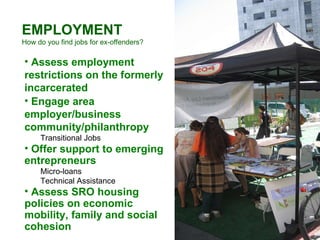
EMPLOYMENT How do you find jobs for ex-offenders? Assess employment restrictions on the formerly incarcerated  Engage area employer/business community/philanthropy Transitional Jobs Offer support to emerging entrepreneurs Micro-loans Technical Assistance Assess SRO housing policies on economic mobility, family and social cohesion
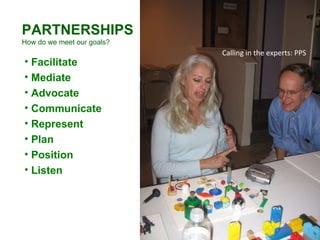
PARTNERSHIPS How do we meet our goals? Facilitate Mediate Advocate Communicate Represent Plan Position Listen Calling in the experts: PPS
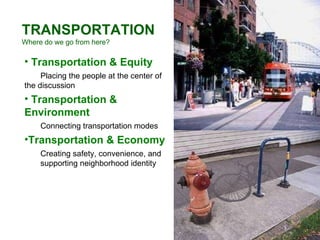
TRANSPORTATION Where do we go from here? Transportation & Equity Placing the people at the center of  the discussion Transportation & Environment Connecting transportation modes Transportation & Economy  Creating safety, convenience, and supporting neighborhood identity
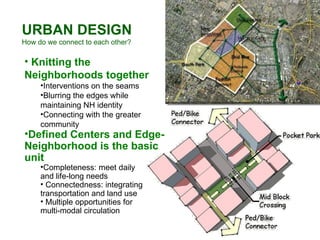
URBAN DESIGN How do we connect to each other? Knitting the Neighborhoods together Interventions on the seams Blurring the edges while maintaining NH identity Connecting with the greater community Defined Centers and Edge-Neighborhood is the basic unit Completeness: meet daily  and life-long needs Connectedness: integrating transportation and land use Multiple opportunities for  multi-modal circulation
Our tools (Sustainability Committee: eight community projects) Outreach   Connecting people to services and programs Reach stakeholders at the neighborhood level Focus on sharing information and capacity-building  (rather than trying to do it ourselves) Education   Knowledge-sharing  Engage those with the know-how (professional or otherwise) to participate in community-based initiatives Empower the individual through community support Advocacy   Voice for the community where necessary Change the way the Neighborhood Council functions Facilitate change through action
Los Angeles is  rapidly changing . The residential population increases annually. Social  equity  is an issue for all neighborhoods. There are empty tree wells, open storm drains, and a lot of waste. Practical ,  accessible, affordable  solutions will have the most immediate impact.
Get involved with your neighborhood council. Share your passion for the environment. Civic engagement will save our city. downtownsustainability.com

Sdat Process And Opportunities 010210

  • 1.
  • 2.
    Veronica Siranosian, AICPCommunity Project Lead Ashley Zarella Hand, LEED AP, Assoc. AIA Chair, Sustainability Committee Director, Area-Wide Workforce, Private Sector
  • 3.
    The Sustainability Committeeis dedicated to empowering the Downtown community to create a culture of sustainability . We will work with the community to increase accessibility to existing programs and services through outreach and public education . We will identify and create opportunities for new programming and partnerships to meet our goals for a more livable , affordable , and efficient urban center. Sustainability Committee (Our mission)
  • 4.
    2009 SDAT (Project6: Sustainable Design Assessment Team Grant) American Institute of Architects, Center for Communities by Design $15,000 in professional assistance $5,000 community match 10 communities selected in 2009 DLANC has paid $1,500 of the community match. Rotary of Los Angeles has committed $1,000. Typically awarded to Mayors’ offices. First time award to a community-based organization like an NC.
  • 5.
    SDAT DLANC community-drivenprocess Empowering all voices of the neighborhood October 2008 First committee meeting March 2009 DLANC committee chairs meeting May 2009 Project team meeting 1 June 2009 APA Planning Excellence Award July 2009 City approves grant August 2009 Project team meeting 2 September 2009 SDAT preliminary visit APA Planning Award of Merit First Annual NC Peer Award October 2009 Project team meeting 3 December 2009 SDAT Visit January 2010 Outreach November 2008 Community meeting DLANC Board approval December 2008 Grant awarded January 2009 Begin contract negotiation February 2009 Placemaking workshop March 2010 Final SDAT Plan
  • 6.
    What are theoutcomes we would like to see? A well connected, balanced Downtown with physically, socially, and economically integrated nodes of activity at the neighborhood level; streetscapes that support pedestrian activity; and open space that is adequate, well-maintained, and accessible. City services to improve sustainability that are coordinated between Departments and easily understood and accessed by Downtown stakeholders. Goals: Articulated through collaboration (Three community meetings + Two Conference Calls with SDAT Leaders)
  • 7.
    Neighborhood Councils withthe capacity, structure, and model to follow on how to achieve sustainability goals at the grassroots level. An actionable strategy for improving sustainability Downtown that can be implemented by the Neighborhood Council and Steering Committee members. SDAT Goals: Organic development (Project 6: Sustainable Design Assessment Team Grant)
  • 8.
    Walter Sedovic, AIALEED AP SDAT Project Lead Jane Jenkins Downtown Business Improvement Districts Jim Diers Neighborhood Development & Governance Mark McDaniel Neighborhood Revitalization Eve Picker Urban Revitalization Paula Reeves Bike/Pedestrian/Transportation Sara Geddes Streetscape, Open Space & Sustainability Robert Yakas, AIA Urban Design & Sustainability SDAT – The Team A national team of experts converged in Downtown for an intense three day visit.
  • 9.
    Preliminary report @LAPD HQ Day 1 Downtown tour Steering Committee meeting Day 2 Stakeholder meetings SDAT collaboration Day 3 SDAT brainstorming Public presentation December 2-4, 2009 Los Angeles SDAT gets started!
  • 10.
    Our outlook iscritical Thoughts and goals as presented by the SDAT Away from “NO” The city has no money… We can’t stop this… We can’t change the streets… We can’t fight the city… to “YES WE CAN” Focus on the power we do have – PEOPLE – stakeholders, community organizations, neighborhoods
  • 11.
    The Preliminary ReportThoughts and goals as presented by the SDAT As an NC, focus on: Empowerment Equity (social/cultural) Environment Economy Example
  • 12.
    EMPOWERMENT Enable individualengagement Expansive Base Include all stakeholders Develop Neighborhood ID Initiatives Ground-up (“Organic”) projects Complex: Stakeholder-Defined Advocacy Data driven Shared vision Partnerships Leverage access to government Symbiosis DLANC Tree Planting Pilot
  • 13.
    Diversity inHousing and Neighborhood Schools Parks & Playgrounds Job Creation Wholesale District Volunteer Neighborhood Stability Seattle: Vacant storefront transformed for youth volunteers to repair bikes EQUITY Social/Cultural Consider the many needs of our community
  • 14.
    ENVIRONMENT Create spacesfor the community Shade Vest pocket parks Indigenous planting Water retention Xeriscape Green roof initiatives Bike and Pedestrian Friendly Advocacy on safety issues Neighborhood identity: what do you see?
  • 15.
    ECONOMY Thoughts andgoals as presented by the SDAT Transportation Links Multi-modal Interspersed with green space Pedicabs Shovel-ready Preparation for the future Philanthropic/Land Bank Anticipate change Art Window Shopping on Broadway Vision of future Downtown Seattle: Local night out highlights restaurants and music
  • 16.
    EXAMPLE Thoughts andgoals as presented by the SDAT Baby Steps / Major Initiatives Measure success Data-driven change Application DLANC as a model for others City-wide / Regional Share success stories Paradigms/recipes Prepare for world stage Empowerment
  • 17.
    WORKING WITH TRADITIONLos Angeles as a polycentric city – Downtown is a hub Downtown Riverside Pasadena Long Beach Santa Monica
  • 18.
    Maximize existing resourcesfor the future of your community What can you do for your neighborhood? If the future of NC funding is unclear, do we adjust?
  • 19.
  • 20.
    AECOM American Instituteof Architects American Planning Association Bike Writers Collective City of LA Bureau of Sanitation City of LA Dept. of Public Works City of LA Planning Department City of LA Urban Design Studio CK Architecture Council District 9 County of Los Angeles CRA/LA DLANC ($) DONE Fashion District BID Gilmore Associates Historic Downtown BID Melendrez Partners Metro Rotary Club of Los Angeles ($) Skid Row Housing Trust South Park BID US Green Building Council USC STEERING COMMITTEE + Participating in the SDAT Process
  • 21.
    AIDS Awareness AmericanDrawing Society American Feng Shui Intitute American Institute of Architects American Institute of Certified Planners American Planning Association Bringing Back Broadway California Apartment Association Central City Association CJHC County of Los Angeles Culver City Downtown Business Association Culver City Rock & Mineral Club Downtown Center BID Grenada Hills Volleyball Historic Downtown BID HAC Issues & Solutions Los Angeles County Metropolitan Transit Authority Mason National Realtors Association NAUL Parent Teacher Association Philip Meadows HOA Right Girl (nonprofit) Santee Court SAG SCAQMD SHMDD Skid Row Groups South Park BID Teen Zone USC DT Alumni US Green Building Council Vero HOA Women’s Empowerment Group Our resources start with our membership OUR BOARD Organizations identified by our leadership
  • 22.
    PROJECT IDEAS Someinitial inspiration from the SDAT Partnership-focused Multi-modal Interspersed with green space Pedicabs Shovel-ready Preparation for the future Philanthropic/Land Bank Anticipate change Art Window Shopping on Broadway Vision of future Downtown
  • 23.
  • 24.
  • 25.
  • 26.
  • 27.
    RECYCLING New visionfor old building
  • 28.
  • 29.
  • 30.
  • 31.
  • 32.
  • 33.
    What does ourcommunity need? Vacant right of way?
  • 34.
    Built by thecommunity For the community A recipe for success … or a community garden?
  • 35.
    HOUSING How doyou maintain affordability? Find ways to reduce costs for developers Eliminate parking requirements Explore public/private partnerships to provide incentives to developers AND residents
  • 36.
    BROADWAY Downtown’s mostsurprising asset Create a land bank Find developers willing to tackle small vacant upper floor projects Build artist housing, startup commercial space, less amenities but more historic charm
  • 37.
    EMPLOYMENT How doyou find jobs for ex-offenders? Assess employment restrictions on the formerly incarcerated Engage area employer/business community/philanthropy Transitional Jobs Offer support to emerging entrepreneurs Micro-loans Technical Assistance Assess SRO housing policies on economic mobility, family and social cohesion
  • 38.
    PARTNERSHIPS How dowe meet our goals? Facilitate Mediate Advocate Communicate Represent Plan Position Listen Calling in the experts: PPS
  • 39.
    TRANSPORTATION Where dowe go from here? Transportation & Equity Placing the people at the center of the discussion Transportation & Environment Connecting transportation modes Transportation & Economy Creating safety, convenience, and supporting neighborhood identity
  • 40.
    URBAN DESIGN Howdo we connect to each other? Knitting the Neighborhoods together Interventions on the seams Blurring the edges while maintaining NH identity Connecting with the greater community Defined Centers and Edge-Neighborhood is the basic unit Completeness: meet daily and life-long needs Connectedness: integrating transportation and land use Multiple opportunities for multi-modal circulation
  • 41.
    Our tools (SustainabilityCommittee: eight community projects) Outreach Connecting people to services and programs Reach stakeholders at the neighborhood level Focus on sharing information and capacity-building (rather than trying to do it ourselves) Education Knowledge-sharing Engage those with the know-how (professional or otherwise) to participate in community-based initiatives Empower the individual through community support Advocacy Voice for the community where necessary Change the way the Neighborhood Council functions Facilitate change through action
  • 42.
    Los Angeles is rapidly changing . The residential population increases annually. Social equity is an issue for all neighborhoods. There are empty tree wells, open storm drains, and a lot of waste. Practical , accessible, affordable solutions will have the most immediate impact.
  • 43.
    Get involved withyour neighborhood council. Share your passion for the environment. Civic engagement will save our city. downtownsustainability.com

Editor's Notes

  • #3 AZ: Introduce Veronica Siranosian – certified planner for the County of Los Angeles; community lead of the SDAT project.
  • #6 DLANC community-driven process
  • #21 DLANC is in a position to leverage the substantial community resources we have within our neighborhood. During the SDAT process alone, we involved the public and private sector, non-profit and for-profit organizations, and leaders in their respective fields.
  • #22 Our organization’s own membership includes a broad cross-section of organizations and overlap with community groups focused on a variety of issues. From our G28 Leadership Conference in late 2008, the following organizations were identified as resources available to our Board.
  • #24 Community identity
  • #25 Community identity
  • #26 Issue-based projects: pedestrian safety and walkability
  • #29 Embrace existing skill sets within community; foster and help people develop additional skills
  • #38 Assess results – what’s working
  • #39 Assess results – what’s working
  • #40 Assess results – what’s working
  • #41 Assess results – what’s working
  • #43 36.9% increase from 2006
  • #44 36.9% increase from 2006