Chapter 1:
Introduction
to supply
chain
management
LEARNING OUTCOMES
After you have studied this chapter, you should be able to
• understand the concept of supply chain management (SCM)
• define key terminologies associated with SCM
• discuss the historical development of SCM
• describe the enablers and drivers of SCM
• understand public procurement and SCM practices.
INTRODUCTION
 SCM AS A SOURCE OF COMPETITIVE
ADVANTAGE
 SCM BEING VITAL TO ORGANIZATIONAL
SUCCESS
1.1 UNDERSTANDING THE
CONCEPT OF SCM
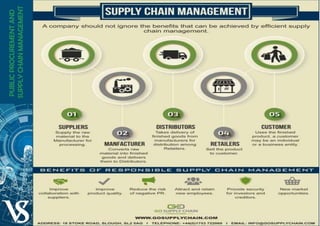
Definition of a supply chain and SCM
Consistencies in the different definitions (internal and
external coordination and integration, operational
efficiencies, value-added, quality materials, products,
customer service and information sharing)
Figure 1.1 Framework for a generic supply chain
Source: Adapted from Wisner, Tan & Leong (2008: 7)
Objectives of SCM:
Create value for customers
Provide a competitive advantage and improved
profitability for supply chain firms
Determine the dimensions of value that may be
important to customers
Develop mechanisms whereby competitive
advantage and improved profitability can be
achieved
UNDERSTANDING THE CONCEPT OF SCM
1.2 KEY TERMINOLOGIES
ASSOCIATED WITH SCM
• Value chain
• Purchasing
• Procurement
• Supply management
• Strategic sourcing
• Public procurement
• Logistics management
1.3 EVOLUTIONAL
DEVELOPMENTS OF
SCM
The first revolution (1910–1920): the Ford
supply chain
The second revolution (1960–1970): the
Toyota supply chain
The third revolution (1995–2000): the Dell
supply chain
EVOLUTIONAL DEVELOPMENTS OF SCM
1.4 IMPLEMENTING
EFFECTIVE SCM
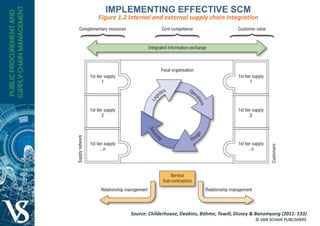
Supply chain integration (SCI):
Internal SCI
External SCI
Figure 1.2 Internal and external supply chain integration
Source: Childerhouse, Deakins, Böhme, Towill, Disney & Banomyong (2011: 533)
IMPLEMENTING EFFECTIVE SCM
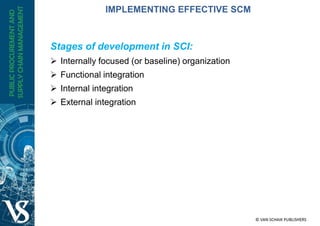
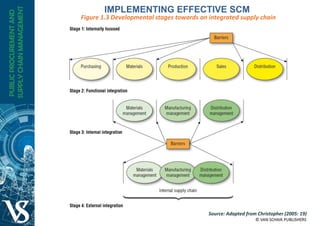
Stages of development in SCI:
 Internally focused (or baseline) organization
 Functional integration
 Internal integration
 External integration
IMPLEMENTING EFFECTIVE SCM
Figure 1.3 Developmental stages towards an integrated supply chain
Source: Adapted from Christopher (2005: 19)
IMPLEMENTING EFFECTIVE SCM
Supply chain relationships
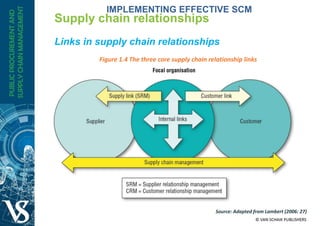
Links in supply chain relationships
Figure 1.4 The three core supply chain relationship links
Source: Adapted from Lambert (2006: 27)
IMPLEMENTING EFFECTIVE SCM
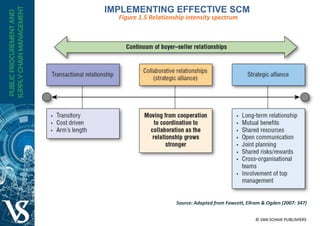
Figure 1.5 Relationship intensity spectrum
Source: Adapted from Fawcett, Ellram & Ogden (2007: 347)
IMPLEMENTING EFFECTIVE SCM
Trust in supply chain relationships
Power in supply chain relationships
IMPLEMENTING EFFECTIVE SCM
Decision areas in SCM
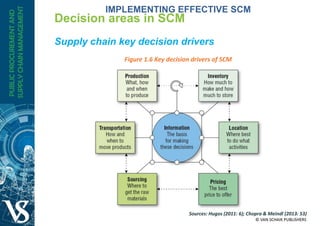
Supply chain key decision drivers
Figure 1.6 Key decision drivers of SCM
Sources: Hugos (2011: 6); Chopra & Meindl (2013: 53)
IMPLEMENTING EFFECTIVE SCM
Phases in supply chain decisions
Figure 1.7 The phases of supply chain decisions
Source: Adapted from Chopra & Meindl (2013: 18)
IMPLEMENTING EFFECTIVE SCM
Supply chain processes
Types of SCM processes
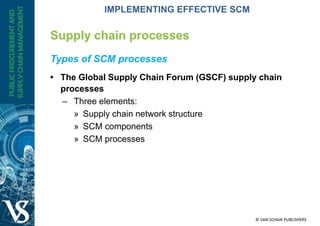
• The Global Supply Chain Forum (GSCF) supply chain
processes
– Three elements:
» Supply chain network structure
» SCM components
» SCM processes
IMPLEMENTING EFFECTIVE SCM
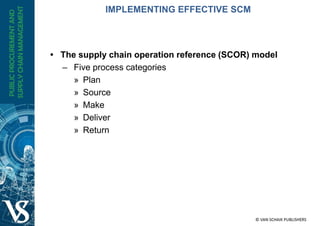
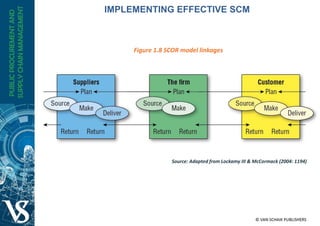
• The supply chain operation reference (SCOR) model
– Five process categories
» Plan
» Source
» Make
» Deliver
» Return
IMPLEMENTING EFFECTIVE SCM
Figure 1.8 SCOR model linkages
Source: Adapted from Lockamy III & McCormack (2004: 1194)
IMPLEMENTING EFFECTIVE SCM
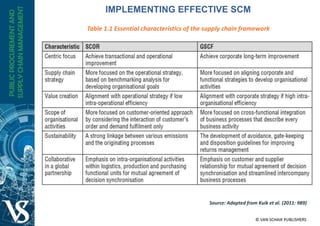
Table 1.1 Essential characteristics of the supply chain framework
Source: Adapted from Kuik et al. (2011: 989)
IMPLEMENTING EFFECTIVE SCM
1.5 PUBLIC PROCUREMENT
AND SCM
Overview and importance of procurement in
the public sector
Differences between procurement and SCM
practices in the public and private sectors
PUBLIC PROCUREMENT AND SCM
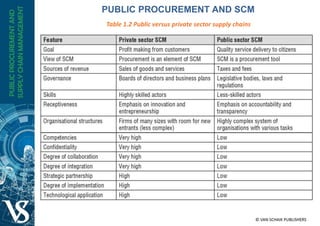
Table 1.2 Public versus private sector supply chains
PUBLIC PROCUREMENT AND SCM

SCM Slide.pptx

  • 1.
  • 2.
    LEARNING OUTCOMES After youhave studied this chapter, you should be able to • understand the concept of supply chain management (SCM) • define key terminologies associated with SCM • discuss the historical development of SCM • describe the enablers and drivers of SCM • understand public procurement and SCM practices.
  • 3.
    INTRODUCTION  SCM ASA SOURCE OF COMPETITIVE ADVANTAGE  SCM BEING VITAL TO ORGANIZATIONAL SUCCESS
  • 4.
    1.1 UNDERSTANDING THE CONCEPTOF SCM Definition of a supply chain and SCM Consistencies in the different definitions (internal and external coordination and integration, operational efficiencies, value-added, quality materials, products, customer service and information sharing)
  • 5.
    Figure 1.1 Frameworkfor a generic supply chain Source: Adapted from Wisner, Tan & Leong (2008: 7)
  • 6.
    Objectives of SCM: Createvalue for customers Provide a competitive advantage and improved profitability for supply chain firms Determine the dimensions of value that may be important to customers Develop mechanisms whereby competitive advantage and improved profitability can be achieved UNDERSTANDING THE CONCEPT OF SCM
  • 7.
    1.2 KEY TERMINOLOGIES ASSOCIATEDWITH SCM • Value chain • Purchasing • Procurement • Supply management • Strategic sourcing • Public procurement • Logistics management
  • 8.
  • 9.
    The first revolution(1910–1920): the Ford supply chain The second revolution (1960–1970): the Toyota supply chain The third revolution (1995–2000): the Dell supply chain EVOLUTIONAL DEVELOPMENTS OF SCM
  • 10.
    1.4 IMPLEMENTING EFFECTIVE SCM Supplychain integration (SCI): Internal SCI External SCI
  • 11.
    Figure 1.2 Internaland external supply chain integration Source: Childerhouse, Deakins, Böhme, Towill, Disney & Banomyong (2011: 533) IMPLEMENTING EFFECTIVE SCM
  • 12.
    Stages of developmentin SCI:  Internally focused (or baseline) organization  Functional integration  Internal integration  External integration IMPLEMENTING EFFECTIVE SCM
  • 13.
    Figure 1.3 Developmentalstages towards an integrated supply chain Source: Adapted from Christopher (2005: 19) IMPLEMENTING EFFECTIVE SCM
  • 14.
    Supply chain relationships Linksin supply chain relationships Figure 1.4 The three core supply chain relationship links Source: Adapted from Lambert (2006: 27) IMPLEMENTING EFFECTIVE SCM
  • 15.
    Figure 1.5 Relationshipintensity spectrum Source: Adapted from Fawcett, Ellram & Ogden (2007: 347) IMPLEMENTING EFFECTIVE SCM
  • 16.
    Trust in supplychain relationships Power in supply chain relationships IMPLEMENTING EFFECTIVE SCM
  • 17.
    Decision areas inSCM Supply chain key decision drivers Figure 1.6 Key decision drivers of SCM Sources: Hugos (2011: 6); Chopra & Meindl (2013: 53) IMPLEMENTING EFFECTIVE SCM
  • 18.
    Phases in supplychain decisions Figure 1.7 The phases of supply chain decisions Source: Adapted from Chopra & Meindl (2013: 18) IMPLEMENTING EFFECTIVE SCM
  • 19.
    Supply chain processes Typesof SCM processes • The Global Supply Chain Forum (GSCF) supply chain processes – Three elements: » Supply chain network structure » SCM components » SCM processes IMPLEMENTING EFFECTIVE SCM
  • 20.
    • The supplychain operation reference (SCOR) model – Five process categories » Plan » Source » Make » Deliver » Return IMPLEMENTING EFFECTIVE SCM
  • 21.
    Figure 1.8 SCORmodel linkages Source: Adapted from Lockamy III & McCormack (2004: 1194) IMPLEMENTING EFFECTIVE SCM
  • 22.
    Table 1.1 Essentialcharacteristics of the supply chain framework Source: Adapted from Kuik et al. (2011: 989) IMPLEMENTING EFFECTIVE SCM
  • 23.
    1.5 PUBLIC PROCUREMENT ANDSCM Overview and importance of procurement in the public sector
  • 24.
    Differences between procurementand SCM practices in the public and private sectors PUBLIC PROCUREMENT AND SCM
  • 25.
    Table 1.2 Publicversus private sector supply chains PUBLIC PROCUREMENT AND SCM