BRAIN STYLES
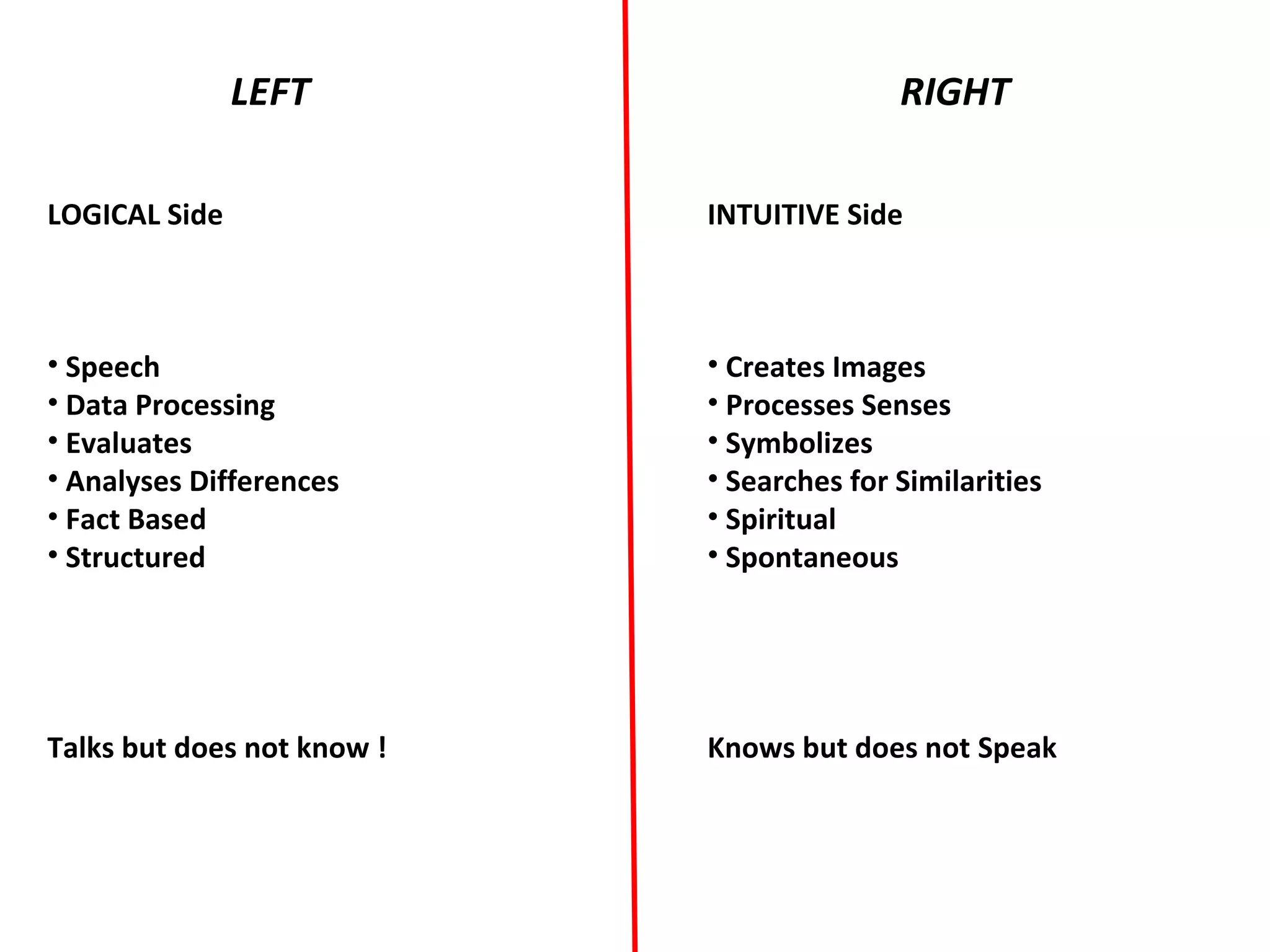
LEFT RIGHT
LOGICAL Side
• Speech
• Data Processing
• Evaluates
• Analyses Differences
• Fact Based
• Structured
Talks but does not know !
INTUITIVE Side
• Creates Images
• Processes Senses
• Symbolizes
• Searches for Similarities
• Spiritual
• Spontaneous
Knows but does not Speak
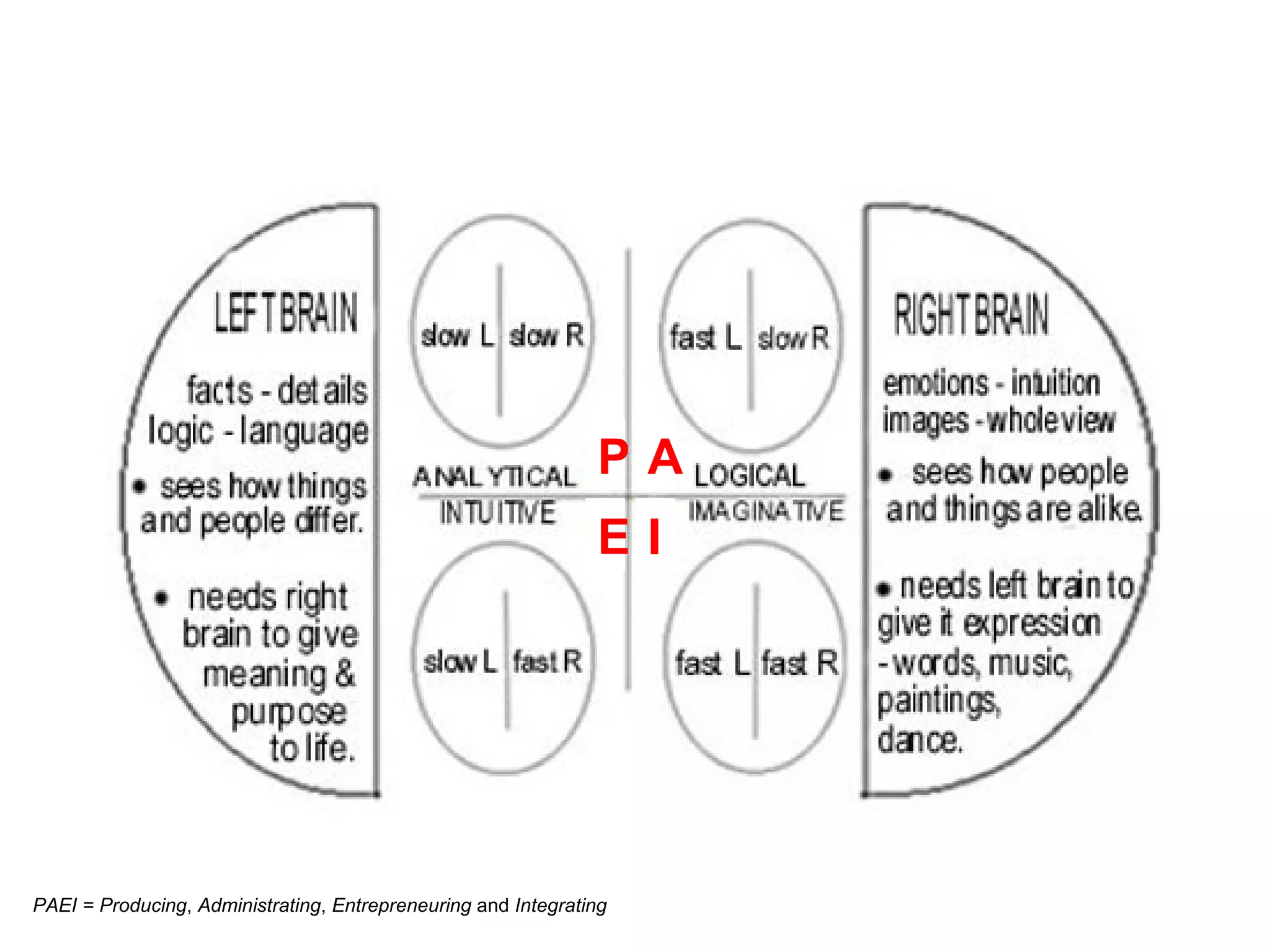
P A
E I
PAEI = Producing, Administrating, Entrepreneuring and Integrating
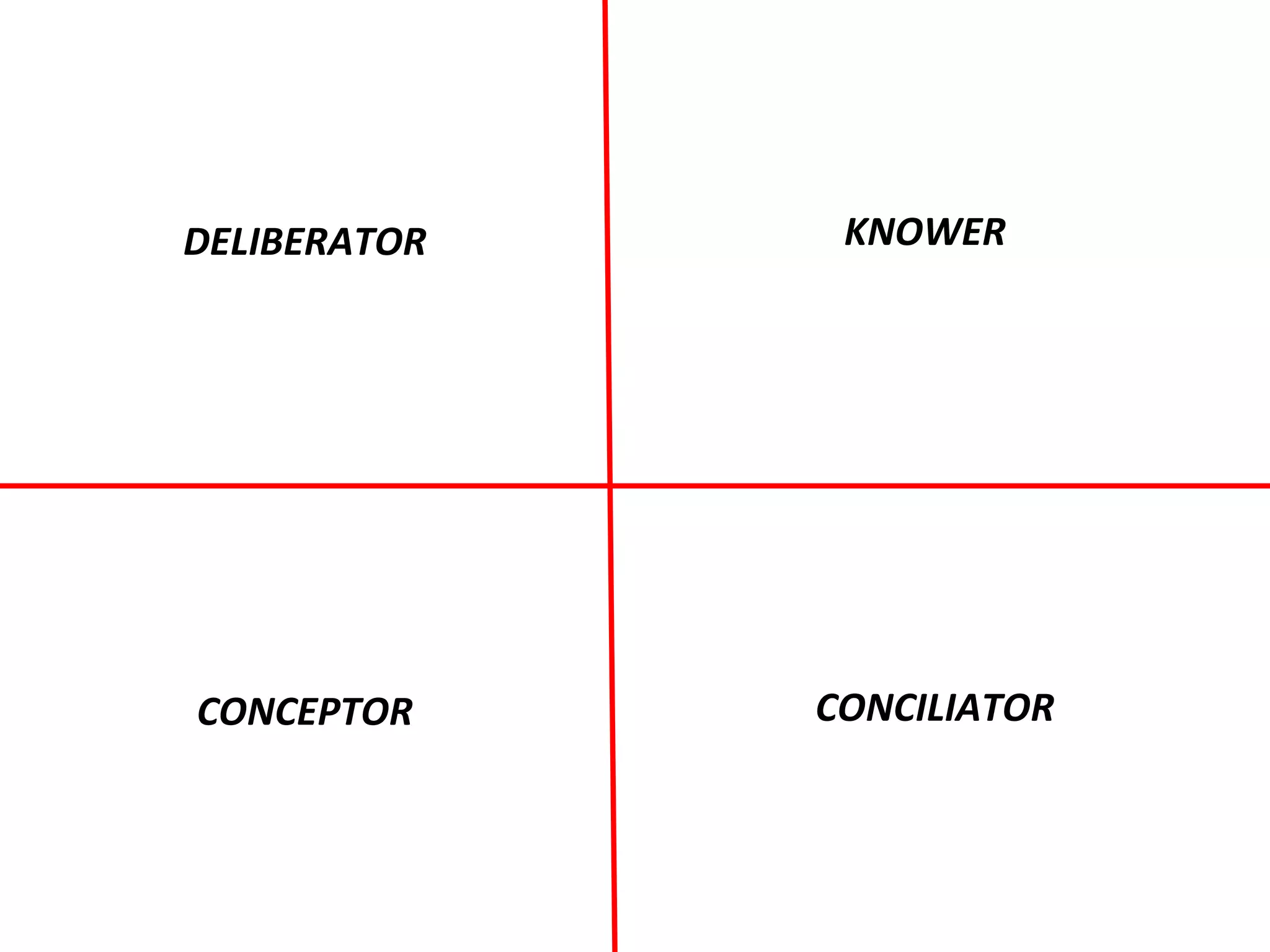
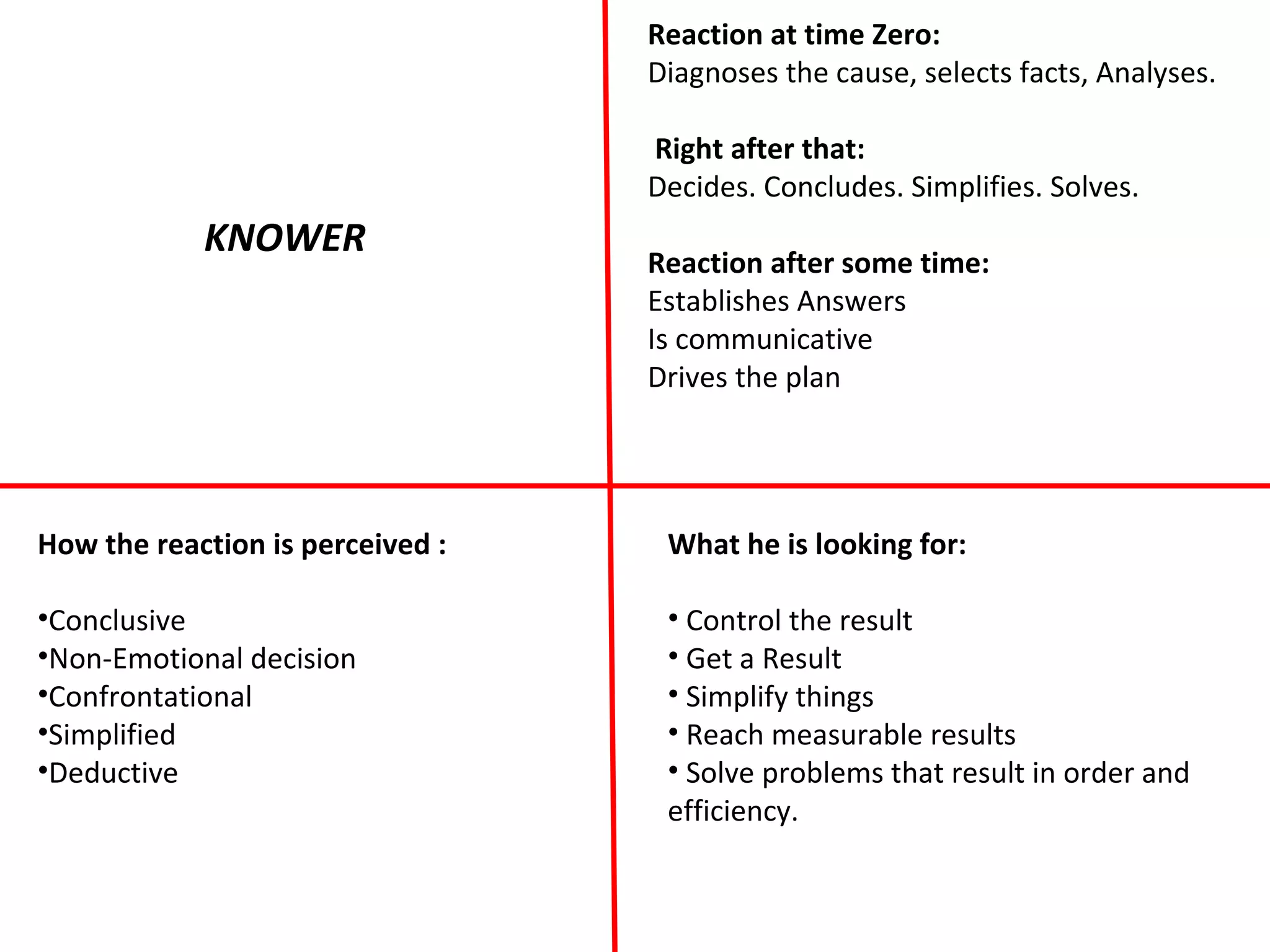
KNOWER
CONCILIATORCONCEPTOR
DELIBERATOR
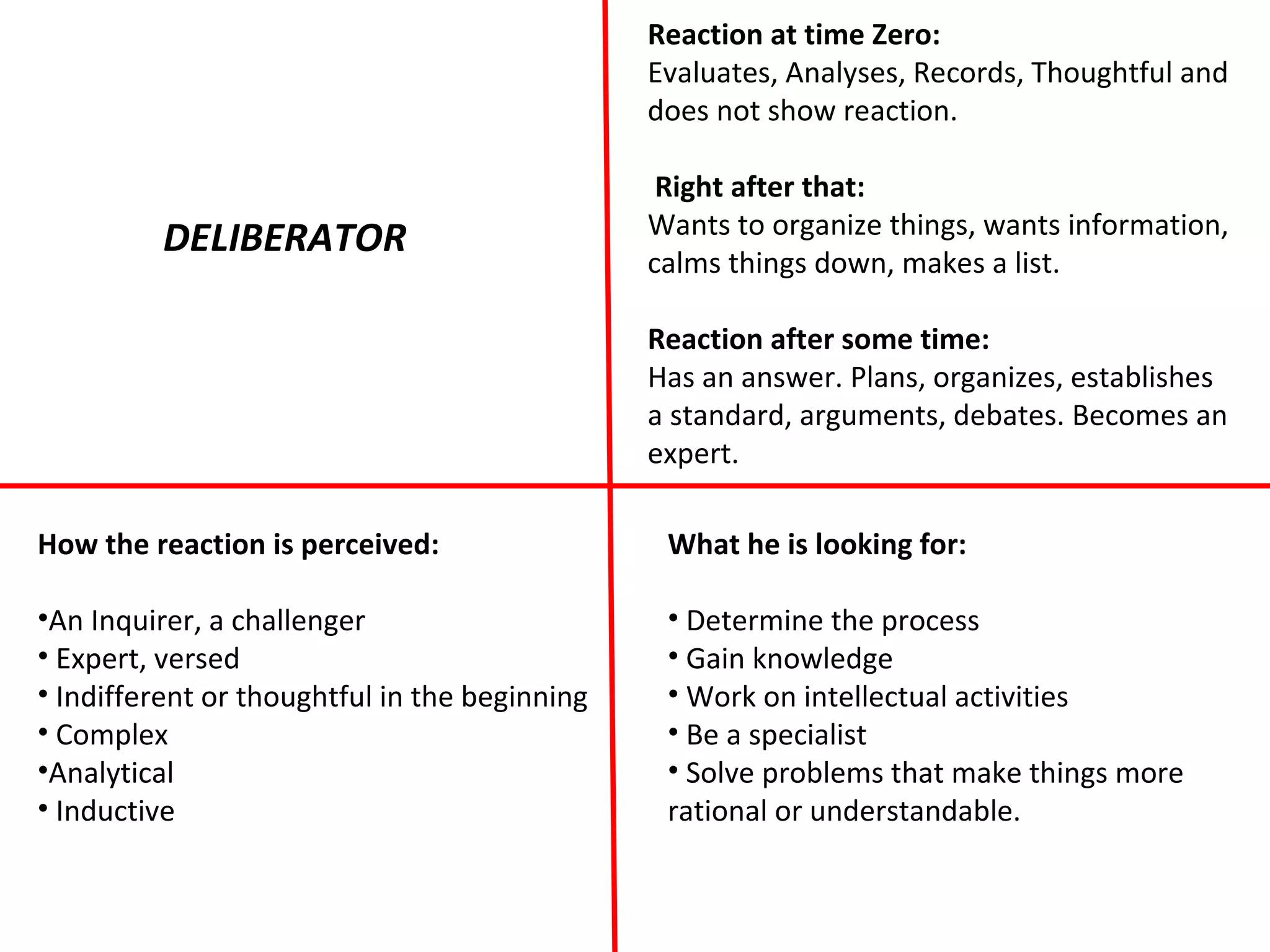
DELIBERATOR
Reaction at time Zero:
Evaluates, Analyses, Records, Thoughtful and
does not show reaction.
Right after that:
Wants to organize things, wants information,
calms things down, makes a list.
Reaction after some time:
Has an answer. Plans, organizes, establishes
a standard, arguments, debates. Becomes an
expert.
How the reaction is perceived:
•An Inquirer, a challenger
• Expert, versed
• Indifferent or thoughtful in the beginning
• Complex
•Analytical
• Inductive
What he is looking for:
• Determine the process
• Gain knowledge
• Work on intellectual activities
• Be a specialist
• Solve problems that make things more
rational or understandable.
KNOWER
Reaction at time Zero:
Diagnoses the cause, selects facts, Analyses.
Right after that:
Decides. Concludes. Simplifies. Solves.
Reaction after some time:
Establishes Answers
Is communicative
Drives the plan
How the reaction is perceived :
•Conclusive
•Non-Emotional decision
•Confrontational
•Simplified
•Deductive
What he is looking for:
• Control the result
• Get a Result
• Simplify things
• Reach measurable results
• Solve problems that result in order and
efficiency.
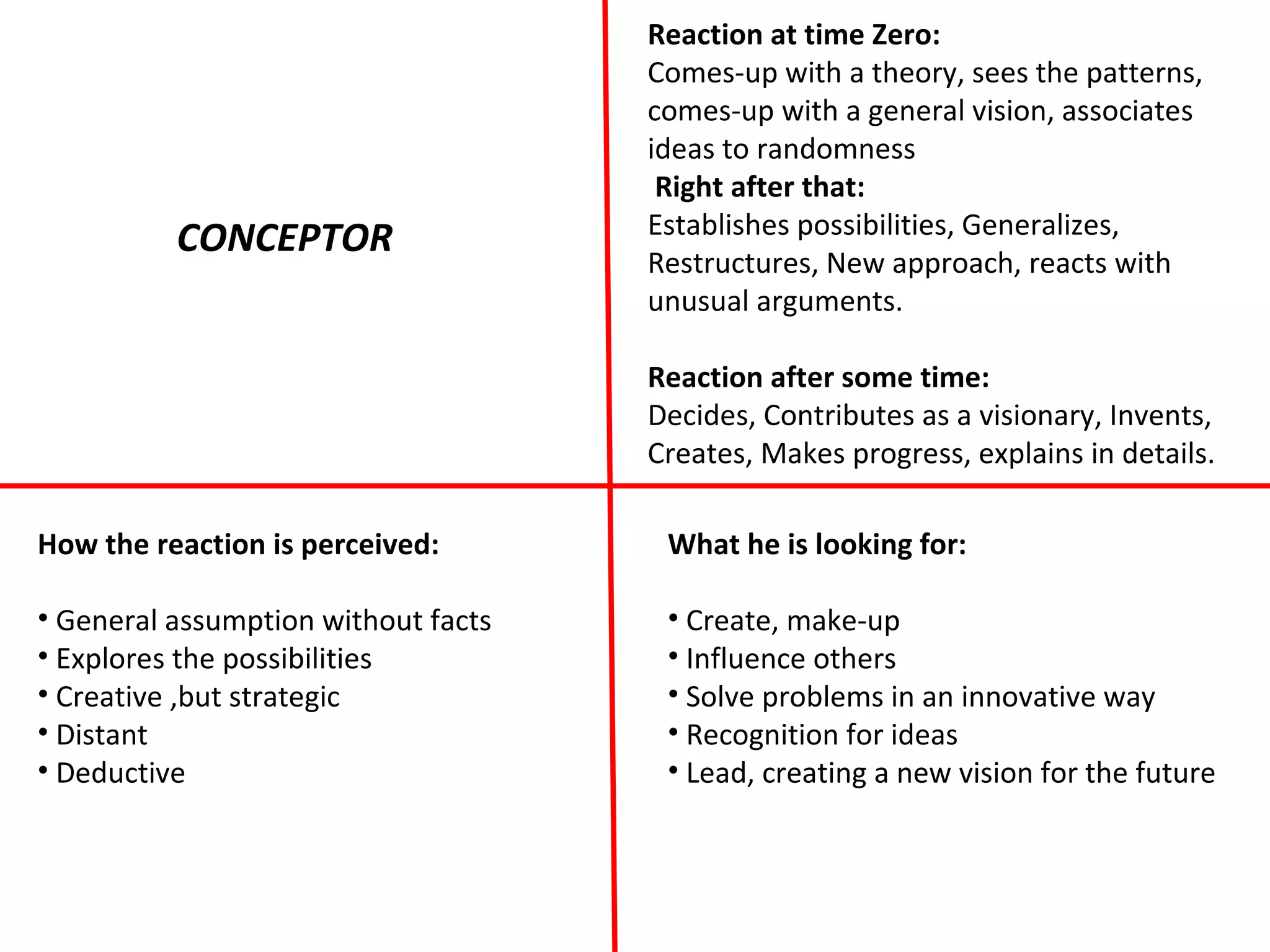
CONCEPTOR
Reaction at time Zero:
Comes-up with a theory, sees the patterns,
comes-up with a general vision, associates
ideas to randomness
Right after that:
Establishes possibilities, Generalizes,
Restructures, New approach, reacts with
unusual arguments.
Reaction after some time:
Decides, Contributes as a visionary, Invents,
Creates, Makes progress, explains in details.
How the reaction is perceived:
• General assumption without facts
• Explores the possibilities
• Creative ,but strategic
• Distant
• Deductive
What he is looking for:
• Create, make-up
• Influence others
• Solve problems in an innovative way
• Recognition for ideas
• Lead, creating a new vision for the future
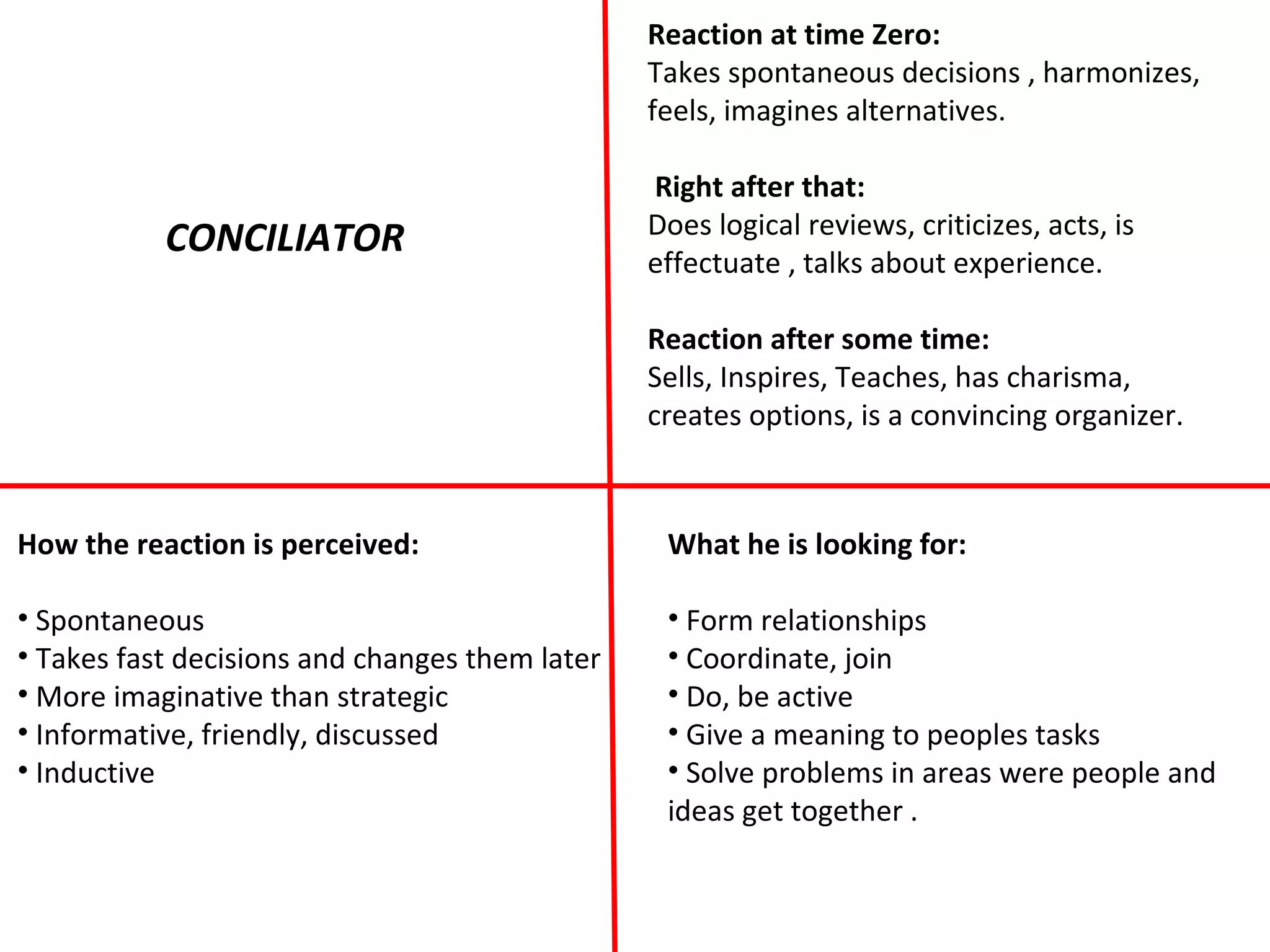
CONCILIATOR
Reaction at time Zero:
Takes spontaneous decisions , harmonizes,
feels, imagines alternatives.
Right after that:
Does logical reviews, criticizes, acts, is
effectuate , talks about experience.
Reaction after some time:
Sells, Inspires, Teaches, has charisma,
creates options, is a convincing organizer.
How the reaction is perceived:
• Spontaneous
• Takes fast decisions and changes them later
• More imaginative than strategic
• Informative, friendly, discussed
• Inductive
What he is looking for:
• Form relationships
• Coordinate, join
• Do, be active
• Give a meaning to peoples tasks
• Solve problems in areas were people and
ideas get together .
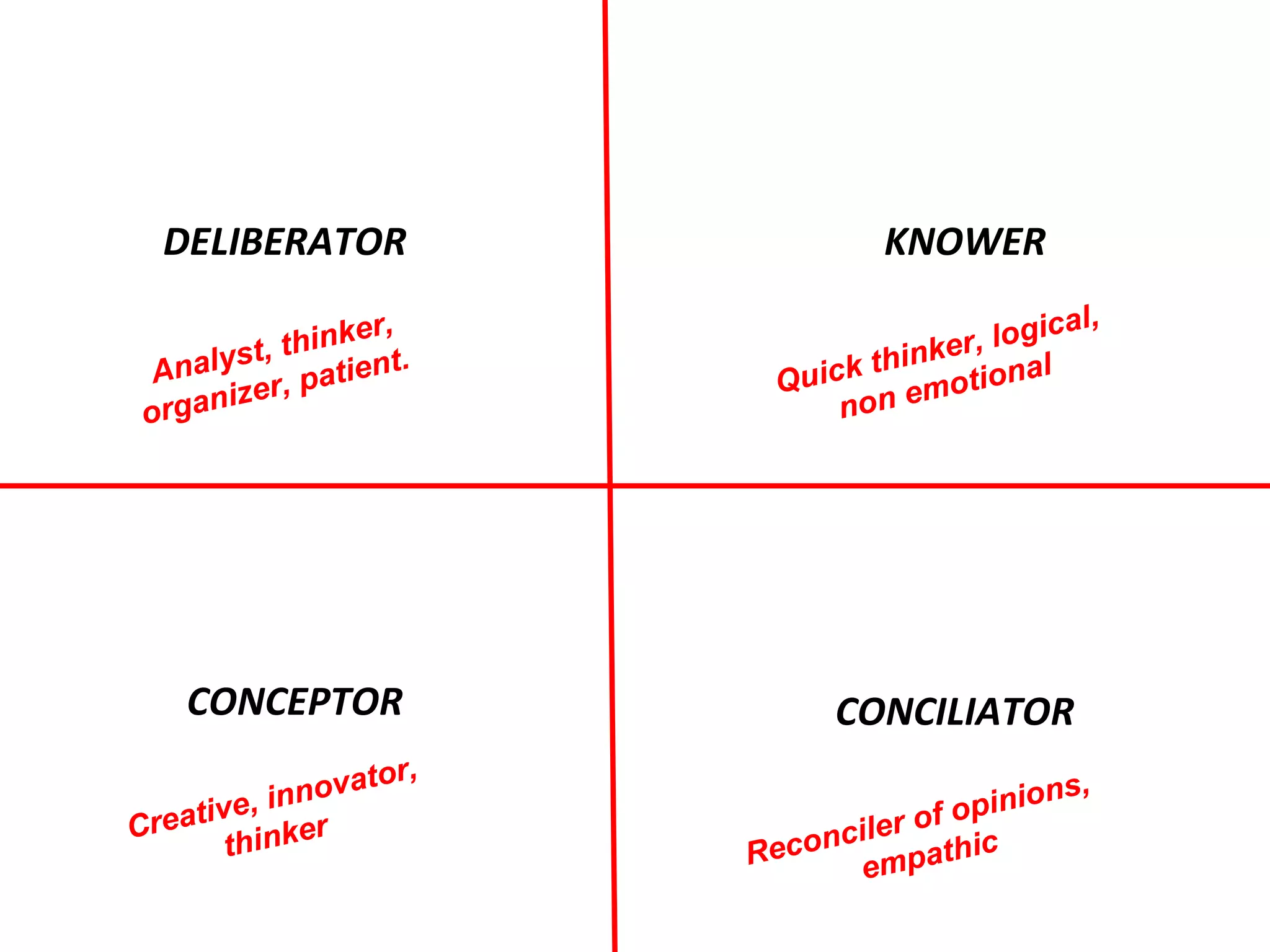
KNOWER
CONCILIATORCONCEPTOR
DELIBERATOR
Quick thinker, logical,
non emotional
Reconciler of opinions,
empathic
Analyst, thinker,
organizer, patient.
Creative, innovator,
thinker
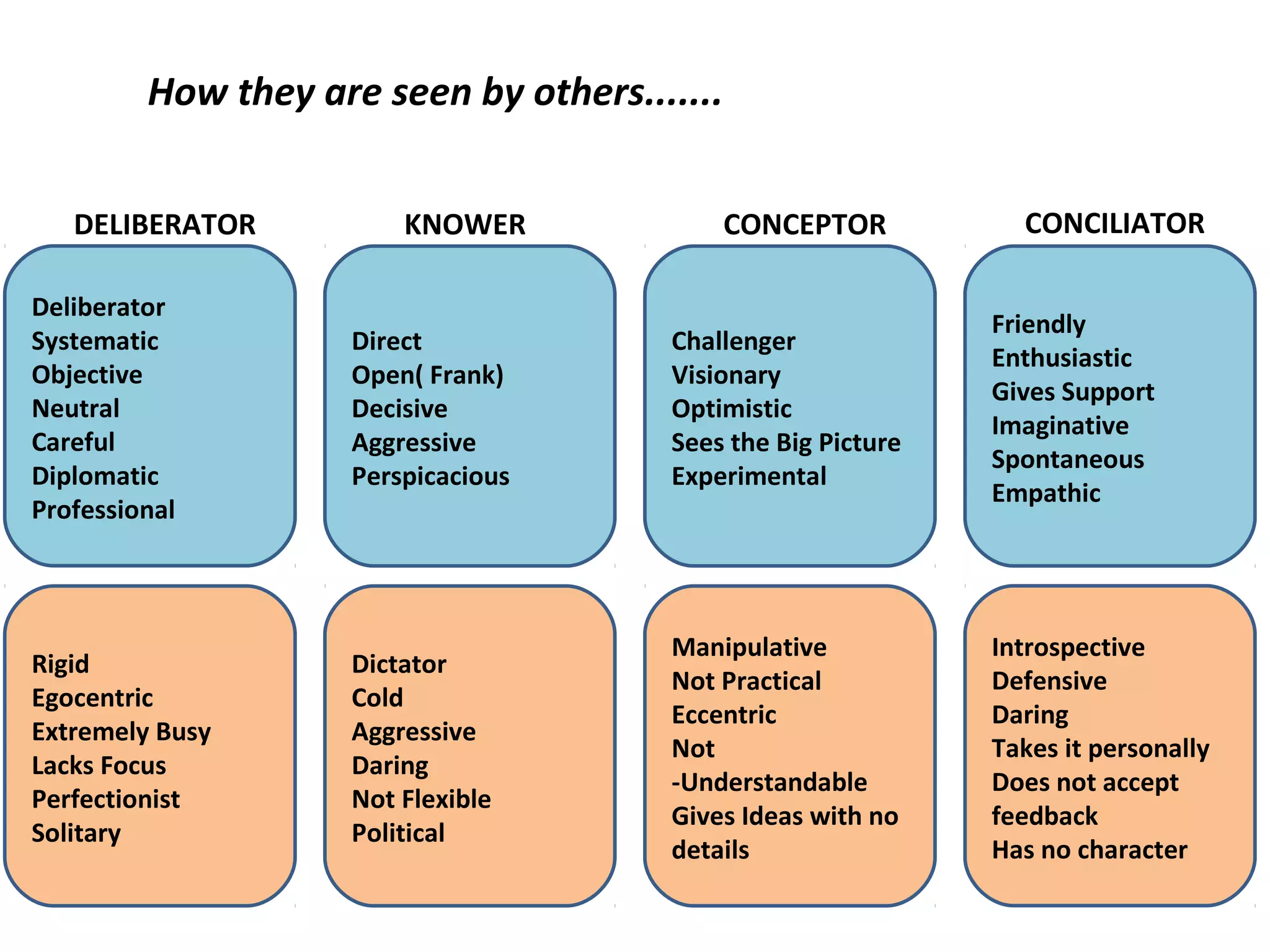
How they are seen by others.......
Direct
Open( Frank)
Decisive
Aggressive
Perspicacious
KNOWER
Dictator
Cold
Aggressive
Daring
Not Flexible
Political
CONCILIATOR
Friendly
Enthusiastic
Gives Support
Imaginative
Spontaneous
Empathic
Introspective
Defensive
Daring
Takes it personally
Does not accept
feedback
Has no character
CONCEPTOR
Challenger
Visionary
Optimistic
Sees the Big Picture
Experimental
Manipulative
Not Practical
Eccentric
Not
-Understandable
Gives Ideas with no
details
DELIBERATOR
Deliberator
Systematic
Objective
Neutral
Careful
Diplomatic
Professional
Rigid
Egocentric
Extremely Busy
Lacks Focus
Perfectionist
Solitary
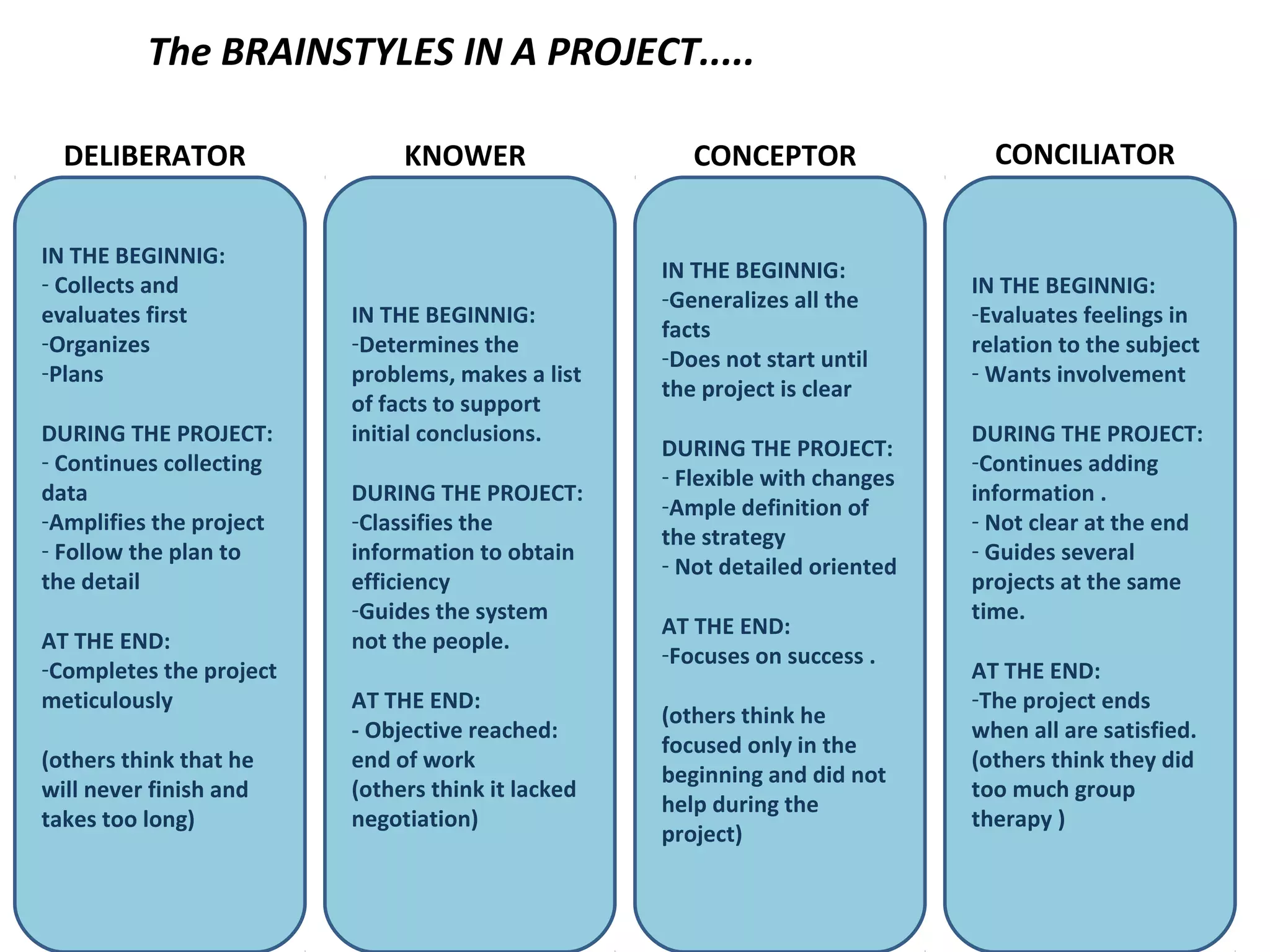
The BRAINSTYLES IN A PROJECT.....
IN THE BEGINNIG:
-Evaluates feelings in
relation to the subject
- Wants involvement
DURING THE PROJECT:
-Continues adding
information .
- Not clear at the end
- Guides several
projects at the same
time.
AT THE END:
-The project ends
when all are satisfied.
(others think they did
too much group
therapy )
IN THE BEGINNIG:
-Generalizes all the
facts
-Does not start until
the project is clear
DURING THE PROJECT:
- Flexible with changes
-Ample definition of
the strategy
- Not detailed oriented
AT THE END:
-Focuses on success .
(others think he
focused only in the
beginning and did not
help during the
project)
IN THE BEGINNIG:
- Collects and
evaluates first
-Organizes
-Plans
DURING THE PROJECT:
- Continues collecting
data
-Amplifies the project
- Follow the plan to
the detail
AT THE END:
-Completes the project
meticulously
(others think that he
will never finish and
takes too long)
KNOWER CONCILIATORCONCEPTORDELIBERATOR
IN THE BEGINNIG:
-Determines the
problems, makes a list
of facts to support
initial conclusions.
DURING THE PROJECT:
-Classifies the
information to obtain
efficiency
-Guides the system
not the people.
AT THE END:
- Objective reached:
end of work
(others think it lacked
negotiation)
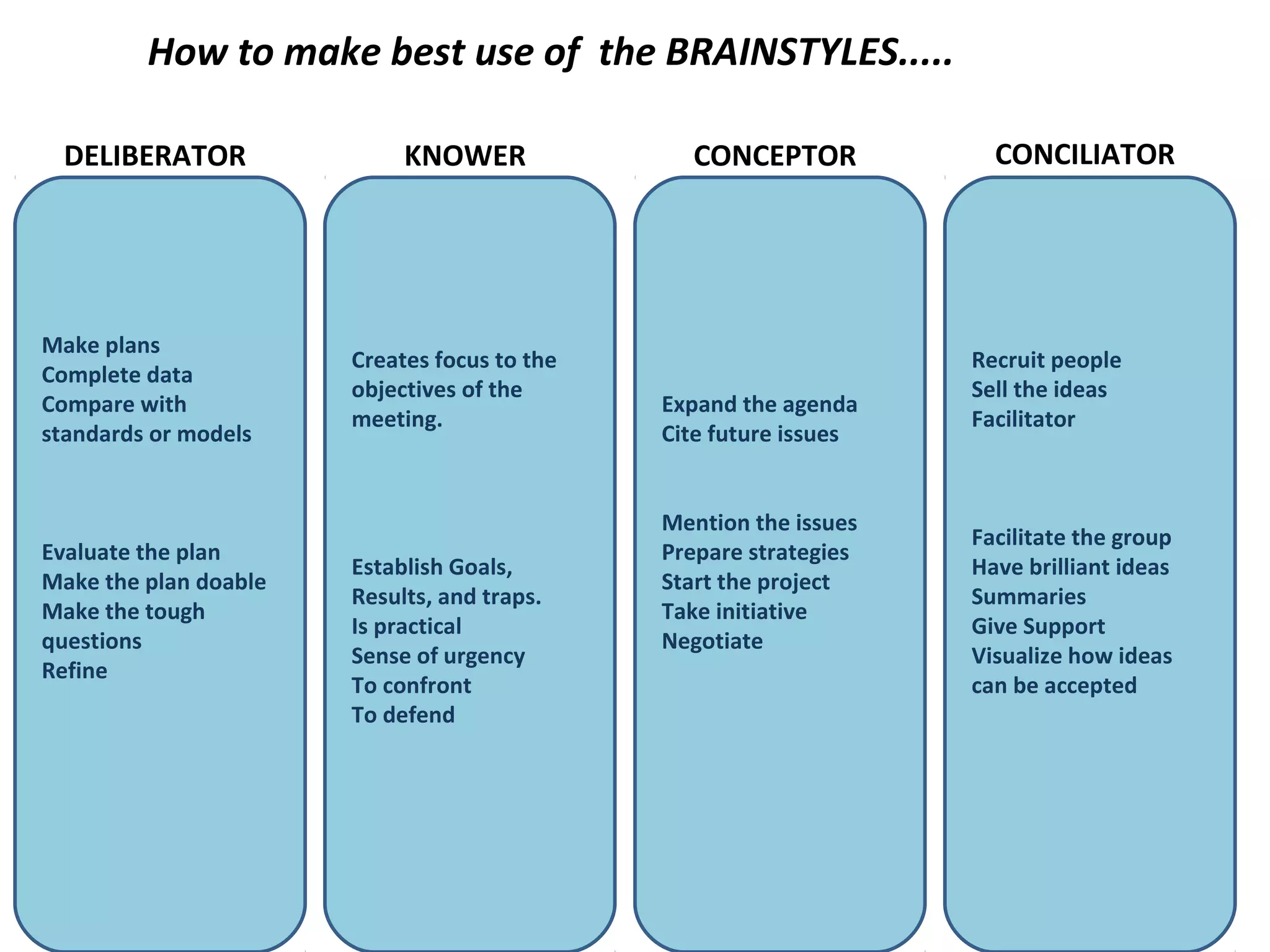
How to make best use of the BRAINSTYLES.....
Recruit people
Sell the ideas
Facilitator
Facilitate the group
Have brilliant ideas
Summaries
Give Support
Visualize how ideas
can be accepted
Expand the agenda
Cite future issues
Mention the issues
Prepare strategies
Start the project
Take initiative
Negotiate
Make plans
Complete data
Compare with
standards or models
Evaluate the plan
Make the plan doable
Make the tough
questions
Refine
KNOWER CONCILIATORCONCEPTORDELIBERATOR
Creates focus to the
objectives of the
meeting.
Establish Goals,
Results, and traps.
Is practical
Sense of urgency
To confront
To defend
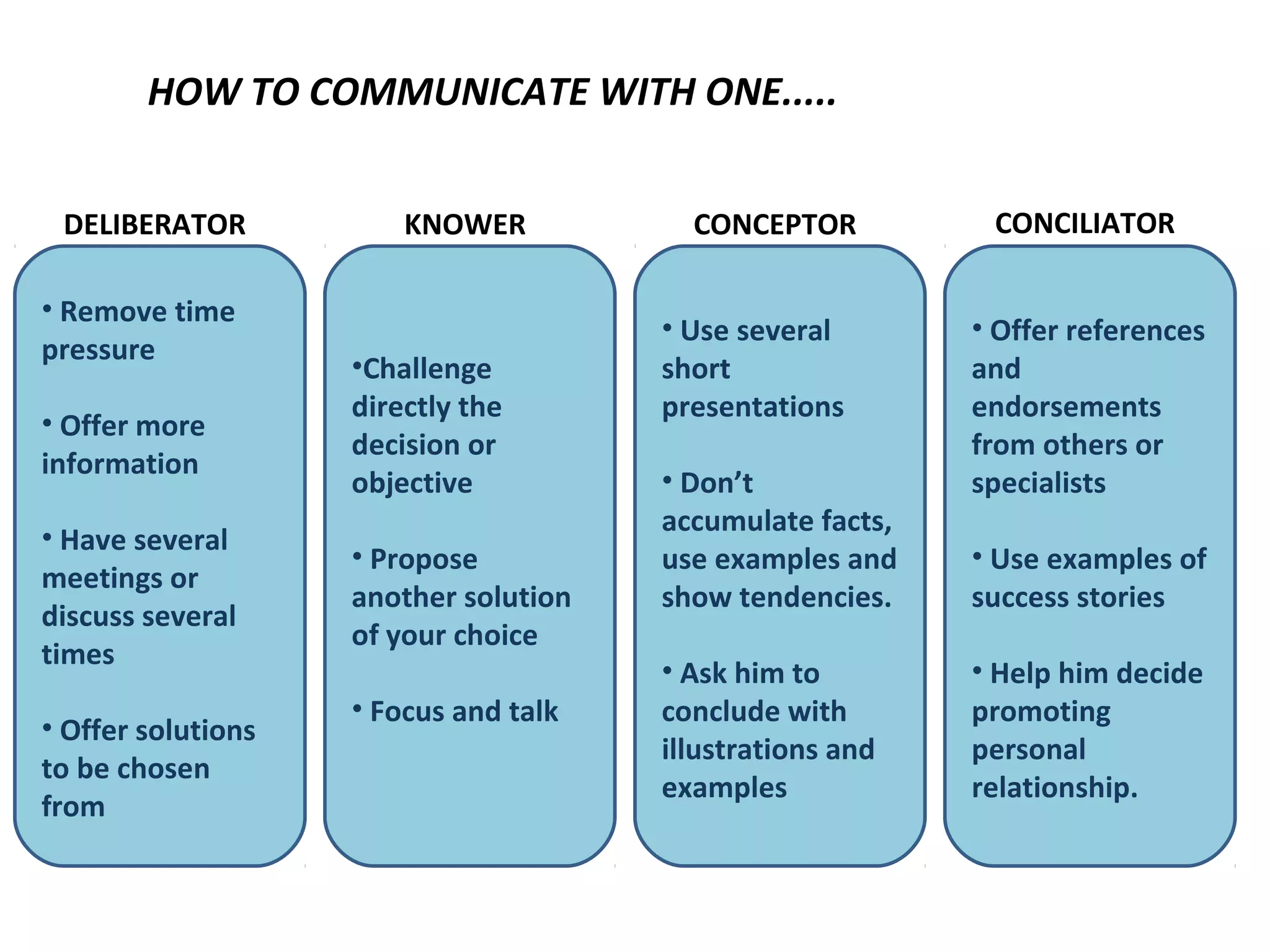
HOW TO COMMUNICATE WITH ONE.....
•Challenge
directly the
decision or
objective
• Propose
another solution
of your choice
• Focus and talk
• Offer references
and
endorsements
from others or
specialists
• Use examples of
success stories
• Help him decide
promoting
personal
relationship.
• Use several
short
presentations
• Don’t
accumulate facts,
use examples and
show tendencies.
• Ask him to
conclude with
illustrations and
examples
• Remove time
pressure
• Offer more
information
• Have several
meetings or
discuss several
times
• Offer solutions
to be chosen
from
KNOWER CONCILIATORCONCEPTORDELIBERATOR
QUESTIONS ??????
???

SCL Event - Brain Styles - Steve Wilson - GSK

  • 1.
  • 2.
    LEFT RIGHT LOGICAL Side •Speech • Data Processing • Evaluates • Analyses Differences • Fact Based • Structured Talks but does not know ! INTUITIVE Side • Creates Images • Processes Senses • Symbolizes • Searches for Similarities • Spiritual • Spontaneous Knows but does not Speak
  • 3.
    P A E I PAEI= Producing, Administrating, Entrepreneuring and Integrating
  • 4.
  • 5.
    DELIBERATOR Reaction at timeZero: Evaluates, Analyses, Records, Thoughtful and does not show reaction. Right after that: Wants to organize things, wants information, calms things down, makes a list. Reaction after some time: Has an answer. Plans, organizes, establishes a standard, arguments, debates. Becomes an expert. How the reaction is perceived: •An Inquirer, a challenger • Expert, versed • Indifferent or thoughtful in the beginning • Complex •Analytical • Inductive What he is looking for: • Determine the process • Gain knowledge • Work on intellectual activities • Be a specialist • Solve problems that make things more rational or understandable.
  • 6.
    KNOWER Reaction at timeZero: Diagnoses the cause, selects facts, Analyses. Right after that: Decides. Concludes. Simplifies. Solves. Reaction after some time: Establishes Answers Is communicative Drives the plan How the reaction is perceived : •Conclusive •Non-Emotional decision •Confrontational •Simplified •Deductive What he is looking for: • Control the result • Get a Result • Simplify things • Reach measurable results • Solve problems that result in order and efficiency.
  • 7.
    CONCEPTOR Reaction at timeZero: Comes-up with a theory, sees the patterns, comes-up with a general vision, associates ideas to randomness Right after that: Establishes possibilities, Generalizes, Restructures, New approach, reacts with unusual arguments. Reaction after some time: Decides, Contributes as a visionary, Invents, Creates, Makes progress, explains in details. How the reaction is perceived: • General assumption without facts • Explores the possibilities • Creative ,but strategic • Distant • Deductive What he is looking for: • Create, make-up • Influence others • Solve problems in an innovative way • Recognition for ideas • Lead, creating a new vision for the future
  • 8.
    CONCILIATOR Reaction at timeZero: Takes spontaneous decisions , harmonizes, feels, imagines alternatives. Right after that: Does logical reviews, criticizes, acts, is effectuate , talks about experience. Reaction after some time: Sells, Inspires, Teaches, has charisma, creates options, is a convincing organizer. How the reaction is perceived: • Spontaneous • Takes fast decisions and changes them later • More imaginative than strategic • Informative, friendly, discussed • Inductive What he is looking for: • Form relationships • Coordinate, join • Do, be active • Give a meaning to peoples tasks • Solve problems in areas were people and ideas get together .
  • 9.
    KNOWER CONCILIATORCONCEPTOR DELIBERATOR Quick thinker, logical, nonemotional Reconciler of opinions, empathic Analyst, thinker, organizer, patient. Creative, innovator, thinker
  • 10.
    How they areseen by others....... Direct Open( Frank) Decisive Aggressive Perspicacious KNOWER Dictator Cold Aggressive Daring Not Flexible Political CONCILIATOR Friendly Enthusiastic Gives Support Imaginative Spontaneous Empathic Introspective Defensive Daring Takes it personally Does not accept feedback Has no character CONCEPTOR Challenger Visionary Optimistic Sees the Big Picture Experimental Manipulative Not Practical Eccentric Not -Understandable Gives Ideas with no details DELIBERATOR Deliberator Systematic Objective Neutral Careful Diplomatic Professional Rigid Egocentric Extremely Busy Lacks Focus Perfectionist Solitary
  • 11.
    The BRAINSTYLES INA PROJECT..... IN THE BEGINNIG: -Evaluates feelings in relation to the subject - Wants involvement DURING THE PROJECT: -Continues adding information . - Not clear at the end - Guides several projects at the same time. AT THE END: -The project ends when all are satisfied. (others think they did too much group therapy ) IN THE BEGINNIG: -Generalizes all the facts -Does not start until the project is clear DURING THE PROJECT: - Flexible with changes -Ample definition of the strategy - Not detailed oriented AT THE END: -Focuses on success . (others think he focused only in the beginning and did not help during the project) IN THE BEGINNIG: - Collects and evaluates first -Organizes -Plans DURING THE PROJECT: - Continues collecting data -Amplifies the project - Follow the plan to the detail AT THE END: -Completes the project meticulously (others think that he will never finish and takes too long) KNOWER CONCILIATORCONCEPTORDELIBERATOR IN THE BEGINNIG: -Determines the problems, makes a list of facts to support initial conclusions. DURING THE PROJECT: -Classifies the information to obtain efficiency -Guides the system not the people. AT THE END: - Objective reached: end of work (others think it lacked negotiation)
  • 12.
    How to makebest use of the BRAINSTYLES..... Recruit people Sell the ideas Facilitator Facilitate the group Have brilliant ideas Summaries Give Support Visualize how ideas can be accepted Expand the agenda Cite future issues Mention the issues Prepare strategies Start the project Take initiative Negotiate Make plans Complete data Compare with standards or models Evaluate the plan Make the plan doable Make the tough questions Refine KNOWER CONCILIATORCONCEPTORDELIBERATOR Creates focus to the objectives of the meeting. Establish Goals, Results, and traps. Is practical Sense of urgency To confront To defend
  • 13.
    HOW TO COMMUNICATEWITH ONE..... •Challenge directly the decision or objective • Propose another solution of your choice • Focus and talk • Offer references and endorsements from others or specialists • Use examples of success stories • Help him decide promoting personal relationship. • Use several short presentations • Don’t accumulate facts, use examples and show tendencies. • Ask him to conclude with illustrations and examples • Remove time pressure • Offer more information • Have several meetings or discuss several times • Offer solutions to be chosen from KNOWER CONCILIATORCONCEPTORDELIBERATOR
  • 14.