Steps
of the
Scientific Method
The Scientific
Method involves a
series of steps that
are used to
investigate a
natural
occurrence.
We shall take a
closer look at
these steps and
the terminology
you will need to
understand before
you start a
science project.
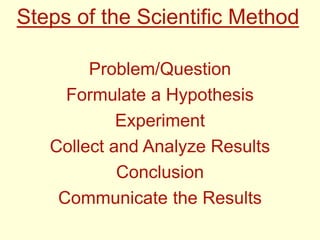
Problem/Question
Formulate a Hypothesis
Experiment
Collect and Analyze Results
Conclusion
Communicate the Results
Steps of the Scientific Method
Steps of the
Scientific Method
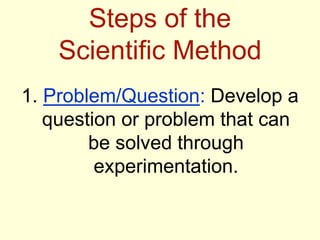
1. Problem/Question: Develop a
question or problem that can
be solved through
experimentation.
Do you remember the
next step?
Steps of the
Scientific Method
2. Formulate a Hypothesis:
Predict a possible answer to
the problem or question.
Example: If soil temperatures
rise, then plant growth will
increase.
Steps of the
Scientific Method
3. Experiment: Develop and
follow a procedure.
Include a detailed materials list.
The outcome must be
measurable (quantifiable).
Steps of the
Scientific Method
4. Collect and Analyze Results:
Modify the procedure if
needed.
Confirm the results by retesting.
Include tables, graphs, and
photographs.
Steps of the
Scientific Method
5. Conclusion: Include a
statement that accepts or
rejects the hypothesis.
Make recommendations for
further study and possible
improvements to the
procedure.
Steps of the
Scientific Method
6. Communicate the Results: Be
prepared to present the project
to an audience.
Expect questions from the
audience.
Think you can name all
six steps?
Problem/QuestionObservation/ResearchFormulate a HypothesisExperimentCollect and Analyze ResultsConclusionCommunicate the Results
Let’s put our knowledge of the
Scientific Method to a realistic
example that includes some of the
terms you’ll be needing to use and
understand.
Problem/Question
John watches his
grandmother bake
bread. He ask his
grandmother what
makes the bread rise.
She explains that yeast
releases a gas as it
feeds on sugar.
Problem/Question
John wonders if the
amount of sugar used
in the recipe will affect
the size of the bread
loaf?
Caution!
Be careful how you use effect and
affect.
Effect is usually a noun and affect, a
verb.
“ The effect of sugar amounts on the
rising of bread.”
“How does sugar affect the rising of
bread?”
John talks with his
teacher and she gives
him a Experimental
Design Diagram to
help him set up his
investigation.
Formulate a Hypothesis
After talking with his
teacher and
conducting further
research, he comes
up with a hypothesis.
“If more sugar is added,
then the bread will rise
higher.”
Hypothesis
The hypothesis is an educated
guess about the outcome of the
experiment
Note: These variables will be
defined in the next few slides.
Do you know the difference
between the independent
and dependent variables?
Independent Variable
The independent variable is the
variable that is changed by the
experimenter. (What I change)
*John changes the amount of
sugar used in his experiment
25g, 50g, 100g, 250g, 500g
Dependent Variable
The dependent variable is what
changes on its own and what is
being measured.
In this case, it would be the size
of the loaf of bread.
Experiment
His teacher helps him
come up with a
procedure and list of
needed materials.
She discusses with
John how to
determine the control
group.
Control Group
The control is the group that
serves as the standard of
comparison.
The control group may be a “no
treatment" or an “experimenter
selected” group.
Control Group
All experiments should have a
control group.
Control Group
Because his grandmother
always used 50g. of sugar in
her recipe, John is going to use
that amount in his control
group.
Constants
John’s teacher reminds
him to keep all other
factors the same so
that any observed
changes in the bread
can be attributed to
the variation in the
amount of sugar.
Constants
The constants (fixed
variables) are all the
factors that the
experimenter attempts
to keep the same.
Can you think of some
constants for this
experiment?
Constants
They might include:
Other ingredients to the
bread recipe, oven used,
rise time, brand of
ingredients, cooking time,
type of pan used, air
temperature and humidity
where the bread was
rising, oven temperature,
age of the yeast…
Experiment
John writes out his
procedure for his
experiment along with
a materials list in his
journal. He has both of
these checked by his
teacher where she
checks for any safety
concerns.
Trials
A Trial is repeating your
experiment to confirm
your results.
John is going to test each
sugar variable 3 times.
Collect and Analyze Results
John comes up with
a table he can use
to record his data.
John gets all his
materials together
and carries out his
experiment.
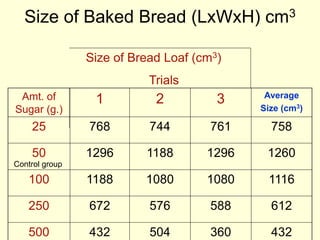
Size of Baked Bread (LxWxH) cm3
Amt. of
Sugar (g.)
1 2 3 Average
Size (cm3)
25 768 744 761 758
50 1296 1188 1296 1260
100 1188 1080 1080 1116
250 672 576 588 612
500 432 504 360 432
Size of Bread Loaf (cm3)
Trials
Control group
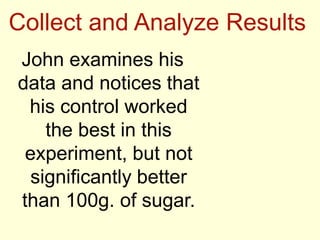
Collect and Analyze Results
John examines his
data and notices that
his control worked
the best in this
experiment, but not
significantly better
than 100g. of sugar.
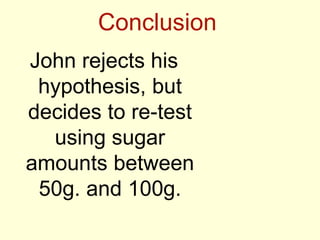
Conclusion
John rejects his
hypothesis, but
decides to re-test
using sugar
amounts between
50g. and 100g.
Experiment
Once again, John
gathers his materials
and carries out his
experiment.
Here are the results.
Can you tell which group
did the best?
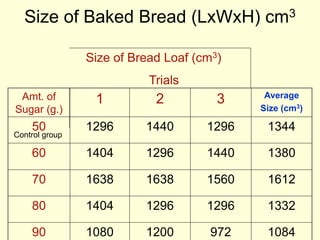
Size of Baked Bread (LxWxH) cm3
Amt. of
Sugar (g.)
1 2 3 Average
Size (cm3)
50 1296 1440 1296 1344
60 1404 1296 1440 1380
70 1638 1638 1560 1612
80 1404 1296 1296 1332
90 1080 1200 972 1084
Size of Bread Loaf (cm3)
Trials
Control group
Conclusion
John finds that 70g.
of sugar produces
the largest loaf.
His hypothesis is
accepted.
Communicate the Results
John tells his
grandmother about
his findings and
prepares to present
his project in
Science class.
Scientific Method six steps

  • 1.
  • 2.
    The Scientific Method involvesa series of steps that are used to investigate a natural occurrence.
  • 3.
    We shall takea closer look at these steps and the terminology you will need to understand before you start a science project.
  • 4.
    Problem/Question Formulate a Hypothesis Experiment Collectand Analyze Results Conclusion Communicate the Results Steps of the Scientific Method
  • 5.
    Steps of the ScientificMethod 1. Problem/Question: Develop a question or problem that can be solved through experimentation.
  • 6.
    Do you rememberthe next step?
  • 7.
    Steps of the ScientificMethod 2. Formulate a Hypothesis: Predict a possible answer to the problem or question. Example: If soil temperatures rise, then plant growth will increase.
  • 8.
    Steps of the ScientificMethod 3. Experiment: Develop and follow a procedure. Include a detailed materials list. The outcome must be measurable (quantifiable).
  • 9.
    Steps of the ScientificMethod 4. Collect and Analyze Results: Modify the procedure if needed. Confirm the results by retesting. Include tables, graphs, and photographs.
  • 10.

    Steps of the ScientificMethod 5. Conclusion: Include a statement that accepts or rejects the hypothesis. Make recommendations for further study and possible improvements to the procedure.
  • 11.
    Steps of the ScientificMethod 6. Communicate the Results: Be prepared to present the project to an audience. Expect questions from the audience.
  • 12.
    Think you canname all six steps? Problem/QuestionObservation/ResearchFormulate a HypothesisExperimentCollect and Analyze ResultsConclusionCommunicate the Results
  • 13.
    Let’s put ourknowledge of the Scientific Method to a realistic example that includes some of the terms you’ll be needing to use and understand.
  • 14.
    Problem/Question John watches his grandmotherbake bread. He ask his grandmother what makes the bread rise. She explains that yeast releases a gas as it feeds on sugar.
  • 15.
    Problem/Question John wonders ifthe amount of sugar used in the recipe will affect the size of the bread loaf?
  • 16.
    Caution! Be careful howyou use effect and affect. Effect is usually a noun and affect, a verb. “ The effect of sugar amounts on the rising of bread.” “How does sugar affect the rising of bread?”
  • 17.
    John talks withhis teacher and she gives him a Experimental Design Diagram to help him set up his investigation.
  • 19.
    Formulate a Hypothesis Aftertalking with his teacher and conducting further research, he comes up with a hypothesis. “If more sugar is added, then the bread will rise higher.”
  • 20.
    Hypothesis The hypothesis isan educated guess about the outcome of the experiment Note: These variables will be defined in the next few slides.
  • 21.
    Do you knowthe difference between the independent and dependent variables?
  • 22.
    Independent Variable The independentvariable is the variable that is changed by the experimenter. (What I change) *John changes the amount of sugar used in his experiment 25g, 50g, 100g, 250g, 500g
  • 23.
    Dependent Variable The dependentvariable is what changes on its own and what is being measured. In this case, it would be the size of the loaf of bread.
  • 24.
    Experiment His teacher helpshim come up with a procedure and list of needed materials. She discusses with John how to determine the control group.
  • 25.
    Control Group The controlis the group that serves as the standard of comparison. The control group may be a “no treatment" or an “experimenter selected” group.
  • 26.
    Control Group All experimentsshould have a control group.
  • 27.
    Control Group Because hisgrandmother always used 50g. of sugar in her recipe, John is going to use that amount in his control group.
  • 28.
    Constants John’s teacher reminds himto keep all other factors the same so that any observed changes in the bread can be attributed to the variation in the amount of sugar.
  • 29.
    Constants The constants (fixed variables)are all the factors that the experimenter attempts to keep the same.
  • 30.
    Can you thinkof some constants for this experiment?
  • 31.
    Constants They might include: Otheringredients to the bread recipe, oven used, rise time, brand of ingredients, cooking time, type of pan used, air temperature and humidity where the bread was rising, oven temperature, age of the yeast…
  • 32.
    Experiment John writes outhis procedure for his experiment along with a materials list in his journal. He has both of these checked by his teacher where she checks for any safety concerns.
  • 33.
    Trials A Trial isrepeating your experiment to confirm your results. John is going to test each sugar variable 3 times.
  • 34.
    Collect and AnalyzeResults John comes up with a table he can use to record his data. John gets all his materials together and carries out his experiment.
  • 35.
    Size of BakedBread (LxWxH) cm3 Amt. of Sugar (g.) 1 2 3 Average Size (cm3) 25 768 744 761 758 50 1296 1188 1296 1260 100 1188 1080 1080 1116 250 672 576 588 612 500 432 504 360 432 Size of Bread Loaf (cm3) Trials Control group
  • 36.
    Collect and AnalyzeResults John examines his data and notices that his control worked the best in this experiment, but not significantly better than 100g. of sugar.
  • 37.
    Conclusion John rejects his hypothesis,but decides to re-test using sugar amounts between 50g. and 100g.
  • 38.
    Experiment Once again, John gathershis materials and carries out his experiment. Here are the results.
  • 39.
    Can you tellwhich group did the best?
  • 40.
    Size of BakedBread (LxWxH) cm3 Amt. of Sugar (g.) 1 2 3 Average Size (cm3) 50 1296 1440 1296 1344 60 1404 1296 1440 1380 70 1638 1638 1560 1612 80 1404 1296 1296 1332 90 1080 1200 972 1084 Size of Bread Loaf (cm3) Trials Control group
  • 41.
    Conclusion John finds that70g. of sugar produces the largest loaf. His hypothesis is accepted.
  • 42.
    Communicate the Results Johntells his grandmother about his findings and prepares to present his project in Science class.