REVIEW:
• Force
• Motion
• Effects of forces on the object’s motion
• Forces on objects at rest
• Normal force
• Friction
• Gravitational force
• Scalar quantity
• Vector quantity
True or False
If an object is at rest,
no forces are acting upon it
Answer: False
There are many forces acting on it
(gravity, friction, air pressure, etc)
but they are all BALANCED
True or False
When there is force, there is motion.
Answer: False
Force may be present but it does not
necessarily result to motion. If forces are
balanced, no motion will be produced.
True or False
In the absence of force, object will continue
to move constantly.
Answer: True.
Because force will slow down or stop
motion.
TODAY’S LESSON
Learning Objective
Aim high - Be able to represent forces using a force diagram
Aim higher - Describe the effect that balanced and unbalanced forces
have on an object
Aim even higher - Be able to calculate the size of the resultant force
Key Words:
Balanced force
Unbalancedforce
Resultant or Net Force
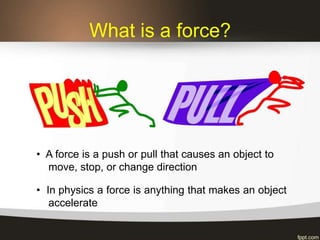
What is a force?
• A force is a push or pull that causes an object to
move, stop, or change direction
• In physics a force is anything that makes an object
accelerate
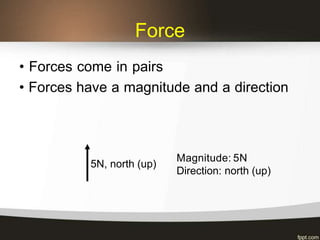
Force
• Forces come in pairs
• Forces have a magnitude and a direction
5N, north (up)
Magnitude: 5N
Direction: north (up)
Balanced and Unbalanced Forces
• Forces occur in pairs and they can be
either balanced or unbalanced
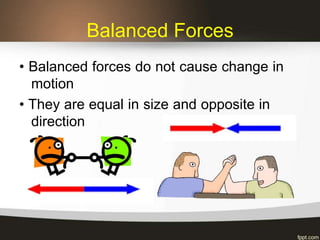
Balanced Forces
• Balanced forces do not cause change in
motion
• They are equal in size and opposite in
direction
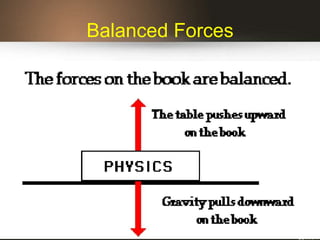
Balanced Forces
We call this NORMAL FORCE. The book is
said to be at equilibrium since there are no
unbalanced forces acting upon the book
and it maintains its state of motion (it still
sits on the table).
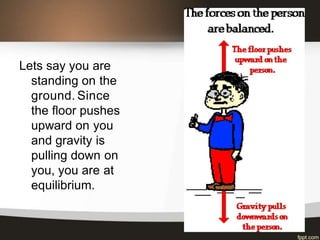
Lets say you are
standing on the
ground. Since
the floor pushes
upward on you
and gravity is
pulling down on
you, you are at
equilibrium.
Unbalanced Forces
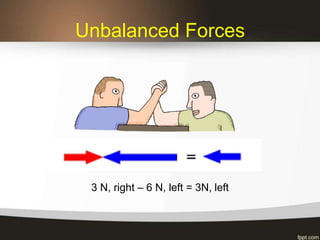
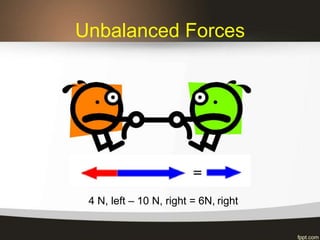
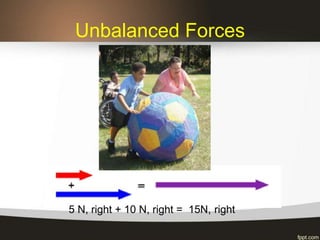
• An unbalanced force always causes a change in
motion
• When unbalanced forces act in opposite
directions you can find the net force
– Net force
• Magnitude
– The difference between the two forces
• Direction
– Direction of the largest force
Unbalanced Forces
3 N, right – 6 N, left = 3N, left
Unbalanced Forces
4 N, left – 10 N, right = 6N, right
Unbalanced Forces
5 N, right + 10 N, right = 15N, right
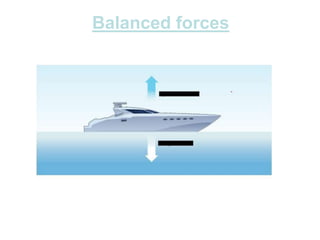
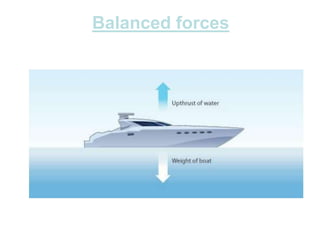
Balanced Forces
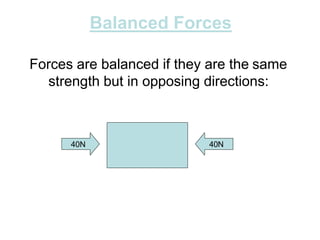
Forces are balanced if they are the same
strength but in opposing directions:
40N 40N
Balanced forces
Balanced forces
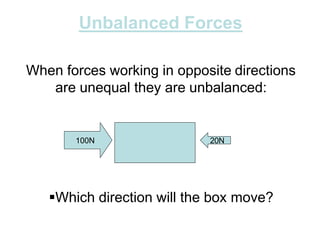
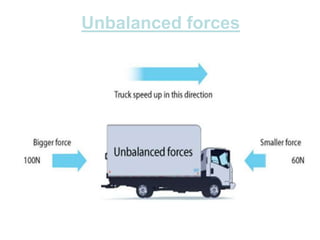
Unbalanced Forces
When forces working in opposite directions
are unequal they are unbalanced:
100N 20N
Which direction will the box move?
Unbalanced forces
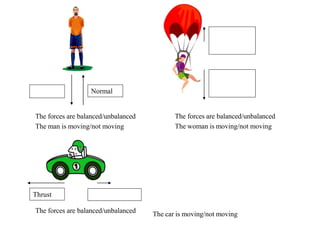
Normal
The forces are balanced/unbalanced
The man is moving/not moving
The forces are balanced/unbalanced
The woman is moving/not moving
Thrust
The forces are balanced/unbalanced The car is moving/not moving
Application Questions
1. A diver wears weights and dives into the
water, which force is bigger, his weight or
upthrust? Draw a diagram to show the
forces acting on him
2. The diver then releases the weight. Now,
which force is bigger, his weight or
upthrust? Draw a diagram to show the
forces acting on him.
Resultant Force
If two forces are unbalanced there is a
resultant force.
It could replace all the others to give the
same effect.
The difference between two forces is the
resultant force.
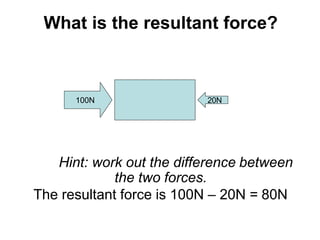
What is the resultant force?
100N 20N
Hint: work out the difference between
the two forces.
The resultant force is 100N – 20N = 80N
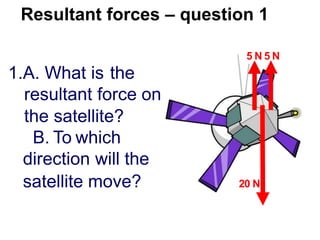
Resultant forces – question 1
5 N 5 N
1.A. What is the
resultant force on
the satellite?
B. To which
direction will the
satellite move? 20 N
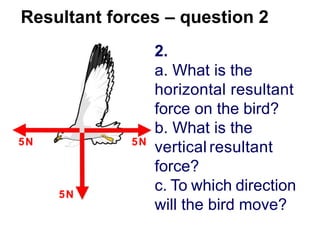
Resultant forces – question 2
2.
a. What is the
horizontal resultant
force on the bird?
5N 5N
b. What is the
vertical resultant
force?
5N
c. To which direction
will the bird move?
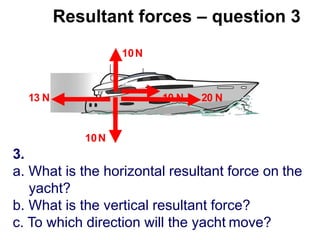
Resultant forces – question 3
10N
13 N 10 N 20 N
10N
3.
a. What is the horizontal resultant force on the
yacht?
b. What is the vertical resultant force?
c. To which direction will the yacht move?
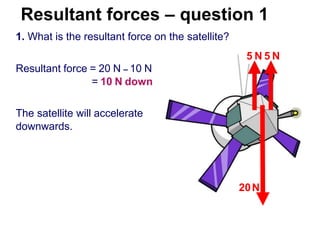
Resultant forces – question 1
1. What is the resultant force on the satellite?
5 N 5 N
Resultant force = 20 N – 10 N
= 10 N down
The satellite will accelerate
downwards.
20N
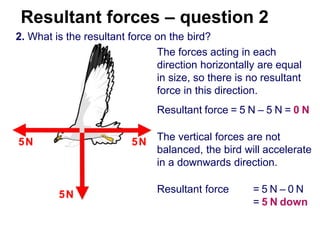
Resultant forces – question 2
2. What is the resultant force on the bird?
The forces acting in each
direction horizontally are equal
in size, so there is no resultant
force in this direction.
Resultant force = 5 N – 5 N = 0 N
5N 5N The vertical forces are not
balanced, the bird will accelerate
in a downwards direction.
5N Resultant force = 5 N – 0 N
= 5 N down
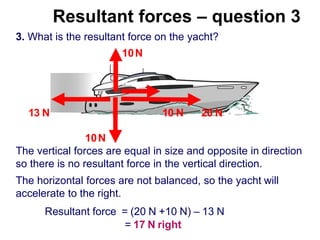
Resultant forces – question 3
3. What is the resultant force on the yacht?
10N
13 N 10 N 20 N
10N
The vertical forces are equal in size and opposite in direction
so there is no resultant force in the vertical direction.
The horizontal forces are not balanced, so the yacht will
accelerate to the right.
Resultant force = (20 N +10 N) – 13 N
= 17 N right

science8 forces and motion.pptx

  • 1.
    REVIEW: • Force • Motion •Effects of forces on the object’s motion • Forces on objects at rest • Normal force • Friction • Gravitational force • Scalar quantity • Vector quantity
  • 2.
    True or False Ifan object is at rest, no forces are acting upon it
  • 3.
    Answer: False There aremany forces acting on it (gravity, friction, air pressure, etc) but they are all BALANCED
  • 4.
    True or False Whenthere is force, there is motion.
  • 5.
    Answer: False Force maybe present but it does not necessarily result to motion. If forces are balanced, no motion will be produced.
  • 6.
    True or False Inthe absence of force, object will continue to move constantly.
  • 7.
    Answer: True. Because forcewill slow down or stop motion.
  • 8.
    TODAY’S LESSON Learning Objective Aimhigh - Be able to represent forces using a force diagram Aim higher - Describe the effect that balanced and unbalanced forces have on an object Aim even higher - Be able to calculate the size of the resultant force Key Words: Balanced force Unbalancedforce Resultant or Net Force
  • 9.
    What is aforce? • A force is a push or pull that causes an object to move, stop, or change direction • In physics a force is anything that makes an object accelerate
  • 10.
    Force • Forces comein pairs • Forces have a magnitude and a direction 5N, north (up) Magnitude: 5N Direction: north (up)
  • 11.
    Balanced and UnbalancedForces • Forces occur in pairs and they can be either balanced or unbalanced
  • 12.
    Balanced Forces • Balancedforces do not cause change in motion • They are equal in size and opposite in direction
  • 13.
  • 14.
    We call thisNORMAL FORCE. The book is said to be at equilibrium since there are no unbalanced forces acting upon the book and it maintains its state of motion (it still sits on the table).
  • 15.
    Lets say youare standing on the ground. Since the floor pushes upward on you and gravity is pulling down on you, you are at equilibrium.
  • 16.
    Unbalanced Forces • Anunbalanced force always causes a change in motion • When unbalanced forces act in opposite directions you can find the net force – Net force • Magnitude – The difference between the two forces • Direction – Direction of the largest force
  • 17.
    Unbalanced Forces 3 N,right – 6 N, left = 3N, left
  • 18.
    Unbalanced Forces 4 N,left – 10 N, right = 6N, right
  • 19.
    Unbalanced Forces 5 N,right + 10 N, right = 15N, right
  • 20.
    Balanced Forces Forces arebalanced if they are the same strength but in opposing directions: 40N 40N
  • 21.
  • 22.
  • 23.
    Unbalanced Forces When forcesworking in opposite directions are unequal they are unbalanced: 100N 20N Which direction will the box move?
  • 24.
  • 25.
    Normal The forces arebalanced/unbalanced The man is moving/not moving The forces are balanced/unbalanced The woman is moving/not moving Thrust The forces are balanced/unbalanced The car is moving/not moving
  • 26.
    Application Questions 1. Adiver wears weights and dives into the water, which force is bigger, his weight or upthrust? Draw a diagram to show the forces acting on him 2. The diver then releases the weight. Now, which force is bigger, his weight or upthrust? Draw a diagram to show the forces acting on him.
  • 27.
    Resultant Force If twoforces are unbalanced there is a resultant force. It could replace all the others to give the same effect. The difference between two forces is the resultant force.
  • 28.
    What is theresultant force? 100N 20N Hint: work out the difference between the two forces. The resultant force is 100N – 20N = 80N
  • 29.
    Resultant forces –question 1 5 N 5 N 1.A. What is the resultant force on the satellite? B. To which direction will the satellite move? 20 N
  • 30.
    Resultant forces –question 2 2. a. What is the horizontal resultant force on the bird? 5N 5N b. What is the vertical resultant force? 5N c. To which direction will the bird move?
  • 31.
    Resultant forces –question 3 10N 13 N 10 N 20 N 10N 3. a. What is the horizontal resultant force on the yacht? b. What is the vertical resultant force? c. To which direction will the yacht move?
  • 32.
    Resultant forces –question 1 1. What is the resultant force on the satellite? 5 N 5 N Resultant force = 20 N – 10 N = 10 N down The satellite will accelerate downwards. 20N
  • 33.
    Resultant forces –question 2 2. What is the resultant force on the bird? The forces acting in each direction horizontally are equal in size, so there is no resultant force in this direction. Resultant force = 5 N – 5 N = 0 N 5N 5N The vertical forces are not balanced, the bird will accelerate in a downwards direction. 5N Resultant force = 5 N – 0 N = 5 N down
  • 34.
    Resultant forces –question 3 3. What is the resultant force on the yacht? 10N 13 N 10 N 20 N 10N The vertical forces are equal in size and opposite in direction so there is no resultant force in the vertical direction. The horizontal forces are not balanced, so the yacht will accelerate to the right. Resultant force = (20 N +10 N) – 13 N = 17 N right