Types of
Chemical
Reactions
Chemical reaction
• Chemical reaction is a process in which
one or more pure substances are
converted into one or more different pure
substance.
Types of Chemical Reaction
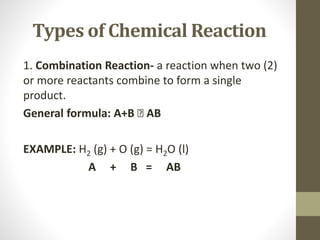
1. Combination Reaction- a reaction when two (2)
or more reactants combine to form a single
product.
General formula: A+B 🡺 AB
EXAMPLE: H2 (g) + O (g) = H2O (l)
A + B = AB
Types of Chemical Reaction
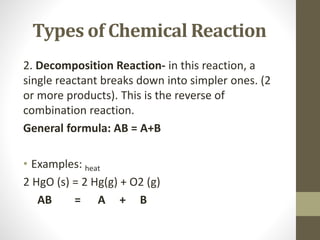
2. Decomposition Reaction- in this reaction, a
single reactant breaks down into simpler ones. (2
or more products). This is the reverse of
combination reaction.
General formula: AB = A+B
• Examples: heat
2 HgO (s) = 2 Hg(g) + O2 (g)
AB = A + B
Types of Chemical Reaction
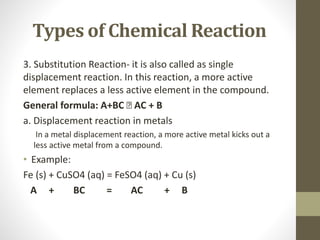
3. Substitution Reaction- it is also called as single
displacement reaction. In this reaction, a more active
element replaces a less active element in the compound.
General formula: A+BC 🡺 AC + B
a. Displacement reaction in metals
In a metal displacement reaction, a more active metal kicks out a
less active metal from a compound.
• Example:
Fe (s) + CuSO4 (aq) = FeSO4 (aq) + Cu (s)
A + BC = AC + B
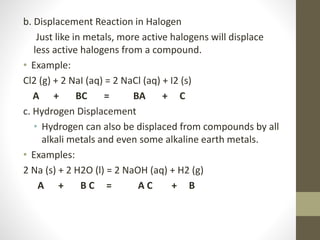
b. Displacement Reaction in Halogen
Just like in metals, more active halogens will displace
less active halogens from a compound.
• Example:
Cl2 (g) + 2 NaI (aq) = 2 NaCl (aq) + I2 (s)
A + BC = BA + C
c. Hydrogen Displacement
• Hydrogen can also be displaced from compounds by all
alkali metals and even some alkaline earth metals.
• Examples:
2 Na (s) + 2 H2O (l) = 2 NaOH (aq) + H2 (g)
A + B C = A C + B
Types of Chemical Reaction
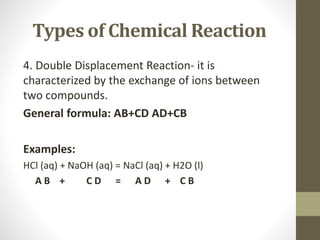
4. Double Displacement Reaction- it is
characterized by the exchange of ions between
two compounds.
General formula: AB+CD AD+CB
Examples:
HCl (aq) + NaOH (aq) = NaCl (aq) + H2O (l)
A B + C D = A D + C B
THANKYOU FOR LISTENING!

SCIENCE10-Types-of-Chemical-Reactions.pptx

  • 1.
  • 2.
    Chemical reaction • Chemicalreaction is a process in which one or more pure substances are converted into one or more different pure substance.
  • 3.
    Types of ChemicalReaction 1. Combination Reaction- a reaction when two (2) or more reactants combine to form a single product. General formula: A+B 🡺 AB EXAMPLE: H2 (g) + O (g) = H2O (l) A + B = AB
  • 4.
    Types of ChemicalReaction 2. Decomposition Reaction- in this reaction, a single reactant breaks down into simpler ones. (2 or more products). This is the reverse of combination reaction. General formula: AB = A+B • Examples: heat 2 HgO (s) = 2 Hg(g) + O2 (g) AB = A + B
  • 5.
    Types of ChemicalReaction 3. Substitution Reaction- it is also called as single displacement reaction. In this reaction, a more active element replaces a less active element in the compound. General formula: A+BC 🡺 AC + B a. Displacement reaction in metals In a metal displacement reaction, a more active metal kicks out a less active metal from a compound. • Example: Fe (s) + CuSO4 (aq) = FeSO4 (aq) + Cu (s) A + BC = AC + B
  • 6.
    b. Displacement Reactionin Halogen Just like in metals, more active halogens will displace less active halogens from a compound. • Example: Cl2 (g) + 2 NaI (aq) = 2 NaCl (aq) + I2 (s) A + BC = BA + C c. Hydrogen Displacement • Hydrogen can also be displaced from compounds by all alkali metals and even some alkaline earth metals. • Examples: 2 Na (s) + 2 H2O (l) = 2 NaOH (aq) + H2 (g) A + B C = A C + B
  • 7.
    Types of ChemicalReaction 4. Double Displacement Reaction- it is characterized by the exchange of ions between two compounds. General formula: AB+CD AD+CB Examples: HCl (aq) + NaOH (aq) = NaCl (aq) + H2O (l) A B + C D = A D + C B
  • 8.