SCIENCE, TECHNOLOGY AND NATURE
AFFECT THEORY:
Popularised by Melissa Grigg and Gregory
Seigworth in a book titled ‘’The Affect Theory
Reader’’.
Some say affect theory is just Critical theory by
another name
• Affect theory is an approach to culture, history, and politics
that focuses on nonlinguistic forces, or affects. Affects
make us what we are, but they are neither under our
“conscious” control nor even necessarily within our
awareness—and they can only sometimes be captured in
language.
• Affect theory is a branch of psychoanalysis that attempts to
organize affects into discrete categories and connect each
one with its typical response. So, for example, the affect of
joy is observed through the reaction of smiling.
• “Affect theory, or the critical study of feelings, enables the
academic examination of emotional responses to real-
world occurrences and structures that affect people,”
explains Cvetkovich. Personal — or felt — experience is
foundational to understanding how people traverse the
world as both individuals and as publics.
• In Sociology, we are interested in finding out the
ways in which science and technology influence
us, that is what is the level of affect they have on
us.
• For example: developments in AI, and
Transhumanism… will they have a net gain or
disadavantage for us?
• We are also interested in determining the level
of affect that nature has on us.
• In what ways does nature affect us?
Actor Network Theory
Principles of Actor Network Theory
28/09/2014 C Hammond - UCBC 7
Principles of Actor Network Theory
• It is a good idea not to take it for granted that there is a
macrosocial system on the one hand, and bits and
pieces of derivative microsocial detail on the other.
• Instead we should start with a clean slate. For instance,
we might start with interaction and assume that
interaction is all that there is.
• Then we might ask how some kinds of interactions
more or less succeed in stabilising and reproducing
themselves: … to generate the effects such as power,
fame, size, scope or organisation
28/09/2014 C Hammond - UCBC 8
ANT & Technology
• For Latour, technology is now integral to our
understanding of human society; to the extent that
human ‘nature’ is fundamentally dependent upon
technology.
• We have developed and shaped technology; but now,
technology is shaping us.
• Technology now shapes, controls and influences our
‘nature’
• We are now all part of a technologically inter-connected,
heterogeneous and complex system.
28/09/2014 C Hammond - UCBC 9
ANT & Technology
28/09/2014 C Hammond - UCBC 10
ANT & Technology
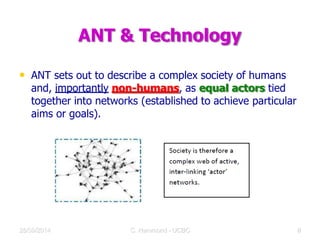
• ANT sets out to describe a complex society of humans
and, importantly non-humans, as equal actors tied
together into networks (established to achieve particular
aims or goals).
28/09/2014 C Hammond - UCBC 11
ANT: Vocabulary & Principles
• Actors: are "entities that do things"; this is very
different to a more conventional sociological definition of
actors as "social entities"
• Importantly for ANT, there is no distinction to be made
between humans and non-humans, embodied or
disembodied skills, impersonation or 'machination'.
• A further sub-division within this concept: an actor is an
actant endowed with a character
28/09/2014 C Hammond - UCBC 12
ANT: Actor / Actant
• EXAMPLE: A coin-shaped piece of metal can be
understood as an actant; once the actant (or potential
actor) is appropriately inscribed and placed into an
active ‘exchange’ process, it then becomes an actor
28/09/2014 C Hammond - UCBC 13
ANT: Network
• Besides ‘actor’, network is the second central concept
associated with the theory.
• The term network can be understood as a: "group of
unspecified relationships among entities of which the
nature itself is undetermined." (Callon, 1993, p.263).
• Networks consist of people and ‘things’.
• ANT suggests that from within the system of networks,
Black Boxes can be identified.
28/09/2014 C Hammond - UCBC 14
ANT: Black Box
• Black box is a metaphor that is able to contain (or
represent) a complex category (or label)
• A set of complex commands/actions that can be
substituted by a ‘box’, because it is generally regular and
stable in its functions (Wiener, 1948).
• Using the ‘finance’ connection (as above) – the term,
‘the economy’ can be understood as a black box:
28/09/2014 C Hammond - UCBC 15
ANT: Black Box
• We can all relate to (or have our own conception of)
‘our’ economy [the SA economy].
• Yet, if we start to try to think about ways in which the
economy works (its complexity of systems, sub-systems
and networks) – it ceases to be a clear, distinct and
separate social element.
• Examples?
28/09/2014 C Hammond - UCBC 16
ANT: Intermediaries
• Intermediaries are the language of the network.
• Through intermediaries actors communicate with one
another and that is the way actors translate their
intentions into other actors
• Heterogeneous & dynamic networks
• Advantages & limitations of ANT?
28/09/2014 C Hammond - UCBC 17
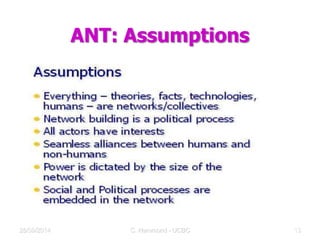
ANT: Assumptions
28/09/2014 C Hammond - UCBC 18
THE
ANTHROPOCENE
Definition
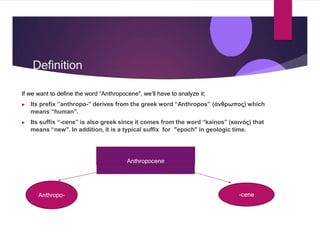
If we want to define the word “Anthropocene", we’ll have to analyze it;
▶ Its prefix ”anthropo-” derives from the greek word “Anthropos” (άνθρωπος) which
means “human”.
▶ Its suffix “-cene” is also greek since it comes from the word “kainos” (καινός) that
means “new". In addition, it is a typical suffix for "epoch" in geologic time.
Anthropocene
Anthropo- -cene
Definition
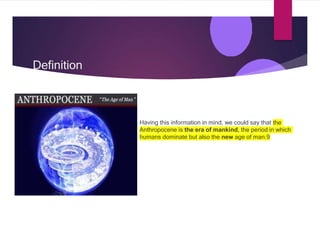
Having this information in mind, we could say that the
Anthropocene is the era of mankind, the period in which
humans dominate but also the new age of man.9
But when did we enter the Anthropocene?
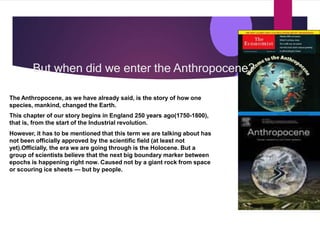
The Anthropocene, as we have already said, is the story of how one
species, mankind, changed the Earth.
This chapter of our story begins in England 250 years ago(1750-1800),
that is, from the start of the Industrial revolution.
However, it has to be mentioned that this term we are talking about has
not been officially approved by the scientific field (at least not
yet).Officially, the era we are going through is the Holocene. But a
group of scientists believe that the next big boundary marker between
epochs is happening right now. Caused not by a giant rock from space
or scouring ice sheets — but by people.
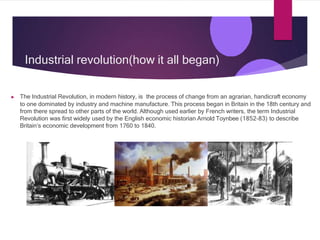
Industrial revolution(how it all began)
▶ The Industrial Revolution, in modern history, is the process of change from an agrarian, handicraft economy
to one dominated by industry and machine manufacture. This process began in Britain in the 18th century and
from there spread to other parts of the world. Although used earlier by French writers, the term Industrial
Revolution was first widely used by the English economic historian Arnold Toynbee (1852–83) to describe
Britain’s economic development from 1760 to 1840.
The changes over the course of the industrial revolution
(1) the use of new basic materials, mainly iron and steel
(2) the use of new energy sources, including both fuels and motive power, such as coal, the
steam engine, electricity, petroleum, and the internal-combustion engine
(3) the invention of new machines, such as the spinning jenny and the power loom that
permitted increased production with a smaller waste of human energy
(4) a new organization of work known as the factory system, which involved increased division
of labor and specialization of function
(5) important developments in transportation and communication, including the steam
locomotive, steamship, automobile, airplane, telegraph, and radio
(6) the increasing application of science to industry. These technological changes made
possible a tremendously increased use of natural resources and the mass production of
manufactured goods
Indicators of the Antropocene
1. The usage of nuclear weapons
Our war efforts have left their mark on geology. When the first nuclear weapon was detonated
on 16 July 1945 in New Mexico, it deposited radionuclides – atoms with excess nuclear energy
– across a wide area. Since 1952, more explosive thermonuclear weapons have been tested,
leaving a global signature of isotopes such as carbon-14 and plutonium-239
2. Fossil fuels
The products of burning fossil fuels will also be an obvious giveaway of the Anthropocene.
Current rates of carbon emission are thought to be higher than at any other time in the last 65
million years
3. New materials
One of the biggest signs of our time will be the presence of three things we use every day:
concrete, plastics and aluminium.
4. Changed geology
Every time we destroy a patch of rainforest, this changes the future of Earth’s geology. So far, we have
transformed more than 50 per cent of the Earth’s land area for our own purposes
5. Fertilizers
Levels of nitrogen and phosphorus in soils have doubled in the last century because of our increased use of
fertilizers. Human activity has had perhaps the biggest impact on the nitrogen cycle for 2.5 billion years,
increasing the amount of reactive nitrogen by 120 per cent compared to the Holocene.
6. Global warming
The planet's temperature is rising. This is because we are overloading our atmosphere with carbon dioxide,
which traps heat and steadily drives up the planet’s temperature.
7. Mass extinction
For as long as life has existed, organisms have gone extinct, but mass extinctions sparked by massive global
changes mark the end and beginning of several geological periods

Science, Technology and Nature.pptx

  • 1.
  • 2.
    AFFECT THEORY: Popularised byMelissa Grigg and Gregory Seigworth in a book titled ‘’The Affect Theory Reader’’. Some say affect theory is just Critical theory by another name
  • 3.
    • Affect theoryis an approach to culture, history, and politics that focuses on nonlinguistic forces, or affects. Affects make us what we are, but they are neither under our “conscious” control nor even necessarily within our awareness—and they can only sometimes be captured in language. • Affect theory is a branch of psychoanalysis that attempts to organize affects into discrete categories and connect each one with its typical response. So, for example, the affect of joy is observed through the reaction of smiling. • “Affect theory, or the critical study of feelings, enables the academic examination of emotional responses to real- world occurrences and structures that affect people,” explains Cvetkovich. Personal — or felt — experience is foundational to understanding how people traverse the world as both individuals and as publics.
  • 4.
    • In Sociology,we are interested in finding out the ways in which science and technology influence us, that is what is the level of affect they have on us. • For example: developments in AI, and Transhumanism… will they have a net gain or disadavantage for us?
  • 5.
    • We arealso interested in determining the level of affect that nature has on us. • In what ways does nature affect us?
  • 6.
  • 7.
    Principles of ActorNetwork Theory 28/09/2014 C Hammond - UCBC 7
  • 8.
    Principles of ActorNetwork Theory • It is a good idea not to take it for granted that there is a macrosocial system on the one hand, and bits and pieces of derivative microsocial detail on the other. • Instead we should start with a clean slate. For instance, we might start with interaction and assume that interaction is all that there is. • Then we might ask how some kinds of interactions more or less succeed in stabilising and reproducing themselves: … to generate the effects such as power, fame, size, scope or organisation 28/09/2014 C Hammond - UCBC 8
  • 9.
    ANT & Technology •For Latour, technology is now integral to our understanding of human society; to the extent that human ‘nature’ is fundamentally dependent upon technology. • We have developed and shaped technology; but now, technology is shaping us. • Technology now shapes, controls and influences our ‘nature’ • We are now all part of a technologically inter-connected, heterogeneous and complex system. 28/09/2014 C Hammond - UCBC 9
  • 10.
    ANT & Technology 28/09/2014C Hammond - UCBC 10
  • 11.
    ANT & Technology •ANT sets out to describe a complex society of humans and, importantly non-humans, as equal actors tied together into networks (established to achieve particular aims or goals). 28/09/2014 C Hammond - UCBC 11
  • 12.
    ANT: Vocabulary &Principles • Actors: are "entities that do things"; this is very different to a more conventional sociological definition of actors as "social entities" • Importantly for ANT, there is no distinction to be made between humans and non-humans, embodied or disembodied skills, impersonation or 'machination'. • A further sub-division within this concept: an actor is an actant endowed with a character 28/09/2014 C Hammond - UCBC 12
  • 13.
    ANT: Actor /Actant • EXAMPLE: A coin-shaped piece of metal can be understood as an actant; once the actant (or potential actor) is appropriately inscribed and placed into an active ‘exchange’ process, it then becomes an actor 28/09/2014 C Hammond - UCBC 13
  • 14.
    ANT: Network • Besides‘actor’, network is the second central concept associated with the theory. • The term network can be understood as a: "group of unspecified relationships among entities of which the nature itself is undetermined." (Callon, 1993, p.263). • Networks consist of people and ‘things’. • ANT suggests that from within the system of networks, Black Boxes can be identified. 28/09/2014 C Hammond - UCBC 14
  • 15.
    ANT: Black Box •Black box is a metaphor that is able to contain (or represent) a complex category (or label) • A set of complex commands/actions that can be substituted by a ‘box’, because it is generally regular and stable in its functions (Wiener, 1948). • Using the ‘finance’ connection (as above) – the term, ‘the economy’ can be understood as a black box: 28/09/2014 C Hammond - UCBC 15
  • 16.
    ANT: Black Box •We can all relate to (or have our own conception of) ‘our’ economy [the SA economy]. • Yet, if we start to try to think about ways in which the economy works (its complexity of systems, sub-systems and networks) – it ceases to be a clear, distinct and separate social element. • Examples? 28/09/2014 C Hammond - UCBC 16
  • 17.
    ANT: Intermediaries • Intermediariesare the language of the network. • Through intermediaries actors communicate with one another and that is the way actors translate their intentions into other actors • Heterogeneous & dynamic networks • Advantages & limitations of ANT? 28/09/2014 C Hammond - UCBC 17
  • 18.
  • 19.
  • 20.
    Definition If we wantto define the word “Anthropocene", we’ll have to analyze it; ▶ Its prefix ”anthropo-” derives from the greek word “Anthropos” (άνθρωπος) which means “human”. ▶ Its suffix “-cene” is also greek since it comes from the word “kainos” (καινός) that means “new". In addition, it is a typical suffix for "epoch" in geologic time. Anthropocene Anthropo- -cene
  • 21.
    Definition Having this informationin mind, we could say that the Anthropocene is the era of mankind, the period in which humans dominate but also the new age of man.9
  • 22.
    But when didwe enter the Anthropocene? The Anthropocene, as we have already said, is the story of how one species, mankind, changed the Earth. This chapter of our story begins in England 250 years ago(1750-1800), that is, from the start of the Industrial revolution. However, it has to be mentioned that this term we are talking about has not been officially approved by the scientific field (at least not yet).Officially, the era we are going through is the Holocene. But a group of scientists believe that the next big boundary marker between epochs is happening right now. Caused not by a giant rock from space or scouring ice sheets — but by people.
  • 23.
    Industrial revolution(how itall began) ▶ The Industrial Revolution, in modern history, is the process of change from an agrarian, handicraft economy to one dominated by industry and machine manufacture. This process began in Britain in the 18th century and from there spread to other parts of the world. Although used earlier by French writers, the term Industrial Revolution was first widely used by the English economic historian Arnold Toynbee (1852–83) to describe Britain’s economic development from 1760 to 1840.
  • 24.
    The changes overthe course of the industrial revolution (1) the use of new basic materials, mainly iron and steel (2) the use of new energy sources, including both fuels and motive power, such as coal, the steam engine, electricity, petroleum, and the internal-combustion engine (3) the invention of new machines, such as the spinning jenny and the power loom that permitted increased production with a smaller waste of human energy (4) a new organization of work known as the factory system, which involved increased division of labor and specialization of function (5) important developments in transportation and communication, including the steam locomotive, steamship, automobile, airplane, telegraph, and radio (6) the increasing application of science to industry. These technological changes made possible a tremendously increased use of natural resources and the mass production of manufactured goods
  • 25.
    Indicators of theAntropocene 1. The usage of nuclear weapons Our war efforts have left their mark on geology. When the first nuclear weapon was detonated on 16 July 1945 in New Mexico, it deposited radionuclides – atoms with excess nuclear energy – across a wide area. Since 1952, more explosive thermonuclear weapons have been tested, leaving a global signature of isotopes such as carbon-14 and plutonium-239 2. Fossil fuels The products of burning fossil fuels will also be an obvious giveaway of the Anthropocene. Current rates of carbon emission are thought to be higher than at any other time in the last 65 million years 3. New materials One of the biggest signs of our time will be the presence of three things we use every day: concrete, plastics and aluminium.
  • 26.
    4. Changed geology Everytime we destroy a patch of rainforest, this changes the future of Earth’s geology. So far, we have transformed more than 50 per cent of the Earth’s land area for our own purposes 5. Fertilizers Levels of nitrogen and phosphorus in soils have doubled in the last century because of our increased use of fertilizers. Human activity has had perhaps the biggest impact on the nitrogen cycle for 2.5 billion years, increasing the amount of reactive nitrogen by 120 per cent compared to the Holocene. 6. Global warming The planet's temperature is rising. This is because we are overloading our atmosphere with carbon dioxide, which traps heat and steadily drives up the planet’s temperature. 7. Mass extinction For as long as life has existed, organisms have gone extinct, but mass extinctions sparked by massive global changes mark the end and beginning of several geological periods