SCIENCE NEWS
Credibility of Scientific Topics in the Media
Lesson 1: Objective

   Scientific news can be found in almost any news
    topic and science journalists use a variety of
    methods to make the information more accessible
    to the reader.

       In this module, students will learn how to recognize
        science news and will learn about the role of a science
        journalist.

    Teacher’s Note: In this lesson, we will define science
      news as broad coverage of any event or topic which
      includes scientific data or requires explanation of
      scientific processes to understand.
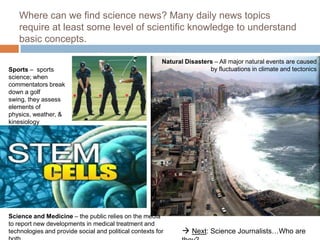
Where can we find science news? Many daily news topics
   require at least some level of scientific knowledge to understand
   basic concepts.

                                                         Natural Disasters – All major natural events are caused
Sports – sports                                                          by fluctuations in climate and tectonics
science; when
commentators break
down a golf
swing, they assess
elements of
physics, weather, &
kinesiology


Science and Medicine – the public relies on the media
to report new developments in medical treatment and
technologies and provide social and political contexts for       Next: Science Journalists…Who are
“Time for change in science journalism?”
                                   - National Association of Science Writers


Click the link above and read the blog post. Science journalism
is not reported with the same immediacy or certainty as other
mainstream news topics. Studies can be unfinished or
unfounded and journalists must take scientists’ best
understanding and explanation of a study because that’s all
anyone really knows at the time.


  Students: What would you do to change science
    journalism for the better?
What is Science Journalism?
      http://www.nytimes.com/pages/science/index.html
      http://www.sciencenews.org/
      http://io9.com/
      http://www.sciencedaily.com/
      http://www.whitehouse.gov/administration/eop/ostp
      http://ngm.nationalgeographic.com/

What type of audience is each site trying to reach? Match the site
 with the audience you think would find it most
 interesting/helpful/accessible.

Age 10-19                                 Scientists
Age 20-29                                 Journalists
Age 30+                                   General Audience
Class Poll
     Rank the previous sites on a political scale.
    (rank each site from 1 – 10, with 1 representing far left views and 10
                             representing far right)


          1 – 2 – 3 – 4 – 5 – 6 – 7 – 8 – 9 – 10
        LEFT                 MODERATE
RIGHT


          Which site appealed to you the most?
         (rank each site from 1 – 10, with 10 being your favorite)

          1 – 2 – 3 – 4 – 5 – 6 – 7 – 8 – 9 – 10
What role do scientists play in science journalism?

The ability of journalists to report science news is directly reliant
on the scientific community to publish it. The press can be
manipulated by scientists who wish to trumpet their particular
subject of study, but the press can also manipulate scientists to
support media objectives. Both parties are responsible for
ensuring the accuracy and neutrality of science news.


   Read the abstract and introduction of this
    report
     Reporting   Science and Conflicts of Interest in the
      Lay Press

Science news lesson module 1

  • 1.
    SCIENCE NEWS Credibility ofScientific Topics in the Media
  • 2.
    Lesson 1: Objective  Scientific news can be found in almost any news topic and science journalists use a variety of methods to make the information more accessible to the reader.  In this module, students will learn how to recognize science news and will learn about the role of a science journalist. Teacher’s Note: In this lesson, we will define science news as broad coverage of any event or topic which includes scientific data or requires explanation of scientific processes to understand.
  • 3.
    Where can wefind science news? Many daily news topics require at least some level of scientific knowledge to understand basic concepts. Natural Disasters – All major natural events are caused Sports – sports by fluctuations in climate and tectonics science; when commentators break down a golf swing, they assess elements of physics, weather, & kinesiology Science and Medicine – the public relies on the media to report new developments in medical treatment and technologies and provide social and political contexts for  Next: Science Journalists…Who are
  • 4.
    “Time for changein science journalism?” - National Association of Science Writers Click the link above and read the blog post. Science journalism is not reported with the same immediacy or certainty as other mainstream news topics. Studies can be unfinished or unfounded and journalists must take scientists’ best understanding and explanation of a study because that’s all anyone really knows at the time. Students: What would you do to change science journalism for the better?
  • 5.
    What is ScienceJournalism?  http://www.nytimes.com/pages/science/index.html  http://www.sciencenews.org/  http://io9.com/  http://www.sciencedaily.com/  http://www.whitehouse.gov/administration/eop/ostp  http://ngm.nationalgeographic.com/ What type of audience is each site trying to reach? Match the site with the audience you think would find it most interesting/helpful/accessible. Age 10-19 Scientists Age 20-29 Journalists Age 30+ General Audience
  • 6.
    Class Poll Rank the previous sites on a political scale.  (rank each site from 1 – 10, with 1 representing far left views and 10 representing far right) 1 – 2 – 3 – 4 – 5 – 6 – 7 – 8 – 9 – 10 LEFT MODERATE RIGHT Which site appealed to you the most?  (rank each site from 1 – 10, with 10 being your favorite) 1 – 2 – 3 – 4 – 5 – 6 – 7 – 8 – 9 – 10
  • 7.
    What role doscientists play in science journalism? The ability of journalists to report science news is directly reliant on the scientific community to publish it. The press can be manipulated by scientists who wish to trumpet their particular subject of study, but the press can also manipulate scientists to support media objectives. Both parties are responsible for ensuring the accuracy and neutrality of science news.  Read the abstract and introduction of this report  Reporting Science and Conflicts of Interest in the Lay Press