Lesson 3: Objective
   Scientific news can be very complex and
    science journalists need to convey accurate
    information to their audience in a concise and
    comprehensive format.
     Inthis homework assignment, students will
     examine how the communication of scientific
     information between scientists and reporters can
     later be misconstrued or misreported, and how
     journalists and scientists can work together to
     communicate more effectively.
What is a Science Journalist?

   Science as a news topic is completely different
    from sports, political or economic news, but it’s
    often intertwined with one of the former.
    Science news is not immediate and it cannot
    be easily confirmed. So how can journalists
    produce accurate, meaningful reports of
    important scientific news without explicit data
    or evidence to back it up?

   Read the following:
    Skeptical of Science – Columbia Journalism Review
 In journalism, we’re taught to double-
  check everything and that it’s usually a
  better decision not to run a story than get
  something wrong.
 In science journalism, reports are
  sometimes revolutionary and require
  immediate publication, but in many
  cases, some statistics, or even entire
  discoveries, could be inaccurate or
  unsupported.
Read the following:

   Reuters.com – Particles Break Speed of Light
   WashingtonPost.com – Revolution or Mistake?
   SymmetryMagazine.com – Scientists still seek explanation

And consider these questions while reading:
   How did the scientists who made the discovery report the accuracy
    of the test? Were they skeptical of their own findings?
   How did the journalists covering the story report the news of the
    discovery? Were they skeptical of the scientific reports?
   Can we really fault scientists for misreporting information that hasn’t
    been extensively tested? Can we fault science journalists for
    reporting unfounded news when it could potentially change scientific
    thought?
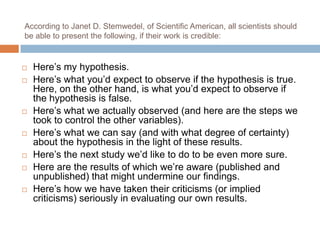
According to Janet D. Stemwedel, of Scientific American, all scientists should
be able to present the following, if their work is credible:


   Here’s my hypothesis.
   Here’s what you’d expect to observe if the hypothesis is true.
    Here, on the other hand, is what you’d expect to observe if
    the hypothesis is false.
   Here’s what we actually observed (and here are the steps we
    took to control the other variables).
   Here’s what we can say (and with what degree of certainty)
    about the hypothesis in the light of these results.
   Here’s the next study we’d like to do to be even more sure.
   Here are the results of which we’re aware (published and
    unpublished) that might undermine our findings.
   Here’s how we have taken their criticisms (or implied
    criticisms) seriously in evaluating our own results.
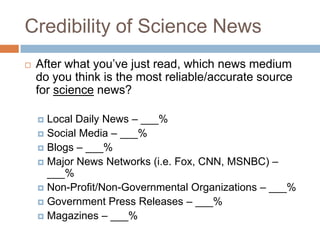
Credibility of Science News
   After what you’ve just read, which news medium
    do you think is the most reliable/accurate source
    for science news?

     Local Daily News – ___%
     Social Media – ___%
     Blogs – ___%
     Major News Networks (i.e. Fox, CNN, MSNBC) –
      ___%
     Non-Profit/Non-Governmental Organizations – ___%
     Government Press Releases – ___%
     Magazines – ___%
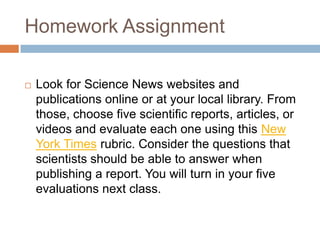
Homework Assignment

   Look for Science News websites and
    publications online or at your local library. From
    those, choose five scientific reports, articles, or
    videos and evaluate each one using this New
    York Times rubric. Consider the questions that
    scientists should be able to answer when
    publishing a report. You will turn in your five
    evaluations next class.

Science news lesson module 3

  • 1.
    Lesson 3: Objective  Scientific news can be very complex and science journalists need to convey accurate information to their audience in a concise and comprehensive format.  Inthis homework assignment, students will examine how the communication of scientific information between scientists and reporters can later be misconstrued or misreported, and how journalists and scientists can work together to communicate more effectively.
  • 2.
    What is aScience Journalist?  Science as a news topic is completely different from sports, political or economic news, but it’s often intertwined with one of the former. Science news is not immediate and it cannot be easily confirmed. So how can journalists produce accurate, meaningful reports of important scientific news without explicit data or evidence to back it up?  Read the following: Skeptical of Science – Columbia Journalism Review
  • 3.
     In journalism,we’re taught to double- check everything and that it’s usually a better decision not to run a story than get something wrong.  In science journalism, reports are sometimes revolutionary and require immediate publication, but in many cases, some statistics, or even entire discoveries, could be inaccurate or unsupported.
  • 4.
    Read the following:  Reuters.com – Particles Break Speed of Light  WashingtonPost.com – Revolution or Mistake?  SymmetryMagazine.com – Scientists still seek explanation And consider these questions while reading:  How did the scientists who made the discovery report the accuracy of the test? Were they skeptical of their own findings?  How did the journalists covering the story report the news of the discovery? Were they skeptical of the scientific reports?  Can we really fault scientists for misreporting information that hasn’t been extensively tested? Can we fault science journalists for reporting unfounded news when it could potentially change scientific thought?
  • 5.
    According to JanetD. Stemwedel, of Scientific American, all scientists should be able to present the following, if their work is credible:  Here’s my hypothesis.  Here’s what you’d expect to observe if the hypothesis is true. Here, on the other hand, is what you’d expect to observe if the hypothesis is false.  Here’s what we actually observed (and here are the steps we took to control the other variables).  Here’s what we can say (and with what degree of certainty) about the hypothesis in the light of these results.  Here’s the next study we’d like to do to be even more sure.  Here are the results of which we’re aware (published and unpublished) that might undermine our findings.  Here’s how we have taken their criticisms (or implied criticisms) seriously in evaluating our own results.
  • 6.
    Credibility of ScienceNews  After what you’ve just read, which news medium do you think is the most reliable/accurate source for science news?  Local Daily News – ___%  Social Media – ___%  Blogs – ___%  Major News Networks (i.e. Fox, CNN, MSNBC) – ___%  Non-Profit/Non-Governmental Organizations – ___%  Government Press Releases – ___%  Magazines – ___%
  • 7.
    Homework Assignment  Look for Science News websites and publications online or at your local library. From those, choose five scientific reports, articles, or videos and evaluate each one using this New York Times rubric. Consider the questions that scientists should be able to answer when publishing a report. You will turn in your five evaluations next class.