1
HALOGENATED INSECTICIDES
(DDT andIts important analogs)
Dr. Geeta Singh
Assistant Professor
Department of Chemistry
D.D.U. Gorakhpur University, Gorakhpur
2.
Halogenated Insecticides
Organochlorine pesticides(OCP) are synthetic pesticides widely used all over the world.
They belong to the group of chlorinated hydrocarbon derivatives, which have vast application in the
chemical industry and in agriculture.
These compounds are known for their high toxicity, slow degradation and bioaccumulation.
The aliphatic or aromatic halogenated compounds which may be used to kill the insects are known as
halogenated insecticides.
The main types of halogenated insecticides are halogenated alkanes, BHC and its isomers, DDT and
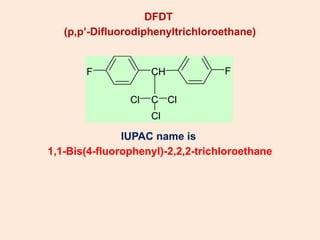
important analogs ( DFDT, DMDT, DDD).
Synthesis
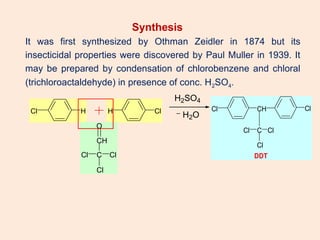
It was firstsynthesized by Othman Zeidler in 1874 but its
insecticidal properties were discovered by Paul Muller in 1939. It
may be prepared by condensation of chlorobenzene and chloral
(trichloroactaldehyde) in presence of conc. H2SO4.
Cl H Cl
H
C Cl
Cl
Cl
CH
O
H2SO4
H2O
Cl CH
C
Cl
Cl
Cl
Cl
DDT
5.
Application and Properties
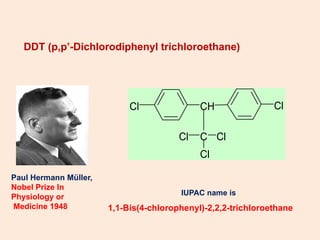
It is colorless, odourless crystalline solid and a M.P. of 108-109 0
C
It is practically insoluble in water but soluble in many organic solvents
such as Acetone, benzene, carbon tetrachloride etc..
DDT is one of the most persistent and durable of all contact insecticides
because of its low water solubility, low vapor pressure and high fat solubility.
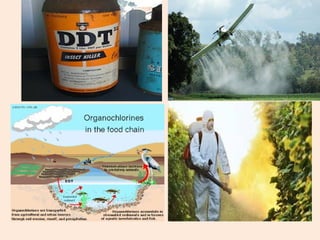
DDT is effective insecticide particularly for mosquito, flies and other crop
pests.
DDT is also effective in the control of other diseases like yellow fever,
dengue, encephalitis and plague. It is toxic to human and other animals,
birds, fishes.
However its use as insecticide has been banned in most of the developed
and developing countries.
Synthesis
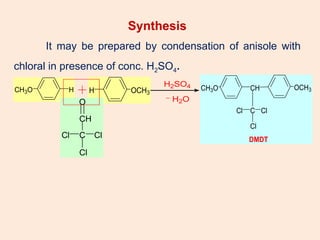
It may beprepared by condensation of anisole with
chloral in presence of conc. H2SO4.
CH3O H OCH3
H
C Cl
Cl
Cl
CH
O
H2SO4
H2O
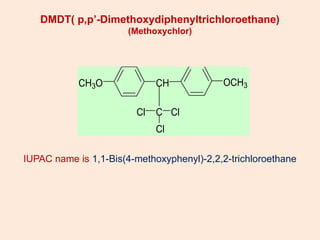
CH3O CH
C
OCH3
Cl
Cl
Cl
DMDT
9.
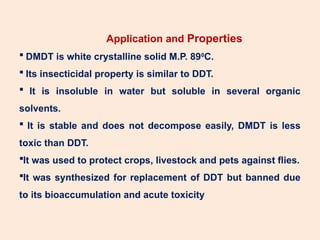
Application and Properties
DMDT is white crystalline solid M.P. 890
C.
Its insecticidal property is similar to DDT.
It is insoluble in water but soluble in several organic
solvents.
It is stable and does not decompose easily, DMDT is less
toxic than DDT.
It was used to protect crops, livestock and pets against flies.
It was synthesized for replacement of DDT but banned due
to its bioaccumulation and acute toxicity
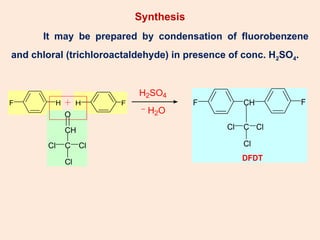
Synthesis
It may beprepared by condensation of fluorobenzene
and chloral (trichloroactaldehyde) in presence of conc. H2SO4.
F H F
H
C Cl
Cl
Cl
CH
O
H2SO4
H2O
F CH
C
F
Cl
Cl
Cl
DFDT
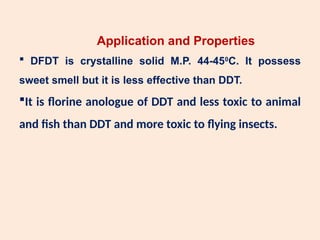
12.
Application and Properties
DFDT is crystalline solid M.P. 44-450
C. It possess
sweet smell but it is less effective than DDT.
It is florine anologue of DDT and less toxic to animal
and fish than DDT and more toxic to flying insects.
Synthesis
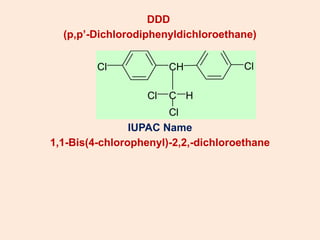
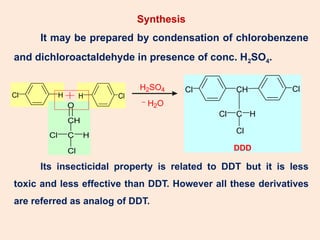
It may beprepared by condensation of chlorobenzene
and dichloroactaldehyde in presence of conc. H2SO4.
Its insecticidal property is related to DDT but it is less
toxic and less effective than DDT. However all these derivatives
are referred as analog of DDT.
Cl H Cl
H
C H
Cl
Cl
CH
O
H2SO4
H2O
Cl CH
C
Cl
H
Cl
Cl
DDD