ENERGY : Types and
Forms
Energy
- is the ability to do work.
Characteristics of Energy
4 Energy exists in many forms.
4 Energy can be moved from one
object to another.
4 Energy can be changed from one
form to another.
4 Energy cannot be created or
destroyed.
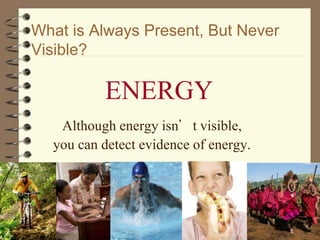
What is Always Present, But Never
Visible?
Although energy isn’t visible,
you can detect evidence of energy.
ENERGY
Types of Energy
• Potential Energy
• Kinetic Energy
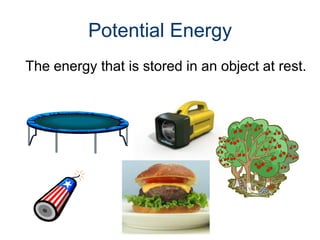
Potential Energy
The energy that is stored in an object at rest.
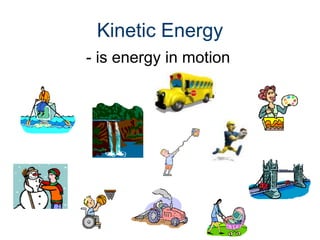
Kinetic Energy
- is energy in motion
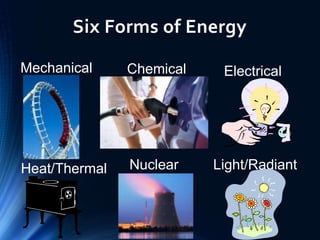
Six Forms of Energy
Mechanical Chemical Electrical
Heat/Thermal Light/Radiant
Nuclear
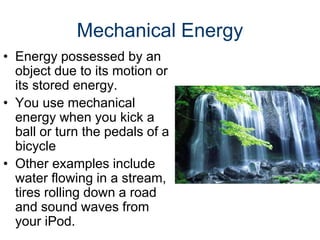
Mechanical Energy
• Energy possessed by an
object due to its motion or
its stored energy.
• You use mechanical
energy when you kick a
ball or turn the pedals of a
bicycle
• Other examples include
water flowing in a stream,
tires rolling down a road
and sound waves from
your iPod.
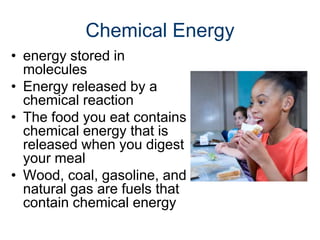
Chemical Energy
• energy stored in
molecules
• Energy released by a
chemical reaction
• The food you eat contains
chemical energy that is
released when you digest
your meal
• Wood, coal, gasoline, and
natural gas are fuels that
contain chemical energy
Electrical Energy
• Energy that comes from
the electrons within atoms
• It is the flow of charged
particles, called electrons.
• Lightning and static
electricity are also forms of
electrical energy
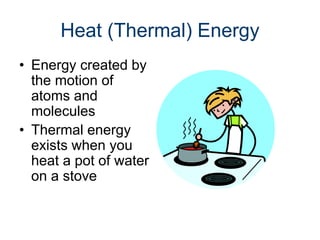
Heat (Thermal) Energy
• Energy created by
the motion of
atoms and
molecules
• Thermal energy
exists when you
heat a pot of water
on a stove
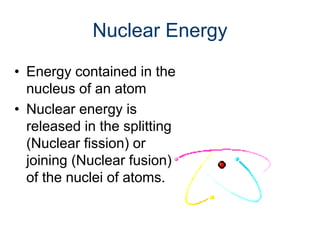
Nuclear Energy
• Energy contained in the
nucleus of an atom
• Nuclear energy is
released in the splitting
(Nuclear fission) or
joining (Nuclear fusion)
of the nuclei of atoms.
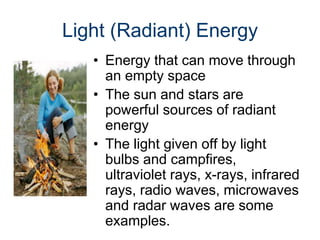
Light (Radiant) Energy
• Energy that can move through
an empty space
• The sun and stars are
powerful sources of radiant
energy
• The light given off by light
bulbs and campfires,
ultraviolet rays, x-rays, infrared
rays, radio waves, microwaves
and radar waves are some
examples.
Sound Energy
• Produced by vibration of objects
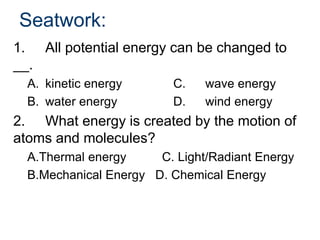
Seatwork:
1. All potential energy can be changed to
__.
A. kinetic energy C. wave energy
B. water energy D. wind energy
2. What energy is created by the motion of
atoms and molecules?
A.Thermal energy C. Light/Radiant Energy
B.Mechanical Energy D. Chemical Energy
3. Which energy can travel through an
empty space?
A. Thermal energy C. Light/Radiant Energy
B. Mechanical Energy D. Chemical Energy
4. What form of energy is stored in the leaves of
plants?
A. heat energy C. chemical energy
B. light energy D. mechanical energy
5. A boy threw a ball over the fence. What energy
did the moving ball have?
A. heat energy C. chemical energy
B. light energy D. mechanical energy
Energy Forms
• These forms of energy do work that end
up as motion, light, or heat.
• Energy is used to power manufacturing,
light buildings, propel vehicles, and
communicate messages.
What else do we use energy for?
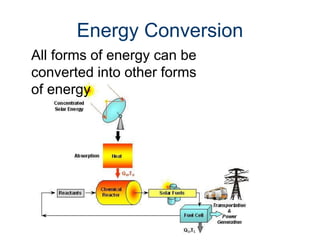
Energy Conversion
All forms of energy can be
converted into other forms
of energy
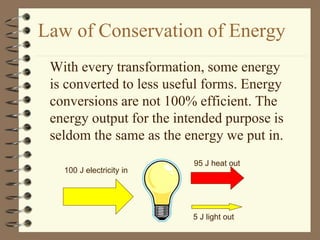
Law of Conservation of Energy
With every transformation, some energy
is converted to less useful forms. Energy
conversions are not 100% efficient. The
energy output for the intended purpose is
seldom the same as the energy we put in.
100 J electricity in
95 J heat out
5 J light out
Image Resources
Microsoft, Inc. (2009). Clip Art. Retrieved March 24, 2009, from
http://office.microsoft.com/en-us/clipart/default.aspx
ETH – Renewable Energy Carriers (2010). Professorship of Renewable
Energy Carriers. Retrieved May 5, 2010, from
http://www.pre.ethz.ch/research/projects/?id=solarfuels

Science - energy_forms_ppt.ppt

  • 1.
    ENERGY : Typesand Forms
  • 2.
    Energy - is theability to do work.
  • 3.
    Characteristics of Energy 4Energy exists in many forms. 4 Energy can be moved from one object to another. 4 Energy can be changed from one form to another. 4 Energy cannot be created or destroyed.
  • 4.
    What is AlwaysPresent, But Never Visible? Although energy isn’t visible, you can detect evidence of energy. ENERGY
  • 5.
    Types of Energy •Potential Energy • Kinetic Energy
  • 6.
    Potential Energy The energythat is stored in an object at rest.
  • 7.
    Kinetic Energy - isenergy in motion
  • 8.
    Six Forms ofEnergy Mechanical Chemical Electrical Heat/Thermal Light/Radiant Nuclear
  • 9.
    Mechanical Energy • Energypossessed by an object due to its motion or its stored energy. • You use mechanical energy when you kick a ball or turn the pedals of a bicycle • Other examples include water flowing in a stream, tires rolling down a road and sound waves from your iPod.
  • 10.
    Chemical Energy • energystored in molecules • Energy released by a chemical reaction • The food you eat contains chemical energy that is released when you digest your meal • Wood, coal, gasoline, and natural gas are fuels that contain chemical energy
  • 11.
    Electrical Energy • Energythat comes from the electrons within atoms • It is the flow of charged particles, called electrons. • Lightning and static electricity are also forms of electrical energy
  • 12.
    Heat (Thermal) Energy •Energy created by the motion of atoms and molecules • Thermal energy exists when you heat a pot of water on a stove
  • 13.
    Nuclear Energy • Energycontained in the nucleus of an atom • Nuclear energy is released in the splitting (Nuclear fission) or joining (Nuclear fusion) of the nuclei of atoms.
  • 14.
    Light (Radiant) Energy •Energy that can move through an empty space • The sun and stars are powerful sources of radiant energy • The light given off by light bulbs and campfires, ultraviolet rays, x-rays, infrared rays, radio waves, microwaves and radar waves are some examples.
  • 15.
    Sound Energy • Producedby vibration of objects
  • 17.
    Seatwork: 1. All potentialenergy can be changed to __. A. kinetic energy C. wave energy B. water energy D. wind energy 2. What energy is created by the motion of atoms and molecules? A.Thermal energy C. Light/Radiant Energy B.Mechanical Energy D. Chemical Energy
  • 18.
    3. Which energycan travel through an empty space? A. Thermal energy C. Light/Radiant Energy B. Mechanical Energy D. Chemical Energy 4. What form of energy is stored in the leaves of plants? A. heat energy C. chemical energy B. light energy D. mechanical energy 5. A boy threw a ball over the fence. What energy did the moving ball have? A. heat energy C. chemical energy B. light energy D. mechanical energy
  • 19.
    Energy Forms • Theseforms of energy do work that end up as motion, light, or heat. • Energy is used to power manufacturing, light buildings, propel vehicles, and communicate messages. What else do we use energy for?
  • 20.
    Energy Conversion All formsof energy can be converted into other forms of energy
  • 21.
    Law of Conservationof Energy With every transformation, some energy is converted to less useful forms. Energy conversions are not 100% efficient. The energy output for the intended purpose is seldom the same as the energy we put in. 100 J electricity in 95 J heat out 5 J light out
  • 22.
    Image Resources Microsoft, Inc.(2009). Clip Art. Retrieved March 24, 2009, from http://office.microsoft.com/en-us/clipart/default.aspx ETH – Renewable Energy Carriers (2010). Professorship of Renewable Energy Carriers. Retrieved May 5, 2010, from http://www.pre.ethz.ch/research/projects/?id=solarfuels

Editor's Notes

  • #4 Gateway To Technology Unit 3– Lesson 3.1– Investigating Energy
  • #5 Gateway To Technology Unit 3– Lesson 3.1– Investigating Energy
  • #7 Gateway To Technology Unit 3– Lesson 3.1– Investigating Energy
  • #8 Gateway To Technology Unit 3– Lesson 3.1– Investigating Energy
  • #9 Gateway To Technology Unit 3– Lesson 3.1– Investigating Energy
  • #10 Gateway To Technology Unit 3– Lesson 3.1– Investigating Energy
  • #11 Gateway To Technology Unit 3– Lesson 3.1– Investigating Energy
  • #12 Gateway To Technology Unit 3– Lesson 3.1– Investigating Energy
  • #13 Gateway To Technology Unit 3– Lesson 3.1– Investigating Energy
  • #14 Gateway To Technology Unit 3– Lesson 3.1– Investigating Energy
  • #15 Gateway To Technology Unit 3– Lesson 3.1– Investigating Energy
  • #20 Gateway To Technology Unit 3– Lesson 3.1– Investigating Energy
  • #21 For example: concentrated solar radiation is used as the energy source of high-temperature process heat for driving thermochemical reactions towards the production of storable and transportable fuels.
  • #22 Energy in a system may take on various forms (e.g. kinetic, potential, heat, light). The law of conservation of energy states that energy may neither be created nor destroyed, but can change its form. Therefore the sum of all the energies in the system is a constant. An incandescent light bulb is only 5% efficient as a lighting device. It would be more efficient as a heater! All of the energy remains, but a lot is converted to “waste” form.
  • #23 Gateway To Technology Unit 3– Lesson 3.1– Investigating Energy