December 2014 • Healthcare Radius • 1
Instruments of change
W
e are living in an era of
industrialisation, where
every day a new innova-
tion occurs. Innovation
and technology has changed the way indus-
tries function, and the field of medicine is
no exception. It’s the energy which works in
background and makes the technology pos-
sible for healthcare.
The vitality of energy is understood,
when power breakdown at a hospital, even
for a minute, costs human life. This makes it
crystal clear that uninterrupted power sup-
ply in healthcare is a must. However, with
limited natural resources at our disposal,
it is a tough call for every country to meet
the ever increasing demand. The ECO-III
benchmarking study reflects that over 140
multi-specialty hospitals in India show an
average annual energy consumption of 378
kWh/sq-m of built area, which is highest
Healthcare welcomes energy-efficient methods with open arms
among the commercial buildings.
Despite this acute shortage, there are
many who belong to the school of thought
that believe slogans like “go green” and “save
earth” are just fads that settle down with
time. With the outlook that organisations
have been performing well even prior to the
dawn of this concept, annual budget focuses
more over concrete and profit yielding
investments than green practices.
We need to accept the fact that the green
practice concept is here to stay. There is
no escape. As responsible individuals, we
need to focus our energies on how to render
a building energy-efficient. Starting from
scratch one needs to understand what “go
green” means. The Indian Green Building
Council (IGBC) defines 'Green Buildings' as
one which uses less water, optimises energy
efficiency, conserves natural resources,
generates less waste and provides healthier
spaces for occupants, as compared to a con-
ventional building.
WAY AHEAD
Strategies for energy efficiency depend
on the type, size of the hospital, hospital’s
energy requirements and its geographical lo-
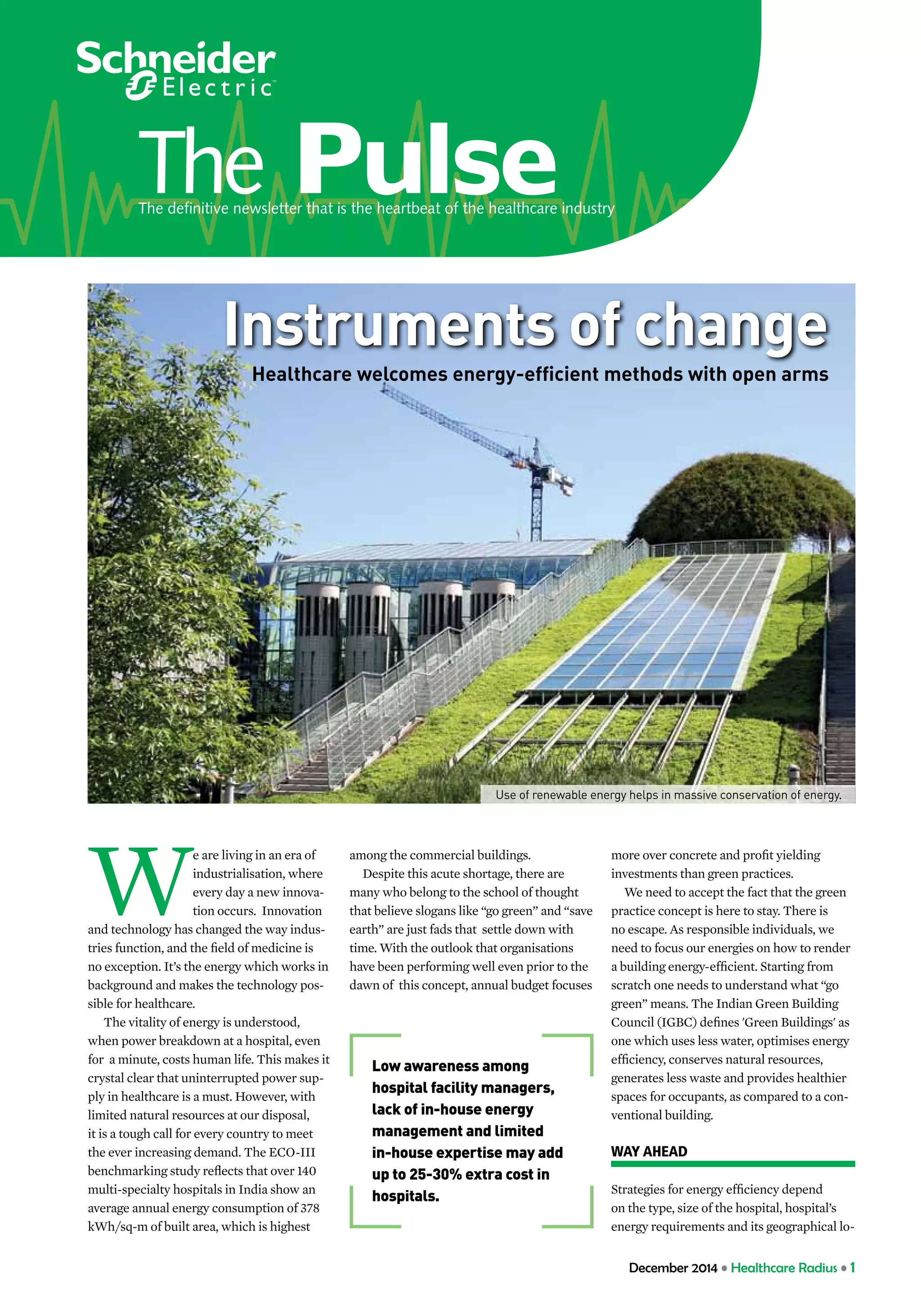
Use of renewable energy helps in massive conservation of energy.
Low awareness among
hospital facility managers,
lack of in-house energy
management and limited
in-house expertise may add
up to 25-30% extra cost in
hospitals.
2 • Healthcare Radius • December 2014
	 The saving in terms of finances will not be immediate
	 Old buildings cannot be made energy-efficient
	 The returns are minimal in comparison to the invest-
ment required
	 It’s only an engineer’s domain
	 All the efforts made in training the human resources
are worthless
cation. A solution that suits a certain type of hospital may not be used
for other hospitals if there is a major difference in the above factors.
Energy optimisation has to be customised to meet the requirements of
each hospital.
Myths
	 Hospitals can cut down on approximately 60% of power
usage by redesigning their energy systems
	 Hospitals are among the top polluters
	 It is a collaborative effort.
	 Every building, weather old or new, can be made energy
efficient.
Realities
HVAC
Lighting
Water pump
Others
30-65%
30-40%
5-10 %
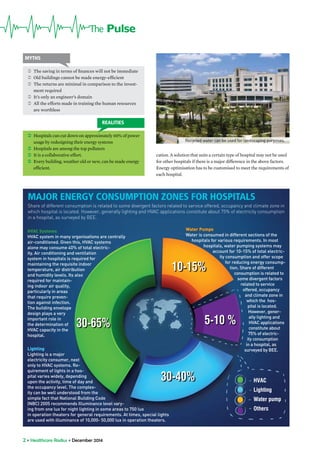
HVAC Systems
HVAC system in many organisations are centrally
air-conditioned. Given this, HVAC systems
alone may consume 40% of total electric-
ity. Air conditioning and ventilation
system in hospitals is required for
maintaining the requisite indoor
temperature, air distribution
and humidity levels. Its also
required for maintain-
ing indoor air quality,
particularly in areas
that require preven-
tion against infection.
The building envelope
design plays a very
important role in
the determination of
HVAC capacity in the
hospital.
Water Pumps
Water is consumed in different sections of the
hospitals for various requirements. In most
hospitals, water pumping systems may
account for 10-15% of total electric-
ity consumption and offer scope
for reducing energy consump-
tion. Share of different
consumption is related to
some divergent factors
related to service
offered, occupancy
and climate zone in
which the hos-
pital is located.
However, gener-
ally lighting and
HVAC applications
constitute about
75% of electric-
ity consumption
in a hospital, as
surveyed by BEE.Lighting
Lighting is a major
electricity consumer, next
only to HVAC systems. Re-
quirement of lights in a hos-
pital varies widely, depending
upon the activity, time of day and
the occupancy level. The complex-
ity can be well understood from the
simple fact that National Building Code
(NBC) 2005 recommends Illuminance level vary-
ing from one lux for night lighting in some areas to 750 lux
in operation theaters for general requirements. At times, special lights
are used with illuminance of 10,000- 50,000 lux in operation theaters.
Major energy consumption zones for hospitals
Share of different consumption is related to some divergent factors related to service offered, occupancy and climate zone in
which hospital is located. However, generally lighting and HVAC applications constitute about 75% of electricity consumption
in a hospital, as surveyed by BEE.
Recycled water can be used for landscaping purposes.
10-15%
December 2014 • Healthcare Radius • 3
ROLE OF HUMAN RESOURCE
The IGBC also gives points to HR initiatives
to help employee turn to conservation. From
carpooling, bus incentive programmes,
messages near switch lights to conserve
energy to competitions for segregation and
reducing waste should be promoted to help
in incorporation of “green building”.
Also, the manpower of the hospital has
to be trained for rational use of all forms of
energy as this is one single most important
factor that is crucial for any energy saving
programme in a hospital. The organisation
will never be able to achieve the aim of energy
efficiency, until every employee (whether in-
house or outsourced) from the top to bottom
is involved. Their participation makes a huge
difference. When they are made aware about
this they will inform about repairs in time
and also try to use energy wisely.
Proven Results
"Though the costs increased by 3%, we were
able to achieve energy efficiency levels upto
40%," proudly declares Dr Rajeev Boud-
hankar - VP, Kohinoor Hospital, Mumbai
after successfully achieving LEED Platinum
Certification for the facility. Kohinoor is the
only hospital in Asia that has this certifica-
tion. Further milestones achieved by them
while completion of 'operation green' are:
	 41.3% REDUCTION in use of Water.
	 96.79% CONSTRUCTION of waste
management.
	 72.05% REGIONAL material.
	 29.75% RECYCLED material.
GO GREEN AT NO ADDITIONAL COST
Dr Vinod, consultant, Hospitech Healthcare, offers strategic approach for various hospital buildings that aim for
energy efficient facilities without excess cost.
General
	Changes in the type of AC’s (depending
on the load).
	Utilisation of solar power.
	Changing the
ordinary lights to
LED lights.
	Investing in wind
mill energy gen-
eration.
	Blinds in rooms
provide protec-
tion from excess
heat penetrating into the room and at
the same time gives enough light and
ventilation.
	Frequent opening of the doors and win-
dows should be avoided as this result
in loss of energy used in the room such
as an AC. If possible, an automatic door
closure device should be fitted.
	Motion sensors for lighting and time
switches for electrical switches can be
used for rooms.
	Capacitors, a common practice for
power factor correction, help in energy
consumption reduc-
tion.
	Used water can be
employed for non-
contact functions like
landscape and plant-
ing and flushing.
Medical Equipments
	While buying equipments, one must
check on the energy consumption and
efficiency of the equipment over its
entire life cycle. This will help bring
down the cost of electricity bills to a
great extent.
	Regular main-
tenance of the
equipments
needs to be
undertaken in
order to check
for any damage
or variation in its
functioning as it
may adversely
affect the power consumption.
	Technical malfunctions of the equip-
ments have to immediately be ad-
dressed with appropriate measures.   
Building Materials
	Minimising the
length of the
pipeline for supply
of water from heat
source can also
be another way of
reducing the heat
consumption as wa-
ter gets cooled down
if it has to travel a
longer distance.
	Pipes should be
properly insulated
for avoiding heat
loss.
	Thermal insulation
of the building also
results in reducing
the heating con-
sumption. Make sure
you also replace the
old and high power
consumption
equipments.  
	Do not use the lifts
for every small activ-
ity, if possible.
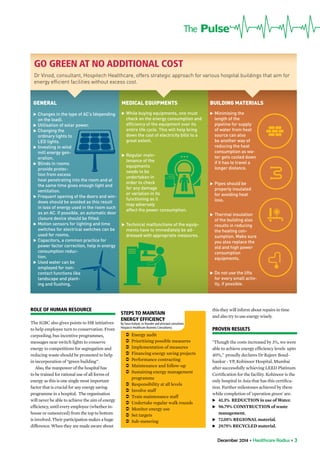
	 Energy audit
	 Prioritising possible measures
	 Implementation of measures
	 Financing energy saving projects
	 Performance contracting
	 Maintenance and follow-up
	 Sustaining energy management
programme
	 Responsibility at all levels
	 Involve staff
	 Train maintenance staff
	 Undertake regular walk rounds
	 Monitor energy use
	 Set targets
	 Sub-metering
Steps to maintain
energy efficiency
By Tarun Katiyar, co-founder and principal consultant,
Hospaccx Healthcare Business Consultancy
4 • Healthcare Radius • December 2014
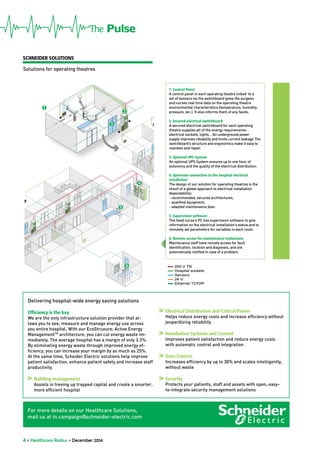
1. Control Panel
A control panel in each operating theatre linked to a
set of sensors via the switchboard gives the surgeon
and nurses real time data on the operating theatre
environmental characteristics (temperature, humidity,
pressure, etc.). It also informs them of any faults.
2. Secured electrical switchboard
A secured electrical switchboard for each operating
theatre supplies all of the energy requirements:
electrical sockets, lights… An underground power
supply improves reliability and limits current leakage The
switchboard’s structure and ergonomics make it easy to
maintain and repair.
3. Optional UPS System
An optional UPS System ensures up to one hour of
autonomy and the quality of the electrical distribution.
4. Upstream connection to the hospital electrical
installation
The design of our solution for operating theatres is the
result of a global approach to electrical installation
dependability:
- recommended, secured architectures,
- qualified equipment,
- adapted maintenance plan.
5. Supervision software
The head nurse’s PC has supervision software to give
information on the electrical installation’s status and to
remotely set parameters for variables in each room.
6. Remote access for maintenance technicians
Maintenance staff have remote access for fault
identification, location and diagnosis, and are
automatically notified in case of a problem.
1
2
220 V TN
Hospital sockets
Sensors
24 V
Ethernet TCP/IP
3
1
2
220 V TN
Hospital sockets
Sensors
24 V
Ethernet TCP/IP
3
Delivering hospital-wide energy saving solutions
Efficiency is the key
We are the only infrastructure solution provider that al-
lows you to see, measure and manage energy use across
you entire hospital. With our EcoStruxure: Active Energy
ManagementTM
architecture, you can cut energy waste im-
mediately. The average hospital has a margin of only 3.3%.
By eliminating energy waste through improved energy ef-
ficiency, you can increase your margin by as much as 25%.
At the same time, Scheider Electric solutions help improve
patient satisfaction, enhance patient safety and increase staff
productivity.
	 Building management
	 Assists in freeing up trapped capital and create a smarter,
more efficient hospital
	 Electrical Distribution and Critical Power
	 Helps reduce energy costs and increase efficiency without
jeopardizing reliability
	 Installation Systems and Control
	 Improves patient satisfaction and reduce energy costs
with automatic control and integration
	 Data Centres
	 Increases efficiency by up to 30% and scales intelligently,
without waste
	 Security
	 Protects your patients, staff and assets with open, easy-
to-integrate security management solutions
Schneider Solutions
2
3
1
4
5
6
Solutions for operating theatres
For more details on our Healthcare Solutions,
mail us at in.campaign@schneider-electric.com

Schneider_Newsletter_Dec 2014_Final-1

  • 1.
    December 2014 •Healthcare Radius • 1 Instruments of change W e are living in an era of industrialisation, where every day a new innova- tion occurs. Innovation and technology has changed the way indus- tries function, and the field of medicine is no exception. It’s the energy which works in background and makes the technology pos- sible for healthcare. The vitality of energy is understood, when power breakdown at a hospital, even for a minute, costs human life. This makes it crystal clear that uninterrupted power sup- ply in healthcare is a must. However, with limited natural resources at our disposal, it is a tough call for every country to meet the ever increasing demand. The ECO-III benchmarking study reflects that over 140 multi-specialty hospitals in India show an average annual energy consumption of 378 kWh/sq-m of built area, which is highest Healthcare welcomes energy-efficient methods with open arms among the commercial buildings. Despite this acute shortage, there are many who belong to the school of thought that believe slogans like “go green” and “save earth” are just fads that settle down with time. With the outlook that organisations have been performing well even prior to the dawn of this concept, annual budget focuses more over concrete and profit yielding investments than green practices. We need to accept the fact that the green practice concept is here to stay. There is no escape. As responsible individuals, we need to focus our energies on how to render a building energy-efficient. Starting from scratch one needs to understand what “go green” means. The Indian Green Building Council (IGBC) defines 'Green Buildings' as one which uses less water, optimises energy efficiency, conserves natural resources, generates less waste and provides healthier spaces for occupants, as compared to a con- ventional building. WAY AHEAD Strategies for energy efficiency depend on the type, size of the hospital, hospital’s energy requirements and its geographical lo- Use of renewable energy helps in massive conservation of energy. Low awareness among hospital facility managers, lack of in-house energy management and limited in-house expertise may add up to 25-30% extra cost in hospitals.
  • 2.
    2 • HealthcareRadius • December 2014  The saving in terms of finances will not be immediate  Old buildings cannot be made energy-efficient  The returns are minimal in comparison to the invest- ment required  It’s only an engineer’s domain  All the efforts made in training the human resources are worthless cation. A solution that suits a certain type of hospital may not be used for other hospitals if there is a major difference in the above factors. Energy optimisation has to be customised to meet the requirements of each hospital. Myths  Hospitals can cut down on approximately 60% of power usage by redesigning their energy systems  Hospitals are among the top polluters  It is a collaborative effort.  Every building, weather old or new, can be made energy efficient. Realities HVAC Lighting Water pump Others 30-65% 30-40% 5-10 % HVAC Systems HVAC system in many organisations are centrally air-conditioned. Given this, HVAC systems alone may consume 40% of total electric- ity. Air conditioning and ventilation system in hospitals is required for maintaining the requisite indoor temperature, air distribution and humidity levels. Its also required for maintain- ing indoor air quality, particularly in areas that require preven- tion against infection. The building envelope design plays a very important role in the determination of HVAC capacity in the hospital. Water Pumps Water is consumed in different sections of the hospitals for various requirements. In most hospitals, water pumping systems may account for 10-15% of total electric- ity consumption and offer scope for reducing energy consump- tion. Share of different consumption is related to some divergent factors related to service offered, occupancy and climate zone in which the hos- pital is located. However, gener- ally lighting and HVAC applications constitute about 75% of electric- ity consumption in a hospital, as surveyed by BEE.Lighting Lighting is a major electricity consumer, next only to HVAC systems. Re- quirement of lights in a hos- pital varies widely, depending upon the activity, time of day and the occupancy level. The complex- ity can be well understood from the simple fact that National Building Code (NBC) 2005 recommends Illuminance level vary- ing from one lux for night lighting in some areas to 750 lux in operation theaters for general requirements. At times, special lights are used with illuminance of 10,000- 50,000 lux in operation theaters. Major energy consumption zones for hospitals Share of different consumption is related to some divergent factors related to service offered, occupancy and climate zone in which hospital is located. However, generally lighting and HVAC applications constitute about 75% of electricity consumption in a hospital, as surveyed by BEE. Recycled water can be used for landscaping purposes. 10-15%
  • 3.
    December 2014 •Healthcare Radius • 3 ROLE OF HUMAN RESOURCE The IGBC also gives points to HR initiatives to help employee turn to conservation. From carpooling, bus incentive programmes, messages near switch lights to conserve energy to competitions for segregation and reducing waste should be promoted to help in incorporation of “green building”. Also, the manpower of the hospital has to be trained for rational use of all forms of energy as this is one single most important factor that is crucial for any energy saving programme in a hospital. The organisation will never be able to achieve the aim of energy efficiency, until every employee (whether in- house or outsourced) from the top to bottom is involved. Their participation makes a huge difference. When they are made aware about this they will inform about repairs in time and also try to use energy wisely. Proven Results "Though the costs increased by 3%, we were able to achieve energy efficiency levels upto 40%," proudly declares Dr Rajeev Boud- hankar - VP, Kohinoor Hospital, Mumbai after successfully achieving LEED Platinum Certification for the facility. Kohinoor is the only hospital in Asia that has this certifica- tion. Further milestones achieved by them while completion of 'operation green' are:  41.3% REDUCTION in use of Water.  96.79% CONSTRUCTION of waste management.  72.05% REGIONAL material.  29.75% RECYCLED material. GO GREEN AT NO ADDITIONAL COST Dr Vinod, consultant, Hospitech Healthcare, offers strategic approach for various hospital buildings that aim for energy efficient facilities without excess cost. General  Changes in the type of AC’s (depending on the load).  Utilisation of solar power.  Changing the ordinary lights to LED lights.  Investing in wind mill energy gen- eration.  Blinds in rooms provide protec- tion from excess heat penetrating into the room and at the same time gives enough light and ventilation.  Frequent opening of the doors and win- dows should be avoided as this result in loss of energy used in the room such as an AC. If possible, an automatic door closure device should be fitted.  Motion sensors for lighting and time switches for electrical switches can be used for rooms.  Capacitors, a common practice for power factor correction, help in energy consumption reduc- tion.  Used water can be employed for non- contact functions like landscape and plant- ing and flushing. Medical Equipments  While buying equipments, one must check on the energy consumption and efficiency of the equipment over its entire life cycle. This will help bring down the cost of electricity bills to a great extent.  Regular main- tenance of the equipments needs to be undertaken in order to check for any damage or variation in its functioning as it may adversely affect the power consumption.  Technical malfunctions of the equip- ments have to immediately be ad- dressed with appropriate measures. Building Materials  Minimising the length of the pipeline for supply of water from heat source can also be another way of reducing the heat consumption as wa- ter gets cooled down if it has to travel a longer distance.  Pipes should be properly insulated for avoiding heat loss.  Thermal insulation of the building also results in reducing the heating con- sumption. Make sure you also replace the old and high power consumption equipments.  Do not use the lifts for every small activ- ity, if possible.  Energy audit  Prioritising possible measures  Implementation of measures  Financing energy saving projects  Performance contracting  Maintenance and follow-up  Sustaining energy management programme  Responsibility at all levels  Involve staff  Train maintenance staff  Undertake regular walk rounds  Monitor energy use  Set targets  Sub-metering Steps to maintain energy efficiency By Tarun Katiyar, co-founder and principal consultant, Hospaccx Healthcare Business Consultancy
  • 4.
    4 • HealthcareRadius • December 2014 1. Control Panel A control panel in each operating theatre linked to a set of sensors via the switchboard gives the surgeon and nurses real time data on the operating theatre environmental characteristics (temperature, humidity, pressure, etc.). It also informs them of any faults. 2. Secured electrical switchboard A secured electrical switchboard for each operating theatre supplies all of the energy requirements: electrical sockets, lights… An underground power supply improves reliability and limits current leakage The switchboard’s structure and ergonomics make it easy to maintain and repair. 3. Optional UPS System An optional UPS System ensures up to one hour of autonomy and the quality of the electrical distribution. 4. Upstream connection to the hospital electrical installation The design of our solution for operating theatres is the result of a global approach to electrical installation dependability: - recommended, secured architectures, - qualified equipment, - adapted maintenance plan. 5. Supervision software The head nurse’s PC has supervision software to give information on the electrical installation’s status and to remotely set parameters for variables in each room. 6. Remote access for maintenance technicians Maintenance staff have remote access for fault identification, location and diagnosis, and are automatically notified in case of a problem. 1 2 220 V TN Hospital sockets Sensors 24 V Ethernet TCP/IP 3 1 2 220 V TN Hospital sockets Sensors 24 V Ethernet TCP/IP 3 Delivering hospital-wide energy saving solutions Efficiency is the key We are the only infrastructure solution provider that al- lows you to see, measure and manage energy use across you entire hospital. With our EcoStruxure: Active Energy ManagementTM architecture, you can cut energy waste im- mediately. The average hospital has a margin of only 3.3%. By eliminating energy waste through improved energy ef- ficiency, you can increase your margin by as much as 25%. At the same time, Scheider Electric solutions help improve patient satisfaction, enhance patient safety and increase staff productivity. Building management Assists in freeing up trapped capital and create a smarter, more efficient hospital Electrical Distribution and Critical Power Helps reduce energy costs and increase efficiency without jeopardizing reliability Installation Systems and Control Improves patient satisfaction and reduce energy costs with automatic control and integration Data Centres Increases efficiency by up to 30% and scales intelligently, without waste Security Protects your patients, staff and assets with open, easy- to-integrate security management solutions Schneider Solutions 2 3 1 4 5 6 Solutions for operating theatres For more details on our Healthcare Solutions, mail us at in.campaign@schneider-electric.com