low carbon
energy
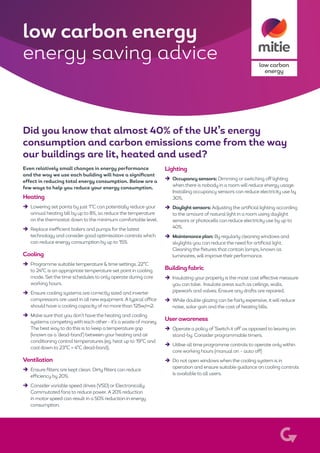
Did you know that almost 40% of the UK’s energy
consumption and carbon emissions come from the way
our buildings are lit, heated and used?
Even relatively small changes in energy performance
and the way we use each building will have a significant
effect in reducing total energy consumption. Below are a
few ways to help you reduce your energy consumption.
Heating
èè Lowering set points by just 1°C can potentially reduce your
annual heating bill by up to 8%, so reduce the temperature
on the thermostat down to the minimum comfortable level.
èè Replace inefficient boilers and pumps forthe latest
technology and consider good optimisation controls which
can reduce energy consumption by up to 15%.
Cooling
èè Programme suitable temperature & time settings. 22°C
to 24°C is an appropriate temperature set point in cooling
mode. Set the time schedules to only operate during core
working hours.
èè Ensure cooling systems are correctly sized and inverter
compressors are used in all new equipment. Atypical office
should have a cooling capacity of no more than 125w/m2.
èè Make sure that you don’t have the heating and cooling
systems competing with each other - it’s awaste of money.
The best way to do this is to keep a temperature gap
(known as a ‘dead-band’) between your heating and air
conditioning control temperatures (eg. heat up to 19°C and
cool down to 23°C = 4°C dead-band).
Ventilation
èè Ensure filters are kept clean. Dirty filters can reduce
efficiency by 20%.
èè Considervariable speed drives (VSD) or Electronically
Commutated fans to reduce power. A 20% reduction
in motor speed can result in a 50% reduction in energy
consumption.
Lighting
èè Occupancy sensors: Dimming or switching off lighting
when there is nobody in a roomwill reduce energy usage.
Installing occupancy sensors can reduce electricity use by
30%.
èè Daylight sensors: Adjusting the artificial lighting according
to the amount of natural light in a room using daylight
sensors or photocells can reduce electricity use by up to
40%.
èè Maintenance plan: By regularly cleaning windows and
skylights you can reduce the need for artificial light.
Cleaning the fixtures that contain lamps, known as
luminaires, will improve their performance.
Buildingfabric
èè Insulating your property is the most cost effective measure
you can take. Insulate areas such as ceilings, walls,
pipework and valves. Ensure any drafts are repaired.
èè While double glazing can be fairly expensive, it will reduce
noise, solar gain and the cost of heating bills.
Userawareness
èè Operate a policy of ‘Switch it off’ as opposed to leaving on
stand-by. Consider programmable timers.
èè Utilise all time programme controls to operate only within
core working hours (manual on – auto off)
èè Do not openwindows when the cooling system is in
operation and ensure suitable guidance on cooling controls
is available to all users.
low carbon energy
energy saving advice
Contact details Jason Roberts
Low Carbon Consultant
07979 701318
jason.roberts@mitie.com
Amy Field
Energy Compliance Manager
07469 030464
amy.field@mitie.com
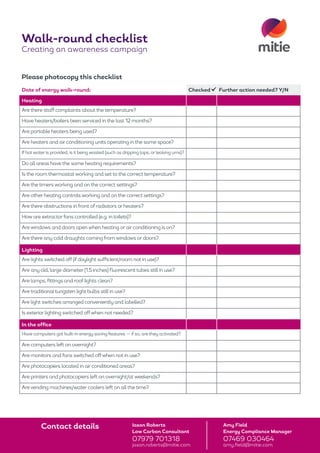
Walk-round checklist
Creating an awareness campaign
Please photocopy this checklist
Date of energy walk-round: Checked Further action needed? Y/N
Heating
Are there staff complaints about the temperature?
Have heaters/boilers been serviced in the last 12 months?
Are portable heaters being used?
Are heaters and air conditioning units operating in the same space?
If hot water is provided, is it being wasted (such as dripping taps, or leaking urns)?
Do all areas have the same heating requirements?
Is the room thermostat working and set to the correct temperature?
Are the timers working and on the correct settings?
Are other heating controls working and on the correct settings?
Are there obstructions in front of radiators or heaters?
How are extractorfans controlled (e.g. in toilets)?
Are windows and doors openwhen heating or air conditioning is on?
Are there any cold draughts coming fromwindows or doors?
Lighting
Are lights switched off (if daylight sufficient/room not in use)?
Are any old, large diameter (1.5 inches) fluorescent tubes still in use?
Are lamps, fittings and roof lights clean?
Are traditional tungsten light bulbs still in use?
Are light switches arranged conveniently and labelled?
Is exterior lighting switched offwhen not needed?
In the office
Have computers got built-in energy saving features — if so, are they activated?
Are computers left on overnight?
Are monitors and fans switched offwhen not in use?
Are photocopiers located in air conditioned areas?
Are printers and photocopiers left on overnight/at weekends?
Are vending machines/water coolers left on all the time?

Low Carbon Energy Saving Advice

  • 1.
    low carbon energy Did youknow that almost 40% of the UK’s energy consumption and carbon emissions come from the way our buildings are lit, heated and used? Even relatively small changes in energy performance and the way we use each building will have a significant effect in reducing total energy consumption. Below are a few ways to help you reduce your energy consumption. Heating èè Lowering set points by just 1°C can potentially reduce your annual heating bill by up to 8%, so reduce the temperature on the thermostat down to the minimum comfortable level. èè Replace inefficient boilers and pumps forthe latest technology and consider good optimisation controls which can reduce energy consumption by up to 15%. Cooling èè Programme suitable temperature & time settings. 22°C to 24°C is an appropriate temperature set point in cooling mode. Set the time schedules to only operate during core working hours. èè Ensure cooling systems are correctly sized and inverter compressors are used in all new equipment. Atypical office should have a cooling capacity of no more than 125w/m2. èè Make sure that you don’t have the heating and cooling systems competing with each other - it’s awaste of money. The best way to do this is to keep a temperature gap (known as a ‘dead-band’) between your heating and air conditioning control temperatures (eg. heat up to 19°C and cool down to 23°C = 4°C dead-band). Ventilation èè Ensure filters are kept clean. Dirty filters can reduce efficiency by 20%. èè Considervariable speed drives (VSD) or Electronically Commutated fans to reduce power. A 20% reduction in motor speed can result in a 50% reduction in energy consumption. Lighting èè Occupancy sensors: Dimming or switching off lighting when there is nobody in a roomwill reduce energy usage. Installing occupancy sensors can reduce electricity use by 30%. èè Daylight sensors: Adjusting the artificial lighting according to the amount of natural light in a room using daylight sensors or photocells can reduce electricity use by up to 40%. èè Maintenance plan: By regularly cleaning windows and skylights you can reduce the need for artificial light. Cleaning the fixtures that contain lamps, known as luminaires, will improve their performance. Buildingfabric èè Insulating your property is the most cost effective measure you can take. Insulate areas such as ceilings, walls, pipework and valves. Ensure any drafts are repaired. èè While double glazing can be fairly expensive, it will reduce noise, solar gain and the cost of heating bills. Userawareness èè Operate a policy of ‘Switch it off’ as opposed to leaving on stand-by. Consider programmable timers. èè Utilise all time programme controls to operate only within core working hours (manual on – auto off) èè Do not openwindows when the cooling system is in operation and ensure suitable guidance on cooling controls is available to all users. low carbon energy energy saving advice
  • 2.
    Contact details JasonRoberts Low Carbon Consultant 07979 701318 jason.roberts@mitie.com Amy Field Energy Compliance Manager 07469 030464 amy.field@mitie.com Walk-round checklist Creating an awareness campaign Please photocopy this checklist Date of energy walk-round: Checked Further action needed? Y/N Heating Are there staff complaints about the temperature? Have heaters/boilers been serviced in the last 12 months? Are portable heaters being used? Are heaters and air conditioning units operating in the same space? If hot water is provided, is it being wasted (such as dripping taps, or leaking urns)? Do all areas have the same heating requirements? Is the room thermostat working and set to the correct temperature? Are the timers working and on the correct settings? Are other heating controls working and on the correct settings? Are there obstructions in front of radiators or heaters? How are extractorfans controlled (e.g. in toilets)? Are windows and doors openwhen heating or air conditioning is on? Are there any cold draughts coming fromwindows or doors? Lighting Are lights switched off (if daylight sufficient/room not in use)? Are any old, large diameter (1.5 inches) fluorescent tubes still in use? Are lamps, fittings and roof lights clean? Are traditional tungsten light bulbs still in use? Are light switches arranged conveniently and labelled? Is exterior lighting switched offwhen not needed? In the office Have computers got built-in energy saving features — if so, are they activated? Are computers left on overnight? Are monitors and fans switched offwhen not in use? Are photocopiers located in air conditioned areas? Are printers and photocopiers left on overnight/at weekends? Are vending machines/water coolers left on all the time?