




#SMX #22A @keithgoode
Scaling SEO Across Large Enterprise Ecosystems
THE ART AND
SCIENCE OF
WRANGLING
CHAOS INTO
ORDER
#SMX #22A @keithgoode
Who Am I?
Name: Keith Goode
Position: SEO Manager, Security, IBM
Experience:
 20+ Years in Online Marketing
 10+ Years of Experience in In-House SEO
 Previous Employers: AMD, HomeAway, BDX,
SpareFoot, Dell, seoClarity
 Appearances: Pubcon, Clarity, SFIMA,
CrossForum, Search Talk Live, SEJ ThinkTank
 Follow: @keithgoode
#SMX #22A @keithgoode
Some Light Housekeeping
* Disclaimer: Opinions expressed herein are my own. No forward-looking statements regarding IBM
have been included. None of IBM’s secret sauce has been revealed. Statements made in this
presentation have not been tested by the FDA.
#SMX #22A @keithgoode
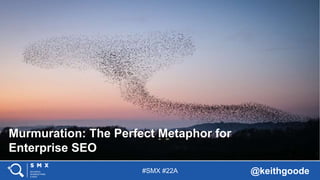
Murmuration: The Perfect Metaphor for
Enterprise SEO
#SMX #22A @keithgoode
The Truth Behind Big Enterprise SEO
Perception vs. Reality
#SMX #22A @keithgoode
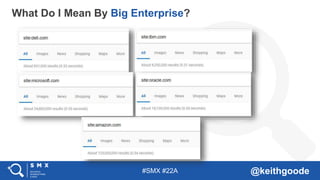
What Do I Mean By Big Enterprise?
#SMX #22A @keithgoode
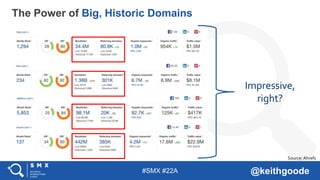
The Power of Big, Historic Domains
Impressive,
right?
Source: Ahrefs
#SMX #22A @keithgoode
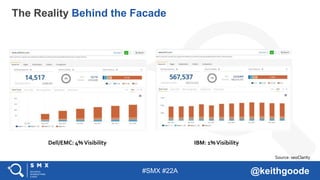
The Reality Behind the Facade
Source: seoClarity
Dell/EMC: 4%Visibility IBM: 1%Visibility
#SMX #22A @keithgoode
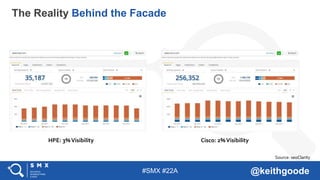
The Reality Behind the Facade
Source: seoClarity
HPE: 3%Visibility Cisco: 2%Visibility
#SMX #22A @keithgoode
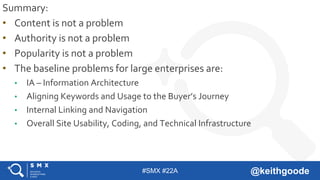
Summary:
• Content is not a problem
• Authority is not a problem
• Popularity is not a problem
• The baseline problems for large enterprises are:
• IA – Information Architecture
• Aligning Keywords and Usage to the Buyer’s Journey
• Internal Linking and Navigation
• Overall Site Usability, Coding, and Technical Infrastructure
#SMX #22A @keithgoode
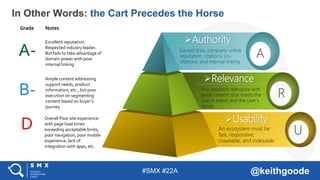
Usability
An ecosystem must be
fast, responsive,
crawlable, and indexable
U
Relevance
You establish relevance with
great content that meets the
search intent and the user’s
needs
R
Authority
Earned links, company online
reputation, citations, co-
citations, and internal linking
A
In Other Words: the Cart Precedes the Horse
A-
B-
D
Grade
Excellent reputation.
Respected industry leader.
But fails to take advantage of
domain power with poor
internal linking
Notes
Ample content addressing
support needs, product
information, etc., but poor
execution on segmenting
content based on buyer’s
journey
Overall Poor site experience
with page load times
exceeding acceptable limits,
poor navigation, poor mobile
experience, lack of
integration with apps, etc.
#SMX #22A @keithgoode
The Right Way and the Current Way
How do Large Enterprises Scale in
Size and Geography?
#SMX #22A @keithgoode
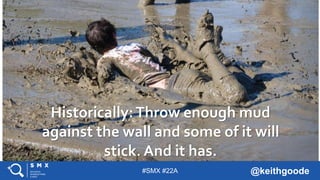
Historically:Throw enough mud
against the wall and some of it will
stick. And it has.
#SMX #22A @keithgoode
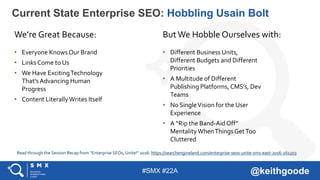
Current State Enterprise SEO: Hobbling Usain Bolt
We’re Great Because: But We Hobble Ourselves with:
• Everyone Knows Our Brand
• Links Come to Us
• We Have ExcitingTechnology
That’sAdvancing Human
Progress
• Content LiterallyWrites Itself
• Different Business Units,
Different Budgets and Different
Priorities
• A Multitude of Different
Publishing Platforms, CMS’s, Dev
Teams
• No SingleVision for the User
Experience
• A “Rip the Band-Aid Off”
MentalityWhenThingsGetToo
Cluttered
Read through the Session Recap from “Enterprise SEOs, Unite!” 2016: https://searchengineland.com/enterprise-seos-unite-smx-east-2016-261203
#SMX #22A @keithgoode
Ideal State Enterprise SEO: Organizational Awareness and
Unified Effort
#SMX #22A @keithgoode
• Proving the Value of SEO and
Showing Missed Opportunities
• Educating and Reinforcing
• Democratizing SEO
• Creating Standards and Policies
• Embedding Assets in the
Business Units
• Avoiding Being Cheap with Your
Geos
Ideal State Global Enterprise SEO
#SMX #22A @keithgoode
• Not only:
• Traffic
• Ranking
• But also:
• Conversions
• Revenue
• Average RPV/AOV
• Competitor’s Value
(extrapolated)
Know Your Numbers,
Know Your Value
I have outlined this and much more at:
https://www.slideshare.net/AustinOtaku
#SMX #22A @keithgoode
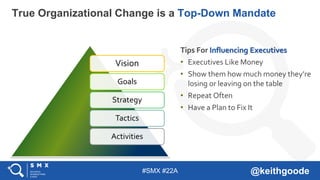
True Organizational Change is a Top-Down Mandate
Vision
Goals
Strategy
Tactics
Activities
Tips For Influencing Executives
• Executives Like Money
• Show them how much money they’re
losing or leaving on the table
• Repeat Often
• Have a Plan to Fix It
#SMX #22A @keithgoode
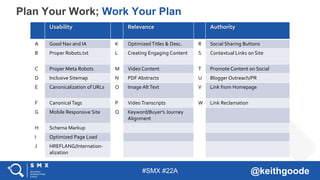
Plan Your Work; Work Your Plan
Usability Relevance Authority
A Good Nav and IA K Optimized Titles & Desc. R Social Sharing Buttons
B Proper Robots.txt L Creating Engaging Content S Contextual Links on Site
C Proper Meta Robots M Video Content T Promote Content on Social
D Inclusive Sitemap N PDF Abstracts U Blogger Outreach/PR
E Canonicalization of URLs O Image AltText V Link from Homepage
F Canonical Tags P Video Transcripts W Link Reclamation
G Mobile Responsive Site Q Keyword/Buyer’s Journey
Alignment
H Schema Markup
I Optimized Page Load
J HREFLANG/Internation-
alization
#SMX #22A @keithgoode
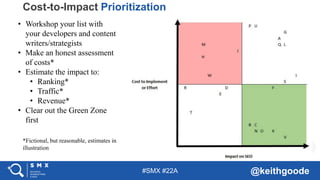
Cost-to-Impact Prioritization
• Workshop your list with
your developers and content
writers/strategists
• Make an honest assessment
of costs*
• Estimate the impact to:
• Ranking*
• Traffic*
• Revenue*
• Clear out the Green Zone
first
*Fictional, but reasonable, estimates in
illustration
#SMX #22A @keithgoode
• Certification
• Badges
• Webinars
• Lunch & Learn
• Customized Training per
Discipline
• Internal Blogs and
Announcements
Educate to Build Awareness
#SMX #22A @keithgoode
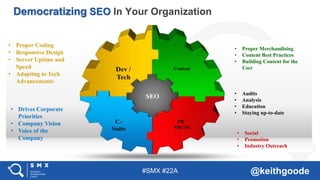
Democratizing SEO In Your Organization
• Social
• Promotion
• Industry Outreach
• Drives Corporate
Priorities
• Company Vision
• Voice of the
Company
• Proper Merchandising
• Content Best Practices
• Building Content for the
User
• Proper Coding
• Responsive Design
• Server Uptime and
Speed
• Adapting to Tech
Advancements
• Audits
• Analysis
• Education
• Staying up-to-date
#SMX #22A @keithgoode
• Codify Everything
• Max Page Load Speeds
• URL Structure
• Tag Usage
• Field Limits
• Resolve Overlap Disputes
• Keyword Governance
Establish Global Standards and Guidelines
#SMX #22A @keithgoode
Embedding Assets in the Business Units and Teams
#SMX #22A @keithgoode
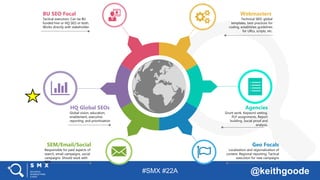
Grunt work. Keyword vetting.
PLP assignments. Report
building. Social proof and
analysis.
Technical SEO, global
templates, best practices for
coding, establishes guidelines
for URLs, scripts, etc.
BU SEO Focal
Tactical execution. Can be BU
funded hire or HQ SEO or both.
Works directly with stakeholder.
Webmasters
Geo Focals
Localization and regionalization of
content. Regional reporting. Tactical
execution for new campaigns
SEM/Email/Social
Responsible for paid aspects of
search, email campaigns, social
campaigns. Should work with
SEO.
HQ Global SEOs
Global vision, education,
enablement, executive
reporting, and prioritization
Agencies
#SMX #22A @keithgoode
Globalization of SEO Efforts
#SMX #22A @keithgoode
• Current State:
• Test Locally, Apply Globally
• Scales Well
• Ideal State:
• Regionalize Content to Speak to that
Countries Audience
• Account for Different User
Experience
• Note: This Does Not Scale Easily
Globalization is Not Copy/Paste
#SMX #22A @keithgoode
Share these #SMXInsights on your social channels!
#SMXInsights
 A long history, a great product, and good PR can take you a
long way in the SERPs, but we shouldn’t be satisfied with that
alone.
 The Ideal State Enterprise SEO requires Organizational
Awareness and Unified Effort from everyone, not just SEOs.
 True Organizational Change is a Top-Down Mandate edified
and bolstered with data.
 Scaling is not an exercise in copying and pasting templates,
but it requires a constant eye on the user’s wants and needs.
#SMX #22A @keithgoode
LEARN MORE: UPCOMING @SMX EVENTS
THANK YOU!
SEE YOU AT THE NEXT #SMX
#SMX #22A @keithgoode
• Photographer: IAN ROSS
• Title: Starling
• URL: https://www.flickr.com/photos/thothian/39533635291/
• Photographer: Donald Macauley
• Title: IMG_2746
• URL: https://flic.kr/p/qjXBw3
• Photographer: Derek Σωκράτης Finch
• Title: Mesmerised by murmuration we follow them
• URL: https://flic.kr/p/Dcae9q
• Photographer: sussexcareers
• Title: murmuration
• URL: https://flic.kr/p/Tzi7bm
• Photographer: Tanya Hart
• Title: Studland starlings
• URL: https://flic.kr/p/QcBBLy
• Photographer: Lars Plougmann
• Title: 1m+ bats leave their dwelling under the Congress Ave
bridge
• URL: https://flic.kr/p/fwpHHv
• Photographer: Clay Junell
• Title: yak to bats
• URL: https://flic.kr/p/6NWs86
• Photographer: U.S. Fish and Wildlife
Service Headquarters
• Title: Mexican free-tailed bats exiting Bracken Bat Cave
• URL: https://flic.kr/p/dcx7ra
• Photographer: Dan Pancamo
• Title: Austin Bat Bridge
• URL: https://flic.kr/p/9JrzuR
• Photographer: ITU Pictures
• Title: 1964-07
• URL: https://flic.kr/p/r6Vskt
• Photographer: Dave Herholz
• Title: Mud for breakfast
• URL: https://flic.kr/p/8fvZSx
All Images Were Licensed for Commercial Use with Mods
Allowed by the Photographer

Scaling SEO Across Large Enterprise Ecosystems

  • 1.
    #SMX #22A @keithgoode ScalingSEO Across Large Enterprise Ecosystems THE ART AND SCIENCE OF WRANGLING CHAOS INTO ORDER
  • 2.
    #SMX #22A @keithgoode WhoAm I? Name: Keith Goode Position: SEO Manager, Security, IBM Experience:  20+ Years in Online Marketing  10+ Years of Experience in In-House SEO  Previous Employers: AMD, HomeAway, BDX, SpareFoot, Dell, seoClarity  Appearances: Pubcon, Clarity, SFIMA, CrossForum, Search Talk Live, SEJ ThinkTank  Follow: @keithgoode
  • 3.
    #SMX #22A @keithgoode SomeLight Housekeeping * Disclaimer: Opinions expressed herein are my own. No forward-looking statements regarding IBM have been included. None of IBM’s secret sauce has been revealed. Statements made in this presentation have not been tested by the FDA.
  • 4.
    #SMX #22A @keithgoode Murmuration:The Perfect Metaphor for Enterprise SEO
  • 5.
    #SMX #22A @keithgoode TheTruth Behind Big Enterprise SEO Perception vs. Reality
  • 6.
    #SMX #22A @keithgoode WhatDo I Mean By Big Enterprise?
  • 7.
    #SMX #22A @keithgoode ThePower of Big, Historic Domains Impressive, right? Source: Ahrefs
  • 8.
    #SMX #22A @keithgoode TheReality Behind the Facade Source: seoClarity Dell/EMC: 4%Visibility IBM: 1%Visibility
  • 9.
    #SMX #22A @keithgoode TheReality Behind the Facade Source: seoClarity HPE: 3%Visibility Cisco: 2%Visibility
  • 10.
    #SMX #22A @keithgoode Summary: •Content is not a problem • Authority is not a problem • Popularity is not a problem • The baseline problems for large enterprises are: • IA – Information Architecture • Aligning Keywords and Usage to the Buyer’s Journey • Internal Linking and Navigation • Overall Site Usability, Coding, and Technical Infrastructure
  • 11.
    #SMX #22A @keithgoode Usability Anecosystem must be fast, responsive, crawlable, and indexable U Relevance You establish relevance with great content that meets the search intent and the user’s needs R Authority Earned links, company online reputation, citations, co- citations, and internal linking A In Other Words: the Cart Precedes the Horse A- B- D Grade Excellent reputation. Respected industry leader. But fails to take advantage of domain power with poor internal linking Notes Ample content addressing support needs, product information, etc., but poor execution on segmenting content based on buyer’s journey Overall Poor site experience with page load times exceeding acceptable limits, poor navigation, poor mobile experience, lack of integration with apps, etc.
  • 12.
    #SMX #22A @keithgoode TheRight Way and the Current Way How do Large Enterprises Scale in Size and Geography?
  • 13.
    #SMX #22A @keithgoode Historically:Throwenough mud against the wall and some of it will stick. And it has.
  • 14.
    #SMX #22A @keithgoode CurrentState Enterprise SEO: Hobbling Usain Bolt We’re Great Because: But We Hobble Ourselves with: • Everyone Knows Our Brand • Links Come to Us • We Have ExcitingTechnology That’sAdvancing Human Progress • Content LiterallyWrites Itself • Different Business Units, Different Budgets and Different Priorities • A Multitude of Different Publishing Platforms, CMS’s, Dev Teams • No SingleVision for the User Experience • A “Rip the Band-Aid Off” MentalityWhenThingsGetToo Cluttered Read through the Session Recap from “Enterprise SEOs, Unite!” 2016: https://searchengineland.com/enterprise-seos-unite-smx-east-2016-261203
  • 15.
    #SMX #22A @keithgoode IdealState Enterprise SEO: Organizational Awareness and Unified Effort
  • 16.
    #SMX #22A @keithgoode •Proving the Value of SEO and Showing Missed Opportunities • Educating and Reinforcing • Democratizing SEO • Creating Standards and Policies • Embedding Assets in the Business Units • Avoiding Being Cheap with Your Geos Ideal State Global Enterprise SEO
  • 17.
    #SMX #22A @keithgoode •Not only: • Traffic • Ranking • But also: • Conversions • Revenue • Average RPV/AOV • Competitor’s Value (extrapolated) Know Your Numbers, Know Your Value I have outlined this and much more at: https://www.slideshare.net/AustinOtaku
  • 18.
    #SMX #22A @keithgoode TrueOrganizational Change is a Top-Down Mandate Vision Goals Strategy Tactics Activities Tips For Influencing Executives • Executives Like Money • Show them how much money they’re losing or leaving on the table • Repeat Often • Have a Plan to Fix It
  • 19.
    #SMX #22A @keithgoode PlanYour Work; Work Your Plan Usability Relevance Authority A Good Nav and IA K Optimized Titles & Desc. R Social Sharing Buttons B Proper Robots.txt L Creating Engaging Content S Contextual Links on Site C Proper Meta Robots M Video Content T Promote Content on Social D Inclusive Sitemap N PDF Abstracts U Blogger Outreach/PR E Canonicalization of URLs O Image AltText V Link from Homepage F Canonical Tags P Video Transcripts W Link Reclamation G Mobile Responsive Site Q Keyword/Buyer’s Journey Alignment H Schema Markup I Optimized Page Load J HREFLANG/Internation- alization
  • 20.
    #SMX #22A @keithgoode Cost-to-ImpactPrioritization • Workshop your list with your developers and content writers/strategists • Make an honest assessment of costs* • Estimate the impact to: • Ranking* • Traffic* • Revenue* • Clear out the Green Zone first *Fictional, but reasonable, estimates in illustration
  • 21.
    #SMX #22A @keithgoode •Certification • Badges • Webinars • Lunch & Learn • Customized Training per Discipline • Internal Blogs and Announcements Educate to Build Awareness
  • 22.
    #SMX #22A @keithgoode DemocratizingSEO In Your Organization • Social • Promotion • Industry Outreach • Drives Corporate Priorities • Company Vision • Voice of the Company • Proper Merchandising • Content Best Practices • Building Content for the User • Proper Coding • Responsive Design • Server Uptime and Speed • Adapting to Tech Advancements • Audits • Analysis • Education • Staying up-to-date
  • 23.
    #SMX #22A @keithgoode •Codify Everything • Max Page Load Speeds • URL Structure • Tag Usage • Field Limits • Resolve Overlap Disputes • Keyword Governance Establish Global Standards and Guidelines
  • 24.
    #SMX #22A @keithgoode EmbeddingAssets in the Business Units and Teams
  • 25.
    #SMX #22A @keithgoode Gruntwork. Keyword vetting. PLP assignments. Report building. Social proof and analysis. Technical SEO, global templates, best practices for coding, establishes guidelines for URLs, scripts, etc. BU SEO Focal Tactical execution. Can be BU funded hire or HQ SEO or both. Works directly with stakeholder. Webmasters Geo Focals Localization and regionalization of content. Regional reporting. Tactical execution for new campaigns SEM/Email/Social Responsible for paid aspects of search, email campaigns, social campaigns. Should work with SEO. HQ Global SEOs Global vision, education, enablement, executive reporting, and prioritization Agencies
  • 26.
  • 27.
    #SMX #22A @keithgoode •Current State: • Test Locally, Apply Globally • Scales Well • Ideal State: • Regionalize Content to Speak to that Countries Audience • Account for Different User Experience • Note: This Does Not Scale Easily Globalization is Not Copy/Paste
  • 28.
    #SMX #22A @keithgoode Sharethese #SMXInsights on your social channels! #SMXInsights  A long history, a great product, and good PR can take you a long way in the SERPs, but we shouldn’t be satisfied with that alone.  The Ideal State Enterprise SEO requires Organizational Awareness and Unified Effort from everyone, not just SEOs.  True Organizational Change is a Top-Down Mandate edified and bolstered with data.  Scaling is not an exercise in copying and pasting templates, but it requires a constant eye on the user’s wants and needs.
  • 29.
    #SMX #22A @keithgoode LEARNMORE: UPCOMING @SMX EVENTS THANK YOU! SEE YOU AT THE NEXT #SMX
  • 30.
    #SMX #22A @keithgoode •Photographer: IAN ROSS • Title: Starling • URL: https://www.flickr.com/photos/thothian/39533635291/ • Photographer: Donald Macauley • Title: IMG_2746 • URL: https://flic.kr/p/qjXBw3 • Photographer: Derek Σωκράτης Finch • Title: Mesmerised by murmuration we follow them • URL: https://flic.kr/p/Dcae9q • Photographer: sussexcareers • Title: murmuration • URL: https://flic.kr/p/Tzi7bm • Photographer: Tanya Hart • Title: Studland starlings • URL: https://flic.kr/p/QcBBLy • Photographer: Lars Plougmann • Title: 1m+ bats leave their dwelling under the Congress Ave bridge • URL: https://flic.kr/p/fwpHHv • Photographer: Clay Junell • Title: yak to bats • URL: https://flic.kr/p/6NWs86 • Photographer: U.S. Fish and Wildlife Service Headquarters • Title: Mexican free-tailed bats exiting Bracken Bat Cave • URL: https://flic.kr/p/dcx7ra • Photographer: Dan Pancamo • Title: Austin Bat Bridge • URL: https://flic.kr/p/9JrzuR • Photographer: ITU Pictures • Title: 1964-07 • URL: https://flic.kr/p/r6Vskt • Photographer: Dave Herholz • Title: Mud for breakfast • URL: https://flic.kr/p/8fvZSx All Images Were Licensed for Commercial Use with Mods Allowed by the Photographer

Editor's Notes

  • #5 Can anyone tell me what this is? It’s a murmuration of starlings, which is a rather interesting phenomenon. Hundreds, sometimes thousands of individual birds, previously hunting, foraging, chirping, etc. on their own, simultaneously converge and begin this amazing swirling, pulsing dance in the sky in complete silence. How they do it is a marvel of coordination. Each starling monitors the movement of 6 to 7 of its nearest neighbors, a little like Scrum teams in an Agile environment, and the result is an amazing example of coordination. I think this is an incredibly insightful metaphor for how incredibly large organizations can work under the right circumstances, and it’s certainly a goal that I have as an enterprise SEO.
  • #6 So, we’ve done the necessary housekeeping and we have a nice metaphor in murmuration. But I want to talk a little about the relative chaos that occurs prior to this grand dance. Before everything is perfect and harmonious, there is chaos. And as such, I want to answer the question that Chris asked me as we were preparing for this session, which is, “How do large organizations scale SEO?” The subtext of this question assumes that Big Enterprise organic awesomeness happens purposefully, that the great success that we see online has always been orchestrated. So, now I want to dispel that notion and talk a little about what I’ve seen in my career as an enterprise SEO. What is the great truth behind Big Enterprise SEO.
  • #7 First, I think we need to level-set our understanding of what I mean by “Big Enterprise.” Not only do I mean sites with hundreds of thousands, millions, tens of millions or even hundreds of millions of pages. Because, frankly, any site can get there. Publish enough content, layer on enough parameters, and heck any site can get to a million pages. But I think for my purposes here today, I should point out that I mean the big brands; notable brands that people have come to know in their day-to-day lives.
  • #8 These brands and their sites have tremendous power online, and you can see that in something like their backlink profiles. I don’t think these backlink profiles would fail to impress most SEOs. 34 million. 442 million. Over a billion backlinks from tens to hundreds of thousands of domains. You look at the wealth of content on these sites and the number of links to their pages, and it’s hard not to be in awe. How could they possibly fail, right?
  • #9 But then you peek behind the façade and look a little deeper. I pulled this data from seoClarity, and while similar data is available from SEMrush, Ahrefs, and BrightEdge’s Data Cube, I like this scoring system. This visibility score is based on the total number keywords each domain is ranking for … in other words, Google is saying, “Yes, this domain is relevant enough for these search phrases to rank in the top 100 … and the number of these terms for which the domains are showing in the top 3, top 10, top 20, and top 100 results, with visibility being in the top 10, weighted toward the top 3. Truly visible results that earn clicks. Now, look at these scores. Dell/EMC’s now combined site: 4%. IBM: 1%. Believe me, when I tell executives we could potentially increase our organic revenue by 100X, they tend to listen.
  • #10 HP: 3%. Cisco: 2%. Incredible. Google is saying, “You’re relevant for these terms.” But they’re also saying, “You don’t quite have what it takes to rank in the top 10 results.” It’s a stunning revelation considering how much revenue these sites are driving just from organic traffic. You’d almost believe that was accidental. It’s funny. When I talk to my business unit stakeholders, I’ll ask them what keywords they think they should rank for and who their competitors are. Invariably, they give me a list of their market competitors – the big guys: Microsoft, Cisco, Oracle, etc.. And then I go out to the SERPs, and I show them who’s really ranking. Their organic competitors are not who they think they are. I’m telling you, as strong as these brands are, it’s the smaller, more nimble organizations that are running circles around them in the SERPs for the non-branded keywords that count. None of the big brands have their game together organically .. Except for maybe Amazon.
  • #11 So, what’s the problem? Why are these huge brands and sites not ranking as well as they could be. Well, obviously content isn’t a problem. They have that in spades as we saw with those site: searches. Authority, as we saw in their link profiles, is not a problem. Popularity, street-level, brand recognition is not a problem. The problem is the chaos of growth. It’s a site that has grown more like a weed than like a well-tended garden. IA is patchwork, and it doesn’t align with the buyer’s journey. Random pages and microsites are created and orphaned with no internal linking to them. And whether it’s a half-dozen different CMS systems or whatever, the technical infrastructure, the coding, and the overall site usability is iffy at best.
  • #12 In other words, even though the cart was often put before the horse, somehow these big brands have arrived. They may score an A, A-, or at worst, B+ in Authority (they have great brand recognition, links and news coverage just falls in their laps), and maybe they have ample content. But they’ve failed to really lay the technical groundwork, from an IA perspective, a navigation perspective, the code is a patchwork of native code, dozens of external scripts, poorly executed canonical tags. Those of you who’ve seen me speak before hopefully will have had this search experience framework seared into your brains by now. But ideally, sites should be aligning their efforts from the foundation up. In other words, sites cannot reach their full potential with just great content and great link equity. By the way, at IBM, we refer to this as the Three Cs of SEO: Crawlability, Content, and Credibility
  • #13 So, to reiterate Chris’ question: the question is “How do large enterprises scale in size and geography?” Well, there’s a right way, and as I’ve pointed out, there’s the current way.
  • #14 Based on what I’ve shown you, a lot of that online brand equity (yeah, I know, that’s not a ranking factor, but I think it’s a good term to use for our purposes) was built in a fashion similar to the adage: throw enough mud against the wall and some of it will stick. And it has.
  • #15 Frankly, a long history, a great product, and good PR can take you a long way in the SERPs. A lot of big brands benefit from that very observable fact, but we shouldn’t be satisfied with that alone. And, as an enterprise SEO, I can tell you that I’m not. I won’t go into all of the details of how enterprises hobble themselves. There’s a great breakdown in the recap of this same session, “Enterprise SEOs: Unite!” back in 2016 in the link below. Check out what my friends, Simon Heseltine and Scott Nichols had to share.
  • #16 From historical tendencies to the ideal state, I want to talk about some of the efforts I’ve been involved with for the better part of the past decade to correct this.
  • #17 Since the beginning, working with large sites, I realized one thing very quickly, if everyone who touches your site as a company isn’t rowing in the same direction, you’re setting yourselves up as SEOs for a very long career of fixing problems. I’ve been working toward this ideal state. Here’s what we should be doing, and truthfully, the order in which we should be doing it. (See list)
  • #22 If you look closely, you’ll see we’ve moved from starlings to bats – Mexican free-tail bats, in fact. I included a photo of them, not just because I’m from Austin, and we have a number of colonies living under bridges there (and nightly, starting in March and going through November, you can see these well-organized, dark smoke-like ribbons of bats flying out at full force to eat up all of our mosquitos, very similar to a murmuration), but their presence in the area is a lesson in instruction. You see, when the bats arrive from Mexico each year, they’re comprised of only pregnant females. The bro-bats stay back in Mexico for a stag party. Once in Central Texas, they give birth and eventually teach their young to survive. Then they all fly back to Mexico in November. In the same way, SEOs have to don the mantel of teacher, nurture company-wide education in search, and continually nourish it.
  • #23 This is how you scale SEO efforts across huge organizations. Rather than centralizing all of the responsibility for a sites organic success with the SEOs, give each part of your organization an understanding of how they personally impact the site’s ability to rank well. Your Dev and Tech teams should know that they are the foundation to your success. The content team should know how to identify opportunities, create great content and focus on the user. PR and Marketing should understand how what they do fits into the buyer’s journey, how they can leverage the relationships they build in the industry to drive authority to the site. And of course, the C-Suite should understand why it’s important to make this an organizational priority. Leaving the SEO team to focus on audits and analysis of the site, staying up-to-date with the multitude of changes we see on a regular basis, and educating the company.
  • #24 This particular goal really does require that executive prioritization. In parallel to your education and democratization, you’ll need to codify your standards, and when I say codify everything, I mean everything: URL structure, max page load speeds, which tags to use and where, field limits, and so forth. The SEOs can also work between business units in very large organizations to resolve keyword overlap disputes.
  • #25 Being present within the business units and teams is also a really good practice.
  • #26 Rather than being a 100% siloed group that sits off on its own, dictating orders, what many organizations do is to assign an SEO to the individual business units, embed with them, attend their scrums, be a part of their development cycle. And in many cases, the organization might look like this.
  • #27 Now, certainly, someone like Aleyda Solis or Zeph Snapp can spend more time talking about globalization, but I didn’t want to end my portion without reiterating the importance of really and seriously focusing scaling efforts on globalization when appropriate.
  • #28 All too often, companies will assume that all they need to do is translate a page, and they’ve done their part for going into different country. They test locally (usually in their biggest market) and apply everything globally. And why wouldn’t you? It scales okay and easily. However, in an ideal state, we’re not satisfied with “easy”. Different users in different countries may navigate differently, may prefer different visuals, may read in a completely different direction than left to right (Arabic and Hebrew for example). If, as a company, you’re committed to not leaving money on the table, then being willing to create different templates per country, optimizing the experience for those users, and committing to true regionalization shouldn’t be a problem. Right?