Running Neo4j in Production
Tips, Tricks and Optimizations
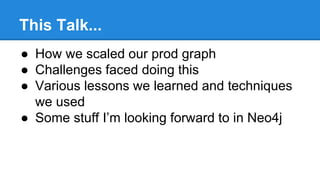
This Talk...
● How we scaled our prod graph
● Challenges faced doing this
● Various lessons we learned and techniques
we used
● Some stuff I’m looking forward to in Neo4j
SNAP Interactive
● Presented by David Fox (Big Data Engineer)
● Social dating app AYI (Are You Interested?)
● Friends and interests
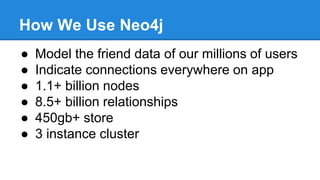
How We Use Neo4j
● Model the friend data of our millions of users
● Indicate connections everywhere on app
● 1.1+ billion nodes
● 8.5+ billion relationships
● 450gb+ store
● 3 instance cluster
Importing lots of data
● Find the right tool
o First try normal Cypher
o No good? Bring out the big guns - Java Batch
Inserter
● Java Batch Inserter
o Sort relationships (GNU sort)
o Try to keep index lookups to in-memory lookups only
 Giant HashMap!
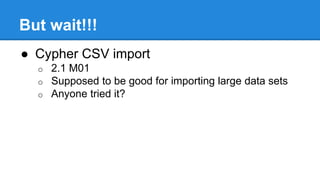
But wait!!!
● Cypher CSV import
o 2.1 M01
o Supposed to be good for importing large data sets
o Anyone tried it?
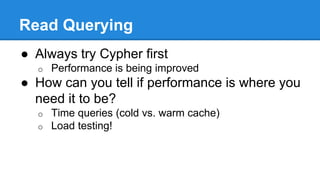
Read Querying
● Always try Cypher first
o Performance is being improved
● How can you tell if performance is where you
need it to be?
o Time queries (cold vs. warm cache)
o Load testing!
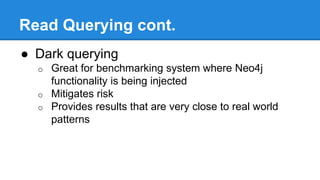
Read Querying cont.
● Dark querying
o Great for benchmarking system where Neo4j
functionality is being injected
o Mitigates risk
o Provides results that are very close to real world
patterns
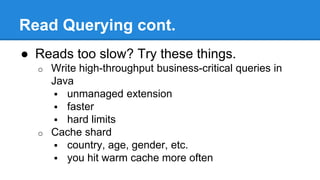
Read Querying cont.
● Reads too slow? Try these things.
o Write high-throughput business-critical queries in
Java
 unmanaged extension
 faster
 hard limits
o Cache shard
 country, age, gender, etc.
 you hit warm cache more often
Read Querying cont.
● Warm the cache!
o Touch all the nodes
o Touch all the relationships
Writing
● Decide which writes need to be synchronous
and which can be asynchronous
● Queue up asynchronous writes (routine
updates, non-vital to immediate user-
experience)
o Try to evenly distribute them
o How do we do this? Baserunner!
Baserunner
● Written by SNAP developer
● Walks userbase randomly instead of
sequentially
o This avoids pockets of heavily increased write
queries
o Allows us to do high-velocity updating of our data
Tuning the JVM
● For a really high-throughput environment,
G1 GC has been very helpful
o Good at adapting itself
o We experienced less system-stopping pauses than
with CMS
o Try CMS first but remember G1 as option
Hardware is Important
● Lots of memory
● Working set too big for memory?
o SSDs are helpful
o Optimization techniques discussed become much
more important
Not Everything is Your Fault!
● Like any software, Neo4j has bugs
● Developers are receptive
● File reports on Github when you find issues
Some stuff to look forward to...
● Relationship grouping (2.1 M01)
o helps mitigate the super node/dense node problem
● Ronja (rewrite of the Cypher query
language, 2.1?)
● More flexible label index searching (after
2.1)
Questions?

Running Neo4j in Production: Tips, Tricks and Optimizations

  • 1.
    Running Neo4j inProduction Tips, Tricks and Optimizations
  • 2.
    This Talk... ● Howwe scaled our prod graph ● Challenges faced doing this ● Various lessons we learned and techniques we used ● Some stuff I’m looking forward to in Neo4j
  • 3.
    SNAP Interactive ● Presentedby David Fox (Big Data Engineer) ● Social dating app AYI (Are You Interested?) ● Friends and interests
  • 4.
    How We UseNeo4j ● Model the friend data of our millions of users ● Indicate connections everywhere on app ● 1.1+ billion nodes ● 8.5+ billion relationships ● 450gb+ store ● 3 instance cluster
  • 5.
    Importing lots ofdata ● Find the right tool o First try normal Cypher o No good? Bring out the big guns - Java Batch Inserter ● Java Batch Inserter o Sort relationships (GNU sort) o Try to keep index lookups to in-memory lookups only  Giant HashMap!
  • 6.
    But wait!!! ● CypherCSV import o 2.1 M01 o Supposed to be good for importing large data sets o Anyone tried it?
  • 7.
    Read Querying ● Alwaystry Cypher first o Performance is being improved ● How can you tell if performance is where you need it to be? o Time queries (cold vs. warm cache) o Load testing!
  • 8.
    Read Querying cont. ●Dark querying o Great for benchmarking system where Neo4j functionality is being injected o Mitigates risk o Provides results that are very close to real world patterns
  • 9.
    Read Querying cont. ●Reads too slow? Try these things. o Write high-throughput business-critical queries in Java  unmanaged extension  faster  hard limits o Cache shard  country, age, gender, etc.  you hit warm cache more often
  • 10.
    Read Querying cont. ●Warm the cache! o Touch all the nodes o Touch all the relationships
  • 11.
    Writing ● Decide whichwrites need to be synchronous and which can be asynchronous ● Queue up asynchronous writes (routine updates, non-vital to immediate user- experience) o Try to evenly distribute them o How do we do this? Baserunner!
  • 12.
    Baserunner ● Written bySNAP developer ● Walks userbase randomly instead of sequentially o This avoids pockets of heavily increased write queries o Allows us to do high-velocity updating of our data
  • 13.
    Tuning the JVM ●For a really high-throughput environment, G1 GC has been very helpful o Good at adapting itself o We experienced less system-stopping pauses than with CMS o Try CMS first but remember G1 as option
  • 14.
    Hardware is Important ●Lots of memory ● Working set too big for memory? o SSDs are helpful o Optimization techniques discussed become much more important
  • 15.
    Not Everything isYour Fault! ● Like any software, Neo4j has bugs ● Developers are receptive ● File reports on Github when you find issues
  • 16.
    Some stuff tolook forward to... ● Relationship grouping (2.1 M01) o helps mitigate the super node/dense node problem ● Ronja (rewrite of the Cypher query language, 2.1?) ● More flexible label index searching (after 2.1)
  • 17.